
Job Creation in Camps: Repair & Refurb Hubs
Discover how repair and refurb hubs in refugee camps create local jobs, cut waste, and extend the life of critical assets—building circular economies in the world’s most protracted displacement settings.
WASTE-TO-RESOURCE & CIRCULAR ECONOMY SOLUTIONS
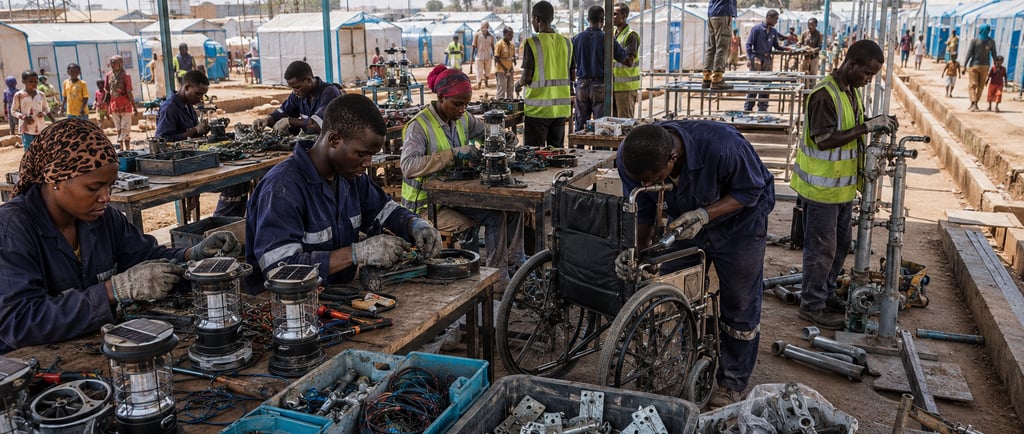
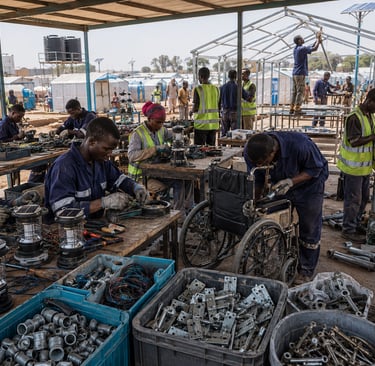
Why Repair and Refurb Hubs Matter Now
Humanitarian camps are often described as temporary, but the reality on the ground is different. Many displacement sites last for years, sometimes decades, while the infrastructure inside them is still designed, funded, procured, and managed as if it will only be needed for a short emergency window. Shelters are patched until they fail. Solar lanterns break and pile up. Water systems need spare parts that are stuck in procurement chains. Plastic sheeting, metal frames, doors, pipes, batteries, wheelchairs, tools, furniture, and WASH components move through camps as consumables instead of assets.
That model is expensive, wasteful, and weak. It also misses one of the clearest economic opportunities inside displacement settings: repair work.
By 2026, the humanitarian system is operating under two pressures at the same time. First, displacement remains at a historic scale. UNHCR's 2026 Global Trends reporting shows that 117.8 million people were forcibly displaced at the end of 2025, including 68.7 million internally displaced people. Even with a slight decline from the previous year, the global total remains close to record levels, and seven out of ten refugees have been in exile for more than five years. That means the basic assumption behind many camps, quick arrival, short stay, quick exit, no longer matches the lived reality for millions of people.
Second, humanitarian budgets are under strain. Aid agencies are being asked to serve more people, over longer periods, with tighter donor funding and higher accountability demands. In that environment, a camp cannot afford to treat every broken item as a replacement order. A torn shelter panel, damaged wheelchair, broken solar lantern, bent metal door, cracked pipe support, or failed pump component should not automatically become waste. It should trigger a repair pathway, a parts recovery process, a skills opportunity, and a local job.
Repair and refurb hubs turn that logic into camp infrastructure. They are on-site or near-site workspaces where trained residents and host-community workers repair, refurbish, repurpose, sort, recover, and maintain camp assets. At their simplest, they fix things. At their best, they become job creation engines, vocational training centers, waste reduction units, inventory control points, safety checkpoints, and local enterprise incubators.
This matters because camps already contain large flows of materials. Shelters, WASH systems, solar products, cooking equipment, mobility aids, school furniture, health facility equipment, tarpaulins, pallets, pipes, water tanks, mattresses, metal frames, batteries, and packaging materials enter camps through procurement systems. Many of these assets degrade under heat, dust, flood exposure, high use, crowding, and repeated relocation. Without structured repair systems, usable value leaks out of the camp every day.
A repair and refurb hub stops that leakage. It extends the life of physical assets. It lowers replacement demand. It reduces waste handling costs. It creates paid or stipend-based work. It gives displaced residents skills they can carry into host economies, return communities, or resettlement contexts. It also helps donors see measurable returns from each asset purchased because the same shelter frame, solar unit, chair, pump stand, or metal fixture can serve longer and be tracked across its use cycle.
The shift is practical, not theoretical. In Cox's Bazar, UNHCR Bangladesh, with partners including NGO Forum for Public Health and Schneider Electric Foundation support, launched an e-waste management program to address electronic waste in refugee camps, with attention to collection, sorting, awareness, safer handling, and skills around fragile waste streams. The case shows that even difficult waste categories, such as batteries, wires, circuit boards, and solar components, can be managed more responsibly when camp-level systems are created instead of leaving broken equipment scattered across households and service points.
The same principle applies beyond electronics. Every camp already has repair demand. The question is whether that demand becomes informal, unsafe, underpaid work, or whether it becomes a structured employment system with tools, training, standards, protective gear, inventory control, and routes into recognized livelihoods.
The Humanitarian Infrastructure Problem: Camps Consume Assets Faster Than They Can Replace Them
A camp is a city under pressure. It may not look like a formal city, but it has similar infrastructure needs: housing, water, sanitation, drainage, lighting, roads, health facilities, schools, storage, markets, communication, cooking systems, waste handling, and transport. The difference is that camp infrastructure is often built faster, with fewer materials, less permanent legal status, harder maintenance conditions, and weaker long-term budgets.
This creates a predictable pattern. Assets arrive through emergency procurement. They are distributed quickly. They face heavy daily use. They degrade faster than planned. Replacement requests build up. Procurement delays stretch response times. Residents improvise fixes. Waste accumulates. Donors fund the next distribution round. The cycle repeats.
This is especially visible in shelter. Better Shelter, one of the best-known modular humanitarian shelter providers, reports that more than 90,000 of its shelters have been delivered to 80 countries since 2015, reaching hundreds of thousands of displaced people. In 2023 alone, 6,600 shelters were delivered to Türkiye and Syria after the earthquakes, serving more than 30,000 people. These numbers show the scale of modular humanitarian infrastructure. They also point to a maintenance reality: every modular shelter system creates long-term demand for panel repair, frame alignment, door and lock replacement, flooring adaptation, roof fixes, ventilation changes, and parts recovery.
The same applies to energy. Portable solar lanterns are now standard relief items in many operations, and UNHCR's 2025 guidance on managing e-waste from solar lanterns highlights the need for safer handling as these products reach end-of-life in displacement settings. The guidance uses Kakuma refugee camp in Kenya as a financial modeling case because the camp had received large numbers of solar lanterns and had conditions that could support e-waste management, including local recycling actors and a relatively stable setting.
This is the core infrastructure issue: humanitarian assets are no longer simple giveaways. They are part of a service system. A solar lantern is light, safety, study time, phone charging support, and household resilience. A shelter frame is privacy, dignity, safety, and weather protection. A wheelchair is mobility and access. A water tank stand is disease prevention. A repaired door lock can affect gender-based violence risk. A working streetlight can change whether women, children, older people, and people with disabilities feel safe moving after dark.
When these assets fail, the impact is not just material. It is social, economic, and protective.
The humanitarian sector has made progress in procurement, logistics, and emergency delivery. It now needs the same seriousness around maintenance. Repair and refurb hubs provide that missing layer. They turn asset failure from a recurring crisis into planned work.
From Aid Distribution to Local Production Capacity
Traditional camp response often begins with distribution: tents, kits, food, water containers, mattresses, hygiene supplies, lights, and tools. Distribution is essential in emergencies, but when displacement becomes prolonged, repeated distribution can trap both agencies and residents in dependency loops.
Repair hubs change the relationship between people and materials. Residents stop being only recipients of aid items. They become technicians, sorters, mechanics, welders, carpenters, electricians, seam workers, inventory clerks, trainers, safety monitors, and workshop managers. Host-community workers can participate too, reducing tension around aid flows and creating shared economic value.
This shift matters because employment is one of the most consistent gaps in displacement response. The ILO has repeatedly argued that decent work should be part of comprehensive responses for refugees, other forcibly displaced people, and host communities, rather than treated as a separate development concern. Its work on refugee employment highlights skills, labour market access, social protection, and host-economy inclusion as central to self-reliance.
The global labour environment makes this harder. The ILO's Employment and Social Trends 2026 report points to stable headline employment but stalled progress in job quality and persistent inequality. For displaced people, these problems are sharper because legal work restrictions, documentation gaps, language barriers, mobility limits, discrimination, childcare burdens, and lack of recognized certification often block access to formal jobs.
Repair hubs cannot solve every labour market barrier. They can, however, create work that matches camp realities. They are local by design. They respond to immediate needs. They can start with basic skill levels and build toward specialization. They can include women, youth, older workers, and people with disabilities if tasks are designed properly. They can pay through cash-for-work, cooperative models, service contracts, social enterprise revenue, or donor-supported stipends. They can also build proof of skill through logbooks, digital badges, assessments, and partner certifications.
This is where repair hubs become more than workshops. They become training systems connected to real demand. Instead of teaching skills in isolation, they train people on assets the camp already uses. A trainee fixing a solar lantern learns electronics basics, testing, safety, parts harvesting, and documentation. A trainee repairing shelter frames learns measurement, fastening, corrosion checks, tool use, and quality control. A trainee refurbishing furniture learns sorting, sanding, joining, finishing, and safe reuse. A trainee repairing WASH parts learns hygiene risk, leak detection, pipe fitting, and preventive maintenance.
The work has immediate value because every repaired item goes back into use.
The Circular Economy Case: Repair Is the Missing Middle Between Procurement and Waste
Circular camp operations are often discussed through recycling, but recycling is usually the last stop before material loss. Repair sits higher in the value chain. It keeps the original product in use for longer. Refurbishment restores performance. Reuse redirects assets to new users. Parts harvesting saves components before the rest of an item becomes waste. Recycling should come after those options have been exhausted.
The ILO's work on decent work in the circular economy notes that repair, recycling, and remanufacturing are labour-intensive and can create opportunities for informal workers to move into better jobs linked to value chains. This is highly relevant to camps because many displaced people already repair items informally. They fix phones, shoes, bicycles, furniture, cookstoves, bags, shelters, and household goods with limited tools and no formal safety system. A camp hub can formalize some of that work without erasing local ingenuity.
Solid waste is one of the clearest entry points. The 2025 humanitarian solid waste management compendium describes solid waste as one of the most under-addressed challenges in emergency response, with direct effects on public health, environmental safety, and community dignity. In dense camps, unmanaged waste blocks drainage, attracts disease vectors, creates fire hazards, contaminates water channels, and increases flood risk. The waste problem is also a materials problem. Much of what becomes waste still contains useful value: plastic containers, metal frames, wood, fabric, pipes, wires, batteries, packaging, pallets, and spare parts.
The IOM-linked study on solid waste management in IDP settings in West and Central Africa found that reuse and recovery practices can become a source of green jobs and livelihood opportunities. That finding is central to repair hub design. The goal is not only to clean up waste. The goal is to intercept useful materials before they become waste, then turn them into safe, productive work.
This can include:
Shelter repair lines for frames, panels, doors, locks, shade structures, tarpaulins, flooring, insulation, and weatherproofing.
WASH repair lines for handwashing stations, pipe supports, tank stands, taps, fittings, drainage channels, latrine doors, wheelchair-accessible supports, and bathing cubicle fixtures.
Energy repair lines for solar lanterns, streetlights, wires, battery casings, mounts, brackets, and charge points.
Mobility and inclusion repair lines for wheelchairs, crutches, walkers, ramps, handrails, benches, and adaptive furniture.
Education and health repair lines for desks, chairs, beds, shelving, privacy screens, partitions, examination tables, and storage units.
Textile and soft-goods repair lines for tents, shade cloth, bags, uniforms, mattresses, mosquito nets, and reusable menstrual hygiene support products where culturally and medically appropriate.
Material recovery lines for metal, plastic, timber, fabric, fasteners, hinges, wheels, cables, and packaging materials.
This structure turns circularity into daily operations. It also gives camp managers a more realistic way to report sustainability. Instead of claiming broad environmental intent, they can measure specific outcomes: items repaired, items returned to use, replacement orders avoided, kilograms of waste diverted, workers trained, income generated, safety incidents reduced, and service downtime prevented.
The Jobs Case: Why Repair Work Fits Displacement Settings
Job creation in camps has to deal with constraints that ordinary employment programs often ignore. People may not have the right to work outside the camp. They may lack recognized documents. They may have trauma, interrupted education, limited mobility, caregiving duties, language barriers, or no access to banking. Camp markets may be active but small. Host communities may worry that refugee employment will compete with their own jobs. Donors may fund short cycles that make long-term enterprise planning difficult.
Repair hubs fit this environment because they are built around internal demand. They do not need to wait for a mature external market before starting. The camp itself generates the work.
This gives repair hubs five employment advantages.
First, demand is constant. Camps need maintenance every day. Shelters tear. taps leak. frames bend. wheels break. lights fail. furniture cracks. tools wear out. drainage needs clearing. The work is not seasonal in the same way as agriculture or short-term construction.
Second, skills can be layered. A worker can begin with sorting, cleaning, basic hand tools, measuring, safe handling, and recordkeeping. From there, they can move into carpentry, welding support, solar diagnostics, small electronics, plumbing, upholstery, tailoring, inventory, quality checks, team supervision, or training. This creates progression rather than one-off cash work.
Third, the work can be inclusive if the hub is designed for it. Not every repair task requires heavy lifting or full mobility. Sorting parts, testing small electronics, sewing, data entry, tool checkout, training support, inspection, customer intake, and quality tagging can include women, older workers, youth, and people with disabilities. Inclusion must be designed from the start, with safe transport, lighting, childcare links, accessible workstations, harassment reporting, and task matching.
Fourth, repair skills are transferable. A person trained in basic electrical repair, welding support, plumbing, carpentry, stock management, or equipment maintenance can use those skills in host markets, return areas, or future resettlement contexts. This matters because displacement is rarely linear. Some people return. Some move onward. Some integrate locally. Portable skills increase options.
Fifth, repair work lowers camp costs while creating income. That is rare. Many livelihood programs require separate funding with indirect benefits. Repair hubs can tie income generation directly to cost savings and service continuity. If a hub repairs 1,000 solar lanterns, refurbishes 500 chairs, restores 200 shelter doors, and repairs 100 wheelchairs, the value is immediate and countable.
Evidence from refugee skills programming supports the importance of connecting training to real economic outcomes. A 2023 review of refugee TVET in low- and middle-income countries found that the evidence base is still uneven, but it also stressed the need to understand when and how vocational training improves employment or livelihood outcomes for refugees. Repair hubs answer one common weakness in TVET: training without demand. Here, the demand is visible, local, and recurring.
Case Studies Showing the Model Is Already Emerging
Repair and refurb hubs are not yet a global standard, but the pieces already exist across humanitarian operations.
Cox's Bazar, Bangladesh: E-Waste Management in Refugee Camps
Cox's Bazar is one of the most complex displacement settings in the world, with dense settlements, heavy infrastructure demand, environmental stress, and long-term service needs. The e-waste management program launched by UNHCR Bangladesh and partners shows how fragile waste streams can be addressed inside camp operations. The case focuses on e-waste collection, safe handling, awareness, and local capacity, which are all relevant to repair hub design. E-waste is especially important because solar lanterns, batteries, cables, phones, small appliances, and electronic devices are now part of daily humanitarian life. Without proper systems, broken electronics can expose residents to toxic materials and create unmanaged fire or contamination risks.
The lesson is clear: technical waste cannot be left to informal recovery alone. It needs collection points, safety protocols, trained workers, sorting systems, records, and downstream partners. A repair hub can sit before the recycling stage, testing what can be fixed, harvesting safe parts, and sending only true end-of-life material to approved recyclers.
Kakuma, Kenya: Solar Lantern E-Waste and Local Recycling Conditions
UNHCR's 2025 guidance on portable solar lantern e-waste uses Kakuma as a modeling case because the camp had received many lanterns and had an enabling context for e-waste management. It notes that Kakuma has relatively stable conditions and access to specialized e-waste recycling companies in Kenya, which makes it a strong setting for building safer management systems.
The wider lesson is that repair hubs do not need to do everything alone. They should connect to external firms, recyclers, training providers, and local authorities. In a strong model, the hub handles collection, triage, minor repair, parts recovery, safe storage, basic records, and worker training. Specialized recyclers handle hazardous downstream processing. This division protects workers and keeps technical standards realistic.
Dadaab, Kenya: Recycling as Livelihood Infrastructure
The IOM-linked study on waste management in IDP settings refers to a recycling pilot in Dadaab refugee camp, implemented by the ICRC since 2016. Dadaab shows why long-term camps need systems that treat waste as a resource flow. When recycling, repair, and livelihood planning are connected, camps can reduce environmental harm and create work at the same time.
The next step is to move beyond recycling alone. Repair and refurb hubs can capture higher-value work before materials are downgraded. For example, a metal bed frame should be inspected, repaired, and reused before it is sold as scrap. A plastic chair should be repaired or reassembled before being shredded. A solar lantern should be diagnosed before its parts are stripped. This protects both value and jobs.
Azraq, Jordan: Green Centers and Managed Waste Systems
Azraq camp in Jordan has been cited for its Green Centre approach to solid waste management, with World Vision providing waste services in the camp. This type of structured waste operation matters because repair hubs need a clean material intake system. Workers cannot repair what is mixed into unsafe waste streams. Segregation, collection schedules, covered storage, and material grading make repair possible.
Azraq also shows the importance of institutional ownership. A hub that is treated as a side project will struggle. A hub connected to camp management, WASH, shelter, energy, logistics, protection, and livelihoods teams has a much better chance of becoming part of normal operations.
Bangladesh Streetlighting: Community Maintenance Models
Humanitarian energy work in Bangladesh has piloted community-based maintenance models for streetlights, including training residents to clean panels and report faults. UNHCR-managed camps have also used a Centralised Information Processing Platform for managing streetlighting information. This is important because maintenance is often cheaper than replacement, but only when faults are reported early and workers know what to do.
Streetlighting is also a protection issue. A broken light is not just a broken asset. It can affect movement, safety, theft risk, and gender-based violence concerns. Repair hubs can support preventive maintenance by assigning trained residents to inspect lights, log faults, clean panels, check mounts, and escalate electrical issues before systems fail.
Nyabiheke, Rwanda: Energy Systems and Maintenance Economics
A study on solar-diesel hybrid mini-grids in Nyabiheke refugee camp found that hybrid systems could reduce total costs by up to 32 percent and emissions by up to 83 percent compared with diesel-only systems, with payback periods ranging from 0.9 to 6.2 years. While this study focuses on energy system design, it has a strong lesson for repair hubs: cleaner infrastructure still needs local maintenance capacity. Solar systems, batteries, wiring, mounts, inverters, and metering systems all create technical service demand. Without local maintenance, renewable systems can fail early and lose their economic case.
Repair hubs can become the human maintenance layer for camp energy transitions. As camps adopt solar, microgrids, battery systems, efficient lighting, and electric water pumping, they will need trained local technicians who can inspect, clean, diagnose, log, repair, and escalate issues.
What a Repair and Refurb Hub Actually Does
A repair and refurb hub should not be imagined as a single shed with random tools. It should be designed as a controlled service point with clear workflows, safety rules, inventory records, trained workers, and links to camp departments.
The core function is triage. Every incoming item should be assessed and placed into a category: repair now, refurbish with parts, harvest parts, recycle safely, dispose safely, or quarantine for hazardous handling. This one step alone can reduce waste and improve accountability.
The second function is repair. This includes basic fixes, component replacement, frame straightening, sewing, patching, fastening, rewiring support, seal replacement, hinge replacement, wheel replacement, sanding, painting, tap repair, pipe support repair, and simple diagnostics. The exact scope depends on the hub's tools and safety level.
The third function is refurbishment. Refurbishment goes beyond fixing a fault. It restores an item to a usable standard for redistribution. This can include cleaning, structural checks, minor upgrades, labeling, testing, and repackaging. Refurbishment is useful for shelters, furniture, wheelchairs, lamps, water containers, school equipment, and reusable construction materials.
The fourth function is parts recovery. Many broken items contain good components. A damaged wheelchair may still have usable wheels, brakes, screws, footrests, or frame sections. A failed lantern may contain a usable casing, switch, wire, or solar panel. A broken bed may contain good metal lengths. A repair hub should store parts in a simple, traceable system so future repairs do not depend entirely on new procurement.
The fifth function is preventive maintenance. Camps often wait until something breaks. Hubs should run inspection rounds for high-value or safety-critical assets: solar lights, water points, latrine doors, ramps, handrails, wheelchairs, clinic furniture, school desks, tank stands, drainage structures, and communal kitchens. Preventive maintenance is cheaper than emergency replacement and helps avoid service disruption.
The sixth function is training. Every repair line should have a skills ladder: beginner, supervised worker, qualified repair worker, quality checker, team lead, trainer. This helps move people beyond short-term casual work and toward employability.
The seventh function is reporting. Donors and camp managers need to know what the hub changed. Useful metrics include number of items received, percentage repaired, percentage refurbished, percentage recycled, replacement value avoided, kilograms diverted from waste, number of workers trained, number of paid workdays created, gender and age participation, disability inclusion, safety incidents, service turnaround time, and user satisfaction.
Designing for Inclusion, Safety, and Dignity
Repair hubs will fail if they reproduce the same inequities that already limit access to camp livelihoods. Job creation must be intentional. Without careful design, repair work can become male-dominated, informal, unsafe, poorly paid, and inaccessible to people who most need income.
Women and girls often face barriers to camp work because of household labour, safety concerns, harassment risk, social norms, limited mobility, and lack of childcare. A repair hub can reduce those barriers by offering safe work zones, women-led repair teams, flexible shifts, childcare links, female trainers, lighting around the workspace, clear reporting routes, and tasks across different physical demands. Textile repair, solar testing, quality tagging, parts sorting, stock records, customer intake, and small-item repair can all be designed for women's participation, while also ensuring women are not limited to low-paid tasks.
Youth inclusion also matters. Many displaced young people have had schooling interrupted. A repair hub can provide structured apprenticeships that combine literacy, numeracy, digital records, tool use, and technical practice. This is especially important in long-term camps where young people can spend formative years without formal employment pathways.
People with disabilities must be included as workers, not only as recipients of repaired mobility equipment. Accessible benches, seated workstations, tool adaptations, visual instructions, ramps, transport support, and task matching can make participation realistic. Workers with disabilities also bring direct knowledge of how mobility aids, ramps, handrails, and accessible WASH fixtures fail in daily use.
Safety is non-negotiable. Repair work can involve sharp metal, batteries, electrical components, fumes, dust, heavy lifting, contaminated WASH parts, and unstable structures. A hub needs personal protective equipment, tool control, hazard zones, first aid, ventilation, fire safety, safe battery storage, child safeguarding rules, and clear limits on what workers are allowed to repair. Some items should be escalated to trained professionals or external firms, especially high-voltage equipment, hazardous electronics, medical devices, pressurized systems, and contaminated materials.
Dignity is also part of the design. Residents should not feel they are working in a dump. The hub should look and operate like a proper workshop: organized, clean, labeled, supervised, and respected. Workers should receive fair compensation where allowed, clear attendance records, training proof, and visible recognition of skill.
This is where repair hubs can change camp culture. They show that displaced residents are not passive beneficiaries. They are builders, maintainers, technicians, and problem-solvers.
The Operating Model: How Camps Can Build Repair Hubs That Last
A strong repair and refurb hub begins with asset mapping. Camp managers should identify the highest-volume and highest-cost items already flowing through the camp: shelters, tarps, metal frames, solar lanterns, streetlights, furniture, wheelchairs, water fixtures, tanks, pipes, doors, school equipment, clinic equipment, pallets, packaging, and plastic items. The first hub should not try to repair everything. It should start with the assets that combine high demand, manageable safety risk, available skills, and measurable savings.
The next step is space design. The hub needs intake, inspection, repair benches, tool storage, parts storage, finished-goods storage, recycling holding areas, hazardous holding areas, training space, handwashing, ventilation, lighting, and secure access. In flood-prone areas, it should be raised or located away from drainage channels. In hot climates, shade and airflow matter. In dense camps, fire risk and crowd control matter.
The hub also needs governance. Shelter teams should refer shelter items. WASH teams should refer water and sanitation parts. Energy teams should refer lights and solar components. Protection teams should advise on safe access and inclusion. Livelihood teams should manage training and worker progression. Logistics teams should connect repair outputs to inventory and distribution. Camp leadership should make sure the hub is not treated as a side activity.
Procurement rules must also change. If agencies buy items with no spare parts, no repair manuals, no modular components, and no local repair option, the hub will be limited from day one. Repair-friendly procurement should favor assets with replaceable parts, standard fasteners, clear manuals, durable materials, and supplier support. Donors can strengthen this by asking vendors for expected lifespan, spare-part kits, repair instructions, end-of-life pathways, and warranty terms.
Digital records help, but the system does not need to start with complex software. A simple mobile form, barcode sticker, QR code, spreadsheet, or paper-to-digital register can track item type, fault, repair action, parts used, worker, date, result, and redeployment. Over time, these records can show patterns. If one shelter component keeps failing, procurement can change. If one water point needs repeated repair, site planning can investigate. If one type of lantern has high failure rates, energy teams can adjust future purchasing.
Partnerships make the hub stronger. Technical schools can support certification. Local businesses can buy refurbished goods where allowed. Recyclers can handle downstream material. Manufacturers can provide spare parts and manuals. NGOs can manage training. Donors can fund startup tools and safety equipment. Municipal authorities can connect the hub to local waste and labour systems. Host-community workers can participate, reducing resentment and building shared value.
A mature hub should aim for four outcomes at the same time: longer asset life, lower waste, more jobs, and stronger local skills. If it only repairs items but creates no worker progression, it misses the livelihood opportunity. If it only trains people but does not repair useful assets, it risks becoming disconnected from camp needs. If it only recycles waste but ignores repair, it loses value too early. If it only tracks numbers but does not improve service quality, it becomes a reporting exercise.
The best repair and refurb hubs sit at the center of camp operations. They connect the material economy of the camp with the human economy of the camp. They reduce the pressure on procurement. They help agencies stretch budgets. They keep infrastructure working. They create work that residents can see, use, and trust.
That is why repair and refurb hubs should be treated as core camp infrastructure, not an optional sustainability project. The market gap is no longer whether repair is useful. The gap is whether humanitarian actors can systematize it, fund it, measure it, and make it inclusive enough to become a new operational standard.
10. Competitive Differentiation (Market Gaps and Upgrades)
While global NGOs and agencies increasingly recognize the value of circularity, very few have fully systematized repair and refurb hubs into their operational DNA. Most humanitarian agencies still operate with a high logistics footprint, prioritizing speed and scale over sustainability—often due to donor compliance pressures and perceived technical complexity.
Market Gaps:
Fragmentation: Most camp infrastructure repairs are ad hoc, not embedded in policy or practice.
Training Inequities: Gender, age, and disability inclusion in repair workforces remains under-addressed; only a fraction of current programs target these groups specifically.
Lack of Digital Traceability: Few camps employ robust digital systems for tracking repairs, inventory, or worker skills—leading to transparency and accountability issues.
Limited Value Transfer: Job creation efforts often stop at entry-level skills—missing opportunities for certification and long-term employability in host environments.
Environmental Blind Spots: Waste reduction and lifecycle extension are still rarely measured or reported to donors.
Upgrade Opportunities:
Fully Integrated Hubs: Embedding repair/refurb pipelines in camp design from the outset, not as a retrofitted afterthought.
Accredited Vocational Pathways: Partnering directly with regional technical schools or certification bodies to create portable, recognized qualifications.
Optimized Feedback Loops: Using digital tools (e.g., mobile apps) to collect repair outcomes, safety incidents, and user satisfaction in real time, catalyzing rapid improvement cycles.
Advanced Public-Private Models: Engaging local manufacturers, recyclers, or renewable energy companies for co-financing and asset supply (e.g., city-DONATED steel frames or corporate-backed microgrids).
Scalable Training Libraries: Curating multimedia manuals and SOPs—open-source, multilingual, and field-validated—to reduce startup time for new hubs worldwide.
Future Trends and Projections:
The International Rescue Committee (IRC) and UNHCR predict camp populations will grow by 30% over the next decade—from climate, conflict, and economic migration. This expansion, when coupled with mounting environmental mandates from global donors, will reward camps and agencies that deploy circular repair and refurb solutions early.
Advances in modular construction and renewables will enable "plug-and-play" repair hubs, even in small or rapidly changing camps.
Artificial intelligence and IoT-enabled asset tracking will enhance preventive maintenance, reduce downtime, and unlock transparent impact reporting across humanitarian networks.
Strategic Takeaway:
For NGOs, donors, and camp operators, early leadership in repair and refurb hub deployment isn't just about reducing costs—it directly increases resilience, maximizes donor ROI, and builds the skillsets that displaced people need for the next phase of their lives. Agencies that bridge the current operational gaps with purpose-built, inclusive, and tech-optimized repair hubs will be the market setters for a new humanitarian standard.
Final Thoughts
As climate migration accelerates, the humanitarian sector must shift from stop-gap infrastructure to regenerative, locally powered systems. Repair and refurb hubs are no longer an experimental overlay—they are a core requirement for circular camp operations that create jobs, reduce waste, and build resilient livelihoods for both displaced residents and host communities.
For practitioners, donors, and policymakers, acting now with structured frameworks, market-differentiated toolkits, and a focus on people-led repair will set a new benchmark for dignity, efficiency, and sustainability in camp management worldwide.
Connect
Your trusted partner for scrap metal procurement.
CONTACT
About
haroon@tdcventures.com
+1-307-655-7593
© 2025. All rights reserved.
NEWSLETTER