
Land-Back and Circular Infrastructure Planning
Discover how Land-Back movements and circular infrastructure planning converge to create culturally relevant, low-waste public assets. Explore a five-phase framework, real-world case patterns, and actionable steps for Indigenous-led, equitable infrastructure.
CULTURAL SUSTAINABILITY & INDIGENOUS CIRCULAR PRACTICES
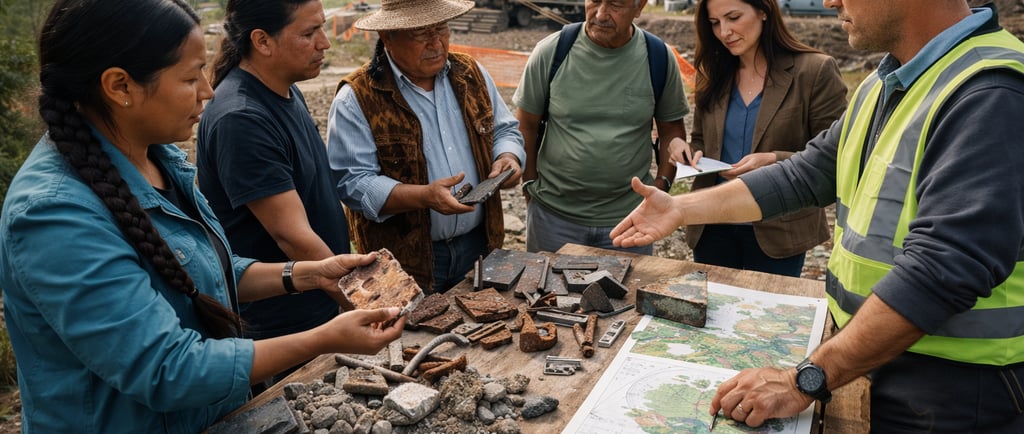
Context: Why Land-Back and Circular Planning Matter
Across North America, Australasia, and beyond, the intersection of public infrastructure, Indigenous sovereignty, and sustainable development is reshaping how leaders approach long-term community investments. The Land-Back movement advocates for either the literal return of ancestral lands to Indigenous peoples or the restoration of their inherent governance rights over those territories. As this movement grows in influence, its principles are increasingly relevant in settings where infrastructure projects directly impact traditional lands and waters.
Simultaneously, the conversation around circular infrastructure is accelerating. Traditional “take-make-waste” infrastructure models—extracting materials, manufacturing components, building assets, and eventually disposing of them—have proven environmentally unsustainable and economically inefficient. By contrast, circular infrastructure systems extend asset longevity, create closed material loops, and embed resource resilience, all while reducing the need for new extraction of finite materials such as metals.
The Convergence of Community, Equity, and Sustainability
At the heart of Land-Back and circular planning lies an opportunity to deliberately embed community leadership, equity, and culture into the fabric of public asset management. When Indigenous nations and local communities take the lead or participate as equal partners, assets become not only sustainable but also culturally relevant and generationally responsible.
The urgency is multi-faceted:
Legal Dynamics: As Indigenous peoples around the globe strengthen their legal positions, often through court victories, public asset managers must be proactive to avoid litigation and ensure free, prior, and informed consent (FPIC) in infrastructure decisions.
Social Expectations: Today’s communities demand more than token consultation. There is growing expectation for genuine community co-ownership, particularly where historical exclusion and impacts persist.
Financial Imperatives: Billions of dollars in sunk infrastructure costs underscore the need for adaptive, future-proofed systems. Projects that ignore society’s cultural dimensions or local land claims risk costly delays, retrofits, or even shutdowns.
Ecological Realities: Intensifying climate impacts and resource depletion (for example, dwindling accessible copper and lithium) spotlight the urgent shift towards circularity—a model in which nothing valuable goes to waste, and ecological balance is restored.
Global studies, such as the Ellen MacArthur Foundation’s research on urban mining, suggest that closed-loop infrastructure can reduce new resource demands by 50-80% in certain sectors. Additionally, the Truth and Reconciliation Commission of Canada, along with similar global truth initiatives, emphasize the importance of restoring Indigenous voices and rights throughout public policy.
In this context, embracing Land-Back with circular infrastructure is not just the right thing to do—it is a strategic, resilient, and future-aligned approach to public asset management.
2. The Problem: Exclusion, Waste, and Governance Gaps
Traditional infrastructure planning has often failed to embody the practices and wisdom offered by Indigenous and local communities. Historic examples abound: highways built over sacred lands without consultation, water projects ignoring Indigenous stewardship science, or waste-heavy upgrades that bypass local labor and cultural values.
The Cost of Exclusion
For decades, exclusion resulted in:
Disenfranchised Communities: Decisions are made at centralized levels, while those most affected have little agency—breeding mistrust and disengagement.
Inefficient Asset Lifecycles: Linear systems generate massive waste. A 2022 UNEP report noted that construction and demolition materials account for over 30% of total urban waste globally—much of it not reused due to lack of circular planning.
Governance Fragmentation: When government agencies, contractors, and communities operate in silos, conflicting priorities stall progress. Reforms, such as New Zealand’s co-governance frameworks for water, show that shared models outperform legacy top-down governance.
Failed Equity Promises: Marginalized communities bear the brunt of environmental harms and rarely access the benefits of infrastructure—jobs, contracts, or profit-sharing.
Emerging Governance Gaps
The growing emphasis on Environmental, Social, and Governance (ESG) compliance has prompted many governments and corporate stakeholders to act, but most do not have frameworks robust enough to knit together circularity, equity, and culturally intelligent governance. According to McKinsey’s 2023 “Closing Governance Gaps” report, over 70% of public sector entities cited a lack of clear models for integrating equity and sustainability goals into infrastructure decision-making.
Without bridging these gaps, infrastructure risks becoming obsolete, opposed, or alienating to the very populations it is meant to serve.
3. Key Concepts and Definitions
To operationalize this new direction, public sector leaders, planners, and ESG professionals need shared language and definitional clarity.
Land-Back
Land-Back is rooted in Indigenous rights movements seeking to restore stewardship, law, and jurisdiction—not simply ownership—over traditional territories. In infrastructure, this means Indigenous nations have meaningful power throughout project life: from concept and design to governance and benefit-sharing. Central to Land-Back is the concept of free, prior, and informed consent (FPIC) and the right to say “no” to projects that threaten culture or environment.
Circular Infrastructure
Circular infrastructure challenges the pattern of resource extraction, single-use, and disposal. Instead, it champions:
Material Circularity: Prioritizing reuse, refurbishment, and recycling, especially of metals like steel, aluminum, and copper.
Lifecycle Optimization: Designing infrastructure for easy upgrades, deconstruction, and material recovery.
Regenerative Outcomes: Enhancing ecosystems rather than depleting them.
This model is backed by research from the World Economic Forum, which estimates that more than $4.5 trillion in economic value could be unlocked globally by 2030 through circular practices across urban infrastructure.
Community Governance
Community governance surpasses “consultation” to recognize local and Indigenous groups as co-decision makers. This includes participatory budgeting, veto rights, rotating board seats, and shared accountability. According to the Harvard Project on American Indian Economic Development, community-led projects demonstrate higher success rates and improved stakeholder satisfaction.
Equity (in Planning)
Equity in infrastructure planning ensures that marginalized groups can shape projects, share directly in their economic and social benefits, and avoid disproportionate burdens. This extends to contracting, employment, and governance roles, not just project outcomes.
Cultural Sustainability
Cultural sustainability measures more than heritage. It is the ongoing vitality of Indigenous languages, practices, land relationships, and stewardship passed through generations and reflected in infrastructure design, material choices, and governance.
The Intersection
All these concepts converge to challenge the old infrastructure paradigm and produce one that is adaptive, just, and future-oriented—one where infrastructure not only works, but truly belongs to its place and people.
4. A Respectful Five-Phase Planning Framework
For meaningful progress, actionable frameworks are essential—they bridge the gap between theory and real-world public works. The following five-phase model has been validated through peer-reviewed case studies, international best practices, and policy pilots in Canada, Australia, and the Nordics.
1. Recognition and Relationship-Building
Purpose: Establishes legitimacy and trust as the foundation. Instead of waiting for late-stage opposition or conflict, project leads begin by engaging Indigenous nations and local communities. This involves transparent communication about intentions, expected impacts, and timelines.
Evidence: Collaboration between BC Hydro and the Tsay Keh Dene Nation offers a prime example, where early relationship-building enabled renewable energy projects to advance smoothly while supporting community aspirations.
2. Cultural and Material Inventory
Purpose: Systematically maps all relevant assets—cultural landscapes, sacred sites, existing infrastructure, and the full scope of material resource flows. Teams use digital mapping, community knowledge, and environmental scans.
Fact: The inclusion of local land users increases the accuracy and completeness of inventory data, as shown in the Nunavut Inuit Land Use Study.
3. Co-Design of Circular System
Purpose: Assets are co-designed to reflect cultural priorities, maximize reuse, and ensure modularity or easy disassembly for future upgrades. Collaboration happens in facilitated workshops and iterative design sessions, incorporating both traditional and modern engineering methods.
Example: The Red Lake Nation’s solar farm retrofit with modular, easily replaced components—designed using participatory, cross-generational workshops—demonstrates circularity in practice.
4. Shared Governance and Benefit Design
Purpose: Formalized through charters and legal agreements, shared governance models provide joint direction, operational oversight, material flow approvals, and benefit distribution (including revenue-sharing and local employment).
Research Insight: According to the Indigenous Clean Energy Network, projects with formal co-governance structures consistently achieve higher local employment rates and reduced delays.
5. Adaptive Management and Stewardship
Purpose: Assets are never “set and forget.” Adaptive stewardship cycles, often run by community-based committees, regularly review system performance, monitor for adverse impacts, and support learning through education and training programs.
Future Trend: Digital twin technologies and AI-powered monitoring are increasingly used for adaptive management, enabling communities to track performance in real time and adjust protocols as needs change.
This framework ensures that project value, ownership, and culture remain interwoven from planning to operation—not as afterthoughts, but as structural pillars.
5. Step-by-Step Example: How a Land-Back Circular Infrastructure Project Actually Moves from Idea to Stewardship
Imagine a mid-sized municipality planning a stormwater, road, and public works upgrade on land that overlaps with an Indigenous nation’s traditional territory. Under the old model, the sequence would be familiar: engineers define the scope, procurement issues a tender, contractors price virgin materials, consultation happens after major decisions are already locked, and community concerns arrive late, often when schedules, capital commitments, and political expectations make meaningful redesign harder. That is precisely the pattern that produces conflict, waste, and mistrust. It is also the pattern that circular and Land-Back planning is designed to replace. The need for a different model is no longer abstract. The global economy is only 6.9 percent circular, while just 11.2 percent of materials exiting the economy are recycled. At the same time, the built environment consumes almost half of all materials extracted globally each year, and circular approaches in the built environment could reduce emissions from building materials by 38 percent by 2050.
In a Land-Back circular model, the first step is not technical scoping. It is jurisdictional recognition and relationship design. The municipality begins by acknowledging that the project sits within a living governance landscape, not an empty delivery zone. This means engaging the Indigenous nation before options are narrowed, confirming decision rights, identifying whether consent thresholds apply, and setting up a process that can absorb “no,” “not yet,” or “only if redesigned” as legitimate outcomes. This is not symbolic. International guidance on free, prior and informed consent treats meaningful Indigenous participation and, in some cases, consent as integral to decisions affecting lands, territories, relocation, cultural heritage, and resource development. The point is to move from procedural consultation to actual power-sharing before irreversible choices are made.
Step two is a dual inventory. One stream maps cultural and ecological realities: water flows, access routes, food gathering areas, sacred and ceremonial spaces, language-bearing landscapes, burial and story sites, and current community uses. The other maps material stocks: culverts, steel, concrete, cable, paving, fixtures, demolition volumes, and salvage quality. This is where circular planning becomes concrete. A road is no longer just a road. It becomes a temporary assembly of recoverable materials, a water-management device, and a cultural intervention with long consequences for movement, habitat, and governance. The practical reason this matters is scale. UNEP reports that the buildings and construction sector consumes 32 percent of global energy and contributes 34 percent of global CO2 emissions, while the construction sector generates an estimated 2 billion tonnes of construction and demolition waste each year. In the United States alone, EPA estimates 600 million tons of construction and demolition debris were generated in 2018, more than twice the amount of municipal solid waste.
Step three is co-design. Here, the project team asks a different set of questions. Can existing materials be harvested and reused on site? Can the road base be retained rather than fully excavated? Can drainage features become wetlands or habitat corridors rather than purely grey infrastructure? Can modular, repairable components replace sealed, replace-all systems? Can public space, utility corridors, and cultural interpretation be co-authored rather than appended later as art or signage? Circularity becomes real when design is forced to prove why new extraction is necessary, not when reuse is treated as a nice extra. Land-Back becomes real when the Indigenous nation is shaping form, phasing, priorities, and stewardship rules, not merely commenting on renderings.
Step four is governance and benefit architecture. Before procurement goes live, the parties define who approves design changes, who controls cultural protocols on site, how salvage revenue is treated, how local contractors are prioritized, how training will work, and what happens if monitoring identifies harm. Research from Harvard’s Project on Indigenous Governance and Development continues to reinforce the same principle: when Native nations make their own decisions, they consistently outperform external decision-makers across governance, resource management, economic development, health care, and social services. Harvard also notes that empowered tribal nations become economic engines for surrounding regions, not isolated success stories. That matters because shared governance is often misread as a cost. In practice, it is often a performance condition.
Step five is adaptive stewardship. The project does not end at ribbon-cutting. The asset enters a monitored stewardship cycle with clear indicators for material recovery, repair rates, water performance, biodiversity, cultural access, training outcomes, and community trust. This is where circular infrastructure stops being a design style and becomes an operating system. The asset is expected to learn, not just endure.
6. Implementation Playbook: What Public Authorities, Utilities, and Project Sponsors Need to Do
The implementation playbook starts with governance before capital. Too many infrastructure teams still treat governance as a risk register item instead of a design input. The first operational move should be a joint project charter signed before concept design is finalized. That charter should define decision-making bodies, escalation routes, information-sharing standards, cultural protocol requirements, data ownership, and the threshold at which community approval is needed for design changes. If the parties wait until procurement, most of the leverage is gone. This is especially important because community conflict remains one of the most expensive project risks in extractives and infrastructure-adjacent sectors. The Davis and Franks research, still widely cited because the economics remain relevant, found that a major mining project could lose roughly US$20 million per week in delayed production from conflict-driven disruption. Infrastructure sponsors ignore that lesson at their own expense.
The second move is to rewrite procurement. Standard tenders reward lowest visible upfront cost, speed of installation, and supply certainty from virgin material chains. A Land-Back circular tender must instead score for design for disassembly, recycled and reused content, repairability, salvage plans, local and Indigenous enterprise participation, workforce development, and measurable whole-life performance. If procurement does not change, the project will revert to linear habits no matter what the strategy document says. This is not theory. EPA’s data show that demolition drives the overwhelming share of C&D debris, and the EPA table indicates that in 2018 the United States generated roughly 600 million tons of C&D debris, with about 456 million tons directed toward next use pathways and about 144 million tons landfilled. That tells you two things at once: the waste stream is enormous, and a large recovery market already exists where systems are designed to use it.
The third move is to fund early-stage participation properly. One of the clearest findings in contemporary First Nations energy case work is that communities often enter negotiations under-resourced while developers and public agencies already have technical teams, legal support, and capital market access. Australia’s First Nations Clean Energy Strategy case study pack highlights that early funding remains a core barrier, even in leading projects. In the East Kimberley Clean Energy Project, Traditional Owners are majority shareholders in a project that includes an approximately 1,000 MW solar farm over 2,000 hectares, yet the case study also notes the continuing need for development funding beyond the initial AU$1.67 million feasibility support. The lesson for infrastructure is simple: if you want equal partnership, you cannot fund only one side of the table.
The fourth move is to build a material intelligence layer. Every serious project should create a digital materials passport or equivalent register for recoverable metals, concrete, timber, asphalt, and mechanical systems. Public owners routinely know the book value of assets but not the recovery value of materials embedded in them. That is a strategic blind spot. A circular Land-Back project should know what can be reused on site, what can be transferred to community enterprises, what must be handled as contaminated legacy waste, and what can be stored for future repair cycles. This matters even more as circularity remains low globally and material demand continues to climb.
The fifth move is to build community capability into the asset itself. Training, apprenticeships, monitoring contracts, cultural interpretation work, maintenance roles, and local enterprise pipelines should be part of capital planning, not separate grant applications chased after the fact. The strongest projects do not merely avoid harm. They leave behind institutions, skills, and revenue pathways that make the next project easier, faster, and more legitimate.
7. Measurement and Assurance: What to Track if You Want the Model to Hold Under Scrutiny
Measurement has to do more than prove carbon savings. If Land-Back circular infrastructure is reduced to a sustainability dashboard, it will fail its own premise. The measurement system needs four linked layers.
The first is governance assurance. Track how early Indigenous nations entered the process, what decisions required joint approval, how often design changes were made because of community direction, how disputes were resolved, and whether consent-related commitments were met in practice. This is the difference between saying a nation was “engaged” and being able to show where it exercised authority. The legal and operational importance of this is reinforced across UN and IFC guidance on Indigenous participation and consent.
The second is circular performance. Track percentage of recovered material reused on site, percentage sold into secondary markets, virgin material displaced, demolition avoided through retrofit, design-for-disassembly score, and embodied carbon avoided. In a circular infrastructure model, landfill diversion is not enough. A crushed beam used as low-grade fill is better than landfill, but it is still lower value than reuse at component level. Projects should therefore separate “diverted,” “recovered,” and “retained at highest value.” That gives a far more honest picture of whether circularity is real. EPA’s breakdown of C&D pathways shows why this distinction matters, because “next use” includes a wide range of outcomes with very different value retention profiles.
The third is ecological and place-based performance. Track water quality, runoff retention, habitat restoration, flood reduction, soil contamination control, and access to culturally significant landscapes. The Whanganui wetland work is instructive here. The council’s 2024 reporting says the Kokohuia and Titoki wetlands, guided by a Hapū-led collective under the Te Awa Tupua framework, were modeled to improve stormwater retention, reduce flooding risk, and provide robust treatment of runoff before discharge into the river, while also pursuing the return of tuna, inanga, manu, and cultural connection to the site. That is what good measurement looks like: one intervention, multiple outcomes, all tied to place.
The fourth is distributive equity. Track Indigenous and local contract value, percentage of project spend retained locally, number of trainees moved into paid roles, ownership stakes where relevant, and the share of monitoring and maintenance budgets controlled by community entities. This is essential because many projects promise community benefit in principle while keeping ownership, revenue, and technical control elsewhere. Recent Australian clean energy work puts hard context around this gap. A 2025 First Nations Clean Energy Network report says more than 20 First Nations clean energy partnerships were in development, including 10 utility-scale project partnerships with equity, yet that still amounted to less than 1 percent of clean energy projects in Australia. The gap between rhetoric and real participation remains large.
8. Case Patterns: What the Strongest Examples Have in Common
The first repeat pattern is legal recognition tied to operating institutions. The Waikato River model did not stop at symbolic recognition. It created an institutional co-governance framework, and the Waikato River Authority says it has granted nearly NZ$79 million across 485 projects since 2011 to restore the health and wellbeing of the Waikato and Waipā rivers. The lesson is that durable transformation needs a statutory or contractual body, a mandate, money, and continuity. Values without institutions do not hold under delivery pressure.
The second repeat pattern is rights-based governance informing practical infrastructure. In the Whanganui system, Te Awa Tupua gave the river legal personality, while Te Kōpuka was established as a multi-party strategy body with representatives from iwi, local government, state actors, commercial users, environmental interests, and others. What matters here is not just the legal innovation. It is that the legal innovation created a framework for ongoing planning, coordination, and accountability. That is exactly the kind of architecture infrastructure projects need when multiple jurisdictions, values, and asset classes intersect.
The third repeat pattern is early Indigenous equity or co-ownership. Australia’s recent clean energy examples show the direction of travel clearly. The First Nations Clean Energy Strategy case study pack highlights projects where Traditional Owners are shareholders, co-developers, or formal partners, and the First Nations Clean Energy Network argues that stronger participation reduces risk, cost, and delay while improving siting, access to capital, offtake prospects, and project progression. This pattern matters beyond energy. When communities have skin in the asset, project incentives change. Design improves because the operating horizon becomes generational, not just contractual.
The fourth repeat pattern is culturally legitimate governance producing broader regional gains. Harvard’s Indigenous governance work is important here because it reframes the debate. Strong Indigenous self-governance does not produce isolated enclaves of success. It produces stronger regional performance. That finding helps dismantle the false trade-off often posed in public debates, where community authority is treated as a brake on development. The evidence points the other way.
9. Enhanced Scenarios: Where This Model Goes Next
One likely 2026 to 2030 scenario is the retrofit corridor. Instead of replacing bridges, depots, transit stops, culverts, or civic facilities through demolition-heavy cycles, public owners will increasingly use phased retrofit, salvage-first procurement, and local material banks. This is where circular planning becomes financially compelling. With the buildings and construction sector responsible for 34 percent of global CO2 emissions and heavily dependent on cement and steel that account for 18 percent of global emissions, public asset owners will face rising pressure to retain and adapt what they already control.
A second scenario is watershed-led infrastructure planning. Rather than organizing projects by agency silos such as roads, water, parks, and waste, more jurisdictions will plan around catchments, estuaries, and culturally significant landscapes. The Whanganui wetland example shows why. Flood mitigation, runoff treatment, habitat restoration, landfill legacy management, cultural reconnection, and community education can all sit inside one place-based project when governance allows it.
A third scenario is Indigenous material enterprises linked to public procurement. Once municipalities begin mapping recoverable materials at scale, Indigenous and local businesses can move upstream into salvage, remanufacture, storage, repair, monitoring, and stewardship services. This is one of the least discussed but most important upgrades in the whole model. Circularity is not only about emissions and waste. It is also about who gets paid during the transition.
A fourth scenario is consent-aware digital infrastructure. More projects will use digital twins, material passports, geospatial cultural overlays, and community-controlled monitoring systems. The risk here is obvious: data extraction can become the new land extraction if communities do not control access, interpretation, and use. The opportunity is equally large: communities can monitor the condition of assets, wetlands, and material flows in real time, making stewardship far more precise. The model that wins will be the one that combines technical transparency with Indigenous data governance. This is where Land-Back planning moves from a project method to a public operating logic.
10. Conclusion
Land-Back and circular infrastructure planning matter because they answer three failures at once. They answer the democratic failure of building on Indigenous lands without Indigenous authority. They answer the material failure of extracting, using, and discarding infrastructure as if waste were cheap and infinite. And they answer the strategic failure of treating community trust as a soft issue when it is often one of the hardest determinants of cost, delay, and long-term asset performance.
The next decade will separate projects that merely reference justice and circularity from projects that are actually structured by them. The leaders in this space will be the ones that move earliest on shared governance, salvage-first design, community capability, and measurable stewardship. They will understand that the strongest infrastructure is not just lower-carbon or lower-waste. It is more legitimate, more repairable, more locally rooted, and more capable of carrying cultural meaning over time. In practical terms, that means fewer stranded assets, fewer costly conflicts, better material productivity, and stronger communities. In deeper terms, it means infrastructure that finally stops acting like an occupying force and starts acting like a long-term relationship with land, water, and people.
Connect
Your trusted partner for scrap metal procurement.
CONTACT
About
haroon@tdcventures.com
+1-307-655-7593
© 2025. All rights reserved.
NEWSLETTER