
Metaverse Hardware Take-Back: Contracts and Channels for XR Electronics Recycling and Design for Repair
Build closed-loop XR hardware take-back programs that turn e-waste into value. Contracts, certified recycling channels, and repair design—proven frameworks inside.
IMMERSIVE TECH RECYCLING & CIRCULAR ELECTRONICS
Context: Why Take-Back in XR Matters Now
Extended Reality (XR) is no longer a niche technology—it’s shaping everything from immersive healthcare training to collaborative product design and next-generation entertainment. Industry forecasts by IDC project global XR hardware shipments to surpass 30 million units annually by 2027, supported by substantial investments from leaders like Meta, Microsoft, and Apple. Each year, new XR applications emerge across manufacturing, defense, education, and retail, fueling demand and rapid hardware refresh cycles.
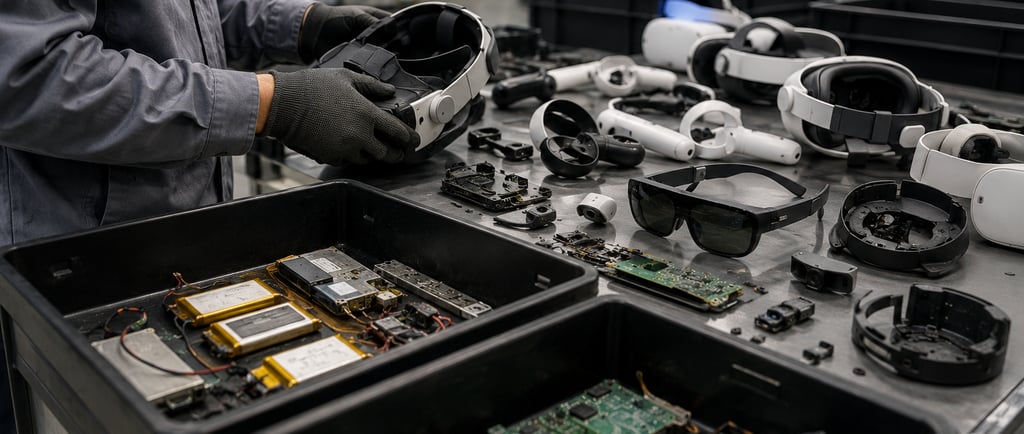
But the speed of innovation brings new sustainability challenges. XR gear—including VR headsets, AR glasses, haptic controllers, and spatial sensors—relies on specialized components, mixed materials, and embedded power systems. These devices often outpace regulatory frameworks, lacking the built-in pathways for responsible end-of-life handling seen in laptops or smartphones. According to the Global E-Waste Statistics Partnership, total e-waste reached a staggering 53.6 million metric tonnes in 2019, and XR’s exponential rise could add significantly to this figure unless industry leaders intervene.
Three major forces make action urgent:
Regulation: The EU’s Ecodesign Directive—and upcoming U.S. state laws—are sharply focused on repairability, reuse, and recycling governance, especially for digital and immersive devices. XR is explicitly in scope for upcoming right-to-repair and take-back requirements.
Enterprise Procurement: Sustainability and ESG requirements are moving from “nice to have” to “non-negotiable” in hardware sourcing decisions. Enterprises routinely demand certified asset recovery, verifiable data erasure, and environmental reporting from all suppliers—including XR OEMs.
Reputational Risk: Both tech brands and large buyers risk fines, negative publicity, and customer churn if obsolete XR hardware is abandoned, landfilled, or mishandled. Tech giants have faced criticism for their e-waste practices in the past; the same stakes now apply to new hardware categories.
For forward-looking businesses, true metaverse success means closing the hardware loop—transforming sustainability commitments from slide decks into closed-loop contracts, robust collection systems, and transparent reporting across the hardware’s entire lifecycle.
2. The Problem: Growing E-Waste and Unsustainable Hardware Models
The Current State of XR Hardware End-of-Life
XR hardware historically followed rapid innovation and replacement cycles, with little emphasis on repair, reuse, or materials recovery. Devices often contain bespoke parts, embedded batteries without easy removal, and complex electronics that frustrate traditional recycling channels. The result: collection rates for used XR hardware lag well behind other IT assets. Industry estimates suggest that only 10–20% of used XR equipment ever enters a certified recycling or refurbishment stream—a stark contrast to category leaders like smartphones, where collection rates in mature programs can exceed 40%.
Traditional e-waste recyclers also face unique hurdles with XR:
Complex Dismantling: Many XR products are sealed using adhesives, proprietary screws, and tightly integrated PCBs, making safe disassembly for recycling labor-intensive and expensive.
Battery Hazards: Lithium polymer cells pose fire and health risks if not properly removed and processed by trained handlers.
Data Security: Devices such as AR headsets may store sensitive images, user profiles, or patient records, making improper disposal a significant privacy risk.
Operational and Strategic Risks
OEM Liability: EU and US legislation increasingly holds OEMs responsible for end-of-life recovery under Extended Producer Responsibility (EPR) regimes. Fines for non-compliance can exceed hundreds of thousands of euros per incident.
Enterprise Buyer Penalties: Companies aiming for net-zero or closed-loop hardware policies can fail audits—and lose contracts—if their XR assets are unaccounted for or handled by uncertified vendors.
ITAD and Recommerce Pressure: Low recycling yields and costly manual processes reduce margins and limit service scalability.
This fragmented landscape costs money, erodes trust, and undermines sustainability. Inaction risks turning circularity pledges into hollow statements, exposing organizations to strategic, financial, and reputational damage.
3. Key Terms: XR, Circularity, ITAD, Take-Back Channels
To navigate the ecosystem, clear shared language is essential. Here’s a jargon-free glossary for industry stakeholders:
XR (Extended Reality): An umbrella term for immersive technologies—Virtual Reality (VR), Augmented Reality (AR), and Mixed Reality (MR)—including all headsets, controllers, sensors, and haptics.
Circularity: The system-level approach to hardware where products are designed, used, collected, and reintroduced into the value chain via repair, refurbishment, or recycling. Circularity stands in direct opposition to the linear model of “take, make, dispose.”
ITAD (IT Asset Disposition): Specialized, certified service providers who handle the secure, auditable transport, processing, data destruction, and environmentally responsible recycling or resale of retired IT hardware.
Take-Back Channels: Strategically designed systems and partnerships for collecting end-of-life electronics—from simple retail drop-off bins, to mail-back labels, to enterprise pickup and shipment with verifiable chain-of-custody documentation.
Bridging hardware design, contract law, logistics, and compliance, these terms anchor the emerging circular electronics value chain in XR.
4. The Hardware Circularity Framework: Design, Collect, Refurbish, Recycle
Leading organizations now follow a deliberate framework to maximize the value and recoverability of every XR device. Here’s how the world’s best programs are architected—and where each stakeholder adds value.
1. Design for Repair & Recycling
Modular Construction: Devices built with standard connectors, swappable parts, and minimal adhesives allow for easy part replacement—a principle popularized in frameworks such as iFixit’s Repairability Index and the EU’s Ecodesign criteria.
Accessible Batteries: Placement and fastening of battery cells for rapid removal, minimizing fire risk and enabling independent battery recycling.
Material Transparency: Full bill-of-materials, recycled content declarations, and part IDs streamline downstream sorting and compliance.
Firmware/Software Lock Removal: Mechanisms for decoupling devices from cloud accounts at end-of-life.
2. Contractual Take-Back
Procurement Clauses: Tying hardware purchases or leases to obligated return, with financial penalties or clawbacks for non-compliance.
Producer Responsibility Agreements: Assigning OEMs or channel partners legal accountability for downstream processing.
3. Multi-Channel Collection
Enterprise Bulk Return: Coordinated pickups with asset tracking at client offices, hospitals, or training sites.
Retail Drop-Off: Convenient return bins or partner kiosks integrated into store aisles.
Prepaid Mail-Back: Print-on-demand labels for small businesses and consumers.
Direct Pickup for Large Clients: Onsite collection events or routine asset sweeps.
4. Certified Handling for Refurbishment & Data Security
R2/ISO Certified Operations: Using only certified processors ensures environmentally sound dismantling and data privacy at every step.
Automated & Manual Diagnostics: Digital triage for firmware wipes, functional tests, and grading for repeated use.
Chain of Custody: Verifiable, digital audit trails (for instance, via blockchain or secure databases).
5. Circular Redistribution or Recycling
Reuse First: Every device is prioritized for resale, donation, or redeployment before materials recycling.
Recycling as Last Resort: End-of-life products go to certified facilities for responsible extraction and downstream material handling.
Transparent Reporting: Stakeholders receive granular data—units collected, processing outcomes, CO₂ savings, landfill diversion, and regulatory conformance.
Example Scenario: Enterprise XR Refresh
A large healthcare system deploys 400 AR headsets across multiple hospitals. Their contract stipulates devices must return to the OEM at end of use. At refresh, the system triggers a secure bulk pickup by a certified ITAD partner. Devices are scanned, wiped, and graded—functional headsets are refurbished and supplied back to training facilities, while obsolete or irreparable units are responsibly recycled with full documentation. This closed-loop process helps the buyer meet its ESG targets and regulatory reporting obligations.
5. Step-by-Step: Building XR Take-Back Programs
A Proven Playbook for XR Take-Back
Assess Product Design and Repairability
Conduct teardown analysis and grading for all SKUs.
Identify “red flags” like sealed casings, embedded batteries, or software locks.
Use repairability assessments as input for future product roadmaps.
Draft Robust Circularity Clauses
Integrate specific language requiring device return, data sanitization, and vendor-managed logistics in procurement contracts.
Assign responsibility for non-recoverable assets.
Identify and Vet Third-Party Partners
Shortlist ITAD and recycling partners with XR-specific handling experience, R2/ISO certifications, and proven chain-of-custody systems.
Evaluate regional coverage and ability to handle anticipated volumes.
Select Optimal Take-Back Channels
Analyze device distribution: enterprise buyers may favor coordinated bulk pickup, while consumers prefer local drop-off or mail-in convenience.
Pilot multiple collection methods to optimize recovery rates.
Pilot the Take-Back System
Start with a select asset class, region, or user group to field-test processes.
Measure logistical efficiency, user compliance, and partner performance.
Certify Processing Workflow
Ensure every asset transfer, data erase, and processing event is digitally logged and auditable.
Partner only with facilities carrying up-to-date environmental and data privacy certifications.
Grade & Refurbish
Functionally test and clean returned hardware.
Categorize as A/B/C grade for reuse, parts harvesting, or direct recycling.
Aggregate & Report
Centralize collection and processing data.
Generate digestible, regular reports for both internal and customer-facing metrics, supporting continuous improvement.
Close the Loop
Convene quarterly reviews with design, logistics, and compliance teams to capture learnings.
Feed modularity, material, and process insights back into next-generation product designs.
Additional Best Practices
Incentivize returns through trade-in credits or sustainability badges.
Integrate take-back performance into supplier scorecards.
Foster innovation by sponsoring repair hackathons or modular design competitions.
6. Implementation Playbook: Contracting and Channel Setup
Moving from planning to execution requires operationalizing circularity via contracts and building high-performance collection ecosystems—what Neil Patel might call the “bridge from strategy to results.”
10-Step Checklist for Bulletproof Implementation
Define Measurable Circularity Goals
Quantifiable targets (e.g., 80% device recovery within 3 years; 70% refurbishment yield)
Aligned with both regulations and corporate ESG frameworks
Incorporate Mandatory Take-Back in All RFPs
Inclusion of end-of-life obligations as a condition for procurement participation
Structure Legally Enforceable Take-Back Clauses
Clear accountability for device return, condition grading, and downstream handling
Penalties, incentives, and recourse for non-compliance
Negotiate Service-Level Agreements with Partners
Detailed SLAs for response times, data erasure standards, logistics, and reporting
Build Asset Tracking & Digital Chain-of-Custody
Assign unique IDs, QR codes, RFID tags to all hardware
Deploy asset management software for real-time location and processing status
Train All Internal Staff and Channel Partners
Ensure logistics, IT, compliance, and frontline teams understand their roles in device handling and documentation
Establish Secure, Validated Collection Points
Approve only officially listed drop-off bins, enterprise pickup partners, or verified mail-in labels
Integrate Data Wipe Verification Into Workflow
Require complete data erasure with digital logs
Mandate independent verification, either by internal audit or third parties
Conduct Third-Party Downstream Audits
Annual audits of all recycling and refurbishment supply chain partners
Onsite visits and paper-trail reviews to verify process integrity
Publish Impact and Compliance Reports
Routine updates (monthly/quarterly) on volumes processed, environmental impact, and compliance outcomes to all stakeholders
Making the Right Decisions
Non-Modular Devices: If existing hardware cannot be disassembled, direct more units to certified recycling, and invest in redesign for future cycles.
Insufficient Partner Capacity: If current ITAD vendors cannot handle anticipated XR volumes, pilot relationships with XR-focused recyclers or expand RFPs to niche providers.
Avoiding Common Pitfalls
Incomplete Asset Tracking: Leads to lost inventory, failed compliance audits, and potential data breaches.
Vague Contract Language: Allows for stakeholder ambiguity at end-of-life, stalling recovery and shifting cost burdens.
Mini Decision Tree
Enterprise User? → Offer certified bulk pickup and ensure closed-loop reporting.
Retail User? → Prioritize local drop-off or prepaid mail-back with clear incentives and reminders.
Below-Grade Device? → Route directly to authorized recycler with full chain-of-custody documentation.
Case Insight: A U.S. state government purchasing department recently reduced e-waste volume by 27% in two years after adopting enforceable circularity SLAs and a three-channel pickup strategy—proof that robust contracts and channels drive measurable results.
Measurement, Reporting, and Proof: How XR Take-Back Programs Earn Trust
A take-back program only becomes credible when it can prove what happened to every device. In 2026, this proof matters as much as the recycling itself. Enterprise buyers, public institutions, insurers, ESG teams, procurement officers, and regulators no longer accept vague claims such as “responsibly recycled” or “handled by an approved partner.” They want device-level records, verified outcomes, and numbers that can survive an audit.
The global context makes this non-negotiable. The world generated 62 million tonnes of e-waste in 2022, equal to 7.8 kg per person, yet only 22.3% was formally collected and recycled through documented channels. By 2030, global e-waste is expected to reach 82 million tonnes, while the documented collection and recycling rate could fall to 20% if collection systems do not keep pace. That gap is the central problem for XR hardware: the sector is growing while the recovery system is still immature.
For XR OEMs and enterprise buyers, measurement should begin at the asset level, not the program level. Each headset, controller, sensor, haptic vest, smart glass unit, battery module, charger, docking station, and spatial tracking accessory needs a unique asset identity. That identity should connect to purchase date, user group, deployment site, warranty status, repair history, firmware status, return status, data wipe status, grading result, reuse outcome, parts recovery outcome, and final recycling certificate.
A mature XR take-back program should track at least six layers of performance.
The First Layer: Recovery Rate
This measures the share of deployed XR hardware that comes back into a controlled channel. For enterprise deployments, a strong target is 80% to 95% return of contracted hardware, especially when assets are leased, rented, subsidized, or tied to training programs. Consumer programs usually perform lower because devices are scattered across homes, small businesses, schools, creators, and gaming users. In consumer channels, a realistic first-year target may be 15% to 30% recovery, rising as trade-in credits, reminders, prepaid labels, and retail drop-off points mature.
The Second Layer: Reuse Rate
This measures how many returned devices can be redeployed after cleaning, testing, repair, refurbishment, or parts replacement. Reuse should sit above recycling in the hierarchy because the highest environmental value usually comes from keeping complex electronics in use for longer. For XR hardware, reuse can include redeployment to internal teams, resale through approved channels, donation to training institutions, spare device pools, or cannibalization for functional parts such as lenses, straps, controllers, face interfaces, tracking modules, boards, and cables.
The Third Layer: Repair Yield
This measures how many failed devices can be restored with reasonable labor, parts availability, and safety controls. XR devices are harder than basic office IT assets because they combine optics, batteries, sensors, plastics, foam, cameras, speakers, displays, and firmware. A repair yield target must be specific by SKU. A modular enterprise headset may support 60% to 75% repair yield. A sealed consumer device with adhesive-heavy construction may fall below 30%. This is why take-back data must flow back into product design. If the same failure repeats across thousands of returned units, the issue is not a recycling problem. It is a design problem.
The Fourth Layer: Data Sanitization Proof
XR hardware can hold sensitive spatial and behavioral information. A headset may store user accounts, room mapping data, Wi-Fi credentials, app usage, biometric settings, training records, screenshots, workplace layouts, patient simulation records, or enterprise login credentials. For healthcare, defense, industrial training, education, and workplace collaboration, this turns retired XR hardware into a privacy risk. Certified processing partners should record wipe method, wipe date, operator, device ID, result, exception handling, and final approval. R2v3 requirements place clear emphasis on data security controls, device tracking, sanitization records, and specific certification requirements where logical data sanitization is performed.
The Fifth Layer: Downstream Accountability
It is not enough to hand devices to a recycler and close the ticket. Every XR take-back program should know which partner received the device, which facility processed it, which components were reused, which materials were recycled, which fractions were sent downstream, and whether any hazardous components were handled by licensed specialists. This matters because e-waste contains hazardous substances such as lead, cadmium, mercury, brominated flame retardants, and lithium batteries. It also contains recoverable materials with real economic value. The EU Raw Materials Information System estimates that about US$62 billion worth of recoverable natural resources are lost annually because of poor e-waste recovery.
The Sixth Layer: Impact Reporting
Buyers need clean reporting that connects circular outcomes to procurement, compliance, and ESG goals. Reports should show total units collected, recovery rate, units reused, units refurbished, units harvested for parts, units recycled, batteries removed, data wipes completed, data wipe exceptions, landfill diversion, estimated avoided emissions, and unresolved assets. Reports should also flag design patterns, such as frequent strap failure, battery swelling, lens scratching, damaged USB-C ports, cracked housings, or software locks that block reuse.
The best XR take-back reports do not read like recycling receipts. They read like asset intelligence. They tell the organization what came back, what value was recovered, what risks were reduced, and what needs to change in the next hardware cycle.
This is where XR can learn from the broader electronics sector. Apple reported in April 2026 that 30% of the material across all products shipped in 2025 came from recycled content, the company’s highest reported level to date. That type of public progress only becomes possible when material recovery, design choices, supplier work, and product reporting are tracked across years, not treated as one-off recycling campaigns.
For XR companies, the takeaway is simple. Do not measure take-back as a bin count. Measure it as a closed asset system. Every missing headset is a compliance risk. Every repaired device is avoided waste. Every harvested part is a design signal. Every recycled battery is a safety win. Every audited record is proof that the program is real.
Case Studies and Market Signals: What XR Can Learn from Electronics, ITAD, and Circular Hardware Leaders
The XR take-back market is still young, but the lessons already exist in adjacent sectors. Smartphones, laptops, data center equipment, enterprise IT, gaming consoles, and medical devices have all faced the same core question: how do you recover value from complex electronics after first use?
Lesson 1: Smartphones and tablets show where regulation is heading
The first lesson comes from smartphones and tablets. The EU’s new Ecodesign and energy labelling rules for smartphones, feature phones, cordless phones, and slate tablets apply to products placed on the EU market from June 20, 2025. These rules cover durability, battery performance, repairability, spare parts, and product information. While these rules do not directly cover every XR device, they show where regulation is moving: longer usable life, better repair access, clearer consumer information, and more accountability for products with batteries and screens.
This matters for XR because headsets share many of the same design barriers. They have displays, batteries, cameras, sensors, ports, speakers, housing, straps, and software lock-ins. If phones and tablets must meet stronger repair and labelling rules, XR hardware will face similar pressure as adoption expands. A headset used in a school, hospital, warehouse, police training program, gaming lounge, or manufacturing site will not be treated as a novelty forever. It will be treated as an electronic product with end-of-life duties.
Lesson 2: EU WEEE targets create a performance benchmark
The second lesson comes from the EU WEEE system. The EU collection target rose from 45% in 2016 to 65% from 2019 onward, measured against the average weight of electrical and electronic equipment placed on the market in the three preceding years. An alternative target is 85% of WEEE generated.
These targets matter because they create a benchmark for XR. Even if XR devices are light compared with appliances, they are material-dense and risk-dense. A 500-gram headset can contain batteries, printed circuit boards, displays, rare earth magnets, plastics, adhesives, optics, foams, cameras, and data-bearing storage. The environmental risk is not only about weight. It is about complexity, hazardous handling, and lost value.
Lesson 3: Certified ITAD already built the operational model XR needs
The third lesson comes from certified ITAD. Enterprise IT asset disposition has already created the operational model XR needs: asset tagging, secure logistics, data sanitization, repair testing, resale grading, certificate generation, downstream audits, and environmental reporting. R2v3 is especially relevant because it covers electronics reuse and recycling practices, including stronger data security and tracking requirements. For XR, this is a better model than consumer recycling bins alone. XR devices often sit inside enterprise workflows, training programs, labs, medical settings, design studios, and public sector deployments. They need ITAD-grade controls, not casual disposal.
Lesson 4: Precious metal recovery shows the value of a controlled stream
The fourth lesson comes from precious metal recovery. In 2024, the Royal Mint opened an e-waste recovery facility in Wales designed to process up to 4,000 tonnes of printed circuit boards per year, with expected recovery of gold, copper, silver, and palladium. The project shows how high-value electronic fractions can support domestic recovery capacity when volumes, process control, and material streams are clear.
XR hardware will not produce the same volume as phones or laptops today, but it contains similar high-value fractions. Printed circuit boards, connectors, magnets, batteries, displays, cameras, and sensor assemblies all have recovery potential. The barrier is not that XR lacks value. The barrier is that many devices are not collected, separated, identified, or processed through channels that can capture that value.
Lesson 5: Circular design leadership connects product to take-back
The fifth lesson comes from circular design leadership. Apple’s 2026 progress update reported record recycled material use across products shipped in 2025. That public signal is important because it links product design, supply chain sourcing, recycled content, robotics, and take-back infrastructure into one story. For XR brands, the same logic applies. A headset cannot claim circular value if it is difficult to open, hard to repair, locked to accounts, missing parts documentation, and invisible after sale.
Lesson 6: Market timing demands channel adaptation
The sixth lesson comes from market timing. IDC reported in March 2026 that the global XR market rebounded sharply in 2025, with total device shipments growing 44.4% year over year. Growth was driven largely by smart glasses, while traditional VR and MR headsets continued to decline.
That shift changes the take-back problem. Smart glasses are smaller, lighter, more wearable, and more likely to move through consumer, creator, field worker, and enterprise channels. They may also be easier to lose, harder to collect, and more likely to end up in drawers. Traditional headsets are bulkier and easier to track in enterprise programs. Smart glasses create a more scattered recovery challenge. The take-back model must adapt before the installed base becomes too fragmented.
The strongest lesson across all case studies is this: the earlier a product category builds take-back into contracts, packaging, retail channels, software, procurement, and service plans, the cheaper and cleaner recovery becomes. The longer XR waits, the more devices disappear into closets, landfills, informal markets, and mixed e-waste streams.
Contracts, Incentives, and Channel Design: How to Make Returns Happen
Most take-back programs fail for one reason: they expect people to behave responsibly without making return behavior easy, visible, and worthwhile.
XR hardware take-back needs more than an environmental message. It needs clear contracts, user prompts, financial cues, partner accountability, and low-effort return channels. People return devices when the process is simple. Enterprises return devices when it is written into procurement. Channel partners support take-back when it affects their scorecard. OEMs improve design when take-back costs show up in the product’s profit and loss.
The strongest starting point is the procurement contract. Every enterprise XR purchase, lease, subscription, pilot, training deployment, or managed service agreement should include take-back language from day one. The clause should define who owns the device, when it must be returned, how it will be shipped, who pays for logistics, how data will be erased, what certifications are required, what reports will be issued, and what happens if devices are missing.
A weak contract says, “Devices should be recycled responsibly at end of life.”
A strong contract says, “All XR devices, accessories, batteries, controllers, chargers, and tracking units must be returned through the approved take-back channel within 45 days of replacement, contract termination, or confirmed retirement. Each asset must be scanned, data-sanitized, graded, and reported with device-level chain-of-custody records. Non-returned assets remain billable or subject to replacement value recovery.”
That difference matters. Weak wording creates good intentions. Strong wording creates return behavior.
Incentives also matter. For consumers, the best incentives are direct and simple. Trade-in credit, repair credit, accessory discounts, warranty extensions, recycling rewards, prepaid mailers, and instant store credits can all raise return rates. For enterprise users, incentives can include lower lease renewal costs, better device replacement terms, ESG reporting credits, reduced service fees, or preferred pricing on upgraded hardware.
Retail channels should be designed around convenience. A user should be able to return an XR headset at the point where they buy a new one, repair a broken one, or seek support. Retailers can place controlled drop-off points near service counters, gaming sections, electronics returns, and repair desks. For higher-risk products with batteries, collection points should not be open bins with mixed waste. They should be supervised, labelled, fire-aware, and connected to an approved handling process.
Mail-back channels should focus on low-volume users, remote buyers, schools, creators, and small businesses. The best mail-back systems include prepaid labels, clear packaging instructions, battery safety guidance, digital tracking, and return reminders. The return should take less than five minutes to start. If users must search for a policy, email support, print forms, or guess whether accessories are accepted, participation falls.
Enterprise pickup works best for hospitals, universities, warehouses, industrial training centers, defense contractors, design studios, and large employers. These environments usually need chain-of-custody records, controlled packaging, asset scans, and data wipe confirmation. Bulk pickup also allows better grading because devices arrive in batches with known histories.
Channel design should account for the full XR kit, not only the headset. Many programs undercount accessories. Controllers, charging docks, straps, haptic gloves, cables, trackers, face interfaces, batteries, spatial anchors, sensors, and carrying cases may all become waste. Accessories are often cheaper than headsets, but their combined volume can be significant across large deployments. A program that recovers only headsets while ignoring controllers and batteries is incomplete.
Software should support return behavior too. XR devices can display end-of-life prompts, warranty expiry reminders, trade-in offers, return instructions, account unlinking guidance, and wipe preparation steps. Managed enterprise dashboards can show devices approaching refresh windows, devices inactive for 90 days, devices assigned to departed employees, and devices with repair flags. This turns take-back from a last-minute scramble into a planned asset process.
For OEMs, the contract should connect take-back outcomes to product design. If take-back data shows high battery failure, cracked housings, broken head straps, lens damage, or charging port defects, the product team should receive that evidence. If repair takes too long because screws are hidden under adhesive or parts are unavailable, the next generation should correct it. The take-back program becomes a product lab.
The best channel mix depends on the user base.
Enterprise-heavy XR brands should lead with contracted return, scheduled pickup, ITAD processing, and device-level reports.
Consumer XR brands should lead with trade-in credit, mail-back, retail drop-off, app reminders, and simple packaging.
Education and public sector deployments should use asset registers, annual collection windows, secure storage instructions, and grant-friendly reporting.
Healthcare and defense deployments should add strict data controls, approved carriers, secure holding areas, and documented wipe standards.
Repair-first brands should direct users to authorized repair centers before recycling, then route non-repairable devices into certified recovery.
A strong take-back program is not one channel. It is a channel system. Every buyer type needs a route. Every device needs a record. Every partner needs a role. Every contract needs teeth.
Design for Repair and Future Regulation: Why XR Hardware Must Change Before the Rules Force It
XR take-back will always be limited if devices are not designed to be opened, repaired, cleaned, upgraded, and processed safely. The recycling channel cannot fix every design decision made upstream.
In 2026, the direction of travel is clear. Regulators are moving toward repairability, spare parts access, battery durability, product information, and longer device life. The EU’s smartphone and tablet rules, active from June 20, 2025, require stronger product information around energy performance, battery life, repairability, dust and water protection, and drop resistance.
XR manufacturers should treat this as a warning shot. Headsets and smart glasses may not yet face the same exact requirements in every market, but the policy logic is likely to spread. XR devices are personal electronics. They use batteries. They collect data. They contain screens and sensors. They are expensive. They are hard to repair. They have software dependencies. That combination makes them a natural target for future right-to-repair and take-back rules.
Design Priority 1: Safe Battery Access
Design for repair starts with the battery. Lithium-ion and lithium-polymer batteries create fire risk when damaged, crushed, punctured, or mishandled. A battery that is glued deep inside a headset increases labor time, raises hazard risk, and lowers recovery value. Battery access should be safe, documented, and possible without destroying the device. Where consumer safety requires limits on user access, professional repair access should still be clear.
Design Priority 2: Standard Fasteners
The second design priority is fastener choice. Standard screws, visible access points, service manuals, and part diagrams can cut disassembly time. Proprietary screws, hidden clips, and adhesive-heavy assemblies raise labor cost and reduce reuse. In e-waste processing, minutes matter. A device that takes 25 minutes to open may be economically unattractive. A device that takes five minutes to inspect, open, wipe, and grade has a much better chance of reuse.
Design Priority 3: Replaceable Wear Parts
The third priority is replaceable wear parts. XR hardware touches faces, hands, hair, sweat, makeup, cleaning chemicals, dust, and workplace environments. Straps, foam interfaces, nose bridges, silicone pads, lenses, and controllers wear out faster than boards and displays. If these parts are replaceable, the whole device can stay in use longer. If they are bonded, unavailable, or priced poorly, the device becomes waste earlier.
Design Priority 4: Software Unlock and Account Release
The fourth priority is software unlock and account release. Hardware that is physically functional but locked to a user, school, company, cloud tenant, or expired subscription may become a stranded asset. XR take-back contracts should require admin-level reset tools, remote unlinking, wipe verification, and end-of-life unlock procedures. Without this, reuse is blocked by software rather than hardware failure.
Design Priority 5: Material Marking
The fifth priority is material marking. Plastics, metal alloys, magnets, glass, elastomers, batteries, and circuit boards should be marked and documented where practical. Clear material information helps recyclers separate fractions, manage hazards, and report outcomes. This is especially important for mixed-material products such as XR headsets, where foam, plastic, electronics, and optics can be tightly integrated.
Design Priority 6: Modular Accessories
The sixth priority is modular accessories. Controllers, batteries, straps, audio modules, lenses, cables, and chargers should be replaceable and separately recoverable. This allows partial repair and parts harvesting. In enterprise fleets, a pool of spare parts can extend device life by years. In consumer channels, replacement parts can prevent premature disposal.
Design Priority 7: Cleanability for Reuse
The seventh priority is cleanability. Reuse depends on hygiene. XR devices used on faces require cleaning protocols, replaceable contact surfaces, sweat-resistant materials, and refurbishable finishes. A headset that can be sanitized, re-foamed, tested, and repackaged has a stronger second life. This matters in education, healthcare simulation, training centers, entertainment venues, and shared enterprise use.
Design Priority 8: Documentation for Repairers
The eighth priority is documentation. Repair manuals, diagnostic codes, teardown instructions, firmware reset steps, spare part lists, battery removal steps, and safe shipping instructions should be available to approved repairers and certified processors. The EU phone and tablet direction already points toward more repair and maintenance information for covered products. XR brands should prepare now instead of rebuilding their documentation under regulatory pressure later.
The business case is strong. Better repair design lowers warranty cost, improves refurbishment yield, reduces recycling labor, supports resale, helps enterprise buyers meet ESG requirements, and protects brand reputation. Poor repair design does the opposite. It pushes usable devices into recycling, raises program cost, frustrates buyers, and increases regulatory exposure.
The next generation of XR hardware should be judged by more than resolution, field of view, weight, refresh rate, pass-through quality, and app library. It should also be judged by how easily it can be repaired, reassigned, wiped, upgraded, collected, and recovered.
A future-ready XR product should answer these questions before launch:
Can the battery be removed safely by a trained technician?
Can the most common failure parts be replaced without destroying the product?
Can the device be wiped and unlocked without the original user?
Can accessories be collected and processed separately?
Can the product be cleaned for second use?
Can the recycler identify major material groups?
Can the OEM prove where returned devices went?
Can enterprise buyers receive device-level reports?
If the answer is no, the product is not circular. It is only temporarily functional.
Global Outlook for 2026 and Beyond: XR Take-Back as a Competitive Requirement
XR hardware take-back is moving from sustainability language into commercial reality. By 2026, the strongest buyers are no longer asking only whether immersive technology works. They are asking whether it can be governed, secured, repaired, tracked, and retired responsibly.
This shift is being driven by five global trends.
Trend 1: The growth of e-waste outpaces formal collection
The first trend is the growth of e-waste. The global e-waste stream is expanding faster than formal collection. In 2022, the world generated 62 million tonnes of e-waste. By 2030, that figure is expected to reach 82 million tonnes. Formal collection and recycling are not keeping up. This creates direct pressure on every new electronics category, including XR.
Trend 2: The XR device mix is changing toward smart glasses
The second trend is the change in XR device mix. IDC reported that XR shipments grew 44.4% in 2025, led by smart glasses. This matters because smart glasses may spread more widely than bulky VR headsets. They can enter workplaces, field service, logistics, healthcare, travel, retail, content creation, and everyday consumer use. The more distributed the device, the harder it is to recover. The time to build take-back channels is before smart glasses become drawer clutter at global scale.
Trend 3: Regulation is tightening across electronics categories
The third trend is regulation. The EU is already raising expectations for repairability and product information in adjacent electronics categories. WEEE targets continue to put pressure on collection and recovery. Right-to-repair rules are becoming more visible across markets. Procurement teams are writing sustainability clauses into hardware contracts. This means XR companies cannot wait for device-specific rules before acting. The broader regulatory direction is already clear.
Trend 4: Enterprise risk is rising with data-bearing XR devices
The fourth trend is enterprise risk. XR is increasingly used in settings where data matters: surgical training, therapy, industrial maintenance, military simulation, public safety, workplace collaboration, warehouse operations, design review, and education. A retired headset can become a data-bearing asset. If it is lost, resold informally, or recycled without proper wiping, the issue is no longer only environmental. It becomes a privacy, cybersecurity, legal, and procurement risk.
Trend 5: Buyer scrutiny demands proof, not promises
The fifth trend is buyer scrutiny. Large buyers want proof. They want asset reports, carbon reporting support, chain-of-custody records, certificates, and supplier accountability. An XR vendor that offers take-back as part of the commercial package has a stronger position in enterprise sales. A vendor that leaves disposal to the buyer creates extra work, extra risk, and extra cost.
The global market will likely split into two groups.
The first group will treat take-back as a compliance burden. These companies will add basic return pages, generic recycling language, and limited partner links after customers ask for them. Their programs will struggle with missing devices, poor reporting, low repair yields, unclear liability, and inconsistent geography.
The second group will treat take-back as part of product and channel design. These companies will build asset tracking into deployment, write return duties into contracts, train channel partners, publish clear repair information, partner with certified ITAD firms, report outcomes, and use returned-device data to improve future hardware. They will be easier to buy from, easier to audit, and easier to trust.
XR is still early enough to choose the second path.
The opportunity is larger than compliance. Take-back can reduce replacement cost, create refurbished inventory, support lower-cost access programs, supply parts, improve product design, create ESG proof, reduce waste, and strengthen enterprise relationships. For schools, hospitals, training companies, and public institutions, refurbished XR can also improve access by lowering hardware costs.
The long-term winners will not be the brands that ship the most devices once. They will be the brands that can manage devices across their full life: sale, deployment, use, repair, redeployment, return, refurbishment, material recovery, and reporting.
Toolkits for XR Take-Back Programs
XR Take-Back Contract Toolkit
A strong XR take-back contract should make return obligations specific. The contract should name every asset included in the program: headset, smart glasses, controllers, chargers, batteries, docking stations, sensors, straps, haptic devices, cases, cables, and accessories. If it has a serial number, battery, board, sensor, or assigned user, it should be included.
The contract should define the return trigger. Common triggers include lease end, warranty replacement, refresh cycle, employee departure, school year closeout, project completion, failed repair, device inactivity, contract termination, product recall, or end-of-support date.
It should define the return window. For enterprise programs, 30 to 60 days is reasonable. For high-security settings, shorter windows may be required. For consumer programs, return windows can be tied to trade-in offers, upgrade campaigns, and warranty incentives.
It should assign logistics responsibility. The contract must say who provides packaging, who pays shipping, who schedules pickup, who handles batteries, who insures the shipment, and who receives the device.
It should require device-level tracking. Each asset should be scanned at deployment, return initiation, pickup, facility receipt, data wipe, grading, repair, reuse, recycling, and final reporting.
It should require data sanitization. The contract should specify approved wipe methods, records required, exception handling, failed wipe procedures, and certificate format.
It should define processing hierarchy. Reuse should come first, then repair, then refurbishment, then parts recovery, then certified recycling. Disposal should be prohibited unless legally required for contaminated or unsafe material.
It should require downstream controls. Processors should use certified facilities, approved downstream vendors, audit rights, and documented material movement.
It should define reporting frequency. Monthly reports are best for large deployments. Quarterly reports may be enough for smaller programs. Annual summaries should support ESG and procurement reporting.
It should include penalties and incentives. Missing devices can trigger replacement charges. High return compliance can unlock better renewal pricing, ESG reporting credits, or trade-in value.
XR Channel Toolkit
A strong XR take-back program needs different channels for different users.
Enterprise bulk pickup is best for large employers, hospitals, universities, warehouses, training providers, defense contractors, and public agencies. It should include asset lists, pickup scheduling, secure packaging, scan-on-pickup, signed custody transfer, and post-processing reports.
Retail drop-off is best for consumers and small businesses. It should be staffed, controlled, and tied to trade-in or repair support. It should not rely on open bins for battery-bearing devices without proper safety controls.
Mail-back is best for remote users, creators, small teams, schools, and distributed workforces. It should include prepaid labels, packaging instructions, battery safety guidance, tracking, and digital confirmation.
Repair-center return is best when the user’s first intent is to fix the device. If repair fails, the device should move directly into the take-back stream.
Upgrade-cycle return is best for OEMs and resellers. When a buyer upgrades, the old device should be captured at the same moment. This is one of the highest-intent return points.
Managed service return is best for leased fleets. The provider keeps ownership or control of the asset and builds recovery into the service model.
XR Reporting Toolkit
A useful report should include device totals, return rate, missing assets, recovery channel, data wipe status, grading outcome, repair outcome, redeployment count, resale count, donation count, parts harvesting count, recycling count, batteries removed, hazardous fractions handled, downstream vendors, certificates issued, audit exceptions, and open issues.
The report should separate headsets from accessories. It should also separate enterprise assets from consumer returns. A single blended number hides operational problems.
The best reports include trend notes. For example, if 38% of returned controllers show charging port failure, that should be flagged. If one region has a 22% lower return rate, that should be flagged. If devices returned through retail are more damaged than devices returned through enterprise pickup, that should be flagged.
Reporting should also connect to design. Product teams should receive recurring defect summaries, disassembly time, parts availability issues, common damage points, wipe failure rates, and refurbishing barriers.
XR Repair and Refurbishment Toolkit
A repair and refurbishment process should begin with safe intake. Devices should be inspected for swelling batteries, cracked housings, fluid exposure, damaged ports, broken lenses, contamination, missing parts, and signs of tampering.
Next comes identity and lock status. The device should be checked against asset records, warranty records, account status, and theft or loss flags. Locked devices should follow a documented unlock or exception process.
Data sanitization comes before resale or redeployment. The process should record method, result, date, operator, and device ID.
Functional testing should cover display, cameras, tracking, sensors, speakers, microphone, battery, charging, controllers, connectivity, buttons, storage, and firmware.
Cosmetic grading should be clear. Grade A devices can return to premium use. Grade B devices may suit internal redeployment or discounted resale. Grade C devices may be used for parts. Failed devices should go to certified recycling.
Cleaning should be treated as a serious step. XR devices touch skin and hair. Refurbishment should include safe cleaning, replaceable face interface changes, strap inspection, lens care, and packaging hygiene.
Parts harvesting should be organized. Useful parts should be catalogued, tested, stored, and matched to future repairs. Random parts bins reduce value. Controlled spare pools extend fleet life.
XR Risk Toolkit
The biggest risks in XR take-back are missing devices, poor data wiping, battery mishandling, uncertified downstream processing, vague contracts, weak user instructions, and poor channel coverage.
Missing devices should trigger automated reminders, manager alerts, replacement billing, or device lock procedures where legal and appropriate.
Data risk should be handled through certified wipe procedures, admin reset tools, proof records, and failed-wipe escalation.
Battery risk should be handled through packaging rules, inspection, safe storage, trained handlers, and approved battery recyclers.
Downstream risk should be handled through certified partners, audit rights, material records, and prohibition of informal export or landfill disposal.
Contract risk should be handled through precise clauses, named responsibilities, clear timeframes, and defined penalties.
User confusion should be handled through simple return pages, QR-based instructions, prepaid labels, in-device prompts, and support scripts.
Channel gaps should be handled through regional partner mapping, mail-back coverage, retail partnerships, and enterprise pickup options.
XR KPI Toolkit
The most useful KPIs for XR take-back include:
Recovery rate by device type.
Recovery rate by buyer segment.
Return time after refresh.
Missing asset rate.
Data wipe completion rate.
Failed wipe rate.
Reuse rate.
Repair yield.
Refurbishment yield.
Parts harvesting rate.
Recycling rate.
Battery removal completion rate.
Average processing cost per unit.
Average resale value per refurbished unit.
Average repair labor time.
Most common failure mode.
Most common missing accessory.
Certificate issuance rate.
Downstream audit pass rate.
Customer participation rate.
Return channel performance.
These KPIs should be reviewed at least quarterly. Annual reviews are too slow for a fast-changing hardware category.
Conclusion: XR Hardware Needs a Closed-Loop Operating Model
Metaverse hardware take-back is no longer a side issue. XR devices are becoming part of healthcare training, education, industrial work, entertainment, design, public safety, and enterprise collaboration. As shipments grow and smart glasses spread, the sector needs a serious plan for what happens after first use.
The global e-waste system is already under strain. The world generated 62 million tonnes of e-waste in 2022, and formal collection covered only 22.3%. By 2030, e-waste could reach 82 million tonnes. XR should not repeat the mistakes of earlier electronics categories by shipping millions of complex devices before collection, repair, and reporting systems are ready.
The answer is not one recycling bin, one mail-back page, or one ESG paragraph. XR needs a full operating model built around contracts, channels, design, repair, certified handling, data security, and proof.
Contracts must make returns mandatory.
Channels must make returns easy.
Design must make repair possible.
ITAD partners must make handling secure.
Reports must make outcomes visible.
Product teams must use returned-device data to improve future hardware.
The companies that act now will gain more than compliance protection. They will recover value, reduce waste, create refurbished supply, support lower-cost access, protect customer data, meet buyer expectations, and build trust in a market where trust will matter more each year.
The metaverse cannot be called future-ready if its hardware ends up in drawers, mixed waste, unsafe recycling streams, or undocumented disposal routes. A responsible XR market needs devices that can come back, be repaired, be reused, be tracked, and be recovered.
That is the real test of XR circularity in 2026. Not how immersive the experience feels on launch day, but how responsibly the device is managed when its first life ends.
Connect
Your trusted partner for scrap metal procurement.
CONTACT
About
haroon@tdcventures.com
+1-307-655-7593
© 2025. All rights reserved.
NEWSLETTER