
Microgrids from Decommissioned Assets: Powering Camps
Discover how circular camp microgrids built from decommissioned solar assets and reused steel can power climate migration camps faster, cut costs by up to 50%, and reduce emissions—delivering dignified, life-saving infrastructure when it matters most.
CLIMATE MIGRATION & CIRCULAR INFRASTRUCTURE PLANNING
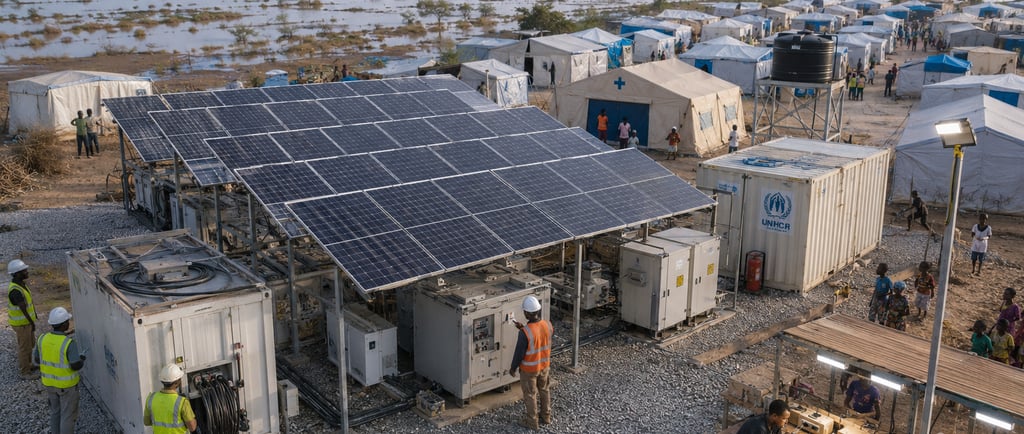
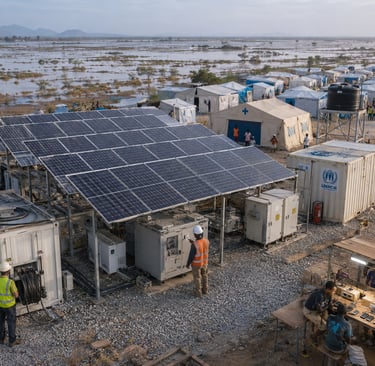
Context: Circular Infrastructure for Climate Migration Camps
Climate-induced displacement remains one of the most pressing humanitarian challenges of our era. According to the UNHCR’s 2023 report, over 100 million individuals are currently displaced worldwide, with climate shocks—droughts, floods, storms—playing an increasingly significant role. For energy planners and humanitarian logistics teams, this surge in displacement means traditional approaches to camp infrastructure are growing obsolete.
The Humanitarian Imperative:
Energy is not just a utility—it is a lifeline. In every climate migration scenario, access to electricity enables vital services: clean water (via pumping), sanitation (waste management), health services (clinics, cold-chain vaccines), communication, and security (lighting for protection). Yet, humanitarian actors find themselves trapped by procurement delays, customs red tape, and stretched global supply chains.
Why Circular Infrastructure Matters:
Circular infrastructure reimagines this paradigm. By deliberately sourcing solar modules, steel, and switchgear from already existing, decommissioned industrial or commercial sites, teams can avoid long waits for new equipment while drastically reducing both cost and carbon emissions. This approach aligns with the UN Sustainable Development Goals (SDGs) for climate action (Goal 13) and responsible consumption and production (Goal 12), signaling to donors and the public that humanitarian energy can—and must—deliver both immediate relief and long-term sustainability.
Leading agencies like the International Committee of the Red Cross (ICRC) and the International Organization for Migration (IOM) have recently piloted circular energy deployments, proving the feasibility of scaling microgrids with circular principles ingrained from day one. These field-tested models now provide blueprints for a new era in camp power infrastructure.
2. Defining the Problem: Resource Scarcity & Rapid Deployment
The traditional, linear method of energy system development—where components are procured new, used, and eventually discarded—creates unsustainable stress on both budgets and the environment. In humanitarian operations, the weakest link is often sourcing and shipping materials, rather than installation itself.
Key Pain Points Include:
Resource Shortages: During global upswings in demand or trade shocks, equipment like steel, inverters, and high-quality solar modules become scarce, occasionally delaying projects by months.
Operational Bottlenecks: Lead times are frequently compounded by customs and cross-border logistics, especially in fragile states.
Rising Costs: Humanitarian OPEX allocations for energy routinely surpass 10%—sometimes exceeding both food and medicine spend in large camps.
Carbon Concerns: Shipping heavy steel and PV equipment across continents contradicts ESG objectives for responsible and low-carbon humanitarian interventions.
The High Stakes of Delay:
Delays in energizing camps have more than a budgetary impact. Without timely electrification, camp residents face:
Unsafe conditions after dark.
Unreliable cold-chain and water supply.
Inability for children to study or communities to communicate.
Lack of economic opportunities for displaced populations.
Circular Infrastructure: A Strategic Opportunity
Estimates suggest recycling decommissioned assets for microgrids can lower procurement costs by up to 50%, with deployment timelines often shrinking from several weeks to just days in urgent scenarios. This is not only about financial and carbon savings—it can be the difference between dignified living conditions and daily survival hardship. And in an era when every humanitarian dollar is scrutinized for impact and ESG alignment, circular infrastructure presents best-practice for responsible, scalable energy in crisis settings.
3. Key Concepts: Circular Infrastructure, Microgrids & Reused Steel
Microgrid
A microgrid is fundamentally a local, self-sufficient energy system capable of providing electricity independently or in concert with the broader grid. In climate migration camps, these microgrids are usually built using solar PV arrays, paired with batteries for storage and sometimes supported by backup generators. They are engineered to serve variable—sometimes rapidly growing—energy loads, ensuring resilience even during grid outages or fuel shortages.
Relevance in Humanitarian Contexts:
Ability to deploy rapidly.
Modular: supporting both small and large-scale settlements.
High degree of energy autonomy—a hedge against unreliable national grids.
Circular Infrastructure
Circular infrastructure intentionally designs systems to keep resources in use as long as possible, extracting maximum value and minimizing waste. In camp power scenarios, circularity means:
Identifying usable legacy assets from commercial, industrial, and utility sectors.
Prioritizing refurbishment over raw manufacturing.
Integrating local recycling and upcycling ecosystems.
Extending the life cycle of energy equipment—critical for ESG reporting.
Decommissioned Assets
Entities such as solar panels, steel support structures, cabling, inverters, battery banks, and switchgear are often left behind when companies upgrade to newer tech or shutter facilities. Instead of heading straight to recycling plants, these assets can be rescued, requalified, and redeployed for life-saving use in crisis zones.
Common Sources:
Closed manufacturing plants.
Upgraded commercial office parks.
Utility-owned solar farms (especially in regions phasing in newer tech).
Telecommunications towers (rich in battery banks and frames).
Reused Steel
Steel production is a major global emitter of carbon. By reclaiming mounting frames and support structures, camp infrastructure teams can:
Cut embodied CO2 by over 80% (according to World Steel Association lifecycle data).
Access “shovel-ready” materials, eliminating the wait and expense of custom fabrication.
Reduce waste, in line with circular economy mandates from donors and regulators.
4. Framework: The Circular Camp Microgrid Model
Delivering a scalable, repeatable methodology is vital for humanitarian energy teams pressed for time and resources. The Circular Camp Microgrid (CCM) framework transforms the asset supply chain—and the impact profile of every camp project.
Circular Camp Microgrid (CCM) Framework
Step 1: Identify Asset Pools
Begin by mapping potential sources of reusable energy assets. Reach out to utility companies, corporations decommissioning renewable plants, and relevant government agencies. More leaders now maintain databases of available assets—some open to humanitarian use under CSR or ESG commitments.
Step 2: Screen for Fit
Evaluate assets for compatibility with your technical, regulatory, and site-specific constraints. For example, ensure solar modules meet local electrical standards and that steel frames conform to structural safety norms.
Step 3: Secure Logistics
Successful field projects hinge on logistical agility. Arrange for careful dismantling, transport, and temporary warehousing. Secure insurance for high-value or fragile components and liaise with local authorities for movement permits.
Step 4: Refurbish
Inspection is paramount. Use thermal imaging and electrical tests for solar modules; non-destructive testing for steel. Clean, repair, and upgrade parts as needed—especially electrical interconnections, which are prone to micro-cracks or corrosion.
Step 5: Microgrid Engineering
Design the system backward from available resources (“reverse engineering”), tailoring the layout and electrical architecture to both the site and the inventory on hand.
Step 6: Build and Deploy
Utilize modular construction techniques wherever possible. Prefabricate subsystems so they can be rapidly slotted together on-site, minimizing skilled labor requirements.
Step 7: Commission and Monitor
After comprehensive quality assurance (QA) testing, train local O&M teams for ongoing operations. Implement real-time or periodic digital monitoring (remote where possible) and document all learnings for transparent donor reporting and future iteration.
5. Step-by-Step Process
A robust yet flexible process underpins all successful circular microgrid deployments. Here’s a proven workflow—each step is driven by traceability and quality standards:
Demand Mapping: Profile critical energy loads: health clinics, communal lighting, water pumps, food storage—and forecast possible surges (e.g., new arrivals, monsoon season).
Asset Scanning: Leverage digital registers and CSR networks to identify candidate asset pools. Use donor consortia to widen access to multi-sectoral asset donors.
Asset Vetting: Request detailed technical specs, insurance/loss records, and up-to-date photographs.
On-Site Evaluation: Where safe, perform in-person inspections. Thermal cameras reveal hidden panel degradation; ultrasonic tools test steel integrity.
Condition Assurance: Use electrical output tests (IV curve tracing for PV), visual inspection, and non-destructive testing on steel.
Performance Adjustment: Assess and plan for asset derating (e.g., older solar panels may operate at only 80% of nameplate output but are still serviceable).
Permits and Approvals: Secure all documentation for removal/transport, including customs waivers and donor compliance checks.
Careful Dismantling: Disassemble assets to avoid new damage; label and document for traceability.
Mobile Refurbishment: Set up a field-friendly workshop equipped with portable tools, test benches, spare connectors, and cleaning solutions.
Targeted Repair: Replace failed modules or corroded bolts; weld or reinforce structural elements as required.
Redesign for Reality: Adapt system design to match available components—think flexibility, not strict adherence to original blueprints.
Minimal Gap Procurement: Source only essential missing items, favoring rapid-delivery or local suppliers.
Custom Fabrication: Commission new parts sparingly—for example, special brackets, couplers, or battery interconnects where legacy elements won’t suffice.
Comprehensive Safety Checks: Test subsystems for electrical (isolation, grounding, insulation) and mechanical (wind/snow load) safety.
Modular Packout: Pack assemblies for easy transport and plug-and-play assembly on-site.
Training & Commissioning: Onboard local staff with hands-on O&M sessions; deliver simplified as-builts and SOPs in relevant languages.
Digital Monitoring: Deploy data loggers if internet is available, or use SMS-based reporting for remote QA.
Transparency & Traceability: Maintain donor-mandated reporting: log every reused component, origin, and refurbishment record for ESG compliance.
Failure Contingencies: If critical component fails, trigger pre-planned response: source alternative asset, escalate donor approval, or pivot build strategy.
Scalability: Embrace iterative expansion—new modules, batteries, or frames integrate seamlessly as additional used assets are found or camp demand grows.
Measurement: Proving That Circular Camp Microgrids Work
A circular camp microgrid cannot be judged only by whether the lights turn on. In a climate migration camp, electricity is tied to safety, health, water access, education, communication, dignity, operating cost, emissions, and donor accountability. Measurement must prove that the system delivers reliable power, lowers dependence on diesel, extends the useful life of decommissioned assets, and improves daily conditions for displaced people.
This matters because the humanitarian energy challenge is expanding while budgets remain under pressure. UNHCR reported that forced displacement remained above 120 million people in 2025, with 122.1 million estimated by the end of April 2025. At the same time, climate shocks continue to multiply humanitarian need. UNHCR-linked reporting in 2025 highlighted that climate-related disasters displaced around 250 million people over the previous decade. For energy planners, this means camp power systems need to be faster, cheaper, cleaner, and easier to expand than traditional diesel-heavy models.
The first measurement layer is service reliability. A circular microgrid must track uptime, outage frequency, outage duration, voltage stability, battery state of charge, inverter performance, and load served by priority category. A clinic refrigerator, a water pump, a women’s safety lighting corridor, and a phone charging hub do not carry the same operational importance. Camp energy teams should measure critical-load availability separately from general-load availability. A camp may have 92% total uptime but still fail if the health post loses cooling during the hottest part of the day.
The second measurement layer is avoided diesel. This is one of the clearest ways to translate circular microgrids into donor language. Diesel generators remain common in humanitarian settings because they are familiar, portable, and fast to procure. They are also expensive to run, exposed to fuel theft, vulnerable to supply disruption, and carbon intensive. In a refugee camp case study from Nyabiheke, Rwanda, researchers found that solar-diesel hybrid mini-grid designs could reduce total costs by up to 32% and emissions by up to 83% compared with diesel-only systems, with payback periods ranging from 0.9 to 6.2 years. That evidence is important because it shows that renewable camp power is not only a sustainability story. It can also be a cost-control strategy.
The third measurement layer is asset circularity. A circular microgrid should report how much of the system came from reused, refurbished, repaired, or locally sourced components. This includes solar modules, steel mounting structures, switchgear, cable trays, junction boxes, battery enclosures, racks, telecom frames, fencing, and auxiliary hardware. The core metrics should include percentage of reused steel by weight, percentage of reused PV capacity by wattage, percentage of refurbished electrical equipment by asset count, estimated years of useful life recovered, kilograms of material diverted from scrap, and avoided embodied carbon.
Steel deserves special attention because it is usually one of the heaviest material streams in a camp microgrid. Worldsteel’s 2026 life cycle inventory work, based on 2024 production data, continues to reinforce the importance of life-cycle accounting and end-of-life steel recovery. Its engineering steel construction profile uses a 95% end-of-life recycling rate in its calculation assumptions, which shows why steel is one of the strongest candidates for circular infrastructure planning. In camp microgrids, reused steel mounting frames and support structures can avoid new fabrication, reduce transport volume, and shorten installation timelines.
The fourth measurement layer is humanitarian outcome. The strongest circular microgrid projects connect energy indicators to human outcomes. These include lighting hours per household, number of vaccine refrigerators powered, liters of water pumped per day, number of children studying after dark, phone charging access per household, number of small businesses connected, reduction in firewood or kerosene use, and number of local operators trained. The Global Platform for Action on Sustainable Energy in Displacement Settings notes that clean energy access supports protection, gender equality, health, water services, sanitation, education, livelihoods, food security, connectivity, and environmental protection. That makes energy a cross-sector intervention, not a standalone utility.
The fifth measurement layer is cost and procurement performance. Circular infrastructure should be judged on landed cost, procurement lead time, refurbishment cost per component, replacement rate after commissioning, spare-parts availability, local labor share, customs clearance time, and total cost of ownership. A reused asset that fails repeatedly is not cheap. A refurbished inverter that arrives without documentation is not ready. A steel frame that needs heavy rework may erase its cost advantage. Measurement protects the model from becoming a feel-good recycling story with weak field performance.
For donor reporting, the most useful measurement package is simple: energy delivered, diesel avoided, money saved, emissions avoided, assets reused, people served, critical services powered, jobs or training created, and failures corrected. This gives donors a clear view of what their funding achieved. It also gives field teams the evidence they need to improve the next deployment.
A circular camp microgrid should therefore be measured across four time windows. The first is pre-deployment, where teams establish baseline energy demand, asset condition, and current diesel use. The second is commissioning, where they confirm safety, output, load balancing, and protective systems. The third is the first 90 days, where early failure patterns appear. The fourth is annual performance, where true cost, reliability, and social value become visible.
By 2026, the best humanitarian microgrid programs should no longer report only installed kilowatts. Installed capacity is useful, but it is incomplete. The real question is whether the system delivered power when people needed it, whether it reduced operating cost, whether it avoided new material extraction, and whether it made the camp safer and more functional.
Quality Assurance: Turning Reused Assets into Safe Field Infrastructure
Quality assurance is the point where circular infrastructure either earns trust or loses it. Reused assets can power clinics, water pumps, schools, security lighting, and emergency communications, but only if they are inspected, documented, tested, and deployed with the same seriousness as new equipment. In humanitarian settings, the margin for error is small. A failed battery bank can shut down a clinic. A weak frame can fail during high wind. A poor connection can cause fire risk. A mislabeled component can slow emergency repair.
The first QA requirement is traceability. Every reused asset should have a record that includes origin, age, prior use, removal date, visual condition, test results, refurbishment actions, derating assumption, installer notes, and warranty status if available. Solar modules should be tagged by serial number where possible. Steel should be tagged by batch or structural set. Batteries should never be accepted without chemistry, age, cycle history if available, state of health, and safety inspection. Switchgear should include manufacturer details, ratings, fault history if known, and inspection results.
The second requirement is technical screening. Solar modules should undergo visual inspection, insulation resistance testing, IV curve testing, electroluminescence testing where possible, and thermal imaging to identify hot spots or cell damage. Older panels may still be valuable if their output is predictable and their degradation is accounted for in system design. The goal is not to pretend reused modules perform like new ones. The goal is to know their real performance before the camp depends on them.
This is especially relevant as global solar deployment matures. The International Energy Agency has warned that solar PV supply chains are concentrated and that recycling can provide environmental, social, and supply security benefits over the long term. IEA PVPS Task 12 also continues to track PV module recycling as a key issue because large volumes of panels will reach end of life in coming years. For humanitarian teams, this creates both a challenge and a supply opportunity. Not every retired panel is fit for reuse, but many early-retired or repowered assets can still serve lower-load, off-grid, or staged systems when properly tested.
The third requirement is structural safety. Reused steel must be checked for corrosion, deformation, cracking, fatigue, missing fasteners, coating damage, and compatibility with the site’s wind, flood, snow, soil, and seismic conditions. Camps are often built in harsh locations: dry plains, flood-prone zones, coastal areas, desert edges, or remote border regions. A steel frame recovered from a temperate commercial rooftop may not be suitable for a cyclone-exposed camp without reinforcement. Non-destructive testing, load checks, and engineer approval should be standard for structural components.
The fourth requirement is electrical protection. Circular microgrids need proper grounding, surge protection, overcurrent protection, isolation, labeling, earthing, residual-current protection where appropriate, safe battery containment, fire separation, and lockout procedures. Reused electrical assets must be treated with caution because prior operating history may be incomplete. Inverters, combiner boxes, charge controllers, and switchgear should be tested before shipment and again after installation.
The fifth requirement is battery governance. Batteries are often the riskiest reused asset class in a camp microgrid. Telecom towers, data centers, warehouses, and commercial buildings can provide second-life batteries, but these assets require strict screening. Lithium-ion batteries need state-of-health testing, thermal risk assessment, battery management system compatibility checks, enclosure review, and emergency procedures. Lead-acid batteries require capacity testing, leak checks, safe handling, and disposal plans. No battery should be accepted because it is available. It should be accepted only because it is safe, documented, and suitable for the load profile.
The sixth requirement is field-readiness testing. Humanitarian infrastructure must survive dust, heat, transport vibration, poor roads, heavy handling, limited spare parts, and variable technical skills on-site. Before deployment, teams should assemble and test as much of the system as possible in a controlled staging area. This includes pre-wired skids, pre-tested distribution boards, labeled cable kits, spare connector sets, and installation manuals with diagrams and photos. The fewer decisions left for a field crew under pressure, the lower the failure risk.
The seventh requirement is post-commissioning review. The first 30 to 90 days should be treated as a controlled observation period. Teams should monitor battery cycling, panel output, inverter alarms, load growth, user behavior, tampering risk, dust accumulation, and any mismatch between design assumptions and real camp use. Camps change quickly. New families arrive. Shops appear. Phone charging demand spikes. Medical needs shift. A circular microgrid must be designed for controlled adaptation.
Quality assurance also protects the reputation of circular humanitarian infrastructure. If a reused system fails, critics may blame circularity itself instead of poor testing, weak documentation, or rushed design. That is why QA must be visible in donor reports, procurement files, and community handover materials. The stronger the QA record, the easier it becomes to convince agencies, governments, insurers, and donors that decommissioned assets can be trusted in high-need environments.
Case Studies: What Existing Humanitarian Energy Projects Teach Us
The strongest evidence for circular camp microgrids comes from existing humanitarian energy projects, even where reused assets were not the main design feature. These projects show that renewable microgrids can improve quality of life, reduce operating costs, create local skills, and support more dignified settlement planning. The next step is to combine those lessons with circular procurement and decommissioned asset pipelines.
Azraq refugee camp in Jordan remains one of the most important examples. In 2017, UNHCR and the IKEA Foundation launched a 2 MW solar PV plant that provided electricity to about 20,000 Syrian refugees living in almost 5,000 shelters. The project made Azraq the first refugee camp powered by renewable energy at that scale. Electricity allowed families to light shelters, charge phones, use fans, and connect refrigerators. It also reduced dependence on expensive grid or diesel-based power models.
Azraq later expanded. By 2018, a 1.5 MW extension brought the solar plant to 3.5 MW, supporting electricity access for a larger share of the camp. IKEA Foundation reported that solar power served at least 40,900 Syrian refugees in up to 10,470 shelters, giving families access to lighting, phone charging, fridges, and fans. UNHCR documentation also noted that the camp’s medium- and low-voltage network connected shelters, businesses, offices, and utilities, making the energy system part of wider camp function rather than a narrow technical project.
The Azraq case matters for circular microgrids because it proves that camp energy projects can be planned as core infrastructure. A circular version of the same model would ask deeper procurement questions. Could mounting steel come from decommissioned industrial sites? Could part of the distribution hardware be refurbished? Could spare structures be designed for later removal and redeployment? Could future repowering create a managed stream of reusable panels for smaller camps, schools, health posts, or border reception centers? Azraq shows the energy model works. Circular procurement can make the next generation cheaper, faster, and less material intensive.
Kakuma and Kalobeyei in Kenya offer a different lesson. These settlements are not short-term emergency sites. They have developed into large, complex communities with households, businesses, education needs, humanitarian operations, and host-community links. UNHCR’s Kenya profile describes Kakuma Refugee Camp and the Kalobeyei Integrated Settlement as major operations in northwest Kenya, while European Commission reporting in late 2025 described the combined area as home to almost 310,000 people. At that size, energy planning starts to resemble municipal infrastructure planning.
A 2024 power-grid mapping study focused on Kakuma and Kalobeyei used high-resolution aerial imagery to identify power poles and line segments across 84 square kilometers. The research reported F1 scores of 0.71 for pole detection and 0.82 for line segmentation, showing that digital mapping can improve energy planning in informal and resource-constrained settlements. This is highly relevant for circular microgrids because reused assets require careful matching between available infrastructure, actual demand, and future expansion zones. You cannot place a reused steel-supported PV field, battery enclosure, and distribution network well if you do not understand the camp’s existing power layout.
Nyabiheke refugee camp in Rwanda provides a strong economic and emissions case. The solar-diesel hybrid mini-grid study found that hybrid systems could reduce total costs by up to 32% and emissions by up to 83% compared with diesel-only supply. This matters because many humanitarian energy decisions are blocked by the assumption that clean power is too slow or too expensive for crisis settings. The study shows that renewable and hybrid systems can win on cost, emissions, and operational resilience when designed around real load profiles.
Rural mini-grid evidence from Kenya and Nigeria adds another layer. A 2024 cohort study of 2,658 household heads and business owners connected to mini-grids found improvements in economic activity, productivity, gender equality, health, and safety. In the Kenyan sample, median income reportedly quadrupled after connection. While refugee camps have different governance and protection conditions than rural commercial mini-grid sites, the implication is clear: electricity changes more than lighting. It can support income generation, safety, education, cold storage, communication, and women’s participation in local economic activity.
These cases point to a practical conclusion. The humanitarian sector already has proof that renewable microgrids can work. It also has growing evidence that mini-grids can improve social and economic outcomes. What is still missing is a repeatable circular asset channel that turns decommissioned solar, steel, batteries, and electrical equipment into tested, insured, documented, field-ready power systems. That is the gap circular camp microgrids can fill.
The Five-Layer Toolkit for Circular Camp Microgrids
A circular camp microgrid needs more than panels, batteries, and steel. It needs a practical toolkit that helps agencies move from idea to safe deployment without losing time in fragmented procurement, unclear quality checks, and disconnected reporting. The strongest model has five layers: asset intelligence, technical requalification, modular engineering, community operations, and impact reporting.
Layer one is asset intelligence. Humanitarian teams need a live inventory of potential decommissioned assets before a crisis peaks. This means building relationships with solar farm operators, utilities, telecom companies, data centers, logistics firms, manufacturers, ports, airports, real estate owners, and government agencies. The asset register should include equipment type, quantity, location, age, condition, owner, removal timeline, technical documentation, estimated remaining life, and whether the asset is available for donation, purchase, or emergency release.
This layer should also track regulatory risks. A solar module suitable for reuse in one country may face certification hurdles in another. A battery bank may be transport-restricted. A steel frame may need local engineering approval. A switchgear cabinet may require replacement parts that are no longer available. Asset intelligence is therefore not a list of “free stuff.” It is a readiness system that separates useful assets from future problems.
Layer two is technical requalification. This is where assets are tested, graded, repaired, and cleared for use. Solar modules should be sorted into grades based on output, visible condition, insulation resistance, and thermal behavior. Steel should be graded by structural suitability. Electrical components should be tested by rating, protection function, condition, and compatibility. Batteries should be screened with the strictest criteria because safety risk is high.
The toolkit should define clear categories. Category A assets are ready for direct reuse after inspection. Category B assets need minor repair or cleaning. Category C assets can be used only in low-criticality applications. Category D assets should be recycled, not reused. This prevents field teams from improvising under pressure and prevents unsafe components from entering life-supporting systems.
Layer three is modular engineering. Circular microgrids work best when designed in repeatable blocks. A 5 kW clinic block, a 10 kW water-pumping block, a 25 kW community-services block, a 50 kW lighting-and-charging block, and a 100 kW expansion block can be adapted using different combinations of reused panels, frames, batteries, and inverters. The point is not to force every camp into the same design. The point is to make each deployment easier to assemble, test, transport, expand, and repair.
Modular design also helps with derating. If reused solar modules perform at 80% to 90% of nameplate capacity, the engineering model can account for it. If reused steel frames come in mixed sizes, the structural layout can use standardized adapter kits. If batteries vary by chemistry, the system can separate storage into compatible banks instead of forcing mismatched components together.
Layer four is community operations. A camp microgrid will fail over time if residents and local operators are excluded. Training should cover safe use, basic troubleshooting, cleaning, reporting faults, load discipline, theft prevention, battery safety, and emergency shutdown. Operators should know which loads are priority loads and which can be curtailed during low-generation periods. Local technicians should be trained to inspect panels, tighten connectors, clean dust, check enclosure ventilation, and report abnormal heat or noise.
This layer also supports dignity and accountability. Residents should know what the system can power, what it cannot power, and how power access decisions are made. Without this, microgrids can create conflict between households, businesses, clinics, schools, and camp offices. Transparent operating rules reduce tension and protect critical services.
Layer five is impact reporting. Donors, agencies, and governments need clear proof that circular microgrids are worth funding. Reporting should include energy delivered, diesel avoided, operating cost savings, emissions avoided, reused material quantities, number of people served, critical services powered, outage performance, training completed, local jobs created, and components repaired or replaced. The reporting system should also identify failures because failures are part of field learning.
By 2026, this fifth layer should include remote monitoring wherever possible. Even low-bandwidth systems can send daily or weekly performance summaries by GSM, SMS, or periodic uploads. AI-assisted forecasting may also become useful for demand planning, fault detection, and battery management, but it should not replace local technical judgment. The most practical systems combine simple dashboards, local inspection routines, and clear escalation rules.
The five-layer toolkit turns circular camp microgrids from an emergency improvisation into a serious infrastructure model. It gives humanitarian teams a way to source faster, test better, install safer, train locally, and report clearly.
Competitive Differentiation: Why Circular Microgrids Can Outperform Traditional Camp Power Models
Circular camp microgrids compete against three familiar alternatives: diesel generators, fully new solar microgrids, and temporary low-power solutions such as lanterns or small solar kits. Each has a role, but each has limits. Diesel is fast but costly and exposed to fuel disruption. New solar is clean but can face long procurement timelines and high upfront cost. Small kits are useful for households but cannot power clinics, water systems, refrigeration, internet hubs, or camp-wide lighting.
Circular microgrids offer a different value proposition. They combine renewable power with reused physical infrastructure, lower material demand, faster sourcing where asset pools already exist, and stronger donor alignment with climate and waste goals. They are not automatically better in every scenario. They become better when asset pipelines, QA, engineering, and local operations are strong.
The first point of differentiation is speed. In crisis response, procurement time can determine whether a camp has safe lighting, working pumps, and functioning clinics in the first weeks. If pre-qualified decommissioned assets are already mapped, tested, and stored regionally, circular microgrids can reduce dependence on long international procurement cycles. This is especially valuable during global supply shocks, port disruptions, conflict-related border closures, or sudden disaster displacement.
The second point is cost control. Decommissioned steel frames, reused mounting systems, second-life enclosures, salvaged cable trays, and refurbished electrical hardware can lower upfront material costs. The exact savings depend on transport, testing, repair, and compliance costs. However, the economic case strengthens when the alternative is diesel dependency. The Nyabiheke study’s finding of up to 32% total cost savings for solar-diesel hybrid mini-grids compared with diesel-only supply shows why renewable displacement of fuel is a major financial lever in camp settings.
The third point is emissions reduction. Diesel reduction cuts operational emissions. Reused steel and reused solar components reduce embodied emissions from new manufacturing. This distinction matters because many humanitarian sustainability plans focus on fuel use but ignore the materials used to build infrastructure. A circular microgrid can report both operational carbon savings and embodied carbon avoidance, giving donors a more complete climate picture.
The fourth point is supply security. The IEA’s 2025 critical minerals outlook noted strong growth in energy mineral demand in 2024, including lithium demand rising by nearly 30%. As electrification expands, competition for minerals, panels, batteries, and grid components will remain intense. Circular use of existing assets can reduce exposure to supply-chain pressure, especially for lower-risk components such as steel, frames, cabinets, and selected PV modules.
The fifth point is donor appeal. Circular microgrids connect humanitarian response with climate action, waste reduction, responsible procurement, and local capacity building. This matters because humanitarian funding is stretched. Projects that deliver multiple outcomes from the same dollar are easier to defend. A circular microgrid can power a clinic, reduce diesel spend, avoid waste, lower emissions, create local technical work, and produce measurable ESG evidence.
The sixth point is exit value. Traditional emergency infrastructure is often abandoned, scrapped, or left unmanaged when camps close or shrink. Circular microgrids should be designed for disassembly, relocation, resale, handover, or integration into host-community infrastructure. This matters because many camps last far longer than expected, while others shift location due to conflict, flooding, politics, or funding cuts. Demountable energy infrastructure preserves future options.
The seventh point is reputational strength. A humanitarian agency that can show where its materials came from, how they were tested, how much diesel they avoided, and how the system will be reused later has a stronger public story than one that simply bought new equipment and shipped it across the world. This does not replace performance. It supports trust when performance is proven.
Still, competitive differentiation depends on discipline. Circular microgrids should not be sold as cheaper by default. They should be presented as smarter when properly governed. The model wins when it uses the right reused assets, rejects unsafe assets, fills gaps with new components where needed, and measures performance honestly. The strongest pitch is not “everything reused.” The strongest pitch is “the safest mix of reused, refurbished, local, and new components for the fastest reliable power at the lowest life-cycle cost.”
Conclusion: Circular Microgrids Are the Next Serious Camp Power Standard
Climate migration is forcing humanitarian infrastructure to change. Camps need power faster. Donors need clearer proof of value. Communities need safer nights, working clinics, reliable water systems, cold storage, communication, and space for livelihoods. At the same time, the world is entering a period where solar assets, steel structures, batteries, telecom equipment, and industrial hardware are being retired, repowered, upgraded, or replaced in growing volumes.
Circular camp microgrids bring these two realities together.
The model is simple in principle but demanding in execution. Find usable decommissioned assets. Test them properly. Refurbish what is safe. Reject what is not. Design modular systems around real camp loads. Train local operators. Monitor performance. Report cost, carbon, reliability, and humanitarian outcomes. Plan for disassembly and redeployment from the beginning.
The evidence base is already strong enough to act. Azraq showed that renewable energy can power refugee shelters and camp services at meaningful scale. Kakuma and Kalobeyei show why large displacement settlements need infrastructure-grade energy planning. Nyabiheke shows that solar-diesel hybrid systems can cut costs and emissions compared with diesel-only supply. Global mini-grid research shows that reliable electricity can improve productivity, safety, health, and income. The next leap is to integrate circular asset recovery into this proven energy direction.
By 2026, the question is no longer whether camp microgrids are technically possible. They are. The better question is whether humanitarian actors can build the procurement, QA, engineering, and reporting systems needed to make circular microgrids dependable at scale.
The answer should be yes.
A circular camp microgrid is not a recycled version of a normal power project. It is a faster, leaner, more accountable way to deliver life-supporting infrastructure in a world where displacement, climate pressure, material scarcity, and donor scrutiny are all rising at once. Done well, it can turn yesterday’s industrial assets into tomorrow’s emergency power backbone, giving displaced communities cleaner energy, safer living conditions, and a more dignified path through crisis.
Connect
Your trusted partner for scrap metal procurement.
CONTACT
About
haroon@tdcventures.com
+1-307-655-7593
© 2025. All rights reserved.
NEWSLETTER