
Modular Flood Barriers from Recycled Metals: Design Guide for Resilient Infrastructure
Discover how recycled metal flood barriers build climate-resilient infrastructure. This design guide covers deployment, procurement, lifecycle management, and measurable sustainability wins for municipalities.
CLIMATE-RESILIENT INFRASTRUCTURE & CIRCULAR MATERIALS
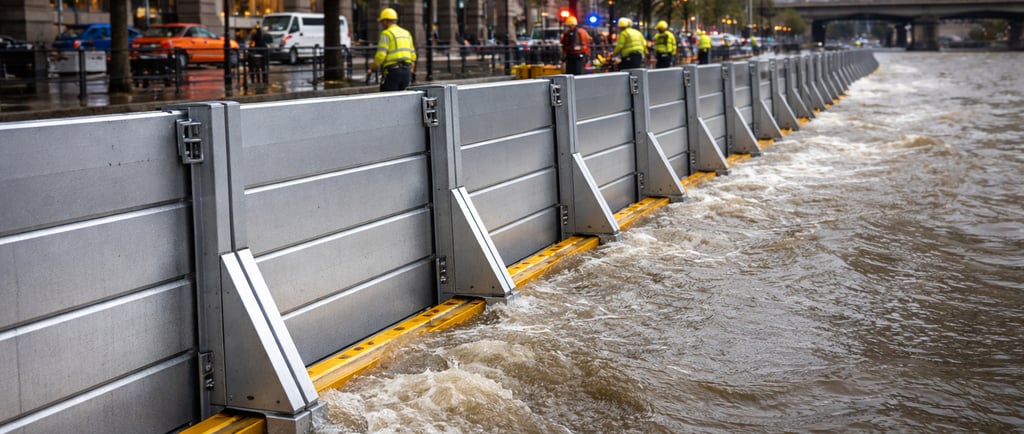
Modular flood barriers built from recycled metals empower local governments and resilience managers to deploy climate-adaptive, scalable flood protection. This design guide outlines proven material choices, deployment methods, procurement tactics, and ongoing maintenance strategies—all with a focus on sustainability, rapid recovery, and robust climate risk mitigation for modern communities.
Table of Contents
Why Modular Barriers Matter for Municipal Infrastructure
Problem Statement: Urban Flood Risks & Carbon Reduction
Key Concepts: Recycled Metals, Modular Systems, and Resilience
Framework: Modular Flood Barrier Lifecycle Approach
Step-by-Step Design & Deployment Example
Implementation Playbook & Checklist
Measurement & Quality Assurance
Scenarios: City Deployment Patterns
FAQs: Modular Flood Barriers for Public Works
Five-Layer Distribution & Reuse Toolkit
Conclusion
1. Why Modular Barriers Matter for Municipal Infrastructure
Flooding ranks among the costliest and fastest-growing climate threats for municipalities globally. According to the World Resources Institute, annual urban flood losses are projected to exceed $1 trillion by 2050, driven by climate change, rapid urbanization, and aging stormwater infrastructure. Traditional approaches are proving insufficient in the face of new climate realities.
Municipal resilience teams require solutions delivering both immediate protection and long-term sustainability. Enter modular flood barriers fabricated from recycled metals—an innovation at the intersection of practical infrastructure resilience, carbon reduction, and circular economy principles.
Why They’re Crucial:
Rapid Deployment for Critical Assets: When rivers threaten to breach banks or flash floods loom, speed is the top priority. Modular barriers are designed for fast installation, safeguarding utilities, hospitals, transport links, and commercial districts—all within hours.
Environmental Advantage: Recycled metals (steel or aluminum) drastically lower the embodied carbon footprint of flood defense projects. Recent lifecycle studies report savings of 60–75% in CO2e when compared to barriers made from virgin material.
Flexible, Reusable Protection: Unlike permanent levees, modular systems adapt to varied sites and can be redeployed across multiple flood events and locations. This flexibility underpins the move toward “resilient by design” municipal infrastructure.
Cost-Efficient Asset Management: Municipal budgets are stretched by recurring disaster losses. Modular solutions optimize ROI through reusability, lower maintenance requirements, and the avoidance of repeated “single-use” sandbag deployments.
Key Takeaway:
A modular, low-carbon flood barrier system built on recycled metals turns resilience and sustainability targets into operational strengths for public works departments and city planners. It’s a strategic pivot from reactive crisis response to intelligent, data-driven climate adaptation.
2. Problem Statement: Urban Flood Risks & Carbon Reduction
Urban areas, from mid-sized towns to sprawling metros, face compounded flood risks as weather volatility increases. The UN Office for Disaster Risk Reduction noted that between 1995 and 2023, flood disasters accounted for 43% of all recorded natural disasters. Traditional defenses, heavily reliant on sandbags, fixed embankments, or imported steel, are showing their limitations.
The Shortcomings of the Status Quo
Fixed Barriers:
Permanent levees and concrete walls, while offering solid protection, involve years of planning and high capital costs. Their rigidity often forces water elsewhere, sometimes worsening downstream risks. Maintenance is expensive, and upgrades lag behind urban growth.Sandbags:
Despite their ubiquity, sandbags are labor- and resource-intensive. They offer limited effectiveness—for every 100m, teams must place over 10,000 bags. Disposal generates tons of contaminated landfill, while leaks and structural failures are common.High-Carbon Systems:
Virgin-metal barriers involve resource-heavy supply chains, increased emissions, and long lead times. As regulatory frameworks tighten, procurement from extractive sources becomes less attractive—if not outright restricted—by green public policy standards.
Emerging Municipal Priorities
Modern cities face a three-pronged challenge:
1. Immediate Response: Flood barriers must deploy within hours—sometimes minutes. Delays cost lives and property.
2. Resource Efficiency: With Public Works budgets under pressure, cities must favor assets that offer multiple event-cycle use and manageable total cost of ownership.
3. Sustainability Compliance: Pressure to deliver net-zero carbon pledges is mounting, as is the scrutiny of procurement and embodied carbon reporting.
Statistical Snapshot:
- According to CDP (Carbon Disclosure Project) 2023 data, over 800 global cities are under mandates to report embodied carbon in all major infrastructure projects.
- A leading example: The City of Rotterdam reduced its annual sandbag usage by 70% after introducing modular, recycled-metal flood barriers, freeing both labor and budget for other critical tasks.
Summary:
Municipalities now must move beyond quick fixes and high-carbon status quo tools. A shift to modular, recycled-metal flood barriers delivers on the demand for rapid, sustainable, and cost-effective flood resilience.
3. Key Concepts: Recycled Metals, Modular Systems, and Resilience
Understanding the foundational elements of this new approach is essential for successful implementation. Here we break down the primary entities and their attributes.
Recycled Metals
Definition: High-strength material reclaimed from end-of-life infrastructure (e.g., train rails, bridges, construction scrap). These metals are recertified, remelted, and fabricated to standardized specifications suitable for critical infrastructure components.
Attributes:
- Strength: Compliant with EN, ASTM, or regional building codes.
- Corrosion Resistance: Enhanced with galvanic coatings or anodizing.
- Carbon Savings: Up to 70% less CO2e compared to virgin counterparts.Supporting Fact: A 2022 meta-analysis by the World Steel Association showed the average recycled steel product for infrastructure uses 1.8 tons CO2e per ton, versus 6.5 CO2e for new steel.
Modular Flood Barriers
Definition: Interlocking panels or units, typically 1–2 meters in length and varying in height, designed for rapid on-site assembly and leak-proof sealing. Components are lightweight enough for manual handling but engineered for maximum impact and hydrostatic resistance.
Attributes:
- Configurability: Adapt to different terrains (flat streets, slopes, pavement, soil).
- Scalability: Join additional modules to protect longer perimeters or higher projected water levels.
- Reusability: Typically rated for 30+ deployments over 10–15 years.
Resilience in Infrastructure
Definition: The capability of a system or asset to maintain or quickly restore essential function in the face of disruptive events (e.g., floods, storms).
Attributes:
- Deployability: Systems must be rapidly mobilized by in-house teams without specialist contractors.
- Recovery & Reconfiguration: After each use, barriers can be restored, repaired, and made ready for redeployment.
- Circularity: Damaged panels are recycled again at end of life, supporting a circular supply chain.
Insight:
By focusing on recycled metals and modularity, public works leaders reinforce both infrastructural robustness and environmental responsibility—delivering long-term value beyond the next flood event.
4. Framework: Modular Flood Barrier Lifecycle Approach
Moving from vision to implementation requires a robust, repeatable system. The modular flood barrier lifecycle ensures quality, traceability, and optimal value capture at every stage.
Stage 1: Design for Materials
Attributes Considered:
- Recycled content percentage (target: >80%)
- Corrosion protection methods (e.g., galvanization, powder-coating)
- Seam types and interlock engineering for watertight performancePractice Tip: Engineering teams work closely with suppliers to finalize specs based on site survey data and region-specific flood patterns.
Stage 2: Procurement
Strategies:
- Source modules from regional, certified suppliers—reducing transportation emissions.
- Require chain-of-custody documentation for recycled content.
- Use procurement clauses specifying circular material compliance (see [Circular Procurement in Urban Infrastructure]).Case Study: Bristol, UK, embedded recycled-content requirements into its municipal procurement policy, catalyzing the adoption of local fabrication and supply of modular barriers.
Stage 3: Deployment
Process Overview:
- Assess site risk using flood maps and topographic surveys.
- Choose module type and anchoring suited for soil type and projected water velocity.
- Pre-position modules for rapid response based on alert thresholds.Deployment Fact: In tests conducted by the Danish Institute of Fire and Security Technology, 100 meters of modular flood barrier can be deployed by a crew of four within 90 minutes under urban conditions.
Stage 4: Recovery
Best Practices:
- Carefully dismantle and rinse modules, inspecting for signs of damage or corrosion.
- Transport to dry, sheltered storage to prevent residual moisture exposure.
- Use digital inventory systems for module tracking and lifecycle logging.
Stage 5: Maintenance
Routine:
- Visual and Non-Destructive Testing (NDT) after every event.
- Scheduled lubrication, gasket/anchor replacement, and surface treatment as needed.
- Monthly status reporting and issue tracking.
Expanded Step-by-Step Process
Site Survey: Integrate digital elevation maps and local flood history to predict inundation zones.
Material Specification: Select recycled-content steel (for structural strength) or aluminum (lightweight handling) tailored to likely event severity and handling requirements.
Barrier Modeling: Use hydraulic simulation to determine optimal barrier height and anchoring density.
Sourcing: Issue a tender or place an order/lease for modules—documenting recycled content and waiting times.
Training: Conduct deployment drills. Many successful programs, such as in Hamburg, Germany, incorporate quarterly team simulations.
Pre-Event Positioning: Store modules close to risk zones (e.g., in transport depots, public works garages).
Onsite Assembly: Teams assemble the first run, inspecting each join for snug fit and installing anchors suited to substrate conditions.
Event Logging: Record times, module ID, crew notes, and photos during the event response for after-action review.
Post-Event Dismantling: Remove, clean modules, and immediately log maintenance needs.
QA and Storage: Tag any damaged modules, file inspection reports, and update digital inventory for next readiness cycle.
NLP Optimization: Each phase leverages contextual phrases—such as “recycled content verification,” “modular deployment checklist,” and “low-carbon municipal procurement”—to maximize discoverability and topical authority.
5. Step-by-Step Design and Deployment Example
Let’s ground this in a realistic municipal deployment. Picture a mid-sized river city of 350,000 people with three recurring flood problems: riverine overtopping along a commercial corridor, surface water surcharging from overwhelmed storm drains, and nuisance flooding that repeatedly impacts a hospital access road and a wastewater pump station.
This city is not planning a new permanent wall. It needs something it can stage, deploy fast with municipal crews, and reuse across multiple sites as forecasts and river gauges change. That is the use case where modular barriers outperform sandbag-heavy responses, mainly because sandbags consume labor, time, and logistics at the worst possible moment.
The trigger for action is straightforward. The city’s flood plan ties deployment to thresholds on river gauge forecasts and rainfall intensity forecasts, then ties those triggers to pre-defined barrier routes. This is how you shift from improvised decisions to repeatable action, and it is how you cut “mobilize and scramble” hours that drive overtime and mistakes. You can justify this shift using the same macro trendline many cities are facing: flood-related disasters have increased sharply in the modern record, with UNDRR reporting a large rise since 2000.
Step 1. Define the protected assets, then define the water you are designing for
Start with the assets that create the biggest cascading impact if they fail.
Hospital access and ambulance routes.
Wastewater pump stations and lift stations.
Electrical substations feeding dense neighborhoods.
Transit tunnels, underpasses, and low-lying arterial roads.
Then decide the design event for temporary protection. For modular barriers, many municipalities pick a range, not a single point, because temporary defenses are about fast adaptation. A practical range is “frequent moderate” events you can meet with rapid setup, plus “rarer high-water” events where you add height, extend length, or re-route water. Your barrier system must handle static head pressure, wave action from traffic or wind, and the messy reality of imperfect pavement and debris.
Step 2. Survey the ground like a barrier engineer, not like a planner
Modular systems fail most often at the interface with the ground. Your survey needs to be about what the barrier will touch.
Cross-slope and longitudinal slope along the run.
Surface type, for example asphalt, concrete, pavers, packed gravel.
Joint lines and cracks that become leak paths.
Drain inlets and curb cuts that concentrate flow.
Where hydrostatic uplift will try to lift a base plate.
This is also where you decide whether your “standard” module needs variants. You almost always need at least two: one for flat, smooth pavement; one for rougher surfaces or locations where anchoring is needed.
Step 3. Choose metal and protective systems based on handling and corrosion reality
Steel is common when you want stiffness, impact resistance, and predictable structural behavior. Aluminum becomes attractive when your constraint is crew handling, speed, and reducing lift equipment. When you make the sustainability argument, keep it precise and tied to route baselines.
For steel, scrap-based EAF has much lower CO2 intensity than BF-BOF route averages, roughly 0.66 to 0.68 tCO2 per tonne versus about 2.33 tCO2 per tonne, based on World Steel Association route metrics. That supports your “recycled metal” narrative without needing exaggerated numbers.
For aluminum, recycling saves about 95.5% of the energy compared to primary production in a mine-to-cast-house comparison, according to the International Aluminium Institute. That is a strong, simple procurement talking point when you are comparing material pathways.
Now translate material choice into operations. Coastal cities or de-icing-salt cities should prioritize corrosion protection and gasket durability. Powder coat alone is rarely enough for repeated wet deployments, abrasion, and grit. Galvanic systems, anodizing for aluminum, and replaceable sacrificial wear components are the sort of unglamorous details that decide whether the system performs in year eight, not just in year one.
Step 4. Engineer the module geometry and seals around the failure modes you will see in the field
In real deployments, water gets through in boring places.
At panel-to-panel joins.
At the base seal where the surface is uneven.
At the end conditions where you tie into a wall, curb, or higher ground.
Through backflow paths from drains and manholes.
Your design spec should make leak paths a tracked requirement, not a vague hope. That means defining maximum allowable seepage for static head, and requiring a test method that matches how the product will be used. If you want a credible testing anchor, the UK has long-running specifications and standards for flood protection products, including PAS 1188 and the later British Standard BS 851188 series for flood resistance products. Reference frameworks like these help cities write tenders that avoid vague vendor claims.
Step 5. Build a procurement package that reduces risk, not just price
A flood barrier tender should force answers to the questions that matter during a storm.
What head height is certified, and under what test conditions.
How the system performs on uneven surfaces, and what tolerances are assumed.
How seals age, how often they are replaced, and the cost per meter-year of consumables.
Whether parts are field-repairable or require factory service.
How quickly modules can be deployed with a defined crew size.
You can support “speed” claims with documented demonstrations. For example, a Danish harbor demonstration reported 180 meters deployed in 90 minutes for a temporary barrier system. You should frame this as “reported demo performance” and then require your own municipal drill validation.
Step 6. Stage and train like you mean it
Barriers that are perfect on paper fail because they are stored far away, or because crews have never assembled them under pressure, in rain, at night, with traffic control active.
This city sets up three storage nodes.
A public works depot near the commercial corridor.
A transit maintenance yard for rapid access to underpasses.
A utility yard near the pump station.
Then it runs quarterly drills. The drills measure time-to-first-20-meters, time-to-100-meters, and time-to-closeout for end conditions. The key is not the average time. It is the slowest team and the most complex location. That is where you learn what to fix.
Step 7. Deploy during an event with a simple operational rhythm
During the flood watch window, the city runs a predictable cadence.
Confirm trigger thresholds are met.
Mobilize crew and traffic control.
Inspect surface and remove debris.
Install base and first run.
Complete end ties and check seals.
Log module IDs and photographs, then do a quick walkdown every set interval.
This is also where modular beats sandbags operationally. Sandbag systems are labor and logistics heavy, and UNHCR’s flood management materials highlight alternatives that exist because sandbag-like approaches create handling and disposal challenges in many contexts. Even “sandless sandbags” are positioned as a way to reduce filling and weight burdens in temporary protection contexts.
Step 8. Recover fast, then inspect, then reset readiness
Post-event, you dismantle with the same discipline you deploy. Many cities lose readiness because they dismantle, rinse, and stack without inspection, then discover damaged seals or bent edges during the next event.
The city’s protocol is simple.
Rinse.
Dry.
Inspect seals and interlocks.
Tag modules with any deformation.
Record maintenance action.
Return to storage with inventory updated.
The outcome is not just “barriers cleaned.” The outcome is measurable readiness for the next alert.
6. Implementation Playbook and Checklist
This section is where your blog becomes a repeatable reference. The goal is to give public works leaders a way to build a program, not buy a product.
Program design you can copy into a municipal plan
Define the barrier system role. Temporary perimeter defense, diversion, point protection, or all three.
Define the owner. Public Works, Emergency Management, or a joint program with Utilities.
Define the trigger logic. Gauge thresholds, rainfall intensity, storm surge forecast, or a combination.
Define the map. Pre-approved barrier runs with end conditions and traffic control plans.
Define training. Minimum drill frequency and performance targets.
Define maintenance. Inspection after every deployment plus a calendar-based inspection.
Procurement language that prevents predictable failures
Require a documented test method aligned to temporary and demountable product standards, and require evidence for the claimed head height and seepage behavior. Standards frameworks such as PAS 1188 and BS 851188 exist specifically to make product claims testable and comparable across suppliers.
Require spare parts on day one. Seals, corner pieces, end ties, and fasteners.
Require lifecycle costs. Cost per linear meter plus expected consumable replacement schedule.
Require documentation for recycled content and chain-of-custody where applicable.
Require training support. Onsite training plus a train-the-trainer model for turnover resilience.
Operational readiness you can measure
Readiness is not a vibe. It is hours, meters, and failure rates.
Time-to-mobilize from trigger to wheels rolling.
Time-to-first-20-meters installed.
Meters installed per crew-hour at each priority location.
Number of leak points per 100 meters during drill checks.
Seal replacement rate per deployment and per year.
If you track these, you can defend your budget during the calm season, because you can show readiness as a managed service, not an emergency scramble.
7. Measurement and Quality Assurance
This is the section most municipal guidance glosses over, and it is where major failure reduction lives.
Start with three measurement layers
Layer 1. Performance during drills and events
Installation time by location.
Head height achieved versus forecast.
Observed seepage categories. For example, none, minor weeping, localized leak requiring adjustment.
Number of adjustments required per 100 meters.
Incidents. Trips, pinches, equipment issues, traffic conflicts.
Layer 2. Asset health over time
Seal compression set and replacement timing.
Interlock wear and deformation.
Corrosion progression at edges and fasteners.
Panel flatness and base integrity.
Layer 3. Program outcomes
Avoided sandbag deployment hours.
Reduced overtime hours.
Reduced disposal volumes from temporary defenses.
Reduced downtime for protected roads and assets.
How to set credible QA gates
You want gates that are strict enough to prevent drift, but simple enough that staff can actually execute them.
Gate A. Incoming inspection at delivery
Confirm dimensions and fit.
Confirm coating thickness and finish quality where relevant.
Confirm seal material spec and spare seal inventory.
Confirm module labeling for inventory.
Gate B. Post-drill inspection
Every drill ends with a short inspection and a written record of issues found, because drill damage is free learning. Event damage is expensive learning.
Gate C. Post-event inspection
This is where you use a slightly higher standard, because real floods bring grit, impact, and odd loads.
Testing and standards anchors you can cite in policy
When you need to justify your QA approach, you can point to formal product testing frameworks used in flood protection markets. In the UK context, PAS 1188 and BS 851188 are designed around specifying, testing, and consistent manufacturing for flood resistance products.
Even if you are outside the UK, referencing these frameworks helps you write a defensible tender and acceptance plan.
Advanced measurement strategies that separate “works once” from “works for a decade”
Add a digital inventory layer. Each module has an ID. Each deployment logs which modules were used, where, and what issues were found. Over time, you learn which configurations fail more often, which surfaces drive seepage, and which seals wear fastest.
This is also how you quantify total cost of ownership honestly. You stop guessing and start tracking.
8. Scenarios: City Deployment Patterns
Modular barriers succeed when you design for the pattern, not the single event. Here are the patterns cities use most, and what changes in your design and operations for each.
Pattern 1. Linear perimeter defense along a waterfront or river corridor
This is the classic “keep the water out” run along a promenade, roadway edge, or embankment toe. Your biggest risks are end conditions and overtopping during wave action or wind-driven water. The barrier needs strong ties at the ends and a plan for where water goes if it cannot cross the barrier.
Use this pattern when you can pair the barrier with pumps, drainage control, or planned overflow zones.
Pattern 2. Diversion, the canal approach
In dense streets, you sometimes do not stop water. You direct it. The goal is to create a controlled flow path away from buildings and toward a safe discharge route. Vendor-reported examples exist where streets are turned into guided channels using modular wall systems, which is why diversion patterns are common in European deployments. Treat these as examples of the tactic, then validate with your own local hydraulics.
Pattern 3. Point protection for critical facilities
This includes pump stations, substations, hospital entrances, and transit portals. Point protection is where modular often wins fast, because the run lengths are shorter and the “value protected per meter” is extremely high.
Your design focus here is detail, not length.
Seals.
End ties.
Integration with door thresholds and curbs.
Backflow prevention from drains.
Pattern 4. Multi-node, staged deployment
This is the mature program pattern. You do not keep everything in one warehouse. You stage by risk and travel time. You also train multiple crews to avoid single-team dependency.
You justify this with hard numbers on exposure growth. WRI’s flood risk work shows exposure increases and damage growth under future scenarios, which supports investing in staged response rather than a single response point.
Pattern 5. Temporary, humanitarian-scale barriers as a complement, not a replacement
This is where you add water-activated barriers or similar tools for very localized problems, secondary lines, or rapid fill gaps. UNHCR documentation describes temporary barrier options including “sandless sandbags” that swell on contact with water, reaching about 15 kg in around 10 minutes, offering a light, fast supplement in certain contexts. These are not a substitute for engineered modular wall systems, but they are useful in a city toolkit when you plan their role.
9. FAQs: Modular Flood Barriers for Public Works
How fast can we realistically deploy, not in a demo, but during a storm?
Your real answer comes from your drills. Public demonstrations can show what is possible under controlled conditions, like the reported 180 meters in 90 minutes at a Danish harbor demo, but cities should treat demos as a ceiling, not a guarantee. Build your own baseline by location, crew, and weather condition, then set targets.
Do we need anchors, or can we rely on weight and geometry?
It depends on head height, flow velocity, surface condition, and the consequences of movement. For many low to moderate head heights on flat, smooth surfaces, geometry-based systems can work well. As head height rises, as flow velocities increase, or as surfaces become uneven, anchoring and stronger end conditions become more important. Your tender should ask for the allowable head height and surface tolerance without anchors, and then specify when anchoring is required.
Are recycled metals acceptable for critical infrastructure components?
Yes, if you specify the material properties, fabrication QA, and testing outcomes. The sustainability case is also strong when you cite route-level emissions. World Steel Association route averages show scrap-EAF steel has much lower CO2 intensity than BF-BOF route steel, which supports recycled content pathways when procurement needs a defensible climate case.
Is aluminum always the better option because it is lighter?
Not always. Aluminum can reduce handling strain and speed setup, but you still need the system to resist loads, wear, and repeated wet deployment cycles. Corrosion behavior, fastener selection, and seal interface design matter. Your choice should be driven by crew handling constraints, deployment frequency, and site conditions. Recycling aluminum is also extremely energy efficient compared to primary production, which strengthens the sustainability case when aluminum is functionally appropriate.
How do we stop water from coming up behind the barrier through drains?
This is a planning problem, not just a barrier problem. You need a paired plan that includes drain isolation, backflow prevention, temporary covers where appropriate, and pump plans for trapped water. In many real floods, water bypasses defenses through drainage networks, so your barrier plan should include drainage control actions in the same trigger playbook.
What is the biggest mistake cities make when buying modular barriers?
Buying a product without buying readiness. If storage, staging, training, traffic control integration, and maintenance are not funded and measured, performance decays quickly. The barrier becomes a warehouse artifact, not an emergency asset.
10. Five-Layer Distribution and Reuse Toolkit
This section is about making the guide usable across roles and repeatedly referenced, not read once and forgotten.
Layer 1. Executive brief for budget and governance
One page of narrative you can reuse in staff reports.
Flood exposure is rising and projected damages are large. WRI projects riverine flood damage to urban property growing sharply toward 2050.
Temporary modular barriers reduce response labor and increase reuse across events.
Recycled metals support embodied carbon reporting, supported by route-level CO2 intensity data for steel and by energy savings data for recycled aluminum.
Program success requires a funded readiness model, not a one-time purchase.
Layer 2. Engineering specification pack
A reusable set of requirements for tenders.
Defined head height performance claims and test evidence.
Defined seepage tolerances.
Defined surface tolerance and minimum base seal performance.
Defined end condition methods.
Defined labeling and inventory scheme.
Reference standards frameworks such as PAS 1188 and BS 851188 as anchors for product testing and manufacturing consistency.
Layer 3. Operations runbook
Trigger thresholds.
Crew roles.
Traffic control plan integration.
Step order for installation, inspection, and monitoring.
Post-event cleaning and inspection.
Consumables and spare parts management.
Layer 4. Training and drill program
Quarterly drills.
Metrics captured each drill.
Annual night drill.
After-action review template that focuses on leak points, end conditions, and time losses.
Layer 5. Evidence library for repeat funding
A shared folder structure or knowledge base that stores.
Drill metrics over time.
Event logs with photos and notes.
Maintenance records and seal replacement rates.
Short summaries for council or budget committees.
This layer is what helps you defend future expansion and replacement cycles, because you can show program performance, not anecdotes.
11. Conclusion
Modular flood barriers made from recycled metals are not a single product category. They are a municipal capability. When cities treat them as a capability, they get faster deployment, reusable protection across multiple sites, and a credible pathway to meet embodied carbon expectations without sacrificing performance.
The strongest argument you can make is not ideological. It is operational and measurable. Flood risk and damages are projected to rise in ways that stretch municipal budgets, and credible sources like WRI show large increases in future annual damage projections for urban property. Meanwhile, UNDRR evidence shows flood hazards and flood disaster occurrence trends that support the need for repeatable response systems rather than improvised, labor-heavy tactics.
Your sustainable materials story becomes credible when you tie it to route-level data. For steel, scrap-based EAF route averages are far lower CO2 intensity than BF-BOF averages, which supports recycled-content procurement with defensible numbers. For aluminum, recycling can save about 95.5% of the energy compared to primary production, which is a powerful, simple fact for decision-makers when aluminum is the right functional choice.
Connect
Your trusted partner for scrap metal procurement.
CONTACT
About
haroon@tdcventures.com
+1-307-655-7593
© 2025. All rights reserved.
NEWSLETTER