
Off-Grid Water Systems: Metal Components and Recovery
Discover how recycled steel and aluminum are building climate-resilient, off-grid water systems. A guide to circular materials, rapid recovery, and low-carbon infrastructure for NGOs and rural utilities.
CLIMATE-RESILIENT INFRASTRUCTURE & CIRCULAR MATERIALS
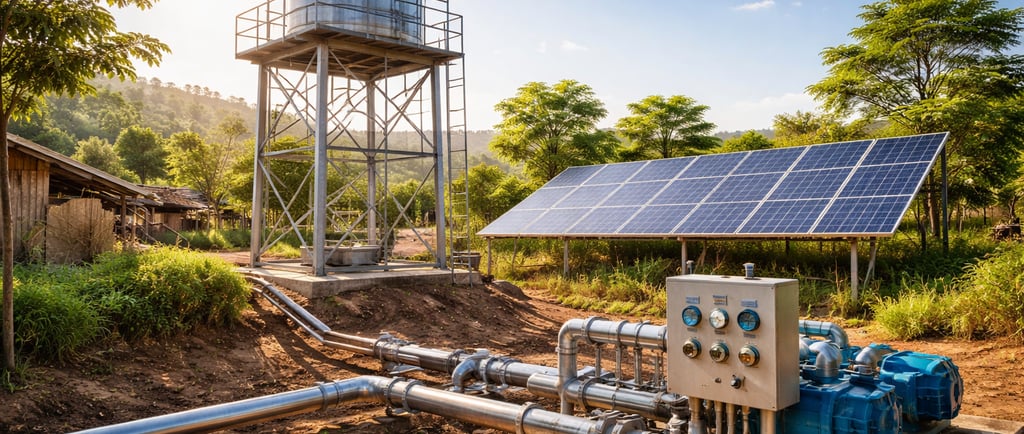
Off-Grid Water Systems: Metal Components and Recovery for Climate-Resilient Infrastructure
Water infrastructure can no longer rely on “business as usual.” Extreme weather, resource scarcity, and rising material costs have intensified the need for off-grid water systems that can withstand disruption—while maintaining low carbon profiles and supporting true circularity. In this guide, we unlock how recycled metal components and planned recovery drive the next generation of resilient, climate-adapted water supply for rural utilities, NGOs, and rapid-response teams.
1. Why Resilient, Low-Carbon Water Systems Matter
Access to reliable, safe water is essential year-round—especially during emergency situations caused by climate shocks, system failures, or supply chain disruptions. According to the World Health Organization, over 2 billion people rely on water systems exposed to climate change risks, including floods, storms, and droughts. In 2022 alone, disaster events disrupted potable water for millions across Africa and Asia, underscoring the urgent demand for adaptable systems (source).
For NGOs, disaster relief coordinators, rural utilities, and community leaders, climate-resilient, off-grid water systems represent both a lifeline and a leap forward—delivering service continuity, cost savings, and reduced environmental impact.
The Challenge:
Most off-grid water setups still depend on conventional components with limited durability and complex maintenance needs. When systems fail, lack of standardized, recovery-ready parts leads to prolonged outages, greater waste, and higher lifetime costs. The carbon footprint also remains high due to virgin material use and limited recycling at end-of-life.
The Solution:
Incorporating recycled metals like steel and aluminum delivers a triple win: robust resilience against environment stress, support for rapid recovery, and a clear pathway for circular, low-carbon operations. Circular planning ensures that when systems or components reach end-of-life, their materials aren’t simply discarded—they’re recovered, recycled, and reintegrated into new supply chains.
Key Impacts for Rural and Off-Grid Water Stakeholders:
Service Continuity: Faster restoration of critical water access post-disaster
Sustainability: Dramatic cuts in greenhouse gas emissions and resource extraction
Affordability: Reduced operating and procurement costs via longer component life and material recovery
Future-Proofing: Flexibility to adapt to changing climate risk profiles
Industry Insight:
A McKinsey report estimates that circular metal use in infrastructure could yield a 26% reduction in sector-wide emissions by 2030 (source), positioning recycled metal strategies as foundational for climate action.
2. Key Concepts in Metal Use and Recovery
The path to building resilience starts with a nuanced understanding of how metals reinforce off-grid water systems and enable continuous, circular use. Here’s a breakdown of critical concepts and terminology:
Resilience (Main Entity):
Refers to the infrastructure's capacity to withstand, absorb, and recover quickly after shocks or chronic stresses. For off-grid water applications, this means robust designs that maintain flow, restore quickly after damage, and minimize downtime during crises.
Recycled Metals:
Metals like aluminum, steel, and copper that have been recovered, processed, and certified for reuse. These retain original material properties such as tensile strength, pressure resistance, and corrosion mitigation—while offering up to 95% lower embodied carbon compared to virgin equivalents (World Steel Association, 2023).
Circular Materials:
Components are intentionally designed for multi-life reuse cycles. All parts—from tanks to pipe joints—can be recovered, repurposed, or recycled, closing the loop and minimizing landfill waste.
Low Carbon Operation:
Reduced greenhouse emissions are achieved by using recycled over virgin metals, implementing local sourcing to lower transport emissions, and deploying modular, repair-friendly system layouts.
Recovery:
Encompasses both operational (restoring system function after damage) and circular (harvesting, sorting, and repurposing components at end-of-life) actions. Effective recovery includes tagging, inventorying, and tracking all significant metal elements to maximize their post-service value.
Additional Key Entities & Attributes
NGOs & Utilities: Primary system owners/maintainers influencing procurement and maintenance standards.
Certified Recyclers: Partners ensuring true circularity and compliance with material standards.
Spare Parts Kits: Pre-positioned, standardized libraries of likely-to-fail components enabling rapid repairs.
Asset Tracking: Digital or physical tagging (QR, RFID, stamped IDs) for lifecycle management.
Corrosion Mitigation: Coatings, alloys, and system designs that limit degradation in harsh climates.
Case in Point:
In East Africa, a regional utility employs recycled steel for rural pump infrastructure, achieving both compliance with NGO procurement guidelines and slashing system failure rates by 38% after switching from plastic-based connectors.
3. The Resilience and Recovery Framework
True resilience emerges from synergy between robust system design, active lifecycle management, and operational excellence. Below is a comprehensive framework tailored for off-grid and rural water infrastructure:
Layer 1: Durable Design
Employ recycled metals (steel/aluminum) in all load-bearing and stress-prone structures: tank shells, support frames, above-ground pipes, joint brackets, and pressure-resistant valves.
Engineer for “modular swap”: All core parts (connectors, tanks, panels) are easy to remove and reinstall, demanding only universally available tools.
Select alloys and coatings based on site-specific risks (corrosion, seismic activity, UV exposure).
Layer 2: Circular Lifecycle Management
All metal components receive asset tags or machine-readable codes at installation, linking to a digital registry or physical logbook.
Spare parts kits are calibrated based on local failure data and stored on site or with trusted operators.
End-of-life planning is hard-wired: every system deploys with a documented flow for disassembly, component aggregation, and regional material recovery.
Layer 3: Response-Ready Operations
Field teams receive hands-on training in system mapping, rapid assessment, modular component swap, materials recovery (including hazardous environment procedures), and accurate documentation.
Standard Operating Procedures (SOPs) govern every major activity—from baseline inspection to post-storm rapid response.
Step-by-Step Field Protocols:
Map essential water access points and their criticality rankings (household, health center, livestock, etc.).
Determine system design: gravity-fed (passive, no energy input), solar direct-pump (renewable, high resilience), or manual pumps.
Source recycled, certified metals for all major assemblies via vetted, local suppliers.
Adopt a site-wide standard for fittings, pipe sizes, and connectors to minimize incompatibility delays.
Apply durable tagging (physical or digital) for total traceability.
Prepare and periodically review a spares kit targeting the top 10 failure-prone points.
Log all procedures and recovery events for both learning and audit purposes.
Run regular modular swap drills—at least quarterly—for all field teams.
At damage or decommissioning, systematically recover all tagged metals, aggregating them for reuse, resale, or recycling with authorized partners.
Value Spotlight:
A 2021 field review in Bangladesh found that tagged, standardized steel parts cut rural water outage times from 11 days to less than 60 hours post-flooding—an 80% improvement in service continuity.
4. Step-by-Step Example: Rural Off-Grid System
Let’s break down a full system lifecycle scenario in a rural context, integrating resilience, recovery, and circular design:
Scenario: Resilient Water System in a Remote Village
System Overview:
3,000L recycled steel gravity tank on a welded tower.
Main distribution: aluminum piping; High-Density Polyethylene (HDPE) for lower pressure sections.
Standardized connectors and valves (recycled steel) at all taps.
Tagged components catalogued in village records.
Spare connectors, joints, and mounting plates kept in a secure but accessible depot.
Event:
A severe storm ruptures a primary connector and damages a section of mainline piping.
Rapid Recovery Process:
Field technician conducts a post-event survey, identifies the failed connector through its tag, and checks spares inventory.
Damaged steel connector is swapped out in under 30 minutes using only an adjustable wrench and screwdrivers—no advanced tools.
Disconnected damaged component is logged, barcoded, and stored temporarily for recycling.
Monthly, all retired/traded-out parts are collected and sold to a regional recycling cooperative.
System is back to full capacity within hours—not days—restoring service to 200+ households.
End-of-Life Circularity:
After 10 years, as the system is replaced or upgraded, every tagged steel or aluminum part is documented, disassembled, and aggregated. Local welding shops purchase these as raw material for solar racks and fencing, creating local value streams and offsetting costs for future infrastructure projects.
Quantified Impact:
Recovery turnaround (post-damage): <6 hours
System uptime: >98% annually
End-of-life metal recovery: >90% yield
Carbon emissions saved (vs. virgin materials): 2.8 tons CO₂e per system, per year
Key Learning:
Field teams using this workflow reported a 50% decline in average repair costs and nearly zero unplanned downtime across five years of operation.
Section 5. The metal components that decide whether an off-grid water system survives disruption
When people talk about off-grid water systems, they often jump straight to the obvious parts: the borehole, the solar array, the storage tank, the pump. In practice, system failure is often driven by smaller metal elements that sit at the junction between structure, pressure, flow, and maintenance. These are the parts that take repeated stress, vibration, corrosion exposure, tool contact, and emergency repairs. If those elements are poorly specified, the whole system becomes harder to maintain, slower to restore, and more expensive to keep running.
Start with the structural backbone. That includes tower frames, tank stands, anchor bolts, cross-bracing, base plates, ladders, handrails, and mounting racks for solar modules and controls. These are not glamorous parts, but in flood, wind, heat, and transport-heavy field conditions they carry the mechanical risk. Recycled steel is often the most practical choice for these assemblies because it combines high strength, mature fabrication capacity, and an established recovery market. Globally, steel remains the most recycled material in the world, and worldsteel estimates that around 680 million tonnes of steel were recycled in 2021, avoiding more than 1 billion tonnes of CO2 that would otherwise have come from virgin production. That matters because resilience projects are increasingly being asked not only whether they work, but whether they can prove a lower-carbon material pathway.
Then come the hydraulic metal components. These include valve bodies, pump casings, strainers, couplings, clamps, flanges, threaded adapters, meter housings, hose tails, metal manifolds, level-sensor housings, and pressure control assemblies. These parts are constantly exposed to water chemistry, temperature swings, and maintenance handling. In remote systems, they should be chosen less like consumer hardware and more like mission-critical field gear. That means standard sizes, repeatable threads, clear markings, and materials that local technicians can identify, replace, and salvage without guesswork. If a part cannot be matched easily in the field, it becomes a downtime risk. EPA guidance for small water systems makes this point indirectly but clearly: asset management starts with a thorough inventory, prioritization of critical assets, and planned reserves for rehabilitation and replacement. In other words, the physical component list is not paperwork. It is part of system reliability.
The third category is what can be called the serviceability layer. This includes access covers, lockable enclosures, instrument brackets, panel hinges, cable trays, fasteners, nameplates, grounding lugs, pump lifting points, and modular mounting rails. These parts rarely headline a procurement document, yet they often decide whether maintenance takes 20 minutes or two days. In an emergency context, a technician should be able to isolate a line, remove a valve, replace a bracket, or lift a pump without cutting, grinding, or improvising around proprietary fittings. Good metal specification reduces repair complexity. It also improves recovery at end of life because assemblies can be removed cleanly instead of being destroyed during disassembly.
This is where many projects still underperform. They choose durable headline materials, then undermine the design with mixed fasteners, odd connector standards, poor coating choices, or inaccessible brackets. The result is a system that looks resilient on day one but becomes fragile in year three. If you want an off-grid water scheme to hold its value, the metal strategy has to reach all the way down to the smallest repeat-failure items.
Section 6. Material selection by climate, water chemistry, and exposure risk
There is no single “best metal” for off-grid water systems. There is only the right metal for a specific exposure profile, maintenance reality, and budget. A rural inland gravity-fed scheme, a cyclone-prone coastal clinic, a brackish-water emergency system, and a drought-stressed solar borehole should not be specified the same way. Material choice should follow environment first, then duty cycle, then recoverability.
For many water handling applications, standard austenitic stainless steels are capable of meeting most corrosion conditions encountered in treatment and water handling equipment. Where higher strength is needed, duplex stainless may be suitable, and where corrosion conditions are more severe, more highly alloyed stainless grades may be justified. That is not a niche point. It is a design rule. The wrong alloy in the wrong water environment does not merely age faster. It can fail in localized, hard-to-predict ways that are expensive to inspect and difficult to repair.
The biggest mistake is treating “water exposure” as one condition. It is not. Fresh water, hard groundwater, chlorinated water, brackish water, coastal spray, stagnant zones, sediment-heavy flow, and high-temperature service all behave differently. Guidance from the Nickel Institute shows that stainless steel performance in water is strongly shaped by oxygen, chloride concentration, conductivity, crevices, sediment, scales, biological activity, chlorination practice, surface condition, pH, and temperature. It also warns that water itself is not the only issue; localized corrosion mechanisms such as galvanic and crevice corrosion are often the real problem. In plain terms, two metals that look acceptable on paper can still create avoidable corrosion if they are paired badly in a conductive water environment.
That matters especially in coastal and brackish settings. Chlorides are a serious design issue for towers, fasteners, pump housings, brackets, and exposed connectors. A low-cost connector choice that is acceptable inland can become a recurring failure point near the sea. If your system sits in a salt-laden atmosphere, near estuaries, or in areas with cyclic wetting and drying, corrosion resistance needs to be treated as a primary resilience variable, not a maintenance afterthought. This is also why “mixed-metal convenience” can be dangerous. Combining stainless, carbon steel, aluminum, and copper alloys without thinking through conductivity and moisture exposure can create galvanic cells that eat away at the less noble metal over time.
Recycled aluminum has an important place in off-grid water infrastructure, especially where weight, transport, and handling matter. It works well for solar mounting structures, equipment housings, lightweight access assemblies, and some above-ground supports when the design is done carefully. Its circularity case is strong. The International Aluminium Institute reports that recycled aluminium requires only 8.3 gigajoules per tonne versus 186 gigajoules per tonne for primary production, a 95.5 percent energy saving. For projects under grant scrutiny or carbon reporting pressure, that is a powerful advantage. But aluminum still needs disciplined detailing. Contact points, fasteners, coatings, drainage paths, and dissimilar-metal interfaces must be handled properly, especially in wet or saline service.
In practical specification terms, the decision logic should look like this. Use steel where you need strength, local fabrication, and strong resale or recovery pathways. Use stainless where corrosion risk and hygiene performance justify the upgrade. Use aluminum where light weight, modularity, and lower embodied energy create a clear field advantage. Then make sure every choice is documented with the exposure condition it is designed for. A material that is “good enough” in theory but wrong for the site is not a saving. It is deferred failure.
Section 7. Recovery planning and circular procurement should be designed in at the start
Most infrastructure teams still treat recovery as an end-of-life issue. In off-grid water systems, that is too late. If you want true circular performance, recovery must begin at procurement. The moment you buy a tank, valve, support frame, or pump skid, you should already know four things: what material it contains, how it is joined, how it will be removed, and where it can go after service. If you do not know those answers at purchase stage, your future “recovery plan” is usually just disposal with better language.
Circular procurement is not simply buying recycled content. It is buying recoverable value. That means preferring mechanical fixings where possible over destructive joins, standardizing dimensions across schemes, avoiding needless part proliferation, keeping material certificates where feasible, and requiring suppliers to provide component-level breakdowns for major assemblies. In the built environment more broadly, design-for-disassembly principles exist for exactly this reason. Structures and products that are easy to maintain, adapt, and disassemble preserve more value and generate less waste. Those principles transfer directly to off-grid water systems. A tank stand that can be unbolted, inspected, re-coated, moved, and reinstalled is a more resilient asset than one that must be cut apart to be replaced.
The circular case is not only environmental. It is financial and operational. The World Bank’s circular water work notes that linear systems undervalue resources, tolerate avoidable losses, and often let 25 to 50 percent of water disappear as non-revenue water in many utilities. While that figure is drawn from utility contexts, the lesson applies to off-grid systems too: leakage, waste, poor asset tracking, and end-of-life neglect are all symptoms of linear thinking. Circular design pushes teams to preserve material value, reduce losses, and plan for reuse, repair, or recycling before failure forces the decision.
This is where tagging matters. Every significant metal component should have an ID that links to a registry, whether digital or paper-based. At a minimum, that registry should record location, material type, installation date, replacement history, standard size, supplier, and expected recovery route. If a valve body, steel bracket, aluminum rail, or stainless enclosure reaches end of life, the team should be able to separate it into one of four streams within minutes: direct reuse, refurbishment, scrap recycling, or disposal. That simple discipline changes field behavior. Parts stop disappearing into informal scrap piles. Technicians stop mixing grades indiscriminately. Procurement teams begin to see residual value instead of only replacement cost.
The climate case for this approach is strong. Recycled steel and aluminum carry major emissions advantages over virgin production, and steel recycling alone avoids more than 1 billion tonnes of CO2 globally according to worldsteel. For donors, utilities, and NGOs working under adaptation and mitigation mandates, that turns recovery from a nice sustainability add-on into a measurable project outcome.
A good recovery clause in a procurement package should therefore ask for five things. Recycled content where appropriate. Standardized parts and dimensions. Documented material breakdowns for major assemblies. Disassembly-friendly design. A declared recovery or take-back pathway where one exists. Teams that do this early spend less time improvising later.
Section 8. Operations and maintenance decide whether design intent becomes real resilience
A resilient off-grid water system is not the one with the best concept note. It is the one that still delivers safe water in year five, after dust, heat, storms, voltage issues, operator turnover, worn seals, loose fasteners, and budget pressure. That is why operations and maintenance need to sit at the center of the design, not at the back of the manual.
The global context makes this urgent. WHO and UNICEF reported in August 2025 that 2.1 billion people still lack safely managed drinking water, including 106 million who still rely directly on untreated surface water. WHO also states that at least 1.7 billion people use a drinking-water source contaminated with faeces, and that microbiologically contaminated drinking water is linked to roughly 505,000 diarrhoeal deaths each year. In settings where water access is fragile, maintenance failure is not a technical inconvenience. It is a public health event.
This is one reason solar-powered off-grid systems have gained real traction. UNICEF says these systems can reduce the impact of declining water levels and extreme weather by pumping from deeper groundwater, and can continue operating after storms when other electrical systems are no longer operational. Since 2019, UNICEF has helped install more than 8,900 solar-powered water systems in 56 countries, with examples ranging from Nigeria to Tanzania and Yemen. In Tanzania’s Kigoma region, one newer system aims to serve 200,000 people across more than 30 villages. This is no longer a pilot category. It is now a serious delivery model.
The economics also favor disciplined O&M. According to Practical Action’s solar pumping guidance, solar modules are typically warrantied for 25 years, panel prices fell by about 80 percent over the preceding decade, payback against diesel is often 0 to 4 years, and life-cycle cost reductions versus diesel can reach 40 to 90 percent. Well-designed and maintained systems can function for more than 10 years without major failure. Those numbers explain why the discussion has shifted from “can solar pumping work?” to “how do we run it properly at scale?”
Running it properly means doing unglamorous work consistently. Inspect fasteners. Tighten support members. Clean panels. Check coatings. Monitor pump performance. Flush sediment-prone lines. Inspect for galvanic interfaces and early corrosion. Verify grounding. Review tank hygiene. Track every repair. Keep a real spares kit, not an aspirational one. EPA guidance for small water systems is useful here because it frames resilience through asset inventory, criticality ranking, reserve planning, budgeting, and regular review. That discipline is just as relevant for an off-grid village system as it is for a small community utility.
Field teams also need practical drills. Not annual classroom sessions, but actual timed replacement exercises for likely failures: a damaged connector, failed clamp, corroded fastener cluster, leaking valve body, bent mounting bracket, torn cable tray support. If a technician has never swapped the part before the storm, the first real failure will take longer, create more errors, and waste more water. The best systems are not only easy to repair. They are routinely rehearsed.
Section 9. What to measure if you want proof, not claims
If this kind of system is going to become a repeatable model for climate-resilient infrastructure, it needs better measurement. Many projects still report only installation numbers: how many systems, how many households, how many litres per day. Those are output figures. They do not tell you whether the system is durable, restorable, affordable, or circular.
The first KPI is service reliability. Track uptime, outage frequency, outage duration, and time to restore after component failure. In climate-vulnerable settings, the most important number is often not annual yield but restoration speed after disruption. A system that restores in six hours instead of three days is delivering resilience in a way that communities can feel immediately.
The second KPI is water quality continuity. Measure whether water remains available when needed and free from contamination. WHO notes that safely managed drinking water means water is on premises, available when needed, and free from contamination. Those three conditions should shape your performance logic. Water that exists physically but fails microbiological safety is not a resilience win. Water that is safe but absent during shock periods is also not a resilience win.
The third KPI is material and asset performance. Track corrosion incidents, fastener failures, connector failures, protective coating integrity, valve replacement cycles, pump casing condition, structural inspection results, and number of unplanned metal component swaps per year. These are the metrics that reveal whether your material choices match your exposure conditions.
The fourth KPI is circularity. Measure percentage of major metal components tagged, percentage of retired metal recovered, percentage sent to reuse or refurbishment before recycling, and residual value captured at end of life. If a project claims circularity but cannot tell you what share of its steel, stainless, and aluminum was recovered in a documented way, it is still operating in a mostly linear fashion.
The fifth KPI is financial resilience. Track O&M cost per cubic meter, emergency repair cost per event, spares consumption rate, reserve adequacy, and cost avoided by recovery or reuse. Case evidence from solar pumping shows why this matters. In Tanzania, the World Bank-supported retrofit program replaced diesel pumping with photovoltaic water pumping, installed 110 systems, and expected reduced O&M costs to help communities lower water prices and expand service. That is a strong example of how technical choice and financial resilience reinforce each other.
The sixth KPI is carbon and material intensity. For steel and aluminum components, estimate the share of recycled input and the avoided emissions versus virgin alternatives where credible data exists. With aluminum, the energy savings are well established. With steel, the recycling pathway also has a major climate dividend. This makes off-grid water projects easier to position in climate finance, adaptation funding, and public procurement settings where embodied carbon is getting more attention.
A strong project dashboard for off-grid water systems should therefore answer six simple questions. Did the system keep working? Was the water safe? Which parts failed? How fast did the team recover? What value was recovered from the materials? What did the whole thing cost to own and restore? If you cannot answer those, you do not yet have a resilience framework. You have an installation record.
Section 10. Market gaps, common failure modes, and the assumptions that still break projects
The market is moving fast, but several gaps still hold back off-grid water systems from reaching their full resilience and circularity potential.
The first gap is overfocus on generation and underfocus on connection detail. Teams spend time on pumps, panels, and tanks, then under-specify brackets, valves, couplings, clamps, and fasteners. Yet in real field conditions, those are often the most exposed and most frequently handled parts. The failure pattern is predictable: a small metal component degrades, leaks, loosens, corrodes, or snaps, and the whole system’s reliability falls with it.
The second gap is weak alignment between material choice and actual exposure. Many projects still specify on cost first and environment second. That works until chloride exposure, sediment load, poor drainage, stagnation, or dissimilar-metal contact begins to accelerate localized corrosion. Guidance for stainless steel in water applications is very clear that the environment, including chlorides, oxygen, conductivity, crevices, and biological activity, strongly shapes corrosion behavior. Yet many procurement documents still use generic language such as “anti-rust metal parts” instead of exposure-based specification.
The third gap is poor asset management in small systems. This is where many otherwise good projects drift into decline. EPA’s asset management guidance for small systems exists because small operators often struggle with inventory discipline, reserve planning, rehabilitation timing, and replacement prioritization. Off-grid systems in rural or emergency contexts face the same issue, usually with fewer staff and less margin for error. When there is no asset register, no condition history, and no spares logic, every breakdown becomes slower and more expensive than it should be.
The fourth gap is that resilience is still too often measured as hardware presence rather than service continuity. A village can have a tank, solar panels, metal stands, and a pump, and still have unreliable water. Research on rural water functionality continues to show that sustained functionality is a major challenge across lower-income settings. A 2024 multi-country analysis highlighted that functionality issues remain widespread, and prior estimates for handpump-heavy contexts in sub-Saharan Africa have placed best-estimate functionality around 75 percent. That is a serious reminder that installation alone does not equal long-term service.
The fifth gap is underdeveloped recovery markets and recovery habits. In theory, metals are ideal circular materials because they can be reused and recycled repeatedly. UNEP has long stressed that metals can be used over and over again, cutting the need for virgin extraction and saving substantial energy and water. In practice, however, many off-grid water systems still reach end of life without proper disassembly plans, material segregation, or local buyer relationships. Valuable steel, aluminum, and stainless parts get damaged during removal, mixed with low-value scrap, or abandoned on site. The problem is rarely that recovery is impossible. The problem is that nobody designed the recovery workflow in advance.
The sixth gap is social and institutional. Distributed and modular water systems are technically promising, but they do not run on engineering alone. The Water Environment Federation’s 2024 framework on distributed water infrastructure stresses that future water systems need to be safe, affordable, dependable, and resilient, and that distributed models face challenges around public perception, regulation, funding, organization, and ownership. The academic literature on modular, adaptive, and decentralized water infrastructure makes a related point: these systems can help address climate and infrastructure stress, but they work best when they are tied to local institutions, social participation, and justice-oriented implementation. In simpler terms, even a well-built system can fail if nobody owns the maintenance logic, the replacement budget, or the recovery process.
The biggest false assumption in this whole space is that off-grid automatically means simple. It does not. Off-grid systems can reduce dependence on centralized infrastructure, fuel logistics, and fragile grids. But they still require serious thinking about materials, corrosion, repairability, governance, and lifecycle value. When teams ignore that complexity, they do not get resilience. They get a smaller version of the same old failure cycle.
Conclusion
Off-grid water systems are moving from niche intervention to core climate-resilience infrastructure. That shift is happening because the need is real, the technology is maturing, and the old model is under strain. WHO and UNICEF’s latest numbers show that billions still lack safely managed water, while climate pressure is making service continuity harder, not easier. At the same time, solar pumping, distributed water infrastructure, and circular material strategies are giving project teams better tools than they had a decade ago.
The lesson is clear. The future of resilient off-grid water is not just about pumping water without the grid. It is about building systems whose metal components are chosen for real exposure conditions, whose critical parts are standardized and easy to swap, whose assets are tagged and tracked, and whose steel and aluminum retain value after service instead of becoming waste. If that sounds more demanding than traditional project delivery, it is. But it is also more honest. Climate-resilient infrastructure is supposed to survive stress, recover fast, and waste less. A water system that cannot do those things is not ready for the decade ahead.
For NGOs, rural utilities, public agencies, and rapid-response teams, the practical takeaway is simple. Specify fewer part types. Choose metals by environment, not habit. Build for disassembly. Track the assets. Stock the likely-fail parts. Drill the repairs. Measure uptime and recovery, not just installation counts. Recover the metal at the end. Do those things consistently, and off-grid water systems stop being temporary fixes. They become durable, lower-carbon infrastructure with a second life already planned into the first.
Connect
Your trusted partner for scrap metal procurement.
CONTACT
About
haroon@tdcventures.com
+1-307-655-7593
© 2025. All rights reserved.
NEWSLETTER