
Optics And Rare Earths in Headsets: Recovery Options for XR Electronics Recycling
Discover how specialty recyclers can reclaim optics and rare earths from XR headsets through component-first recovery. Learn repair, parts harvesting, magnet extraction, and closed-loop strategies that turn e‑waste into critical material value.
IMMERSIVE TECH RECYCLING & CIRCULAR ELECTRONICS
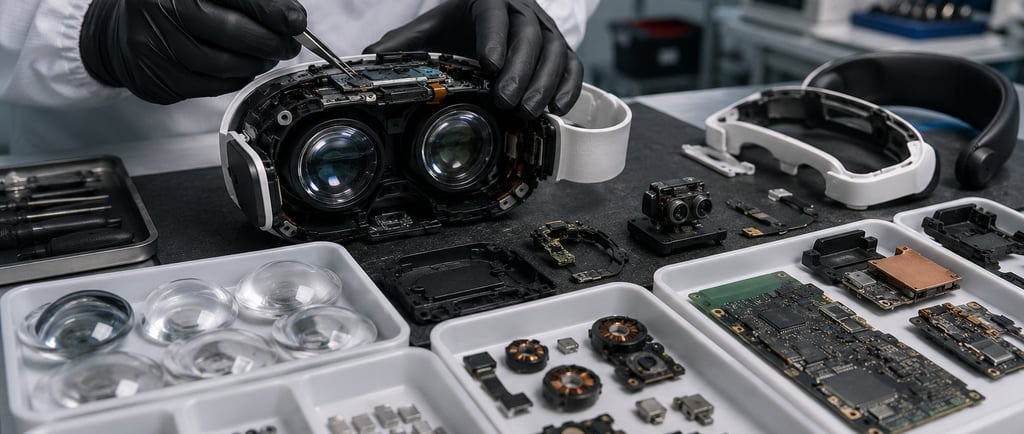
Context: Why Optics & Rare Earth Recovery Matters for XR and Specialty Recyclers
The rapid acceleration of immersive technology—XR (Extended Reality), spanning augmented (AR), virtual (VR), and mixed reality (MR)—is birthing a new generation of e-waste. Recent reports from the Consumer Technology Association project the global XR market to surpass $120 billion by 2026, creating tens of millions of devices to be refreshed and retired annually. Behind each headset is an assembly of high-value optics and rare earth elements, central to performance but notoriously challenging to reclaim. While sustainability conversations have focused on smartphones and laptops, XR hardware is now a critical e-waste frontier.
Why Does Rare Earth Recovery Matter?
Rare earth elements (REEs), such as neodymium, dysprosium, and terbium, are critical for the high-strength magnets in speakers, haptic actuators, and motion-tracking assemblies. XR headsets utilize optically pure glass, polymer lenses, and waveguides that define the user’s visual experience. But global supply chains for rare earths are concentrated—over 85% of rare earth oxides are produced in just three countries (China, the US, Australia), as reported by the US Geological Survey (2023). Price spikes, supply disruptions, and export controls make in-country recovery a strategic imperative for Original Equipment Manufacturers (OEMs) and recycling vendors.
Market Forces and ESG Imperatives:
Environmental, Social, and Governance (ESG) mandates, notably the European Union’s Waste Electrical and Electronic Equipment (WEEE) Directive and the Restriction of Hazardous Substances (RoHS), are amplifying pressure on OEMs and recyclers to authenticate supply chain ethics and circular economics. Passive e-waste shredding, which fragments and contaminates precious materials, is becoming an illicit liability rather than a default disposal option. Instead, the industry is trending toward high-yield, closed-loop recovery designed for both compliance and competitive advantage.
Recent high-profile sustainability commitments—from Meta’s pledge to net-zero supply chains to Apple’s investment in material circularity—underscore why the XR sector must rethink device recovery, integrating advanced protocols, precision tools, and partnerships with material recovery vendors capable of closing the loop.
2. The Problem: Rare Earths, Optics, and the Design Challenge
Rare Earth Crisis Meets New Device Waves
Emerging data from the International Energy Agency reveals the rare earth market’s extreme volatility: neodymium prices soared by almost 80% in 2022 alone, driven by surging demand and geopolitical stress. XR headsets use substantial quantities of these critical elements, particularly in precision magnet assemblies essential for tactile feedback, audio quality, and accurate motion tracking. If current recycling rates don’t improve, analysts estimate that nearly 120 tons of rare earths could be landfilled each year from obsolete immersive tech by 2028.
Optics Complexity
XR optics include advanced aspheric lenses, multi-layer coatings, and intricate waveguides that define clarity and field of view. Industry teardown analyses (e.g., iFixit, TechInsights) reveal that many XR optical assemblies are glued or welded into place, making them difficult to extract cleanly. Traditional e-scrap techniques—such as bulk shredding—almost always destroy these components, releasing hazardous dust and eliminating the prospect of reuse. This is a missed opportunity: even partially damaged optics can sometimes be refurbished and repurposed if recovered non-destructively.
The Design Bottleneck
OEM design choices often prioritize sleekness, weight, and cost over modularity or recyclability. Magnets may be embedded within resin-molded housings; optics locked behind ultrasonic welds. For most recyclers, these design features mean low recovery rates and high processing losses. The lack of accessible bill of materials (BOMs) and secure teardown guides further impedes efficient component mapping and extraction.
Operational and Regulatory Risks
For recyclers, the stakes are high. Regulations increasingly require traceable reporting of recovered critical materials, especially in the EU and North America. Contracts for asset recovery demand certified, auditable flows of rare earths and optics—a function unattainable via traditional e-waste channels. Without these capabilities, both OEMs and vendors risk substantial compliance costs and reputational harm.
3. Key Concepts in XR Materials Recycling
Let’s break down the essential terminology and system attributes in this new era of XR electronics recycling:
XR Devices:
Refers to the class of hardware that augments or simulates real-world environments using advanced displays, sensors, and audio. These devices are densely engineered, with minimal unused space, and integrate fragile, high-precision components.
Rare Earth Elements (REEs):
Critical in high-performance magnets found in audio drivers, tactile motors, and tracking units. These elements—such as neodymium and dysprosium—are classified as “critical raw materials” by organizations such as the EU Commission due to their supply risks and irreplaceable role in modern electronics.
Optics:
High-value parts ranging from molded polymer lenses with anti-reflective coatings to glass waveguides used for display projection and light field shaping. Optics are both intricate and fragile, requiring specialized handling protocols for extraction and refurbishment.
Design for Repair:
Increasingly, industry leaders advocate designing XR devices with repairability and recovery in mind. This means modular assemblies, clearly marked fasteners, and accessible components—all enabling higher yields in recovery and greater lifecycle flexibility.
Specialty Recyclers:
Specialized vendors go beyond bulk separation. They employ advanced disassembly, material sorting, and purification technologies to achieve high recovery rates for rare earths and optics, often under stringent documentation and traceability standards.
Material Flow Diagram:
A visual lifecycle mapping tool, tracing the passage of an XR headset through collection, assessment, targeted extraction, material purification, and reintegration into the supply chain. Material flow diagrams are crucial for regulatory compliance and process optimization.
Vendor Short List Criteria:
The new best practice is to audit vendors for technical proficiency (e.g., can they handle neodymium demagnetization?), comprehensive chain-of-custody documentation, third-party environmental certification, and secured logistics.
4. Framework: End-to-End Recovery for XR Devices
The XR Recovery Optimization Protocol (XROP)
As XR electronics recycling matures, a systematic playbook for maximum component recovery and circularity becomes essential. The XR Recovery Optimization Protocol (XROP) divides recovery into four critical phases:
1. Design for Recovery
Collaborate with OEMs prior to mass production to ensure key optical and magnetic components are labeled, indexed, and modular for easy non-destructive removal.
Use standardized assembly layouts and avoid adhesives or welds when possible, substituting quick-release fasteners and marked access points.
Secure BOMs through NDAs to enable accurate component targeting.
2. Controlled Collection & Triage
Only intake XR hardware that meets eligibility criteria (e.g., age, model, material composition).
Initial visual and electronic triage determines if a device can be refurbished (with optics cleaning and simple replacements) or must be fully disassembled for raw material extraction.
Serial number tracking and tamper-seal audits support traceability.
3. Precision Disassembly & Extraction
Employ cleanroom benches, anti-scratch tools, gloveboxes, and solvent-free release agents to detach optics without damaging sensitive surfaces or coatings.
Advanced demagnetization and ultrasonic vibration loosen magnet assemblies, allowing extraction without residual contamination.
Each extracted batch of optics or magnets receives labeled storage and is logged by lot and device source for full traceability.
4. Material Processing & Loop Closure
Recovered rare earth magnets are sent to hydrometallurgical or pyrometallurgical refining partners for separation and purification.
Refurbishable optics move to inspection, cleaning, and (where needed) coating reapplication.
Certified reports and material samples complete the chain of custody, enabling OEM buyback or verified secondary market sales.
Example in Action
Imagine a large-scale asset refresh where a leading technology firm delivers 1,000 XR headsets to a certified specialty recycler. After pre-assessment, 300 units meet criteria for direct resale following minor refurbishment. The remaining 700 are methodically disassembled: optics and magnets sorted, batch-processed for cleaning, and outstanding components sent for precious metal and polymer recovery. The process yields traceable metrics on rare earth output, optics resale rates, and landfill diversion—all ready for sustainability reporting.
5. Recovery Options for XR Optics and Rare Earth Components
The recovery pathway for XR headsets begins with a hard truth: most headset value is lost before the recycler ever sees the device. Once a headset is bulk-shredded, the optics are scratched, coated plastics are mixed with lower-grade polymers, magnets are fragmented, and rare earth content becomes dispersed across fines, dust, and mixed metal fractions. For ordinary e-waste, this may still recover copper, aluminum, gold-bearing boards, and some plastics. For XR hardware, it destroys the parts that make the device strategically valuable.
This is why XR recycling in 2026 must shift from commodity recovery to component-first recovery. The goal is no longer just “keep it out of landfill.” The better goal is to decide, at intake, whether each headset should move through resale, repair, parts harvesting, optics refurbishment, magnet recovery, board recovery, polymer sorting, or specialist refining. That decision matters because global e-waste reached 62 million tonnes in 2022 and is projected to reach 82 million tonnes by 2030, while documented collection and recycling may fall from 22.3% to 20% by 2030 if recycling systems fail to keep pace. The global system is already behind, and XR will add a smaller but more complex waste stream on top of a much larger electronics problem.
The first and highest-value recovery option is direct reuse. Many XR devices fail commercially before they fail technically. Enterprise headsets may be retired because a fleet refresh changes software support, warranty coverage, hygiene standards, or IT policy. Consumer headsets may be discarded because a new generation launches, not because the old headset is unusable. This creates a strong case for triage before dismantling. A recycler handling 10,000 enterprise headsets should not assume every unit is scrap. Some units may need only face interface replacement, lens cleaning, battery screening, controller pairing, firmware reset, and secure data erasure. If even 25% to 40% of a fleet can be redeployed, resale value will usually exceed the material value by a wide margin.
The second option is parts harvesting. This is especially important for controllers, head straps, speakers, batteries, camera modules, proximity sensors, display assemblies, and optical blocks. In a repair-constrained market, recovered parts can support warranty replacements, refurbish lower-grade units, and extend the life of older fleets. The best recyclers will grade these parts by model, cosmetic condition, function, and traceability. This is where XR recycling begins to look less like waste handling and more like reverse manufacturing.
The third option is optical recovery. XR optics deserve their own process because they are fragile, coated, and often model-specific. A VR headset may use Fresnel lenses, pancake optics, molded polymer lenses, glass elements, polarizers, films, and anti-reflective coatings. AR smart glasses may use waveguides, microLED or LCOS display modules, prisms, diffractive optical elements, and coated lens stacks. These parts cannot be treated like ordinary plastics or glass. They need low-abrasion removal, contamination control, scratch inspection, haze testing, coating review, and separate grading. In many cases, reuse will be limited to the same model family, but even that has value if OEMs and service providers maintain repair stock.
The fourth option is rare earth magnet recovery. XR headsets and accessories use small but important permanent magnets in speakers, haptic motors, actuators, charging docks, straps, and tracking components. The volume per device is low, but the strategic value is high because rare earth supply chains remain concentrated. USGS reported that the United States produced about 45,000 tonnes of rare-earth-oxide equivalent in mineral concentrates in 2024, while global rare earth mining and processing remained heavily concentrated across a small number of countries.
Magnet recovery should follow a targeted process. Magnets must be identified, removed before shredding, separated by chemistry where possible, demagnetized or stabilized for handling, and sent to processors that can produce magnet feedstock, rare earth oxides, or alloy inputs. For XR, the economics improve when recyclers aggregate magnets across headsets, controllers, earbuds, hard drives, motors, robotics, drones, and other small electronics. A single headset stream may not justify a dedicated rare earth recovery line. A mixed high-magnet electronics stream can.
The fifth option is printed circuit board and precious metal recovery. XR headsets contain mainboards, flex circuits, cameras, sensors, charging contacts, connectors, and display drivers. These contain copper, gold, silver, palladium, tin, and other recoverable metals. This is already familiar territory for certified e-scrap processors, but XR adds one complication: boards are often tightly packed around glued optics and batteries. If batteries and optical assemblies are not removed carefully, downstream processing risks increase. Strong process design should separate hazardous battery handling, optics removal, magnet extraction, and board recovery before any destructive processing begins.
The sixth option is polymer and casing recovery. XR devices use mixed plastics, elastomers, foam, fabric, adhesives, coatings, and flame-retardant materials. These materials are harder to reclaim at high value than metals, but they still matter. The Global E-waste Monitor estimates that inadequate recycling causes roughly US$62 billion in recoverable natural resources to be lost each year, which shows the cost of treating complex electronics as low-value waste.
The most practical approach is to separate clean rigid plastics from contaminated foams, textile straps, silicone interfaces, and adhesive-heavy pieces. Recyclers should also track brominated flame retardant risk, battery contamination, and hygiene materials. Face cushions and soft-touch parts may require disposal or low-grade recovery because of sweat, skin oil, and sanitation risk. Hard housings, brackets, trays, and some structural polymers may have better reuse or recycling potential if they are removed cleanly and sorted by resin type.
The best recovery pathway in 2026 is not one method. It is a ranked decision system:
Repair first when the device can safely re-enter use.
Harvest parts when the full unit cannot be resold but components still have value.
Recover optics before destructive processing.
Extract magnets before shredding.
Remove batteries before any mechanical treatment.
Send boards to certified precious metal recovery.
Sort polymers only after higher-value components are removed.
This sequence protects value. It also protects recyclers from the biggest mistake in XR processing: treating a compact, sensor-rich headset like a generic plastic gadget with a battery.
6. Case Studies, Global Signals, and Competitive Implications
The XR recovery market is being shaped by three forces at the same time: hardware volatility, critical mineral policy, and the shift from VR headsets to AI-connected smart glasses. This creates both risk and opportunity for recyclers. Companies that wait for massive XR waste volumes before building capability may miss the market. Companies that learn on small batches now can become preferred recovery partners once enterprise refresh cycles grow.
The first global signal is market instability. XR hardware is not moving in a straight line. IDC reported in March 2026 that the XR market expanded by 44.4% in 2025 as smart glasses grew, but also noted that Meta’s Quest VR headset shipments declined 42.3% year over year. IDC also reported that mixed reality and virtual reality headset shipments were expected to decline sharply in 2025, while the rest of the XR market grew by more than 200%, with XR glasses projected to grow at a 29.3% CAGR from 2025 to 2029.
This matters for recycling because the waste stream will not be uniform. Recyclers will see a mix of bulky VR headsets, high-end mixed reality devices, lightweight AR glasses, display-free smart glasses, controllers, charging cases, prescription inserts, and enterprise accessories. Each category carries different recovery value. A VR headset may offer more plastic, displays, batteries, boards, and larger optics. AR glasses may carry smaller but more delicate optical parts, waveguides, microdisplays, batteries, cameras, and sensors. Smart glasses may look less valuable by weight but may scale faster in volume.
The second global signal is supply-chain pressure around rare earths. The IEA’s critical minerals work continues to identify rare earths as strategically important for clean energy, defense, electronics, and advanced manufacturing. At the same time, recent regulatory moves in the United States and Europe are pushing buyers to reduce exposure to Chinese rare earth materials and magnets. In May 2026, Reuters reported that Lynas, the largest non-Chinese rare earths producer, said U.S. and European rules are already influencing buyers to move away from China-linked supply.
For XR recyclers, this creates a competitive opening. Rare earth recovery from headsets alone may not solve national supply risk, but verified recovery from high-tech electronics can become part of a larger secondary materials strategy. The recycler that can document magnet origin, grade, weight, processing route, and final destination will be more valuable than the recycler that simply sells mixed e-scrap by the tonne.
The third global signal is regulation. The EU Critical Raw Materials Act sets 2030 benchmarks for the EU to meet 10% of annual needs for extraction, 40% for processing, and 25% for recycling of strategic raw materials. It also introduces requirements tied to permanent magnets, including recyclability and recycled content disclosure.
This changes the buyer conversation. OEMs will need more than certificates of recycling. They will need evidence. They will ask for chain-of-custody logs, batch weights, material destination, vendor certifications, audit records, and proof that critical raw materials were not lost through poor handling. In Europe, this will become a procurement issue. In North America and Asia, it will become a supply-chain risk issue. In global enterprise sales, it will become part of ESG, repairability, warranty, and take-back scoring.
A useful case study is the difference between headset failure and headset retirement. Meta’s Quest Pro shows how fast high-end XR devices can move from flagship to discontinued hardware. The device launched at a premium price, later saw a price cut, and was no longer sold by early 2025. Market coverage linked the move to weak demand, high cost, and product fit issues.
For recyclers, this is not just a product story. It is a warning. High-end XR hardware can become commercially obsolete while still containing useful parts, optics, boards, cameras, controllers, and magnets. If these units enter a generic e-waste stream, most of that value is lost. If they enter a specialist recovery stream, they can support spare parts, secondary markets, repair programs, and materials recovery.
Apple Vision Pro adds another lesson. Reports in early 2026 described production cuts and weak sales tied to price, comfort, limited app depth, and slow mass adoption.
This shows the risk of premium, low-volume hardware. These devices may contain advanced materials and high-value parts, but recovery economics can be difficult if volumes are low, product designs are hard to open, and OEM repair channels are restricted. Specialist recyclers must prepare for this reality. They should build flexible disassembly cells, not single-model production lines. They should document teardown procedures, track part demand, and create model-specific value maps. A headset that is poor as a bulk scrap item may still be valuable as a parts donor.
A third case study is the rise of AR and AI smart glasses. Counterpoint reported that global VR headset shipments fell 12% year over year in 2024, the third consecutive annual decline, while AR and AI smart glasses became a stronger growth area heading into 2025. IDC also projected strong growth for the broader glasses segment, especially as AI features move into lighter eyewear formats.
This shift has major recycling implications. Smart glasses compress electronics into smaller, more delicate form factors. Batteries are smaller and closer to skin-contact parts. Cameras, microphones, speakers, hinges, temples, and optical elements are integrated into narrow frames. Waveguides and display modules may be difficult to remove without breakage. If smart glasses scale faster than headsets, recyclers will face a higher-volume stream that is lighter by weight but more difficult per kilogram.
This is where competitive separation will happen. The lowest-cost recyclers will compete on collection, shredding, and commodity sale. The stronger recyclers will compete on part recovery, repair grading, secure handling, material traceability, and OEM reporting. The best recyclers will build a “device intelligence” layer around recovery. They will know which models have reusable lenses, which controllers have valuable haptic motors, which batteries create handling risk, which headsets have poor resale demand, and which optical assemblies are worth preserving.
By 2026, recyclers that want to win XR contracts should build five capabilities.
First, they need model-level intake intelligence. Every headset should be identified by brand, model, generation, serial status, region, storage size where applicable, accessories, and visible damage. This is the foundation for resale, parts recovery, compliance, and reporting.
Second, they need non-destructive disassembly skill. The right tools, fixtures, heat control, anti-static handling, lens protection, and battery isolation steps can decide whether a headset becomes a resale unit or a destroyed parts pile.
Third, they need rare earth and magnet routing. Even if the recycler does not refine rare earths in-house, it must know how to extract, aggregate, store, document, and transfer magnet fractions to qualified downstream partners.
Fourth, they need optical grading. Scratch level, coating damage, haze, yellowing, delamination, contamination, and compatibility must be recorded. Optics cannot be treated as anonymous plastic.
Fifth, they need audit-grade reporting. Enterprise clients and OEMs will increasingly expect lot-level reporting, not vague recycling claims. Weight-based diversion reports are no longer enough for critical material recovery.
The competitive implication is clear. XR recycling will reward companies that behave more like reverse supply-chain partners than waste vendors. A recycler that can recover 5% more resale units, 10% more reusable parts, and a documented magnet fraction from the same inbound batch can beat a cheaper vendor that only offers destruction. In a market shaped by critical mineral policy and hardware refresh cycles, proof will matter more than promises.
7. Future Trends: How XR Recovery Will Change by 2030
By 2030, XR recovery will be shaped by lighter devices, more complex optics, more critical material disclosure, tighter take-back rules, and higher buyer expectations. The market will not wait for recyclers to catch up. OEMs, enterprise buyers, regulators, and investors will push recovery standards upward because the material risk is now too visible to ignore.
The first trend is the move from headset-heavy waste to glasses-heavy waste.
Traditional VR and mixed reality headsets are bulky and easier to identify in e-waste streams. Smart glasses are different. They are lighter, more wearable, more personal, and more likely to be replaced like consumer accessories. If glasses become a mainstream AI interface, recyclers will see shorter refresh cycles and more fragmented device streams. The material value per unit may fall, but the handling complexity may rise.
This will force a shift in economics. Recyclers cannot rely only on weight. A kilogram of smart glasses may contain more units, more batteries, more cameras, more small magnets, more speakers, and more sensitive optical elements than a kilogram of simpler electronics. The value is in precision, not bulk.
The second trend is the rise of optical design as a circularity issue.
In VR, lenses can be relatively large and accessible. In AR glasses, waveguides and display optics may be bonded, coated, laminated, and tightly integrated into frames. A broken waveguide may have little reuse value, but an intact one may be valuable for repair, warranty support, testing, training, or remanufacturing. OEMs that design these assemblies for recovery can reduce service costs and improve circularity performance. OEMs that permanently bond everything may create expensive waste.
The third trend is permanent magnet transparency.
The EU’s policy direction already points toward more disclosure around permanent magnets, recyclability, and recycled content.
This will likely influence product design beyond Europe because global OEMs prefer common hardware platforms where possible. If one major region demands magnet-related disclosure, manufacturers may begin tracking magnet content more carefully across product lines. XR devices may need clearer documentation of magnet location, weight, chemistry, and recovery instructions. That could make teardown faster and improve rare earth recovery rates.
The fourth trend is the growth of secondary critical material markets.
New mining and refining projects take years, and supply concentration remains a serious risk. A 2026 report on EU critical mineral dependence highlighted the region’s continued exposure to imports and the difficulty of building domestic mining and refining capacity quickly.
This makes recycling more strategic. Secondary supply will not replace primary mining in the near term, but it can reduce waste, improve resilience, and support regional supply targets. For XR, the biggest opportunity is not isolated rare earth recovery from one headset model. The bigger opportunity is integrating XR into wider recovery streams for permanent magnets, batteries, boards, and precision optics.
The fifth trend is repair-linked recycling.
The old model separated repair from recycling. Devices went to repair if they were reusable, and to recycling if they were waste. XR will blur that line. A device may fail as a full unit but still provide a working display, clean lens, usable speaker module, intact head strap, or good controller board. Future recovery facilities will need repair benches beside dismantling benches. They will need technicians who can test and grade components before destruction. They will need software access, diagnostic tools, cleaning protocols, and secure reset procedures.
The sixth trend is stricter enterprise procurement.
Large companies buying XR for training, design, healthcare, education, field service, defense, and manufacturing will start asking better end-of-life questions before purchase. They will want to know whether the OEM offers take-back, whether parts are available, whether batteries can be replaced, whether optics can be serviced, whether materials are traceable, and whether the device has a credible retirement pathway. This will affect OEM sales. A headset with a weak end-of-life plan may lose enterprise bids even if the hardware performs well.
The seventh trend is AI-assisted teardown and grading.
By 2030, recyclers will increasingly use computer vision to identify headset models, detect damage, guide disassembly, flag battery swelling, recognize optical scratches, and sort components. This will be especially useful for mixed inbound loads where devices arrive without packaging or documentation. AI will not replace skilled technicians, but it can reduce mistakes, speed up grading, and create better records.
The eighth trend is recovery-ready product passports.
XR device passports can connect serial number, model, repair history, battery replacements, parts, materials, ownership transfer, and end-of-life instructions. For recyclers, this could reduce guesswork. Instead of reverse-engineering every product, a certified recycler could scan a device and access approved teardown steps, hazardous component warnings, magnet locations, optical part numbers, and downstream routing instructions. That would make recovery faster, safer, and easier to audit.
The ninth trend is a split between certified and informal channels.
As XR devices become more common, some units will enter informal resale and repair markets. That can extend product life, but it can also create risks around batteries, hygiene, counterfeit parts, unsafe chargers, data security, and poor disposal. Certified recyclers can win by offering a safer alternative: secure data handling, sanitation, tested parts, documented recycling, and verified material recovery.
The tenth trend is regional specialization.
Europe will likely lead with critical raw material rules and producer responsibility. North America will focus on supply security, enterprise asset disposition, and domestic processing. East Asia will remain central to manufacturing, refurbishment, component recovery, and high-volume electronics processing. The Middle East and Africa may become more important as device adoption grows, but infrastructure gaps could create leakage into informal waste streams unless collection systems improve. Latin America may see opportunity in repair-first models because cost sensitivity often supports longer device life.
By 2030, the strongest XR recovery companies will not define themselves as recyclers alone. They will define themselves as reverse logistics partners, repair partners, critical material recovery partners, and compliance partners. Their value will come from knowing what to preserve, what to harvest, what to refine, what to document, and what to return to the market.
Conclusion: XR Recovery Is Moving From Waste Management to Strategic Material Control
Optics and rare earths make XR devices powerful, but they also make them difficult to recycle. A headset is not just plastic, glass, wires, and a battery. It is a compact stack of lenses, coatings, magnets, displays, sensors, speakers, cameras, circuit boards, adhesives, and software-linked components. If treated as ordinary e-waste, much of its value disappears. If handled through a specialist recovery process, the same device can support resale, repair, parts reuse, optical recovery, magnet aggregation, precious metal recovery, and verified material reporting.
The timing matters. Global e-waste is growing faster than documented recycling capacity. Critical minerals are becoming a policy concern. Rare earth supply chains remain exposed to geopolitical pressure. XR hardware is shifting from bulky headsets toward lighter smart glasses and AI-enabled wearables. Enterprise buyers are becoming more demanding. Regulators are asking for more proof. These forces point in the same direction: XR recovery must become more precise, more documented, and more commercially mature.
The winners will be the OEMs that design for recovery before devices reach the market. They will use modular parts, accessible batteries, reduced adhesives, marked materials, documented magnet locations, and repairable optical assemblies. They will treat end-of-life planning as part of product strategy, not a disposal problem.
The winners will also be the recyclers that move beyond bulk destruction. They will build model-level intake systems, clean disassembly workflows, optical grading processes, magnet recovery partnerships, secure data handling, and audit-grade reporting. They will know when to resell, when to refurbish, when to harvest, and when to refine.
For specialty recyclers, XR is still an early market. That is exactly why it matters. The volumes are not yet as large as smartphones, laptops, or televisions, but the complexity is higher and the strategic value is rising. Companies that build capability now will be better positioned when enterprise fleets refresh, smart glasses scale, and regulations make critical material recovery harder to ignore.
The future of XR recycling will not be won by the company that shreds the fastest. It will be won by the company that protects the most value, proves the cleanest chain of custody, and returns the highest-quality materials and parts back into productive use.
Connect
Your trusted partner for scrap metal procurement.
CONTACT
About
haroon@tdcventures.com
+1-307-655-7593
© 2025. All rights reserved.
NEWSLETTER