
OSHA Hot-Work Compliance: Yard Applications
A practical guide to achieving OSHA hot-work compliance in scrap yards. Learn the framework to reduce fire risk, avoid fines, and streamline operations without sacrificing productivity.
COMPLIANCE & REGULATORY OPERATIONS IN RECYCLING
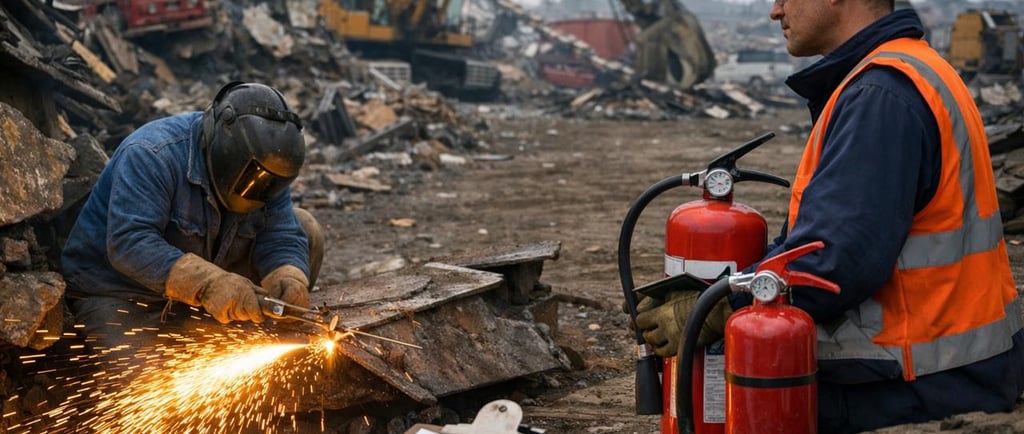
Scrap yards operate in a high-stakes environment where efficiency often collides with risk. From Minneapolis to Miami, recycling and metal yards handle diverse, unpredictable material streams, ranging from crushed vehicles to loose plastics, hydrocarbons, and ever-present dust. Amid this controlled chaos, hot-work operations—welding, cutting, grinding—are a daily necessity to maintain productivity.
However, hot work also introduces acute fire hazards. According to the National Fire Protection Association (NFPA), hot-work activities account for an average of 4,440 structure fires per year, with direct property damage exceeding $287 million annually across U.S. industrial sites. Recent cases have shown that a single stray spark can ignite not only materials on-site but also reputational crises due to regulatory scrutiny. For scrap and metal operations, the blend of combustible debris, shifting work zones, and outdoor exposures creates conditions for rapid fire spread.
OSHA’s updated General Industry Standard 1910.252 enforces strict documentation, permit controls, and procedural adherence for hot-work tasks. Insurers now routinely require evidence of programmatic fire-risk reduction—a trend supported by growing data integration between OSHA enforcement and commercial insurance underwriting. A robust OSHA hot-work program is not only critical for regulatory compliance, but also for defending against rising business interruption and insurance premium costs.
Moreover, workforce dynamics have evolved. Expanding use of contract labor and temp agencies means more variability in training, procedural awareness, and language proficiency. This makes a clear, accessible, and repeatable hot-work process essential. Streamlining OSHA hot-work compliance in yards optimizes throughput and mitigates tangible risks—safeguarding assets, people, and the bottom line simultaneously.
Defining the Compliance Problem and Yard Stakes
Understanding the Yard’s Unique Hot-Work Compliance Challenges
Compliance failures are rarely about bad intent—they typically surface due to time pressure, incomplete understanding, or the reality of chaotic yard conditions. But the stakes are unmistakable.
Key Compliance Problems:
Permit Gaps: Despite clear rules, it’s easy for teams to skip hot-work permits, especially for “quick fixes.” In one 2021 incident, a $2 million fire at a Midwest yard was directly linked to missing hot-work documentation.
Fire Watch Lapses: Even diligent crews can default on post-work monitoring, believing “it only takes a few minutes” or assuming night shift will handle the check. A National Safety Council study found that over 40% of industrial hot-work fires involved inadequate fire watch.
Contractor Variability: External welders or mechanics may not get the same training as in-house staff, increasing risk. Insurance underwriters increasingly flag contractor compliance gaps.
Inconsistent Recordkeeping: Manual or ad-hoc tracking can leave organizations exposed during an OSHA or insurer audit.
The Business and Safety Stakes in Yards
Financial Exposure: OSHA fines now range from $13,000 to $150,000 per violation, and a major fire may trigger penalties, insurance non-renewal, and unplanned downtime. Industry research by the Scrap Recycling Industries Association indicates average downtime losses of $25,000 per day for mid-sized yards. When operations hinge on tight schedules and slim margins, even brief disruptions impact quarterlies and partner relationships.
Operational Impact: Poor hot-work compliance often causes broader disruptions. A single event may shut down future projects, slow throughput, and trigger emergency response reviews. Internal credibility with crews drops when compliance is uneven, and morale follows.
Reputation and Liability: Regulatory citations are public record and often picked up by local media. Clients, business partners, and future employees track these signals, affecting recruiting and commercial relationships.
Continuous Improvement Opportunities: Leading yards use near-miss data and failed audits as springboards to evolve their safety culture—transforming each compliance challenge into a driver for leaner, more resilient operations.
Key Concepts and Terms: Hot Work, Permits, and Risk
Clarity around hot-work terminology and roles is foundational:
Hot Work
Defined by OSHA and the NFPA as any process capable of igniting materials—welding, grinding, torch cutting, brazing, heating, or soldering. In the yard context, this typically means repairs, dismantling, cutting new paths, or salvaging.
Hot-Work Permit
A formal, auditable record granting time-limited authorization for specific hot-work activities, in a defined area, with explicit controls in place. Modern hot-work permits capture:
Exact task
Location
Date/time window
Hazards identified and mitigated
PPE and equipment status
Fire-watch personnel and post-work monitoring duration
Approvals and signatures
EHS Oversight
Environmental Health & Safety (EHS) managers or designated supervisors act as compliance anchors—training teams, overseeing audits, acting as regulatory/insurance liaisons, and updating procedures. Their involvement ties compliance to daily operational leadership, not distant “head office” policies.
Fire Watch
A trained person dedicated solely to scanning for ignition or smoldering risk, with control over extinguishers and alarms for a set period after hot work. Neglecting a fire watch is a common citation during inspections. In July 2020, an Ohio scrap yard fire prompted by missed fire watch led to six figures in direct damages and months of litigation over insurance coverage.
Audit Trail and Recordkeeping
Every hot-work task, whether completed or aborted, should generate a digital or physical record—permit, training logs, incident reports, fire-watch logs—stored for three to five years depending on insurer and OSHA guidance. This documentary trail is your first—and often only—defense during scrutiny.
Combustible Management
In yard environments, this means ongoing daily assessment of evolving piles, fuel leaks, paper/plastic proximity, and operational overlaps. Combustible management drives much of the “hazard mitigation” in hot-work permits, and failure to manage these variables rapidly escalates downstream risks.
The Practical Compliance Framework for Hot-Work Operations
The following practical framework has enabled market-leading scrap yards to achieve near-100% OSHA hot-work compliance—without throttling productivity.
The Yard Hot-Work Compliance Loop: Expanded
Pre-Work Hazard Survey
Use a standardized checklist (digital or paper) tailored to the yard’s specific risk profile.
Proactively assess for stray plastics, dust, vehicle fluids, and shifting debris. Data shows that positively identifying and removing just 10% more combustibles before hot work drops post-task fire events by ~30% (source: Zurich North America risk data).
Include weather assessments; wind and humidity can exponentially increase risk.
Permit Issuance
Permits should be granular: one permit per area, per job, per shift. Centralized digital permit systems (such as iAuditor, SafetyCulture) are now industry best practice—enabling instant retrieval and compliance dashboards.
Each permit must document all pre-work mitigation: extinguishers staged, combustibles removed or shielded, equipment inspected, and fire-watch assignments made with named personnel.
Use color-coding or digital flagging for tasks with elevated risk or exceptional conditions.
Team Briefing and Role Assignments
Hold a brief task-specific “tailgate” safety meeting before work. This improves recall and engagement—especially critical with teams using multiple contractors, shifts, or non-native English speakers.
Define and communicate: who is the operator, who is the fire watch, who is the EHS contact, and what is the emergency plan.
Check-Off Start Conditions
Each item (PPE, hazard removal, equipment checks, weather evaluation) is checked and initialed directly on the permit. Permits lacking checks/initials are immediately flagged in weekly audits. This creates accountability and ensures each risk control is actually completed.
Digital checklists can require photographic evidence of extinguisher placement or combustibles removal, raising compliance quality and audit defensibility.
Continuous Fire Watch and Documentation
Assign the fire watch as an exclusive duty—no multitasking. Fire-watch duration adjusts for site conditions; for example, in high-wind regions or extreme dryness, require minimum one-hour monitoring.
Use incident logbooks to track any sparks, small ignitions, or near-misses—data that advances future risk modeling.
Post-Job Review and Closeout
The fire watch ends only after the full required monitoring period, area re-inspection, and final signoff by the supervisor or EHS designated lead.
Archive all permits and logs in a central digital repository, tagged and indexed for instant retrieval during OSHA or insurance audits.
Worked Example: Deep Dive
A maintenance crew at an urban recycling facility needs to torch-cut a partially collapsed steel awning above an outdoor processing area. During the pre-work walkdown:
Nearby piles contain plastic bins, cardboard drums, and hydraulic fluid leaks from an adjacent loader—flagged as high-risk combustibles.
Weather forecast reports gusts at 18 mph; supervisor uses digital system to extend required fire watch from 30 to 60 minutes.
All preparations (removal or shielding of combustibles, portable extinguishers, PPE) are photographed and appended to the permit.
Jobs are delayed by 20 minutes as staff removes last-minute hazards—a decision later shown to prevent a fire that broke out from a hidden paper roll.
All documentation is immediately uploaded to EHS’s compliance portal for review.
Net outcome: No fire, no audit findings, uninterrupted operations—and a compliance process resilient enough for real-world, variable yard conditions.
Implementation playbook for OSHA hot-work compliance in scrap yards
This playbook assumes one reality. Hot work happens fast. People improvise. The yard changes by the hour. Your system has to work when the loader is leaking, the wind picks up, and a contractor shows up late.
Step 1. Set the non-negotiables, then publish them
Start with a short yard hot-work policy that fits on one page. Your policy should state:
No permit, no hot work, outside designated hot-work areas.
One permit per job, per location, per shift.
Fire watch is mandatory when OSHA conditions trigger it, including when combustibles are within 35 feet, or when sparks can travel to combustibles beyond that.
Post-work fire watch time follows the stricter of your insurer requirement or your internal rule, never below the OSHA minimum language that appears in the regulatory text.
Then make it visible. Put it at the scale, in the maintenance bay, and at contractor check-in.
Step 2. Define roles so the permit is not “paperwork”
A hot-work program fails when “everyone is responsible.” Make responsibilities sharp.
Authorizing individual (often the supervisor or area lead)
Inspects the area before work starts.
Confirms controls are in place, not just checked on a form.
Has the authority to stop the job for wind, combustibles, or access issues.
Hot-work operator (welder, cutter, grinder)
Follows the permit controls exactly.
Stops work if conditions change, for example wind direction shifts or a new pile is staged near the work.
Fire watch
Watches for ignition during the job and after the job.
Stays dedicated. No loading, no spotting trucks, no multitasking.
Knows alarm procedure and extinguisher use, and when to evacuate and call for help.
EHS lead or program owner
Owns training content, audits, and corrective actions.
Owns permit form design and revisions.
Owns insurer and regulator readiness.
Step 3. Separate “designated hot-work areas” from “permit-required areas”
You want two lanes.
Lane A: Designated hot-work areas
A controlled bay or pad where hot work is expected and engineered for it.
Fixed fire protection, clear floors, minimal combustibles, controlled traffic.
Still requires procedural controls, but it should reduce permits for routine shop work.
Lane B: Permit-required areas
This is most of the yard. It is where hot work becomes dangerous, because combustibles are unpredictable and exposure is wide.
Step 4. Build a permit that matches yard reality
Your permit should capture, at minimum:
Exact work type (torch cut, weld repair, gouging, grinding).
Exact location (zone name plus landmark).
Start time, stop time, and expiry, usually end of shift.
Combustibles assessment, including the 35-foot rule and what was moved, shielded, or covered.
Equipment checks, including hoses, regulators, and cylinders condition.
Fire protection staged and verified.
Fire watch name, start time, end time, and signoff.
Closeout confirmation that the area was rechecked.
Digital permits help retrieval and trend analysis, but paper can work if you enforce filing discipline. The key is standardization.
Step 5. Engineer the pre-work hazard survey for scrap yard fuel sources
Hot-work guidance often assumes a clean facility. Scrap yards are not clean facilities.
Your pre-work survey must force people to look for the yard-specific ignition chain:
Fluids and residues: hydraulic oil leaks, fuel tanks, oily rags, contaminated absorbents.
Hidden combustibles: paper, plastics, insulation, foam, seat fabric, debris inside vehicles or appliances.
Fine fuels: fluff, dust, shred residue, and wind-blown light plastics.
Exposure pathways: sparks dropping to lower levels, sparks traveling with wind, sparks entering conveyors, pits, or trenches.
OSHA makes it clear that fire watch is required when a fire might develop, and it lists conditions tied to combustibles and spark travel. Use that language to drive your survey discipline.
Step 6. Control the work area, do not “work around it”
Before ignition starts, enforce controls that crews can verify visually.
Minimum controls you should require
Clear combustibles within 35 feet where feasible, or shield with welding blankets and noncombustible barriers when removal is not possible.
Wet down only when appropriate. In yards, wetting can create runoff and environmental issues, so treat it as a controlled tactic, not a default.
Stage extinguishers where the fire watch can grab them in seconds, not where they “should” be stored.
Control traffic. Put cones or barricade tape so a forklift does not stage a new pile into your cleared zone mid-job.
Step 7. Get serious about fire watch duration, and document why
A common failure mode is underestimating delayed ignition. Smoldering starts fires after the sparks stop.
OSHA’s regulatory text includes a minimum expectation of at least a half hour after completion for fire watch in the welding and cutting context.
Many safety bodies and insurers push longer times in higher-risk environments, often 60 minutes or more, and longer when conditions warrant.
A yard-ready rule set that holds up in audits
Baseline: 60 minutes post-work fire watch for permit-required yard hot work.
Increase to 90 to 120 minutes when you have wind, shred residue, oily surfaces, confined voids, or work on equipment with hidden cavities.
Extend further if the fire watch observes any smoke, odor, unusual heat, or small ignition.
If you want to be strict, make the authorizing individual write the watch time decision on the permit. That one field drives discipline.
Step 8. Closeout like you expect a dispute later
Your closeout should assume two things. OSHA may ask. Your insurer may ask.
Closeout actions that matter
Fire watch signs off with an end time after the full watch period.
Supervisor or authorizer reinspects, then signs.
If practical, use thermal checks on high-risk jobs, such as torch cutting near enclosures or near residue piles. You do not need fancy gear to start, but thermal tools reduce “missed smolder” risk.
Step 9. Record retention that matches your risk profile and regulatory scope
Retention requirements vary by rule set, so be explicit about what you follow.
Examples that commonly affect industrial sites
OSHA Process Safety Management hot-work permits must be kept on file until completion of hot work operations. That is a minimum, not a best practice.
EPA Risk Management Program hot-work permits must be retained for three years after completion. This is an explicit federal retention requirement where it applies.
Many risk-control programs and insurers recommend keeping permits at least one year or longer for audit and claims defensibility.
For scrap yards, keep permits and supporting evidence long enough to cover insurer expectations and the time window where a claim or regulatory inquiry is still plausible. If you operate under EPA RMP at any site, follow the three-year rule for those covered hot-work permits.
Quality assurance and audit readiness
Quality assurance is not “more paperwork.” It is how you prove the program works, and how you spot failure patterns before they become fires.
Start with three program goals
Zero unauthorized hot work outside designated areas.
Zero permits missing fire watch signoff and watch duration.
Zero repeat findings from internal audits.
Then measure the few things that actually predict performance.
Leading indicators you should track monthly
Permit compliance rate
Permits issued versus observed hot-work jobs performed.
Target is effectively 100% outside designated hot-work areas.
Permit quality score
A simple scoring rubric for completeness, location specificity, controls listed, and signoffs.
If you see “same handwriting, all boxes checked” patterns, you have a pencil-whip problem.
Fire watch adherence
Percentage of permits where fire watch stayed the full required time.
Track the reasons for extensions and early terminations.
Near-miss and small ignition log
Small ignitions count. Sparks that hit residue count. Smoking debris found during watch counts.
These events are your best predictors of a future loss.
Contractor variance
Separate metrics for contractor-performed hot work.
Many risk engineers focus on contractor hot work because controls often break there.
Audit cadence that works in a yard
Weekly spot checks, 15 minutes
Walk the yard during hot work.
Verify permit is posted or carried, and location matches.
Verify extinguishers and fire watch presence.
Monthly deep checks, 60 to 90 minutes
Review a sample of permits across shifts.
Call out missing fields, vague locations, and weak controls.
Close corrective actions with names and dates.
Quarterly drill
Run a simulated hot-work ignition response.
Test alarm, extinguishers, radio calls, and evacuation control.
Record gaps and fix them.
Why this matters now
Hot work is a major driver of property fire loss across commercial and industrial settings. Zurich reports hot works cause 15% of fires in commercial and industrial properties in its claims data.
NFPA’s hot-work fire reporting shows large direct property damage totals, and the numbers remain consistently high across reporting windows.
When you combine that with rising OSHA maximum penalties, you have financial exposure on both sides, loss and enforcement.
Case studies and case patterns for scrap yards
Instead of one-off stories, use patterns that match how yards get burned, literally and financially.
Case pattern 1: “Quick cut” on a mixed pile
What happens
A loader operator asks maintenance for a fast torch cut on a tangled mixed-metal bundle near a staging pile. The crew treats it as a five-minute job. No permit. No fire watch. Wind carries sparks into fluff or light plastics. Smolder starts under the pile. Fire is discovered late.
What the program control would have caught
Permit requirement outside designated area.
35-foot combustible rule triggers immediate relocation or shielding.
Fire watch required, plus post-work watch long enough to catch smolder.
Case pattern 2: Contractor repair with weak orientation
What happens
A contractor arrives to repair a shear or torch a bracket. They have their own habits. They do not understand your yard fuel sources, or your emergency procedures. They start work, then leave as soon as the repair is done. Fire watch is treated as optional.
What the program control would have caught
Contractor prequalification and orientation, tied to permit signoff.
Authorizing individual responsible for verifying controls before start.
Insurer-grade hot-work risk controls, which explicitly stress fire watch and completion signoff.
Case pattern 3: Smoldering ignition after the shift change
What happens
Work ends near end of shift. Fire watch gets shortened to “make the clock.” The next shift assumes the area is safe. A smolder becomes open flame 45 minutes later.
What the program control would have caught
Minimum post-work fire watch expectation in OSHA text, and stricter internal watch times in high-risk yard zones.
Clear closeout rule that the permit is not closed until watch time ends and signoff is complete.
Case pattern 4: Battery-related fires intersect with hot work
What happens
A yard already experiencing elevated battery fire risk introduces hot work near incoming material zones or residue piles. Baseline fire risk is already high, so the margin for error shrinks.
Why you should treat this as a force multiplier
Publicly reported fire tracking shows scrap metal recycling yards represent a significant share of reported incidents over multi-year periods, and the issue remains active in recent years.
This does not mean hot work caused those fires, but it does mean yards operate in a higher-fire-frequency environment. Your hot-work controls must be stricter, not looser.
Frequently asked questions
Do I always need a hot-work permit in a scrap yard?
If the work is outside a designated hot-work area, you should treat a permit as required. Permits make the hazard survey, controls, and fire watch explicit.
When is a fire watch required under OSHA?
OSHA requires fire watchers when welding or cutting is performed where a fire might develop, and it lists conditions tied to combustibles and spark travel, including combustibles within 35 feet.
How long should fire watch last after hot work ends?
OSHA’s regulatory text includes at least a half hour after completion for welding and cutting operations.
Many organizations and insurers recommend 60 minutes or longer depending on conditions, and some guidance supports monitoring beyond an hour in higher-risk settings.
In yards, 60 minutes is a safer baseline for permit-required work, with extensions for wind, residue, oily surfaces, and hidden voids.
What should I do differently for outdoor hot work with wind?
Wind expands the spark travel zone and makes “35 feet” feel small. If wind is pushing sparks toward combustibles, stop and relocate the job, or build hard barriers and increase watch time. Treat wind as a stop-work trigger when you cannot control exposure.
Do grinders count as hot work?
Yes, if the process can generate sparks capable of ignition. In many yards, grinding near residue is as dangerous as torch cutting.
What records do I need to keep, and for how long?
Retention depends on which rules apply to the site.
Under OSHA PSM, the permit must be kept on file until completion of hot work operations.
Under EPA RMP, hot-work permits must be retained for three years after completion.
Even when not strictly required, keeping permits longer supports internal audits and claims defense, and many risk-control programs recommend at least one year.
What is the real business cost of getting this wrong?
Two buckets hit at once.
Enforcement cost. OSHA maximum penalties increased for citations issued on or after January 15, 2025, up to $16,550 per serious violation and up to $165,514 per willful or repeated violation.
Loss cost. Hot work remains tied to large annual property damage totals in NFPA reporting, and hot works contribute materially to insurer fire loss experience.
Downtime can then multiply the hit. Industrial surveys routinely put downtime in the tens of thousands to hundreds of thousands per hour range in many sectors, which is why insurers focus on hot-work controls so aggressively.
Conclusion
A scrap yard hot-work program works when it behaves like operations, not like compliance theater. Your strongest defense is repeatability. A permit that forces a real hazard survey. A fire watch that stays long enough to catch smolder. A closeout process that assumes scrutiny. When you ground the system in OSHA’s explicit fire watch triggers and time expectations, and you align your watch times with insurer-grade practices, you reduce the chance that a routine cut turns into a loss event.
Connect
Your trusted partner for scrap metal procurement.
CONTACT
About
haroon@tdcventures.com
+1-307-655-7593
© 2025. All rights reserved.
NEWSLETTER