
Permafrost-Aware Foundations: Alloys and Design for Resilient Infrastructure
As permafrost thaws, traditional infrastructure is failing. Discover how circular metal alloys and adaptive foundation design are building climate-resilient infrastructure for the Arctic and beyond.
CLIMATE-RESILIENT INFRASTRUCTURE & CIRCULAR MATERIALS
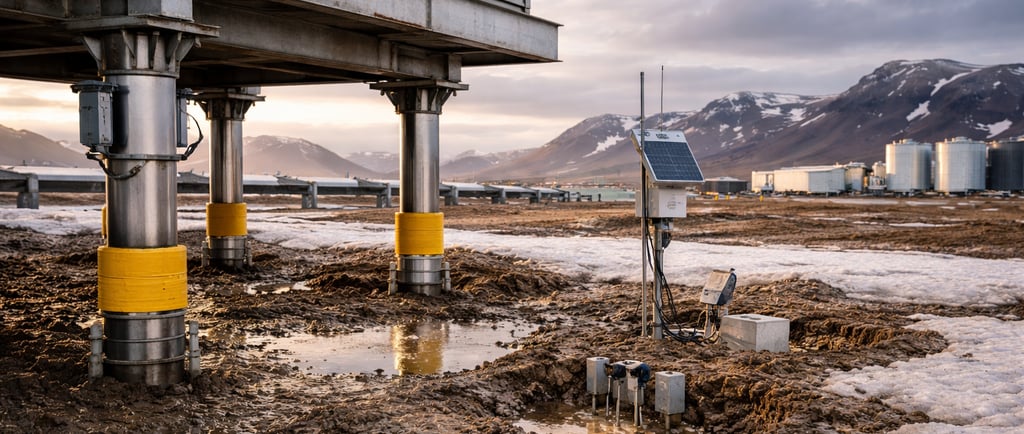
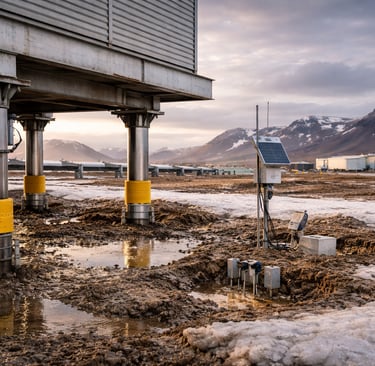
Context: Why Permafrost-Aware Foundations Matter
In northern and sub-Arctic regions, permafrost has long provided fundamental ground stability for infrastructure assets such as utilities, pipelines, roads, energy platforms, and essential community facilities. Historically, designers relied on the enduring nature of frozen ground, calculating foundation loads, settlement potential, and frost heave using established norms. However, the climate crisis has massively altered these traditional calculations. Recent studies by the Geological Survey of Canada show the active permafrost layer in parts of the Northwest Territories thinning by over 4cm per year since 2010—a rate triple its historical baseline.
With permafrost thaw and degradation, infrastructure failure risks are sharply rising. The consequences have been profound: collapsed buildings in Siberia, ruptured water mains in Alaska, and destabilized communication towers in Nunavut underscore the region-wide challenge. Foundations that seemed stable for half a century now face unpredictable settlement, severe heave, corrosion, and rapid loss of load-bearing strength as thaw cycles multiply.
The stakes are high for civil engineers, energy utilities, and infrastructure operators. A single foundation failure in a remote oil pipeline valve station can halt production and spill tens of thousands of liters of hydrocarbons into fragile tundra, triggering costly environmental recovery operations. For remote communities, housing, schools, and hospitals built atop permafrost stand as lifelines—any failure means unsafe living, emergency evacuations, and spiraling repair expenses. In one 2021 study, annual maintenance costs for remote northern buildings were found to be 90% higher compared to southern equivalents, largely due to ground movement and foundation issues.
There is now an urgent, dual mandate: mitigating infrastructure vulnerability due to climate change and minimizing the carbon footprint of any new construction or retrofit. Traditional approaches relying on virgin steel-reinforced concrete are falling short, both in physical resilience and in supporting regional climate goals or emerging circular economy mandates.
Enter permafrost-aware design with circular metal alloys. By blending cutting-edge engineering practices, recycled low-carbon metals, and data-driven monitoring systems, leaders in northern infrastructure are not only tackling ground instability head-on, but also enabling faster recovery, radical carbon reductions, and long-lived assets—even as permafrost shifts unpredictably beneath.
2. Defining the Problem and Opportunity
Problem: Advanced Ground Risks and Legacy Gaps
Permafrost thaw induces extreme and unpredictable infrastructure hazards, many of which are rapidly outpacing the capacity of current foundation designs and material standards. The primary engineering challenges fall into three key categories:
Foundation Instability: As the active layer of permafrost deepens and migrates, soil can experience uplift, rapid settlement exceeding 5cm/year, or severe lateral shear. These forces test the limits of traditional rigid foundations, which often lack the flexibility to respond. For example, between 2018 and 2022, over 1,500 reported incidents of heave-related pipeline distortion were registered in Alaska’s north slope alone.
Accelerated Corrosion: The chemistry of melting, thawed soils is changing. More frequent water ingress and higher salt loads—especially near sea-influenced permafrost—accelerate the corrosion of steel piles and connectors. Corrosion incidents in the Canadian Arctic have nearly doubled since 2010, resulting in increased foundation failures and expensive repairs.
High Operational Risk: Unplanned outages, contaminant releases, and safety incidents are direct consequences. As repair costs and logistical hurdles mount in remote Arctic regions, traditional “react and rebuild” approaches routinely lead to project overruns, supply chain delays, and even early retirement of critical assets.
Compounding these risks, most existing permafrost foundation standards—such as many AASHTO and CSA foundational codes—derive from data prior to the acceleration of modern climate change. They frequently ignore scenarios of year-on-year thaw acceleration and changed hydrochemistry, leaving a regulatory lag that exposes both assets and communities.
Traditional construction materials carry their own risks. Virgin steel and concrete foundations lock in high embodied carbon. Globally, construction and building materials account for over 11% of total carbon dioxide emissions, with a disproportionate share arising from remote infrastructure logistics and single-use material flows. According to the Carbon Leadership Forum, Arctic infrastructure built using traditional approaches often generates up to 30% more embodied carbon, per kilometer, than projects in temperate climates, due to higher transportation, insulation, and maintenance requirements.
Opportunity: Circular Metals, Design Innovation, and Real-Time Monitoring
The evolving risk landscape also presents clear opportunities:
Recycled Low-Carbon Metals: Next-generation alloys, especially those manufactured with at least 50% recycled feedstock, feature dramatically improved corrosion resistance and lower embodied carbon. LCA studies from the International Molybdenum Association indicate recycled duplex stainless steel can reduce total lifecycle GHG emissions by 70% compared to virgin grades.
Advanced Foundation Typing and Jointing: Modular, flexible design strategies enable rapid recovery and targeted replacement. For example, European Arctic airfields using insulated pile systems with flexible joinery reported a 50% extension in design life and a 40% reduction in mean-time-to-repair, compared to rigid concrete pads.
Outcome-Driven Monitoring and Maintenance: Real-time monitoring enables predictive, condition-based interventions, as opposed to reactive overhauls. In field trials in northern Scandinavia, infrastructure equipped with continuous corrosion and tilt monitoring achieved a 60% reduction in emergency repairs over a five-year period.
The market opportunity is enormous. Arctic2020, a market analysis group, projects annual investment in permafrost-resilient foundations could exceed $2 billion globally by 2026, driven by both private sector and government initiatives. These investments are not just for new builds — retrofitting older stock with circular alloys and digital monitoring can recover up to 80% of planned asset life at a fraction of replacement costs.
3. Key Concepts and Definitions for Northern Infrastructure
Permafrost: Permanently frozen soil or rock, typically at or below 0°C for at least two years. Roughly 24% of the northern hemisphere’s exposed land contains permafrost—a key constraint for infrastructure.
Resilience (Primary Entity): The demonstrated ability of infrastructure systems—including foundations—to maintain service, performance, and safety in the face of disturbances, particularly thaw events and differential ground movement.
Low-Carbon Alloys: Advanced materials—such as duplex stainless steels and new aluminum-magnesium blends—engineered to reduce GHG footprint. Attributes include high recycled content, specific corrosion-resistance ratings (e.g., EN 10088-4), and enhanced mechanical flexibility at low temperature.
Circular Materials: Building products intentionally designed to minimize waste, support reuse, and facilitate end-of-life recycling—creating a continuously circulating material loop.
Adaptive Foundation Engineering: Integrating design elements (floating slabs, insulated piles, joint isolators) that respond dynamically to ongoing ground movement, temperature variance, and water flow.
Thermal Movement: Polycyclic expansion and contraction in both soils and foundation members due to freeze-thaw and temperature variability, critical for sizing joints and planning sensor placement.
Corrosion Management: Systematic use of cathodic protection, engineered claddings, and high-performance alloys specifically evaluated for Arctic/sub-Arctic site chemistry (salinity, pH, water content).
Lifecycle Monitoring: Embedded use of ground-based temperature sensors, movement loggers, and corrosion coupons to deliver continuous or periodic data on performance and trigger interventions before failures escalate.
Understanding and precisely defining these terms ensures a common framework for policy, procurement, and operational conversations—a foundational step often overlooked in traditional project cycles.
4. Core Framework: Circular Alloys & Adaptive Foundation Design
Framework Overview: Entity-Attribute-Value Approach
To ensure repeatable, high-resilience results in permafrost infrastructure, a structured, outcome-focused framework is essential:
Assessment: Initiate each project with permafrost and climate risk mapping, including borehole temperature data, historic settlement trends, salinity/pH profiling, and hydrology studies.
Material Selection: Specify high-recycled-content metals (steel or aluminum alloys), matched to site exposure, with validated EPDs (Environmental Product Declarations). For example, choose EN 1.4362 duplex stainless or AA6000 aluminum series with >50% recycled content and proven performance to –50°C.
Adaptive Foundation Typing: Select from a suite of foundation options—insulated floating slabs, elevated piles (with adjustable heads), or hybrid modular systems—based on mapped ground conditions.
Corrosion & Joint Engineering: Deploy a combination of high-performance coatings (e.g., thermal-bonded epoxy), sacrificial anodes, and water-resistant, elastomeric joint seals. Confirm system compatibility across –40°C to +30°C.
Modularization & Recovery Planning: Design all foundation assemblies for off-site prefabrication, rapid on-site assembly, and field repair using modular components.
Monitoring Integration: Ensure every foundation has built-in data access for ground temperature, settlement, tilt, and corrosion monitoring, including remote telemetry if feasible.
Step-by-Step Process
Site Survey: Deploy ground temperature data loggers and validate with deep-soil borings and continuous water sampling.
Risk Mapping: Cross-reference permafrost stability maps, regional climate models, and local land-use history to classify risk zones. Utilize GIS overlays for planning.
Alloy Specification: Set minimum requirements—such as >50% recycled content with corrosion resistance to saline-melt environments (ISO 9223 C5 environment rating).
Foundation Engineering: Choose foundation systems — such as helical pile systems or insulated raft slabs — calibrated to site movement profiles (e.g., acceptable settlement tolerance at 5cm/year).
Corrosion Mitigation: Specify duplex/super duplex stainless or aluminum-magnesium alloys wherever soil salinity or persistent water exposure is modeled as high. Deploy cathodic protection and inspectability measures.
Jointing Solutions: Use expansion joints tested in certified labs for thermal movement and water tightness, proven to endure over 30,000 freeze-thaw cycles.
Pre-Fabrication & Modularization: Manufacture modules offsite to minimize on-site labor, cut error rates, and simplify future maintenance. Emphasize rapid logistics—crucial during short Arctic field windows.
Sensor Networks: Integrate strain gauges, tiltmeters, temperature probes, and replaceable corrosion coupons at all critical stress points.
Performance Commissioning: Establish a baseline database for ground movement, site chemistry, and initial settlement using both manual and automated logs.
Adaptive Maintenance & Rapid Response: Develop protocols for cycle-based visual and remote inspection, with defined triggers (e.g., >10% coupon corrosion loss, >4cm pile settlement, detected joint leakage) resulting in rapid modular interventions.
Worked Example: Northern Utility Team
A remote hydro power distribution station above the Yukon River faces severe annual permafrost settlement and saline meltwater exposure. Risk assessment flags a projected 6cm/year thaw-driven settlement. The engineering team responds by specifying 60% recycled duplex stainless-steel piles with adjustable caps and cathodic protection. Insulated, modular foundation slabs (precast with recycled content) are joined using water/gas-tight thermal expansion seals and equipped with sensor pods reporting tilt and corrosion rates. All materials are delivered modular for the short winter construction window. If settlement at any pile exceeds the 4cm alarm threshold, a rapid modular swap protocol activates, leveraging locally cached parts and trained crew. Early results demonstrate 80% less unplanned downtime and a lifecycle carbon reduction of 58% compared to legacy solutions.
From Material Choice to Long-Life Performance in Thawing Ground
Choosing Alloys That Hold Up in Thawing, Wet, Saline, and Remote Conditions
Once a project team accepts that permafrost stability can no longer be treated as fixed, the next question becomes practical. Which metals actually belong in foundations that may face freeze-thaw cycling, rising groundwater, saline intrusion, thermal gradients, and highly expensive maintenance windows?
That choice matters more than many project teams admit. In Arctic and sub-Arctic conditions, the wrong metal does not simply corrode faster. It can alter inspection frequency, jack up life-cycle cost, add transport weight, narrow repair options, and increase the odds of abrupt service interruption. In remote areas, even a moderate material mismatch can become a major operating problem because crews, cranes, replacement members, and weather windows are all constrained.
For steel-based systems, duplex stainless grades deserve far more attention than they usually get in foundation conversations. Duplex stainless steels are widely used where corrosion cracking and chloride exposure matter because they combine high strength with better resistance to chloride-driven attack than many common carbon steels and basic stainless grades. That high strength can also let designers reduce section thickness in certain applications, which can cut weight and ease handling during short construction windows. At the same time, stainless has a strong circularity profile. World Stainless states that stainless steel is 100 percent recyclable, and its life-cycle data show that on average 95 percent of stainless steel is recycled at end of life. Verified product declarations for duplex products in Europe also show recycled content at roughly 50 percent in some commercial grades, which is directly relevant for embodied-carbon reporting and procurement scoring.
That does not mean duplex is the answer everywhere. Carbon steel still has a role, especially where budgets are tight, section replacement is straightforward, and soils are relatively benign. But in thaw-prone zones with standing water, variable redox conditions, and marine or near-marine salt exposure, the total cost picture often shifts fast. A cheaper pile at procurement stage can become the expensive choice once coating repair, cathodic protection checks, inspection flights, and emergency interventions are added over a 30-year horizon. This is especially true in places where construction mobilization alone can consume a large share of annual maintenance funding.
Aluminum alloys also deserve a more serious place in the discussion than they often receive. Recycled aluminum requires far less energy than primary aluminum, with the International Aluminium Institute reporting energy savings of about 95.5 percent. The Aluminum Association gives the same broad message for recycled aluminum in practice. That makes aluminum attractive where weight, prefabrication, and embodied-carbon reporting matter. In foundation systems, aluminum is not a blanket substitute for steel, but it can perform well in secondary structural members, access systems, modular housings, service frames, and corrosion-sensitive assemblies where dead load reduction has value.
The real decision is rarely steel versus aluminum in the abstract. It is more often this: which member must carry long-term axial load in unstable frozen ground, which member must tolerate wet chemistry and salt, which member needs adjustability, and which member should be easy to swap without cutting into the main load path? Once those questions are asked properly, the material schedule usually becomes mixed rather than singular.
A sound northern material strategy often follows four rules. Put the highest-corrosion-resistance alloys where inspection is hardest. Put lighter, high-recycled-content metals where modularity and transport matter most. Avoid hidden interfaces where trapped moisture can sit for years. And never treat the material choice as separate from the maintenance plan, because on thawing ground those two decisions are one and the same.
Foundation Types That Match the Ground You Actually Have, Not the Ground You Wish You Had
Permafrost-aware foundation design fails most often when teams start with a preferred foundation type and then try to force the site to fit it. The better sequence is the reverse. Start with thermal regime, ice content, hydrology, thaw sensitivity, drainage behavior, and future warming outlook. Then choose the foundation family.
This matters because thaw does not damage every site in the same way. Some sites lose bearing slowly. Some experience sharp differential settlement because of excess ground ice. Some begin to move laterally after slope weakening. Some appear stable until subsurface water starts cutting a talik under the asset. Work on the Alaska Highway in Yukon is a strong warning here. USGS-backed research showed that subsurface porewater flow can accelerate talik development under transport corridors, raising the risk of collapse faster than a simple temperature-based reading would suggest. That means engineers cannot rely on thermal data alone. Water movement is often the hidden driver.
For colder and more stable continuous permafrost, elevated pile systems still make sense, especially when they reduce heat transfer from buildings into the ground and allow snow management under the structure. But the old assumption that a standard pile detail can simply be repeated across northern projects is no longer safe. The latest U.S. military Arctic and Subarctic design guidance states directly that conventional foundation practice must be modified for permafrost, seasonal frost heave, and climate-driven ground change over time. In Canada, CSA S500 was developed specifically because changing and unstable permafrost conditions are already affecting buildings and because designers need a clearer standard for thermosyphon-supported foundations.
Thermosyphons remain one of the clearest examples of climate-aware foundation design moving from niche to mainstream. They passively remove heat from the ground during cold periods, helping preserve frozen conditions beneath a structure. They are not a cure-all. They still depend on good pad design, installation quality, drainage, and long-term monitoring. But they have moved well beyond theory. Guidance tied to Canada’s northern standardization work shows why they are now part of the serious design conversation for new buildings in unstable permafrost regions.
Adjustable foundations also need more attention in this field. The Alaska guide from the Cold Climate Housing Research Center points out the practical value of adjustable systems, where screws or jacks can be used to re-level structures as ground conditions change. That sounds simple, but it has major operational value. An adjustable head detail can turn a future failure into a planned maintenance event. It can also extend service life without a full rebuild. On unstable sites, that is often the difference between a maintainable asset and a stranded one.
Insulated raft slabs, pile-supported systems, hybrid thermopiles, and modular steel grillages each have a place. The point is not to crown one winner. The point is to match the system to the forecasted ground behavior over the design life, and to assume that design life now includes more climatic uncertainty than older standards ever expected.
Monitoring, Inspection, and Trigger Points, Because a Good Foundation Is Also a Measured Foundation
No permafrost-aware design is complete if the project ends at commissioning. In thaw-prone regions, foundations should be treated as living assets, not static installations. That means measuring the ground, the structure, and the chemistry around them.
This is no longer optional. The Arctic is changing too fast for inspection-by-incident to be acceptable. NOAA’s 2024 Arctic Report Card states that permafrost warming trends continue and that Alaska observations were the second warmest on record. The broader Arctic continues to warm much faster than the global average, with major knock-on effects across tundra, hydrology, carbon cycling, and ground conditions. When background conditions shift this quickly, a foundation that was “within tolerance” five years ago may already be outside its original design envelope today.
A credible monitoring plan should track at least five things. Ground temperature. Active-layer depth. Vertical and differential movement. Corrosion condition. Water movement. Too many projects collect only one or two and then act surprised when they miss the actual failure path.
Ground temperature remains the base layer because it shows whether the site is moving toward seasonal instability or long-term thaw. Active-layer measurements help translate those trends into practical risk for shallow support systems and utilities. Settlement markers, tilt sensors, and strain instruments show whether the structure is moving in a way that matters to serviceability or safety. Corrosion coupons, electrical potential checks, and periodic section-thickness readings reveal whether the chemistry around the asset is becoming more aggressive as thaw changes drainage and oxygen conditions. Hydrological tracking, especially where roads, embankments, or pads alter local flow, can expose the real reason a site is deteriorating.
Remote sensing is becoming important here as well. Recent Canadian work under the smartEarth initiative used satellite radar and machine learning across 12,000 square kilometers in northern Canada to monitor public infrastructure in permafrost terrain. This matters because it points to a future where operators no longer need to wait for a visible crack or emergency call to identify movement trends. For large portfolios, remote screening can tell owners where to send crews first, which is exactly the kind of triage northern asset managers need.
The most important part of monitoring, though, is not the sensor. It is the trigger. A useful northern asset plan defines action thresholds before the problem arrives. That can include a settlement trigger, a tilt trigger, a corrosion-loss trigger, a thaw-depth trigger, or a drainage trigger. If the threshold is crossed, the maintenance action is already decided. That is how you stop data collection from turning into passive observation.
In practice, the best-performing owners treat every foundation like a managed risk file. They know what they are measuring, why they are measuring it, how often they are reviewing it, and what action follows when the number moves.
Case Patterns From the North, What Failure and Success Actually Look Like
One reason this topic needs a stronger second half is that permafrost foundation design has moved beyond theory. The evidence base now spans roads, airports, buildings, pipelines, and industrial pads, and the pattern is clear. Where teams combine site-specific thermal study, drainage control, passive cooling where needed, and active monitoring, asset performance improves. Where they rely on old assumptions, failure speeds up.
Take large-scale risk first. A 2025 study in Communications Earth & Environment estimated that thaw-related losses to Alaska’s buildings and roads could reach $37 billion under a moderate emissions path and $51 billion under a higher one. That is a major update because it used improved infrastructure mapping and suggests the economic risk is larger than older estimates captured. Earlier Arctic-wide work had already shown that nearly four million people and about 70 percent of current infrastructure in the permafrost domain are located in areas with high potential for near-surface thaw by mid-century. The scale of exposure is no longer in doubt.
Transport corridors offer some of the clearest evidence. The Alaska Highway and nearby Yukon corridors have shown how thaw, water flow, and ice-rich soils can destabilize embankments and roadbeds faster than traditional models predicted. That is not only a geotechnical issue. It is a supply-chain issue, a public safety issue, and a regional economy issue, because northern corridors often serve as lifelines rather than optional routes.
Airport projects in the Canadian Arctic show the other side of the story. The Iqaluit airport project used thermosyphon-supported foundation design to protect permafrost beneath key structures, and monitoring was built into the project because the asset is critical for the community and differential settlement would be costly. That kind of pairing, passive cooling plus instrumented follow-up, is exactly what resilient northern design should look like. It treats the foundation as something to manage over time, not just something to build once.
There are also harder lessons. Recent research at Point Lay, Alaska documented public-health and infrastructure hazards linked to rapid subsidence, including unstable foundations, water and sewer failures, listing poles, and other visible service impacts. These are not isolated technical defects. They show what happens when thaw moves from geocryology into daily civic operations. When that happens, foundation failure is no longer a narrow engineering issue. It becomes a community continuity issue.
For industrial operators, especially in fuel, power, mining, and logistics, the lesson is direct. A remote foundation problem almost never stays remote. It can become an outage, a spill, a permit problem, a reputation problem, or a stranded-asset problem. That is why permafrost-aware design belongs in board-level capital planning, not only in technical appendices.
Procurement, Carbon, and Policy, The Commercial Side of Getting This Right
Engineering teams often know more than procurement documents allow them to buy. That gap needs to close.
If public or private buyers want foundations that last in thawing ground, bid language has to move past lowest installed cost and start scoring for long-term ground performance, inspectability, verified carbon data, and repairability. Otherwise the market keeps rewarding first-cost shortcuts while operators pay the price later.
That shift is also consistent with where climate and materials policy is already moving. UNEP’s 2024 global report states that buildings were responsible for 37 percent of global energy- and process-related CO2 emissions in 2022, while embodied carbon from materials remains a major share of the total footprint. GlobalABC also continues to highlight embodied carbon from materials as a key decarbonization target. In practical terms, that means foundation packages in remote regions will face more pressure to show their material footprint, not just their structural capacity.
This is where circular metals gain a commercial edge. World Steel reports that around 680 million tonnes of steel were recycled in 2021, avoiding more than one billion tonnes of CO2 that would otherwise have been emitted from virgin production. Stainless steel’s end-of-life recycling rate is also very high, and recycled aluminum delivers major energy savings. Those figures matter because they give procurement teams real grounds to ask for recycled content disclosure, verified EPDs, and end-of-life recovery planning.
A serious procurement package for northern foundations should ask for six things. A site-specific permafrost risk assessment. Material declarations with verified environmental data. A corrosion plan tied to local soil and water chemistry. An adjustability or modular repair plan where ground movement risk is moderate or high. A monitoring schedule with clear thresholds. And a whole-life cost comparison that includes maintenance access, not just material price.
Canadian standards are already moving in this direction. The BNQ standard on geotechnical investigations for building foundations in permafrost regions ties the level of investigation to both permafrost sensitivity and consequence of failure. That is important because it recognizes what many procurement systems still miss, namely that the right level of investigation depends not only on the soil, but on what happens if the foundation gets it wrong.
The commercial lesson is simple. In the North, a foundation is not cheap because the tender price is low. It is cheap only if it stays serviceable, measurable, and repairable through its actual design life.
What the Best Owners Will Do Next
The strongest conclusion for this subject is not a dramatic one. It is practical.
Permafrost-aware foundation design is no longer a specialist concern for a small group of Arctic engineers. It is now a core infrastructure question for governments, utilities, mining firms, transport agencies, telecom operators, airport authorities, defense planners, and community asset owners across the circumpolar world. The ground assumptions that shaped older projects are changing. Codes are catching up, but climate effects are moving faster than many legacy standards. The owners that do best over the next decade will be the ones that act as if this is already true.
That means they will stop treating permafrost as a background condition and start treating it as a changing operating variable. They will stop buying foundations as one-time capital items and start buying them as long-life systems. They will use metals with proven durability and strong recycled-content pathways where exposure justifies it. They will pair material choice with drainage control, thermal management, and built-in measurement. They will favor adjustable and modular details where the site tells them settlement is likely. And they will write procurement language that rewards service life, field repair, and carbon transparency.
The wider climate picture makes delay a bad bet. The Arctic Report Card continues to show fast change across the region. New economic studies keep pushing the projected cost of thaw damage upward. Community-level reporting keeps showing the same failure modes, unstable foundations, service breaks, road issues, and higher maintenance burdens. The message from the evidence is steady, even if the local expressions differ. Waiting for clearer proof is itself a risk decision.
The good news is that the path forward is visible. The tools already exist. Better standards exist. Thermosyphons exist. Adjustable pile systems exist. Remote sensing exists. High-recycled-content metals exist. Verified product data exists. What is still missing, in many cases, is the decision to pull those pieces together early enough in the project cycle.
That is the real conclusion of permafrost-aware foundation design in 2026. The question is no longer whether thawing ground will test northern infrastructure. It already is. The question is whether owners will keep funding foundations built for yesterday’s frozen ground, or start building for the unstable ground that is already here.
Connect
Your trusted partner for scrap metal procurement.
CONTACT
About
haroon@tdcventures.com
+1-307-655-7593
© 2025. All rights reserved.
NEWSLETTER