
PFAS-Free Operations: Auditing Chemicals at the Yard
Facing 2025 PFAS regulations? Our audit roadmap helps scrap yards, landfills, and industrial sites identify hidden PFAS risks, phase out harmful chemicals, and cut liability. Get the step-by-step guide to build a compliant, PFAS-free operation.
COMPLIANCE & REGULATORY OPERATIONS IN RECYCLING
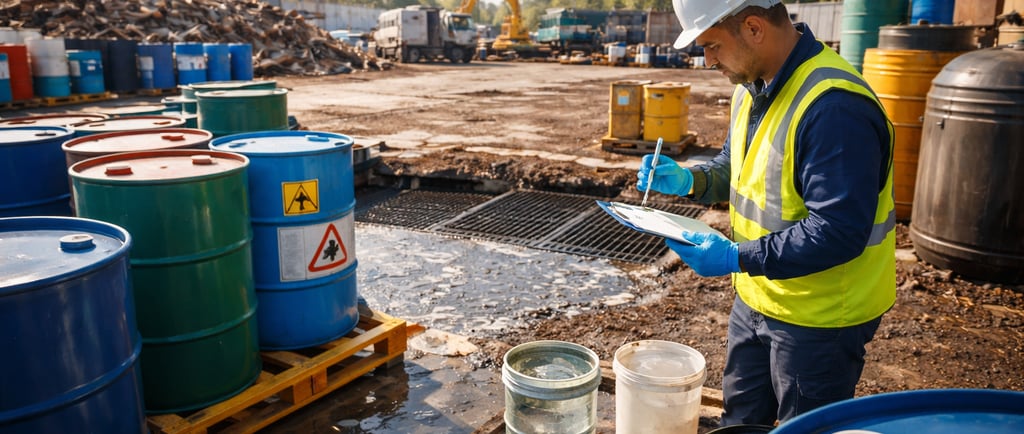
PFAS is now a yard problem, even if you do not manufacture chemicals.
If you run a scrap yard, recycling yard, waste transfer site, logistics yard, port terminal, landfill, or industrial depot, you store, use, and discharge more chemicals than most teams realize. PFAS enters that picture because it can hide inside common products, it persists in soil and water, and regulators now treat certain PFAS like long-tail liabilities.
You do not need a single “PFAS product” label on a drum for PFAS risk to exist. PFAS can sit inside firefighting foams, surface treatments, coatings, sealants, de-icers, detergents, repellents, and specialty lubricants. The risk climbs fast at sites with wash pads, stormwater collection, retention ponds, sumps, oily-water separators, leachate systems, or any history of foam use.
PFAS scale and why it keeps showing up
PFAS is not one chemical. It is a large family. OECD has identified over 4,700 PFAS by CAS number, and regulators also reference far larger “universe” counts depending on definitions and data sources. OECD+2kemi.se+2
This matters for your audit. You are not hunting for a single ingredient. You are building a way to spot a broad class of compounds that often appear under trade names, generic descriptors, or mixtures.
The regulatory signal is clear and getting stricter
You can treat PFAS as a compliance line item, or as a business risk category. Regulators are pushing it into the second bucket.
United States, liability trigger
EPA finalized the designation of PFOA and PFOS as hazardous substances under CERCLA. That expands cleanup and reporting exposure tied to releases and contaminated media. EPA+1
EPA also set national drinking water limits in 2024 for several PFAS. It later announced in May 2025 that it would keep the PFOA and PFOS limits while revisiting parts of the broader 2024 package, including timelines and some other PFAS components. The direction stays the same, lower allowable exposure and higher scrutiny. EPA+2EPA+2
European Union, broad restriction pathway
ECHA published the PFAS restriction proposal targeting around 10,000 PFAS under REACH, with ongoing evaluation updates through 2025. European Chemicals Agency+2European Chemicals Agency+2
The European Commission also moved to restrict PFAS in firefighting foams, with the measure taking effect by the end of October 2025 and transition periods that vary by use case. Reuters
Your yard takeaway
If you have foam, runoff, or any off-site discharge pathway, you have a real exposure route. If you have older site history, you also have legacy risk.
The financial signal is also clear
PFAS is now a litigation and settlement domain with large numbers attached. 3M announced it would exit all PFAS manufacturing by the end of 2025 and disclosed PFAS-related sales of about $1.3 billion with estimated EBITDA margins around 16%. 3M News Center+1
3M also reached a major settlement with public water suppliers, with public reporting placing it in the $10.5 to $12.5 billion range depending on participation and terms. 3M Company+1
In parallel, PFAS litigation and state actions continued to produce large settlements in 2025, including New Jersey’s agreement with Chemours, DuPont, and Corteva. Reuters+1
You do not need to be a manufacturer to get pulled in. If your site becomes a source area, your cost stack can include sampling, emergency response, treatment, disposal, legal, and insurance friction.
Why a “PFAS-free yard” belongs in your operations plan
PFAS control is not only a chemical topic. It hits core operating systems:
Stormwater and discharge performance
PFAS moves with water. Any leak, washdown, or firewater event can become a site-wide migration issue.
Safety systems
Fire suppression matters. Many sites used AFFF because it worked. Now the transition is underway. FAA has published transition guidance for fluorine-free foam for aircraft firefighting, and airports are actively switching. Federal Aviation Administration+2portseattle.org+2
Waste classification and disposal routes
If you identify PFAS in certain wastes, your disposal options can narrow. Costs can rise. Lead times increase.
Customer and investor diligence
Large buyers, insurers, and lenders increasingly ask for proof. CDP reports that hundreds of financial institutions representing tens of trillions in assets request environmental disclosure from companies. That pressure flows down supply chains. CDP
The audit roadmap, what you do before Step 4
Your goal in Part 1 is simple.
You build a complete chemical map.
You identify where PFAS can exist and where it can escape.
You phase out what you can, then control what you cannot.
Step 1: Build your chemical inventory and map every touchpoint
Most yards think they have a chemical list. They usually have a purchasing list. That is different.
Build an operational inventory. Capture what is used, where, why, and how it leaves the site.
Set the audit boundary
Include all chemicals and chemical-containing products used for:
Maintenance shops, degreasers, solvents, penetrants, brake cleaners.
Mobile equipment, hydraulic fluids, greases, coolant additives, cutting fluids.
Wash pads and fleet washing, detergents, surfactants, rinse aids.
Stormwater and wastewater treatment, flocculants, coagulants, pH control, filter media.
Dust suppression and odor control, binders, neutralizers, deodorizers.
Fire suppression and training, foam concentrates, premixes, system additives.
Facility materials that contact water, sealants, coatings, floor finishes, liners.
Build a “where used” map
Walk the site with operations and maintenance.
Mark each chemical use point and each exit pathway.
High-risk yard zones usually include:
Foam storage and fire pump rooms.
Maintenance bays with floor drains.
Wash bays, sumps, trench drains, oil-water separators.
Storm drain inlets, catch basins, retention ponds.
Leachate tanks and tanker loading points.
Scrap cutting zones where fluids and residues collect.
PPE storage and laundering areas, if you handle contaminated gear.
Collect the documents, then assume gaps exist
Gather:
Safety Data Sheets for each product.
Technical Data Sheets and product specs.
Purchase history, at least 24 months.
Supplier declarations, if available.
Reality check. SDS often fails as a PFAS detector for three reasons:
PFAS can sit inside proprietary mixtures.
Some PFAS may not be listed at low concentrations.
Polymers and treatments can appear under broad descriptors.
So treat SDS as your starting point, not your proof.
Create a simple yard-ready inventory record
For each item, record:
Product name and supplier.
Intended use and process step.
Average usage frequency.
Storage location and maximum on-site volume.
Where it goes after use, drain, container, rag waste, off-site pickup.
Primary release pathway risk, water contact, heat, spray, aerosol.
This inventory is your baseline. Without it, Step 4 procurement rules and training will miss real exposures.
Step 2: Screen for PFAS, then confirm with supplier proof or testing
You need two layers here.
A fast screen to rank the pile.
A confirmation method to avoid false confidence.
Run a PFAS screen on your inventory
Flag products tied to known PFAS categories:
AFFF and legacy firefighting foams.
Water, oil, or stain-repellent treatments.
Anti-stick or low-friction coatings and sprays.
Certain specialty surfactants in cleaners and wetting agents.
Fluorinated sealants and surface treatments.
Also flag any product where:
The SDS shows fluorinated ingredients.
The SDS uses vague proprietary language.
The supplier refuses full disclosure.
Use supplier disclosure that is specific enough to matter
Ask suppliers for:
A statement on intentionally added PFAS.
CAS numbers, when applicable.
A threshold definition they used.
A list of PFAS restricted or tested for.
If your supplier cannot answer in writing, treat the product as suspect until proven otherwise.
Decide where you actually need lab work
Testing costs money. Use it where it changes decisions.
Testing makes the most sense when:
A chemical sits in a high-volume process with water contact.
A product ties to foam, washdown, or spill history.
You have discharge permits and community sensitivity.
You plan a major chemical swap and need proof.
Common testing targets at yards:
Stored foam concentrates and premix tanks.
Wash bay effluent, sumps, and separator outlets.
Stormwater outfalls and first-flush points.
Sediment in catch basins and retention ponds.
Soil near foam use or training zones.
Rank PFAS risk using yard logic
Build a simple risk score using:
Likelihood of PFAS presence.
Volume and frequency of use.
Water contact probability.
Ease of substitution.
Regulatory sensitivity for your region and permits.
Consequence if released, off-site migration potential.
This ranking drives Step 3. It also sets up Step 5 metrics later.
Step 3: Phase out, substitute, and control the remaining exposure points
Now you act. Do not try to fix everything at once.
Start with the “big three” for many yards
Firefighting foam, especially older AFFF.
Wash and maintenance chemistries that go to drains.
Treatment and deodorizer products that touch water and air pathways.
Replace PFAS-containing foams in a controlled transition
Foam changes require safety validation.
Use the transition playbook seen in airport and ARFF contexts:
Confirm your site’s fire risk classes and system requirements.
Select fluorine-free foam that meets your performance standard.
Flush and decontaminate systems correctly, so PFAS residue does not re-contaminate new foam.
Document the change, including disposal of legacy foam.
FAA’s fluorine-free foam transition work shows how formal this process has become in aviation contexts. That same discipline applies to any high-consequence industrial yard system. Federal Aviation Administration+2Federal Aviation Administration+2
Substitute yard chemicals with proof, not marketing
When you replace a chemical, require:
Performance testing on your actual equipment.
Compatibility checks for seals, hoses, and materials.
Waste impact review, does the new product create a different hazardous stream.
Documentation, so you can show what changed and why.
Add engineering controls where substitution is slow
If you cannot swap immediately:
Increase secondary containment.
Close drain pathways in high-risk zones.
Add capture and treatment steps for wash water.
Tighten spill response playbooks for chemical handling points.
Lock in disposal and legacy management
Your audit should produce a “legacy list,” items you remove from service and must dispose of correctly.
Track where it went, who took it, and what documentation you have.
This is the foundation you need before culture, procurement policy, training, and dashboards can work at scale.
At this point, you have:
A full chemical map.
A ranked PFAS risk list.
A set of completed and planned phase-outs.
Controls on the hardest pathways.
Now you move from project mode to operating mode, so the gains stick and do not drift.
Step 4: Embed PFAS-Free Best Practices in Your Operational Culture
Implementing PFAS-free chemicals is a major win, but sustaining these gains takes continual attention and systemic changes. Leading organizations don’t settle for one-time swapsthey embed PFAS-free sourcing and sustainable chemical management into their daily operations and company culture.
Create a PFAS-Free Procurement Policy
Explicit Chemical Restrictions: Draft procurement guidelines that explicitly ban PFAS-containing materials unless absolutely mission-criticalwith clear exceptions subject to management review.
Supplier Codes of Conduct: Integrate PFAS-free expectations into vendor agreements and onboarding processes.
Ongoing Supplier Audits: Regularly audit chemical suppliers, both through documentation and on-site checks, to ensure sustained compliance.
Train Employees for “PFAS Vigilance”
Comprehensive Training: Offer targeted workshops for teams handling chemicalsoperations, maintenance, EHSon identifying PFAS compounds and safe handling/disposal.
Reporting Mechanisms: Create an accessible channel for employees to flag suspect chemicals or processes for further investigation.
Continuous Learning: Use digital learning modules and update your training as PFAS regulations or best practices evolve globally.
Upgrade Tracking and Data Integration
Chemical Tracking Software: Invest in solutions that use barcoding, RFID, or IoT sensors to provide real-time tracking of chemical use, emissions, and lifecycle data from procurement to disposal.
Centralized Dashboards: Implement data platforms that make it easy to visualize PFAS inventories, regulatory compliance gaps, and sustainability KPIs.
Step 5: Monitor and Communicate Results for Accountability
Measurement and transparency turn your PFAS-free efforts into a competitive advantage. Effective data collection and reporting also keep your organization compliant and ready for whatever regulatory shifts the future brings.
Key Metrics to Track
PFAS Chemical Phase-Out Rates: Quantify the percentage and total volume of PFAS chemicals removed from the yard over time.
GHG Emissions Reduction Attributable to PFAS Phase-Out: Calculate emissions avoided for each eliminated chemical using LCA and Scope 3 data.
Supply Chain Traceability Score: Track how many of your suppliers provide full PFAS disclosure and LCA-backed data.
Compliance Status: Monitor adherence to applicable PFAS regulations (EPA, EU REACH, state-level bans) and internal policy standards.
Cost-Benefit Analysis: Assess savings from avoidance of fines, reduced hazardous waste management, and lower insurance premiums.
Reporting Best Practices
Sustainability Reporting Standards: Align disclosures with frameworks like GRI (Global Reporting Initiative), SASB (Sustainability Accounting Standards Board), or CDP (Carbon Disclosure Project).
Annual Sustainability Reports: Share your PFAS-free progress, with data-backed highlights, in annual ESG (Environmental, Social, Governance) reports accessible to stakeholders and the public.
Transparent Crisis Communication: If a PFAS incident occurs, respond swiftly with clear facts, remediation plans, and timelines to maintain trust.
Case Studies: PFAS-Free Yard Operations Driving Sustainable Impact
Integrating real-world examples adds practical validation and showcases how organizations are achieving PFAS-free, lower-carbon operations:
Manufacturing: 3M’s PFAS Exit for Decarbonization
3M, a global manufacturing leader, announced in 2022 it would exit PFAS manufacturing by 2025. This move followed internal audits revealing that transitioning to PFAS-free processes would lower energy use and shrink Scope 3 emissions attributable to raw chemical inputs and waste streams. As a result, 3M is projecting future regulatory cost avoidance in the billions and aligning its chemical footprint with science-based decarbonization targets.
Waste Management: PFAS-Free Leachate Treatment
A North American waste management firm piloted PFAS-free deodorizers and cleaning agents in its landfill operations. Over two years, the company recorded an 18% reduction in facility Scope 1 and 3 GHG emissions associated with chemical use, alongside smaller hazardous waste bills and improved community relations. Key to success were rigorous supplier audits and a real-time dashboard monitoring all yard chemical use and emissions outputs.
Logistics: Firefighting Foam Transition
A global logistics company phased out PFAS-containing firefighting foams at all its distribution yards. Life Cycle Assessments revealed a significant decrease in downstream remediation emissions and liability exposure. The up-front investment was recouped within three years, thanks to lower insurance premiums, avoided regulation penalties, and enhanced ESG scores, attracting sustainability-minded clients.
Supporting Data: The Decarbonization and Compliance Imperative
The push for PFAS-free operations is not a passing trend. Consider these industry-wide statistics and regulatory insights:
Regulatory Escalation: As of early 2024, over 50 countries have introduced or expanded PFAS restrictions, and the U.S. EPA is moving to classify PFOA and PFOS as hazardous substances under CERCLA (Superfund law).
Financial Risk: Analysts estimate global remediation costs for PFAS-contaminated sitessuch as yards and manufacturing plantswill top $20 billion by 2030.
Investor Pressure: CDP reports that in 2023, 71% of institutional investors want comprehensive chemical transparency, with PFAS risks playing a growing factor in investment decisions.
Emission Factor: Studies in the Journal of Cleaner Production link PFAS manufacturing and application to significant energy use, water contamination, and end-of-life GHG emissions.
Looking Forward: PFAS-Free, Low-Carbon Yards are the New Industry Standard
Emerging trends signal that PFAS-free operations will soon become a baseline expectationmuch like renewable energy sourcing or zero-waste commitments.
Regulatory Pathways Tightening
Expect rapid adoption of stricter PFAS limits worldwide, with the EU’s Chemicals Strategy for Sustainability setting a “zero pollution ambition.” U.S. EPA legislation will intensify reporting and clean-up obligations, making proactive PFAS auditing a business necessity.
Green Chemistry Innovation Rising
Green chemistrya holistic, science-driven approach to chemical selectionis fueling a new generation of PFAS-free, low-carbon alternatives that outperform legacy products. By 2026, analysts predict the global PFAS-free chemicals market will exceed $15 billion, driven by demand in sectors like construction, logistics, and industrial manufacturing.
Increasing Customer and Investor Expectations
Customers, governments, and investors are demanding full-lifecycle transparency on chemicals. ESG ratings, supply chain traceability, and third-party PFAS-free certifications will define brand credibility and determine access to markets, contracts, and even capital.
Roadmap to Action: How to Lead in the PFAS-Free Decarbonization Era
Start Now: Delaying PFAS auditing only increases risk and cost. Launch multi-disciplinary audits and baseline your chemical footprint today.
Prioritize High-Risk Touchpoints: Target chemicals with the greatest PFAS concentration, emissions impact, and regulatory sensitivity first.
Engage the Value Chain: Build a partnership networkfrom suppliers to downstream userscentered on chemical transparency, data sharing, and green R&D.
Elevate Metrics and Disclosures: Upgrade digital infrastructure for live tracking, showcase PFAS-free milestones, and link efforts to your decarbonization narrative in public reports.
Fuel a Culture of Continuous Improvement: Make PFAS-free, low-carbon decision-making a standing agenda item for operations and sustainability leadership teams.
Conclusion: Why PFAS-Free Operations Are Critical for Sustainable Decarbonization
The journey toward a PFAS-free yard isn’t just about ticking boxes for compliance. It’s a golden opportunity to reimagine your operational footprint, cut hidden greenhouse gas emissions, and future-proof your enterprise against cascading regulatory, financial, and reputational risks.
By proactively auditing yard chemicals, mapping your risk-to-reward tradeoffs, and investing in supplier partnerships and digital tracking, you position your organization as an industry leader in both decarbonization and chemical stewardship.
In a world where the next sustainability breakthrough could be a yard away, the organizations that audit, innovate, and communicate on PFAS-free operations today will define tomorrow’s marketand help shape a safer, decarbonized planet.
Connect
Your trusted partner for scrap metal procurement.
CONTACT
About
haroon@tdcventures.com
+1-307-655-7593
© 2025. All rights reserved.
NEWSLETTER