
Pop-Up Cities: Demountable Housing with Reused Steel
Discover how circular pop-up cities built with demountable housing and reused steel can shelter climate migrants faster, cut carbon, and restore dignity. A complete deployment model, design scorecards, and real-world scenarios for humanitarian engineers, policy makers, and sustainability leaders.
CLIMATE-RESILIENT INFRASTRUCTURE & CIRCULAR MATERIALS
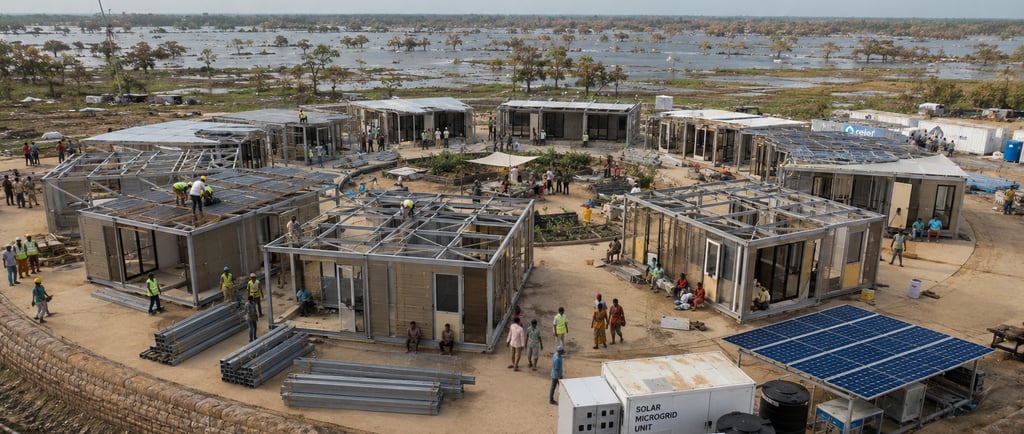
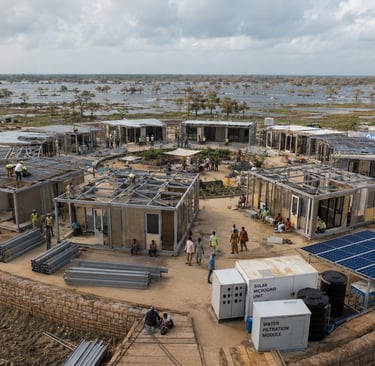
Context: The Urgency of Circular Pop-Up Cities for Climate Migration
The climate crisis is now the defining force behind global displacement trends. According to the World Bank’s Groundswell report, over 216 million people could become internal climate migrants by 2050 unless bold, coordinated action is taken. In 2022 alone, the Internal Displacement Monitoring Centre (IDMC) tracked 32.6 million new displacements from weather-related disasters—an unprecedented spike primarily driven by floods, storms, and drought.
This surge in mobility places immense pressure on governments, NGOs, and aid agencies to secure safe, humane, and promptly deployable living solutions for newly displaced populations. Yet, the current response toolbox falls short:
Tents or provisional shelters too often become semi-permanent slums, lacking dignity and climate resilience.
Conventional shipping container housing may offer rapid deployment but brings heavy carbon footprints and logistical bottlenecks.
Traditional construction is slow, waste-heavy, and ill-suited for situations that require flexibility and reversibility.
This is where the model of circular pop-up cities, built on demountable housing with reused steel and modular microgrids, becomes not only relevant but urgently necessary. These cities empower humanitarian actors to rapidly establish, adapt, and relocate quality accommodation cycles as needs shift—all while slashing embodied carbon, minimizing waste, and upholding human dignity.
Why Responding with Circularity Matters Now
The traditional "build-dispose-rebuild" approach is now recognized as unsustainable both environmentally and financially. The steel industry alone contributes to roughly 7% of global CO₂ emissions (IEA). By closing material loops—prioritizing steel reuse and designing for full modular demountability—responders can address several critical objectives simultaneously:
Reduce landfill and material loss: Reuse of structural steel can decrease construction waste by up to 80%.
Decrease carbon emissions: Every ton of reused steel prevents ~1.5 tons of CO₂ compared to new production.
Accelerate response times: Modular demountable kits with standardized connectors enable assembly rates ten times faster than traditional builds.
Leverage local circular economies: Sourcing, fabrication, and assembly can empower local trades and businesses, enhancing long-term resilience.
2. Problem and Opportunity: Rapid Deployability, Circularity, and Human Dignity
The Triad of Pop-Up Shelter Success
1. Speed:
When cyclones hit or rivers flood, each day’s delay exacerbates health risks, exposure, and vulnerability. The challenge: move from disaster to dignified dwelling in days. With demountable housing kits pre-packed for instant assembly, it becomes possible to shelter thousands—rapidly and reliably.
2. Circularity:
Climate migration cannot be addressed with single-use thinking. Typical temporary housing generates mountains of waste, and humanitarian crises are rarely "one and done." Pop-up cities redefine the life cycle: every structure is designed for repeated use, full deconstruction, and seamless reintegration into the next deployment. Circular supply chains for steel, solar assets, and even water modules become key.
3. Humaneness:
Emergency shelters often lack privacy, safety, or basic amenities—undermining dignity during already traumatic times. Circular demountable housing brings generous space standards, sound insulation, secure entrances, thermal comfort, and adaptable layouts, substantially improving well-being and supporting community cohesion.
Tackling Systemic Gaps: Where Opportunity Lies
Bridging the Deployment Gap:
Traditional procurement and shipping can take weeks or months. Localized, circular supply networks with standardized reused steel elements—and locally trained assembly teams—make it possible to scale up at unprecedented speed.Reducing Waste and Increasing Value:
Non-circular relief models create “waste problems” for host countries and erode recovery budgets. Structured circularity not only reduces landfill but extracts value from every recovery and redeployment cycle.Enabling Future-Ready Infrastructure:
As climate shocks increase, multi-use, modular infrastructure offers a resilient foundation for both emergency and long-term development. By prioritizing design for adaptability and integration with clean energy microgrids, pop-up cities become stepping stones to greener futures.
Industry Perspective:
Major steel firms like ArcelorMittal, startups such as MASS Design Group, and humanitarian alliances (e.g., the Global Shelter Cluster) are all investing in circular design and local steel reuse. These collaborative models bring together engineers, urban planners, and public policy experts to accelerate rapid deployment while keeping sustainability and occupier dignity at the core.
3. Key Concepts: Demountable Housing, Reused Steel, Microgrids, Circular Infrastructure
Demountable Housing
Demountable housing refers to structures designed for both rapid assembly and easy, tool-light disassembly. These aren’t one-off kits; they’re modular, standardized building blocks—walls, frames, floors, connectors—that fit together without specialized labor, tools, or heavy machinery. When the site or needs change, units can be unbolted, packed flat, and redeployed or reassembled elsewhere.
Distinct Features:
Snap-fit or bolt-together joints improve speed and minimize tool needs.
Panels and modules are standardized in size and shape for easier reuse.
Foundation systems (like helical piles or modular skids) ensure adaptability on variable terrain.
“Plug-and-play” service cores enable fast wiring, plumbing, and microgrid linkage.
Reused Steel
Reused steel is sourced from dismantled buildings, bridges, warehouses, or other structures slated for end-of-life. Unlike recycled steel (which is melted down for new production), reused steel maintains its original form and inherent strength, dramatically reducing the environmental and financial costs of shelter provision.
Why It Matters:
Lower Embodied Carbon: Studies show reused structural steel can reduce global warming potential by 80–96% compared to new steel.
Local Sourcing: Urban areas often harbor vast “urban mines” of decommissioned steel, making supply chains less reliant on global shocks.
Circularity at Scale: With robust certification standards (such as the REUSE-Steel Protocol), safety and quality are guaranteed.
Microgrids
Microgrids provide decentralized, site-adaptable power generation—typically through solar PV panels, wind turbines, or hybrid battery-backed setups. In pop-up cities, modular microgrids:
Offer instant access to lighting, device charging, heating/cooling, water pumps, and communications.
Slash reliance on diesel generators (delivering up to 80% carbon reduction).
Are sized to match evolving population needs and can be expanded, moved, or downsized as sites evolve.
Circular Infrastructure
Circular infrastructure means more than just reusing structural steel. It encompasses:
Sourcing all building components to maximize future reuse or upcycling.
Designing every element—from wall panels and fasteners to energy and water systems—for efficient recovery and minimal waste.
Employing digital twins for real-time material traceability and fast remediation.
Key Standards:
ISO 20887: Design for deconstruction and adaptability in buildings.
European Green Deal Circular Economy: Emphasizes reuse and extended producer responsibility for infrastructure assets.
4. Core Framework: The Pop-Up City Deployment Model
Deploying demountable, circular housing at scale demands a proven, repeatable, and efficient framework. The Pop-Up City Deployment Model below integrates operational excellence, circular design, and actionable best practices from real-world disaster recovery, humanitarian engineering, and modular construction.
Pop-Up City Deployment Model in Practice
1. Needs and Site Assessment
Population Sizing: Accurately determine displaced numbers (families, vulnerable subgroups, medical needs).
Land & Legality: Confirm land tenure or access arrangements to accelerate mobilization.
Hazard Analysis: Map exposure to secondary risks—floods, landslides, heatwaves, disease.
Local Resources: Inventory local deconstruction sites/facilities for reclaimed steel, identify existing logistics corridors, and evaluate renewable energy potential by climate zone.
Community Engagement: Include local leaders, future residents, and volunteers early to ensure needs-appropriate solutions and smoother assemblies.
2. Material Sourcing and Design
Steel Supply Agreements: Establish contracts with demolition operators, scrap yards, or commercial developers to source certified, process-ready reused steel.
Inventory Mapping: Match available steel sections and panels to modular design templates (e.g., universal 600mm x 2.4m wall panels, standard I-beam lengths).
Kitted Design: Develop modular housing kit BOMs with detailed assembly instructions, trimming out bespoke components to speed up manufacturing.
Design for Assembly: Ensure every connector, panel, and service module fits simple assembly tools and skills.
3. Fabrication and Pre-Deployment
Prefabrication: Batch-build walls, floors, roofs, and integrated service cores in controlled environments, optimizing for reused steel integration.
Microgrid & Utility Prep: Pre-wire power hubs and water purification modules, ready for plug-and-play connection.
Kit Labeling: Color-coding, QR codes, and part numbers streamline rapid on-site assembly and asset tracking.
4. Assembly and Commissioning
Just-in-Time Transport: Use flatbed trucks, rail, or shipping containers, enabling efficient delivery even to remote or flooded areas.
Phased Assembly: Prioritize shelter before community or clinic build-outs.
On-Site Training: Engage local trades for “train-the-trainer” sessions, multiplying speed and building local skills.
Systems Activation: Bring microgrid, water, and sanitation online as units are finished—avoiding “shelter without services.”
5. Operation, Decommissioning, and Recovery
Continuous QA: Use digital checklists and real-time mobile reporting for maintenance, repairs, and usage monitoring.
Decommissioning Planning: Build-in full demount instructions from day one, ensuring clear assembly logs for future moves.
Circular Recovery: Feed all demounted steel and reusable modules back into stock for new builds, closing the loop.
5. Step-by-Step Example: Deploying a Pop-Up City for Flood Refugees (In-Depth Scenario)
Imagine a major riverine flood displaces 25,000 people in Bangladesh’s delta. Here’s how a circular, rapid deployment unfolds:
Assessment:
A joint task force—government, UNHCR, regional NGOs—quickly maps affected areas, confirming 5,000 families in need. They secure a 20-hectare elevated site, with initial legal clearances and transport access.
Material Sourcing:
The engineering lead secures contracts for 1,200 metric tons of reused steel, sourced from recently deconstructed high-rise and port warehouse sites in Dhaka. Local trades prepare the steel (cutting, cleaning, certifying per ISO/REUSE guidelines).
Design:
Engineers adapt modular 22m² shelter units to maximize use of available I-beams and C-sections, creating snap-fit designs. Mobile assembly platforms pair these with regionally sourced insulated wall panels for thermal comfort in the humid climate.
Fabrication:
A nearby prefabrication hub produces frame modules, standardized flooring and roof elements, and pre-fit microgrid panels with 1.5kWp solar per home.
Transport:
Within four days, over 1,000 kits are shipped by flatbed to the relief site; overflow moves by river barge. Materials are color-coded for end-user clarity.
Assembly:
Teams of local workers, trained in advance with digital guides, erect 400 shelters a week, ramping up with skilled oversight. Every home is powered, water points operate from day one, and community clinics are completed within 10 days.
Operation:
For 18 months, the settlement sustains itself, with 98% microgrid uptime, low maintenance needs, and >4.0 satisfaction scores reported via digital survey. At event’s end, every demountable is unbolted and stored for future crisis cycles.
Recovery:
Of 1,200 tons of steel, less than 2% is lost or scrapped—most is remanufactured for permanent affordable housing in safer locations.
6. Implementation Playbook: From Supply to Standing City
Delivering circular, pop-up cities isn’t just a technical feat—it’s a logistical and social challenge requiring methodical, best-practice action. Here’s a detailed step-by-step playbook optimized for field realities and circular construction NLP:
Conduct rapid site analysis (demographics, land, hazards, regulatory status).
Quantify infrastructure needs (housing, clinics, support).
Map circular supply: tap local and regional reused steel and allied material sources.
Vet local partners for prefab and on-site assembly ability.
Choose modular templates fitting available reused steel inventory.
Assess microgrid and clean energy infrastructure; source modular, scalable units.
Draft precise bills of material for buildings, kits, and shared facilities.
Pre-assemble kits, embed traceable QR labelling and digital instructions.
Plan logistics: prioritize roads, rail, or boats resistant to damage or delay.
Train assembly teams and certify local supervisors.
Run “pilot build”: deploy one unit, audit, update docs, fix snags.
Roll out phased, zone-based build (shelter, community, peripheral support).
Activate microgrids and basic water/sanitation as shelters are completed.
Embed two-way feedback (digital kiosks, SMS, or paper complaints) for adaptation.
Deploy mobile QA: monitor assembly, perform ongoing safety and maintenance.
Conduct audits: monitor traceability, ensure compliance with recovery KPIs.
Schedule periodic demountability and circularity reviews, plan for next deployment cycles.
Integrate operational data with supply and accountability dashboards.
Decision Points and Failure Mode Mitigation
Steel Shortage: If reused steel supply lags, use hybrid models with light-gauge new steel (<20%) and carbon offsets.
Difficult Sites: Where terrain limits access, use elevated or modular footings.
Microgrid Delays: Deploy battery-solar rapid-response kits at outset.
Local Skills: Prioritize “assembly-while-learning” models—train, assemble, hand off.
Common Pitfalls:
Underestimating delays in cross-border supply.
Skipping QA checks on reused steel quality and load-bearing capacity.
Failing to integrate feedback from local contractors or users.
Unplanned site conditions causing re-engineering delays.
7. Circular Design Scorecards: How to Measure Whether a Pop-Up City Is Truly Reusable
A circular pop-up city should not be judged only by how fast it goes up. Speed matters, but speed without recovery creates the same waste problem in a different format. A demountable housing system must prove that its steel, panels, fasteners, energy assets, water systems, and interior components can move through multiple deployment cycles with minimal loss.
This matters because displacement is no longer a rare emergency event. IDMC reported 83.4 million people living in internal displacement at the end of 2024, more than double the figure from 2018. Disaster and conflict shocks are also overlapping more often, which means temporary settlements are being used longer, moved more often, and placed under heavier operational pressure. A shelter system built for one short emergency cycle is no longer fit for the real pattern of global displacement.
A strong circularity scorecard should measure five things: reuse, recovery, speed, dignity, and cost per cycle. Each one tells a different story.
Structural Reuse Score
The first metric is the percentage of structural steel recovered in usable condition after decommissioning. A strong target is 90% or higher. A best-in-class target is 95% to 98%, especially when the system uses bolted connections, protected sections, low-damage foundations, and clear assembly records.
This score should track:
Percentage of reused steel in the original build
Percentage of reused steel recovered after takedown
Percentage of steel redeployed without melting
Number of deployment cycles completed per steel component
Damage rate per assembly and disassembly cycle
Percentage of steel requiring recertification, repair, or downgrading
The key difference is between recycling and direct reuse. Recycling steel still has value, but it requires collection, transport, sorting, melting, casting, rolling, and redistribution. Direct reuse avoids much of that process. Since the steel sector accounts for about 7% of global energy-related CO₂ emissions, the avoided emissions from reuse are material, especially when large settlements require hundreds or thousands of tonnes of structural material.
Assembly Speed Score
A demountable settlement must also prove that it saves time in the field. Assembly speed should not be measured only by the first pilot unit, because first units are always slower. Measure it across three stages:
First unit assembly time
First 50-unit batch assembly time
Full settlement daily completion rate after teams are trained
For emergency shelter, useful targets include:
First demonstration unit completed within 1 day
Trained crew completing 2 to 4 housing units per day, depending on unit size
Settlement zone with shelters, basic lighting, water access, and sanitation activated within 7 to 14 days
Health post, distribution point, and community support spaces live within 10 to 21 days
Modular construction can shorten build timelines because major components are prepared off-site under controlled conditions. The Modular Building Institute describes modular construction as off-site building using the same codes and materials as conventional construction, with projects often completed in about half the time compared with traditional site-built methods.
Shelter Dignity Score
Emergency housing often fails because it meets the minimum physical requirement but ignores privacy, heat, safety, disability access, and daily routine. A proper scorecard must include human dignity as a technical outcome.
UNHCR’s emergency shelter guidance sets a minimum of 3.5 m² of covered living space per person in tropical or warm climates, excluding cooking facilities, with a minimum height of 2 m at the lowest point. Settlement planning guidance also refers to 45 m² per person as a recommended planned settlement standard when land allocation includes shelter plots, roads, footpaths, sanitation, water storage, distribution points, administration, and household gardens.
A demountable housing system should aim higher than minimum survival space where land and funding allow. Useful dignity indicators include:
Covered living area per person
Thermal comfort during peak heat and cold
Ventilation rate and indoor air quality
Lockable doors and secure openings
Lighting inside and outside units
Separate sleeping space for family privacy where culturally appropriate
Accessible units for older people, pregnant women, injured residents, and people with disabilities
Safe walking distance to toilets, water points, clinics, and distribution areas
Women’s safety feedback collected through confidential channels
Resident satisfaction score tracked monthly
A pop-up city fails if it can be assembled quickly but leaves people exposed, unsafe, or humiliated. The real goal is a temporary city that protects recovery, family life, education, health, and social stability.
Energy Resilience Score
A pop-up city must be judged by how well its energy system performs once the first week of deployment passes. Diesel generators are common in humanitarian operations, but fuel logistics can become expensive, dangerous, and unreliable. Solar hybrid microgrids with batteries can reduce operating cost, reduce emissions, and cut fuel dependence.
A study of solar-diesel hybrid mini-grids in Nyabiheke refugee camp in Rwanda found that renewable and hybrid systems could reduce total costs by up to 32% and emissions by up to 83% compared with diesel-only systems, with payback periods from 0.9 to 6.2 years depending on design.
A strong energy scorecard should track:
Microgrid uptime
Diesel fuel avoided per month
Solar share of total electricity
Battery autonomy during cloudy periods or night use
Cost per kWh delivered
Critical load reliability for clinics, lighting, water pumps, communications, and refrigeration
Repair time for failed inverters, batteries, and distribution points
Percentage of energy assets recovered and redeployed after settlement closure
The energy system should be modular like the housing system. Start with life-safety loads, then expand to household lighting, charging, cooling, education spaces, refrigeration, and small enterprise activity.
Cost Per Use Cycle
A circular pop-up city may look more expensive at first purchase than tents, tarpaulins, or basic container conversions. That comparison is incomplete. The correct metric is cost per use cycle.
A reusable steel housing kit used once may be costly. The same kit used five times changes the economics. The same kit used ten times, with repairable panels, replaceable fasteners, reusable foundations, and recoverable microgrid assets, becomes a long-term emergency infrastructure asset.
A practical cost scorecard should include:
First deployment cost per household
Transport cost per deployment
Assembly labor cost per unit
Maintenance cost per month
Energy cost per resident
Decommissioning cost
Storage cost
Repair cost before redeployment
Residual material value
Number of completed use cycles
Cost per occupied household month across all cycles
The aim is not to make emergency housing cheap at any cost. The aim is to prevent recurring waste, repeated procurement, repeated shipping, and repeated failure.
8. Advanced Deployment Scenarios: How Demountable Steel Cities Adapt to Different Crisis Types
A circular pop-up city cannot be designed around one ideal site. Real crises are messy. The road may be gone. The land may be disputed. The climate may be too hot, too wet, too cold, or too remote. A serious demountable housing model must work across several deployment scenarios.
Scenario A: Flood Displacement in South Asia
Flood displacement requires speed, elevation, drainage, and water-safe material handling. In low-lying regions, a pop-up city must avoid becoming the next flood casualty. Housing units should sit on raised modular footings, helical piles, steel skids, or elevated platforms. Drainage channels, greywater routing, and protected electrical distribution must be planned before the first units arrive.
The 2022 Pakistan floods showed how quickly climate-linked disasters can overwhelm shelter systems. Millions were affected, and large areas remained waterlogged for extended periods. In this context, demountable steel housing offers two major advantages: frames can be raised above flood-prone ground, and components can be removed before the site becomes unsafe again.
For a flood scenario, the housing kit should prioritize:
Raised floors
Corrosion-protected reused steel
Ventilated wall and roof assemblies
Non-absorbent lower wall panels
Elevated battery and inverter cabinets
Walkways above mud and standing water
Drainage-first site layout
Quick replacement of damaged panels
Community kitchens and clinics placed on the highest ground
The biggest mistake in flood displacement response is treating the shelter as separate from drainage. A unit may be structurally sound, but if the surrounding paths become mud, toilets flood, water points fail, or power systems sit too low, the settlement becomes unsafe.
Scenario B: Heatwave and Drought Migration in North Africa and the Middle East
Climate migration is not only caused by sudden disasters. It can also emerge from slow-onset pressure, including water scarcity, crop decline, and extreme heat. The World Bank’s Groundswell work projects that climate change could force 216 million people to move within their own countries by 2050, with migration hotspots emerging as early as 2030. It also states that early climate and development action could reduce the scale of internal climate migration by as much as 80%.
In hot, dry regions, pop-up cities must prioritize passive cooling before mechanical cooling. Solar-powered cooling has value, but poor envelope design can make energy demand spiral. Reused steel frames should be paired with insulated panels, reflective roof surfaces, shaded outdoor areas, cross-ventilation, and protected courtyards.
A heat-focused pop-up city should include:
Deep roof overhangs
Shade structures over pathways and gathering spaces
Light-colored roof skins
Ventilated roof cavities
High-level vents for hot air escape
Low-energy fans before air conditioning
Solar microgrid sized for cooling peaks
Water-saving fixtures
Greywater reuse where safe and permitted
Heat-safe clinic and cooling room access
The settlement layout matters as much as the unit. Narrow heat-trapping corridors, unshaded queues, long walks to water points, and exposed distribution lines all increase risk. In extreme heat, a pop-up city should be planned as a shade and water system first, then as a housing layout.
Scenario C: Urban Earthquake Response
Urban earthquakes create a different challenge. The displaced population may not want to leave the city because jobs, schools, hospitals, family networks, and property claims remain there. Land is limited. Roads may be blocked. Heavy machinery may be unavailable. At the same time, damaged buildings may contain recoverable steel.
This is where local urban mining can become part of the shelter response, but only with strict safety controls. Reused steel from damaged buildings should never be used without inspection, grading, traceability, and structural approval. The opportunity is not to improvise with unsafe materials. The opportunity is to recover steel from controlled demolition, sort it, certify it, and feed it into modular housing or community infrastructure.
Urban earthquake pop-up cities may use:
Small-footprint multi-unit layouts
Stackable low-rise modules where codes allow
Shared service cores
Rooftop or canopy solar where ground space is limited
Temporary clinics and classrooms
Steel-framed community kitchens
Noise-control panels
Firebreaks and safe access routes
Clear address systems for aid delivery
In urban settings, the biggest risk is unplanned density. Families may accept cramped space at first, but overcrowding quickly increases fire risk, disease risk, gender-based safety concerns, and mental stress. Demountable steel systems should support expansion, reconfiguration, and conversion from emergency shelter to transitional housing when the site remains active longer than expected.
Scenario D: Island and Coastal Storm Recovery
Island and coastal communities face high transport costs, salt exposure, wind risk, limited storage, and fragile local infrastructure. Shipping conventional housing materials can be slow and expensive. A demountable steel system for island deployment must be compact in transport, corrosion-resistant, and able to lock down against high wind.
For coastal storm recovery, design priorities include:
Hot-dip galvanized or otherwise protected steel
Stainless or coated fasteners in exposed areas
Wind-rated connections
Raised anchoring systems
Compact flat-pack transport
Rainwater capture
Solar-battery kits with protected housings
Spare parts stored locally
Repair training for local crews
The circular advantage is clear. Instead of importing low-quality temporary structures after every cyclone or hurricane season, agencies and governments can maintain regional stockpiles of reusable kits. After each deployment, the kits are cleaned, repaired, audited, and stored for the next season.
Scenario E: Long-Stay Refugee Settlement Upgrade
Many settlements planned as short-term solutions become long-term living environments. Rohingya camps in Bangladesh show the strain created when displacement lasts for years under funding pressure, crowding, extreme weather exposure, and restricted livelihood options. Reuters reported in June 2026 that around 1.2 million Rohingya refugees were in Bangladesh, with about 150,000 new arrivals since early 2024, while funding shortfalls were putting food, shelter, health, and education services under pressure.
In long-stay settlements, the question is no longer only “How fast can we shelter people?” It becomes “How do we prevent temporary shelter from turning into unsafe permanent poverty?”
A demountable steel upgrade model can replace failing shelters in phases without forcing full relocation. It can add stronger roofs, safer doors, better ventilation, solar lighting, raised walkways, community buildings, and repairable frames. It can also support training programs so residents gain paid skills in assembly, maintenance, energy systems, and safe deconstruction.
For long-stay settlements, useful additions include:
Repair workshops
Resident maintenance teams
Women-led safety audit groups
Youth training in assembly and electrical safety
Community storage facilities
Clinics with reliable power
Classroom modules
Market stalls made from reusable steel frames
Material banks for spare parts
Digital records for each housing unit
The value of demountability is not only relocation. It is controlled improvement without starting from zero.
9. Enhanced Toolkits for Governments, NGOs, Donors, Engineers, and Steel Suppliers
A circular pop-up city requires coordination across groups that do not always work from the same priorities. Governments need legal clearance and public order. NGOs need speed and protection. Donors need accountability. Engineers need safety. Steel suppliers need predictable demand. Residents need dignity, privacy, and stability.
The following toolkits translate the model into practical workstreams.
Government Toolkit: Policy, Land, Procurement, and Permits
Governments decide whether pop-up cities move quickly or get trapped in paperwork. A rapid shelter program needs pre-approved land pathways, emergency procurement rules, building safety acceptance, local labor channels, and clear environmental requirements.
A government readiness toolkit should include:
Pre-identified emergency settlement land
Hazard maps for flood, landslide, heat, fire, and storm exposure
Legal templates for temporary land use
Fast-track permits for demountable structures
National standards for reused steel inspection
Procurement rules that allow reuse, not only new materials
Local fabrication partner registry
Emergency transport route plan
Customs relief for imported microgrid and water assets
Public health requirements for shelter density, sanitation, and ventilation
Decommissioning and site restoration rules
The most important policy shift is to treat demountable housing as public infrastructure, not disposable relief stock. Once a government owns or co-owns reusable kits, it can redeploy them across floods, earthquakes, heatwaves, fires, and conflict-related displacement.
NGO Toolkit: Field Delivery, Protection, and Resident Feedback
NGOs are often closest to residents, so their toolkit must focus on safe deployment and real feedback. A technically impressive settlement can still fail if women feel unsafe walking to toilets, children cannot study, older residents cannot access clinics, or families cannot cook in culturally acceptable ways.
An NGO field toolkit should include:
Household registration process
Vulnerability mapping
Resident committee setup
Women’s safety walk process
Child protection routing
Complaint and response channel
Shelter allocation logic
Maintenance ticket process
Local hiring plan
Community orientation material
Fire safety drills
Seasonal weather readiness checks
Decommissioning communication plan
Every household should know how to report a broken door, unsafe light, electrical issue, water failure, or protection concern. Every report should have a response time target. A circular shelter model must be repairable, but repair only works when problems are visible.
Donor Toolkit: Funding the Full Life Cycle
Donors often fund the visible emergency phase, but circular systems need funding across procurement, storage, maintenance, redeployment, repair, and audit. If donors pay only for the first build, assets degrade between crises and the reuse promise fails.
A donor funding model should cover:
Initial kit purchase
Local fabrication setup
Assembly training
Material testing and certification
Microgrid purchase
Spare parts
Digital asset tracking
Storage facilities
Post-deployment repair
Third-party safety audits
Resident feedback systems
Decommissioning
Redeployment planning
A donor should ask for cost per occupied household month across multiple use cycles, not only cost per unit in the first deployment. This changes the funding conversation. A unit used across five deployments can justify stronger materials, better fasteners, and higher-quality service cores because the value is spread across years.
Engineering Toolkit: Safety, Testing, and Repeatability
Engineers must protect the model from unsafe shortcuts. Reused steel is not automatically usable steel. Every section needs traceability, inspection, grading, and approval. Each connection must be designed for repeated assembly. Every load path must be clear.
An engineering toolkit should include:
Reused steel acceptance criteria
Visual inspection checklist
Material grade verification process
Corrosion assessment process
Load-bearing design assumptions
Connection testing
Wind, snow, seismic, and flood load checks
Fire separation requirements
Foundation selection guide
Panel replacement method
Electrical safety guide
Microgrid grounding and protection rules
Deconstruction instructions
Redeployment inspection checklist
The engineering principle is simple. Reuse should reduce waste, not reduce safety. Any steel section that cannot be verified should be downgraded to non-structural use, recycled, or excluded.
Steel Supplier and Scrap Yard Toolkit: Turning Urban Mines into Shelter Supply
Scrap yards, demolition firms, steel fabricators, and developers can become critical partners in circular shelter systems. Their role is to create a predictable pipeline of reusable steel sections, not only sell metal by weight.
A supplier toolkit should include:
Inventory classification by beam, column, plate, tube, angle, and sheet
Length, thickness, grade, and condition records
Deconstruction-first recovery practices
Segregated storage for reusable structural steel
Cleaning and surface preparation
Cut-to-kit services
Certification documents
Transport bundling by shelter type
Digital inventory feeds for designers
Buyback or take-back agreements after deployment
This is especially important as scrap becomes more strategically important to low-carbon steel production. Research on the circular transformation of the European steel industry notes that scrap metal is becoming a strategic resource as electric arc furnace capacity grows and competition for scrap supply increases.
For pop-up cities, this creates both opportunity and risk. Opportunity comes from stronger local circular supply networks. Risk comes from future scrap competition that may increase prices. Long-term agreements with demolition companies, municipalities, and steel handlers can reduce that risk.
10. Frequently Asked Questions: Reused Steel, Safety, Cost, Speed, Microgrids, and Long-Term Use
Is reused steel safe enough for emergency housing?
Yes, but only when it is inspected, documented, and designed into the system properly. Reused steel should be treated like a certified structural input, not a random salvage material. Engineers need to verify section size, corrosion, deformation, previous damage, coating condition, and material grade. Where full structural certainty is not possible, the steel should be used for non-critical elements or sent to recycling.
The safest approach is to standardize the kit around common steel profiles. That allows repeat testing, known connection details, predictable load paths, and faster field approval.
Is reused steel better than recycled steel?
For circular construction, direct reuse is usually better when safety and logistics allow it. Recycled steel still needs melting and manufacturing. Reused steel keeps the original section in service, which can avoid a large share of embodied emissions. Since iron and steel remain one of the highest-emitting industrial sectors, material efficiency and reuse are major climate strategies. The IEA states that the sector directly accounts for 2.6 Gt CO₂ annually, about 7% of global energy-related CO₂ emissions.
Recycling should remain the fallback for damaged, unsuitable, or surplus material. Reuse should be the first option for verified sections.
Do pop-up cities risk becoming permanent camps?
Yes, if governments and agencies fail to plan for transition. This is why demountability matters. A demountable system gives planners more choices: move the settlement, shrink it, upgrade it, convert parts into permanent community infrastructure, or redeploy assets elsewhere.
The danger is not that shelters are too good. The danger is that temporary sites are created without legal pathways, livelihoods, services, education, and long-term recovery planning. Better housing must be paired with clear settlement governance.
Are demountable steel systems too expensive for humanitarian response?
They can be expensive if judged only by first-purchase cost. They become far more competitive when measured across multiple deployments. Tents and low-grade temporary shelters may look cheap at first but often require replacement, generate waste, and provide poor protection against heat, wind, rain, and long-term occupancy.
A proper comparison should include:
Purchase cost
Transport cost
Installation labor
Replacement frequency
Energy cost
Maintenance cost
Health and safety outcomes
Waste disposal
Recovery value
Number of redeployments
The unit that costs less on day one may cost more by year three.
Can local workers assemble these systems?
Yes, if the design is standardized and training is built into deployment. The best systems use simple bolted connections, repeatable modules, visual assembly guides, local-language instructions, and supervised first builds. Local assembly reduces dependence on international crews and leaves useful skills behind.
A strong training plan should include:
Safety briefing
Tool training
Connection practice
First-unit demonstration
Team-based assembly
Quality checks
Supervisor certification
Maintenance training
Deconstruction training
The goal is not to remove skilled engineers. The goal is to use engineers for design, testing, supervision, and critical checks while enabling local crews to build and maintain the settlement.
How much power does a pop-up city need?
It depends on climate, household size, service level, clinic needs, water pumping, refrigeration, lighting, communications, and cooling. A minimal emergency system may provide lighting, charging, clinic power, water pumping, and administration. A more advanced settlement may support fans, refrigeration, internet access, learning centers, small enterprises, and cold-chain storage.
The energy plan should start with critical loads:
Clinic equipment
Vaccine or medicine refrigeration
Water pumps
Security lighting
Communications
Charging hubs
Administrative systems
Then it can expand to household and community loads. Solar-battery microgrids can reduce diesel dependence, but they must be designed for local weather, dust, heat, theft risk, maintenance capacity, and spare part availability.
What happens when panels, doors, roofs, or fasteners fail?
They should be replaceable without dismantling the whole unit. A circular pop-up city needs spare parts by design. Every high-wear component should be standardized, stocked, and easy to swap.
The maintenance system should track:
Door failures
Lock failures
Fastener loss
Roof leaks
Panel cracks
Corrosion points
Electrical faults
Battery issues
Water damage
Foundation movement
Each unit should have a maintenance record. After decommissioning, parts should be graded for direct redeployment, repair, downgraded reuse, recycling, or disposal.
Can demountable housing support schools, clinics, kitchens, and community spaces?
Yes. The same reused steel logic can support shared infrastructure. In fact, community buildings may be where demountable steel offers the greatest value because larger spans, repeated use, and stronger frames are useful for clinics, classrooms, distribution halls, kitchens, storage, and shaded gathering areas.
A pop-up city should not be designed as rows of sleeping units only. It should include the infrastructure of daily life: education, health, food, water, safety, prayer, childcare, administration, and small trade.
How do you prevent theft or loss of reusable components?
Asset tracking matters. Components should be marked, logged, and checked at each stage. QR codes, RFID tags, stamped identifiers, or low-tech painted codes can help, but tracking must not depend on fragile internet access.
A practical system includes:
Component register
Unit-level inventory
Issue and return logs
Maintenance records
Decommissioning checklist
Storage audit
Redeployment inspection
Missing-part review
The system should assume some loss. The goal is to keep loss low enough that reuse economics still work.
What is the biggest reason these projects fail?
The biggest reason is treating the housing unit as the whole solution. It is not. A pop-up city fails when it ignores land, services, governance, maintenance, security, culture, gender safety, climate, local labor, and exit planning.
A strong project starts with the full life cycle:
Where will it be built?
Who owns the land?
Who maintains it?
Who powers it?
Who repairs it?
Who decides allocation?
Who tracks materials?
What happens after 6 months?
What happens after 3 years?
Where do the assets go next?
Circularity only works when every phase is planned before the first truck arrives.
11. Conclusion: Pop-Up Cities Must Become Reusable Civic Infrastructure
Climate migration, conflict displacement, and disaster recovery are no longer separate planning categories. They increasingly overlap. A flood can hit a conflict-affected region. A heatwave can intensify water stress. A storm can damage an already overcrowded refugee settlement. A city can face housing shortages, informal displacement, and infrastructure failure at the same time.
That reality demands a better shelter model.
Demountable housing with reused steel gives governments, NGOs, donors, engineers, and local suppliers a practical path toward faster, cleaner, safer, and more dignified temporary cities. It cuts waste by keeping steel in use. It reduces embodied carbon by avoiding unnecessary new production. It improves response speed through repeatable kits and trained crews. It supports better living conditions through stronger structures, safer layouts, and integrated services. It also creates local economic value through deconstruction, fabrication, maintenance, assembly, and repair.
The case for this model is stronger in 2026 than it was even a few years ago. The World Bank has warned that climate change could drive 216 million people to migrate within their own countries by 2050. UNHCR reported 123.2 million forcibly displaced people worldwide at the end of 2024. IDMC reported 83.4 million people living in internal displacement at the end of 2024. These numbers point to a clear conclusion: temporary shelter can no longer be designed as a short-lived product for isolated emergencies. It must become reusable civic infrastructure.
The next generation of humanitarian housing should be judged by a tougher standard. Can it be built quickly? Can it protect dignity? Can it survive harsh climates? Can it be maintained locally? Can it reduce diesel dependence? Can its steel be recovered? Can it serve the next crisis instead of becoming waste?
A circular pop-up city answers yes to those questions when it is designed properly. It treats every beam, panel, battery, fastener, and service core as part of a longer material life. It treats residents as people rebuilding stability, not as temporary occupants of disposable space. It treats emergency response as a repeatable public capability, not a one-time scramble.
The future of disaster shelter will not be defined only by how quickly agencies can deliver roofs. It will be defined by how intelligently those roofs are sourced, assembled, powered, repaired, dismantled, and used again.
Connect
Your trusted partner for scrap metal procurement.
CONTACT
About
haroon@tdcventures.com
+1-307-655-7593
© 2025. All rights reserved.
NEWSLETTER