
Post-Disaster Scrap Collection Playbooks for Resilient, Low-Carbon Infrastructure
Discover post-disaster scrap collection playbooks for resilient, low-carbon infrastructure. Learn how municipalities, recyclers, and ports can turn disaster metal into recovery assets through FEMA-aligned planning, temporary yard design, and circular materials strategies.
CLIMATE-RESILIENT INFRASTRUCTURE & CIRCULAR MATERIALS
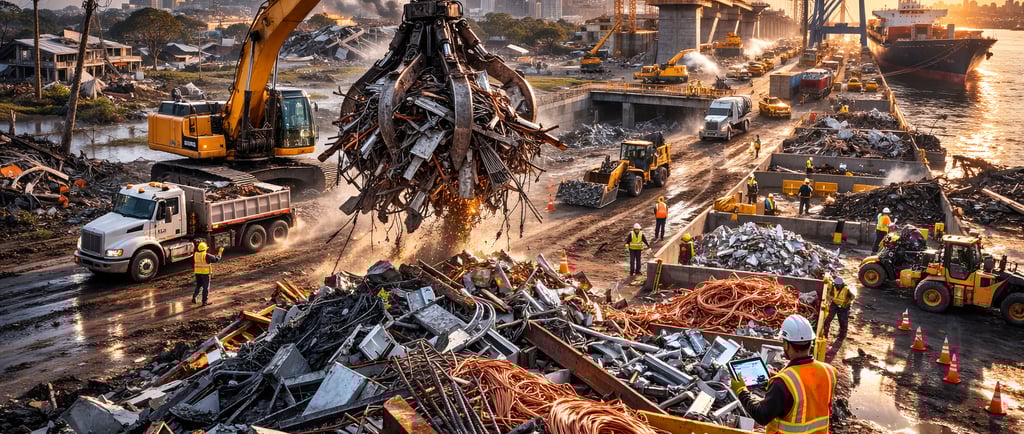
Context and Why It Matters for Municipal Debris Leads, Recyclers, Haulers, and Ports
The intensifying impact of climate change is forcing municipalities across the United States to rethink disaster debris management. Over the past decade, the U.S. has experienced a dramatic uptick in billion-dollar disaster events—from hurricanes ravaging the Gulf and Atlantic coastlines to wildfires transforming California’s landscape. FEMA’s 2023 National Preparedness Report highlighted that debris from just one major hurricane can exceed a city’s annual waste volume in a single week.
For municipal leaders, public works departments, professional recyclers, haulers, and port authorities, the post-disaster period brings urgent, high-stakes decisions about resource deployment and public communication. Metal debris—everything from crumpled bridge girders to twisted transmission lines—often comprises 30–50% of the disaster waste stream (EPA, 2021).
Why does this matter? Because each ton of recyclable metal quickly separated and reintegrated into infrastructure rebuilds accelerates recovery, avoids landfill capacity crises, and shrinks the city’s carbon footprint. Municipal action in this phase visibly charts the community’s path from devastation to resilience—and sets benchmarks for climate adaptation, operational excellence, and public trust.
Key Decision-Makers:
Debris Management Leads: Oversee collection and disposal logistics, balancing speed with sustainability goals.
Recycling Firms & Haulers: Provide expertise in rapid assessment, sorting, and safe transport of metals, often under challenging field conditions.
Port Operators: Offer critical land, equipment, and throughput for temporary yards and outbound scrap shipping.
Making the right call not only restores lifeline infrastructure (roads, power, hospitals) but also signals a city’s commitment to circular materials management and climate adaptation. In today’s climate reality, the stakes for fast, low-carbon urban recovery are higher—and more visible—than ever.
2. Defining the Problem and Operational Stakes
The Scale and Complexity of Post-Disaster Scrap
When disaster strikes, the sudden surge of debris can overwhelm even the most robust municipal systems. Hurricane Katrina generated over 26 million cubic yards of waste—enough to fill the Superdome in New Orleans over 13 times. In more recent events like Hurricane Harvey (2017), Houston’s landfill and recycling infrastructure buckled under a daily inflow of over 8,000 tons of debris.
Key Operational Challenges:
Volume Spike: Municipalities face debris quantities 10–20x normal daily volumes within days of a disaster.
Material Mix and Contamination: Metals are intertwined with concrete, wood, plastics, and hazardous waste, complicating safe recovery.
Infrastructure Bottlenecks: Roads, bridges, and ports may be damaged or blocked, impeding both heavy equipment movement and access to disposal/reuse sites.
Environmental and Regulatory Pressures: Time-sensitive EPA and state mandates require proper separation and reporting of recyclables and hazardous wastes.
The Real Stakes: From Cost to Climate
Financial Impact: Missed scrap revenue can run into the millions. For example, during the Houston response, every day’s delay in debris clearance added an estimated $2 million in direct and indirect recovery costs (FEMA, 2018).
Safety Hazards: Poorly managed debris piles can cause fires, chemical releases, and physical injuries. OSHA estimates post-disaster workers face 60% higher injury rates where sorting best practices are not rigorously applied.
Sustainability Slippage: Failing to capture and recycle metals undermines city, state, and federal circular economy goals, driving up greenhouse gas emissions through additional raw material extraction.
Loss of Community Confidence: Residents and businesses expect swift action and transparency. Failure to communicate progress (or setbacks) can erode public trust and complicate future resilience initiatives.
High-Stakes Summary: Timely, efficient, and sustainable scrap collection is more than operational hygiene—it is mission-critical for economic, environmental, and social recovery.
3. Key Concepts: Resilience, Circular Materials, and Low-Carbon Infrastructure
Achieving rapid and climate-resilient recovery requires a clear understanding of three interlocking concepts:
Resilience
Resilience in the infrastructure context means not just bouncing back, but building back better—ensuring systems can absorb, adapt, and recover rapidly from disruptions. The Rockefeller Foundation and 100 Resilient Cities define it as “the capacity of systems and communities to survive, adapt, and thrive no matter what kinds of chronic stresses and acute shocks they experience.”
Tactical Implication:
A resilient recovery process transforms disaster-generated materials into foundational assets for rebuilding, reducing dependence on outside supply chains.
Circular Materials
Circular materials strategies aim to close the loop on resources, maximizing reuse and minimizing waste. In disaster recovery, this translates into:
Recovery: Maximum extraction of usable metals (steel, aluminum, copper, etc.) from debris streams.
Remanufacturing: Processing sorted metals locally whenever possible, reducing emissions from raw extraction and long-haul transportation.
Reintegration: Channeling processed metals into new infrastructure—bridges, transit lines, temporary shelters—thereby shortening supply chains and speeding up community normalization.
Global circular economy studies (Ellen MacArthur Foundation, 2020) suggest cities that robustly recycle post-disaster scrap can cut landfill volumes by 30–50% and reduce supply chain delays by weeks.
Low-Carbon Infrastructure
This is infrastructure intentionally reconstructed with a reduced carbon footprint—achieved through:
Sourcing: Leveraging recycled metals that have up to 80% lower embodied carbon versus virgin materials (World Steel Association, 2022).
Localizing Supply Chains: Using regionally reprocessed metals, municipal projects avoid emissions from international shipping.
Innovation: Integrating advanced low-carbon alloys and green cement in new construction.
Example: New York City’s post-Sandy recovery integrated almost 70% recycled rebar in metro repairs, significantly curbing emissions and setting a precedent for climate-smart rebuilding.
Scrap Metal Streams and Temporary Yards
Scrap Metal Streams: Meticulously sorted debris—steel (structural beams, rebar), aluminum (window frames, siding), copper (wire, piping)—maximize value and minimize contamination.
Temporary Yards: Quickly established depots with proper permits, signage, and hazard controls. These serve as operational hubs for weighing, documenting, and staging material for recycling markets.
4. Core Framework: The Recycled Metals Recovery Process
To operationalize a resilient, low-carbon recovery, municipalities and partners should deploy a structured recovery cycle.
The 5-Stage Recovery Cycle
Assessment & Prioritization
Using drones, GIS tools, and on-the-ground assessments, teams map debris zones, prioritizing areas by metal density, accessibility, and critical public infrastructure (hospitals, emergency routes). For example, GIS-integrated assessment software (such as Esri’s Disaster Response solutions) can cut initial mapping time by 60%.Rapid Routing
Deploy specialized hauler teams to high-priority zones, focusing first on critical corridors and utility routes. Real-time traffic and weather feeds help optimize routing and avoid delays.Sorting & Temporary Yarding
Establish pop-up yards with clear separation lines for different metals. Mobile scales and barcode/RFID scanning ensure real-time inventory tracking, improving transparency and compliance. Facilities follow best practices for traffic flow and safe materials handling ([see more: Temporary Yard Setup Best Practices]()).Quality, Safety, and Contamination Control
On-site supervisors enforce PPE protocols, monitor for hazardous waste, and ensure fire prevention (e.g., maintaining maximum pile heights, fire lanes, and temperature checks). OSHA and EPA benchmarks are integrated into real-time dashboard reporting ([see: Injury Prevention in Disaster Cleanup Operations]()).Reintegration into Reconstruction Supply Chain
Processed and graded metals are rapidly matched to local foundries or rebuilding projects—bridges, shelters, transit repairs—accelerating material deployment and reducing procurement costs. Partnerships with regional and interstate recyclers ensure sustained demand, even if local rebuilding lags ([see: Choosing Regional Recyclers for Post-Disaster Processing]()).
Deep-Dive Example: Urban Hurricane Response
Scenario: A Category 3 hurricane devastates a coastal city.
Tactics Deployed:
GIS teams deploy drones for aerial assessment, generating a real-time debris density map.
Metal-hauler teams with GPS tracking are prioritized for medical and transit routes.
Temporary yards are stood up on port grounds, equipped with digital weigh-in stations.
All materials are logged via cloud dashboards for daily reporting to city leaders and the public.
Over 10 days, 80% of all eligible metal scrap (by weight) is processed—local foundries and construction firms receive prioritized lots, speeding up critical bridge and road repairs.
Result: Recovery timelines are up to 50% faster compared to previous disasters where ad hoc scrap management prevailed.
Post-Disaster Scrap Collection Playbooks for Resilient, Low-Carbon Infrastructure
Governance, Contracting, and Incident Command, Where Good Intentions Usually Fail
Most disaster debris failures do not start in the field. They start in governance. Cities often think the hard part is collecting twisted steel, damaged rail, collapsed fencing, burned vehicles, broken lighting poles, snapped wire, and damaged HVAC units. In practice, the harder part is deciding who has authority to classify, move, document, segregate, sell, stage, and release that material, under what rules, and with what chain of custody.
That distinction matters because a debris event is not a normal sanitation event. It is a compressed, high-volume, multi-agency supply chain problem under public scrutiny. Public works, emergency management, environmental health, procurement, legal, finance, police, utilities, ports, recyclers, and state and federal agencies all touch the same stream. If those roles are not defined before the first truck rolls, the city loses time where it can least afford it.
FEMA has been blunt on this point for years. Communities with a debris management plan are better prepared to restore services and protect health and safety after disaster, and FEMA’s debris guidance ties eligibility, monitoring, and documentation directly to how work is planned and managed. EPA guidance makes the same point from the waste side, urging communities to define debris streams, management sites, recycling options, and agency responsibilities before the event rather than during the scramble after it.
A high-functioning post-disaster scrap playbook should define five things in advance.
First, command structure. The city needs one named debris lead with delegated authority, not a committee trying to act like a dispatcher. That person should sit within the incident command structure and have direct access to operations, procurement, legal, finance, and public communications.
Second, contract posture. FEMA’s procurement and public assistance rules are strict for a reason. Debris contracts that are vague, poorly monitored, or written in noncompliant ways can create reimbursement problems later. The goal is not only to move debris fast, but to move eligible debris under an eligible process.
Third, material authority. Someone must decide when debris becomes recoverable scrap, when it remains evidence, when it is contaminated waste, and when it can enter a recycling stream. This is especially important after fires, industrial incidents, storms involving utilities, and transportation accidents.
Fourth, title and disposition. Municipalities need pre-written rules for ownership and sale proceeds, especially when material originates from roads, rights-of-way, utilities, schools, private opt-in programs, or shared state and local assets.
Fifth, reporting cadence. Daily operational reports should exist from day one. Mayors, council members, state agencies, FEMA liaisons, and the public will ask the same questions immediately: How much has been cleared, where is it going, how much is recyclable, what is the safety record, what corridors are open, what is the burn or contamination status, and how soon can rebuilding material flow begin?
When these five pieces are missing, even a well-equipped city starts making expensive decisions blind. Trucks queue at the wrong sites. Loads arrive mixed. Scrap gets landfilled because no one is willing to sign off on segregation. Police block access to staging areas that logistics teams expected to use. Port operators wait for manifests that never arrive. Finance departments discover too late that field records do not match invoice language. That is how a two-week disruption becomes a two-month bottleneck.
Temporary Yard Design, The Hidden Engine of the Entire System
A disaster scrap playbook is only as good as its temporary yards. These yards are where strategy becomes throughput. If they are too small, badly laid out, poorly drained, hard to access, or missing basic controls, the city loses speed, safety, revenue, and public confidence all at once.
EPA guidance recommends identifying debris management site locations and capacities before disaster, and evaluating whether existing reuse and recycling programs can scale to absorb disaster-related volumes. FEMA debris guidance also points municipalities toward pre-identifying temporary debris staging and reduction sites and their operating controls.
For scrap-heavy disasters, the temporary yard should not be treated as a generic dump yard. It should be treated as a controlled materials recovery hub. That means the site layout should be intentional from the start.
The entry should separate inbound and outbound flows. The scale house should capture vehicle ID, origin zone, debris type, gross and tare weights, driver, time stamp, and destination code. The inspection zone should give spotters room to reject contaminated or mixed loads before they pollute clean stockpiles. The segregation area should split ferrous, non-ferrous, wire and cable, white goods, damaged utility hardware, rebar, structural steel, metal roofing, fencing, vehicles and heavy mechanical units into distinct streams. The quarantine area should isolate suspicious loads that may contain asbestos, fuel residues, batteries, transformers, pressurized cylinders, or fire ash contamination. The emergency lanes and fire breaks should be obvious and enforced, not painted as an afterthought.
This is not overplanning. It is what prevents yard shutdowns.
EPA’s disaster debris planning guidance repeatedly stresses pre-incident site selection, staging, storage, separation, and decontamination planning. In wildfire and mixed-structure events, debris streams can contain hazardous material and fine ash contamination that change how yards must operate. OSHA also warns that cleanup operations expose workers to unstable materials, sharp objects, electrical hazards, hazardous substances, heat stress, heavy equipment interaction, and fire risk.
The cities that handle this well keep one principle front and center: clean yards create fast yards. The moment mixed material becomes the default condition, productivity falls. Commodity value falls. Injury risk rises. Regulatory risk rises. Public trust falls with it.
The best yards also think in time, not only in space. What matters is not just how many acres are available, but how many turns per truck per shift the site can support. A smaller yard with disciplined slotting, fast inspection, clean signage, live inventory, and good access control can outperform a much larger site that functions like an unmanaged field.
Ports can be especially powerful as temporary-yard partners because they bring acreage, security, heavy equipment, rail or barge connections, and outbound logistics. But port use requires early alignment on customs boundaries, security protocols, vessel schedules, storm recovery priorities, and commercial conflicts with normal cargo activity. If a port is going to be part of the debris system, it has to be written into the plan before the event.
Contamination Control, Safety, and Why Scrap Recovery Can Collapse in One Bad Shift
Post-disaster scrap recovery is never only a materials problem. It is a contamination problem and a worker-protection problem.
After hurricanes, flood debris can carry petroleum residues, sewage, mold, and chemical contamination. After wildfires, metal may be recoverable, but ash, insulation, batteries, coatings, household chemicals, and structural residues can change handling rules. After utility failures, transformers, capacitors, switchgear, and older electrical infrastructure raise PCB and hazardous-material questions. After industrial incidents, the city may be dealing with product residues, compressed gases, chemical tanks, or mixed hazardous loads.
EPA’s materials-and-wastes guidance makes it clear that separating reusable and recyclable items from waste helps preserve disposal capacity and conserve resources, but only if management plans account for the distinct handling requirements of each stream. OSHA’s disaster cleanup guidance likewise stresses hazard assessment, PPE, training, and controls before work begins.
In real playbooks, contamination control starts at pickup, not at the yard. Collection crews need simple field rules they can apply under pressure:
if a load contains suspect ash, isolate it;
if it contains friable insulation or demolition fines, flag it;
if it includes electronics, batteries, propane cylinders, or chemical containers, route it out of the clean metal flow;
if it is utility equipment, tag it for owner review before release.
That sounds basic, but this is where many operations fail. Field teams are often judged only on clearance speed. When speed becomes the only score, contamination travels downstream and the whole system pays for it later.
Worker safety needs that same practical mindset. Disaster cleanup is not standard scrap-yard work. Conditions are unstable. Materials are stressed, partially collapsed, flooded, burned, or embedded in other debris. The route to a metal pile may pass through downed wires, broken glass, exposed rebar, spoiled refrigeration units, and chemically affected runoff. OSHA’s cleanup guidance highlights the mix of struck-by hazards, electrical exposure, falls, confined spaces, hazardous materials, and heat-related illness that define this work.
A serious municipal playbook should require, at minimum, site-specific hazard briefings, clear exclusion zones, spotters for heavy-equipment movements, documented PPE rules by debris type, hydration and heat-stress controls, ignition-source control, and immediate stop-work authority for supervisors. It should also require daily near-miss reporting. Near misses are often the earliest signal that yard layout, routing, or field segregation is breaking down.
The playbook should never pretend that safety and throughput are competing goals. In debris operations, safety is a throughput issue. One fire, one severe injury, one uncontrolled contamination event, or one yard shutdown can erase days of progress.
The Port, Rail, and Heavy Logistics Layer That Most City Plans Underbuild
Many city debris plans are written as if the recovery system ends at curbside collection. That is a major mistake. The real bottleneck is often not pickup. It is transfer, staging, loading, modal shift, and outbound movement.
If metal recovery is going to support resilient, lower-carbon rebuilding, the city needs a logistics bridge between local clearance and downstream use. That bridge may include transfer stations, ports, barge terminals, railheads, shredder operators, processors, mills, foundries, and project owners that can absorb recovered material.
This is where ports matter. A port is not just a place to ship material out. In many disasters, it is the place where the city regains industrial rhythm. Port acreage can function as overflow staging. Cranes and handlers can reduce pile congestion. Security can protect high-value copper and aluminum streams. Berth and rail access can keep metal moving when roads and inland routes are still constrained.
But the port layer should never be bolted on late. It should be mapped into the debris plan before the event, with named contacts, trigger conditions, land-use assumptions, environmental controls, security rules, and traffic routing. If not, the city ends up negotiating commercial access in the middle of an emergency.
The same logic applies to rail. Rail can move bulk ferrous volumes more efficiently than long-haul trucking once enough clean material has been accumulated, but it only works when the playbook already knows which sidings, operators, loading windows, and handling contractors are available. A port or rail plan that exists only in theory is no plan at all.
There is also a carbon reason to get this right. Recycled metal only becomes a low-carbon rebuilding tool if the recovery chain is short, clean, and usable. World Steel states that every tonne of steel scrap used avoids 1.5 tonnes of CO2 emissions and also avoids the consumption of 1.4 tonnes of iron ore, 740 kilograms of coal, and 120 kilograms of limestone. For aluminum, the International Aluminium Institute states that recycled aluminum uses about 95.5 percent less energy than primary production. Those are enormous gains, but they depend on keeping scrap from becoming downgraded, mixed, or stranded.
That is why logistics is climate policy in practice. The cleaner and faster the city moves metal from debris to processor to project, the more likely that material displaces virgin input in the rebuild.
Digital Chain of Custody, Because “We Think We Moved a Lot” Is Not Good Enough
A city cannot manage what it cannot prove.
In disaster debris work, the standard reporting failures are familiar. Loads are counted but not weighed. Zones are cleared but not time-stamped. Material is separated but not graded. Inventory exists in the yard but not in a live system. Contractors invoice based on assumptions that do not match monitor records. Public dashboards report totals without telling leaders what share is recyclable, hazardous, sold, quarantined, or ready for reintegration.
FEMA’s debris monitoring guide exists because this documentation problem is not minor. It is central to accountability, reimbursement, and operational control. The guide focuses on observing and documenting debris from collection through temporary sites and final disposal or processing.
For metal-heavy disaster recovery, the data layer should capture six things on every meaningful movement:
origin,
material class,
weight,
condition,
custody transfer,
and destination.
That does not require a complicated technology stack. It requires discipline. Some cities will use cloud dashboards, GIS layers, QR-coded load tickets, truck telematics, and mobile inspection apps. Others will combine simpler weighbridge systems with scanned tickets and a central reconciliation team. The exact tools matter less than the operating standard.
The operating standard should answer these questions at any hour of any day:
How many tons of ferrous and non-ferrous material were collected today?
From which zones?
What percentage was clean enough for direct processor sale?
What percentage is under contamination review?
How much material is sitting in each yard?
What is the average dwell time by stream?
Which routes are constrained?
How much revenue has been realized or is pending?
Which local rebuilding projects could use matching material in the next seven, fourteen, and thirty days?
When those answers are available in near real time, decision-making changes. Crews can be rerouted based on yard congestion, not guesswork. Public leaders can communicate progress with confidence. Procurement teams can start matching outbound scrap to inbound rebuilding demand. Finance teams can reconcile invoices before errors compound. That is what a mature debris playbook looks like.
Finance, FEMA, Revenue, and the Difference Between Clearing Cost and Recovery Value
One reason municipalities underinvest in scrap recovery planning is that they think of debris only as cost. In reality, post-disaster scrap sits at the intersection of cost avoidance, reimbursement, landfill preservation, commodity recovery, and rebuilding acceleration.
FEMA policy is central here. Under standard Public Assistance rules, if an applicant receives revenue from recycling debris, FEMA reduces funding by the amount of the revenue received. FEMA’s Public Assistance Program and Policy Guide states this directly. However, FEMA’s debris alternative procedures have historically created more room for applicants to retain recycling revenue for approved recovery-related purposes under specific conditions. FEMA and related recovery guidance also emphasize that debris management plans and prequalified contracts matter for faster, cleaner, more defensible operations.
The practical point is this: the city must understand its reimbursement framework before promising itself that scrap sales will “pay for the cleanup.” Sometimes the value is direct revenue. Sometimes it is non-federal cost-share relief. Sometimes it is landfill life saved. Sometimes it is schedule compression on the rebuild. Sometimes it is a mix of all four.
EPA’s disaster debris case material shows why this matters. In one wildfire case highlighted in EPA guidance, more than 128,000 tons of debris were collected and about 74,000 tons of concrete, metal, and vegetative debris were recycled, yielding nearly a 60 percent recycling rate and preserving more than 185,000 cubic yards of landfill space. In another case cited by EPA, after negotiation FEMA allowed San Francisco to include recycling as a debris-management method following the 1989 earthquake, and the city recycled about 56 percent of collected debris, totaling over 1.5 million tons.
Those are not marginal gains. They change landfill pressure, hauling needs, public optics, and rebuilding economics.
A municipal scrap playbook should therefore treat finance in four buckets.
Bucket one is eligible clearance cost. What work is reimbursable, under what procurement conditions, and with what documentation.
Bucket two is salvage and recycling value. What streams have market value, what processing costs apply, and how those economics interact with FEMA or state recovery rules.
Bucket three is avoided cost. Every ton of clean metal diverted from scarce disposal capacity has value, even before sale. In large events, preserved landfill space can become a strategic public asset.
Bucket four is rebuild acceleration value. The sooner local and regional processors can turn clean metal back into usable supply, the less exposed the city is to volatile virgin-material markets, procurement delays, and import bottlenecks.
The best playbooks do not reduce recovery value to commodity price alone. They look at total system value.
Public Communication, The Part That Decides Whether the Operation Keeps Social Permission
Citizens do not see debris management the way operators do. They do not see route balancing, load rejection logic, or inventory reconciliation. They see blocked roads, noise, dust, truck traffic, burned neighborhoods, damaged schools, and the speed at which visible normalcy returns.
That means communication is not a side task. It is part of the operating model.
The city should publish from the start:
which zones are being cleared first and why,
what materials are being separated,
what contamination protections are in place,
where temporary sites are located,
what hours trucks operate,
how dust and runoff are being controlled,
what the city is doing to recycle metal and other recoverable material,
and what progress has been made in weights, routes reopened, and critical facilities restored.
This is even more important where ports or temporary yards sit near homes, schools, or culturally sensitive areas. Recent wildfire cleanup disputes in places like Maui show how quickly debris-site concerns can turn into broader debates about trust, environmental protection, and long-term harm if public communication is weak or late. Maui County said roughly 400,000 tons of wildfire debris were involved in the Lahaina cleanup, and public concern around storage and final disposal became a major issue.
The lesson is simple. If residents learn more from rumors, drone videos, and neighborhood groups than from official channels, the debris program has already lost part of its operating room.
The city does not need polished messaging. It needs plain, regular, credible communication backed by visible facts. Daily maps. Tonnage moved. Routes cleared. Photos of site controls. Clear hotline escalation. Honest disclosure when contamination slows a zone. That is how public trust survives a messy recovery.
Case Patterns That Separate Strong Recovery Systems From Weak Ones
The best global referral resources do not only give theory. They show patterns.
One useful pattern comes from California wildfire cleanup. EPA case material shows that substantial portions of disaster debris can be recycled when plans account for separation, permits, routing, and diversion goals. In the wildfire example already noted, nearly 60 percent of collected debris was recycled and more than 185,000 cubic yards of landfill space were preserved. That is what happens when a recovery system treats debris as a managed materials stream rather than anonymous waste.
Another pattern comes from urban earthquake recovery. EPA’s disaster debris guidance notes that San Francisco negotiated to use recycling as part of debris management after the 1989 earthquake and ultimately recycled about 56 percent of collected debris, more than 1.5 million tons. The lesson here is institutional, not only environmental. Recycling at scale usually requires policy permission, operational proof, and someone willing to fight for it early.
A third pattern comes from Japan after the 2011 earthquake and tsunami. UNEP described the Tohoku debris operation as the largest of its kind in the world, and World Bank materials note that the Great East Japan Earthquake generated about 20 million tonnes of waste, with some prefectures facing volumes many times their normal annual treatment capacity. The lesson is that post-disaster debris is not merely a sanitation event. It is a national industrial logistics challenge. Once volumes reach that scale, normal waste systems are no longer the right frame. Temporary processing capacity, inter-regional transfer, and disciplined stream separation become unavoidable.
A fourth pattern comes from the broader U.S. disaster environment. NOAA data show that from 1980 through 2024 the United States experienced 403 confirmed billion-dollar weather and climate disasters, with a 1980 to 2024 annual average of 9.0 events but a 2020 to 2024 average of 23.0. In 2024 alone there were 27 such events.
That means debris surges are no longer rare edge cases for public agencies. They are recurring operating conditions.
Taken together, these patterns point to one conclusion. Cities should stop writing debris plans as compliance documents and start writing them as industrial recovery playbooks.
Measurement, What the Best Playbooks Track Every Day
A post-disaster scrap playbook should close with measurement because what gets measured gets managed under pressure.
The minimum dashboard should track total debris collected, total metal collected, clean ferrous yield, clean non-ferrous yield, contamination rejection rate, truck cycle time, average yard dwell time, critical corridor clearance time, worker incidents and near misses, landfill diversion rate, and tons placed back into rebuilding channels.
For strategic leadership, five measures matter most.
First, hours to first controlled metal segregation. This tells you whether the city moved beyond generic debris clearance fast enough.
Second, percentage of loads that arrive pre-sorted or easily sortable. This tells you whether field instructions are working.
Third, tons diverted from landfill. This shows operational and environmental performance at once.
Fourth, average days from collection to processor release. This shows whether the city has built a real recovery chain or just another stockpile problem.
Fifth, recovered material matched to reconstruction demand. This is the metric that turns circular-economy language into something tangible.
These metrics should be published internally every day in the acute phase and at least weekly afterward. A city that waits for a final after-action report to learn what happened has waited too long.
The Practical Blueprint, What a Full Playbook Should Actually Contain
If this blog is going to become a true field reference, the final step is to state plainly what belongs in the finished playbook itself.
It should include hazard-specific debris assumptions for hurricanes, floods, fires, earthquakes, winter storms, and industrial accidents. It should include named roles, decision trees, pre-approved sites, map layers, contract templates, haul routes, mutual-aid contacts, port and rail contacts, environmental-control checklists, contamination triage rules, PPE rules, public messaging templates, daily report templates, and finance and reimbursement workflows.
It should also include trigger thresholds. At what debris volume does the city open a second yard? At what truck queue length does it shift routing? At what contamination rate does it establish a separate fire-ash lane? At what inventory level does it start rail or barge transfer? At what point does it bring in additional monitors or third-party QA support?
Without those trigger thresholds, a playbook becomes a binder full of good intentions.
And there is one more thing it should include, local reconstruction pathways. If the city knows in advance which foundries, fabricators, mills, rebar suppliers, utility contractors, and public projects can absorb recovered metal, then the playbook does more than clean up. It shortens the path to rebuilding.
That is what resilient, low-carbon recovery actually looks like. Not abstract sustainability statements. Material moving out of chaos and back into use.
Final Thoughts
The core idea behind post-disaster scrap collection should be simple. Disaster metal is not just wreckage. It is delayed recovery capacity.
Every twisted beam, damaged wire bundle, burned aluminum frame, broken rail component, and collapsed fence line sits at a decision point. One path sends it into mixed disposal, longer truck miles, higher landfill pressure, slower rebuilding, and more virgin extraction. The other path sends it into controlled recovery, cleaner yards, faster logistics, documented custody, safer processing, lower carbon intensity, and better infrastructure replacement.
The difference between those two paths is not luck. It is planning.
Official guidance already tells us what works. FEMA emphasizes debris plans, monitoring, contract discipline, and site controls. EPA emphasizes pre-incident planning, separation, reuse, recycling, and tailored debris-stream management. Industry data show why metal matters so much once it is recovered cleanly. Every tonne of steel scrap used avoids 1.5 tonnes of CO2. Recycled aluminum uses about 95.5 percent less energy than primary production. And recent disaster case material shows that meaningful diversion rates are achievable when the system is built to recover, not merely to dump.
So the logical conclusion is not that cities need “better debris removal.” They need a different standard.
They need post-disaster scrap collection playbooks that treat recovery as a materials, logistics, safety, finance, and public-trust system, all at once.
When that happens, debris stops being the symbol of what was lost. It becomes part of how the city rebuilds faster, cleaner, and with more control.
Connect
Your trusted partner for scrap metal procurement.
CONTACT
About
haroon@tdcventures.com
+1-307-655-7593
© 2025. All rights reserved.
NEWSLETTER