
Quick-Rebuild Kits: Demountable Metal Structures for Low-Carbon Resilience
Discover how demountable metal structures enable rapid, low-carbon disaster recovery. Our guide covers deployment, recycled materials, and reuse for resilient infrastructure.
CLIMATE-RESILIENT INFRASTRUCTURE & CIRCULAR MATERIALS
Instant Answer
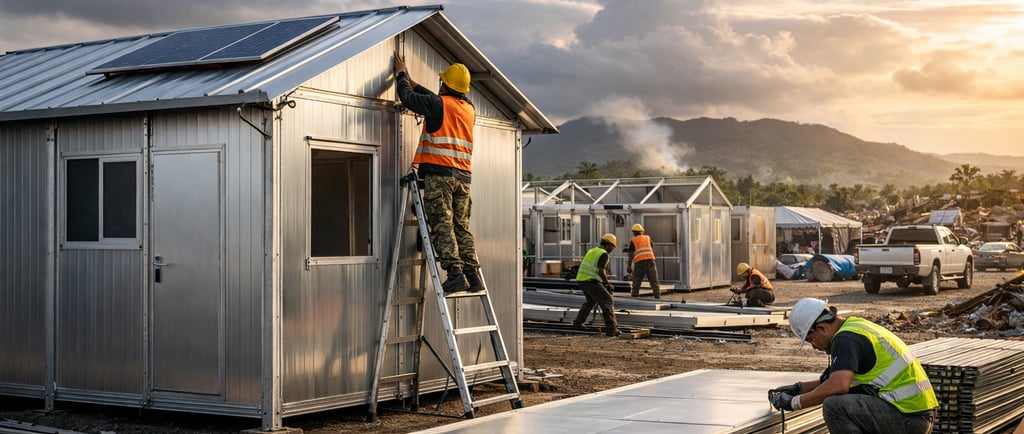
Quick-rebuild kits using demountable metal structures deliver rapid, resilient infrastructure for disaster recovery. Leveraging recycled metals, they enable fast deployment, reduced carbon footprint, and easy reuse, making them ideal for emergency shelter, clinics, or community hubs where speed, durability, and sustainability are critical.
Table of Contents
Context: Why Rapid, Low-Carbon Structures Matter Now
Defining Resilience and Low-Carbon Demountables
Framework: Fast Recovery with Recycled Metal Kits
Step-by-Step: Sourcing to Site Deployment
Implementation Playbook: Checklist & Decision Points
Measurement and QA: Metrics that Prove Success
Case Patterns: Emergency Scenarios in Action
FAQs: Quick-Rebuild Kits for Disaster Response
Embedded Five-Layer Toolkit: Strategic Distribution & Reuse
Likely Market Gaps (Assumption) & How This Guide Fills Them
Conclusion
1. Context: Why Rapid, Low-Carbon Structures Matter Now
Shifting Disaster Recovery Paradigms
Climate-driven disasters are escalating. According to EM-DAT, global reported natural disasters have quadrupled since 1970, with over 400 significant events annually. These aren’t isolated to “disaster-prone” geographies—coastal, arid, and mountainous regions alike face repeating threats. As a result, emergency response teams, NGOs, and municipalities must now plan for repeat infrastructure cycles—not just one-time rebuilds.
The Carbon Emergency in Construction
Traditional construction is carbon-intensive. The Global Alliance for Buildings and Construction reports that the built environment accounts for an estimated 39% of annual global CO₂ emissions, with about 11% from materials and construction processes (“embodied carbon”). Concrete, cement, and virgin steel require immense fossil energy for production and logistics. With carbon regulations tightening and funders emphasizing sustainable procurement, “business as usual” is no longer viable.
New Requirements: Speed, Strength, and Sustainability
Modern recovery isn’t just about “putting up a shelter fast.” Solutions must:
Deploy rapidly—within 24–72 hours.
Meet strength and safety codes for wind, seismic, and flood events.
Minimize carbon burden by choosing reused or recycled materials.
Enable future flexibility: disassemble, relocate, or repurpose the structures.
Quick-rebuild demountable metal kits meet this intersection of speed, resilience, and circularity—empowering cities and humanitarian agencies to “build back better and greener,” not just faster.
2. Defining Resilience and Low-Carbon Demountables
What Is Resilience Infrastructure?
Resilience is the backbone of disaster response. In infrastructure, resilience is measured by how quickly structures can:
Be deployed and become operational in emergent situations.
Withstand extreme external stresses—wind, earthquakes, deluge, and even aftershocks.
Be adapted or repurposed based on evolving community needs.
A truly resilient asset isn’t static. It’s designed for lifecycle flexibility and low disruption.
Low-Carbon, Circular Construction Explained
Low-carbon construction means pursuing the lowest possible greenhouse gas emissions across sourcing, transport, assembly, use, and end-of-life. Key measures include:
High recycled metal content: Aluminum, steel, and certain alloys can now exceed 70–95% recycled content, drastically lowering CO₂ per ton. Aluminum from recycled sources uses just 5% of the energy compared to virgin production.
Minimal use of concrete or plastics: Anchoring or shell work is optimized to reduce carbon-intensive materials where possible.
Sourcing within 500–1000 km: Sourcing recycled metals closer to use sites reduces transport emissions.
Circularity takes this further: every frame and panel should be designed for multiple reuses, not single-use. Each kit should return to the supply chain, not landfill, after initial deployment.
Anatomy of Demountable Metal Structures
Demountable structures share three defining traits:
Prefabrication: Modular elements are produced in controlled settings for quality and rapid on-site assembly.
Tool-less or basic-tool assembly: Most systems avoid heavy machinery—common hand tools suffice.
Disassembly and redeployment: Structures can be deconstructed and rebuilt elsewhere or recycled without material loss.
Key Attributes:
Bolted or interlocking metal panels and frames—no need for on-site welding.
Configurable layouts (sleeping, clinic, classroom) with scalable footprints.
Circular design: Panels, frames, and fixings all have unique serials for tracking reuse cycles.
Forward-Thinking: ESG and Funding Compliance
Entities in this niche must now align with green building standards (like LEED, BREEAM), humanitarian procurement benchmarks (SPHERE standards), and donor requirements. Prefabricated modules with clear environmental product declarations (EPDs) are fast becoming prerequisites for funding and insurance in many regions.
3. Framework: Fast Recovery with Recycled Metal Kits
Deep Dive: The Rapid-Resilience Metal Kit Method
1. Pre-Qualified Recycled Metal Supply
Quality starts with the supply chain. Partner only with metal fabricators providing robust EPDs, ensuring a documented chain of custody for every batch of recycled aluminum or steel. Some leading suppliers now provide QR-coded batch tracking, directly linked to carbon reporting software.
2. Optimized Modular Designs
Instead of bespoke builds, the market’s strongest kits are standardized—a key for both speed and predictable performance. Global standards (such as ISO 21929 for sustainability of buildings) increasingly influence these designs. Example module sizes are informed by real-world field needs: a 6x3m or 7.2x2.4m module can house 8–10 people, deliver privacy partitions, and support common medical or classroom functions.
3. Secure, Rapid Assembly Fixings
Quick-rebuild kits use patented bolt-lock or “tool-less” click-in systems to cut assembly times. Newer designs integrate anti-loosen fixings (used in aerospace) for extra resilience—ensuring safety across multiple assembly cycles, even under vibration from weather events.
4. Logistic and Packaging Innovation
Kits are flat-packed—each module optimized for containerization (e.g., a 40’ container fitting 4–8 structures depending on size/type). Leading suppliers now integrate RFID for “just-in-time” part delivery, reducing site bottlenecks.
5. Anchors for Any Site—No Heavy Plant Required
Next-generation foundation systems include helical screw piles, duckbill anchors, or heavy-duty mats—eliminating the need for concrete pours. These innovations open up flooded, sandy, or unstable ground previously considered “no-go.”
Current Trends: Smart Add-Ons and Digital Integration
Leading vendors now offer embedded IoT monitoring—sensors within the structure track temperature, humidity, and movement (for security or safety alerts). Some flagship projects leverage solar-ready roof anchors and plug-and-play battery integration, supporting off-grid deployments relevant for remote or disaster-impacted communities.
4. Step-by-Step: Sourcing to Site Deployment
Field-Proven Process for Rapid Deployment
1. Needs Assessment
Map out the scale and nature of demand: How many structures? For which purpose—shelter, health, logistics, education? Factor in vulnerable populations (elderly, disabled, children) and operational durations. The best practice: employ digital assessment tools (e.g., GIS mapping, mobile survey apps) to accelerate accurate site sizing.
2. Sourcing & Specifications Verification
Select your kit size and configuration from a vetted supplier list (reference EPDs for each). If specific hazards (high winds, seismic zones) are present, select the reinforced variant.
3. Logistics Planning
Work closely with logistics partners experienced in disaster corridors. Use GPS/telematic route planning for container deliveries and coordinate with emergency response convoys. Shorten lead times by pre-positioning kits in regional hubs.
4. Site Preparation
Leverage rapid assessment drones or boots-on-ground teams for soil analysis, debris clearance, and hazard marking (downed power lines, unstable trees, standing water). Digital site checklists minimize errors.
5. Arrival—Inventory and Staging
Upon kit arrival, confirm all shipments via barcode scan or RFID log, matching manifests and part lists. Any shortages flagged are escalated immediately for emergency shipment.
6. Foundation & Frame Assembly
Site team lays out anchors per soil report, assembles frames section by section, verifying plumb and level at each step. Modular panels install with two-person teams; latest designs use color-coded connectors to minimize assembly errors.
7. Shell Completion & Weatherproofing
Install walls and roofs, ensuring all joints receive specified sealing tape or foam gaskets to guard against wind-driven rain. Optional exterior cladding or insulation for harsh climates.
8. Utilities & Commissioning
Plug in pre-wired solar, water, or telecom modules if available. Commission with walk-through and final checks—record with digital photos for documentation and insurance.
9. Handover & Ongoing Management
Document serial numbers, assembly notes, and site conditions. Provide basic maintenance and “demounting guide” to local operators for future cycles.
Innovations in the Field
Digital Twins: Some rapid-rebuild projects now leverage digital twins to track structural use and predict maintenance cycles.
Smart Inventory: QR-based tracking helps keep all parts accounted for—vital in large-scale disaster responses where hundreds of kits may move between sites over months.
5. Implementation Playbook: Checklist & Decision Points
Comprehensive Deployment Checklist (Expanded with Practical Insights)
Disaster Briefing: Identify disaster type, local weather, forecasts for recurrence, and regulatory constraints.
Stakeholder Coordination: Activate cross-agency task force—municipal, NGO, and procurement officials—via a shared digital dashboard.
Kit Selection & Supplier Vetting: Compare kit models, pay close attention to EPDs—seek at least 75% recycled metal content and ISO or BREEAM certifications for resilience.
Logistics Planning: Confirm staging areas, set up supply chain redundancies for critical spares.
Site Assessment: Pull latest satellite and drone imagery. Map out topography, flood risks, past soil history if available.
Assembly Crew Preparation: Identify local skilled/unskilled labor pools; assign safety supervisors. Organize rapid WhatsApp or SMS-based training modules.
Kit Verification and Inventory: Use RFID/barcode checklist to document each kit. Missing or defective items trigger automated alerts to suppliers.
Foundation and Anchoring: Select anchoring based on live soil/moisture data. Have spares on site for rapid swaps (e.g., screw piles v. weighted mats).
Modular Assembly Workflow: Assign teams by module, clarify step sequencing to avoid cross-structure confusion.
Fastener Torque & Joint Quality Checks: Employ digital torque wrenches (where available) logging values for QA tracking.
Alignment and Weatherization: Recheck alignment after each structural addition—laser levels improve accuracy.
Utilities Prep: Stage solar, generator, or battery modules in advance.
Final Inspection & Safety Review: Use checklists with photographic evidence—these aids insurance and future claims.
Digital Documentation: All steps logged in a recovery project management platform, creating an audit trail.
Handover Planning: Provide a laminated “demount and redeploy” workflow to on-site managers.
Real-World Decision Points (With Examples)
Urgency vs. Complexity: If only 48 hours are available, select the simplest, most easily assembled kits—even basic A-frame shelters over full clinics.
Labor Constraints: For untrained teams, opt for “pre-mounted” wall panels rather than fully manual configurations.
Ground Uncertainty: When in doubt, portable weighted mats outperform fixed anchor types on unstable soils.
Common Pitfalls and How to Avoid Them
Logistical Gaps: Always keep buffer stock of connectors and fasteners—these are the most commonly lost/miscounted parts under crisis pressure.
Weatherproofing Overlooked: In a rush, sealant steps get skipped. Mandate double-checks with joint lists and assign a dedicated “seal officer.”
Assembly Fatigue: Rotate teams every two hours. Assembly is repetitive and accuracy drops over time.
By rigorously following each playbook step and integrating digital tools, teams eliminate common errors, minimize risk, and fast-track resilient recovery.
6. Measurement and QA: Metrics that Prove Success
If you cannot measure it fast, you cannot manage it under disaster pressure. The highest-performing recovery programs track three categories at the same time: time-to-service, life-safety performance, and carbon and circularity performance. Treat these as non-negotiable, because they decide funding eligibility, insurance acceptance, and whether your assets actually get reused instead of scrapped.
Operational speed metrics that matter in the field
Time-to-operational, not time-to-assembly. Track the full chain from “kit arrives at staging” to “people safely inside with functional lighting, ventilation, and sanitation.” Teams often celebrate a fast frame build, then lose two days to missing fasteners, mispacked panels, or delayed utilities.
Use three checkpoints:
Arrival-to-inventory-close, target 2 to 6 hours per container load at a regional hub with scanning and a disciplined laydown plan.
Inventory-close-to-weatherproof shell, target 8 to 24 labor hours for small shelter footprints, higher for clinics and command centers with partitions and MEP.
Weatherproof shell-to-service-ready, target 6 to 24 hours depending on plug-in utilities and inspections.
Logistics reliability. Track on-time-in-full percentage for each shipment, plus “critical shortfall rate,” meaning any missing item that prevents safe commissioning. In disaster settings, small parts kill schedules.
Labor productivity. Track labor hours per square meter, plus rework hours. Rework is the hidden schedule killer. It usually comes from unclear sequencing, fastener errors, and skipped alignment checks.
Life-safety and performance metrics you can defend
Structural capacity verification. You do not need to turn a field site into a lab, but you do need evidence. Use traceable torque logs, anchoring installation logs, and final inspection photos linked to kit serial numbers. If you have wind or seismic exposure, record the design assumptions and the kit variant selection rationale.
Envelope and weatherization performance. Measure what causes displacement after a rebuild: water ingress, condensation, and wind-driven rain. Track:
Observed leaks per structure during first storm cycle.
Seal integrity audit pass rate, based on a joint checklist.
Interior humidity and temperature stability, especially for clinics and shelters hosting vulnerable populations.
Indoor air quality and ventilation basics. For occupied spaces, especially medical uses, set minimum ventilation targets and filter standards aligned to the purpose. Your draft already nods to negative pressure and filtration concepts seen in rapid hospital builds. Even when you are not building an isolation ward, you should specify baseline ventilation, moisture management, and filtration to reduce respiratory risk.
Carbon and circularity metrics that survive procurement scrutiny
Embodied carbon per square meter, plus a clear boundary. Define whether you are reporting cradle-to-gate for materials, transport-to-site, and end-of-life scenarios. Public buyers increasingly ask for EPD-backed reporting, and many procurement policies explicitly require EPD collection for building materials.
Recycled content with documentation. Do not state “75 percent recycled content” without a traceable basis. Require supplier declarations and EPDs where available. EPDs are also increasingly required on public projects and are used to compare bid compliance.
Energy and emissions advantages of recycled metals. Your draft claims are directionally right, but you should attach credible numbers. Industry sources report aluminum recycling can save about 95 percent of the energy needed for primary production. That is one reason recycled aluminum is often described as around 5 percent of the energy of primary aluminum. Use these as guardrails, then state that actual carbon impact depends on electricity mix, transport, and fabrication.
Reuse cycle tracking, not “reusable” marketing. Track:
Number of deployments per kit.
Parts replacement rate per deployment.
Time and cost to refurbish between deployments.
End-of-life recovery rate, meaning percent of mass recycled at retirement.
If your program cannot show two or three successful redeployments with controlled refurbishment, you do not have a circular solution, you have a fast build that still becomes waste.
QA system that works under disaster constraints
Most QA systems fail because they assume stable staffing and quiet sites. You need QA that works with rotating crews, language differences, and high fatigue.
A practical disaster QA stack includes:
Pre-deployment qualification tests at the supplier, then lock the bill of materials. If you allow substitutions mid-event, your kit becomes untestable.
Digital part verification at arrival, using barcodes or QR codes tied to serial numbers.
Standard work packs per kit variant, with photo-based steps and a hard stop checklist for safety-critical joints.
Torque verification for primary fasteners. If you can, use digital torque tools that log values, but even manual logging is better than nothing.
A dedicated weatherization pass separate from structural assembly. Treat sealing as its own trade, because it is where shortcuts happen.
Commissioning checklist with minimum criteria for occupancy, and an escalation path when criteria are not met.
If you want one “best practice” move to add, add a defect taxonomy. Make crews label defects as missing part, wrong part, misalignment, seal failure, anchor issue, or damage-in-transit. Once you have counts by category, you can fix root causes in procurement and packing.
7. Case Patterns: Emergency Scenarios in Action
Case Pattern A: Rapid medical capacity when speed beats perfection
The most cited proof point for rapid modular deployment is the wave of emergency hospital builds during early COVID, including Huoshenshan Hospital in Wuhan, widely reported as completed in under 10 days using prefabricated methods. Whether or not every jurisdiction can replicate that pace, the transferable lesson is procurement and standardization. Speed came from standard modules, synchronized logistics, and round-the-clock labor, not from a magical material.
How to translate this to demountable metal kits for disaster recovery:
Pre-approve clinic layouts as “modules,” triage, exam, pharmacy, staff rest, storage.
Specify ventilation, filtration, and moisture control appropriate to the clinical role, then lock it.
Use serial-based documentation so health authorities can accept consistent evidence structure-to-structure.
Case Pattern B: Temporary housing bottlenecks when you do not pre-position kits
Housing is where recovery programs get criticized because timelines stretch. FEMA’s own published material on Katrina notes deployment of large volumes of temporary units, with more than 12,000 travel trailers and 9,800 mobile homes in the year following the storm, but that scale also shows how logistics and lead times dominate outcomes. Research reviews note that in severe situations FEMA has allotted 30 to 60 days before temporary housing is provided, which is a brutal gap for families in shelters.
What this means for your guide:
Your 24 to 72 hour deployment target is realistic only when kits are already staged regionally or nationally, with a pre-trained partner network and pre-negotiated transport. Without that, you should frame “fast build” as “fast once the kit is on site.”
Case Pattern C: Flooded or unstable ground where foundations decide everything
In floods, coastal storms, and saturated soils, foundations stall projects. Your mention of helical piles and low-disturbance anchoring is the right direction. Helical or screw pile vendors commonly emphasize minimal excavation, minimal spoil, and rapid installation, which is why they are often proposed for temporary structures and sensitive sites.
How to make this useful in practice:
Define a foundation decision tree by soil saturation and access constraints.
Pre-stock two anchor types, for example screw piles plus ballast mats, so you can switch without redesigning the kit.
Make anchor install logs mandatory, because anchor errors become liability events.
Case Pattern D: Long-duration “temporary” that becomes permanent
Many “temporary” structures stay for years. This creates a different risk profile: thermal comfort, corrosion maintenance, and community acceptance become major drivers. Your guide should explicitly address this scenario, because it is common after large events.
Practical upgrades for long-duration deployments:
Corrosion strategy by environment, coastal salt, industrial pollution, freeze-thaw.
Thermal and moisture strategy, insulation approach, vapor control, and condensation prevention.
Refurbishment interval plan, including inspection cycles and parts replacement.
8. FAQs: Quick-rebuild kits for disaster response
How fast can you deploy, realistically?
If kits are pre-positioned within the region and you have trained crews, you can often commission basic shelter footprints quickly after arrival. If kits are not pre-positioned, transport, customs, and corridor access dominate timelines. Use your guide to separate “build speed” from “program speed,” because funders care about the latter.
Do demountable metal kits reduce carbon in a defensible way?
They can, but only if you document recycled content, transport, and reuse cycles. Buildings and construction are tied to large global emissions shares, with a meaningful portion from materials and construction, so embodied carbon reductions matter. For aluminum, recycling is associated with very large energy savings relative to primary production, often cited around 95 percent energy savings. The biggest carbon win, though, often comes from reuse. One kit deployed three times can beat a “low-carbon” single-use kit that gets discarded after the first event.
Do you need EPDs?
If you want to sell into public procurement and major donor programs, assume yes. EPD collection is increasingly embedded in Buy Clean and similar procurement policies, and federal guidance explicitly discusses EPDs in the context of project requirements.
How do you keep parts from going missing across redeployments?
Treat the kit like aircraft ground support equipment. Every part needs an identity, every kit needs a manifest, every redeploy needs a closeout. QR codes work if scanning discipline exists. If not, simplify. Reduce unique fastener types, standardize panel families, and ship spares as a fixed percentage.
What is the biggest failure mode?
Weatherization. Leaks and condensation push people out faster than structural issues. Your guide already flags sealant steps, but you should elevate it into a formal QA phase with sign-off.
What about local codes and approvals?
You need a pre-approved compliance pack per kit variant. Include structural calcs, fire and egress assumptions, anchoring options, and commissioning criteria. Without it, approvals become ad hoc and slow.
9. Embedded Five-Layer Toolkit: Strategic Distribution & Reuse
This section should function like an operating system readers can reuse. It should cover who does what, what gets pre-built, what gets measured, and how the program stays ready between disasters.
Layer 1: Pre-event readiness and pre-positioning
Create a regional hub plan tied to risk corridors. Decide where kits live before disasters. If you wait to buy after an event, your timeline becomes “supply chain time,” not “assembly time.”
Set target coverage, for example enough kits to support 500 people within 72 hours in your highest-risk zone.
Run at least one live drill per year, not a tabletop drill. People learn the real bottlenecks only when they unload containers and assemble.
Layer 2: Standardization and interoperability
Standardize on a small family of footprints, for example shelter, clinic, classroom, command center.
Standardize openings, panel sizes, and fasteners across variants so parts swap between deployments.
Lock substitutions. If procurement swaps materials midstream, QA collapses.
Layer 3: Procurement and compliance pack
Require EPDs where available, and at minimum require documented recycled content, manufacturing location, and transport assumptions.
Bundle the compliance pack into the purchase, calcs, assembly method statement, inspection checklists, and a refurbishment guide.
Layer 4: Field execution system
Create a role map for assembly teams: assembly lead, safety lead, weatherization lead, inventory lead, commissioning lead.
Use photo-based standard work, because literacy and language vary.
Enforce a commissioning gate. No gate, no occupancy.
Layer 5: Redeployment, refurbishment, and learning loop
After demount, run a refurbishment triage: clean, inspect, replace wear parts, and re-pack to standard.
Track failures and delays by category, then fix root causes upstream in design, packing, and supplier QA.
Publish a short after-action report internally after every deployment. The programs that improve fastest treat each event as a learning cycle.
10. Likely Market Gaps and How This Guide Fills Them
Gap: Everyone sells “rapid,” few prove “operational fast.”
Your expanded measurement section creates proof around time-to-service, not just assembly speed, which matches what agencies and communities actually experience.
Gap: Carbon claims are often vague and undocumented.
By tying low-carbon claims to EPD direction and known emissions context for buildings and materials, you make the procurement case clearer.
Gap: Reuse is promised, but redeployment systems are missing.
The reuse cycle tracking, refurbishment logic, and kit governance fills the biggest operational hole in “circular” disaster infrastructure.
Gap: QA is treated as a luxury.
Disasters punish weak QA. The field-ready QA stack gives teams a way to protect life safety and reduce displacement caused by leaks and envelope failures.
Gap: Foundation and site uncertainty is under-modeled.
By formalizing anchor options and documentation, you reduce a major source of schedule slip and safety risk.
Gap: Long-duration temporary is ignored.
Your expanded case patterns and upgrades address reality. Temporary often becomes multi-year.
11. Conclusion: Future-proofing the disaster recovery approach
Disaster recovery is shifting from rare response to recurring operations. That shift changes what “good” looks like. A “good” temporary structure is not one that goes up fast once. It is one that goes up fast, stays safe and habitable, then comes down cleanly and deploys again with predictable refurbishment.
The strongest argument for demountable metal quick-rebuild kits is not speed alone. It is controlled repeatability. You reduce human suffering by shrinking the time gap between displacement and safe occupancy. You reduce program risk by standardizing QA and compliance evidence. You reduce emissions by lowering materials demand over multiple cycles, and by specifying recycled metals with defensible documentation, in a sector responsible for a major share of global emissions.
If you want this guide to become the resource people bookmark and share internally, your next draft should add two things with priority. First, a sample “compliance pack index” that lists exactly what documents a buyer gets with each kit variant. Second, a worked example that shows the numbers, time-to-operational, labor hours, defect rate, and embodied carbon reporting boundary for a single deployment, then again after the second redeploy. That is the difference between a strong article and a reference standard.
Connect
Your trusted partner for scrap metal procurement.
CONTACT
About
haroon@tdcventures.com
+1-307-655-7593
© 2025. All rights reserved.
NEWSLETTER