
R2v3 Controls for Mixed-Stream Facilities: Reliable Compliance for Electronics Recyclers
A practical guide to R2v3 controls for mixed-stream electronics recyclers—ensure audit success, manage complex compliance, and mitigate risks with actionable frameworks and real-world scenarios.
COMPLIANCE & REGULATORY OPERATIONS IN RECYCLING
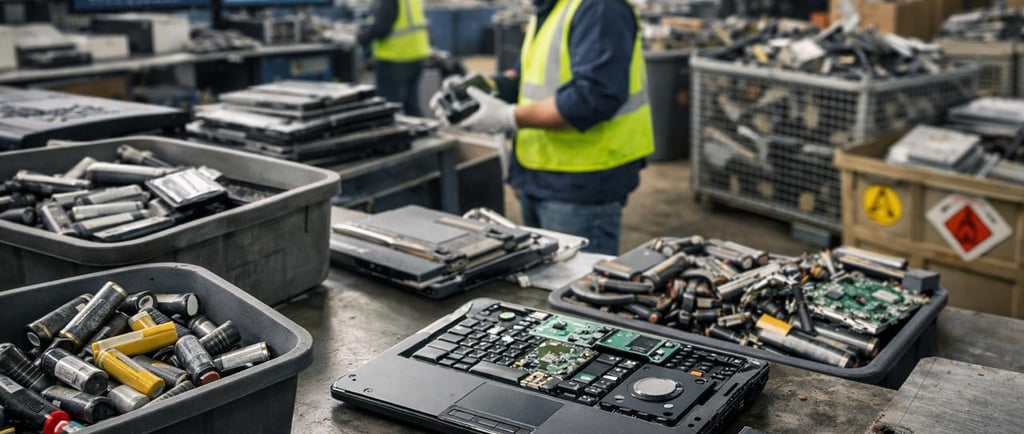

Instant Answer
R2v3 controls for mixed-stream facilities refer to operational and regulatory requirements designed within the R2v3 standard to ensure that electronics recyclers who process a variety of devices and waste types maintain strict compliance, manage permits efficiently, and pass audits consistently. These controls support regulatory adherence, risk mitigation, environmental stewardship, and data protection—while optimizing operational efficiency.
Table of Contents
Context and Why It Matters for Electronics Recyclers
Defining the Compliance Challenge in Mixed-Stream Facilities
R2v3 Controls: Key Concepts and Definitions
Practical Framework: Streamlined Compliance without Bottlenecks
Implementation Playbook for R2v3 Mixed-Stream Control Systems
Measurement, Audit, and Quality Assurance
Mini-Case Scenarios in R2v3 Mixed-Stream Compliance
Frequently Asked Questions (FAQs)
Embedded Five-Layer Distribution and Reuse Toolkit
Likely Market Gaps and Differentiation (Assumption)
1. Context and Why It Matters for Electronics Recyclers
With global e-waste projected to reach over 74 million tons by 2030 (source: United Nations University), the electronics recycling industry has become the frontline for environmental and data security protection. Mixed-stream facilities—handling arrays of laptops, smartphones, batteries, cables, and components—must navigate a maze of constantly evolving regulations, each designed to minimize environmental impact and prevent hazardous exposures.
Key Reasons R2v3 Compliance is Critical:
Regulatory Complexity: Regulatory requirements differ by locality and material, but the R2v3 standard provides a harmonized approach trusted globally.
Stakeholder Expectations: Manufacturers, enterprise clients, and government agencies demand rigorous compliance as a precondition for partnerships. An R2v3 certificate acts as a business license and credibility marker.
Data and Environmental Risks: Consumer and corporate data privacy violations, or hazardous material releases, have led to multimillion-dollar fines and serious reputational harm. In 2021, the largest single R2v3 audit failure resulted in a facility losing contracts worth over $20 million.
Competitive Pressures: R2v3-certified facilities win longer contracts and can command premium service prices, while non-certified recyclers increasingly find themselves excluded from key markets.
Industry Trends
Certification Growth: Over 1,000 facilities in more than 21 countries have achieved R2 certification, with most growth seen in the mixed-stream segment due to its scale and diversity.
Digital Integration: Top-performing recyclers are investing in digital solutions—such as real-time dashboards and automated alerts—to manage compliance in dynamic, high-volume environments.
Public Scrutiny: Environmental NGOs and regulators are increasing transparency requirements through public audit records and facility scorecards.
Staying R2v3 compliant is no longer simply about passing an audit; it’s required to attract and retain customers, mitigate business risks, and support a global shift to circular electronics.
2. Defining the Compliance Challenge in Mixed-Stream Facilities
Unlike single-stream recyclers, mixed-stream environments manage overlapping flows of e-waste—from universal waste batteries to high-risk data-bearing devices—each with distinct compliance criteria. This complexity can create vulnerabilities in tracking, handling, and reporting if not managed through robust controls.
Operational Stakes for Non-Compliance
Loss of R2v3 Certification: The majority of public and private-sector recycling contracts explicitly mandate R2 certification. Loss of certification due to audit failure or regulatory infringement can terminate key business relationships immediately.
Fines and Enforcement: In recent years, several facilities have faced six-figure penalties for improper battery segregation or missing hazardous waste permits.
Process Bottlenecks: Manual, isolated compliance activities often create operational friction—delaying batches, frustrating staff, and impeding throughput.
Insurance Implications: Insurers require documented risk controls. Repeated compliance failures can void critical coverage.
Brand and Trust Issues: News of compliance breakdowns spreads rapidly. Social media and watchdog groups have amplified the repercussions of high-profile failures.
Analyzing the Complexity
Mixed-stream facilities face unique challenges:
Varied Material Risks: Lithium batteries, mercury lamps, and data devices all require tailored handling, permits, and hazard controls.
Dynamic Inventory: Daily shifts in the material composition force real-time risk assessment. Facilities report seeing up to 20 different hazardous and regulated material types weekly.
Supplier and Vendor Management: Third-party downstream vendors introduce further compliance dependencies.
Adopting a system where compliance is part of every process—automated, visible, and integrated—is essential. According to a recent GreenBiz survey, facilities that integrate controls into workflows experience 40% fewer audit deficiencies and 30% faster resolution times for exceptions.
3. R2v3 Controls: Key Concepts and Definitions
A solid understanding of the foundational terms and components of R2v3 controls is pivotal for successful implementation and audit success. Let’s break down these core concepts, optimized to align with industry entities, attributes, and value models.
Core Definitions
R2v3 (Responsible Recycling Standard v3): Recognized globally, R2v3 is the latest revision of the Responsible Recycling standard developed by Sustainable Electronics Recycling International (SERI). It codifies requirements around environmental responsibility, worker health and safety, data sanitization, and transparency.
Mixed-Stream Facility: Facilities that simultaneously process two or more streams of regulated electronics or components. For instance, a single load may include desktop computers (with sensitive data), lithium batteries (classified as universal waste), and peripherals (with plastics, metals, and PCBs).
Compliance System: Integrated organizational process architecture—including standard operating procedures (SOPs), digital tracking, and compliance records—ensuring ongoing R2v3 adherence.
Permits: Legal authorization from local, state, or national agencies for handling regulated waste streams, often including hazardous, universal, and e-waste-related permits.
Audit: Either scheduled or surprise inspections by accredited third-party auditors or regulatory bodies, evaluating systems, records, and performance against R2v3 controls.
Good Phrases and Entity Attributes
Material Traceability: The ability to track all movements and status changes for specific materials or devices within facility operations, from intake to downstream handoff.
Risk Segregation: The documented separation and tracking of high-risk materials, ensuring proper handling and reducing cross-contamination or compliance lapses.
Environmental Safeguards: Controls (both engineering and administrative) for preventing unauthorized releases and environmental harm.
Data Security Controls: Processes for secure data destruction, tracking, and validation for devices containing sensitive information.
Continuous Improvement and EAV in Practice
Modern R2v3 controls utilize an Entity-Attribute-Value approach to ensure clarity and precision, for example:
Entity: Battery shipment
Attribute: Permit validity
Value: Current (expires in 60 days)
Enhanced compliance depends not just on identifying these attributes but keeping them current and auditable—fitting the R2v3 standard’s emphasis on evidence-based conformance and transparency.
4. Practical Framework: Streamlined Compliance without Bottlenecks
Mixed-stream compliance fails at handoffs. Not at the policy level. Your goal is to make every handoff produce evidence that matches R2v3 expectations, without turning production into paperwork. Start by grounding the operating model in what R2v3 actually forces you to prove during audits.
Core controls you must be able to evidence, daily
Legal compliance plan and proof. R2v3 expects a documented approach to identifying, monitoring, and demonstrating legal compliance, including proof of legality for imports and exports. In mixed-stream, this expands fast because you may touch universal waste, hazardous waste, transport rules, and export restrictions at the same time.
EH&S management system as the backbone. R2v3 requires certification to an environmental, health, and safety management system, positioned as the foundation for managing R2 requirements and controls. If your floor changes faster than your EH&S process, you will accumulate nonconformities.
Tracking that survives reality. R2v3 requires tracking inbound streams, changes due to processing, and outbound streams leaving the facility. For mixed-stream, your biggest risk is “temporary ambiguity”, bins that become unlabelled, pallets that move zones, and exceptions that never get closed.
Sorting and categorization that decides the pathway. R2v3 expects you to identify the status of equipment, components, and materials throughout the process so each item follows the right pathway. This is where mixed-stream sites win or lose audits, because one gaylord can contain both data-bearing and focus-material risk.
Data security from first touch to final proof. R2v3 expects data-containing devices to be secured from the moment they enter your control, then sanitized either by physical destruction or by enhanced sanitization under Appendix B rules. If you perform logical wiping, Appendix B certification is required.
Focus materials controls that match your actual streams. R2v3 names focus materials such as circuit boards, batteries, mercury, CRT glass, and PCBs, and requires a detailed focus materials management plan plus downstream verification and a downstream chain flowchart. Mixed-stream facilities cannot treat this as a “hazmat corner”. Focus materials appear across intake every day.
Downstream chain qualification and transparency. Appendix A defines how you qualify and manage downstream vendors for R2 controlled streams across the chain. R2v3 allows downstream tracking to stop at the first R2v3-certified downstream vendor, but only if you register the downstream chain with SERI.
The floor-level control points that matter most
You can run the whole site on six control points. Each control point needs clear decisions, containment rules, and evidence outputs.
Control point 1. Intake and load break. Goal: establish chain-of-custody, initial risk flags, and routing. Evidence: inbound IDs, photos where needed, bill of lading links, source classification, first scan timestamp.
Control point 2. Triage and quarantine. Goal: isolate unknowns fast. Mixed-stream sites need a real quarantine step, not a “we will sort it later” culture. Typical quarantine triggers: swollen batteries, damaged devices, unknown liquids, unlabeled drums, medical devices, and any device from regulated enterprise programs pending data classification.
Control point 3. Categorize into three lanes. Lane A: data-bearing. Lane B: focus materials present or likely. Lane C: general devices and peripherals. This is where you reduce cross-contamination. It also protects throughput. You stop dangerous items before they reach shredders or balers.
Control point 4. Processing by lane. Lane A: controlled access, controlled storage, and audited data outcomes. Lane B: controlled packaging, controlled storage, and documented downstream pathways. Lane C: normal processing, still tracked.
Control point 5. Outbound staging. Goal: lock the outbound identity to the final record. Evidence: outbound weights, container IDs, vendor IDs, packaging method, date, and routing proof.
Control point 6. Downstream proof and closure. Goal: close the loop so every controlled stream has an accountable endpoint. If you do not close loops, your site becomes a “temporary warehouse of liabilities.”
One mixed-stream rule that quietly drives audit outcomes
Negative value streams cannot be stored longer than one year. In mixed-stream, negative value often hides in piles because staff avoid the hard work. R2v3 does not care why it stayed. It cares that it stayed.
Why battery and fire risk must be treated as a compliance control
Even if your R2v3 audit does not focus heavily on fire statistics, your insurers, landlords, and regulators do. The Global E-waste Monitor 2024 shows e-waste hit 62 million tonnes in 2022 and is projected to reach 82 million tonnes by 2030. Formal documented collection and recycling is 22.3 percent. That means more devices, more batteries, and more “surprise hazards” entering mixed loads. The US EPA documented 245 fires across 64 waste facilities from 2013 to 2020 linked to lithium and lithium-ion batteries. Publicly reported fires across waste and recycling facilities in the US and Canada rose to 430 in 2024, up from 373 in 2023, based on Fire Rover’s annual review reported by Resource Recycling. Mixed-stream sites should treat battery identification, segregation, and safe packaging as a core control, not a safety poster.
5. Implementation Playbook for R2v3 Mixed-Stream Control Systems
This section assumes you already have basic operations. The focus is turning compliance into repeatable floor behavior.
Phase 1. Map your real streams, not your org chart
Walk the floor and list what actually arrives in a typical week. Then assign each stream three attributes: Data risk: yes, no, unknown. Focus material likelihood: high, medium, low. Regulatory friction: high, medium, low. Use that mapping to decide where you need “hard stops” versus “soft checks”.
Phase 2. Build the minimum evidence set per control point
Audits get painful when evidence is scattered. Define the minimum evidence outputs at each control point.
At intake: Source identification and acceptance criteria. Inbound tracking ID tied to paperwork. Immediate flags for battery, CRT, mercury devices, and enterprise data programs.
At triage and quarantine: Quarantine log with reason codes. Time in quarantine metric and escalation rule.
At processing: Work instructions that match your lanes. Operator sign-off or scan-based confirmation at key steps. For data work, align outcomes to Core 7 and Appendix B rules when wiping is performed.
At outbound: Outbound ID tied to vendor, weight, and packaging. Shipping documentation tied back to your legal compliance plan.
At downstream closure: Downstream chain flowchart for focus materials and controlled streams. Vendor qualification records per Appendix A. Closure evidence that supports the point of final disposition, or registered stop at the first R2v3-certified downstream vendor.
Phase 3. Treat focus materials as “always present” in mixed-stream
SERI’s focus materials guidance lists PCBs, mercury, CRT glass, batteries, and circuit boards, including devices or components that contain these. Practical floor changes that reduce failures:
Put battery identification at intake, not at dismantling.
Use closed, labeled battery collection containers with a daily reconciliation count.
Separate CRT handling with a trained micro-team and a defined pathway.
Gate circuit boards into a controlled bin system that prevents loss and mixing.
Phase 4. Lock down downstream vendor control before you scale volume
If you scale volume while downstream control is weak, you increase liability faster than revenue. Appendix A is the spine for downstream chain qualification and management for controlled streams. What “good” looks like:
A vendor list tied to each outbound material category.
A requalification cadence, with triggers for immediate review, such as permit changes, ownership changes, or incident history.
Proof that your downstream chain matches what you claim in customer sales materials.
Phase 5. Data security that stands up under scrutiny
Most mixed-stream sites lose trust on data before anything else, because one mistake can become a headline. R2v3 requires secure handling from receipt and effective sanitization by physical destruction or enhanced processes under Appendix B.
Why this matters beyond R2v3
Morgan Stanley’s wealth management unit was fined 35 million dollars by the SEC for failures tied to improper disposal of devices containing customer personal information, including weak oversight of a vendor handling decommissioning. The OCC also assessed a 60 million dollar penalty against Morgan Stanley related to failures around oversight and controls in data center decommissioning. Your facility may not be a bank, but your enterprise customers will benchmark you against what banks are forced to do.
6. Measurement, Audit, and Quality Assurance
If you cannot measure it, you cannot defend it during an audit, an insurance review, or a customer escalation.
R2v3 audit reality you should design for
SERI’s summary stresses that required records must be available during every audit, and auditors must be able to witness live operations. It also highlights internal audit cycle expectations, and that open nonconformities can carry into certification audits.
A measurement set that actually predicts audit risk
Intake accuracy rate. Percent of inbound loads correctly classified on first pass. Target example: above 98 percent for high-volume programs, but your number depends on inbound variability.
Quarantine cycle time. Median hours from quarantine entry to disposition decision. This is a hidden throughput killer. It also hides safety risk.
Exception rate by stream. Exceptions per 100 inbound units, split by batteries, CRT, mercury devices, and unknown data status. Track trend, not just totals.
Battery incident rate. Count of battery-related safety events per month, including swelling, overheating, damaged cells, and near-miss sparks.
Controlled stream chain closure rate. Percent of controlled stream shipments with completed downstream closure evidence inside the defined SLA, for example 30 to 90 days depending on the vendor.
Data outcomes integrity. Percent of data-bearing units with complete chain-of-custody and final sanitization proof. If you do wiping, track wipe verification pass rate and rework rate. Appendix B requires specific tracking and sanitization records.
Aging inventory exposure. Days in storage by stream, especially negative value streams due to the one-year limit.
Training completion tied to job roles. Percent of staff current on lane-specific training, plus refresher intervals.
What QA looks like in mixed-stream
QA is not a separate department. It is a set of recurring checks that catch drift.
Daily Battery container count and condition check. Quarantine reconciliation, nothing “unowned.” Outbound staging check, IDs match records.
Weekly Spot checks on focus materials segregation. Downstream shipment record review, random sample. Data chain-of-custody sample review.
Monthly Internal audit against the highest-risk controls, not against the easiest ones. Downstream vendor review for changes, permits, insurance, incident flags.
7. Mini-Case Scenarios in R2v3 Mixed-Stream Compliance
Scenario 1. The “device donation” pallet with hidden lithium risk
A school district sends mixed laptops, tablets, chargers, and loose electronics in boxes. Your intake team sees “standard IT equipment” and moves it into general sorting. Two hours later, a tablet with a damaged battery vents in a picking line.
Control failures that caused it
No intake flagging for small-device battery risk.
No early lane routing for “battery likely” items.
No quarantine for damaged devices.
What R2v3-aligned control would do
At intake, route all small mobile devices into a battery-aware lane.
Require quick visual inspection and segregation into safe containers before general sorting.
Measure battery near-misses and treat them as corrective action triggers.
Scenario 2. Enterprise servers arrive with unclear data handling requirements
A logistics company ships servers and drives, but the paperwork is incomplete. Your team starts dismantling to recover boards and metals.
Control failures that caused it
Unknown data status treated as non-data.
Chain-of-custody broken once dismantled.
Better outcome
Default “unknown” to “data-bearing” until proven otherwise.
Hold in secure area.
Confirm customer requirement and match it to Core 7, then proceed with physical destruction or Appendix B wiping where applicable.
Scenario 3. CRT glass found in a general electronics load
Your team breaks down a load and finds CRT devices mixed in. They set them aside, but the area is not controlled and glass debris spreads.
Control failures
No defined pathway for CRT handling.
No containment and cleaning procedure.
Better outcome
Route CRT items into a controlled handling zone with trained staff.
Document the processing path and downstream chain closure.
Scenario 4. Downstream vendor permit change mid-contract
Your downstream vendor for circuit boards changes facility ownership and updates permits. Your outbound continues as normal. Two months later, an auditor asks for your Appendix A vendor qualification evidence and current status.
Control failures
No trigger-based requalification.
Vendor file is stale.
Better outcome
Appendix A control includes change triggers.
You re-check permits, insurance, and capability evidence before the next shipment.
Scenario 5. Customer asks for proof of legal export
A customer wants evidence that outbound shipments comply with legal requirements, including cross-border movements.
Better outcome
Your legal compliance plan includes proof of legality for imports and exports. You keep shipping documentation tied to outbound IDs so you can produce evidence fast.
8. Frequently Asked Questions (FAQs)
Does every mixed-stream facility need Appendix B?
No. Appendix B applies when you perform logical data sanitization, sometimes called data wiping, and R2v3 notes that facilities performing logical sanitization must be certified to Appendix B. If you only do physical destruction for data devices, Appendix B may not be required, but you still must meet Core 7 controls.
What exactly counts as focus materials?
R2v3 lists focus materials such as circuit boards, batteries, mercury, CRT glass, and PCBs, and SERI guidance expands on focus materials and how they appear across electronics.
Can I stop downstream tracking at my first R2-certified downstream vendor?
R2v3 allows downstream tracking and verification to stop at the first R2v3-certified downstream vendor, but you must register your downstream chain with SERI to do so.
What is the one-year storage rule people forget?
R2v3 states negative value streams cannot be stored longer than one year. If you let hard-to-process piles sit, you are building audit risk into inventory.
Why does battery control keep coming up in mixed-stream?
Because the risk is rising, and the consequences are severe. The EPA documented hundreds of fires linked to lithium batteries, and fire incident reporting shows upward trends across facilities. Battery control is a safety issue, a compliance issue, and an insurance issue at the same time.
9. Embedded Five-Layer Distribution and Reuse Toolkit
This toolkit is designed so your operations work better and your market trusts you more. It also supports commercial growth because buyers want proof, not promises.
Layer 1. Internal operating assets you can train on
Lane-based work instructions for intake, triage, quarantine, processing, and outbound.
Role-based training map tied to lane access and tasks.
Shift-start brief format, focused on the top three risks that week.
Layer 2. Audit-ready evidence pack
A “single source of truth” index of where evidence lives, by R2v3 requirement area.
Pre-audit internal walk routine that ensures auditors can witness live operations, with required records ready.
Layer 3. Customer trust pack
A one-page process overview for customers that explains: How you secure data from receipt to final proof. How you handle focus materials and controlled streams, including downstream chain handling. What proof they receive and when.
Layer 4. Partner and downstream governance pack
Downstream vendor qualification file structure aligned to Appendix A applicability.
A change-trigger list that forces immediate review.
A chain closure SLA policy so you can enforce completion timelines.
Layer 5. Public positioning and content distribution
Use your controls as proof points in your marketing and sales channels, without exposing sensitive details.
Website pages: “Data security outcomes”, “Focus materials pathways”, “Downstream chain governance”.
Buyer enablement: short PDFs for RFPs and enterprise procurement teams.
Industry participation: webinars or short talks on battery risk handling and controlled stream accountability, supported by credible e-waste growth stats from the Global E-waste Monitor 2024.
10. Likely Market Gaps and Differentiation
Most R2v3 content online fails mixed-stream operators because it stays abstract. Your differentiation comes from being concrete, measurable, and audit-aligned.
Gaps you can fill
They explain R2v3 “at a high level” but do not show floor control points. You win by describing exactly where decisions happen, and what evidence is produced.
They talk about downstream vendors but skip the “stop at first R2 DSV” conditions. You win by explaining that stopping at the first R2v3 downstream vendor requires downstream chain registration with SERI.
They discuss data security but ignore what enterprise enforcement looks like. You win by tying data controls to real penalties, like the SEC’s 35 million dollar penalty tied to improper device disposal controls and oversight.
They mention focus materials but do not connect them to mixed-stream reality. You win by showing how focus materials appear across random loads, and how your lanes prevent cross-contamination.
They ignore the battery fire trend line. You win by treating battery control as a core operating control, supported by fire data and e-waste growth trends that make the risk worse over time.
Connect
Your trusted partner for scrap metal procurement.
CONTACT
About
haroon@tdcventures.com
+1-307-655-7593
© 2025. All rights reserved.
NEWSLETTER