
Radiation SOP: From Portal Alarm to Regulator Call
Step-by-step radiation SOP for scrap yards: from portal alarm to regulator call. Ensure compliance, avoid fines, and maintain operational continuity.
COMPLIANCE & REGULATORY OPERATIONS IN RECYCLING
Instant Answer
A radiation Standard Operating Procedure (SOP) for scrap yards demystifies every step from the instant a portal alarm triggers to the moment regulatory reporting is finalized. Immediate isolation of at-risk loads, methodical surveying, escalation protocols, and airtight documentation guarantee audit-proof compliance, minimizing operational risk while upholding productivity. Adhering to a well-drilled framework ensures safe, transparent handling of radioactive detections—making seamless compliance not just achievable, but routine.
Table of Contents
Why Radiation SOPs Matter to Scrap Yards and Mills
Problem Statement and Operational Risks
Key Concepts and Definitions for Radiation Compliance
Step-by-Step Framework: Portal Alarm to Regulator Call
Implementation Playbook: Checklist and Decision Points
Measurement, QA, and Scorecard Metrics
Real-World Scenarios: Mini-Cases from the Field
Frequently Asked Questions (FAQs)
Embedded Five-Layer Distribution & Reuse Toolkit
Assumed Market Gaps and Differentiators
Why Radiation SOPs Matter to Scrap Yards and Mills
Radiation alarms are no longer rare disruptions; they’re a persistent reality for modern scrapyards, metal processors, and recycling facilities. The National Council on Radiation Protection and Measurements (NCRP) estimates that with every million tons of scrap handled, dozens of radioactive sources are unknowingly circulated, often from outdated industrial devices, medical waste, or contaminated NORM (Naturally Occurring Radioactive Material). Portal alarms don’t just indicate a blip—they signal an event with financial, operational, and regulatory consequences.
The Cost of Noncompliance
A single botched response can result in:
Regulatory investigations: Fines exceeding $100,000 (as documented by U.S. NRC enforcement data).
Unplanned shutdowns: Mills and yards with contaminated melt face losses reaching six to seven figures daily.
Reputational blowback: Clients are less likely to trust suppliers with known radiation incidents.
Health risks: Inadequate reaction can expose staff and the public to unsafe radiation levels.
Yet, excessive caution without clarity stalls throughput, clogging your yard and damaging relationships with suppliers, carriers, and customers.
A robust radiation SOP is the invisible backbone that keeps your operations smooth, your compliance strong, and your team confident—even in moments of high stress.
Problem Statement and Operational Risks
The Challenge:
Scrapyards, steel mills, and recycling facilities operate within a supply chain rife with unknowns. Portal alarms—often sounding dozens of times annually in high-volume sites—require split-second, high-consequence decisions. An absence of a defined SOP leaves room for improvisation, errors, and costly oversights.
Operational Risks Detailed:
Missed Reporting Deadlines: Regulators typically require notification within hours of a confirmed event. Failure can result in escalating enforcement and repeat audits.
Non-Compliance Fines and Permitting Threats: Agencies such as the EPA, NRC, and state regulators can impose fines, suspend permits, or mandate costly corrective actions when SOPs aren’t followed.
Cross-Contamination and Untraceable Spills: Improper handling allows radioactive material to spread, impacting equipment, downstream materials, and even customer products.
Production Halts and Lost Revenue: Facilities may be forced to halt intake or processing until an investigation concludes—jeopardizing contracts and eroding margins.
Eternal Audit Trails: Once a radiation incident enters the record—even if mishandled years ago—it can resurface in audits, permit renewals, and customer requests.
Case in Point:
In 2022, a midwestern U.S. steel recycler lost $750,000 in revenue across three days after failing to notify the regulator within the four-hour window, triggering a full-site investigation and permit freeze. Proper adherence to the SOP would have prevented disruption and fines.
Key Concepts and Definitions for Radiation Compliance
Establishing a shared language is fundamental not only for compliance but also for internal communication and training. Below are definitions central to radiation event management in metal recycling:
Portal Monitor:
Permanently installed device at facility entry or exit, equipped with gamma/neutron detectors sensitive enough to recognize minute radioactive sources within scrap.
SOP (Standard Operating Procedure):
Documented step-by-step workflow covering every conceivable scenario, from first alarm to final reporting, emphasizing regulatory compliance and staff safety.
Regulator Call:
Legal obligation to alert local, state, or federal agencies (e.g., NRC, state health departments), supported by incident data, time-stamped logs, and initial findings.
Isolation Zone:
Physically marked area set aside for the sequestration of suspect vehicles or materials, away from staff, public, and regular operations.
Call Tree:
Predefined escalation chart specifying who to call, their backup, and their next steps, including the facility manager, RSO, EHS team, and external contacts.
Regulatory Threshold:
Pre-established radiation measurement (often in micro-roentgens per hour or counts per minute) above which mandatory action is triggered. Example: State of Texas triggers at 25 µR/h above background.
Incident Log/Report:
Complete written or digital record of the alarm, survey readings, escalation communications, regulator correspondence, corrective actions, and final disposition.
Embedding these terms in training materials, SOP manuals, and signage helps standardize event response and streamlines audit reviews.
Step-by-Step Framework: Portal Alarm to Regulator Call
Operational excellence in compliance comes from breaking down the chaos of alarm events into manageable, repeatable actions. The framework below is extensively validated against industry guidelines (NRC Reg Guide 8.39, ISRI protocols, and state regulations).
The “Detect-Isolate-Assess-Escalate-Report” Model
1. Detect:
The portal monitor triggers an audible and visual alarm.
Immediately, the system logs time, identity of the load (truck, container ID), and portal readings.
Notification is dispatched (automated, where possible) to the RSO or primary responder.
2. Isolate:
Stop the vehicle before it joins the general queue or offloads.
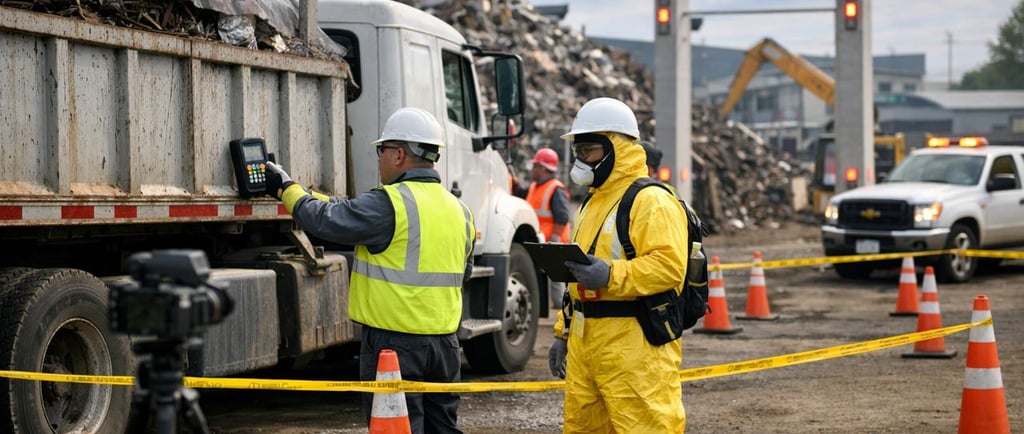
Direct it to a clearly designated isolation zone, marked by physical barriers, cones, or signage.
Restrict access with trained personnel—no unauthorized interaction permitted.
3. Assess:
The RSO or trained staff approach the vehicle with a calibrated handheld survey instrument, donning PPE as prescribed.
Conduct a systematic survey: measure all sides, cab, load surface, and undercarriage, keeping a safe distance as applicable.
Document all readings, noting any areas of elevated radiation.
4. Escalate:
If readings are above regulatory threshold, prompt activation of the call tree is mandatory.
Internal communications ensure management, EHS, and corporate safety receive situational updates within minutes.
Decision-makers gather available information for swift regulatory action.
5. Report:
Complete a detailed incident report in standardized format (electronic or paper).
Contact the regulator, providing precise load details, background readings, survey data, isotope (if known), vehicle/driver info, and immediate actions taken.
Document regulator instructions and follow their directives (additional quarantine, isotope ID, material return, or further investigation).
Industry Statistic
According to ISRI, over 250 radiation events are reported annually at U.S. recycling sites, and 40% of audit failures involved incomplete adherence to this five-step model.
Worked Example
Scenario:
A municipal scrap yard in Pennsylvania notes a truck triggering a 70 µR/h portal alarm. The regulatory notification threshold in PA is 25 µR/h.
Isolation: The operator guides the vehicle to a secure lot.
Assessment: Survey readings confirm elevated levels at 63 µR/h on the surface of the load.
Escalation: RSO is present within eight minutes; the call tree is activated.
Documentation: Staff initiate a digital incident log, inputting photos, readings, timestamps.
Regulator Reporting: The Pennsylvania Department of Environmental Protection is contacted, provided with the complete incident package.
Audit Readiness: Documentation and regulator response are archived, flagged for the next state inspection.
Implementation Playbook: Checklist and Decision Points
Start with the operating assumption that radioactive material can enter scrap streams through orphan sources, mis-disposed industrial gauges, and naturally occurring radioactive material in oilfield and mineral-related scrap. National regulators explicitly recognize scrap-metal recycling as a common pathway for orphan sources to surface.
The playbook below is written so you can run it at a small yard or a high-volume mill gate. You still need to align the “call now” thresholds to your local regulator, but the structure stays the same.
A. Pre-work, what must exist before the first alarm
Roles you must assign in writing
Primary responder. Usually your Radiation Safety Officer equivalent, or an EHS lead trained on survey meters.
Secondary responder. A backup for shift coverage and vacations.
Incident commander. The person who can stop intake, block lanes, and approve holds.
Regulator caller. One named person, one alternate, both trained on what to say and what not to guess.
Scribe. Someone who logs times, readings, photos, names, and regulator instructions.
Equipment you must have on-site and ready
Portal monitor at entry or exit, with alarm logging.
A calibrated handheld survey meter suited for your expected sources and NORM.
Barriers and cones for a controlled isolation zone.
A way to measure and record background at consistent times.
A camera workflow for evidence capture.
Portal monitors at scrap facilities are widely used to detect radiation before processing because melting radioactive items can contaminate metal, equipment, and the site, with cleanup that can cost millions.
Portal systems commonly detect gamma radiation, often using large sodium iodide detectors, with neutron detection sometimes added.
The physical layout you should standardize
A clearly marked isolation zone that does not require the truck to cross active traffic lanes.
A standoff area where the driver can wait at a safe distance, with line-of-sight control.
A “survey path” around the vehicle, so responders do not improvise.
A secure spot for temporary evidence storage and documentation.
Your documentation kit, ready to print or open
One-page incident worksheet.
A photo checklist.
A call script.
A regulator contact list for your jurisdiction and after-hours numbers.
A “load disposition” form with signatures.
B. Alarm response, the operational sequence with decision points
Step 1. Control the scene in under 60 seconds
Stop the vehicle and keep it intact. No unloading.
Move it to isolation using a pre-defined route.
Limit access. One entry point, one exit point.
Start the incident log with exact time, vehicle ID, carrier, origin paperwork, and portal reading.
Step 2. Validate the alarm, do not assume it is real
The Canadian alarm-response guidance is explicit: run a second pass, and manage distance and background before escalating.
Do this sequence:
Replace the driver, then pass the vehicle through the portal a second time. If it does not alarm, treat as non-radioactive and document the negative result.
If it alarms again, park the vehicle about 30 metres away from the portal to prevent the portal from re-triggering and to reduce noise in readings.
Measure background and compare. The same guidance gives an example background range and a simple decision rule: if the reading is more than about twice background, treat it as a positive detection and continue.
This approach matters because background radiation fluctuates, and false alarms are a known reality in portal monitoring programs.
Step 3. Survey and locate the hotspot, then classify it
Approach with a handheld instrument and conduct a controlled scan.
Scan the full vehicle, then tighten to the load, then tighten to a specific area.
The Canadian guidance describes scanning all around, then scanning within about 5 cm to locate the source once elevated readings are confirmed.
Classify what you likely have, without overpromising:
Likely NORM. Often diffuse, spread across the load, commonly associated with scale, slag, minerals, oilfield equipment.
Likely sealed source or “orphan source.” Often a sharp hotspot, small area, big jump in reading.
The UNECE expert guidance explains why this classification is hard in practice, low-level radionuclides exist naturally, and it can be difficult to determine whether the signal is natural or from human activity, especially at low levels.
Step 4. Decide whether this is “internal manage” or “call out now”
You need two decision layers:
A site “action level” to trigger operational controls.
A regulator “report level” that is defined by your jurisdiction.
A practical global pattern is:
If it is above your action level, you hold the load, lock down the area, and start external calls.
If it crosses the report level, you notify the regulator and follow their instructions.
The Canadian guidance provides an example of action-level thinking: if dose rate exceeds 25 μSv/h at 1 metre, you erect a barrier at least 5 metres from the vehicle and contact a radiation-protection expert.
It also gives report triggers expressed as multiples of background and dose-rate thresholds. Examples include reporting if the source is about 10 times background, 100 times background, or 500 nSv/h at 1 metre, and immediate reporting if it is about 1000 times background or 2 μSv/h at 1 metre.
Do not copy these thresholds into your SOP as universal law. Use them as a model for how to write clean decision points that auditors can follow.
Step 5. Regulator call, what you say, what you do not guess
Before you call:
Have your baseline background recorded.
Have your portal reading and handheld readings recorded with units.
Have exact location of hotspot, distance used, and photos.
Have vehicle and driver details, shipping documents, and origin claims.
During the call:
State observed facts only.
State whether the vehicle is isolated, access controlled, and no unloading occurred.
Ask for disposition instructions: hold time, further survey requirements, authorized transporter, return permissions, and required reporting format.
After the call:
Write down regulator instructions verbatim.
Time-stamp everything.
Assign actions and deadlines.
C. Load disposition controls, the part most yards under-write
You need three tracks, and you document which track was used.
Track 1. False alarm resolved
Second pass clears, handheld confirms at background, documentation saved, release the load.
Track 2. NORM-like material
Hold and follow your jurisdiction’s NORM handling expectations.
Decide whether you accept, reject, or segregate based on customer specs and local rules.
Document that you did not melt or process it until resolved.
Track 3. Suspected sealed source or orphan source
Hold and secure.
Do not allow the load to leave unless authorized.
Follow regulator instructions on recovery and transport.
This is not theoretical. The UNECE expert guidance states that if radioactive substances are not discovered, they can be incorporated into steel and non-ferrous metals through melting, creating health concerns and serious commercial impacts, including costly recovery and cleanup and loss of confidence in scrap as a resource.
National regulators also identify scrap-metal disposal as a common route for orphan sources to reach metal recyclers.
Measurement, QA, and Scorecard Metrics
Most radiation programs fail quietly through inconsistency, not through one huge mistake. Measurement fixes that. Build your QA around three layers: system performance, human performance, and documentation performance.
A. System performance metrics
Alarm rate by lane, by shift, by month.
Confirmed positive rate, defined as alarms that exceed your “twice background” rule or your local confirmation rule.
False alarm rate, and top causes, including nearby radiography work, medical shipments, or high-background weather days.
Radiography sources can set off portal monitors from far away, even off-site, which is a real driver of nuisance alarms and responder fatigue.
Background trending. Record background at fixed times daily, and after major weather changes.
Downtime minutes for portal monitors and handheld meters.
Calibration compliance. Percent of devices within calibration interval, and documented checks.
B. Human performance metrics
Time to isolate, measured from portal alarm to wheels stopped in isolation.
Time to first handheld reading.
Time to hotspot localization.
Time to regulator notification, where required.
Training completion rates and requalification intervals.
Drill performance scores, with at least two unannounced drills per year for shift realism.
C. Documentation performance metrics
Completeness score for incident logs, including units, distances, time stamps, photos, chain-of-custody.
Correct use of decision points, showing why you escalated or did not.
Regulator instruction capture accuracy.
If you want one single “audit score” that is easy to run, use a 100-point internal score:
25 points, scene control and isolation.
25 points, valid confirmation workflow.
25 points, escalation and regulator communications where required.
25 points, documentation completeness and retention.
Keep the evidence trail long. Regulators and customers will ask for historical incident patterns, especially if you ship to mills that enforce strict inbound radiation requirements. The UNECE expert guidance stresses that monitoring and response approaches vary widely, and the goal is consistent and harmonized practice. Your recordkeeping is how you prove you run a controlled operation.
Real-World Scenarios: Mini-Cases from the Field
Scenario 1. Portal alarm, second pass clears
A roll-off truck alarms at the gate.
You run the second pass with a different driver.
No alarm on pass two.
Handheld checks at 1 metre show background levels.
You document the two-pass result and release.
This is the fastest safe win, and it aligns with the validate-first pattern in national alarm-response guidance.
Scenario 2. Diffuse elevated readings, likely NORM
A load of oilfield-related scrap alarms.
Second pass alarms again.
Handheld readings are elevated across much of the load, with no sharp hotspot.
You hold the load and contact your radiation-protection support for confirmation and handling instructions.
You segregate the material and do not process until disposition is documented.
Scenario 3. Sharp hotspot, suspected sealed source
A scrap bin alarms and handheld readings spike dramatically at a single point.
You stop all movement around that area.
You establish barriers and standoff.
You notify external radiation experts and regulators per your report level.
This is the scenario that creates the highest cleanup risk if mishandled. EPA notes that melting a radioactive item can contaminate the metal, equipment, and the facility, and cleanup can cost millions.
Scenario 4. The portal keeps alarming all day, but the loads vary
Your inbound stream changes, yet the portal alarms repeatedly.
Your handheld checks do not confirm a source on vehicles.
You discover a nearby radiography operation or industrial inspection work is active.
You coordinate a schedule or shielding changes with the neighbor, and you document the root cause for auditors.
Vendor guidance for portal monitor operation warns that powerful radiography sources can trigger monitors at significant distances.
Scenario 5. Cross-border shipment dispute
An imported container alarms.
The supplier claims it is “natural.”
Your documentation shows repeated alarms, above-background confirmation, and hotspot location.
Regulators instruct hold and controlled disposition.
Your contract language allows you to charge demurrage and costs back to the supplier when a radioactive hold occurs.
This scenario is why international guidance focuses on unified national approaches and clear responsibilities across sellers, buyers, and transport authorities.
Frequently Asked Questions (FAQs)
What is the single biggest mistake yards make after an alarm
They unload before confirmation. It spreads contamination risk, breaks chain-of-custody, and turns a manageable event into a yard-wide incident.
Do portal monitors “prove” a load is radioactive
They are a screening tool. EPA describes portal monitors as detection devices used to scan scrap before processing. You still confirm with handheld survey and your decision rules.
If my handheld reads only slightly above background, do I still report
It depends on your jurisdiction and your SOP thresholds. A good SOP uses background-based multiples plus local report triggers. Use a structured approach like the Canadian report-threshold model, but replace the numbers with your regulator’s expectations.
Who is the “regulator” in practice
It depends. In many countries, it is a national radiation protection authority. In federated systems, it can be state or provincial radiation control, sometimes supported by federal programs. National regulators explicitly note scrap metal as a place where orphan sources are discovered.
How long should I keep radiation incident records
Long enough to cover permit cycles, customer audits, and insurer inquiries. Many incidents resurface later during renewals and due diligence. Keep a retention period that matches your highest-risk customer requirement.
Do I need isotope identification
Not always at the yard level. Focus on confirmation, hotspot location, dose rate at defined distance, and regulator instructions. If your regulator or contracted experts require isotope identification, they will direct the method.
Embedded Five-Layer Distribution & Reuse Toolkit
This section makes the SOP reusable across training, audits, and customer trust. Build it once, then reuse it everywhere.
Layer 1. Operations, the floor tools
A one-page “alarm response card” for every gate operator.
Isolation-zone signage with simple do and do not rules.
A laminated handheld survey workflow that matches your meters.
Layer 2. Training, short modules that stick
A 20-minute onboarding module for all scale house and gate staff.
A 60-minute responder module for RSO and backup.
A quarterly micro-drill that tests only the first five minutes, because that is where most failures happen.
Layer 3. Compliance evidence pack, what you hand an auditor
Your SOP version history.
Calibration logs and background logs.
Incident logs with photos and regulator instructions.
A drill log with corrective actions.
Layer 4. Commercial trust pack, what you give mills and buyers
A two-page summary of your inbound radiation control program.
Your confirmation and escalation rules in plain language.
Your response time targets and last 12-month performance highlights.
The UNECE expert guidance stresses that incidents can undermine confidence in scrap as a resource, so showing disciplined monitoring and response is a commercial advantage, not just compliance.
Layer 5. Supplier and carrier playbook
A supplier notice that explains you will hold and report confirmed events.
A driver script for what happens during isolation and why.
A carrier instruction sheet for dispatch, waiting area, and prohibited actions during a hold.
Assumed Market Gaps and Differentiators
Most yards have “a procedure.” Few have a system that survives stress, turnover, and customer scrutiny. These are the gaps your article should call out, and the differentiators your SOP should claim.
Gap 1. Confusing alarms with confirmed events
Differentiator: a validation step that includes second pass, controlled distance, and background comparison before escalation, based on regulator-style guidance.
Gap 2. No clear decision points
Differentiator: defined action levels and report levels, written as “multiples of background” plus dose-rate triggers at a specified distance, aligned to local regulator requirements.
Gap 3. Weak documentation
Differentiator: time-stamped logs, units, distances, photos, and captured regulator instructions that can be audited later.
Gap 4. Poor incident economics
Differentiator: contract language and operational controls that reduce detention time, reduce disruption, and allocate costs fairly, especially for cross-border shipments.
Gap 5. Over-reliance on one person
Differentiator: role redundancy, drills, and shift-ready tools that let the program run even when your best person is off-site.
Conclusion:
A portal alarm is a test of discipline, not a moment for guesswork. Radioactive material can enter scrap streams through orphan sources and mis-disposed devices, and national regulators explicitly call out scrap metal as a common pathway where these sources get found. When a yard mishandles an event and a source reaches a melt, the impact can jump from minutes of delay to site contamination, shutdown risk, and cleanup costs that can exceed a million dollars.
Your Radiation SOP should make every alarm boring and repeatable. You validate first with a second pass and a background comparison, then you isolate, survey, classify the signal, and escalate only when your decision points say you must. That “validate, investigate, report” structure matches the published alarm-response approach built specifically for scrap and waste facilities by Canadian Nuclear Safety Commission. From there, your program lives or dies on two things: fast scene control and clean records. If you can show time-stamped readings with units and distance, photos, chain-of-custody, and written regulator instructions, you stay defensible during inspections and customer audits.
At the industry level, this is also about protecting scrap’s status as a trusted raw material. United Nations Economic Commission for Europe guidance highlights the commercial damage when radioactive material slips through monitoring and ends up in production, because it undermines confidence in scrap as a resource and triggers costly recovery and cleanup. Treat this SOP as part of your throughput system, not a binder on a shelf. When you train it, drill it, measure it, and keep evidence tight, you cut downtime, reduce disputes, and show regulators and mills that you run a controlled operation that takes safety seriously, including the risks flagged by U.S. Environmental Protection Agency and U.S. Nuclear Regulatory Commission.
Connect
Your trusted partner for scrap metal procurement.
CONTACT
About
haroon@tdcventures.com
+1-307-655-7593
© 2025. All rights reserved.
NEWSLETTER