
Rail Resilience: Weatherizing Metal Components
Discover how weatherizing metal components with recycled content and advanced coatings is transforming rail resilience against climate change, cutting costs, and reducing embodied carbon.
CLIMATE-RESILIENT INFRASTRUCTURE & CIRCULAR MATERIALS
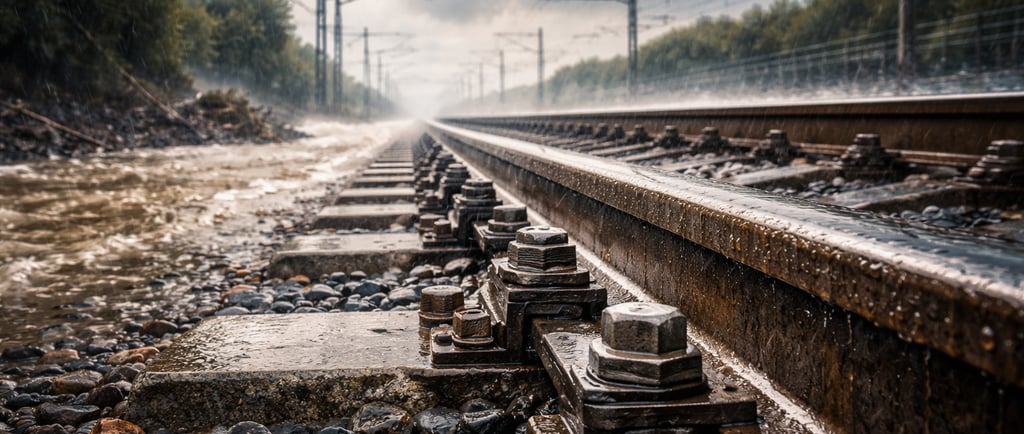
Rail is often presented as the low-carbon backbone of modern mobility. That is true only if the network keeps running when the weather turns hostile. Heat waves deform track and strain overhead systems. Floodwater undermines embankments, attacks fasteners, and accelerates corrosion in hidden joints. Freeze-thaw cycling opens microcracks, traps water, and shortens the life of connectors, housings, supports, and bridge details. Salt spray in coastal corridors and de-icing salts in winter regions keep metal surfaces wet and chemically active for longer. The result is simple: climate risk is now a metal durability problem as much as it is an operations problem. The International Union of Railways says railways are already feeling the impacts of climate change through heat waves, droughts, floods, and storms that damage infrastructure and disrupt service. The U.S. Federal Railroad Administration has likewise warned that sea level rise, storm surge, flooding, and more frequent extreme heat and cold events can delay or close rail services and damage assets.
That matters because weatherization is no longer a maintenance side project. It is now part of service reliability, safety, whole-life cost control, and climate compliance. Corrosion alone imposes an immense economic burden across infrastructure. AMPP cites a global corrosion cost above $2.5 trillion a year, roughly 3% to 4% of global GDP, and states that proven corrosion control practices can cut a meaningful share of those losses. In Canada, AMPP pegs the annual cost of corrosion at $51.9 billion, or 2.98% of GDP. For rail operators, every preventable failure in a bracket, fastener, tray, cabinet, rail base, connector, or support can trigger service delay, emergency possession time, crew overtime, replacement cost, and public scrutiny.
Why Weatherizing Metal Components Now Decides Rail Resilience
The climate case for weatherization is no longer abstract. Railways across Europe, North America, and Asia are dealing with more frequent extremes, higher asset exposure, and stricter public accountability. UIC’s recent resilience work frames heat, heavy rain, floods, storms, and drought as current operational threats, not distant scenarios. The UK’s Office of Rail and Road says climate change is already creating main risks and barriers for the rail sector and requires adaptation to maintain safe, reliable service. Network Rail’s adaptation work has moved weather resilience into standards, governance, design review, route planning, and asset strategy, which shows how large operators now treat it as a core operating issue rather than an occasional engineering fix.
Metal components sit at the center of this problem because they are often the first assets to degrade and the hardest to ignore once failure begins. Rails, baseplates, clips, fishplates, overhead line hardware, masts, cabinets, cable support systems, fixings, handrails, bridge secondary steel, switchgear enclosures, and drainage grates all face some mix of water, oxygen, salts, pollutants, vibration, thermal cycling, and stray current. In many cases, they do not fail in a dramatic single event. They weaken quietly, lose section, lose coating adhesion, trap more moisture, then fail under load or during an extreme-weather event when spare margin is already gone. That is why weatherization must cover hidden corrosion, not just visible rust.
Rail is especially vulnerable because the operating environment is harsh by design. The EN 50125 railway environmental conditions standard exists for a reason. It addresses temperature, humidity, rain, snow, hail, ice, solar radiation, lightning, and pollution because rail equipment must perform through a broad range of real-world exposures. ISO 55000 makes the same point from an asset-management angle. Value is created when assets are managed over their life cycle in a proactive, structured way. Weatherizing metal components is that principle made practical. It turns climate exposure into a managed design and maintenance variable.
There is also a funding and reporting angle that rail leaders cannot ignore. Public agencies increasingly need to show that resilience spending is evidence-based, measurable, and aligned with low-carbon goals. Network Rail has embedded weather and climate risk assessment into projects subject to its environment and social minimum requirements, and it updated drainage standards to include climate-change uplifts. In Canada, Transport Canada’s Rail Climate Change Adaptation Program is funding proactive washout risk systems, remote sensing, water-level monitoring, machine-learning analysis, culvert and bridge standard reviews, and testing of ties made from recycled materials. These are signs of where the market is heading: toward programs that connect material choice, failure prevention, climate adaptation, and carbon reporting in one package.
The practical takeaway is direct. If you are still treating metal weatherization as paint plus inspection, you are already behind. In 2026, the leading rail operators are building climate-adjusted design criteria, location-specific risk registers, material qualification rules, and digital inspection records into the system from the start. That shift changes how rail should specify, buy, maintain, and replace metal components.
The Real Failure Picture: What Weather Actually Does to Rail Metals
Weather does not attack rail components in one clean, isolated way. It stacks mechanisms on top of each other. Moisture starts the process. Salts increase conductivity and speed corrosion. Daily temperature swings stress coatings and joints. Freeze-thaw cycles push water deeper into defects. Vibration and cyclic loading turn small flaws into fatigue initiators. Pollution changes surface chemistry. In electrified territory, stray current adds another pathway for metal loss. That mix is why some components that look acceptable in a workshop fail early in service.
Rail base corrosion is one of the clearest examples of how climate exposure and mechanical loading combine. The FRA’s rail base corrosion and cracking work found that damage alone could reduce rail fatigue life by as much as one order of magnitude, and that added corrosion could reduce life by as much as another order of magnitude. That is a severe compounding effect, not a minor maintenance nuisance. Once a corrosive environment reaches damaged steel, the economics change fast. You are no longer managing surface condition. You are consuming fatigue life.
That same pattern appears outside the running rail. Bolted assemblies suffer crevice corrosion where water is trapped and oxygen access is uneven. Coated fasteners fail when coating damage at the thread root becomes a corrosion seed. Electrical connectors face galvanic attack when dissimilar metals are paired without proper isolation. Cable support systems and outdoor cabinets fail early when seals age, drains clog, or condensation is not controlled. Overhead line fittings and support brackets can remain serviceable for long periods, then deteriorate rapidly once protective systems break down. In cold climates, icing and freeze-thaw conditions worsen the problem by trapping water where it should not stay and by increasing mechanical strain during temperature transitions.
Location changes the failure pattern. Coastal lines deal with chloride-rich air, persistent humidity, and salt deposition that keeps surfaces conductive even without direct splash. Flood-prone corridors face prolonged wetting, sediment abrasion, contamination, and hidden washout-related exposure around supports and connections. Urban electrified routes often combine pollution, moisture, and stray-current risk. Mountain and northern routes face freeze-thaw, icing, snowmelt, and frequent transitions across the dew point. FRA climate assessments for the Northeast Corridor point to sea level rise, storm surge, severe storms, and extreme temperature swings as direct threats to rail infrastructure. UIC’s recent work on resilient railways highlights heavy rainfall and high temperature as priority hazards for network adaptation.
This is why weather resilience cannot rely on average climate assumptions. A component that survives five mild winters may still fail during one bad freeze-thaw sequence. A connector that performs inland may degrade far faster in a marine corridor. A mast base detail that drains adequately in one region may trap sediment and standing water in another. The correct engineering question is not, “Does this material work in general?” It is, “How does this metal system behave here, under this exposure, with this maintenance interval, at this criticality level?” Network Rail’s climate guidance and route-level planning point in that exact direction: site-specific weather risk, climate-adjusted design, and consistent assessment methods across projects and asset classes.
Material Strategy: Alloys, Recycled Content, and Low-Carbon Performance
Once the failure environment is clear, material selection becomes the first major decision. This is where many rail programs either gain years of service life or lock in avoidable problems. The answer is rarely to choose the most expensive alloy everywhere. The answer is to match alloy, form, joint detail, coating system, and expected inspection interval to the exposure and criticality of each asset.
Carbon steel still has a place in rail, especially where section size, cost, fabrication ease, and established standards matter. But bare or lightly protected carbon steel in persistent wet or salt-contaminated locations is a false economy. Corrosion-resistant steels, stainless grades, duplex systems, coated alloy assemblies, copper alloys for electrical duty, aluminum where weight and corrosion performance support it, and polymer-isolated mixed-metal assemblies can all make sense when used carefully. The hard part is not picking a material from a catalogue. The hard part is qualifying how it behaves in the exact geometry and maintenance context you will actually run.
Recycled metals matter here for both supply and climate reasons. The steel sector remains a major emissions source, and the IEA says sharp reductions in emissions intensity are necessary this decade. Secondary production routes and better scrap use are a major part of that path. For aluminum, the International Aluminium Institute reports that recycled aluminum needs just 8.3 gigajoules per tonne versus 186 gigajoules per tonne for primary aluminum, a 95.5% energy saving. The same source says recycling saves a similar share of greenhouse gas emissions. For copper, the International Copper Association says copper products contain more than 30% recycled content on average and that recycling reduces the energy demand and greenhouse gas burden associated with copper production. For rail systems under pressure to show lower embodied carbon, these are material facts, not branding lines.
That does not mean “recycled” should be treated as automatically superior. Rail components need consistency in chemistry, cleanliness, mechanical properties, and traceability. The correct approach is controlled circularity. Source scrap carefully. Verify alloy composition. Require processing and certification discipline. Test representative assemblies, not just coupons. Keep digital records of batch, coating, installation date, and service environment. Recycled metal can match or exceed performance when the qualification process is serious. It underperforms when circularity is treated as a procurement slogan rather than an engineering requirement.
There is also a supply-security angle. Copper and aluminum are both under pressure from the energy transition. The World Resources Institute argues that recycled copper can help meet growing clean-energy demand without relying solely on new mining, which often faces long development timelines and permitting delays. In rail, that matters for overhead electrification, signaling, bonding, earthing, and power distribution. Operators that build strong recycled-content pathways with proper quality control can reduce both embodied carbon and supply exposure, especially for high-volume replacement programs.
The smart material strategy, then, is a tiered one. Put assets into exposure classes. Map each class against criticality, expected life, maintenance access, and failure consequence. Then assign approved material families, not single one-size-fits-all materials. A lightly exposed indoor cabinet support does not need the same solution as a coastal signal gantry fixing, a mountain-pass fastener set, or an urban catenary connector. That discipline keeps budgets under control while still moving the network toward lower-carbon, longer-life metal systems.
Protective Systems: Coatings, Sealing, Drainage, Isolation, and Design for Disassembly
Material choice alone does not weatherize a rail component. Protection depends on the system around it. In practice, that means coating architecture, surface preparation, sealing, water-shedding geometry, drainage, galvanic isolation, inspection access, and ease of replacement. A good alloy with a poor joint detail will still fail early. A decent alloy with a disciplined protection system may outperform expectations.
Coatings are the first line of defense in many rail environments, but the coating must match the exposure. Salt-rich and wetting-heavy locations usually need multi-layer systems rather than a single barrier coat. The logic is straightforward. One layer improves adhesion and corrosion control at the substrate. Another builds film thickness and barrier strength. A final layer resists UV, moisture, abrasion, or chemical exposure as required. The blog section you provided later refers to duplex systems with zinc-aluminum undercoats and polymer or epoxy top coats, and that is directionally consistent with how aggressive environments are usually handled. The exact system should be chosen through exposure testing, maintenance access review, and repair practicality, not by habit. FRA research on rail base corrosion also supports the broader point that anti-corrosion surface treatments can extend fatigue life where corrosion and damage interact.
Surface preparation is just as important as the coating chemistry. Many weatherization failures begin before the asset is even installed. Poor blast profile, contamination, trapped moisture, incomplete edge treatment, bad cure conditions, or coating damage during transport can erase the advantage of a good specification. This is why QA must start at fabrication, not after the first winter. Network Rail’s adaptation approach, with standards, governance, and project-level risk assessments built into the process, points toward that front-loaded model. You do not wait for a route to fail, then decide documentation matters.
Drainage and water-shedding details are often the cheapest high-impact upgrade in the whole system. If a bracket forms a horizontal shelf, it will hold water. If a box section is not vented and drained, it will trap condensation. If a mast base detail collects sediment, it will keep the metal wet longer. If a cabinet seal blocks intended drainage, internal humidity will do the damage that rain never did directly. Network Rail’s update to require climate-change uplifts in drainage design makes the bigger point clearly: water management is asset protection, not a separate civil issue.
Galvanic isolation deserves more attention than it usually gets. Mixed-metal assemblies are common in rail, especially in electrification and signaling systems. If dissimilar metals are paired without proper isolation, a wet conductive path can turn the more active metal into a sacrificial part of the assembly whether you intended that or not. Add salts, pollution, or condensation, and the problem speeds up. Electrical interfaces need both corrosion thinking and current-path thinking. That means compatible metal pairing, non-absorbent washers or sleeves where needed, protected contact zones, and clear installation rules for technicians in the field.
Design for disassembly is the final piece that separates old-school protection from modern circular resilience. A component that is hard to inspect, hard to isolate, and hard to replace will stay in service too long and generate more waste when it finally comes out. A component designed with modularity, accessible fasteners, standard replacement kits, and recyclable material streams gives maintenance teams better options under pressure. That is especially useful after storms, floods, and freeze events when time, access windows, and spare availability are all constrained. Circularity works best when it is designed into maintenance speed, not added later as a reporting line.
Implementation Playbook: From Climate Exposure Map to Network Standard
The most common reason weatherization programs stall is not lack of technology. It is lack of structure. Teams know the problem exists, but the work stays fragmented across engineering, procurement, maintenance, sustainability, and operations. The fix is a staged implementation path that starts small enough to control, but serious enough to change standards.
Step one is exposure mapping. Build a network map that classifies asset environments by chloride exposure, flooding likelihood, humidity persistence, freeze-thaw intensity, pollution load, stray-current relevance, and maintenance access. Then layer criticality on top. Ask which metal components can stop service, trigger speed restrictions, or create safety issues if they fail. This moves you from generic maintenance to consequence-based weatherization. UIC’s resilience framing, FRA climate risk work, and Network Rail’s route and asset-level climate assessments all support this risk-based approach.
Step two is failure-mode prioritization. Do not start by rewriting every specification in the network. Start with the parts that fail often, fail silently, or fail expensively. Rail base corrosion, vulnerable fastener systems, coastal housings, urban electrification connectors, cabinet supports, bridge secondary steel in splash zones, and hard-to-access fixings are usually better targets than low-risk indoor metalwork. The FRA’s findings on corrosion plus fatigue give a strong reason to prioritize areas where mechanical damage and corrosive exposure overlap.
Step three is qualification. For each priority component family, define approved material and protection options by exposure class. That means alloy rules, recycled-content thresholds where appropriate, coating systems, minimum surface prep, inspection windows, repair methods, and traceability requirements. ISO 55000 is useful here because it forces a life-cycle lens. The goal is not to buy a component cheaply. The goal is to obtain value from the asset over time through managed performance, risk, and cost.
Step four is pilot corridors. Choose a coastal route, a flood-prone route, a freeze-thaw corridor, or an urban electrified zone where you can compare old and new systems directly. Instrument the pilot. Record installation condition, batch traceability, coating thickness, service exposure, inspection results, and failure events. Transport Canada’s current adaptation funding shows where this is going across the industry: toward sensor-backed, data-rich climate adaptation programs rather than opinion-led maintenance.
Step five is procurement reform. Weatherization fails when procurement asks for “equivalent” materials without defining equivalence properly. Technical documents should specify the performance outcome, the exposure class, the allowable materials, the coating and preparation rules, the evidence required, and the digital records that must accompany every batch. Supplier approval should include proof of process control, not just price and delivery. This is also where circular targets should be written carefully. Ask for verified recycled content and traceability, not vague environmental claims.
Step six is maintenance integration. Inspection teams need simple field logic that matches the design intent. Where are the known water traps? Which defects are cosmetic, and which indicate active loss of life? Which parts must be replaced on condition, and which can be repaired in place? What photo evidence is mandatory? What coating touch-up is allowed, and what requires workshop refurbishment? Network Rail’s use of guidance notes, weather resilience assessment methods, and governance layers shows that adaptation becomes durable only when it enters everyday engineering practice.
Step seven is governance. Assign ownership. One team should own the standard. One team should own the approved material list. One team should own the digital record structure. Route teams should own local risk review and feedback. Sustainability teams should translate recycled-content and embodied-carbon gains into reporting language. Operations teams should feed weather-incident data back into prioritization. Without that structure, even good pilots stay local and die after the first budget cycle. ISO 55000 exists precisely because value from assets does not appear by accident. It appears when decision rights, risk logic, and performance measures are clear.
If this foundation is in place, the next stage becomes much easier. You can measure corrosion-related failure rate, inspection completion, recycled-content verification, response time, digital record accuracy, spares exposure, and embodied carbon with confidence because the underlying system has been designed to produce those signals. You can study case patterns across coastal, alpine, urban, and storm-prone networks because your asset classes and exposure classes are already defined. You can answer operator FAQs clearly because your standards are tied to evidence. And you can build a distribution and reuse toolkit that other teams, suppliers, and public agencies can actually use.
6. Measurement & QA: Metrics, Benchmarks, and Scorecard
Delivering weatherization programs for rail resilience must be grounded in measurable outcomes, not just intentions. Quantitative tracking and continuous improvement ensure that investments translate into real-world resilience and sustainability gains.
Establishing Metrics: What Should Be Measured?
To ensure a rail weatherization initiative delivers strategic objectives, operators should prioritize key performance indicators (KPIs) across asset performance, lifecycle cost, sustainability, and operational readiness. The following metrics not only monitor present conditions but help forecast future risks, enabling a proactive maintenance and risk management culture:
Corrosion-Related Failure Rate: Monitoring this monthly can highlight emerging issues before cascading failures occur.
Inspection Completion Rate: Weekly tracking holds teams accountable and pinpoints bottlenecks in asset management.
Recycled Content Verification: Higher recycled content directly supports public sustainability commitments and emissions reporting.
Response Time for Weather Failures: Measuring the time from incident to resolution ensures resilience planning translates into real-world asset uptime during climate events.
Digital Record Accuracy: Maintaining digital coating/application records offers traceability, vital for analytics and regulatory reporting.
Critical Spares Stockouts: Zero tolerance for stockouts in high-risk segments ensures rapid response and system continuity.
Year-on-Year Embodied Carbon Reduction: Quantifies progress toward net-zero or low-carbon infrastructure mandates, supporting funding and regulatory requirements.
By developing a scorecard aligned to these metrics, teams can easily visualize gaps, celebrate improvements, and trigger deeper root-cause analysis when targets are missed.
Benchmarking for Resilience and Carbon
Comparative benchmarking against regional peers or international standards (such as ISO 55000 asset management, or CENELEC standards for railway applications) helps organizations calibrate their efforts. For example, European agencies targeting a 50% drop in weather-related metal component failures within a decade now serve as a reference point for ambitious North American and Asian transit operators.
Innovative agencies also integrate their metrics into sustainability reporting, scoring well in ESG (Environmental, Social, and Governance) rankings and creating a direct link between weatherization and organizational reputation. By quantifying embodied carbon reductions—such as a measurable 10% year-on-year cut from recycled metals—rail operators can unlock climate funding or green bonds while demonstrating a science-based approach to infrastructure decarbonization.
Quality Assurance and Continuous Learning
Success depends on closing the loop with structured QA: test results, third-party supplier audits, and real-time data review via automated dashboards. Digital twin technology can further enhance visibility, enabling asset managers to simulate weather impacts on various metal alloys and coating systems, fine-tuning maintenance regimes before disruptive failures occur.
Quality improvement cycles—such as Six Sigma or Lean—integrated into the weatherization program can yield compound benefits: faster root-cause analysis, streamlined spares management, and continuous optimization of coatings and materials.
7. Case Patterns: Weatherization in Action
Real-world validation of weatherization efforts builds organizational confidence and clarifies best practices. Examining case studies across climate zones demonstrates efficacy and uncovers patterns for replication.
Example Scenario 1: Coastal Rail Corridors
Coastal lines, such as the UK’s Great Western Main Line or New Jersey Transit’s Northeast Corridor, frequently battle salt-induced corrosion. In these contexts, the switch to recycled, marine-spec stainless steel housings and use of high-performance duplex coatings increased the replacement interval from one year to four years—delivering both cost savings and environmental benefits.
Insight:
Advanced coatings combined with recycled alloy selection are especially potent in saline or fog-prone environments.
Example Scenario 2: High-Altitude Freeze-Thaw Regions
Mountain passes on Canada’s Trans-Canada Railway and the Swiss Alps' network face repeated mechanical and thermal stresses during spring thaws. Using polymer-coated recycled alloy bolts has reduced fastener failures by over 70%, and predictive analytics now prioritize pre-winter replacements.
Insight:
Polymer undercoats and targeted alloy selection extend fatigue life significantly, especially when combined with real-time remote monitoring.
Example Scenario 3: Urban Catenary and Electrification Upgrades
Dense metropolitan networks in New York or Tokyo have increased high-pollution exposure on overhead electrification hardware. Upgrading to modular, multi-layer-coated recycled copper alloy connectors has doubled inspection intervals and minimized repair-related interruptions.
Insight:
Circular, modular components—especially for high-voltage assets—optimize both reliability and the ease of disassembly for recycling.
Example Scenario 4: Spares Availability in Extreme Events
Regions subject to hurricanes or blizzards, such as the Gulf Coast or Midwest, have experienced protracted service outages when specialized weatherized spares were unavailable. Operators deploying predictive, digital inventory systems reduced storm recovery times and maintained service even after back-to-back severe weather events.
Insight:
Data-driven spares management tied closely to local climate risk data dramatically enhances infrastructure resilience.
8. FAQs: Rail Resilience & Weatherized Metals
Q1. How does weatherizing metal components improve rail resilience?
Weatherization prevents corrosion, fatigue, and weather-induced failures, thus ensuring higher system uptime, fewer emergency repairs, and lower whole-life costs.
Q2. Why are recycled metals important for climate-resilient rail?
They reduce the rail system’s carbon footprint and, when carefully sourced and processed, achieve or exceed the performance of virgin metals—vital for regulatory compliance and public trust.
Q3. What are the best coatings for rail metal exposed to salt spray?
Duplex systems, especially those blending high-build zinc-aluminum undercoats with polymer or epoxy top coats, provide multi-layer barriers proven to resist aggressive salt environments.
Q4. How often should weatherized metal assets be inspected?
Inspection cadence is risk-based, but best-in-class operators perform quarterly checks for vulnerable connectors and fasteners, with annual reviews for larger or less-exposed assets.
Q5. How does circularity affect maintenance?
Designing for rapid disassembly and using recyclable components allow maintenance teams to replace failed parts faster and return materials to the supply chain, reducing waste and costs.
Q6. What’s the impact of embodied carbon reduction in rail infrastructure?
Reducing embodied carbon boosts environmental performance, supports ESG reporting, and can unlock government and investor funding, creating a competitive advantage.
Q7. Can weatherized recycled metals perform as well as virgin metals?
Yes. With rigorous alloy selection and surface treatment, recycled metals reach equivalent or superior durability, especially in corrosion-prone contexts.
Q8. What technologies support weatherization and monitoring?
Corrosion sensors, mobile inspection software, and asset digital twins bring unprecedented precision and agility to maintenance planning.
Q9. How do you manage spares inventory for resilience?
Modern rail systems employ data-driven inventory controls—dynamically adjusting spares by location, asset type, and observed weather risks.
Q10. How does rapid failure analysis support resilience?
Immediate root-cause analysis after failures closes feedback loops, enabling continuous improvement and preventing repeat incidents.
Q11. Are there funding incentives for upgrades?
Yes, from federal resilience grants in the U.S. to EU Green Deal funds, agencies prioritizing low-carbon, circular rail often access preferential funding.
Q12. Common weatherization pitfalls?
Inconsistent inspection, improper application of coatings, and insufficient documentation undermine even the best strategies—robust QA is essential.
9. Five-Layer Distribution and Reuse Toolkit
To maximize impact and knowledge-sharing, implement a layered toolkit for the distribution and uptake of weatherizing playbooks and case data:
1. Internal Knowledge Base
Build out an accessible digital knowledge base comprising SOPs, case studies, inspection protocols, and technical datasheets. Update quarterly to reflect latest findings.
2. Cross-Functional Training
Develop modular workshops for track engineers, procurement specialists, and field technicians, enabling rapid onboarding for new weatherization standards and digital inspection tools.
3. Supplier Co-Innovation Forums
Host quarterly forums to align suppliers with your evolving material specs, QA requirements, and circularity mandates—ensuring the supply chain is resilience-ready.
4. Public-Facing Sustainability Reports
Share clear outcomes on weatherization and circular materials performance with regulators, funding bodies, and stakeholders via annual sustainability reports and dashboards.
5. Open Data for Peer Learning
Participate in national/international platforms (e.g., OpenRail, UIC sustainability networks) to standardize benchmarking and enable comparative learning.
Conclusion: Weatherizing Metal Components Is the Future of Low-Carbon Rail
Rail networks worldwide face a perfect storm of climate volatility, public scrutiny, and sustainability mandates. Weatherizing metal components is no longer a discretionary upgrade—it’s central to resilient, future-ready rail operations.
Embracing recycled metals, advanced coatings, modular designs, and digital monitoring transforms not just asset longevity, but the entire risk profile of the network. As weather extremes intensify, the leaders will be those who operationalize circularity, anticipate failures before they cascade, and transparently report real resilience gains.
The time for robust weatherization is now—delivering not just continuity and cost savings, but trust, compliance, and climate leadership for railway operators in every geography.
Connect
Your trusted partner for scrap metal procurement.
CONTACT
About
haroon@tdcventures.com
+1-307-655-7593
© 2025. All rights reserved.
NEWSLETTER