
Refurbish vs. Recycle: Decision Trees for Appliances
Discover how data-driven decision trees optimize appliance end-of-life choices between refurbishment and recycling to maximize metal circulation, reduce waste, and unlock circular economy value.
WASTE-TO-RESOURCE & CIRCULAR ECONOMY SOLUTIONS
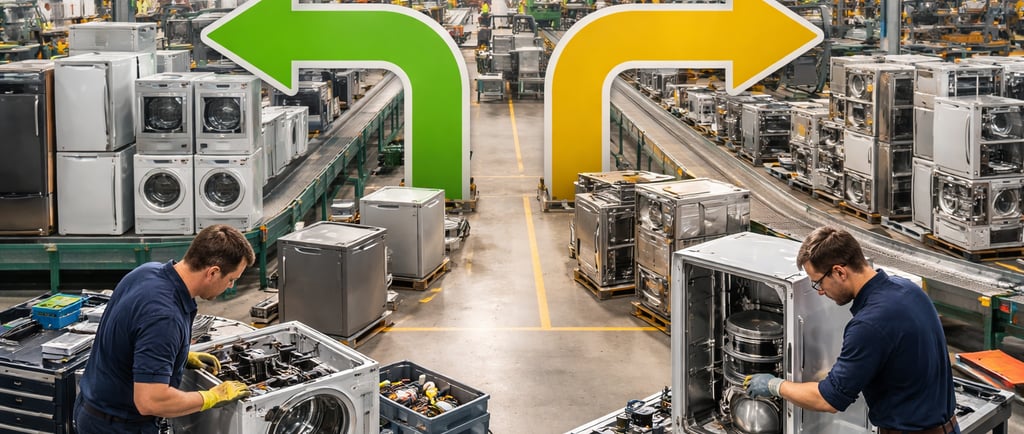
In today's rapidly evolving world, the classic linear economy—where products are manufactured, consumed, and tossed away—has passed its prime. With global raw material consumption projected to double by 2060 (OECD), and electronic waste (e-waste) swelling past 50 million metric tons annually (United Nations University), shifting gears to a truly circular economy is not just desirable but mission-critical. Nowhere is this circular transformation more urgent than with major household appliances: those hefty, metal-rich essentials that populate our homes and power our daily lives.
But when these devices reach the end of their initial use, pivotal decisions loom. Do we maximize the lifespan through refurbishment and remanufacturing? Or do we commit them to the recycling stream, aiming for maximum metal recovery with minimum waste? Decision trees provide smart, data-driven roadmaps to answer these pressing questions, enabling organizations, consumers, and regulators to unlock enormous environmental and economic value.
In this deep dive, we'll pull back the curtain on the blueprints, diagnostic tools, and business model innovations that are driving the appliance industry toward next-level circularity—ultimately keeping vital metals in use and building a sustainable foundation for future growth.
Why Metals in Appliances Matter in the Circular Economy
Large appliances—think refrigerators, dishwashers, washing machines, ovens, and air conditioners—are far more than boxes of convenience. These products are engineered with dense concentrations of high-value metals: stainless steel for structure and durability, copper for electrical conductance, aluminum for lightweight strength, and, increasingly, rare earth elements like neodymium used in high-efficiency motors or cooling systems.
The Environmental Stakes
To grasp why keeping these metals circulating matters, consider the resource and emissions math:
Raw Material Extraction: Mining one ton of copper can generate as much as 110 tons of waste material. The steel sector alone accounts for nearly 7% of global carbon dioxide emissions.
Manufacturing Energy: Producing brand-new steel uses about 75% more energy than recycling it (World Steel Association).
Circular Recovery: According to the European Commission, up to 95% of metals in appliances can be recovered and reintegrated through high-quality recycling and refurbishing flows.
Simply put, every appliance we successfully refurbish or recycle represents avoided emissions, reduced ecological impact, and less demand for new extraction—a trilogy central to circular economy objectives.
Appliance Metal Lifecycles: Case Example
In Sweden, a national take-back program boasts 80% recovery of all large household appliances, with 93% of metal content recirculated. This closed-loop approach has halved the environmental footprint of the nation's appliance sector in a decade—a powerful proof point that effective metal circulation tangibly advances circular economy KPIs.
Refurbish vs. Recycle: The Critical Decision Point
No two appliances show the same wear, nor end their first life at the same time. Decision points arise daily for everyone from manufacturers to municipal recyclers:
Refurbishing: Give Items a Second, Even Third Life
Refurbishment is the gold standard in the circular economy hierarchy. It focuses on returning products to 'like new' status using repairs, part replacements, cleaning, and re-testing—while typically consuming only a fraction of the energy of remanufacturing or recycling. According to the World Economic Forum, refurbishment can reduce environmental impact by up to 60% compared to creating a new appliance.
Recycling: Unlock Raw Metal Potential
When products are no longer suitable for safe use or repair, advanced recycling offers a second chance for materials. By disassembling appliances and recovering metals, glass, and some plastics, recycling feeds materials back into the supply chain. This avoids landfill and reduces extraction demand, though it does require additional processing and can sometimes compromise material quality (downcycling).
Critical Moment: The Role of Condition and Technology
Determining the most sustainable and profitable path—refurbishment if possible, recycling if necessary—relies on precise evaluation techniques and decision support systems. That's where decision trees and structured assessment frameworks shine.
Global Stat Snapshot
The Ellen MacArthur Foundation estimates that cascading product lifespans through refurbishing could deliver $630 billion annually in global resource savings—highlighting why finding the right end-of-life pathway matters for nearly every business.
Understanding Decision Trees: A Blueprint for Smart Choices
A decision tree is an actionable, step-by-step logic model guiding organizations—and even end consumers—through a logical sequence of questions. The goal: identify the route (refurbish, remanufacture, recycle) that maximizes both value retention and sustainability.
Key Assessment Factors
A well-constructed appliance end-of-life decision tree considers multiple weighted variables:
Product Age: Appliances under 10 years are statistically more viable to refurbish, as major components typically remain within or close to their design life.
Structural & Functional Integrity: Checking core elements like motors, compressors, electronics for safe operation and repairability.
Market Demand & Local Context: A thriving market for certified used appliances vastly improves refurbishment value.
Part Availability: Scarcity of replacement parts can pivot decisions toward recycling or component harvesting.
Labor & Technical Expertise: Skilled labor, certified repair technicians, and proper equipment are pre-requisites for safe, effective refurbishment.
Cost & Environmental Analysis: Lifecycle carbon assessments and cost-benefit models influence the ultimate decision.
Example: Real-World Application
In the UK, AO.com (a leading appliance retailer) implemented decision-tree-driven diagnostics at its return centers. It reduced unnecessary recycling by 27% in two years—by accurately identifying units suitable for fast-tracked repair or resale.
Integration with Digital Technology
Today's leading decision trees are increasingly digitized. AI-powered assessment tools, connected diagnostics, and IoT data streams feed into algorithmic decisioning—delivering faster, more reliable triage at scale.
The Role of Reverse Logistics in Appliance Circularity
From Consumer Back to Value Chain
Efficient reverse logistics is the backbone of every circular appliance strategy. It refers to orchestrating the collection, tracking, and return of used—sometimes bulky—equipment from the field back to processing facilities, where the next circular step begins.
Emerging Global Models
Producer Responsibility Schemes: Under the European Union's Waste Electrical and Electronic Equipment (WEEE) Directive, producers must fund and manage end-of-life appliance collection and processing—driving innovation in pick-up and routing strategies.
Retailer Take-Back Programs: Home Depot in the US, and MediaMarkt in Germany, offer free collection of old appliances upon delivery of new ones, feeding units back into either refurbishment or recycling streams.
Municipal Drop-Off Points: Cities like San Francisco operate recycling centers with RFID-enabled tracking, logging every appliance intake to optimize subsequent processing.
Digital Solutions in Reverse Logistics
Barcodes & Advanced RFID Systems: Each appliance is tagged at sale, scanned through its journey, and logged into centralized databases for ultimate traceability.
IoT-Connected Fleet Management: Dynamic routing optimizes collection runs, reducing unnecessary journeys and associated carbon emissions.
Collaborative Data Platforms: Ecosystems where manufacturers, logistics companies, and repair specialists share information for optimal reverse supply chain flow.
Stat to Note
DHL's research into reverse logistics found that integrated digital and physical models cut end-to-end appliance processing costs by up to 20%, making circularity more accessible and scalable.
Customer Trust and Experience: The New Differentiator
When brands offer hassle-free, transparent return and refurbishment options—backed by real-time status tracking—consumer confidence rises. Over 70% of surveyed electronics buyers in Germany indicated higher trust if return and refurbishment were "seamless and environmentally certified" (GfK, 2022).
Tools Empowering Refurbishment and Remanufacturing
Empowering large-scale refurbishment requires more than skilled technicians; it demands a robust digital and physical toolkit designed for efficiency, compliance, and quality.
1. AI-Powered Condition Assessment
AI and machine learning unlock granular diagnostics:
Visual Inspections: Computer vision algorithms detect dents, corrosion, and faults rapidly.
Connected Testing: IoT sensors monitor real-world usage and failure points, generating predictive maintenance insights.
Automated Reporting: Diagnostic data flows directly into decision trees, flagging the ideal path (refurbish, harvest, recycle) instantly.
2. Digital Twin Technology
By creating a virtual replica of every appliance, including component provenance and repair history, companies ensure:
Full traceability (vital for warranty, regulatory, and sustainability reporting).
Better planning for spare part needs.
Faster response during recalls or quality alerts.
3. Automated Disassembly Robotics
Robotic platforms deployed in advanced recycling centers are transforming the efficiency of both part harvesting and material separation. For example, Cascade Asset Management in the US uses robotic arms to disassemble appliances, improving recovery rates of rare and high-value metals by 15%.
4. Quality Tracking and Certification Apps
Mobile tools provide real-time quality control, certification issuance, and upload of product status to circularity dashboards—reassuring buyers and bolstering secondary market trust.
Why "keep it whole" usually wins, until it does not
Appliance circularity is a value-retention problem disguised as a waste problem.
When you refurbish, you keep product value, labor value, and embedded manufacturing value in one piece.
When you recycle, you reset the clock. You recover metals, but you lose the assembled product premium.
That is why decision trees matter. They prevent two expensive mistakes:
Sending repairable units to shredders.
Sending unsafe or uneconomic units into resale channels.
Zoom out for a second. Global materials use is projected to more than double from 79 Gt in 2011 to 167 Gt in 2060. OECD+1
E-waste hit 62 million tonnes in 2022, and only 22.3% was documented as formally collected and recycled. ITU+2World Health Organization+2
Rare earth recovery is a rounding error, about 1% of demand is met by e-waste recycling today. E-Waste Monitor+1
Large appliances sit inside that same math, with one extra twist.
They are heavy. They are logistics-intensive. Small improvements in routing, triage, and channel choice move serious tonnage.
Metal circulation math, what is inside the box
You cannot build a decision tree without a bill of materials mindset.
Refrigerators give you a clean example because the material fractions are well-studied and the depollution step is strict.
One detailed recycling and LCA study reports:
Steel at 35.9 wt-% of total mass.
Plastics at 23.4 wt-%.
Polyurethane insulation at 21.7 wt-%.
A neodymium-based magnet at 0.4 wt-%.
PCB at 0.1 wt-%. MDPI
That same study shows why "recycle" is not one thing.
In one refrigerator recycling process, copper recovery was 52.4%. In a metallurgical recovery route, copper recovery reached 88%. MDPI
Aluminium recovery in that process was 68.4% due to unliberated fractions, even though metallurgical recovery of aluminium from the non-ferrous fraction can be far higher. MDPI
Translation. If you shred too early, you can trap value inside mixed streams.
Now look at washing machines.
A materials breakdown shown in an engineering reference summary lists, by part mass, major metals like mild steel (23 kg), stainless steel (5.4 kg), copper/brass (1.8 kg), aluminium (1.9 kg), plus cast iron and other steels. ScienceDirect
That is why refurbish often wins for many units under typical household duty cycles.
You keep a large steel chassis, a motor, and a working system. You avoid remelting and re-forming.
Decision trees 2.0: from simple yes/no to scoring that survives real-world volume
Most "decision trees" fail because they treat every variable as equal.
In practice, three gates dominate outcomes.
Gate 1: Safety and legal compliance
If a unit fails here, you do not refurbish it. Full stop.
Examples:
Refrigerants and oils in cold-chain equipment.
High-voltage hazards.
Structural damage that compromises safe operation.
Missing compliance-critical components.
Gate 2: Technical repairability at acceptable cost
This is where parts access, technician time, and test equipment decide the outcome.
Gate 3: Market channel fit
A technically repairable unit can still be a bad refurb if you cannot sell it fast enough at a margin that covers reverse logistics and warranty risk.
A field-ready scoring method you can implement
Use a 0–100 score. Make the score explainable. Keep it auditable.
Here is a practical model used by many operators in some form, even if they call it something else.
Identity and baseline
Confirm model, serial, and age band.
Pull known failure modes and parts list for that SKU.
Check recall status.
Safety and depollution gate, pass or fail
Refrigerant present, yes or no.
Evidence of coolant circuit breach.
Electrical insulation integrity.
Fire damage, flood exposure, severe corrosion.
Fail this gate, route to depollution then recycle. Pass this gate, continue.
Condition score, 0–40 points
Cosmetic grade and housing integrity.
Evidence of misuse.
Noise, vibration, heat, cooling performance, cycle completion.
Water leaks on washers, dishwashers.
Core component score, 0–30 points
Compressor or motor health.
Control board condition and connector integrity.
Wiring harness condition.
For fridges, sealed system performance.
Parts and labor score, 0–20 points
Parts availability lead time.
Part cost as a share of expected resale value.
Technician minutes required, including test cycle time.
Channel score, 0–10 points
Local demand and price bands.
Bulk buyer availability, landlords, student housing, property managers.
Warranty expectations in that channel.
Suggested routing thresholds
80–100: refurbish and certify for resale.
55–79: repair only if you can bundle, parts-harvest, or sell "as-is" with disclosure.
Below 55: depollute and recycle, consider parts harvesting first.
This structure avoids the most common trap. It makes "repairable" and "worth repairing" two different answers.
Business model deep dives: how operators make money while keeping metals circulating
Model 1: OEM-owned take-back plus certified refurbished
How it works
The brand uses retailer returns, warranty claims, and take-back programs as feedstock.
It triages units into:
A-grade refurb for certified resale.
B-grade repair and resale through outlet channels.
Parts harvesting for future service.
Recycling for the rest.
Why OEMs like it
They control quality.
They protect brand perception.
They lock in parts demand and service revenue.
Where it breaks
Reverse logistics costs can erase margin fast.
Warranty risk rises if testing is weak.
Parts access can become a self-inflicted constraint if the OEM limits third-party supply.
What to copy
Build one "gold standard" test lane per category.
Fridge testing needs temperature stabilization time, not just a quick power-on.
Washer testing needs full cycle testing, not a spin-only shortcut.
Model 2: Retailer reverse logistics hubs and outlet resale
Retailers sit on a unique advantage.
They see returns first.
They already run delivery fleets.
AO in the UK built a dedicated recycling facility, reported as a £20m investment.
That kind of hub model works when you do three things well:
Minimize handling touches.
Standardize triage.
Clear inventory fast through the right resale channel.
Revenue streams
Resale margin on certified units.
Service and installation upsells.
Scrap and material sales on non-repairable units.
Key KPI
Minutes from arrival to decision.
Every extra day increases storage cost, damage risk, and value decay.
Model 3: Utility-funded appliance recycling and replacement programs
Utilities pay for appliance removal because old fridges are grid liabilities.
They often offer cash rebates and free pickup.
Examples in the US show $50 rebates for recycling working refrigerators and freezers through utility programs, with smaller rebates for room AC units and dehumidifiers.
This model creates reliable collection volume.
It also improves depollution compliance, because the pickup flow routes units to approved processors.
Where refurb fits
Utilities usually target energy-hungry, still-working units for retirement, not resale.
So refurbishers should not treat utility programs as refurb feedstock.
Treat them as a recycling feedstock and a lead source for upgraded replacement sales.
Model 4: Independent refurbishers with warranty-backed trust
Independent refurb wins on speed and local market knowledge.
It loses on parts access and credit risk.
What wins
Tight sourcing, retailer returns, warranty write-offs, housing upgrades, bulk trade-ins.
Standard grades, A/B/C, with clear disclosure.
Short, real warranties that match failure curves, not marketing goals.
What fails
No test discipline.
No parts inventory strategy.
No documented repair history.
The trust flywheel
You build repeat demand when customers get:
Clear grading.
Proof of testing.
Simple warranty claims.
Model 5: Parts harvesting as a first-class business
Parts harvesting is the bridge between refurbish and recycle.
It extends product life without forcing full-unit resale.
High-value targets
Motors, compressors, pumps.
Control boards and sensors.
Copper harnesses, copper tubing.
Stainless panels and structural parts for some SKUs.
Rules that prevent chaos
Harvest only parts with repeat demand.
Track harvest yield by model.
Scrap the rest fast.
Model 6: High-spec recycling with depollution and quality standards
Recycling is not a low-tech fallback.
It becomes a high-skill operation the moment you touch cold appliances and foams.
Depollution matters because gases and blowing agents can drive most of the climate risk.
One audited fridge recycler reported a 98% gas recovery rate at scale, processing about 250,000 fridges per year, around 10,000 tonnes.
Standards matter because buyers and regulators demand proof, not claims.
The WEEELABEX system ties treatment and preparation for re-use operations to EU standards, with monitoring requirements for depollution performance.
If you run recycling as a business, your product is not "recycling."
Your product is consistent, spec-grade outputs:
Ferrous.
Non-ferrous.
Copper-rich fractions.
Plastics where viable.
Documented depollution.
Policy and targets that shape the business case
In the EU, the WEEE Directive sets category targets that force process discipline.
A recent WEEE Forum report summarizes targets for large household appliances as:
85% recovery rate.
80% reuse and recycling rate.
But collection still leaks.
Eurostat data summarized by the European Commission shows the EU WEEE collection rate at 37.5% in 2023, below the 65% target based on equipment placed on the market.
That gap is where business opportunity and risk live at the same time.
Opportunity, because better collection and triage captures value.
Risk, because informal handling often strips value and increases environmental harm.
Challenges that block circular appliance programs, and how top operators handle them
Challenge 1: Collection leakage and damaged units
Bulky goods get damaged in transit. One drop can change a refurb decision.
How to reduce it
Use vertical transport rules, especially for refrigeration.
Standardize pickup packaging and tie-down procedures.
Grade at pickup when possible, before you pay long-haul transport.
Challenge 2: Refrigerants, foams, and compliance cost
Fridges and freezers hide the hardest part of appliance circularity.
Depollution needs training, equipment, and audited process.
How to reduce it
Route cold appliances through depollution-first lanes.
Treat foam and blowing agent handling as a core process, not an afterthought.
Use certified treatment standards where they exist, because it reduces buyer and regulator friction.
Challenge 3: Mixed materials and trapped value after shredding
The refrigerator recycling study shows how unliberated fractions drive big losses, especially for copper and aluminium in certain routes.
How to reduce it
Push selective dismantling earlier for known high-value components.
Use better separation steps where they pay back, not everywhere.
Measure yield by SKU family, then change process, not slogans.
Challenge 4: Parts access and repair bans by design
If parts take weeks, refurb inventory turns into dead stock.
Policy is starting to bite here.
The EU's right to repair rules aim to make repair easier, including stronger access to spare parts and protections against practices that block independent repair.
How to reduce it
Build a "top 50 parts" inventory for your highest-volume SKUs.
Partner with parts recyclers for used OEM parts where allowed.
Use parts harvesting as your internal supply line.
Challenge 5: Trust, warranties, and resale friction
Secondary markets punish uncertainty.
If the buyer expects failure, your conversion rate drops and returns rise.
How to reduce it
Publish your test checklist by category.
Attach a test report to each unit, even if it is one page.
Use short warranties that you can honor without cashflow stress.
Challenge 6: Regulation changes across borders
A program that works in one country can fail in another due to:
Different EPR rules.
Different refrigerant rules.
Different waste shipment limits.
How to reduce it
Localize the decision tree thresholds to local cost and channel reality.
Keep documentation export-ready, especially depollution records and chain-of-custody.
Future trends you should plan for now
Trend 1: Repair becomes the default consumer right in major markets
The EU has moved to require more repair availability and incentives, including warranty extensions after repair, and rules meant to stop practices that block repair.
If you sell in Europe, this pushes more product back into repair lanes, not replacement lanes.
Trend 2: Product data becomes a trade asset
The EU's Ecodesign for Sustainable Products Regulation sets the direction toward stronger durability, circularity, and digital product information across categories.
This changes triage economics.
When you can pull model-level repair info, parts lists, and compliance details fast, your decision tree gets faster and more accurate.
Trend 3: Treatment quality standards separate winners from everyone else
As regulators tighten and buyers demand proof, certified depollution and audited treatment will act as a market filter.
Trend 4: Longer replacement cycles shift feedstock timing
Consumer behavior is already moving toward longer replacement cycles in white goods, with one industry analysis noting an increase in consumers waiting 10 years or more to replace products from 35% in 2023 to 39% in 2024.
This affects refurb supply.
You see older units.
You see higher failure probability.
You need stronger parts harvesting and recycling lanes.
Trend 5: Metals policy pressure rises as steel decarbonization remains hard
Steel sits at the center of appliance mass.
Worldsteel reports 1,886 Mt of steel produced in 2024, with average emissions of 2.18 t CO2e per tonne of steel, and sector emissions on the order of 7%–8% of global anthropogenic GHG emissions.
This pushes buyers and policymakers toward higher recycled content and stronger recovery.
It also increases the value of clean, spec-grade scrap streams.
Practical takeaways you can use as a checklist
If you run a refurb operation
Build a safety gate first, especially for refrigeration.
Standardize testing by category, then measure pass rates by SKU family.
Stock your top failure parts. Do not stock everything.
Treat cosmetic grade as a pricing input, not a moral judgment.
Use parts harvesting as your buffer against parts lead times.
If you run a recycling operation
Depollute first for cold appliances, then shred.
Measure yield by material stream and by SKU family.
Use audited standards where possible, because it reduces downstream buyer risk.
Track gas recovery and document it, because it is often your biggest climate lever.
If you are a retailer or OEM
Treat reverse logistics as a core profit center, not a cost center.
Separate "returns processing" from "circular processing." They need different KPIs.
Put the decision tree at the intake dock, not at the end of the line.
Design outlet channels for speed, because storage destroys value.
A 30–60–90 day execution plan
Days 1–30
Define your safety gate rules by category.
Build your scorecard and routing thresholds.
Choose your test procedures and write them down.
Set up tracking for arrival, decision time, and outcome.
Days 31–60
Pilot on one category, fridges or washers.
Measure: refurb yield, parts harvest yield, recycle yield.
Fix the top two process bottlenecks, usually testing time and parts lead time.
Days 61–90
Add a second category.
Add a certified resale channel or a bulk buyer channel.
Audit your depollution documentation and chain-of-custody.
Decision tree blueprints you can actually run on a dock
Most circular appliance programs fail for one basic reason. They treat every unit like a generic return. That approach collapses under volume, because each category fails in different ways, carries different safety risks, and holds value in different components.
You need category-specific branching from the start. A refrigerator is a compliance and energy decision. A washer is a water, vibration, and bearing decision. A cooktop is often a safety and electronics decision. The only way to route units correctly at scale is to run one universal intake flow, then branch hard by category.
Universal intake, every appliance, every time
Start by building a repeatable intake routine that any trained intake tech can run. This routine should take minutes, not hours, and it should produce an auditable record you can use to defend routing decisions later.
First, identify the unit and lock the basics. Capture the model, serial, and manufacture date. Record the purchase channel if you know it. Log any known fault code. Take a photo set that covers at least six angles so you can defend condition grading and damage attribution.
Next, run a fast safety gate. Give yourself about 60 seconds. The goal is not to diagnose a repair. The goal is to remove obvious hazards from the refurb lane. If you see fire damage or soot inside the housing, flood exposure or waterline marks in the controls bay, severe corrosion on structural members, or a cut cord and exposed conductors, route the unit straight to your recycle lane.
Then run a fast commercial gate, again about 60 seconds. This is where you protect technician time. Some units are repairable in theory, but they will never clear basic resale rules. If a unit is missing critical components such as the door, drum, compressor, or key panels, or it has frame twist, a cracked tub, a crushed condenser, or broken hinge mounts, route it to parts-harvest or recycle. Also route anything your resale policy bans, even if it powers on. Policies exist for a reason.
After those gates, branch by category. Now you run the right tests, in the right order, for the appliance in front of you.
Refrigerators and freezers: the energy plus refrigerant tree
Cold appliances are where refurb vs recycle gets tricky. A working unit can still be the wrong unit to keep in service, especially if it is inefficient or if the sealed system sits on the edge of failure.
Before you think about cosmetic repair, add two gates.
The first gate is refrigerant and sealed system integrity. If you cannot confirm sealed system health quickly, stop and route it to depollution then recycling. Treat oil stains near joints, crushed condenser or evaporator lines, compressor short cycling, and unstable pull-down as high-confidence fail signals.
This gate is non-negotiable because gas handling drives risk and cost. Large-scale operators that do this well track gas recovery as a core KPI. One UK recycler reported processing about 250,000 fridges per year, around 10,000 tonnes, and achieving a 98% gas recovery rate with an 83% recycling rate.
The second gate is an energy intensity screen. Refurbishing a very inefficient fridge can lock in years of avoidable emissions and higher power bills. Use a simple rule. If the unit is old enough that it likely predates modern efficiency requirements, run a keep-or-retire check before you approve refurb.
The anchor numbers are clear. The European Commission reports average electricity consumption of sold refrigerator-freezers fell from 477 kWh per year in 1990 to 181 kWh per year in 2020 due to Ecodesign and Energy Labelling measures. That delta matters. If you keep an inefficient unit in service for five more years, you can erase a lot of the climate benefit you expected from refurb.
Use a practical routing rule. If the unit is likely to become an extra fridge, push toward retirement unless it is already efficient. If it is a main fridge replacement, compare expected annual kWh against current local options and use that as a routing input, not as an afterthought.
This logic also explains why many utility recycling programs target working fridges. They treat them as energy liabilities. In several programs, consumers see incentives such as a $50 rebate and free pickup for a working refrigerator or freezer.
Once a cold unit clears sealed system integrity and clears the energy screen, your refurb pass criteria should be strict and consistent. Look for stable pull-down and temperature stability, door seals that pass a basic seal test, no liner cracks that trap residue, and noise and vibration within acceptable limits. If it passes, refurbish and certify. If it fails, depollute and recycle.
Washers and dryers: the water and vibration tree
Laundry is where repeatable failure modes give you fast wins. Your decision tree should focus on water risk first, mechanical health second, and electronics third.
Start with water safety. Route to recycle if the tub is cracked, leaks recur at housing seams, or you see standing water evidence inside the control bay. Those signals carry high warranty risk.
If it clears water safety, move to mechanical health. This is where you check spin vibration, bearing noise, drum alignment, and motor and belt condition. These checks often reveal whether you are looking at a simple kit-based repair or a long labor job that will not pay back.
Then check electronics. Confirm control board response, door lock function, and scan any error codes. Keep this step structured so technicians do not spend 45 minutes chasing ghosts.
Refurb makes the most sense when the unit has cosmetic issues and predictable, low-part-cost failures such as pumps, seals, belts, and latches. That is where you can standardize repairs and cut cycle time.
Labor efficiency dominates your economics in this category. One study summarizing large appliance repair costs reported labor at 44% of repair cost share, parts at 39%, and transportation at 16%. That breakdown tells you what to improve. Build standard work instructions, invest in test benches that cut time, and use repeatable repair kits for your top failures.
Dishwashers: the leak plus heat tree
Dishwashers fail in ways that create costly returns. Treat them as leak machines and your tree will get simpler.
Start by checking for hidden leaks. Run a short fill and circulation check and inspect the base pan and float switch area. A unit that leaks in this step is usually not a candidate for a light-touch refurb unless you can fix it with a known part swap you have in stock.
If it clears the leak check, move to heating and drying. Confirm heater circuit operation and thermistor readings, then verify drain pump performance. This step prevents the classic resale failure where the unit "works" but does not dry or drain properly in real use.
Finish with door and rack integrity. Broken racks and worn seals kill buyer confidence and increase returns. If you can clear leak risk with a known swap and the unit passes heat and drain checks, refurb can work. If you see recurring tub seam leaks or control failures that require long diagnostics, route to recycling.
Cooking appliances: the safety certification tree
Cooking looks simple on materials, but it gets harder on liability.
Gas units need a stricter routing posture. If you have uncertainty around valves, regulators, or combustion integrity, route to recycling or to a certified specialist lane. Do not guess and do not downgrade safety requirements.
Electric units still need discipline. Focus on element continuity, control board behavior, and the integrity of door hinges and insulation. Refurb only if you can certify safety and document the result.
The unit economics you need before you scale volume
A decision tree without unit economics becomes a feelings process. You need hard cost drivers per unit so your routing thresholds stay stable under pressure.
A detailed economic model from an appliance recycling roundtable in British Columbia provides useful planning anchors. It cited an average pick-up fee charged by retailers of $25 per appliance. Transportation from consumer to a retailer warehouse averaged about $35 per appliance, and the model treated $17.50 as the incremental cost in many cases. Storage cost was estimated at about $3.50 per appliance. ODS removal fees typically ranged from $8 to $12 per appliance, with $10 used as an assumption. Scrap metal revenue received by retailers was estimated at about $3.50 per appliance in 2015, based on $40 per tonne net of transport and average appliance weight.
Use that structure to build a break-even test for refurb. Your break-even resale price must cover incremental transport and handling, testing time, parts cost, warranty reserve, and sales channel fees, then subtract the salvage value you would have earned by recycling. If you cannot clear that bar, do not refurbish. Harvest parts if you can, then recycle.
Business model deep dives, with real operator patterns
Retailer take-back plus triage hubs
works because the truck is already rolling. Delivery of a new unit becomes your pickup event. That lowers incremental transport cost, increases capture rate, and gives you clear routing options into outlet resale, donation, and recycling.
The best operators invest in an in-house facility, a dedicated triage line, and materials separation that protects output quality. In the UK, AO states it processes returned appliances at its £20m in-house recycling facility and breaks units into metals, plastics, and insulation foam. A local case study also reports AO Recycling recycles or reuses more than one million appliances per year. The decision-tree takeaway is straightforward. If you control intake volume, you can afford better testing and better separation. That increases the share routed to refurb and parts lanes, and it raises recovery value on the remainder.
OEM-certified refurbished programs
win on trust. OEMs can sell "refurbished" without the same stigma independent resale faces, because buyers expect standardized testing and consistent quality. Whirlpool describes its Certified Refurbished Program as returned appliances that are cleaned, inspected, and tested before resale. These programs grow because they improve buyer confidence, give better access to parts and service manuals, and simplify warranty handling.
They can still break when internal routing becomes slow and returns sit in storage, or when parts policies restrict supply and slow repairs. If you want the trust advantage without being the OEM, publish your test protocol, use consistent grading, and attach an inspection record to every unit.
Utility-funded retirement programs
are pay-to-remove models. Utilities want old working fridges off the grid, so they pay consumers to hand them over, often with incentives such as a $50 rebate and free pickup for working refrigerators and freezers. This model is usually not refurb feedstock. It is an energy reduction model. Refurbishers can still benefit by partnering on replacement sales and by using the pickup event as a lead source for certified refurbished, but only when the unit being replaced is efficient enough to keep in service elsewhere.
Appliance-as-a-service
shifts incentives toward lifespan and repairability. If the provider owns the appliances, repair becomes the default choice because it protects the asset. Electrolux announced an appliance-as-a-service program with SKB, where SKB pays a monthly fee and Electrolux installs, cares for, and repairs appliances, aiming to extend life and reduce carbon footprint per building. The circularity impact comes from higher repair rates, lower damage rates due to planned servicing, and tighter end-of-life routing because the owner decides where units go. Even if you do not run subscriptions, you can copy the pattern by targeting landlords and property managers, bundling maintenance and swap-outs, and locking in predictable volume.
Tools and operating system, what you need beyond a technician
Refurb at scale is an operating system problem. Start with a digital intake record that travels with the unit. It should include a unique unit ID, category and SKU, age band, condition grade, fault code or symptom, photos, routing outcome, repair actions and parts used, final test results, and warranty terms. This record gives you traceability and it turns your operation into a learning system. You can see which models are worth refurbishing, which failures dominate, and which suppliers deliver bad units.
Standard work beats hero technicians. Build test lanes and keep the sequence the same every time. Cold lanes need temperature logging over time, door seal checks, and noise and vibration checks. Laundry lanes need vibration and bearing checks, leak checks, and cycle spot tests. Dishwasher lanes need fill and drain checks, heater verification, and base pan leak checks. When you control sequence and timing, your outcomes become predictable and your warranty exposure drops.
Cut the time killers that destroy margin. Pre-kit your top repairs. Store parts by failure type as well as by brand. Enforce a scrap-now rule so your floor does not fill with dead units waiting for a miracle.
Depollution is a process, not a step. If you handle cold appliances, treat depollution like its own operation with trained staff, proper equipment, and documentation. If you do not, partner with a certified processor. Independent audited standards exist for treatment operations. WEEELABEX documentation ties eligibility to treatment types and excludes operations that only cannibalise without depollution. That matters because your downstream buyers and regulators will ask for proof, not intention.
Future trends that will reshape these decision trees
Digital Product Passports will change intake and routing
The EU's Ecodesign for Sustainable Products Regulation is introducing Digital Product Passports, a digital identity record for products, components, and materials. As appliance categories get pulled into passport requirements, intake becomes scan-to-route. You will be able to see material composition, repair guidance, compliance status, end-of-life instructions, and parts mapping in seconds. Operators that build for this early will cut decision time and reduce misroutes.
Preparation for reuse is still tiny, which is the opening
The European Commission's evaluation of the WEEE Directive reports that across the EU-27, the preparation for reuse rate averaged about 0.6% to 1.7% from 2012 to 2020. That gap between stated priorities and real outcomes is where the next decade of contracts and policy pressure will land. Programs that raise reuse rates without increasing safety incidents will win supply, win public support, and win economics.
Actionable takeaways you can implement this quarter
Start with one category and build depth before breadth. Washers and dishwashers usually let you move fast. Fridges bring bigger volume but heavier compliance and energy screening.
Write your routing rules on one page and train to it. Use pass-or-fail gates and clear thresholds, then require manager sign-off for exceptions. That one discipline prevents the slow drift that kills yields.
Pick a few KPIs that force good behavior. Track minutes from intake to routing decision, refurb yield into certified resale, parts harvest yield per 100 units, and a documented depollution compliance rate for cold appliances.
Use economics as your guardrail. Keep anchors like pickup fees, incremental transport cost, storage cost, ODS removal fees, and scrap revenue visible to the team. Your local numbers will differ. The structure will not.
Connect
Your trusted partner for scrap metal procurement.
CONTACT
About
haroon@tdcventures.com
+1-307-655-7593
© 2025. All rights reserved.
NEWSLETTER