
Remanufacturing with Recycled Metals: OEM Playbooks
Discover how OEMs are transforming supply chains and cutting carbon by integrating remanufacturing with verified recycled metals. Learn the playbook for scaling circular metal programs.
SUSTAINABLE METALS & RECYCLING INNOVATIONS
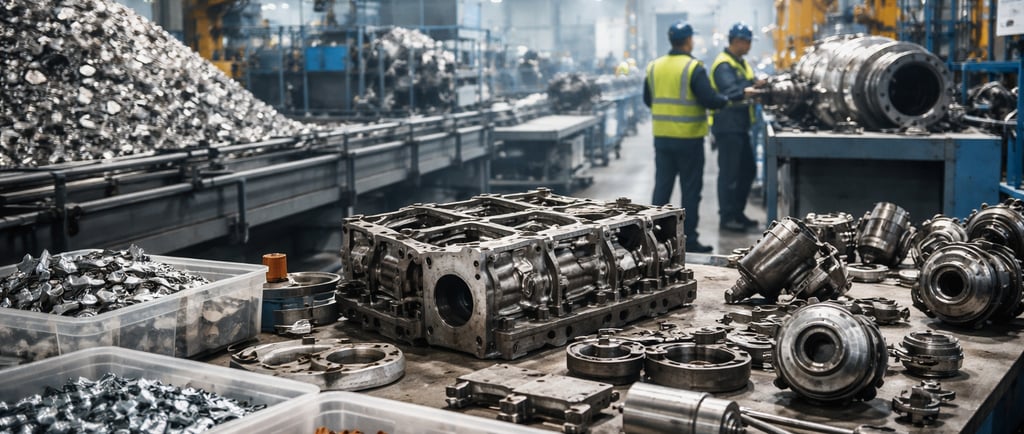
Remanufacturing is moving from an "aftermarket cost saver" to a board-level tool for supply, margin, and risk control. You feel the pressure in three places.
Your metal bill swings with macro cycles and energy shocks. Your lead times stretch when one casting, forging, or specialty alloy becomes a bottleneck. Your customers and regulators ask harder questions about footprint, waste, and circularity.
If you build machines, vehicles, turbines, industrial electronics, or high-duty components, metals sit at the center of both cost and carbon. That is why remanufacturing, paired with clean recycled-metal inputs, is becoming a serious OEM capability.
WHY METALS MAKE REMANUFACTURING A SERIOUS BUSINESS LEVER
Start with steel, because it shows scale and physics in one frame. The steel industry consumes around 650 million tonnes of scrap each year. Worldsteel estimates this avoids roughly 975 million tonnes of CO2 annually. It also avoids iron ore, coal, and limestone use, because every tonne of scrap used for steel production avoids about 1.5 tonnes of CO2. worldsteel.org
The production route matters more than most OEM conversations admit. Typical blast furnace and basic oxygen furnace steel can sit around 2.2 tCO2 per tonne of crude steel, while scrap-based electric arc furnace steel can sit around 0.3 tCO2 per tonne. Same category of material, radically different carbon profile. ScienceDirect
Aluminium is even more extreme on energy. The International Aluminium Institute reports that recycling saves about 95% of the energy needed for primary aluminium. It also reports a 2022 comparison of about 15.1 tCO2e per tonne for primary aluminium (mine to cast house) versus about 0.52 tCO2e per tonne for recycled aluminium processing (gate-to-gate). International Aluminium Institute+1
Copper shows the supply constraint angle. The International Copper Association notes that copper's end-of-life recycling rate is around 40%, and that recycled copper already supplies over 30% of global copper demand. International Copper Association
These numbers explain the real OEM opportunity. Remanufacturing is not only "reuse a part." It is a way to cut primary metal demand without cutting output, reduce exposure to alloy volatility and constrained lead times, and control footprint where it is actually concentrated, in material production and heavy processing.
WHAT REMANUFACTURING IS, AND WHAT IT IS NOT
Teams often mix multiple concepts and customers notice the difference.
Repair fixes a defect to restore function, but it usually does not reset the whole part to a known baseline.
Refurbishment improves appearance or basic function, often with limited replacement of wear items.
Rebuild replaces and machines key wear components, but specs and test coverage can vary by shop and region.
Remanufacturing is different because it is an industrial process. A widely used definition from the U.S. International Trade Commission describes it as restoring end-of-life goods to original working condition, or better, through a controlled, repeatable process. In practice, you treat the returned unit as a "core" and manage it like a production input, with defined acceptance criteria, traceability, and end-of-line testing. USITC
Recycling matters, but it sits outside the inner loop. Recycling melts and refines metal back into feedstock. It is essential, but it throws away the embedded value in geometry, machining, heat treatment, and precision finishing that you can keep through reman.
THE TWO-LOOP SYSTEM OEMS NEED
A durable OEM program runs on two loops that support each other.
The inner loop is remanufacture and reuse. You keep the geometry and much of the embedded manufacturing value. You also keep high-value alloys out of the melt stream when you can, which protects both cost and supply continuity.
The outer loop is recycle what you cannot remanufacture. You recover clean metal streams and protect alloy quality so the recycling loop does not turn premium materials into mixed scrap with limited reuse value.
"Remanufacturing with recycled metals" becomes real when you run both loops on purpose. You remanufacture cores into like-new components, and you feed verified, segregated recycled metals back into new production where reman is not possible or where controlled blending is required for spec.
If you do not design and run both loops, you get trapped. Too many cores fail inspection and become waste. Too much scrap becomes mixed-alloy contamination. Too much recycled input becomes "mass you cannot prove," which blocks procurement approvals and customer claims.
FOUNDATIONS OF AN OEM REMANUFACTURING PLAYBOOK
Build a reman program like a production system, not like a service desk.
Start by picking targets where physics and economics agree. High metal content, high unit value, known failure modes, and a stable installed base matter more than hype. Programs often gain traction first in engines, transmissions, turbochargers, rotating equipment, hydraulics, gearboxes, industrial motors, and selected turbine components where repair methods are qualified and repeatable.
Then treat core supply like strategic raw material. Demand is rarely the limiting factor. Inputs are. The OEMs that scale tend to combine core deposits, exchange programs, buy-back pricing tied to condition grades, dealer take-back agreements, and reverse logistics that prevent damage, corrosion, and mix-ups.
Next, build "metal truth" into intake. If you cannot identify what you have, you cannot reman it reliably, and you cannot recycle it cleanly. That means serial and batch traceability from first scan, family-level awareness of alloys and coatings, clear disposition rules for mixed alloys and plated parts, and defined segregation streams for metal that fails reman criteria.
This is also where recycled metals begin inside the reman plant. Every teardown creates streams. Some parts are reusable as-is. Some are repairable. Some are non-repairable metal that must stay chemically clean if you want high-value recycling rather than downgrade.
From there, industrialize the process chain. A mature reman line typically builds discipline around disassembly standards, cleaning processes that remove oils and residues without damaging substrates, inspection using NDT and metrology matched to failure modes, machining and surface restoration, qualified repair methods for high-value alloys, and end-of-line functional testing to new-part standards.
This is where advanced repair methods can change the economics for high-duty components. Siemens Energy highlights additive manufacturing as a way to repair and restore complex gas turbine parts, which can reduce scrap and extend component life when the repair is qualified and controlled. siemens-energy.com+1
Quality and warranty must be non-negotiable if you want mainstream adoption. Customer skepticism usually drops when you remove ambiguity. Clear acceptance criteria, documented test coverage, and warranty terms that mirror new parts, where feasible, do more than any marketing.
Finally, design the bridge from reman into new manufacturing. Reman cannot absorb everything. You need a clean pass-through for metals you recover. Keep alloy families separate. Keep coatings and hazardous contaminants out. Agree recycled feedstock specs with your mills and foundries that they can actually hold. Build documentation that procurement teams, auditors, and customers accept.
Digital traceability is moving from "nice to have" to expected. The EU's Ecodesign for Sustainable Products Regulation introduces a Digital Product Passport concept, a digital identity for products, components, and materials, aimed at supporting sustainability, circularity, and compliance. Even outside the EU, this direction is shaping how OEMs prove recycled content, repair history, and end-of-life pathways. European Commission
Run the program on tight KPIs from day one. Track core return rates and return time, acceptance rates by grade, yield by component family, scrap rate by reason code, cost per reman unit versus new, warranty returns versus new baseline, metal recovery by alloy stream, and verified footprint deltas by product family. The goal is simple. Make reman a controlled factory process with visible drivers, not a black box.
OEM SUCCESS STORIES, LEADING THE CHARGE
Caterpillar, Cat Reman
Caterpillar built one of the best-known OEM remanufacturing programs. In its 2023 sustainability reporting, Caterpillar states it took back 147 million pounds of end-of-life material for remanufacturing. It also reports that Cat Reman can deliver 65% to 87% lower greenhouse gas emissions from manufacturing processes compared with new parts, depending on the product and comparison basis. https://www.caterpillar.com/en.html
The operational lesson is not the headline number. It is the system behind it. Core collection, controlled processes, and OEM-grade test and warranty expectations turn reman into a repeatable supply stream, not a one-off repair service.
Renault, from Choisy-le-Roi to The Refactory and The Remakers
Renault has long used remanufacturing to reduce cost and materials pressure in aftersales. Its newer circular industrial push has made the program easier to understand at scale. Renault reports that its circular operations gave 350,000 parts "a new lease of life" in 2024, with quality and warranty aligned to new parts expectations. Renault Group
Renault's Remakers positioning also makes the value clear for customers. Renault states remanufactured parts are around 30% more economical than new parts, while maintaining OEM standards. The Future Is Neutral
The Choisy-le-Roi history still matters because it shows how long a reman culture can compound into capability. Earlier reporting and circular economy case materials highlight Choisy-le-Roi as a reman center for engines, gearboxes, injection systems, and other parts, with reman parts often materially cheaper than new. Ellen MacArthur Foundation
Siemens Energy, extending life of critical alloy components
In gas turbines, the metal itself can be a strategic constraint. Nickel and cobalt superalloys are expensive, specialized, and exposed to supply volatility. Siemens Energy points to additive manufacturing and advanced repair approaches as tools to restore and extend life of complex turbine components when repairs are engineered and qualified. For OEMs, the value is twofold. You reduce dependence on constrained virgin materials, and you reduce downtime and lead time exposure tied to new-part manufacturing. siemens-energy.com+1
OVERCOMING CHALLENGES, BARRIERS AND SOLUTIONS
Quality assurance and customer perception tends to be the first barrier. Many customers assume "used" means "risk." The fix is not persuasion. It is proof. Documented acceptance criteria, transparent testing, and warranties that match new parts, where feasible, turn the conversation from belief to evidence.
Supply chain complexity is next. Closed-loop metal flows are hard when customers are spread globally and products were not designed for return. This is where reverse logistics, dealer networks, and track-and-trace systems become part of manufacturing, not an afterthought.
Material contamination can quietly destroy the economics. Mixed alloys, coatings, fluids, and residues turn premium streams into low-value mix. The solution is disciplined segregation, clear disassembly rules, and increasing use of automation where volume justifies it. Apple's Daisy is a useful illustration of what high-throughput disassembly looks like in practice, with Apple stating Daisy can disassemble 200 iPhones per hour and that each Daisy can process up to 1.2 million devices per year. You do not need that exact machine in heavy industry, but the lesson is the same: process design and automation protect material quality. Apple
Economic viability is real, especially at the start. Reman needs upfront investment in tooling, inspection, cleaning, and test. The fastest path is to begin with a narrow set of high-value parts, prove yield and warranty performance, then expand only where data supports it.
Regulatory complexity is rising, not falling. The practical answer is to treat compliance like product engineering. Build it into labeling, traceability, documentation, and vendor qualification so it scales across regions.
FIRST STEPS, HOW OEMS CAN LAUNCH
Begin with a baseline. Map where metal value sits in your products, where failures occur, and where you lose recoverable value today. Run LCAs where needed, but do not wait for perfect data. You need a directional view that picks a first target family.
Then set KPIs that management actually uses. Pick 3 to 5 that make success unambiguous, such as core return rate, acceptance rate by grade, yield, cost versus new, and warranty return rate.
Run one pilot with factory discipline. Treat it like a production line, with process controls and documentation from day one. Use field feedback and teardown data to improve product design for disassembly and repair, because design choices decide reman cost more than slogans ever will.
Invest next where constraints show up. If cleaning is the bottleneck, fix cleaning. If inspection drives rejects, fix inspection. If contamination drives downgrade, fix segregation and packaging in reverse logistics.
Finally, market it with evidence. State what is tested, what is warranted, what is traced, and what the buyer gets. Most customers do not need a circular economy lecture. They need reliability, availability, and a clear business case.
WHERE THIS IS GOING NEXT
Three trends are already shaping the next iteration of the playbook.
AI and analytics will keep improving failure prediction, core grading, and process control, especially in inspection and test.
Digital product passports and traceability expectations will keep spreading, with the EU's framework explicitly pushing product-level information systems that support circularity and compliance. European Commission
Cross-company material systems will also matter more. The OEM that wins is the one that treats reman cores and clean recycled metal streams as strategic inputs, with engineering, procurement, aftersales, and compliance operating on the same definitions and the same data.
START YOUR CIRCULAR METAL PROGRAM
If you are an OEM, the fastest advantage comes from one decision. Treat remanufacturing and verified recycled-metal inputs as manufacturing capability, with factory controls and clear proof. Start narrow. Prove yield and warranty performance. Scale what works.
Connect
Your trusted partner for scrap metal procurement.
CONTACT
About
haroon@tdcventures.com
+1-307-655-7593
© 2025. All rights reserved.
NEWSLETTER