
Reusable Shipping Frames and Cages: A Total Cost of Ownership (TCO) Analysis
Discover how reusable shipping frames and cages cut Total Cost of Ownership (TCO) by 20-60%, reduce damage by 90%, and future-proof operations against regulation and waste. Learn the ROI blueprint.
WASTE-TO-RESOURCE & CIRCULAR ECONOMY SOLUTIONS
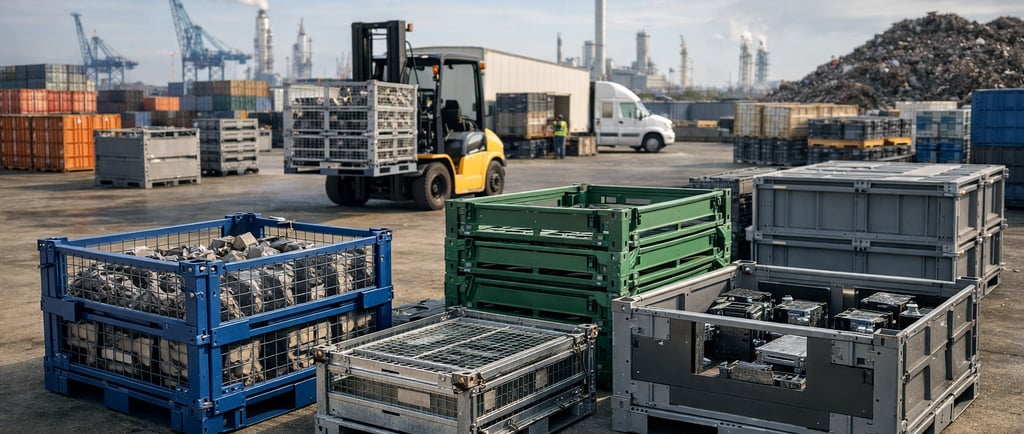

Are Reusable Shipping Frames and Cages the Smartest Way to Cut Total Cost of Ownership (TCO) in Industrial Logistics?
Direct Answer: Why This Matters Now
Reusable shipping frames and cages have surged from a sustainability “nice-to-have” to an economic imperative in modern industrial logistics. The global supply chain disruptions since 2020 have spotlighted how single-use packaging exposes manufacturers to unpredictable costs: soaring commodity prices, landfill surcharges, labor shortages, and volatile fuel rates. The calculus has changed—industries now calculate value over long asset lifespans, not single shipments.
Recent data from the World Economic Forum shows that packaging costs, when measured by total cost of ownership (TCO), makeup 8–12% of a typical manufacturer’s logistics expenses—much higher than the sticker price suggests. What sets reusable frames and cages apart is their ability to normalize these costs over time, creating predictability and resilience as well as alignment with environmental, social, and governance (ESG) standards.
TL;DR: Key Takeaways
Reusable shipping frames and cages consistently deliver 20–60% lower TCO across sectors, with some industry leaders exceeding this range where reverse logistics is well-optimized.
Metals used in industrial packaging maintain value through extended reuse and periodic remanufacturing, supporting circular economy objectives and reducing raw material dependency.
Reverse logistics effectiveness is the “unlock” for realizing designed lifespan savings; without a robust process, lost assets or inefficient returns can erode projected benefits.
New technology adoption—such as RFID tracking, IoT asset monitoring, and packaging asset management (PAM) platforms—has improved recovery rates, making reuse less risky and far more scalable.
Early movers in reusable packaging gain a reputational edge with customers and investors who are prioritizing supplier circularity and measurable ESG progress.
What Is a Reusable Shipping Frame or Cage?
A reusable shipping frame or cage is not simply “a heavy-duty box”—it’s an engineered logistics asset. Constructed primarily from high-grade steel or, increasingly, lightweight aluminum alloys, these containers offer superior load-bearing capacity and impact resistance compared to single-use packaging. Their lifespan typically surpasses five years, with many completing hundreds of loops before requiring refurbishment.
Real-world examples include:
Automotive OEMs using tailored shipping racks for engine blocks and suspension assemblies, reducing in-transit injuries and assembly line downtime.
Heavy equipment manufacturers deploying modular cages for multi-component shipments, cutting repacking times by as much as 80%.
Electronics and aerospace suppliers leveraging custom-fitted frames to safeguard sensitive components, reducing part rejection and quality return rates.
Did you know? According to industrial design reports, a custom reusable steel cage reduces annual damage claims by upwards of 90% compared to makeshift wooden crates in complex supply chains.
Why TCO Beats Unit Cost Every Time
The “false economy” of cheap, disposable packaging evaporates when full lifecycle costs are considered. Manufacturers often fixate on per-unit purchase price, overlooking non-obvious expenses that accumulate invisibly:
Recurrent purchasing and disposal orders
Loading dock space required for excess packaging waste
Hidden costs of product rework, insurance claims, and logistics delays attributable to damaged goods
A comprehensive 2023 survey by the Reusable Industrial Packaging Association (RIPA) confirmed that 72% of companies that adopted reusable frames saved more than initially forecasted, primarily from:
Fewer shipments rejected at customer sites
Elimination of emergency repacking labor
Lowered insurance premiums achieved by improved asset traceability
Analysis from Bain & Company shows companies that model and rigorously track TCO, including downstream handling and reverse logistics, are twice as likely to meet aggressive cost-out targets compared to those focused solely on unit pricing.
How Reusable Shipping Assets Enable the Circular Economy
Moving from a linear to a circular logistics model is more than just environmental good sense—it’s an economic disruptor. By designing packaging for repeated return and reconditioning, metals such as steel or aluminum retain their value far longer than fiberboard or plastics.
Key Circular Economy Benefits in Industrial Packaging
Material Savings: An average mid-sized manufacturer diverts 500+ tons of steel per year from landfill through multiplatform reuse, according to Circular Economy 100 (CE100) results from 2025.
Carbon Reduction: Lifecycle assessments indicate up to a 60% reduction in greenhouse gas (GHG) emissions versus one-way packaging, making it a primary climate action lever.
Resource Independence: Reuse buffers organizations from fluctuations in global scrap and commodity pricing trends.
Case-in-Point: In 2024, a leading North American agriculture machinery brand replaced high-volume single-use packaging with modular steel cages, achieving a 43% drop in Scope 3 carbon emissions in transport and packaging.
The Blueprint: Designing Frames and Cages for Maximum ROI
Design can make or break a reusable shipping program. Forward-thinking companies are collaborating with packaging engineers and supply chain planners to prioritize not just durability, but also operational flexibility and reverse logistics optimization.
Core Design Strategies:
Modular Architecture: Allows the same frame to handle seasonal or model-based SKU shifts, boosting asset utilization rates by up to 150%.
Over-Engineered Stress Points: Smart reinforcements—especially at base corners and fold junctions—add multiple years to asset life without significant weight or cost increases. This results in a 33% lower failure rate compared to standard duty models as per a recent TUV SUD report.
Stackability & Nesting: Fold-flat or nestable cages solve the “empty return” dilemma by enabling up to 4x more empty frames per outbound load, slashing both return trip costs and required storage space.
Material Choice: The latest trend is hybrid construction—steel for the main frame, composite panels for weight reduction—now being piloted by European OEMs to comply with strict transportation emissions regulations.
Future Trend: Expect to see 3D-printed replacement parts and cloud-based design libraries, enabling global enterprises to rapidly iterate frame configurations for new product launches.
Tools That Make Reuse Scalable
Digital innovation radically improves asset tracking and ROI measurement, turning packaging from a “cost sink” into a transparent, auditable process.
Core Technologies:
RFID or QR Tracking: These fast-scan technologies allow granular traceability, from factory door to customer dock and all return legs. Bloomberg Intelligence reports RFID adoption in reusable packaging has tripled since 2022, driving down asset loss rates.
Packaging Asset Management (PAM) Software and Mobile Apps: Such platforms let teams estimate optimal cycle rotations, allocate assets among distribution hubs, schedule maintenance, and produce compliance reports.
IoT Sensors: Connected sensors now detect and transmit vibrations, drops, or moisture infiltration, enabling predictive maintenance and loss prevention.
Digital Case Insight: In 2024, a Tier 1 automotive supplier retrofitted their legacy steel racks with IoT beacons, achieving a 21% reduction in lost frame incidents and an additional $370,000 annual TCO savings.
Reverse Logistics: The Make-or-Break Factor
Reusable packaging is only as effective as the reverse loop behind it. Many reuse programs stall not because of poor engineering, but because they underestimate the operational complexity of asset return.
Actionable Steps for Reverse Logistics Success
Map the Asset Ownership Chain: Define who is responsible at each node, minimizing “grey areas” where assets get misrouted or ignored.
Establish Return Consolidation Points: Use network design tools to locate optimal aggregation hubs, reducing deadhead miles and turnaround time.
Create Incentives and Enforce Accountability: Equipment lease models or deposit-based systems encourage timely returns; companies tracking and communicating return performance see a 25% higher asset recovery, according to a 2025 Gartner logistics survey.
Outsource Where Appropriate: Third-party pooling partners now offer “reverse logistics as a service,” making world-class processes accessible even for mid-sized firms.
Emerging Trend: AI-powered route optimization is now lowering reverse route costs by up to 30% in mature programs using dynamic load planning algorithms.
Advanced business models that make reusable frames and cages pencil out
Reusable frames and cages do not win on engineering alone. They win when the business model matches how your network actually moves parts. In practice, most programs land in one of four models, and the best companies mix them by lane.
Dedicated closed-loop ownership, you own the assets
This is the simplest model when you have stable, high-volume lanes between known plants, suppliers, and customers. You buy steel racks, stillages, or wire mesh cages, assign them to a lane, and run a managed return loop.
Where it works best
Automotive inbound to assembly, powertrain components, stampings, castings, interior modules.
Industrial equipment and appliances with repeatable supplier routes.
Any lane where you can predict return frequency and keep cycle time tight.
Where it fails
Networks with too many small customers, low shipment frequency, or weak receiving discipline. If returns drift, assets vanish into “somebody’s corner,” and your cost per trip rises fast.
Shared pooling, you pay for use, the pool operator owns and manages
Pooling takes ownership, cleaning, repair, and repositioning out of your hands. You pay for availability and turns. This model is common in pallets and totes, and it is growing across crates, trays, and other reusable transport packaging categories.
Why pooling keeps expanding
It converts capital purchase into an operating service.
It reduces the “we do not have time to run repairs” barrier.
It reduces empty miles and deadhead when the pool operator has density across shippers.
Packaging Dive describes pooling as a model where one company collects, sanitizes, repairs, and redistributes reusable pallets, crates, or totes. That same concept applies to cages and racks in dense industrial corridors, especially when suppliers overlap. packagingdive.com
Rental or lease with strict service levels
This sits between ownership and pooling. A provider rents a specific rack design to you, often lane-dedicated, with clear terms for damage, loss, maintenance, and turnaround.
When it wins
You need custom racks, but you do not want to own them.
You have a program start date, and you want a fast ramp without a large upfront purchase.
You want predictable monthly cost and clear penalties for non-return.
Packaging-as-a-service, pay-per-trip with performance clauses
This is the most CFO-friendly model when done right. You pay a per-trip rate that includes the asset, tracking, repair, and in some cases return transport. The contract ties performance to measurable outcomes, cycle time, recovery rate, and damage rate.
The hard truth
This model only works if you can measure trips and prove performance. That means tracking, scan compliance, and a shared data layer. If you cannot enforce scanning, you will argue invoices every month.
The hidden fifth model, refurbish and remanufacture as a cost control loop
Even the best racks need refurb work. Smart operators treat refurbishment as part of the model, not an exception. In practice, refurb cycles turn “end of life” into “back to spec,” and keep TCO predictable. Research in automotive packaging design and reconditioning shows measurable savings when companies recondition metal stillage cages rather than replacing them outright. Revista GESec
Expanded global case studies, what real programs show
Automotive, pooled systems with measurable logistics gains
A one-page CHEP automotive case study for a Tier 1 brake and suspension supplier reports results after switching from one-way packaging to pooled reusable alternatives. It cites up to 30% reduction in packaging spend, 25% reduction in freight costs, 50% reduction in stacking space, and 40% increase in transport capacity. Those are the kinds of gains that show up when pack density improves and returns stay under control. Chep
Automotive, scale and volume, returnable packaging at industrial magnitude
Automotive Logistics reported that Schoeller Allibert supplied over eight million pieces of returnable transit packaging to the automotive segment in 2015, and that automotive represented roughly 15–20% of its business, more than €100 million annually at the time. This matters because it confirms that returnable systems are not niche, they are built at massive scale in automotive supply chains. Automotive Logistics
Food and grocery, damage reduction and service-unit models
Euro Pool System published a Tesco pooling case study that reports a 97.5% reduction in product waste from logistical damage when using reusable folding trays versus single-use packaging, alongside CO2 savings claims in the same program description. The key point for industrial readers is not the category, it is the mechanics: local service units, standardized assets, and controlled reverse flows. HubSpot
Fresh supply chains, LCA-backed impact deltas
Euro Pool System also shared LCA-based comparisons in Spain showing reusable plastic boxes generating 25% less environmental impact than disposable cardboard boxes for fruit and vegetables distribution, based on an LCA carried out by the UNESCO Chair in Life Cycle and Climate Change (ESCI-UPF). Your industrial frames and cages are different assets, but the lesson carries over, reusables win when cycle count is high and reverse loops stay tight. Euro Pool System
Retail handling, labor is part of TCO
Tosca cites an independent engineering study claim that reusable plastic containers reduced egg retail labor by 53% versus corrugated. Even if you do not ship eggs, the message is useful, handling time is a real cost line in TCO, and container ergonomics plus faster stocking can pay back faster than procurement expects. Tosca
Tracking-driven recovery, RFID can pay back on loss reduction alone
A published RFID RTI white paper summarizes a European dairy cooperative case where RFID asset management reduced annual roll container loss by 7.5% and reduced the number of containers needed by 20%, with payback reported at 95% in just under three years. This is exactly the logic reusable frame programs live or die on, loss rate and cycle time. Acrovision
ESG and compliance impacts that now change the economics
Regulation is moving from “nice to report” to “must meet.” That shifts reusable frames and cages from a sustainability project into a risk and cost project.
Europe, packaging waste pressure is already quantified
EU packaging waste rose from 66 million tonnes in 2009 to 84 million tonnes in 2021, and each person generated 188.7 kg of packaging waste in 2021. Without additional measures, the European Parliament noted this could rise to 209 kg in 2030. This is the political and economic pressure behind reuse and reduction rules. European Parliament+1
Material mix matters for your reporting story
Eurostat reports that in 2021, EU packaging waste was 40.3% paper and cardboard, 19.0% plastic, 18.5% glass, 17.1% wood, and 4.9% metal. If you use steel cages and racks, you sit in a smaller share of the packaging waste stream by mass, but you also have high reuse potential and high recycling value at end of life. European Commission
EU Packaging and Packaging Waste Regulation, reuse requirements include transport packaging
A KPMG legal alert summarizing Regulation (EU) 2025/40 states reuse targets for transport packaging inside the EU. From January 1, 2030, at least 40% of transport packaging, including pallets, foldable plastic boxes, trays, pails, and drums, must be reusable packaging within a reuse system, increasing to 70% from January 1, 2040. That pushes companies to prove they operate a reuse system, not just that they bought reusable hardware. KPMG Assets+1
Scope 3 accounting, where reusable packaging shows up
If you track emissions through the value chain, transport and distribution sit in Scope 3 Category 4 upstream and Category 9 downstream in the GHG Protocol guidance. Reusable packaging affects both, because it changes freight efficiency, return legs, and packaging production and end-of-life profiles. The categories also matter because procurement teams increasingly need auditable numbers, not claims. GHG Protocol+2GHG Protocol+2
Transport emissions methods are tightening
ISO 14083 provides requirements and guidance for quantifying and reporting greenhouse gas emissions arising from transport chain operations across modes. If you plan to claim emissions reduction from better cube utilization or fewer damage re-shipments, align your method with recognized standards like ISO 14083 so your numbers survive scrutiny. ISO+1
How to avoid the common failure modes
Most failures come from operations, not steel thickness.
Failure mode 1, you underestimate loss and “asset drift”
Cages and racks do not disappear all at once. They bleed out through yard corners, supplier overflow, and customer storage. Fix it with three controls.
A clear asset owner at every node, in writing.
A recovery clock, return due dates, with escalation.
Tracking IDs that are scanned at ship, receive, and return.
GS1’s Global Returnable Asset Identifier (GRAI) exists for exactly this purpose, unique identity for reusable transport items in return systems. Pair that with event capture standards like EPCIS if you want multi-party visibility without custom one-off data formats. GS1 Sweden+2gs1.org+2
Failure mode 2, empty returns cost more than you planned
If your cages return “full cube,” your return transport can erase savings. This is why collapsible or nestable designs matter. It is also why consolidation points matter. The moment you consolidate empties and return them in dense loads, costs change.
Failure mode 3, cleaning and quality are treated as afterthoughts
Industrial cages pick up oil, corrosion, and debris. If you ship into regulated environments, food, medical, clean manufacturing, you need a cleaning spec, a wash validation method, and acceptance criteria. Without it, you get rejects and delays at receiving.
Failure mode 4, you ignore handling time, and your labor cost quietly climbs
If a rack saves damage but adds minutes per load in handling, your warehouse payroll absorbs it. Include handling time in TCO, not as a footnote. This is why studies that measure labor changes matter, because labor can be the swing factor even when packaging costs look similar. Tosca
Failure mode 5, you buy custom racks before you standardize SKUs and lanes
Custom racks are great, until product dimensions change or the lane mix shifts. Start with modular features where you can, adjustable dunnage, removable inserts, and standardized footprints that fit your material handling equipment.
Decision criteria, how you decide if reusable frames and cages are the smartest TCO move
You can make this decision without complex math, if you force the right inputs.
Start with a simple per-trip comparison
Reusable cost per trip = Purchase price divided by expected trips plus average repair and maintenance per trip plus tracking and administration per trip plus return transport per trip plus cleaning per trip where required plus loss allowance per trip.
Single-use cost per trip = Purchase price per trip plus disposal and waste handling plus extra labor for repacking and waste plus damage and claims cost plus delay cost from rejects and rework.
Then apply these pass or fail gates.
Gate 1, lane stability
If your shipping lanes change monthly, your recovery rate drops. If lanes are stable, you can hit high turns.
Gate 2, return discipline and recovery rate
If you cannot reliably recover assets, do not start with ownership. Start with pooling or a rental model that bakes loss terms into the contract.
Gate 3, cube and pack density
If a rack improves pack density or stackability, you often win twice, fewer loads out, fewer loads back. CHEP’s reported improvements in stacking space and transport capacity show how big this can get when packaging design matches the load. Chep
Gate 4, damage sensitivity and part value
The higher the part value and the higher the cost of a defect, the faster reusables pay back. This is why automotive, aerospace components, and precision assemblies adopt racks and custom dunnage early.
Gate 5, compliance exposure
If you operate in the EU, reuse system requirements for transport packaging become a planning constraint over time. The question becomes, “Can you prove a reuse system,” not “Can you buy reusable cages.” KPMG Assets+1
Gate 6, tracking readiness
If you cannot capture events at ship, receive, and return, you will fight loss. Use standards-based identification and event capture. The dairy cooperative RFID case shows how quickly loss and container count can change when tracking is done properly. Acrovision+1
Future-proofed summary and CTA
Reusable shipping frames, stillages, wire mesh cages, and shipping racks can cut total cost of ownership when you treat them as a system: asset design, reverse logistics, tracking, and refurbishment. Market adoption is already large. The RPA reports that food and beverage accounts for about one-third of global reusable transport packaging market value, with automotive near 22%, which tracks with where closed loops and disciplined returns are strongest. Reusable Packaging Association
If you want this to work on your network, run a pilot that produces numbers you can defend.
Week 1 to 2, baseline: Measure current one-way packaging spend, disposal cost, damage rate, claims, repacking labor, and freight cube.
Week 3 to 6, controlled loop: Choose one stable lane, one part family, one rack design. Tag every asset with a unique ID. Require scan events at ship, receive, and return.
Week 7 to 10, tighten the loop: Add a consolidation point for empties if needed. Add repair and inspection checkpoints. Track cycle time and recovery rate weekly.
Week 11 to 12, decide: Calculate cost per trip with real data. Decide whether to expand with ownership, pooling, or rental.
Connect
Your trusted partner for scrap metal procurement.
CONTACT
About
haroon@tdcventures.com
+1-307-655-7593
© 2025. All rights reserved.
NEWSLETTER