
Reverse Logistics for Warranty Returns
Discover how circular reverse logistics transforms warranty returns for XR devices and electronics into value. Learn the implementation playbook, KPIs, and future trends driving cost recovery, compliance, and sustainability by 2026.
IMMERSIVE TECH RECYCLING & CIRCULAR ELECTRONICS
Context and Why It Matters
The explosive growth of XR (Extended Reality) devices and emerging electronics is redefining the returns landscape in the electronics sector. In recent years, devices such as AR headsets, VR glasses, smartwatch ecosystems, and smart home systems have proliferated, with the XR hardware market alone projected to surpass $70 billion globally by 2027 (Statista, 2024). These next-generation devices, while revolutionary, also introduce sophisticated assembly, integration, and dependency on both hardware and firmware resilience. As a result, warranty return volumes are surging—driven not just by genuine faults but also by complex user expectations and rapidly evolving product iterations.
Why the shift to advanced reverse logistics now? Sustainability targets, tightening regulations, and evolving consumer behaviors are coalescing to make reverse logistics in electronics a board-level priority:
Regulatory pressure: Governments worldwide are mandating Extended Producer Responsibility (EPR) and “right to repair” laws. Europe’s WEEE Directive and new U.S. state laws (such as California’s SB 244) make it illegal to impede repairability or dispose of e-waste haphazardly. Non-compliance leads to hefty fines and reputational risk.
Sustainability as a competitive lever: Gartner reports that 55% of electronics customers consider sustainability as pivotal in brand loyalty and purchase decisions. Brands like Apple, HP, and Samsung tout aggressive “zero waste” and “circular electronics” targets—expecting to repurpose or recycle 85%+ of returned hardware by 2025.
Margin pressure and cost containment: The average cost for handling an unresolved warranty return now exceeds $50 per unit, factoring in logistics, write-offs, and lost secondary market value (Deloitte, 2023). Optimizing reverse logistics is imperative not only for environmental targets but also for protecting bottom lines.
The consequence? Leading brands, large retailers, and third-party logistics providers (3PLs) can no longer treat returns as mere “cost of doing business.” Instead, those that embrace advanced, circular reverse logistics—anchored in design for repair, refurbishment, and material recovery—stand to achieve measurable cost savings, stronger ESG compliance, and elevated brand trust. Industry laggards risk fines, shrinking margins, and lasting damage to customer relationships.
2. Defining the Problem: Reverse Logistics in Circular Electronics
Legacy reverse logistics in electronics was modeled on simplicity. Manufacturers and retailers focused on collecting broken or outdated units, performing basic visual inspections, and, at best, sending some for rudimentary refurbishment. However, as the average connected device now incorporates over 300 individual components, custom firmware, and sensitive user data, this linear “collect and dispose” model is obsolete.
Complexity is the new normal: XR and smart electronics feature tightly integrated sensors, dense circuit assemblies, sealed batteries, biometric security, and frequent over-the-air firmware updates. Diagnosing issues is no longer merely a hardware exercise—it demands seamless triage of both digital and physical issues, with privacy and data compliance at every touchpoint.
Key Stakeholder Pain Points
Manufacturers face direct costs of $40–$100 per unresolved return (Gartner, 2023). Worse, every unit scrapped represents lost potential in parts recovery and secondary sales.
Retailers must juggle scattered returns depots, regulatory reporting, and increasingly vocal customer complaints about slow resolution or unsatisfactory exchanges.
3PLs are on the frontline, expected to seamlessly route, diagnose, and process an expanding mix of product types—without driving up costs or regulatory risk.
Regulatory and Sustainability Mandates
EPR / WEEE / Right-to-Repair: Failing to recover components or provide repairability documentation carries fines ranging from €200–€500 per unit in the EU, and rising penalties in the U.S. and APAC.
Sustainability goals: Global e-waste hit 53.6 million metric tonnes in 2020, with less than 18% officially recycled (UN Global E-Waste Monitor). Brands are publicizing landfill diversion and parts recovery metrics, which must be auditable and accurate.
The Opportunity: Move from Linear to Circular
Successfully transitioning to circular reverse logistics turns a compliance headache into a value engine. Recovering, refurbishing, and reintegrating materials feed secondary markets, extend device lifecycles, reduce raw material extraction, and enhance brand loyalty. The modern reverse logistics process must be proactive, deeply integrated, and data-driven—adaptive to both consumer expectations and regulator demands.
3. Key Concepts and Definitions
To ensure clarity for all stakeholders—brands, logistics partners, and customers—let’s outline critical terminology anchoring this reverse logistics transformation:
Reverse Logistics: The coordinated management of returns, encompassing the retrieval, transport, assessment, repair, refurbishment, recycling, and responsible disposal of electronic products.
Warranty Return: Any customer-initiated return that falls under product warranty, typically triggered by faults, malfunction, or dissatisfaction. XR and smart electronics introduce new failure triggers, such as firmware corruption or sensor drift.
XR (Extended Reality): A category unifying augmented reality (AR), virtual reality (VR), and mixed reality (MR) devices. These technologies rely on miniaturized sensors, displays, and real-time operating systems—amplifying reverse logistics complexities.
Design for Repair: The practice of designing electronics with modular architecture, user-serviceable components, open firmware, and service-friendly casing, facilitating rapid diagnostics and repairs while reducing e-waste.
Circular Electronics: A philosophy and business approach in which the lifecycle of devices doesn’t end at first use. Emphasizes repair, parts harvesting, remanufacturing, and material recycling, aligned with the broader circular economy movement.
These concepts are strongly interdependent; excelling at reverse logistics in the context of warranty returns and circular electronics requires synchronized design, operations, and compliance execution.
4. The Core Framework: Circular Reverse Logistics for XR and Electronics
Let’s explore the robust, scalable blueprint for modern reverse logistics, balancing value capture, regulatory compliance, operational efficiency, and consumer satisfaction. This model is based on industry benchmarks and actual case implementations from leading brands.
Step-by-Step Process
1. Pre-Return Enablement
Design for serviceability: Top-performing brands involve service ops and sustainability teams in R&D phases. For example, Microsoft’s HoloLens 2 uses modular pods for key components. Transparent device diagrams, service guides, and easy RMA (Return Merchandise Authorization) portals smooth the customer journey.
Automated triage and RMAs: Intelligent support platforms (e.g., device self-diagnostic apps) pre-identify common faults, cutting return initiation friction by 40–60% (IDC, 2023).
2. Return Collection
Seamless returns logistics: Smart return labels (QR, RFID) and partnerships with local courier networks reduce shipping cost per return by up to 20%. Innovative in-store return drop-offs (Best Buy, Apple) now account for 35%+ of electronics returns in North America.
Expedited intake: Consumer-facing portals prompt users with guided questions, accelerating sorting and pre-claim validation.
3. Triage & Assessment
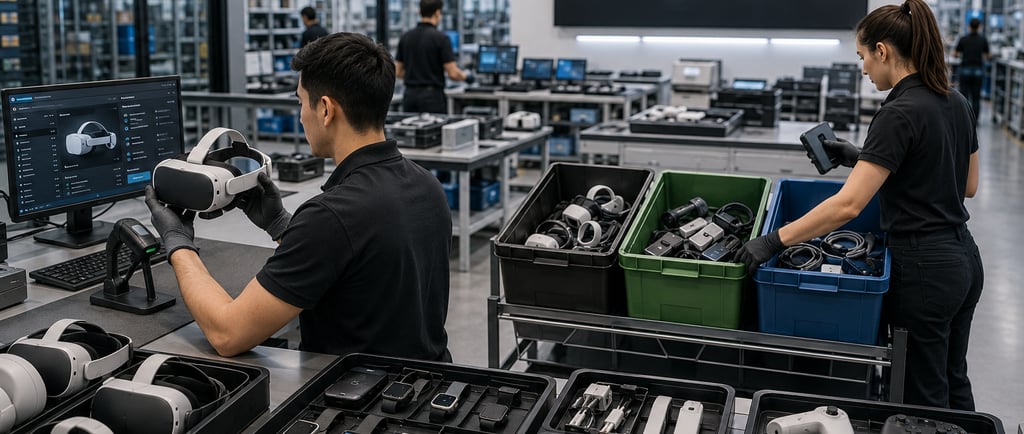
Automated, data-driven evaluation: Intake centers use handheld scanners, proprietary diagnostic benches, and AI-powered defect detection (using photos and usage logs). Advanced solutions score device condition in under five minutes and log root cause data for OEM analysis.
Real-time routing: Devices trigger instant workflow assignments: repair (minor issue), refurb (cosmetic or moderate hardware issue), or direct recycling (non-repairable).
4. Repair/Refurbishment
Component-level repair: Skilled technicians address high-frequency issues (battery, screen, sensor replacement) with access to modular parts and clear service manuals.
Secure data management: All devices undergo GDPR-compliant data erasure upon arrival, with process validation via WMS/ERP checkpoint.
Refurb for secondary markets: Devices passing tooling and functional checks are sanitized, repackaged, and assigned for direct resale or redeployment—often with a renewed warranty and certification.
5. Recycling & Material Recovery
Maximizing recovery yields: When repair is impossible, devices are dismantled for rare-earth elements, copper, gold, lithium-ion batteries, and reusable sensors.
Certified recycling partners: Recent updates require audited, transparent e-waste tracking (EU Digital Product Passport) to demonstrate responsible processing and divert hazardous material from landfills.
6. Customer Communication
Automated, transparent notifications: Real-time status updates via SMS, email, and online portals slash “where is my return?” service calls by up to 70%. Customer-centric messaging includes repair progress, estimated completion, and final device outcome.
7. Analytics & Continuous Improvement
Granular analytics dashboard: Stakeholders monitor real-time metrics: device failure rates, fastest/slowest process steps, landfill diversion progress, and OPEX performance.
Feedback loop to R&D and supply chain: Aggregated field failure data informs future product redesign—establishing a true circle of continuous improvement.
Worked Example: XR Headset Returns (Consumer Electronics Retailer)
Let’s illustrate the circular reverse logistics framework in action at a large North American CE retailer:
Trigger: A consumer’s AR headset stops charging. The support portal detects symptoms matching a common, recallable battery defect. An RMA and parcel return label are issued instantly.
Collection: The customer opts for a fast, local drop-off—using a physical retail partner that scans in the device and prints a receipt. The system logs receipt time; the clock starts.
Triage: At the intake facility, the device’s serial and logs are scanned. Diagnostic software flags the unit as having an eligible battery fault, not general hardware failure.
Repair: The defective battery module is replaced with a certified, modular spare. A cleaning and data wipe process is completed for privacy and hygiene.
Refurbishment: Following functional verification and final quality assurance, the device is classified as a candidate for “certified pre-owned” resale.
Material Recovery: The faulty lithium battery is tagged and routed to a certified battery recycling firm, tracking weight and serial for EPR reports.
Customer Update: The original customer receives a push notification of successful repair and shipment, plus assurance of data erasure.
This single-case flow illustrates all seven pillars in practice, recovering maximum value, minimizing delay, and documenting compliance all the way.
5. Implementation Playbook: Building a Warranty Returns System That Recovers Value
A modern warranty returns program cannot begin at the warehouse door. It has to begin before the customer even submits the return. By 2026, electronics warranty returns sit at the intersection of customer service, product engineering, privacy law, sustainability reporting, repair access, logistics cost control, and secondary-market resale. That means the implementation plan has to connect all of those functions into one operating model.
Retail returns reached an estimated $890 billion in 2024 in the U.S. retail sector alone, with retailers estimating that 16.9% of annual sales would be returned. Electronics are especially costly because returned units often require serial-level tracking, fault verification, data wiping, battery safety checks, parts inspection, software reset, and controlled resale or recycling. At the same time, global e-waste reached 62 million metric tonnes in 2022, while only 22.3% was formally collected and recycled. The gap between product growth and formal recovery is widening, which makes warranty reverse logistics a direct business and compliance issue.
For XR, wearables, smart home devices, and connected electronics, the stakes are higher than traditional returns. These devices contain displays, lenses, batteries, sensors, cameras, microphones, haptics, processors, speakers, wireless modules, biometric data, calibration profiles, and sometimes enterprise credentials. A poor returns system can turn a repairable headset into scrap, expose private data, lose usable parts, inflate warranty cost, and create weak evidence for ESG claims. A strong system does the opposite. It turns returns into a measurable source of recovered product value.
Step 1: Separate Warranty Returns Before They Enter the General Returns Stream
The first mistake many retailers and OEMs make is mixing warranty returns with general dissatisfaction returns, open-box returns, buyer’s remorse, and dead-on-arrival units. That creates unnecessary handling, weak root-cause evidence, and poor recovery decisions.
Warranty returns need their own intake path. The customer-facing portal should ask structured questions before issuing an RMA. For an XR headset, those questions should identify symptoms such as charging failure, display flicker, controller pairing issues, overheating, tracking drift, lens damage, strap breakage, audio failure, battery swelling, failed firmware update, or app-level malfunction. For a smartwatch or wearable, the questions should cover charging, screen response, water exposure, strap integrity, sensor readings, pairing errors, battery drain, and data sync failures.
The goal is not to make the customer do technical work. The goal is to collect enough information to route the device correctly. A battery complaint should not travel through the same pathway as cosmetic wear. A firmware fault should not be routed directly to destructive recycling. A device with possible swelling should be flagged for safe handling before it reaches a general returns bench.
A strong intake portal should capture:
Product model, serial number, SKU, purchase date, warranty status, and region
Customer symptom description with guided answer choices
Photos or short videos where useful
Battery condition questions for lithium-ion safety
Data privacy confirmation
Accessory checklist
Return reason code
Initial repair, replacement, refund, or exchange preference
Consent for diagnostics, wiping, repair, refurbishment, resale, or recycling where applicable
The earlier the return is classified, the less money is lost downstream. A device that can be fixed with a software reset should not be shipped through a full repair depot. A device that needs a known battery module should not wait in a generic inspection queue. A headset with cracked lenses should be routed toward parts evaluation before it is treated as total loss.
Step 2: Build a Serial-Level Chain of Custody
Warranty reverse logistics depends on proof. Every unit needs a record that follows it from the customer to final outcome. This is no longer just good warehouse practice. It is becoming necessary for right-to-repair compliance, EPR reporting, battery traceability, data protection, and resale confidence.
At minimum, every returned device should receive a digital record at RMA creation. That record should follow the device through carrier pickup, drop-off scan, warehouse receipt, inspection, diagnostics, repair, QA, data erasure, refurbishment, parts harvesting, recycling, resale, or disposal. The record should also capture who handled the unit, when it moved, what test was performed, what result was found, and what final decision was made.
For XR and smart electronics, the record should include both physical and digital evidence. Physical evidence covers condition, missing accessories, damage, contamination, battery status, and visible tampering. Digital evidence covers firmware version, diagnostic logs, error codes, device activation status, lock status, calibration status, and whether secure wipe was completed.
This matters because warranty disputes often come down to evidence. Was the defect covered under warranty? Was the damage caused by misuse? Was the battery safe on arrival? Did the customer return the controllers and charging dock? Was the device wiped before resale? Was a harvested part tested before reuse? Without serial-level records, teams fall back on manual judgment. That creates inconsistent claim decisions, higher leakage, weak supplier recovery, and weaker audit trails.
Step 3: Create a Triage Ladder Instead of a Single Inspection Step
The old model treated inspection as one step. Modern electronics need layered triage. The first layer should be fast, safe, and low-cost. The later layers should become more technical only when the device deserves that level of attention.
A practical triage ladder can work like this:
Level 1: Identity and safety check
The unit is scanned, matched to the RMA, checked for missing items, inspected for battery swelling, severe damage, liquid exposure, contamination, and obvious misuse.
Level 2: Functional check
The device is powered on where safe, paired if needed, and tested for basic functions such as charging, display, audio, controller connectivity, cameras, sensors, buttons, ports, and wireless connection.
Level 3: Software and firmware check
Technicians review update status, boot errors, device locks, OS recovery options, logs, known bug patterns, app-level issues, and firmware recovery paths.
Level 4: Component-level diagnostics
The device goes to a technical bench for battery health, display quality, board faults, sensor calibration, thermal behavior, fan performance, connector damage, or charging-board inspection.
Level 5: Economic decision
The system compares repair cost, part availability, replacement cost, resale value, warranty policy, and recycling value before assigning the final path.
The goal is to prevent overprocessing. If 20% of returns are no-fault-found units, a strong early diagnostic layer can send many of them back into saleable stock after testing, cleaning, wiping, and repackaging. If 10% of a product’s returns come from one known firmware failure, the system should route them to software recovery before any technician opens the housing. If a model has a known weak strap assembly, that part should be stocked near the triage bench and replaced quickly.
Step 4: Use Root-Cause Codes That Product Teams Can Actually Use
A warranty return should never be treated as a dead administrative record. It is field intelligence. Every returned device carries evidence about design, materials, packaging, firmware, user behavior, shipping damage, documentation gaps, and supplier quality.
The problem is that many return reason codes are too vague. “Defective,” “not working,” “customer complaint,” and “damaged” do not help engineering teams. A useful code structure should be specific enough to inform action.
For XR devices, root-cause codes should include categories such as:
Charging port failure
Battery module fault
Battery swelling risk
Display panel failure
Lens scratching or coating damage
Tracking sensor drift
Controller pairing failure
Speaker or microphone issue
Fan noise or thermal issue
Strap or fit system failure
Firmware update failure
Activation lock or account lock
App compatibility issue
Cosmetic damage only
No fault found
Customer education issue
Transit damage
Missing accessory
Unauthorized repair attempt
The codes should be reviewed monthly. If one model shows a rise in tracking sensor faults after a firmware release, product and software teams need to know. If controller pairing failures spike after a packaging change, the packaging team needs to know. If “no fault found” is high, the customer support script may be weak, or customers may misunderstand setup requirements.
A mature warranty returns operation turns return records into product improvement. That is where cost reduction becomes structural. The best return is the one prevented by better design, clearer instructions, stronger packaging, or earlier software detection.
Step 5: Design the Repair Decision Around Time, Cost, Risk, and Residual Value
Repair decisions should not be emotional, slow, or inconsistent. They should follow a clear decision logic. For every device, the team needs to know whether repair makes economic, legal, safety, and customer sense.
The decision should consider:
Warranty obligation
Replacement cost
Repair labor time
Part cost
Part availability
Device age
Cosmetic condition
Remaining resale value
Data risk
Battery safety risk
Customer SLA
Local repair law
EPR obligations
Carbon and waste impact
Ability to recover reusable parts
For example, a $700 headset with a $25 strap failure should almost always be repaired. A $400 device with liquid damage, failed main board, damaged battery, and missing controllers may be better routed to parts harvesting and certified recycling. A premium enterprise headset may justify deeper repair because its replacement cost is higher and the customer relationship is more valuable. A low-cost wearable may not justify board-level repair, but it may still justify battery removal, sensor recovery, material sorting, and supplier defect analysis.
This is also where right-to-repair policy changes matter. The EU Directive on repair of goods entered into force on 30 July 2024, with member states required to apply national measures after transposition. It strengthens the consumer’s ability to seek repair and pushes manufacturers toward better access to repair options. California’s SB 244 also created repair access obligations for many electronics and appliances sold in the state. By 2026, brands selling across multiple markets should assume that repair documentation, parts access, and reasonable repair pathways are becoming a normal business requirement, not a niche expectation.
Step 6: Build the Returns Network Around Regional Speed and Safe Handling
Reverse logistics costs rise quickly when every return is sent to a central facility. For high-volume electronics, brands should use a tiered network.
The first tier can be local drop-off points, retail counters, locker systems, or parcel partners. The second tier can be regional intake and grading centers. The third tier can be specialist repair depots. The fourth tier can be certified recyclers, battery processors, parts harvesters, or resale partners.
This structure reduces unnecessary movement. A device that can be confirmed as no-fault-found at a regional center should not travel to a specialist depot. A device with battery swelling should not move through standard parcel handling. A high-value enterprise XR unit may need direct routing to a secure repair center with controlled access and documented data erasure.
A practical network should answer:
Which products can be accepted in-store?
Which products require parcel pickup?
Which battery conditions trigger hazardous goods handling?
Which models can be tested regionally?
Which repairs require OEM-certified technicians?
Which products can be refurbished by a 3PL?
Which units must be returned to the OEM?
Which units can move to parts recovery?
Which recyclers are approved for batteries, boards, displays, and plastics?
Which records are required for each country, state, or province?
For batteries, the regulatory direction is clear. The EU Battery Regulation, Regulation (EU) 2023/1542, aims to make batteries more sustainable across their lifecycle, including collection, recycling, recycled content, carbon footprint, and information requirements. From 2027, digital battery passport requirements begin for certain categories, including EV batteries, industrial batteries above 2 kWh, and light means of transport batteries. While many small consumer electronics batteries will not carry the same passport scope at first, the direction is obvious: battery traceability, safe handling, and lifecycle evidence are becoming more important.
Step 7: Treat Data Erasure as a Core Returns Function
Connected electronics cannot be treated like ordinary physical goods. XR headsets, smartwatches, phones, tablets, smart speakers, fitness trackers, and smart home devices may store names, photos, biometric patterns, Wi-Fi details, enterprise credentials, location history, voice recordings, app sessions, payment credentials, and health-related data. Even when the data is not directly visible, the risk remains.
Every returned connected device should be assumed to contain personal or business data until proven otherwise. Data erasure should happen before repair resale wherever possible, and the process should be recorded. For enterprise returns, the customer may require a certificate of data sanitization. For consumer returns, the brand still needs evidence that account locks, activation locks, and user data were handled correctly before refurbishment or resale.
The workflow should include:
Customer guidance before return
Device lock and account lock check
Secure wipe or reset process
Firmware reinstall where needed
Verification scan
Data erasure certificate for enterprise or regulated clients
Exception handling for devices that cannot be powered on
Physical destruction path for storage-bearing parts when erasure is impossible
R2v3 certification has become an important reference point in the electronics reuse and recycling industry because it focuses on responsible processing, worker safety, environmental controls, and data security. Brands do not have to outsource everything, but they do need standards-based controls. A warranty return that becomes a refurbished device should leave the process with clean ownership status, clean firmware, tested functionality, and traceable data handling.
Step 8: Create a Refurbishment Grade System Customers Can Trust
Refurbishment is where warranty returns can recover significant value. But refurbished electronics only work as a business model if customers trust the grading, testing, warranty, and return policy.
A strong grading system should be simple externally and detailed internally. Customers may only need grades such as Excellent, Good, Fair, and Parts Only. Internally, the business should track screen condition, lens clarity, battery health, housing condition, strap condition, controller condition, port condition, sensor performance, firmware status, accessory completeness, and packaging status.
For XR and smart electronics, refurbishment should also include hygiene controls. Headsets and wearables touch the face, hands, ears, and skin. Cleaning should cover face pads, straps, controllers, charging contacts, lenses, vents, and surfaces. If soft components cannot be safely sanitized, they should be replaced. This matters for customer trust, resale value, and brand protection.
A certified refurbished path should include:
Full functional test
Battery health threshold
Display and lens inspection
Sensor and camera test
Audio and microphone test
Wireless connectivity test
Firmware reinstall or update
Data wipe verification
Cleaning and sanitation
Cosmetic grading
Accessory completeness check
Final QA seal
Updated warranty term
Clear resale listing language
Companies that make refurbished products feel risky lose resale value. Companies that make them feel professionally tested can recover more value and reduce waste.
Step 9: Build Parts Harvesting Into the Process, Not After the Fact
When a device cannot be repaired as a whole unit, it may still contain valuable parts. Displays, cameras, speakers, sensors, controller boards, straps, charging assemblies, screws, flex cables, batteries, lenses, fans, haptics, and casings may be recoverable.
Parts harvesting should not be a random teardown activity. It needs rules. A harvested part should be identified, removed safely, tested, labeled, stored, and linked to the original device record. If the part will be used in warranty repair, the repair team needs confidence that it meets quality standards. If it will be sold as a spare, the buyer needs grading and compatibility information. If it cannot be reused, it should move to material recovery.
The most valuable recovered part is not always the most expensive component. Sometimes the hardest part to source becomes the most important part to recover. A small hinge, magnetic connector, camera bracket, lens frame, or controller trigger can keep many devices repairable when new parts are delayed or discontinued.
This is especially important for XR devices because hardware cycles move quickly. A model may be replaced before parts supply is mature. If warranty teams wait until end-of-life to start parts recovery, the repair window may already be closing.
Step 10: Connect Recycling With Real Material Recovery, Not Generic Disposal
Recycling should be the last useful path, not the default path. When a device cannot be reused, repaired, refurbished, or harvested for parts, it should be dismantled and processed through certified channels.
Electronics contain recoverable copper, aluminum, steel, plastics, lithium-ion batteries, circuit boards, magnets, gold, silver, palladium, and rare earth elements. The Global E-waste Monitor 2024 estimates that global e-waste generation reached 62 million metric tonnes in 2022 and could rise to 82 million metric tonnes by 2030 if current patterns continue. That means every large electronics warranty operation is also part of the global material recovery challenge.
A responsible recycling process should separate:
Lithium-ion batteries
Printed circuit boards
Copper-rich wiring and coils
Aluminum frames and heat sinks
Steel fasteners and brackets
Plastic housings
Optical components
Display assemblies
Speakers and magnets
Hazardous or contaminated materials
Documentation matters. Brands should know where the material went, how it was processed, what weight was recovered, and what certificates were issued. Generic “recycled” claims are no longer enough for serious buyers, regulators, or sustainability teams.
6. Metrics and KPIs: Measuring Reverse Logistics Performance
A warranty returns operation can only improve what it measures. But the wrong metrics can create the wrong behavior. If the only metric is fastest closure, teams may scrap repairable units. If the only metric is lowest handling cost, teams may ignore resale value. If the only metric is customer refund speed, the business may lose recoverable inventory. The right measurement system balances customer experience, financial recovery, repair quality, compliance, sustainability, and product learning.
Return Rate by Product, Model, Batch, Region, and Channel
The basic return rate is useful, but it is not enough. The real insight comes from segmentation.
A 4% warranty return rate may look acceptable overall. But if one batch of XR controllers has a 14% pairing failure rate in one region, the business has a supplier, firmware, packaging, or environmental issue. If one retail channel has higher no-fault-found returns than direct-to-consumer sales, the problem may be customer education or sales misalignment. If one country has higher battery complaints, local climate, charging behavior, or adapter quality may be involved.
Useful cuts include:
Model
Production batch
Supplier lot
Firmware version
Region
Sales channel
Customer type
Device age
Return reason
Warranty claim type
Repair outcome
No-Fault-Found Rate
No-fault-found is one of the most important metrics in electronics returns. It indicates devices returned as defective that pass inspection and functional testing. High no-fault-found rates can point to weak setup instructions, poor onboarding, confusing app behavior, unstable firmware, bad support scripts, or unrealistic customer expectations.
For XR products, no-fault-found can occur when users mistake poor room lighting, reflective surfaces, incorrect guardian setup, low controller battery, app compatibility issues, or Wi-Fi instability for hardware failure. For wearables, it may stem from pairing errors, notification permissions, charging cable issues, or misunderstanding of sensor readings.
A high no-fault-found rate should trigger content and support improvements before the product is redesigned. Better in-app diagnostics, setup videos, support scripts, and guided troubleshooting can reduce unnecessary returns.
Average Days to Resolution
Customers do not care how complex the reverse logistics process is. They care when the issue is resolved. Average days to resolution measures the time from return initiation to repair completion, replacement shipment, refund, exchange, or final decision.
This metric should be split by outcome. Repair time, replacement time, refund time, refurb processing time, and recycle closure time are different workflows. Combining them hides the true bottlenecks.
For premium electronics, delays can damage loyalty. For enterprise XR programs, delays can disrupt training, field service, design, medical simulation, or industrial workflows. A headset used for warehouse training or remote technical support may have business value far beyond its hardware price.
Repair Yield
Repair yield measures the percentage of warranty returns successfully repaired and returned to use. This is one of the clearest indicators of circular performance.
Repair yield should be tracked by model and issue. If battery failures repair at 92% but display faults repair at 38%, the team needs different strategies. If one device design has poor repair yield because the display is glued to the housing, future product design needs change. If a wearable has high strap failure but fast strap replacement, the repair yield may be high, but the root cause still needs attention.
Refurbishment Yield
Refurbishment yield measures how many returned devices become certified resale units. This metric connects directly to margin recovery.
A unit may not be suitable for return to the original customer but may still be suitable for resale after repair, cleaning, testing, and regrading. Refurbishment yield can be improved through better cosmetic parts availability, replacement straps, fresh packaging, clean accessory kits, battery health thresholds, and clear resale grading.
The refurbished electronics market benefits from price-sensitive buyers, enterprise buyers, schools, training programs, developers, and sustainability-conscious consumers. For XR and wearables, this can open important secondary channels, especially where new devices are expensive.
Parts Recovery Rate
Parts recovery rate measures the percentage of non-repairable units that produce usable components. It should be tracked by part type, value, reuse rate, and defect recurrence.
A high parts recovery rate is only useful if the parts are tested and used. A warehouse full of unverified parts is not recovered value. It is deferred clutter. The metric should track how many recovered parts were reused in repairs, sold as spares, or held for planned support needs.
Material Recovery Rate
Material recovery rate measures how much material is diverted from landfill or uncontrolled disposal and sent through certified recycling. It should be expressed by weight, material type, and recycling partner.
The global e-waste problem makes this metric essential. Officially documented recycling remains far below total e-waste generation. For electronics brands, strong material recovery reporting helps support sustainability claims, EPR obligations, investor reporting, and customer trust.
Warranty Cost Per Unit
Warranty cost per unit should include shipping, labor, replacement parts, refunds, replacements, write-offs, customer support time, recycling fees, resale recovery, and supplier recovery. Many companies undercount this number because they only include obvious repair costs.
The more accurate version is net warranty cost per unit. That means the business subtracts recovered value from refurbished resale, parts reuse, supplier credits, and material recovery.
A simple example:
A returned XR headset costs $28 to ship, $14 to inspect, $22 to repair, $8 to clean and repackage, and $6 in admin handling. Gross cost is $78. If the repaired device is resold or redeployed with $210 in recovered value compared with scrapping, the net economics change completely.
Customer Contact Rate
Customer contact rate measures how often customers contact support after starting a return. High contact rates usually mean poor visibility. The customer does not know whether the item was received, inspected, repaired, delayed, refunded, or shipped.
Real-time status updates can reduce “where is my return?” pressure. Customers should receive updates at key milestones: RMA approved, parcel received, inspection started, repair approved, repair complete, replacement shipped, refund issued, or final decision made.
Compliance Completeness
Compliance completeness measures whether each return has the required records. This includes data wipe proof, battery handling notes, recycling certificate, repair record, part record, customer communication history, and final outcome.
This metric is especially important for connected devices and regulated markets. By 2026, brands should prepare for more product-level traceability expectations through repair laws, EPR programs, battery rules, and digital product information requirements.
7. Case Patterns: What Leading Electronics Returns Programs Are Teaching the Market
The best lessons in warranty reverse logistics do not come from theory. They come from repeating patterns across brands, retailers, repair networks, recyclers, and electronics categories. By 2026, several clear case patterns have emerged.
Case Pattern 1: The No-Fault-Found Problem Is Often a Customer Education Problem
Many smart electronics returns are not caused by broken hardware. They are caused by setup friction, app confusion, firmware behavior, pairing issues, or unclear product expectations.
XR products are especially vulnerable. A headset may appear defective when the room is too dark for tracking, when a reflective surface disrupts sensors, when a controller has low battery, when the account setup fails, or when the device is running an outdated firmware version. Wearables face similar issues with Bluetooth pairing, health app permissions, charging contacts, watch-face settings, notification permissions, and sensor calibration.
The practical lesson is simple: diagnostics should start before the return. Brands should use guided troubleshooting, app-based checks, short setup videos, remote logs, chatbot flows with real decision logic, and support scripts built from actual return data. If a customer can fix the issue in five minutes, the brand saves shipping, inspection, labor, replacement cost, and customer frustration.
Case Pattern 2: Modular Design Creates Lower Warranty Cost Later
Repair-friendly design lowers reverse logistics cost. That is now harder to ignore because repair access laws are expanding and consumers are more aware of repairability.
Devices designed with accessible batteries, replaceable straps, serviceable ports, modular sensor assemblies, standard fasteners, and available repair instructions can move through warranty returns faster. Devices sealed with heavy adhesive, proprietary screws, fragile clips, or paired parts that reject replacement can create higher handling cost and more scrap.
The lesson is that reverse logistics should have a seat in product design reviews. Engineers should ask: Can the battery be removed safely? Can common failure parts be replaced without destroying the housing? Can firmware support authorized repair? Are serialized parts manageable? Can a technician open the device in under a target time? Can the device be cleaned and regraded after use?
Case Pattern 3: Retail Drop-Off Can Improve Speed, But Only With Better Intake Controls
Retail drop-off is attractive because customers like convenience and retailers can consolidate return flows. But drop-off alone does not create value. The item still needs the right intake questions, labels, scans, accessory checks, and safety flags.
For electronics, front-counter staff should not have to make technical decisions. The system should guide them. A swollen battery, cracked display, missing controller, liquid damage note, or suspected data-bearing device should trigger the right handling path.
The best retail return models combine convenience with strong back-end routing. The customer gets fast confirmation. The business gets clean records. The warehouse receives a pre-classified item instead of a mystery box.
Case Pattern 4: Refurbished Programs Work When They Look and Feel Official
Customers buy refurbished electronics when the offer feels controlled, tested, and backed by a warranty. They hesitate when listings feel vague.
For XR and wearables, trust is even more important because the device is worn on the face, wrist, ear, or body. Buyers want confidence that the device has been cleaned, tested, reset, and graded honestly. A refurbished XR headset should not arrive with worn face padding, unclear battery health, scratched lenses, missing accessories, or old account locks.
The brands that win in refurbished resale usually standardize grading, testing, cleaning, packaging, warranty terms, and customer language. They also keep replacement soft goods available. A fresh face interface, strap, ear tip, or band can dramatically improve customer perception.
Case Pattern 5: Battery Handling Is Becoming a Compliance and Safety Centerpiece
Battery failures are among the most sensitive warranty issues in modern electronics. Lithium-ion batteries require safe storage, shipping classification, handling rules, inspection training, and recycling pathways. A damaged or swollen battery can turn a routine return into a safety incident.
By 2026, battery traceability is becoming more structured, especially in the EU. The Battery Regulation pushes the market toward lifecycle responsibility, collection, recycled content, carbon footprint reporting, and digital information. Even where small consumer electronics are not yet subject to the same passport detail as large batteries, companies should start building better battery records now.
Warranty returns teams should know:
Which devices contain lithium-ion batteries
Whether the battery is removable
What swelling or damage looks like
How damaged batteries are stored
Which carrier rules apply
Which recycler handles the battery
What documentation is required
Whether battery failure trends point to a supplier issue
Case Pattern 6: Data Risk Can Destroy Refurbished Value
A perfectly repairable device can lose resale value if it is account-locked, activation-locked, enterprise-managed, or missing wipe verification. This is common in phones, tablets, laptops, smartwatches, and increasingly XR devices.
The warranty process should detect ownership lock status early. If a device cannot be unlocked, reset, or verified, it may need a customer follow-up path, OEM unlock process, enterprise admin release, or parts-only classification. Waiting until the resale stage creates delays and inventory buildup.
The practical lesson: data and account status are not IT details. They are core reverse logistics fields.
Case Pattern 7: Product Teams Need Monthly Return Intelligence, Not Annual Reports
Warranty returns reveal product truth faster than surveys. They show what breaks, what confuses users, what parts fail, what packaging fails, what firmware causes trouble, and what customers misunderstand.
A monthly warranty review should include:
Top return reasons by model
No-fault-found rate
Repeat failures
Batch-level anomalies
Firmware-linked issues
Part shortage impact
Average repair time
Scrap reasons
Refurbished yield
Customer complaint patterns
Supplier recovery opportunities
This review should include product, engineering, quality, customer support, logistics, sustainability, finance, and supplier management. When these teams see the same evidence, warranty returns stop being a back-office cost and become a product improvement system.
8. Technology Stack: Systems Needed for Modern Warranty Reverse Logistics
Technology should support the process, not bury teams in dashboards. The most useful systems are the ones that reduce manual judgment, keep records clean, and make the next best action obvious.
RMA Portal
The RMA portal is the front door. It should verify warranty status, collect symptoms, guide troubleshooting, capture photos, confirm accessories, flag battery risk, issue labels, and set expectations. It should also integrate with customer service so agents can see the same record.
Warehouse Management System
The WMS should track every unit by serial number, location, status, and next action. Warranty returns should not sit in generic bins. They should move through clear statuses such as received, safety hold, inspection, diagnostics, repair, waiting for part, QA, wipe complete, refurb ready, recycle ready, or claim disputed.
Diagnostic Tools
Diagnostics can include device logs, firmware tools, automated test benches, charging tests, battery health readers, display tests, wireless checks, camera tests, sensor calibration tools, and app recovery tools. For XR, diagnostics should include tracking, controller pairing, camera function, display quality, lens condition, audio, thermal behavior, and firmware recovery.
Data Erasure Tools
Secure wipe tools should support the product categories being returned. They should create evidence that the device was wiped or explain why wiping was not possible. For enterprise devices, certificate generation may be required.
Repair Management System
The repair system should track technician work, parts used, labor time, test results, and repair outcome. It should also connect to inventory so parts shortages do not surprise the team after the device reaches the bench.
Refurbishment and Resale System
The resale layer should turn tested units into clear product records with grade, condition, accessories, warranty term, and channel assignment. It should prevent incomplete or locked units from reaching resale listings.
Recycling and Compliance Records
Recycling partners should provide certificates, weight records, material categories, battery handling documentation, and downstream processing evidence. These records should connect back to the original device or batch.
Analytics Layer
The analytics layer should show operational and product patterns. It should not only answer “how many returns?” It should answer “why are returns happening, what are they costing, and what can be prevented?”
9. Common Failure Modes and How to Avoid Them
Warranty reverse logistics fails when the process is vague. The symptoms usually appear as high cost, slow turnaround, customer complaints, poor resale value, weak recycling evidence, and repeated defects.
Failure Mode 1: Treating All Returns the Same
A warranty return, a remorse return, and a damaged-in-transit return need different handling. If they are mixed, teams waste time and lose evidence. The fix is separate intake logic and clear return categories from the start.
Failure Mode 2: Weak Return Reason Codes
Generic return codes hide product issues. The fix is a detailed root-cause system that technicians can apply quickly and consistently.
Failure Mode 3: No Battery Risk Screening
Battery issues must be flagged early. The fix is customer-facing questions, photo prompts, receiving checks, safe storage, and approved recycling pathways.
Failure Mode 4: Poor Accessory Tracking
Missing controllers, cables, docks, straps, and chargers reduce resale value. The fix is an accessory checklist at RMA creation and receiving.
Failure Mode 5: Delayed Data Wiping
If data wiping is left until resale, locked or unmanaged devices pile up. The fix is to check lock status and wipe path during intake or early diagnostics.
Failure Mode 6: Scrapping Repairable Devices
This happens when repair parts, instructions, or technician training are missing. The fix is to stock common parts, maintain repair guides, train technicians, and track economic repair thresholds.
Failure Mode 7: No Feedback Loop to Product Teams
If engineering never sees return evidence, the same defects repeat. The fix is a monthly warranty intelligence review with clear ownership.
Failure Mode 8: Unverified Refurbished Listings
A refurbished product with vague testing damages trust. The fix is a certified grading process, clear warranty, clean packaging, and documented QA.
Failure Mode 9: Recycling Without Proof
A recycling claim without records creates audit risk. The fix is partner certification, certificates, weights, material categories, and downstream records.
10. Future Trends: Where Warranty Reverse Logistics Is Heading
By 2026, warranty reverse logistics is moving from a cost center to a product intelligence and recovery function. Several trends will shape the next five years.
Digital Product Records Will Become Normal
The EU Ecodesign for Sustainable Products Regulation creates the basis for Digital Product Passports across regulated product groups. The direction is clear: product information will become more accessible, structured, and tied to repair, reuse, and recycling. Electronics brands should begin preparing product records that include parts, materials, repair instructions, recycled content, battery information, and end-of-life pathways.
Repair Access Will Keep Expanding
Right-to-repair rules are moving into mainstream policy. The EU repair directive and California’s repair law show a broader shift toward parts access, repair information, and fewer artificial repair barriers. Warranty teams should prepare for customers, independent repairers, and regulators to ask harder questions about why a product cannot be repaired.
Battery Traceability Will Become More Detailed
Battery information is becoming a major compliance area. The EU Battery Regulation points toward stronger lifecycle records, collection expectations, recycled content rules, and digital information for certain battery classes. Electronics companies should treat battery data as a strategic compliance asset.
AI-Assisted Triage Will Grow, But Human Oversight Will Still Matter
AI can help classify photos, detect cosmetic damage, read serial numbers, predict likely faults, review logs, and recommend routing. But warranty decisions still affect customers, compliance, and safety. Human oversight remains necessary for dispute handling, battery risk, unusual damage, and high-value devices.
Refurbished Electronics Will Become a Bigger Brand Channel
As new device prices rise and consumers become more sustainability-aware, certified refurbished electronics will become more important. Brands that control quality, grading, warranty, and customer trust will recover more value from returns.
XR Returns Will Become More Complex
XR devices are adding better displays, eye tracking, hand tracking, spatial mapping, passthrough cameras, depth sensors, AI processors, and advanced wearables integration. More sensors mean more failure modes. Warranty systems will need better diagnostics, calibration tools, parts access, and privacy controls.
Compliance Claims Will Need Evidence
Customers, regulators, investors, and enterprise buyers will expect proof behind sustainability claims. “Recycled responsibly” will not be enough. Brands will need records showing what was repaired, refurbished, harvested, recycled, and diverted from landfill.
Conclusion: Warranty Returns Are No Longer the End of the Product Journey
Reverse logistics for warranty returns has become one of the most important pressure points in modern electronics. The old model of collecting, inspecting, replacing, and scrapping cannot handle the complexity of XR devices, wearables, smart home systems, and connected electronics. These products carry more value, more data, more regulatory exposure, more battery risk, and more recovery potential than legacy electronics.
A strong warranty returns system does more than resolve customer complaints. It protects margin, reduces waste, supports repair rights, strengthens customer trust, improves product design, recovers parts, creates refurbished inventory, supports material recovery, and builds the evidence needed for compliance.
The future belongs to companies that treat returned devices as assets with decisions to be made, not waste to be cleared. Every returned headset, watch, controller, sensor, or smart device should answer a clear set of questions. Can it be fixed? Can it be resold? Can its parts be reused? Can its materials be recovered? Can the root cause prevent future failures? Can the customer be kept informed? Can the process be proven?
By 2026, this is no longer optional for serious electronics brands. Global e-waste is rising, formal recycling is still far behind total generation, retail returns remain costly, repair laws are expanding, and product-level traceability is becoming stronger. Warranty returns now sit at the center of circular electronics strategy.
The brands that build disciplined, transparent, repair-first reverse logistics systems will recover more value from every unit, reduce regulatory risk, and create better products over time. The brands that keep treating returns as a warehouse problem will pay for the same failures again and again through higher costs, weaker resale value, avoidable waste, and slower customer recovery.
The warranty return is not the end of the device. It is the moment where a company decides whether value is lost, recovered, or multiplied.
Connect
Your trusted partner for scrap metal procurement.
CONTACT
About
haroon@tdcventures.com
+1-307-655-7593
© 2025. All rights reserved.
NEWSLETTER