
Right-to-Repair Meets XR: Policy & Practice in Electronics Recycling
Discover how right-to-repair policies are transforming extended reality (XR) recycling. This guide covers modular design, secure data erasure, closed-loop logistics, and the metrics that matter for circular XR electronics.
IMMERSIVE TECH RECYCLING & CIRCULAR ELECTRONICS
Instant Answer
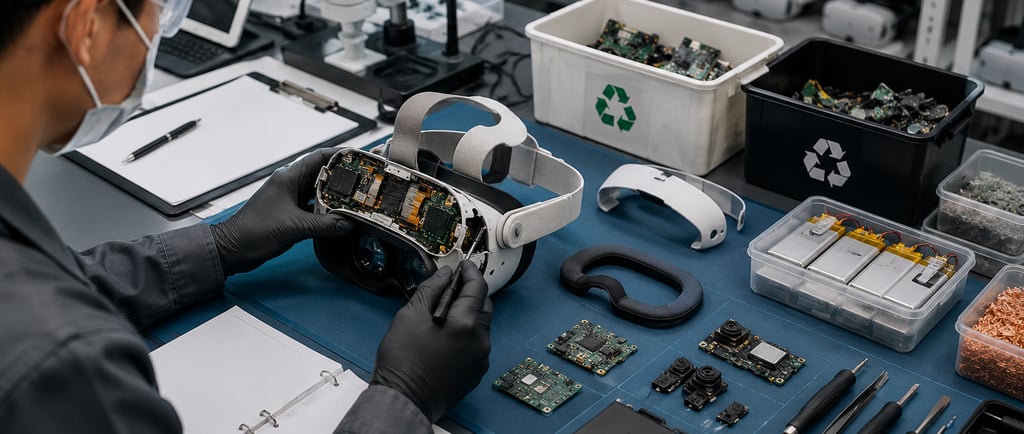
Extended reality (XR) devices present complex challenges for electronics recycling, repairability, and lifecycle compliance. Policy and operational leaders must infuse right-to-repair principles throughout the XR ecosystem—from modular design to secure data erasure and advanced material recovery—ensuring organizations meet evolving regulations, minimize e-waste, and promote effective circular electronics at scale.
Table of Contents
1. Context: The Policy Stakes of XR and Right-to-Repair
2. Defining the Problem: XR Device Lifecycles & Regulatory Pressure
3. Key Concepts: Design for Repair, Circular Electronics, XR
4. Operational Framework: Managing XR for Repair & Recycling
5. Step-by-Step Example: Implementing a Closed-Loop XR Program
6. Implementation Playbook: From Prototyping to Compliance
7. Measurement & QA: Metrics, Scorecard, and Audits
8. Case Patterns & Scenarios
9. Frequently Asked Questions (FAQ)
10. Embedded Five-Layer Toolkit
1. Context: The Policy Stakes of XR and Right-to-Repair
The accelerated growth of extended reality (XR)—spanning virtual reality (VR), augmented reality (AR), and mixed reality (MR)—is not just transforming workplaces and consumer experiences; it’s introducing formidable new policy challenges in electronics recycling and repair. Industry research from Statista forecasts global XR hardware shipments will surpass 40 million units annually by 2026—up from just 11 million in 2022. As sales skyrocket, so do end-of-life management stakes.
Policy teams at global electronics manufacturers (OEMs), sustainability managers, and repair network operators now navigate strict and rapidly changing right-to-repair laws. Market leaders must ensure that:
Devices are engineered for straightforward, non-destructive repair and part replacement.
Official and third-party repairers get access to up-to-date schematics, component labeling, and repair documentation.
Formalized asset take-back, collection, and certified recycling routes are embedded, not bolted on.
Regulatory Landscape:
Robust frameworks like the EU Circular Electronics Initiative, France’s Repairability Index, and new state laws in the US (New York and California) set stringent benchmarks for repair readiness and recycling access. For OEMs, the consequence of non-compliance is not hypothetical. Recent EU directives have imposed multi-million-euro fines, and large institutional customers—governments, schools, and enterprises—now make repairability a condition in tenders.
XR’s Unique Risk:
Unlike smartphones, XR devices mix optics, wearables, and sensitive sensors. Their highly customized form factors complicate the recycling process, and existing frameworks often struggle to classify them (are they considered computers, displays, or medical devices?). Failing to address these ambiguities upfront can restrict market access and trigger regulatory action.
2. Defining the Problem: XR Device Lifecycles & Regulatory Pressure
XR hardware introduces several practical and compliance challenges unlike those seen in legacy electronics:
Frequent Refresh Cycles:
Companies like Meta and Apple release annual or semi-annual hardware revisions, shrinking device lifespans. A 2023 Forrester report found that 72% of enterprise XR deployments replace or retire equipment within 24 months.
Challenging Internal Architecture:
Proprietary flex cables, adhesive-fixed optics, and non-standard batteries make safe disassembly risky, increasing labor and cost for third-party repair networks.
Integrated Data Storage and Sensors:
Devices capture biometric, video, and spatial data, often stored locally. Handling end-of-life devices without robust data-wipe protocols can expose organizations to major privacy penalties under GDPR and CCPA.
Infrastructure Gaps:
Most regions lack dedicated XR refurbishment centers or specialist recycling partners, leading to wider device disposal and downcycling—counter to circular economy goals.
Unclear Compliance Categories:
Is an AR headset a computer, a camera, or a medical device? Jurisdictions differ, confusing e-waste processing rules and thresholds.
Operational Consequences:
An OEM that misses a repairability rating can lose eligibility for government procurement frameworks.
Repair networks report up to 60% longer repair times on XR versus laptops (iFixit data), straining warranty and turnaround SLAs.
News headlines circulate rapidly when high-profile products fail right-to-repair audits, damaging brand trust and raising activist scrutiny.
The Upside of Proactive Design:
Leading OEMs are preemptively engineering modular designs, fostering open repair communities, and investing in XR-specific reverse logistics. By taking ownership across the device lifecycle, they reduce e-waste, unlock extended residual value, and futureproof against patchwork global regulation.
3. Key Concepts: Design for Repair, Circular Electronics, XR
Let’s explore the foundational terminology powering effective policy and operational design:
XR (Extended Reality):
An umbrella term for immersive devices enabling digital overlays (AR), virtual worlds (VR), or seamless blends (MR). This includes headsets, smart glasses, haptic gloves, and spatial computing devices.
Design for Repair:
A holistic engineering approach ensuring products are serviceable throughout their lifecycle. Best practices include:
Use of standard-size fasteners (e.g., Torx, Phillips)
Minimal use of adhesives
Clearly marked internal components
Official teardown guides and repair documentation for third-party shops.
Electronics Recycling:
Recovering metals (gold, copper, palladium), batteries, and plastics from end-of-life devices, while eliminating toxic elements like lead or rare earth elements from general waste streams.
Circular Electronics:
Shifting from take-make-waste to closed-loop models. Circularity means maximizing device, part, and material reuse through repair, refurbishment, remanufacture, and safe recycling, enabled by transparent supply chains and reverse logistics.
Right-to-Repair (RTR):
A legislative and social movement requiring OEMs to make parts, software, and manuals available, fostering competition, consumer empowerment, and environmental sustainability. In 2024, the EU Green Deal articulated RTR as central to a climate-friendly electronics future.
Emerging Terminology:
Repairability Score: (e.g., iFixit’s 1–10 scale, France’s index) quantifies device repair ease.
Reverse Logistics: Managing end-of-life device collection, transport, and processing for reuse, recycling, or renewal.
4. Operational Framework: Managing XR for Repair & Recycling
Embedding circularity into XR’s operational life demands a full-spectrum framework, accommodating device design, regulatory tracking, logistics, workflow standardization, and compliance assurance.
The 4Rs Framework for XR Circularity
1. Design for Repair:
Use modular chassis, standardized fasteners, clearly labeled parts, and public-facing service manuals. Example: Microsoft’s HoloLens 2 increased repair scores by switching to accessible internal screws.
2. Collection:
Build user-friendly return portals, partner with logistics providers versed in data-sensitive electronics, and automate notifications for device returns at lease/end-of-support.
3. Refurbishment:
Equip partner centers with diagnostic kits, certified spare parts, and comprehensive repair guides. Verify standards with periodic audits—ensuring non-working units are prioritized for materials recovery.
4. Recycling:
Develop product-specific disassembly instructions for downstream processors, leveraging qualified e-waste recyclers who can extract rare earths and manage hazardous battery disposal.
Process in Action
Imagine a global OEM launching a new VR headset:
Design Audit: Catalog all adhesives, identify bottlenecks for battery or screen replacement.
Global Compliance Mapping: Track laws in each target market (e.g., does New York’s Digital Fair Repair Act require open repair documentation?).
Partner Onboarding: Vet logistics, refurbishment, and recycling partners for R2 or e-Stewards certification.
User Education: Push in-app and email communications to fleet customers with step-by-step return and privacy-cleaning instructions.
Live Feedback Loop: Repair partners log recurring design issues, feeding continuous improvement to product teams.
By the Numbers
OEMs report repair documentation can reduce device turnaround times by 35% (Circular Electronics Partnership Data, 2023).
Up to 25% of waste electronics in EU e-waste are wearable, AR, or XR devices—a category growing much faster than traditional IT hardware.
Step-by-Step Example: Implementing a Closed-Loop XR Program
A practical XR repair and recycling program starts before the first unit ships. The best time to reduce waste, lower repair cost, protect user data, and meet right-to-repair expectations is during product planning. By 2026, this is no longer a sustainability side project. It is a market access issue, a procurement issue, and a risk issue.
Global e-waste reached 62 million tonnes in 2022 and is projected to reach 82 million tonnes by 2030. Formal documented collection and recycling reached only 22.3% in 2022, and the rate could fall to 20% by 2030 under a business-as-usual path. That means repair, reuse, and controlled recovery must happen earlier in the product lifecycle, before devices become mixed waste. XR devices make this even more urgent because they combine batteries, displays, cameras, sensors, speakers, plastics, optics, circuit boards, magnets, and user data in one compact product.
A closed-loop XR program can be built in five practical stages.
Stage one is product classification.
The company must define what each device is under each target market’s rules. A VR headset used in a school may be treated as consumer electronics. A mixed reality headset used in clinical simulation may trigger healthcare procurement and data handling requirements. A smart glass device used in a warehouse may be treated as enterprise IT equipment. The classification affects warranty terms, repair access, data erasure, battery handling, transport, and end-of-life routing.
Stage two is repair-first design review.
The engineering team should identify every part likely to fail within the first three years: battery, face padding, head strap, lenses, displays, charging port, speakers, cameras, sensors, fan modules, flex cables, controller triggers, haptic motors, and internal storage. Each part should be graded by expected failure rate, replacement time, tool needs, adhesive use, data risk, and part availability. The question is simple: can a trained repairer replace this part without destroying the unit?
Stage three is controlled reverse logistics.
Every headset should have a return path before it leaves the warehouse. Enterprises need return portals, serial number capture, chain-of-custody logs, shipping labels, battery-safe packaging guidance, and return reason codes. Consumer programs need simple return instructions, trade-in offers, repair booking, and clear privacy steps. For high-volume fleets, return triggers should be tied to lease expiry, warranty expiry, device refresh cycles, or failed diagnostics.
Stage four is triage.
When a returned XR device arrives, it should not go straight to recycling. It should pass through a decision tree: redeploy as-is, repair, refurbish, harvest parts, recover materials, or destroy. Working controllers, straps, face interfaces, cameras, display assemblies, speaker modules, and batteries may have recoverable value. A device with a damaged shell but working optics may become a donor unit. A device with swollen batteries or unknown data status needs isolation and specialist handling.
Stage five is documented closure.
Every unit should end with a record: repaired, refurbished, resold, redeployed, dismantled, recycled, or destroyed. The record should include serial number, device model, condition grade, repair actions, parts replaced, data sanitization method, recycler certificate, battery handling status, and final destination. For enterprise customers, this record becomes proof. For regulators, it shows control. For internal product teams, it shows where design changes can reduce cost.
Data handling deserves its own layer. XR devices can hold account tokens, voice recordings, spatial maps, room scans, eye-tracking data, hand-tracking data, usage logs, Wi-Fi credentials, screenshots, videos, and enterprise app data. NIST SP 800-88 Rev. 1 defines media sanitization as rendering access to target data infeasible for a given level of effort, and its updated guidance continues to center practical methods such as clear, purge, and destroy. For XR programs, that means reset alone may not be enough when devices handled sensitive enterprise, medical, education, or defense data.
A well-run XR loop also needs repair documentation. Apple’s Self Service Repair program shows where mainstream electronics repair access has moved: official manuals, genuine parts, diagnostics, and tools are becoming part of the public repair conversation, even for complex devices. The same direction will affect XR hardware as regulators, enterprises, schools, and repair networks ask why headsets and smart glasses cannot follow similar principles.
The operational target is not perfect circularity on day one. The target is controlled routing. No XR device should disappear into a general e-waste stream without a repair, reuse, parts, data, and battery decision first.
Implementation Playbook: From Prototyping to Compliance
The strongest XR repair and recycling programs are built in phases. The goal is to move from design intent to repeatable execution, then from execution to documented compliance.
The first phase is the prototype teardown.
Before mass production, every prototype should be torn down by a team that includes product engineers, repair technicians, recycling partners, privacy leads, and compliance managers. This teardown should measure access time for the battery, display, optics, mainboard, cameras, sensors, speakers, charging port, and straps. It should also identify broken parts during disassembly. If a battery can only be removed after heating adhesive beside a fragile display, that is a repair and safety risk. If a flex cable tears during normal access, that is a design cost. If a camera module is paired to software in a way that blocks part reuse, that is a repair access issue.
The second phase is the parts strategy.
XR devices need spare parts planning from launch, not after warranty claims rise. The company should define which parts will be sold to authorized repair partners, which parts will be available to independent repairers where required by law, which parts require calibration, and which parts must be serialized for security reasons. The parts list should also identify consumables such as facial interfaces, foam pads, straps, nose pieces, cable clips, lens inserts, controller covers, and battery doors. These parts often fail first, and replacing them can extend usable life at low cost.
The third phase is documentation.
Repair documentation should include exploded diagrams, part numbers, torque guidance, adhesive removal instructions, battery safety warnings, calibration steps, diagnostic flows, data wipe procedures, and safe packing instructions. Documentation should be version controlled. A repair guide for version 1.0 of a headset may be wrong for version 1.2 if the cable layout, adhesive type, firmware lock, or battery supplier changed.
The fourth phase is legal mapping.
The EU Directive on common rules promoting the repair of goods was adopted on 13 June 2024 and entered into force on 30 July 2024. It pushes repair as a consumer right and requires EU Member States to transpose the directive into national law. For global XR sellers, this means repair access can no longer be treated as a country-by-country afterthought.
The EU also moved faster on device-level repairability rules for smartphones, feature phones, cordless phones, and slate tablets. Ecodesign and energy labelling requirements began applying to those categories from 20 June 2025, including durability, battery, and repair-related information. XR devices are not always directly covered by the same product category, but the policy direction is clear. Products with screens, batteries, processors, and consumer use cases will face rising expectations for durability, repair access, and lifecycle disclosure.
The fifth phase is regional U.S. readiness.
California’s Right to Repair Act became effective on 1 July 2024 and focuses on creating a fair repair market for electronic and appliance products. New York’s Digital Fair Repair Act also changed the U.S. repair landscape. OEMs selling XR devices in the United States should assume that repair documentation, parts access, tooling, and diagnostic access will keep moving from voluntary programs into legal and procurement expectations.
The sixth phase is partner qualification.
XR companies should not treat all e-waste vendors as equal. A qualified partner should be able to handle batteries, data-bearing electronics, optics, rare earth magnets, mixed plastics, adhesives, circuit boards, and lithium fire risk. R2v3 is especially relevant because it places reuse before materials recovery where feasible and focuses on protecting data, people, and the planet. That hierarchy matters for XR because many returned units may still have working parts, even when the complete headset is no longer sellable.
The seventh phase is procurement alignment.
Enterprise buyers should require repairability and recycling clauses in contracts. The contract should state spare parts availability, repair turnaround targets, data erasure responsibilities, reporting requirements, packaging requirements, and end-of-life ownership. A large school district, hospital network, training company, logistics group, or defense supplier should never buy XR fleets without a retirement plan.
The final phase is review.
Every quarter, the company should examine returns, repair failures, parts shortages, battery incidents, customer complaints, recycler reports, and warranty claims. The findings should feed directly into design changes. If 28% of returned controllers have trigger failure, redesign the trigger. If 40% of units fail because the charging port is damaged, make the port replaceable. If optics are scratched during repair, improve access steps and protective handling.
Compliance is not a document. It is a chain of decisions, proven unit by unit.
Measurement & QA: Metrics, Scorecard, and Audits
XR circularity must be measured with numbers that operators can act on. A vague sustainability claim will not satisfy regulators, procurement teams, enterprise customers, or repair partners. The program needs clear metrics across repairability, reuse, recycling, data security, safety, cost, and customer outcomes.
The first metric is repair success rate.
This measures how many failed devices can be repaired and returned to service. A strong program should separate cosmetic repair, functional repair, battery replacement, display replacement, controller repair, and full refurbishment. A single repair success percentage hides too much. A headset may be easy to refurbish cosmetically but hard to repair electrically.
The second metric is average repair time.
XR repair time should be tracked by part and process step. Battery access time, display access time, optics replacement time, controller repair time, diagnostic time, data wipe time, and final QA time all matter. If the team only measures total turnaround time, it will miss the exact point where cost rises.
The third metric is parts recovery rate.
This shows how many usable modules are recovered from non-repairable units. For XR devices, parts recovery can include straps, face pads, lenses, cameras, displays, speakers, sensors, haptic modules, magnets, fans, batteries, boards, and controller components. Parts recovery is often the bridge between repair and recycling. It keeps value in circulation before material shredding begins.
The fourth metric is battery incident rate.
Lithium battery risk is one of the most important XR end-of-life issues. Batteries may be glued near optics or boards. Returned units may be swollen, punctured, overheated, deeply discharged, or physically damaged. Each incident should be recorded by device model, battery supplier, age, use pattern, storage condition, and handling step. A battery incident in a repair center is a design signal, not only a safety event.
The fifth metric is data sanitization completion.
Every data-bearing unit should have a documented outcome: wiped, verified, destroyed, or quarantined. For enterprise XR, this is critical. A headset may carry spatial maps of a factory, training footage, user profiles, authentication tokens, or biometric settings. The audit record should show method, technician, timestamp, serial number, tool used, and verification result.
The sixth metric is reuse-before-recycling rate.
This shows whether the program is following the correct order: redeploy, repair, refurbish, harvest parts, then recycle. If too many units go directly to material recovery, the program may be losing usable value. The Global E-waste Monitor 2024 notes that only 1% of rare earth element demand is met by e-waste recycling. That figure shows why reuse and parts harvesting matter. Recovery technologies are improving, but most value is still preserved by keeping devices and parts working longer.
The seventh metric is recycler yield.
This tracks material recovered from end-of-life units: copper, aluminum, steel, plastics, circuit boards, lithium batteries, magnets, optical assemblies, and precious metal fractions. XR devices are small, mixed, and dense. The yield data helps product teams understand whether design changes can improve material separation.
The eighth metric is customer return participation.
A take-back program fails if users do not return devices. Participation should be measured by customer type, geography, device age, incentive, channel, and return reason. A return rate below target may signal unclear instructions, weak incentives, lack of shipping support, or poor customer education.
The ninth metric is procurement compliance.
For enterprise sales, track how many tenders require repairability, take-back, data destruction, recycling certification, spare parts terms, or lifecycle reporting. This converts right-to-repair from a legal topic into a sales topic. If repairability helps win contracts, executives will fund it.
The tenth metric is design defect recurrence.
Repair and recycling teams often see product weaknesses before product teams do. If the same cable, hinge, strap, port, lens coating, fan, or battery door fails repeatedly, it should become an engineering issue with a named owner and target fix date.
Audits should happen at three levels. Internal audits check whether the company is following its own procedures. Partner audits check whether repair, logistics, and recycling vendors are handling devices correctly. Product audits test whether new models are improving or getting worse. The audit should include teardown time, repair success, spare parts access, documentation quality, data wipe proof, battery handling, and final disposition records.
A practical scorecard for XR should answer six questions:
Can the device be opened safely?
Can the battery be replaced without damaging the product?
Can high-failure parts be replaced with standard tools?
Can data be removed and verified?
Can usable parts be harvested?
Can end-of-life materials be routed to qualified recovery?
If the answer is no to any of these, the program is not ready.
Case Patterns & Scenarios
The XR repair and recycling problem looks different across industries. A consumer gaming headset, a hospital training device, a military simulator, a warehouse smart glass system, and a school VR lab do not create the same risk profile. The strongest programs adjust operations by use case.
In enterprise training, the biggest challenge is fleet turnover. Companies may buy hundreds or thousands of headsets for onboarding, safety training, equipment simulation, or sales demos. These devices often pass between users, which increases wear on straps, facial interfaces, controllers, charging ports, and hygiene-sensitive parts. The best route is a service model with scheduled inspection, replaceable wear parts, serialized assets, and bulk return cycles. The program should treat face pads, straps, and controller parts as planned consumables.
In education, affordability and safety matter most. Schools may struggle to manage repair, storage, cleaning, student account data, and broken accessories. A repair-ready XR program for schools should include durable storage cases, easy controller replacement, low-cost straps, simple wipe instructions, and clear end-of-life collection. For procurement teams, the key clause is not only purchase price. It is total cost over three to five years, including repairs and replacements.
In healthcare, data and sanitation are central. XR devices used in surgical planning, medical training, rehabilitation, or patient education may handle sensitive workflows. Even when no medical record is stored locally, the device may capture images, locations, or user profiles. Any end-of-life path needs strict chain of custody, verified data sanitization, cleaning protocols, and approved recycling partners. The device may also require separation between medical-use units and general consumer returns.
In industrial operations, durability and downtime dominate. Smart glasses used in warehouses, utilities, mining, oil and gas, logistics, and field service face dust, heat, vibration, sweat, impacts, and frequent charging. A repair program should focus on fast swap units, ruggedized parts, battery access, port protection, and field replaceable accessories. For these buyers, right-to-repair is not only about consumer choice. It is about keeping operations running.
In defense and public safety, security controls decide the program. Devices may contain maps, training footage, network settings, location history, and mission-related data. These programs need stricter sanitization, controlled transport, approved destruction paths, and recycler screening. In some cases, parts harvesting may be limited because the data or security risk outweighs residual value.
In consumer XR, the hardest issue is behavior. Many users keep old headsets in drawers, resell them without wiping data, throw accessories away, or replace devices when batteries degrade. A strong consumer program needs simple trade-in, mail-back labels, clear wipe steps, visible repair options, and honest repair pricing. If repair costs approach replacement cost, users will replace. If battery replacement is unavailable, the device becomes disposable by design.
The strongest case pattern is the service-led fleet model. Instead of selling XR devices once and leaving repair to chance, the OEM or reseller provides a managed lifecycle package. That package includes deployment, user onboarding, spare parts, repair, swap units, data wiping, refurbishment, redeployment, and recycling. This model is easier for enterprises, schools, and healthcare systems because it turns device retirement into a planned process rather than a scramble.
A second strong pattern is the certified refurb channel. Returned devices are graded, repaired, cleaned, tested, repackaged, and resold into lower-cost markets. This can support education, small businesses, training centers, and emerging markets. It also helps OEMs capture value that would otherwise move to uncontrolled resale markets.
A third pattern is the parts donor model. Some XR devices will never be economical to repair as complete units. But they can still supply working displays, optics, cameras, sensors, controllers, straps, boards, or casing parts. This requires careful inventory systems and compatibility tracking. A donor part from one version may not fit another version, especially when internal revisions change.
A fourth pattern is the high-security destruction model. Some enterprise or government customers may require destruction instead of resale. Even then, destruction should not mean poor recovery. The device can still be dismantled under controlled conditions, data-bearing components destroyed, batteries isolated, and remaining fractions sent to qualified processors.
These scenarios show the core point: XR circularity cannot be one process for every device. It must be risk-based, use-case specific, and tied to real product design.
Frequently Asked Questions (FAQ)
What does right-to-repair mean for XR devices?
Right-to-repair means users, repair shops, and qualified partners should have fair access to the parts, tools, manuals, diagnostics, and software steps needed to repair devices. For XR, this applies to batteries, straps, controllers, displays, lenses, ports, sensors, and other failure-prone parts. It also includes documentation that allows safe disassembly without damaging optics, batteries, or data-bearing components.
Are XR headsets covered by current right-to-repair laws?
It depends on the jurisdiction and product category. Some laws cover broad electronic products, while others apply to specific categories. The EU’s 2024 repair directive and 2025 device repairability rules for phones and tablets show the direction of travel. Even when XR is not named directly, OEMs should prepare because XR devices share many regulated features with phones, tablets, wearables, cameras, and computers.
Why are XR devices harder to recycle than laptops or phones?
XR devices combine many product types in one shell. They include optics, displays, cameras, sensors, speakers, microphones, batteries, circuit boards, plastics, magnets, straps, foam, and sometimes biometric sensors. Their parts are often small, glued, curved, or tightly packed. That makes disassembly slower and increases the risk of breaking parts during repair.
What is the most important repairability improvement for XR hardware?
Battery access is usually the first priority. Batteries degrade, carry fire risk, and often determine whether a device can stay in service. A headset with a replaceable battery has a much stronger lifecycle profile than one where battery removal damages the display, optics, or casing.
Can XR devices be refurbished safely?
Yes, if the program includes inspection, cleaning, data sanitization, battery checks, parts replacement, firmware reset, QA testing, and documented grading. Refurbishment is unsafe when devices are resold without verified wiping, battery screening, or functional testing.
What data should be wiped from XR devices before repair or recycling?
Accounts, app data, Wi-Fi credentials, device logs, room scans, spatial maps, voice recordings, photos, videos, usage history, calibration profiles, and enterprise authentication tokens should be removed or verified as inaccessible. Higher-risk devices may require stronger sanitization or physical destruction of storage media.
What certifications should XR recyclers have?
R2v3 and e-Stewards are common reference points for responsible electronics processing. A qualified XR partner should also show battery handling capability, data security procedures, downstream vendor controls, worker safety controls, and reporting quality. R2v3 is especially relevant because it places reuse first when feasible, then materials recovery when reuse is no longer viable.
Should OEMs publish repair manuals for XR devices?
Where required by law, yes. Even where not required, repair manuals reduce repair errors, improve partner consistency, support enterprise procurement, and reduce unnecessary recycling. Manuals should be paired with parts access, safety warnings, diagnostics, and calibration guidance.
Is recycling enough to solve XR e-waste?
No. Recycling is necessary, but it is the last step. Repair, reuse, refurbishment, and parts harvesting preserve more value and delay material loss. The global e-waste system is already under pressure, with formal collection and recycling failing to keep pace with generation.
How should enterprises write XR take-back clauses?
They should require serial-level reporting, data sanitization proof, repair-first triage, battery-safe handling, certified recycling, parts recovery where feasible, and final disposition records. The clause should also define who pays for return shipping, who owns replaced parts, and how long spare parts remain available.
Embedded Five-Layer Toolkit
A mature XR right-to-repair and recycling program needs five connected layers. Each layer protects a different part of the lifecycle.
Layer one is design readiness.
This layer belongs to product and engineering teams. The device should use fewer adhesives, standard fasteners, accessible batteries, replaceable wear parts, labeled components, and documented teardown steps. The design team should review every high-failure part before launch. The goal is simple: repair should not require destruction.
Layer two is repair access.
This layer includes manuals, diagnostics, spare parts, tool access, calibration steps, and partner training. A repair network cannot perform well if it receives incomplete instructions or parts too late. Repair access should include version control, because a small manufacturing change can make old instructions unsafe or inaccurate.
Layer three is data security.
This layer includes user reset instructions, enterprise wipe tools, technician procedures, sanitization logs, verification, quarantine rules, and destruction paths for high-risk devices. XR raises the stakes because spatial and biometric-adjacent data can be more sensitive than ordinary files. The program should follow recognized sanitization guidance and keep proof for audits.
Layer four is reverse logistics.
This layer moves devices back from users to the right destination. It includes return portals, labels, packaging instructions, chain-of-custody records, battery-safe transport, return reason codes, and routing rules. A poor reverse logistics system causes devices to sit in offices, closets, warehouses, and drawers until their value drops.
Layer five is recovery and reporting.
This layer includes refurb grading, parts harvesting, certified recycling, material yield reporting, battery disposition, downstream processor records, and customer reports. It turns repair and recycling into traceable business data. That data should feed procurement, sustainability reporting, compliance files, and product redesign.
The five layers work only when they share information. Repair data should inform design. Recycling data should inform material choices. Data wipe failures should inform software controls. Return rates should inform customer education. Tender requirements should inform product planning.
The practical toolset should include:
A repairability checklist for every new XR model.
A part failure register updated monthly.
A spare parts availability map by region.
A teardown time log by model and repair type.
A data sanitization record tied to serial number.
A battery incident log.
A recycler qualification file.
A customer return script.
A procurement clause template.
A quarterly lifecycle review.
This toolkit gives OEMs, recyclers, repair networks, and enterprise buyers a shared operating language. Without it, right-to-repair remains a policy slogan. With it, XR lifecycle management becomes measurable and defensible.
Conclusion: Right-to-Repair Is the Operating System for Circular XR
XR hardware is entering the same policy path that phones, tablets, laptops, and appliances entered before it. The difference is complexity. XR devices are worn on the body, packed with sensors, tied to spatial data, built with delicate optics, powered by compact lithium batteries, and refreshed quickly. That makes repair and recycling harder, but it also makes lifecycle planning more valuable.
By 2026, the strongest XR companies will not wait for every law to name every product category. They will build for the direction of regulation, not the minimum wording of today’s rule. They will design batteries and high-failure parts for replacement. They will publish repair documentation where required and prepare it where expected. They will qualify recyclers before units return. They will treat data wiping as a core safety step. They will measure reuse before recycling. They will turn repair records into product improvements.
The global e-waste crisis is already large enough to make passive disposal unacceptable. With 62 million tonnes generated in 2022 and 82 million tonnes projected by 2030, every product category with fast refresh cycles must reduce waste at the source. XR is still young enough to avoid repeating the worst mistakes of sealed, disposable electronics.
Right-to-repair is not only about giving someone a screwdriver and a manual. For XR, it is about building a complete lifecycle system: design, parts, data, repair, logistics, reuse, recycling, and proof. The companies that do this early will lower warranty cost, win enterprise trust, meet public-sector procurement requirements, reduce waste, and keep more product value in circulation.
The future of XR will not be judged only by display quality, immersion, or compute power. It will also be judged by what happens when the device breaks, ages, or reaches the end of its first life. A repair-ready XR product is a better product. A traceable recovery system is a safer system. A circular XR program is the only credible path for a market that wants to grow without creating the next major electronics waste problem.
Connect
Your trusted partner for scrap metal procurement.
CONTACT
About
haroon@tdcventures.com
+1-307-655-7593
© 2025. All rights reserved.
NEWSLETTER