
Salt-Resistant Fasteners from Recycled Stainless
Discover how salt-resistant fasteners made from recycled stainless steel enhance coastal infrastructure. Learn about 316 & duplex grades, circularity, and corrosion-resistant specifications for climate-resilient building.
CLIMATE-RESILIENT INFRASTRUCTURE & CIRCULAR MATERIALS
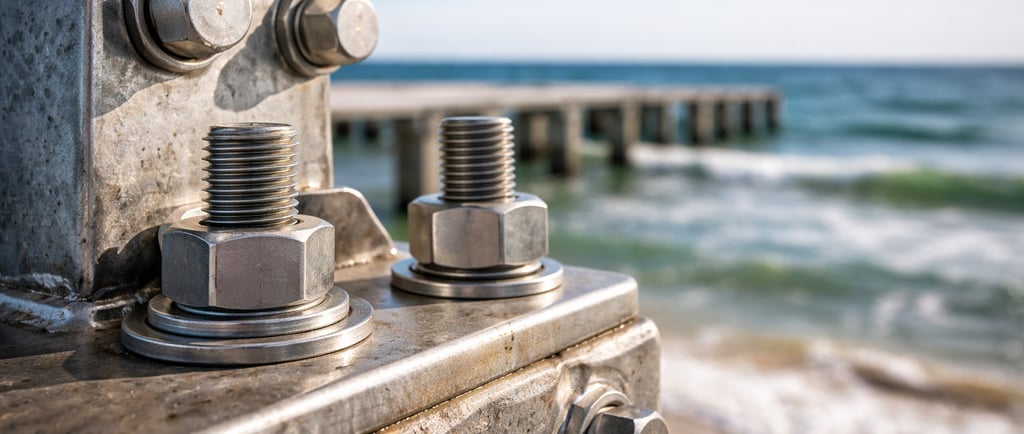
Context: Salt-Resistant Fasteners and Coastal Infrastructure
Saltwater and coastal air are relentless adversaries for the built environment. About 40 percent of the world’s population lives within 100 kilometers of the coast, so chloride exposure is not a niche design issue. It is a mainstream infrastructure problem that affects bridges, boardwalks, marinas, ports, rooftop solar systems, seawalls, flood-control assets, and coastal buildings across the world. As climate pressure, coastal density, and storm intensity rise, the margin for material mistakes gets smaller.
The weak point is often not the beam, slab, or pile. It is the connector. A single corroded bolt in a hurricane tie-down, rail connection, marina pile cap, cladding support, or equipment mount can trigger local failure, water ingress, safety risk, and expensive unplanned maintenance. Corrosion remains one of the largest hidden cost centers in infrastructure. AMPP and the NACE economic impact work place the global cost at about $2.5 trillion annually, roughly 3.4 percent of global GDP. FHWA guidance also continues to identify chloride-induced corrosion as one of the main deterioration mechanisms in bridge infrastructure.
That is why salt-resistant fasteners deserve far more attention than they usually get. In coastal and chloride-heavy environments, they are not commodity hardware. They are part of the asset’s durability strategy, maintenance strategy, and risk strategy. When the fastener package is well chosen and well documented, it can extend service life, reduce replacement frequency, and support more credible environmental claims at the same time. Stainless steel’s circularity strengthens that case. World Stainless reports that stainless steel is 100 percent recyclable and that at least 95 percent of stainless steels are recycled at end of life.
The Problem and Opportunity: Corrosion, Carbon, Circularity
Corrosion in coastal infrastructure is rarely dramatic at the start. It begins quietly. Chlorides settle on surfaces, moisture lingers in crevices, saltwater dries and concentrates, oxygen conditions change at tight interfaces, and localized attack begins where washers, threads, overlapping plates, brackets, and mixed-metal contacts create ideal failure conditions. FHWA bridge documents and related preservation guidance describe chloride-induced corrosion as a major deterioration pathway, especially where salt exposure and moisture persistence are high.
Fasteners are especially exposed because they combine several risk factors in one place. They introduce threads, contact pressure, tight gaps, assembly damage, dissimilar metals, and repeated wet-dry cycling. In other words, they create exactly the kind of micro-environment where chloride-driven corrosion does its best work. This is one reason connection points often deteriorate faster than adjacent members, even when the surrounding structure still appears sound.
The opportunity sits on the other side of that risk. Owners do not need hardware that simply survives handover. They need hardware that keeps performing after years of salt spray, trapped moisture, deferred maintenance, and real service loads. Recycled stainless steel fasteners offer a practical path to that outcome because they combine corrosion resistance with a strong end-of-life recovery profile. When those fasteners are specified correctly, supported by traceable documentation, and installed with care, they can lower whole-life maintenance cost while supporting circular procurement goals. LEED v4.1 guidance also recognizes certified recycled-content documents and Type III EPDs as valid parts of product compliance review, which makes the documentation side of material selection more important than ever.
Key Concepts: Stainless Grades, Corrosion Resistance, Recycled Content
A strong coastal fastener strategy starts with metallurgy. Type 304 stainless steel is widely used in general construction, but it is not the right default for critical coastal connections. Nickel Institute guidance notes that at chloride levels between 200 and 1000 ppm, Type 304 can be only marginally satisfactory, depending on temperature, crevice severity, and other local factors. That is a warning sign for exposed coastal applications, not a comfort signal.
Type 316 stainless steel is the usual baseline for serious coastal work because molybdenum improves resistance to chloride attack. Nickel Institute guidance states that Type 316 is preferred for critical applications where salt content exceeds 200 ppm and adverse factors such as tight crevices are present. In practical terms, 316 is often the minimum sensible starting point for routine coastal atmospheric exposure where failure would be costly or hard to access.
Duplex stainless steels such as 2205 move performance further up the ladder. The Nickel Institute duplex guide describes duplex grades as highly resistant to chloride stress corrosion cracking and about twice as strong as common austenitic stainless steels. That mix of higher strength and stronger chloride performance makes duplex a strong candidate for offshore-adjacent energy systems, highly exposed bridges, flood-control hardware, marine anchorage, and other demanding connections where both load and exposure are severe.
Recycled content matters too, but only when it is backed by real documentation. Stainless steel has a strong circularity profile because it is highly recyclable and widely recovered, yet recycled-content claims should still be verified through product documentation, recycled-content certificates, and where available, Type III EPDs. That keeps the environmental case tied to evidence rather than marketing language.
Coatings can help in some applications, but coatings alone do not solve coastal fastener risk. Once the coating is scratched, cracked, or damaged at the thread or bearing surface, the substrate is exposed and localized attack can begin. In aggressive chloride service, alloy selection and joint design usually matter more to long-term performance than a simple reliance on protective coating. FHWA bridge corrosion work repeatedly shows that chloride-driven deterioration is persistent, localized, and expensive once it takes hold.
Galvanic corrosion is another issue that cannot be treated as an afterthought. Stainless steels are relatively noble. When stainless fasteners contact aluminum, zinc-coated steel, or other less noble metals in the presence of an electrolyte, the less noble metal can corrode faster. Nickel Institute guidance on galvanic behavior in water systems is clear on this point. Mixed-metal assemblies need proper design, proper drainage, and where needed, real isolation measures.
Framework: Fast-Tracking Climate-Resilient Installations with Recycled Metals
The 4R model gives coastal projects a practical structure for fastener decisions.
Risk profiling comes first. Not every point on a coastal asset faces the same exposure. Direct salt spray, splash-zone service, tidal wetting, trapped chloride deposits, marine atmosphere, and inland coastal influence are different conditions with different failure rates. Good teams map those differences early rather than labeling the entire project "coastal" and using one hardware decision everywhere. FHWA service-life guidance stresses the importance of exposure-based design and deterioration awareness.
Resilient grade selection comes next. Once exposure is mapped, the fastener grade should follow the environment, the consequence of failure, and the replacement burden. Type 316 or A4-class stainless is often the practical floor for routine coastal service. Duplex grades deserve stronger attention where chloride severity, crevice risk, or structural demand rises. The point is not to overspecify everything. The point is to stop underspecifying critical joints.
Recycled-content validation is the third step. If circular procurement is part of the project brief, the fastener package should carry traceable proof, not vague claims. Batch certificates, recycled-content declarations, heat or lot traceability, and EPDs where available help owners verify what they are buying and defend that choice later in sustainability reporting or certification review.
Rapid recovery planning is the fourth step. Coastal infrastructure has to be maintained under real-world conditions, not ideal ones. Standardized, traceable, corrosion-resistant fastener packages support faster inspection, faster repair, and cleaner replacement after storms or flood events. That matters for uptime, insurance documentation, and public recovery timelines.
Expanded, Step-by-Step Specifications for Salt-Resistant Fasteners from Recycled Stainless
A durable specification starts by defining exposure first, alloy second, and paperwork third.
Step one is environment classification. Separate the project into at least four zones: inland but coastal-influenced atmosphere, direct salt-spray exposure, splash or tidal exposure, and aggressive micro-environments such as trapped chlorides, stagnant crevices, or seawater combined with deicing exposure. Stainless performance depends on actual service conditions, not generic terms. Nickel Institute guidance on chloride-containing waters supports that approach directly.
Step two is alloy matching. For low-severity architectural conditions with good washdown and low consequence, 304 may survive. That does not make it the right default for critical connections. For routine coastal and marine atmospheric exposure, Type 316 or equivalent A4-class stainless is usually the sensible baseline. For harsher conditions, especially where crevices, trapped moisture, heavy salt loading, or high structural demand are expected, duplex grades such as 2205 deserve active consideration.
Step three is system specification. A fastener package is more than a bolt. It includes nut, washer, anchor, sleeve, backing plate, thread condition, contact surfaces, and mating substrate. A 316 bolt paired with the wrong washer, carbon-steel backing hardware, or an unisolated dissimilar-metal interface can still fail early. Coastal durability depends on the full connection system, not a single material callout.
Step four is surface integrity. Stainless steel depends on its passive surface film. If site handling contaminates the surface with iron particles from carbon-steel tools, grinding debris, or dirty storage, staining and localized attack can follow. Clean tools, dry storage, separation from carbon-steel contamination, and proper handling are basic requirements, not nice extras.
Step five is documentation. Do not write "sustainable fasteners preferred." Write measurable requirements. Call for declared recycled content, traceable lot records, alloy designation, applicable standards, and EPDs where available. That is how a circularity claim becomes auditable procurement language instead of generic sustainability talk.
Step six is exclusion language. Do not allow vague "marine grade" substitutions. Do not allow avoidable mixed-metal assemblies in wet saline service without an engineered isolation strategy. Do not assume a coated carbon-steel substitute is equivalent because it looks acceptable on delivery day. In coastal work, substitution control is part of corrosion control.
A practical specification should say, in substance, that all exposed or concealed critical fasteners in salt-laden atmospheric, splash, or tidal service must be corrosion-resistant stainless steel selected for the exposure condition, with Type 316 or A4 as the minimum for routine coastal service and duplex stainless considered where chloride severity, crevice exposure, or structural demand is high. It should also require compatible nuts and washers, galvanic isolation where dissimilar metals are present, and traceable documentation for alloy, recycled content, and product declarations. That is language owners can actually buy against and enforce in submittals.
Implementation Playbook: From Concept to Commissioning
The first rule is simple. Decide the corrosion strategy before tender, not during submittals. Once low-cost alternatives appear in value-engineering rounds, durability often loses unless the contract documents are clear. FHWA corrosion guidance points in the same direction. Better long-term outcomes come when durability decisions are made early and built into design policy rather than negotiated late under cost pressure.
During concept design, classify fasteners by consequence of failure, exposure severity, and replacement difficulty. A visible trim screw that can be swapped in minutes is not in the same category as a hidden connector inside a seawall assembly or a coastal solar mount buried beneath panels. This one step improves material decisions immediately because it stops teams from treating all hardware as equal.
At schematic design, map mixed-metal interfaces. Look for stainless-to-aluminum, stainless-to-galvanized steel, stainless-to-carbon steel, and other dissimilar pairings. Then define where inert washers, sleeves, bushings, sealants, or dielectric separators are needed. Many premature failures that appear to be "bad stainless" are really bad joint design.
At design development, ask practical supply questions early. Can the specified alloy be sourced at the required scale. Can lot traceability be maintained. Can recycled-content proof and environmental documentation be delivered without creating procurement delays. Those questions decide whether a strong specification survives contact with the market.
At tender stage, require submittals before installation. The package should identify alloy designation, governing standard, dimensions, mating hardware, recycled-content records, EPDs where available, and installation guidance for torque control and anti-galling practice where applicable. Silent downgrades usually happen where submittal discipline is weak.
At installation, control contamination, galling, and water traps. Dry assembly, damaged threads, over-speed tightening, dirty tools, and poor drainage can ruin a coastal connection long before alloy limitations become the main issue. In other words, stainless is not a permission slip for sloppy field practice.
At commissioning, create a corrosion baseline. Photograph representative joints. Record alloy and lot records by area. Log mixed-metal interfaces. Set inspection intervals according to exposure severity and consequence of failure. Owners who do this early remove years of guesswork later.
Advanced Measurement Strategy: What to Track, How Often, and Why It Matters
A coastal fastener program should measure more than visible rust.
The first metric is service-life expectation by zone. Teams should estimate expected inspection and replacement intervals for each fastener family in each exposure zone. Even when those estimates are rough, they force better design discipline. Stainless steel is widely used as a long-life infrastructure material, but actual life depends heavily on chloride severity, geometry, and maintenance conditions.
The second metric is corrosion incident rate per 1,000 installed fasteners or by connection family. Count staining, pitting, thread seizure, washer loss, cracking, hole enlargement, and replacement events. Without a denominator, teams tend to overreact to isolated visible issues and miss repeating failure clusters at the joint level.
The third metric is whole-life maintenance cost. Corrosion is not just a materials bill. It includes labor, access, inspection, downtime, safety exposure, and secondary damage. The AMPP and NACE corrosion impact figures matter because they frame corrosion as a system-level economic problem, not a minor maintenance nuisance.
The fourth metric is embodied carbon per fastening package, not just per kilogram of metal. A cheaper fastener with a short replacement cycle can look attractive at bid stage and perform badly over 20 to 50 years once repeated replacement, access mobilization, and disposal are counted. That is where EPDs and recycled-content documentation become useful, because they support fuller life-cycle comparisons.
The fifth metric is circularity verification. Track the share of installed fasteners backed by verified recycled-content documents, the share tied to lot traceability, and the share recoverable at end of service. A circularity claim only matters if it can be checked.
The sixth metric is inspection productivity. Measure how many connections per labor hour can be inspected, cleaned, documented, or replaced. This matters because durable fastener systems create value partly by reducing the maintenance burden in hard-to-reach coastal locations.
Inspection cadence should follow exposure and consequence. Mild coastal atmospheric zones may justify periodic visual checks and less frequent detailed review. Splash-zone, tidal, concealed, or access-limited critical joints often justify tighter intervals. The principle is simple. Inspection frequency should rise with chloride severity, moisture persistence, replacement difficulty, and consequence of failure.
Field-Proven Case Studies and Patterns
The market already shows a clear pattern. As chloride severity rises, the alloy choice rises with it.
In marine fastener guidance, Nickel Institute notes that higher-performance duplex and high-molybdenum alloys offer higher strength and stronger resistance to chloride stress corrosion cracking and crevice corrosion in seawater than Type 316. That does not mean every coastal connection needs exotic alloy. It means the market has already learned a simple lesson. When exposure and consequence increase, the alloy system must move up with them.
The same pattern appears in aluminum structures and mixed-material assemblies. Nickel Institute's practical guide to marine fasteners explains that stainless-steel fasteners are commonly used with aluminum structures, but also warns that galvanic corrosion can enlarge the fastener hole in marine atmosphere and cause the intact stainless fastener to drop out as the aluminum corrodes. That is a direct reminder that fastener success depends on the joint system, not only the fastener metal.
Bridge preservation shows the same logic at a larger scale. FHWA peer exchange work on corrosion prevention and mitigation emphasizes that agencies are shifting toward earlier intervention, better detailing, and material decisions that prevent chloride-driven deterioration rather than waiting to repair the damage after it appears. Fasteners belong squarely inside that logic because they sit at some of the most vulnerable interfaces in an asset.
Common Failure Modes in Coastal Fastener Systems
Coastal fastener failures are usually predictable.
The first common failure mode is wrong-grade substitution. A project may be designed around Type 316 or duplex stainless, then shift quietly to 304 or to an undefined stainless product during procurement or installation. The hardware may look acceptable on day one, then disappoint after repeated chloride exposure, trapped moisture, and real service conditions begin to work on the joint. Nickel Institute guidance makes the difference clear. Type 304 can be marginal in chloride service, while Type 316 is preferred where salt content and adverse local conditions rise.
The second is crevice design. Stainless can perform well near the coast, but not when geometry traps saltwater and keeps the connection wet for long periods. Tight gaps between overlapping members, washers, plates, and fittings create low-oxygen, chloride-rich pockets where localized attack starts. FHWA bridge maintenance material notes that corrosion is often found in crevices, between tightly fitted members, and in areas that hold moisture and debris.
The third is mixed-metal contact without isolation. Stainless fasteners placed directly against aluminum, galvanized steel, or other less noble metals in wet saline service can accelerate corrosion of the less noble component. This shows up on solar racks, railings, cladding supports, rooftop equipment, and marine platforms. The fastener itself may remain intact while the surrounding metal degrades faster than expected.
The fourth is contamination from carbon-steel tools, swarf, or poor storage. Stainless is often accused of rusting when the visible staining actually begins as free iron contamination on the surface. The problem is then site discipline, not alloy failure. Clean handling matters.
The fifth is thread galling and poor installation practice. Dry assembly, damaged threads, high-speed tightening, poor torque control, and reuse of compromised hardware can seize a joint or damage it before corrosion becomes the dominant issue. In coastal work, bad installation can be just as costly as bad material choice because it affects inspection access, replacement schedules, and long-term reliability.
What Strong Coastal Fastener Specifications Need
Strong coastal fastener specifications need speed, clarity, proof, and field realism.
They need fast exposure-based selection. Coastal atmosphere, direct salt spray, splash zone, tidal service, and trapped-moisture chloride conditions are not the same environment, so they should not produce the same alloy decision. A good specification system lets a designer move from exposure condition to likely baseline alloy quickly and defensibly.
They need language that survives procurement. Vague phrases such as "marine grade" or "corrosion-resistant hardware" invite substitution. Clear specifications identify alloy, standard, mating hardware, galvanic isolation requirements, and submittal documentation. That is how design intent survives bid pressure.
They need proof behind the circularity claim. If recycled stainless is part of the value proposition, the claim should be backed by recycled-content declarations, lot traceability, and EPDs where available. Otherwise the sustainability story is weak the moment someone asks for evidence.
They need inspection language grounded in field reality. Coastal failures usually start in repeatable places: crevices, drainage traps, mixed-metal interfaces, contaminated surfaces, damaged threads, and hidden wet joints. Inspection plans should call out those conditions directly.
They need strong sourcing discipline. The strongest claims in this space are the ones backed by durable sources: United Nations data for coastal population exposure, AMPP and NACE for the economic cost of corrosion, FHWA for infrastructure durability and chloride-related deterioration, Nickel Institute for grade behavior and marine corrosion mechanisms, World Stainless for recyclability, and USGBC for documentation frameworks.
Conclusion
Salt-resistant fasteners made from recycled stainless are easy to underestimate because they are small, relatively inexpensive compared with the full asset, and often hidden once the job is done. That is exactly why they deserve more attention. In coastal construction, failure often starts at the interfaces, the crevices, the edges, and the connectors. Fasteners sit directly in that danger zone.
Choosing the right stainless grade matters. So do joint geometry, galvanic isolation, contamination control, installation practice, traceable documentation, and inspection planning. When those pieces work together, coastal fastener systems can deliver what modern infrastructure needs most: longer service life, lower maintenance burden, stronger resilience in chloride-heavy environments, and a cleaner circularity story backed by records that can actually be verified.
That is the real standard to aim for. Not hardware that merely survives handover, but hardware that still performs after years of salt spray, moisture cycling, deferred maintenance, and real-world service.
Connect
Your trusted partner for scrap metal procurement.
CONTACT
About
haroon@tdcventures.com
+1-307-655-7593
© 2025. All rights reserved.
NEWSLETTER