
Sample And Assay Protocols: Avoiding Disputes
Prevent costly payment holds and disputes in scrap metal trade. Our guide reveals the sampling and assay protocols that ensure representativity, defendable results, and fast settlement.
COMPLIANCE & REGULATORY OPERATIONS IN RECYCLING
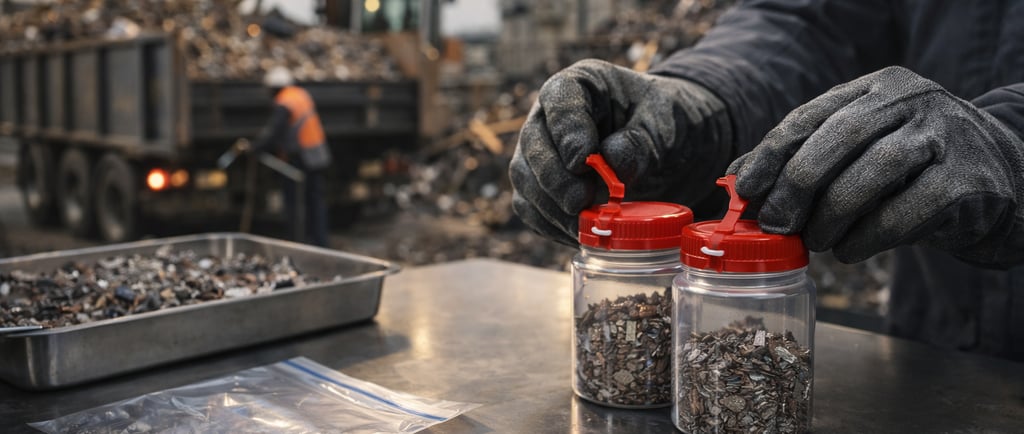

Section 1. Why sample and assay protocols matter in recycling
Scrap and secondary metals now sit closer to the center of industrial supply chains than they did a decade ago. Energy, emissions, and policy pressure have shifted decision-making toward recycled feedstocks, and that raises the financial stakes on every percentage point of payable metal.
One simple example shows why this matters. In aluminum, major institutions consistently report that producing secondary aluminum uses about 95% less energy than primary production. The International Aluminium Institute quantifies this using 2019 global energy intensity figures, with primary at about 186 GJ per tonne and recycled at about 8.3 GJ per tonne, a 95.5% energy saving. Natural Resources Canada makes the same point in its national facts on aluminum.
When recycled metal becomes the preferred option, buyers tighten quality gates and documentation standards because they want fewer surprises after melt, fewer penalty claims, and faster settlement.
That is why sampling and assaying are no longer treated like back-office lab work. They are price, risk, and reputation controls. If you ship a heterogeneous lot and the sample is not representative, the number on the Certificate of Analysis becomes a negotiation trigger. The larger the lot value and the tighter the downstream spec, the more likely the issue turns into a withheld payment, reprocessing claim, or a relationship-breaking dispute.
This is not a new technical problem, it is a well-studied sampling science problem. Pierre Gy’s work on sampling errors, and later practical guides used across industries, make a blunt point: heterogeneity and poor sampling design create errors that no instrument can “fix” later. If you start with bias, you will get a precise, repeatable number that is still wrong.
For readers who trade, recycle, or audit, here is the core idea you should keep in mind while reading the rest of this guide. Sampling is the highest-leverage control point in the entire assay pathway, because it controls whether the test item actually represents the lot.
Section 2. The real problem behind disputes, and why it keeps repeating
Most disputes present as “my lab says X and your lab says Y.” In practice, that is often a false story. The real drivers are usually upstream.
Representativity failures. Heterogeneous scrap segregates by density, particle size, and contamination profile. Sampling only the top layer, only the first trucks, or only one side of a pile creates a biased sample.
Sample preparation divergence. Even if both parties sample correctly, differences in drying, crushing, milling, splitting, and homogenizing can create two different test items from the “same” material.
Method mismatch. One party uses XRF screening, the other uses ICP-OES after digestion, and neither party fully specifies sample prep and decision rules in the contract annex.
Chain-of-custody breaks. When custody records are incomplete, results become hard to defend. In legal sampling guidance used in Canada, the distinction between “legal sampling” and “routine sampling” is explicitly tied to whether you can prove chain of custody, meaning you can show who handled the sample, when, and how.
A useful way to understand why disputes persist is to look at how other commodity sectors settle them. Concentrates and refining agreements often use an “assay exchange” model with a defined “splitting gap.” If the two assays differ by less than the agreed gap, parties settle on an average. If the difference exceeds it, an independent umpire assay is triggered. This is not theory, it is a widely documented commercial pattern.
The same logic applies to scrap trading. If you do not set the sampling, preparation, method, and umpire mechanics in advance, you are effectively choosing to negotiate under stress later.
Time and closure also matter. The London Metal Exchange rulebook shows why serious markets set clocks. It contains clear language requiring additional sampling and analysis to be carried out within defined time windows in certain contexts, and it ties certificates to traceable identifiers like batch and seal numbers.
You do not need to trade on an exchange to learn from the exchange mindset. You need time-bounded objections, traceable IDs, and a final decision path.
Section 3. Key concepts you must align before the first sample is taken
This section is short on purpose. These definitions are the foundations you will keep returning to when you write contracts, design SOPs, and defend results.
Lot definition. A lot is what you claim you sampled. If the lot boundary is vague, every downstream number becomes negotiable. A defensible lot definition names the material, the shipment identifiers, the time window of loading, the storage condition, and the blending rules.
Increment. An increment is one individual grab or cut taken as part of building a composite. You use many increments because scrap heterogeneity is real.
Composite sample. The combined material made from multiple increments, mixed and then reduced to lab-sized test portions using controlled splitting methods.
Test item, test portion, and preparation. These terms matter because two labs can test “the same sample” but do different preparation steps. A method annex must specify preparation, not only the instrument.
Assay and method. The assay method is the full analytical pathway. It includes preparation steps, digestion conditions, calibration approach, detection limits, and reporting rules.
Measurement uncertainty. A number without an uncertainty story is an argument waiting to happen. ISO/IEC 17025 requires labs to consider measurement uncertainty where relevant, and to assure validity of results through quality control approaches such as proficiency testing and interlaboratory comparisons. Guidance from accreditation bodies and training materials tied to ISO/IEC 17025 reinforce this emphasis.
Handling and chain of custody. ISO/IEC 17025 is direct about handling test items. It requires procedures for transportation, receipt, handling, protection, storage, retention, and disposal or return, including precautions to avoid contamination, deterioration, loss, or damage. Even if you are not a lab, aligning your field practice to this standard makes your sample defensible.
For legal defensibility, government sampling manuals state plainly that chain-of-custody documentation is what allows you to prove sample integrity in court or enforcement contexts.
Section 4. A dispute-prevention framework that survives audits and claims
If you want fewer disputes, do not rely on goodwill or “we’ve always done it this way.” Build a system that can be verified by a counterparty, a buyer auditor, or a regulator.
Pillar 1. Protocol clarity that removes interpretation
Write sampling and assay procedures in operational language, not vague references.
What to specify in writing, every time
Material description and lot definition rules.
Sampling method by material form, including increment frequency during loading.
Minimum number of increments and minimum increment mass.
Mixing, splitting, and reduction steps, with contamination controls.
Moisture and volatile handling rules when payable content can be affected.
Test method and preparation steps, including whether results are on a dry basis and how corrections are applied.
Reporting format, detection limits, and how “below detection” is handled.
Where standards fit, and where contracts must fill the gaps
For steel and iron sampling and preparation for chemical composition, ISO 14284 exists and provides recognized methods for sampling and preparation for analysis. It is a strong reference when your material and test needs align.
For heterogeneous scrap forms, you often need a contract annex that is more specific than any single general standard. You can still ground your approach in established sampling science, including Gy’s identification of multiple sampling error types and practical industrial guidance on sampling protocol design.
Pillar 2. Role assignment and witnessing rules
Disputes thrive in ambiguity. Assign roles and define witnessing rules for higher-risk lots.
Minimum role map that works in real yards and ports
Sampler. Executes the field method, controls tools, avoids cross contamination.
Witness. Counterparty or independent inspector, signs the sampling record.
Custodian. Controls sealed samples, controls reserve sample storage access.
Carrier. Transfers samples to lab, time stamps handoff events.
Lab receiver. Confirms seals on receipt, records condition, logs any deviations.
Analyst and reviewer. Runs the method and verifies QC criteria.
If you cannot staff a live witness, require video evidence tied to the sample ID, plus a same-day signoff of the sampling record. What matters is auditability and speed of agreement.
Pillar 3. Audit trail and sample integrity controls that are hard to attack
Adopt the same thinking ISO/IEC 17025 forces on laboratories. Protect the test item at every stage and record what happened.
Practical integrity controls that stop most arguments
Tamper-evident seals with unique IDs on every sample container.
Two-sample strategy. One primary sample to the lab, one sealed reserve sample stored under restricted access.
Photo set. Sampling points, composite mixing, sealing, labels, handoffs, and seal condition at receipt.
Time stamps. Collection time, seal time, handoff time, lab receipt time.
Deviation handling. If anything is off, log it as a deviation, do not hide it. ISO/IEC 17025 requires labs to have processes for nonconforming work, and that mindset is exactly what you want in the field.
Pillar 4. Dispute clause mechanics that create closure
A dispute clause must be executable. That means it has clocks, it has a referee path, and it has a finality rule.
The cleanest structure mirrors established commodity settlement practice
Assay exchange with a defined splitting gap. If results are within the gap, settle by average. If outside, go to umpire.
Pre-agree the referee lab or qualification requirements.
Define which sample goes to umpire, usually the sealed reserve sample.
Define cost allocation. In real refining settlement guidelines, the party whose assay is farthest from the umpire pays, and if equidistant the parties split the cost.
Define the objection window and the maximum time to umpire. Time-bounded procedures are common in serious markets because they limit dispute drift.
Section 5. Worked example, brass scrap shipment done the defensible way
Scenario
A UK processor sells 50 tonnes of brass scrap to a European buyer. The buyer is sensitive to copper and zinc ranges and to penalty elements. Both parties want fast settlement, and both have been burned before by “top-of-pile” sampling and unclear prep steps.
Step 1. Contract annex locks the reality of the lot
They define the lot as the 50 tonnes loaded into a specified container set, within a defined loading window, from a named stockpile segment. They prohibit last-minute blending unless it is documented and witnessed. The annex states that payment is based on a dry basis analysis, with moisture measured and corrected using the agreed procedure.
Step 2. Sampling plan matches the material form
Because brass scrap is heterogeneous, they agree to incremental composite sampling across the entire loading sequence. Instead of one scoop, the sampler takes increments at defined tonnage intervals and from different positions during loading, and then combines these into one composite. This reflects the basic principle emphasized in sampling guidance, that representativity comes from properly designed incremental sampling and mixing, not from a single convenient grab.
Step 3. Composite mixing and splitting are controlled
The composite is mixed thoroughly, then reduced using a controlled splitting method into lab test portions. The sampler documents tool cleaning and any visible contamination removal. This is where many disputes are created, because poor subsampling produces two different “samples” from the same composite.
Step 4. Sample integrity is protected like a lab test item
They prepare two identical sealed containers from the reduced composite: a primary sample and a reserve sample. Each has a unique ID and a tamper-evident seal number. The chain-of-custody record captures collection time, seal time, witness signature, and every handoff. This aligns to ISO/IEC 17025 handling expectations at a practical level, even though the yard is not the lab.
They also treat it as legal-grade custody. The record is written in a way that could be defended, reflecting the principle stated in government sampling manuals that chain of custody is what makes a sample provable in enforcement settings.
Step 5. Lab selection and method control reduce argument space
They use an ISO/IEC 17025-accredited lab for the payable metals analysis, and the annex specifies the preparation and analytical pathway, not only the instrument type. The lab logs seal condition on receipt, records any anomalies, and retains the lab’s own handling records as required by ISO/IEC 17025.
For this shipment, both parties also agree that any in-house XRF checks are screening only and not settlement-grade.
Section 6. Implementation playbook, turning the protocol into daily operations
If you want fewer disputes, you need less “hero work” and more routine control. The goal is simple: every shipment should produce results that a counterparty can reproduce within a pre-agreed tolerance, using pre-agreed methods, within pre-agreed timing.
Start with a “lot” definition that survives an argument
Disputes often start because parties sampled different “things” while using the same word. One side samples a day’s production, the other samples a single truck bay, the lab receives a blended portion that no longer matches what shipped.
Write a lot definition that includes:
Material identity and grade name, plus a physical description. For example: loose brass scrap, sheared pieces, mixed sizes, oily, stored outdoors.
Lot boundaries. Start time and end time for loading, or container numbers, or stockpile segment markers.
Maximum lot size before you force sub-lots. For heterogeneous scrap, smaller lots reduce sampling variance.
Segregation rules. If you blend, describe how you blend and how you prevent density segregation.
This is not paperwork. It is what makes the number on your COA defensible.
Build a sampling plan that fits the material form
Sampling is different for:
Loose heterogeneous scrap, where segregation is extreme.
Granulated or chopped material, where a composite can be highly representative if you collect enough increments and control moisture.
Bales, where surface sampling is often misleading and probe strategy matters.
Molten metal, where mixing and timing drive representativity.
Use established guidance when available. The European Commission’s sampling guidance for waste stresses representative incremental sampling and thorough mixing into an aggregate sample.
If your trade uses exchange or exchange-like procedures, align to the relevant contract rules and approved samplers and assayers processes.
Then write your sampling plan in operational language:
Where increments come from. “Every 3–5 tonnes during loading” is easier to defend than “randomly”.
How many increments minimum. Set a floor, then scale up by lot size and heterogeneity risk.
Increment mass minimum. Too small and you only capture fines or surface contamination.
Tools and cleaning steps. Cross contamination from shovels, buckets, or grinders is a quiet dispute trigger.
Moisture handling. If moisture affects payable content or contaminant thresholds, define how you measure and correct it.
Make sample integrity non-negotiable
ISO/IEC 17025 expects controlled procedures for transportation, receipt, handling, protection, storage, and retention or disposal of test items. That is the lab side, but you should mirror the same logic on the field side so your sample is defensible before it ever reaches the lab.
Field controls that prevent arguments later:
Tamper-evident seals with unique IDs.
Two-sample strategy: one primary sample to the lab, one sealed reserve sample stored under controlled access.
Photo evidence tied to the sample ID, showing the sampling points, the composite mixing, the sealing, and the handoff.
Witnessing rules for higher-value shipments. If you cannot get an onsite witness, use recorded video plus a shared checklist signed within hours.
Chain of custody that holds up under scrutiny
A chain of custody is only as strong as its weakest handoff. Your minimum viable custody record should capture:
Sample ID, lot ID, date-time, location.
Who collected it, who witnessed it, who sealed it.
Seal number and condition.
Storage conditions. Locked cabinet, restricted access, temperature limits if relevant.
Every transfer event. Person to person, vehicle to lab reception, reception to analyst.
This is not theoretical. Labs pursuing or maintaining ISO/IEC 17025 accreditation are routinely audited on sample handling and custody controls.
Lock the test method and the decision rules before the first sample is taken
Many disputes are “method drift” disputes. One party uses XRF screening, the other uses ICP-OES on a digested sample, and both assume they measured the same thing.
Write into your contract annex:
Analytical method, including prep. For example: digestion method, mesh size after milling, drying temperature for moisture removal if used.
Detection limits and reporting format.
Calibration expectations: certified reference materials where applicable, and traceability expectations consistent with ILAC policy on metrological traceability.
Acceptance logic: which result controls payment, and what happens when results differ.
For certain copper scrap forms, ASTM has explicitly pushed best practices for sampling particulate copper scrap such as chops, granules, and turnings, because representativity is the entire fight.
Use a dispute clause that is actually executable
A dispute clause fails when it is vague. Make it executable by defining:
The objection window. Many exchange-like frameworks use defined timelines for additional sampling or analysis. The LME rulebook includes timing rules for additional sampling and analysis for certain warrant contexts, and that mindset is what you want, a clock that closes the argument.
The referee lab or umpire lab, named or pre-qualified.
Which sample goes to the referee, usually the sealed reserve sample taken at the same time as the primary.
Cost rules. Umpire mechanisms often allocate cost to the party farthest from the umpire result, or split in defined cases.
Finality. State clearly that the referee result is final for settlement.
Train people like this is revenue protection, because it is
Sampling is a skill. Grinding, mixing, splitting, sealing, labeling, and documenting are all failure points. Add:
Initial certification for samplers and sample prep techs.
Quarterly refreshers using real dispute examples from your own shipments.
Competency checks, observed sampling, and signed competency records.
Section 7. Measurement and QA system, proving your results hold up
You reduce disputes when you can show two things:
Your sampling process captures the lot.
Your lab results are stable, traceable, and comparable over time.
Most teams only focus on the second point. The first point is where the money is.
Separate sampling uncertainty from analytical uncertainty
If you do everything right in the lab but pull a biased sample, your number is precise and wrong. That is why modern sampling science emphasizes the “assay exchange” problem, when two parties exchange assay results and argue, the root cause is often sampling variance and lot heterogeneity, not instrument noise.
Build a simple uncertainty story your buyer can understand:
Sampling error drivers: segregation, moisture, particle size distribution, density differences, surface contamination, loading sequence.
Analytical error drivers: calibration drift, matrix effects, digestion efficiency, instrument repeatability, human prep variability.
Your target is not perfection. Your target is predictability within agreed tolerance.
Adopt ISO/IEC 17025-aligned handling and record discipline
Even if you are not a lab, align your system to what accredited labs must do. ISO/IEC 17025 requires procedures for handling test items, including protection and storage, and it expects records that show what happened.
If you use third-party labs, insist that they can show their clause 7.4 handling controls and any nonconformity handling for damaged or insufficient samples.
Use proficiency testing and interlaboratory comparison as your dispute shield
When a buyer challenges your numbers, proficiency performance is one of the cleanest counters because it shows your lab performs in external comparisons.
ISO/IEC 17025-aligned programs routinely rely on proficiency testing and interlaboratory comparisons as evidence of competence, and accreditation bodies publish guidance tied to those expectations.
Practical actions you can take:
Require your lab to participate in relevant round robin or proficiency programs for your analytes and matrices.
Request the last 4 quarters of proficiency summaries for the methods you rely on.
If you run in-house screening, run split-sample comparisons quarterly against an external accredited lab.
Metrological traceability and reference materials, where it matters
For payable metals and regulated contaminants, you want traceability, meaning you can link measurement results to reference standards or certified reference materials through an unbroken chain.
ILAC’s policy on metrological traceability underpins how accredited labs think about traceability, including traceability through reference materials.
National bodies publish practical interpretations, including calibration and reference material expectations tied back to ILAC policy.
KPIs that measure whether your protocol actually works
Do not measure “number of COAs issued”. Measure dispute risk and settlement speed.
Core operating KPIs:
Dispute rate, per 100 shipments, and per 1,000 tonnes.
Days to settlement, from loading completion to final payment.
Assay delta distribution, your result minus counterparty result, tracked by material grade and supplier.
Resample rate, percent of shipments needing rework due to sampling issues.
Chain-of-custody defects, missing fields, broken seal events, late handoffs.
Process control KPIs:
Percent witnessed sampling on high-value lots.
Percent samples sealed within X minutes of composite completion.
Percent samples delivered to lab within agreed time window.
Percent reserve samples stored under controlled access with documented access logs.
Cost KPIs:
Average dispute cost as a percent of shipment value.
Cashflow impact, days sales outstanding changes tied to assay disputes.
If you track these, you can prove improvement. You can also price your risk more accurately.
Section 8. Real-world cases and failure modes, what actually breaks deals
Case 1. Particulate copper scrap, “good sample, bad split”
Scenario: copper chops or granules, one party grabs a scoop from one side of a tote, the other uses a composite.
Failure mode: fines and heavier pieces segregate. One scoop is not representative. The assay difference looks like fraud, but it is physics.
Prevention:
Use a composite built from many increments across the container and throughout loading.
Standardize mixing and splitting, avoid bias in subsampling.
This is exactly why industry groups have pushed best practices for sampling particulate copper scrap forms.
Case 2. Exchange-grade mindset, time-bounded dispute windows
Scenario: metal held in a warehouse system with defined certificates of analysis, and a party requests additional sampling.
Failure mode: the longer the window, the more room for claims and handling variability.
Prevention:
Adopt an explicit objection window with defined additional sampling timelines and presence rules.
The LME framework illustrates why timing rules exist, because they force closure.
Case 3. Complex recycling feedstock, copper recovery economics magnify assay risk
Scenario: complex e-scrap or cable waste shipped to a recycler, payable content hinges on copper yield and penalty elements.
Failure mode: small differences in copper percent and penalty contaminants swing settlement materially. This is becoming more common as complex waste volumes rise and new plants scale.
Industrial context: major recyclers are investing heavily in complex waste capacity. Aurubis launched a large US recycling plant designed to process up to 180,000 tonnes per year of complex waste, producing blister copper and other metals, and expects full capacity in the first half of 2026.
Prevention:
Tighten sampling increments during loading, not after.
Define penalty element list and methods.
Add reserve samples and referee lab mechanism because the value swing can be large.
Case 4. Cross-border trade pressure, demand and flows increase disputes unless controls improve
Scenario: tightening supply of concentrates pushes more demand toward scrap and secondary feed, including cross-border flows.
Industrial context: Reuters reported China’s copper scrap imports rose 25% in the first four months of 2024 versus the prior year, highlighting how fast scrap flows can change when upstream supply tightens.
When flows jump, new suppliers enter, and dispute frequency often increases because protocol maturity lags volume growth.
Prevention:
Standardize onboarding. No shipment moves without a signed sampling annex.
Use a shared digital custody record from day one.
Case 5. Legal defensibility, chain of custody breaks are often the real reason you “lose”
Scenario: you have the right number, but you cannot prove the sample was protected from tampering or mix-ups.
Failure mode: missing custody steps, broken seals with no incident record, samples stored in uncontrolled areas.
Prevention:
Adopt controlled receipt and restricted access practices aligned with ISO/IEC 17025 handling expectations.
Treat custody defects as nonconformities with corrective action, not as clerical issues.
Section 9. FAQ, the questions buyers, labs, and traders ask most
How many increments do you need for a representative composite?
Enough to cover the heterogeneity of the lot. For highly heterogeneous scrap, more increments taken across the full loading period beats fewer larger grabs. Use a defined minimum and scale with lot size. If you need a defensible baseline for waste consignments, the European Commission sampling guidance emphasizes random incremental sampling and thorough mixing into an aggregate sample.
Should you use XRF or ICP-OES?
Use what the contract says, then make sure prep aligns. XRF is excellent for rapid screening and sorting, but it can be sensitive to surface conditions and matrix effects. ICP-OES is strong for full compositional analysis when digestion and prep are correct. The dispute is rarely “which is better”, it is “did you agree in writing, and did both sides prep the sample the same way”.
Do you need an ISO/IEC 17025 lab every time?
Not always, but for regulated streams, high-value shipments, or when payment hinges on narrow tolerances, accredited labs reduce argument space because their systems must meet competence, handling, and record requirements.
What is the cleanest way to settle disagreements?
Use reserve samples and a referee lab process that is written before shipment. This model is widely used in commodity agreements through assay exchange and umpire mechanisms, with defined cost allocation and finality.
How long should you keep reserve samples?
Long enough to cover the objection window, payment settlement, and any audit or claims period you expect. Set a default such as 90 days, then adjust for trade lane risk and buyer requirements. Define storage controls and access logs so reserve samples remain defensible.
What documentation should always travel with the COA?
At minimum:
Sampling plan version and date.
Lot definition and shipment identifiers.
Chain of custody record.
Photo set tied to sample IDs.
Lab method summary and any deviations.
Seal IDs and condition at receipt.
These align closely with what ISO/IEC 17025 expects to be controlled in handling and records for test items.
What is the single biggest mistake you see in scrap sampling?
Sampling only the top layer or only the start of loading. Segregation during storage and loading is predictable, so one-point sampling almost guarantees a fight.
Section 10. Conclusion, the short list that prevents expensive surprises
If you want fewer disputes, design your process so it is easy to prove what happened. That means you control representativity, you control custody, and you control method agreement.
The most reliable dispute prevention stack looks like this:
A written lot definition that prevents parties from sampling different realities.
A sampling plan built for the material form, with enough increments across the full loading window.
Tamper-evident seals, barcoded IDs, a primary and a reserve sample, and time-stamped custody events.
A locked method annex, including sample prep rules, detection limits, reporting format, and deviation handling.
A referee lab clause with a tight objection window, clear sample routing, cost rules, and finality.
This is becoming more important, not less. Non-ferrous recycling is a massive global market by any serious estimate, and supply pressure is pushing more production toward secondary materials, which increases reliance on accurate sampling and assays.
When demand rises and flows shift quickly, your protocol is what keeps payment predictable and relationships intact.
Connect
Your trusted partner for scrap metal procurement.
CONTACT
About
haroon@tdcventures.com
+1-307-655-7593
© 2025. All rights reserved.
NEWSLETTER