
School Take-Back Programs for Wearables
Discover how schools can launch effective take-back programs for wearables and XR devices. Learn frameworks for e-waste recycling, data privacy compliance, and turning device disposal into student learning opportunities.
IMMERSIVE TECH RECYCLING & CIRCULAR ELECTRONICS
Why School Take-Back Programs for Wearables Matter
The era of classroom technology has arrived, and with it, a surge in XR (extended reality), smartwatches, fitness trackers, and other wearable devices. According to IDC, worldwide sales of AR and VR headsets topped 10 million units in 2023, with education cited as a key growth sector. School districts and nonprofits must now confront a rising tide of electronic waste (“e-waste”)—including devices powered by increasingly complex batteries and storage.
E-waste is not a hypothetical threat; it's a documented crisis. The United Nations’ Global E-Waste Monitor highlights that e-waste is the fastest-growing domestic waste stream in the world, rising by nearly 21% between 2014 and 2019. In the U.S., this stream accounts for an estimated 70% of toxic waste in landfills, despite representing just 2% of overall landfill mass. Hazardous substances from discarded wearables—lithium-ion batteries, lead solder, rare earth elements—pose risks to local water and soil, with direct implications for environmental justice in underserved communities.
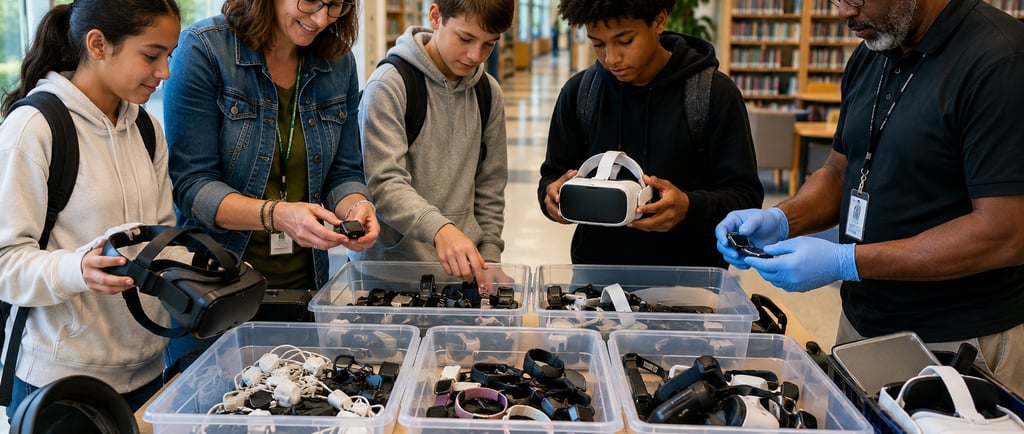
Take-back programs empower schools to become agents of positive change. By modeling how to manage device life cycles responsibly, schools not only comply with regulatory requirements but also create hands-on learning opportunities. When students participate in technology collection, witness device triage, and learn about design for repair, circularity and sustainability become tangible values, not just buzzwords.
Benefits extend beyond environmental stewardship:
Regulatory Compliance: Adhering to evolving local, state, and federal laws, especially concerning data-bearing devices and hazardous substances.
Community Trust: Visibility for green initiatives enhances goodwill and builds bridges with eco-conscious families.
Equity and Inclusion: Collected and refurbished devices can be redistributed, supporting digital access for students who might not otherwise benefit from wearable tech.
Cost Optimization: Refurbishing and reusing hardware can reduce procurement costs, and demonstrate ROI for technology investments.
Brand Differentiation: Schools seen as sustainability pioneers attract partnerships, grants, and positive media coverage.
Failing to address these responsibilities leaves schools open to compliance violations, legal risks, and public relations headaches, while missing a powerful lever for 21st-century learning.
2. Defining the Challenge: XR and Emerging Electronics Recycling
Today’s wearable technology—especially XR equipment—poses recycling challenges unparalleled by earlier generations of classroom devices. Most headsets, AR glasses, and smartwatches blend tightly integrated circuit boards, laminated displays, proprietary charging cables, and high-capacity lithium-ion batteries—none of which are easy to separate for material recovery.
Four Core Obstacles:
Complex Disassembly and Incompatibility: Products are often built to be lightweight and compact, leading to glued assemblies and non-standard parts. According to iFixit’s Repairability Index, most mainstream wearables rank below 4/10, making repair and recycling extremely labor-intensive.
Data Privacy and Security Risks: XR and wearables are often personalized, storing user credentials, health data, and even images or video. Regulatory frameworks such as FERPA, COPPA, and GDPR require schools to ensure customer and student privacy in the device disposal process.
Nonexistent or Opaque Take-Back Channels: Many leading XR brands lack local or transparent take-back programs, leaving schools and families to guess the safest end-of-life options.
Awareness Gaps: A 2023 Consumer Technology Association survey found that only 32% of American households were aware of proper e-waste recycling options.
Addressing these issues demands a conscious shift towards circularity, with schools as both implementers and role models for responsible tech stewardship.
3. Key Concepts for Circular Electronics in Schools
Understanding the foundational language of sustainable electronics management is essential. Here are the core ideas every school program should master:
XR (Extended Reality): Refers to the spectrum of immersive digital technologies—from virtual (VR) and augmented reality (AR) to mixed reality (MR)—increasingly standard in STEAM and experiential learning environments. Google Expeditions, Meta Quest, and ClassVR are among platforms now seen in classrooms.
Take-Back Program: A structured process for accepting no-longer-needed devices from students, teachers, and staff. These can be one-off events, continuous collection points, or part of end-of-year checkouts.
Electronics Recycling: The managed dismantling, material recovery, and safe disposal of electronic products. Proper e-waste recycling ensures compliance with R2 or e-Stewards standards.
Design for Repair: The procurement approach where school tech buyers prioritize devices known for accessible parts, robust documentation, and manufacturer repair support, making cost-effective lifetime management possible.
Circular Electronics: A design philosophy and management system where devices cycle through repair, reuse, and refurbishing loops—delaying or averting landfill disposal, and creating educational touchpoints throughout their life cycle.
Integrating these concepts aligns with broader sustainability goals such as the UN Sustainable Development Goals (SDGs), state green schools programs, and tech equity initiatives.
4. Framework: Designing Effective Take-Back and Recycling Programs
To institutionalize circularity, schools need actionable structures. Enter the CIRCLET Framework—a practical, school-centered approach that makes wearable take-back feasible and impactful.
Collect:
Collection succeeds when it’s convenient and visible. Integrate collection points in main offices, media centers, and during community events. Data from UK-based WRAP shows that take-back rates double when collection is combined with fun, themed drives or sustainability lessons.Identify:
Every device is different—capture model, serial, condition, and owner at intake. This supports privacy compliance and streamlines downstream decision-making.Review:
Secure data deletion is not optional. Institute a double-check protocol, using certified software or device management tools. Assess each device’s repair potential versus recycling requirements.Channel:
Partnering with certified, local recyclers and refurbishers ensures transparency. Some devices can be returned to manufacturers via Extended Producer Responsibility (EPR) programs, further leveraging the circular economy.Learn:
Sustainability is a shared journey. Involve students in poster design, impact storytelling, or STEM data analysis. Make the process part of Earth Day or recycling week curricula.Engage:
Publicize the results—use newsletters, social media, and school platforms to highlight wins. This motivates further participation and secures long-term buy-in.Track:
Data-driven iteration is crucial. Monitor participation rates, device distribution, problems encountered, and outcomes reused versus recycled. Iterate the framework annually, striving for continuous improvement.
By embedding CIRCLET principles, schools streamline responsible device management, model green policies, and elevate their brand within the community.
5. Implementation Playbook: How Schools Can Launch a Wearable Take-Back Program
A school take-back program only works when it is simple enough for families to use, safe enough for administrators to trust, and structured enough for recyclers to process without confusion. Wearables create a higher-risk category than older classroom electronics because they often contain embedded lithium-ion batteries, student-linked accounts, health data, location data, biometric-adjacent usage records, cameras, microphones, and proprietary parts. A forgotten smartwatch in a drawer may look harmless, but at scale, these devices create privacy, fire, procurement, and environmental exposure for schools.
The first step is to define the program scope. Schools should separate wearable and XR take-back from general donation bins because these devices need a higher level of intake control. A proper program should accept smartwatches, fitness trackers, VR headsets, AR glasses, mixed reality headsets, wearable sensors, controllers, charging docks, head straps, prescription inserts, external battery packs, and proprietary cables. It should also clearly exclude loose damaged batteries, swollen batteries, wet devices, unknown industrial electronics, and devices with signs of overheating unless the school has a pre-approved hazardous handling route.
The global reason for this urgency is clear. The Global E-waste Monitor 2024 reported that the world generated 62 billion kg of e-waste in 2022, equal to 7.8 kg per person, and only 22.3% was formally collected and recycled in an environmentally sound way. The same report projects e-waste could reach 82 million tonnes by 2030 if collection and recycling systems do not keep pace. For schools, this means wearable programs cannot be treated as one-off “green” events. They need to become part of annual technology governance.
A practical launch can follow a five-stage rollout.
Stage 1: Inventory Before Collection
Before asking families to bring devices in, the school should count what it already owns. This includes classroom VR kits, district-issued wearables, health and fitness devices used in PE programs, assistive technology, robotics accessories, and pilot-program devices sitting in storage closets. Many schools discover that their largest e-waste issue is not what families bring from home. It is the backlog of unsupported hardware purchased through grants, pandemic-era funding, STEM pilots, or donor programs.
Each device should be logged with:
Device type
Brand and model
Serial number, where visible
Asset tag, if school-owned
Owner category, such as school, student, family, teacher, or donor
Battery condition
Screen condition
Included accessories
Account lock status
Data wipe status
Reuse, repair, recycle, or quarantine recommendation
This inventory step prevents the most common failure: collecting boxes of mixed electronics with no chain of custody. Once mixed, broken, locked, reusable, and dangerous items become harder to separate. That raises recycler costs and lowers recovery value.
Stage 2: Build the Intake System
The intake process should be designed for speed, not complexity. A parent or student should be able to hand in a device in less than two minutes. Staff should not be expected to diagnose every item at the table. The intake desk only needs to capture the right minimum information and sort the device into the correct stream.
A strong intake flow includes four bins, each physically separated:
Reuse and refurbish: Working devices with chargers and no visible damage.
Repair assessment: Devices with cracked straps, missing cables, controller drift, charging issues, or minor physical damage.
Recycling: Devices that are obsolete, locked, incomplete, or not worth repairing.
Battery risk quarantine: Swollen, hot, punctured, crushed, wet, corroded, or burned devices.
Lithium-ion battery safety deserves special handling. The U.S. EPA advises that lithium-ion batteries and electronics containing them should not be placed in household trash or regular recycling bins. It recommends bringing them to household hazardous waste collection sites or electronics recyclers, with terminals taped and batteries bagged individually where applicable.
This matters because battery fires are no longer rare edge cases. EPA’s battery collection resources cite an analysis where 64 waste facilities experienced 245 fires caused by, or likely caused by, lithium metal or lithium-ion batteries. Wearables may be small, but a collection bin full of devices with embedded batteries can become a fire risk if crushed, shorted, or stored incorrectly.
Stage 3: Run Data Sanitization Before Reuse or Recycling
Data must be handled before any device leaves school control. XR headsets and smartwatches can hold more sensitive information than many people assume. They may include linked student accounts, app histories, saved Wi-Fi networks, cloud tokens, voice recordings, camera captures, location histories, fitness metrics, health-related usage patterns, and device management profiles.
Schools should require a documented wipe process for every data-bearing device. For district-owned equipment, this should usually happen through mobile device management tools before collection day. For family-owned devices, the school should publish device-specific reset instructions in advance. For any item that cannot be reset, the device should go to a certified recycler or IT asset disposition provider with documented data destruction capability.
This is where student privacy law becomes operational. COPPA applies to operators of websites and online services directed to children under 13, and to operators that knowingly collect personal information from children under 13. The FTC’s COPPA rule defines personal information to include individually identifiable information such as names, email addresses, and Social Security numbers. A school wearable program may not be the operator of the service, but schools still need to avoid sending devices downstream with recoverable child-linked data.
FERPA also shapes school risk. Any school-managed device that contains education records or student-identifiable information should be treated as a controlled asset until data is removed or destroyed. A 2025 Washington Post report about student records and equipment left in a Maryland school scheduled for demolition showed how quickly privacy, disposal, and public trust can collide when schools do not control records and assets during facility transitions.
The right rule is simple: no wearable, XR headset, controller, tablet-linked accessory, or storage-bearing device should leave the district without a wipe record, destruction certificate, or documented exception.
Stage 4: Select Certified Partners
Schools should avoid informal “we know a guy” recycling. Wearables contain batteries, plastics, metals, sensors, small circuit boards, adhesives, and sometimes user data. The partner must be able to handle all of that responsibly.
A qualified partner should provide:
Proof of R2v3, e-Stewards, or equivalent certification
Written data destruction process
Battery handling procedure
Insurance documentation
Downstream vendor disclosure, where available
No-landfill and no-illegal-export policy
Itemized collection report
Certificate of recycling or destruction
Reuse and donation pathway, where applicable
R2v3 is designed for electronics resellers, refurbishers, recyclers, de-manufacturers, asset recoverers, brokers, and related operators. It covers environmental performance, worker safety, final disposition accountability, and data security.
EPA also encourages electronics collection for reuse and recycling through certified recyclers and promotes public reporting of collection and recycling data through its Sustainable Materials Management electronics work. For schools, this supports both compliance and community trust.
Stage 5: Make Collection Predictable
A single Earth Day event is useful, but it is not enough. Wearables enter schools throughout the year through birthdays, upgrades, classroom pilots, sports programs, donations, special education programs, and grant-funded technology purchases. Schools should create a recurring schedule.
A strong annual rhythm looks like this:
August or September: Collect obsolete summer cleanout devices before the school year begins.
November: Run a pre-holiday device drive before families upgrade electronics.
January: Collect old devices after holiday replacements.
April: Run the main Earth Month campaign.
June: Collect devices during end-of-year checkout, locker cleanout, and tech return.
The best programs become routine. Families know when to bring devices. Teachers know where to send them. Administrators know what report they will receive. Recyclers know what volume to expect.
6. Program Governance: Policies, Roles, and Risk Controls
Wearable take-back should not sit entirely with one enthusiastic teacher or student club. It needs light governance so it survives staff turnover, budget cycles, and leadership changes. The goal is not bureaucracy. The goal is repeatability.
A school or district should assign clear ownership across five roles.
The technology lead should own asset records, data wipe procedures, device management systems, and school-owned equipment. The facilities or operations lead should own storage, movement, fire safety, and vendor pickup coordination. The sustainability lead should own reporting, environmental impact messaging, and student engagement. The privacy or compliance lead should confirm FERPA, COPPA, state privacy, and district policy alignment. The finance or procurement lead should use the findings to shape future device purchases.
This matters because the end-of-life stage exposes weaknesses created at the purchase stage. If a school buys low-cost devices with sealed batteries, proprietary charging, poor repair support, and short software life, the take-back program inherits those problems three years later. The program should therefore feed directly into procurement rules.
Schools should add circularity requirements to technology purchasing. For every wearable, XR device, or classroom electronic, buyers should ask:
Can the battery be safely replaced?
Are chargers standard or proprietary?
Is repair documentation available?
Are replacement straps, controllers, cables, and face interfaces available?
Does the manufacturer offer a take-back route?
Does the device receive security updates for the expected school use period?
Can the device be factory reset without the original owner?
Can the vendor provide recycling or refurbishment support at contract end?
Does the device use standard fasteners or glued assemblies?
Does the vendor publish repairability or environmental data?
This shifts schools from reactive recycling to responsible lifecycle management. The Ellen MacArthur Foundation defines circular economy as a system where products and materials are kept in circulation through maintenance, reuse, refurbishment, remanufacture, and recycling. In electronics, that means schools should keep working devices in use for as long as practical, then recover parts and materials when reuse is no longer viable.
Governance should also address storage. Wearables should not be left in cardboard boxes for months, especially if they contain lithium-ion batteries. Collection bins should be placed away from heat, moisture, exits, and flammable materials. Damaged devices should be separated immediately. Staff should be trained to recognize swelling, hissing, chemical smell, heat, punctures, crushed casing, corrosion, and burn marks.
For schools with larger programs, the safest setup is a locked, labeled storage cabinet in a supervised area, with collection transferred to a certified partner on a fixed schedule. The longer devices sit, the higher the risk of lost records, misplaced assets, battery problems, and accidental reuse of unwiped devices.
7. Student Learning: Turning Take-Back Into Curriculum
The best school take-back programs do more than remove waste. They turn discarded devices into a practical lesson in science, design, economics, ethics, and civic responsibility. Wearables are ideal teaching tools because students understand them. A smartwatch, VR headset, or fitness tracker feels more relevant than an abstract discussion about global waste streams.
A take-back program can support science lessons on batteries, metals, circuits, polymers, sensors, rare earth magnets, and material separation. It can support math lessons on collection rates, device weights, reuse percentages, avoided waste, and cost savings. It can support social studies discussions on mining, labor, environmental justice, repair rights, and global trade. It can support digital citizenship lessons on privacy, data deletion, passwords, and responsible ownership.
This is especially important because technology in education is no longer just about access. UNESCO’s 2023 Global Education Monitoring Report examined both the potential and risks of education technology, noting that digital tools can support learning but also require careful governance, equity, and purpose. A wearable take-back program gives schools a concrete way to connect digital learning with responsible technology use.
A strong student engagement model can include:
Student-designed collection posters and announcements
Device lifecycle mapping projects
Battery safety lessons
“Where does my smartwatch go?” classroom discussions
Repairability scoring exercises
Math projects calculating reuse versus recycling outcomes
Student sustainability ambassador teams
Parent education campaigns
STEM projects using safe, non-data-bearing components
Annual impact reports presented by students
Research also supports hands-on e-waste learning as a way to connect technical skills with sustainability. A 2025 paper on metarecycling in basic education described students using e-waste reuse processes in physics education, including building a portable battery and a bicycle-powered charger while connecting the work to the UN Sustainable Development Goals.
Schools should be careful, though. Students should not dismantle lithium-ion batteries, cracked screens, unknown circuit boards, or devices that may contain personal data. The learning value is strongest when students analyze, map, document, and design solutions, while hazardous handling stays with trained adults and certified partners.
8. Measurement: What Schools Should Track
A take-back program needs numbers. Without metrics, the program becomes a feel-good collection drive with no proof of impact. With metrics, it becomes a sustainability asset, a grant narrative, a procurement feedback loop, and a community trust builder.
Schools should track four categories: participation, material outcomes, privacy outcomes, and educational outcomes.
Participation metrics show whether families and staff are using the program. These include number of devices collected, number of participating students, number of participating classrooms, number of households reached, number of staff contributors, and collection volume by event.
Material outcome metrics show what happened to the devices. Schools should track how many were reused, refurbished, repaired, recycled, quarantined, returned to owners, returned to manufacturers, or sent for certified destruction. They should also track total weight collected, device categories, battery-containing items, and accessory recovery.
Privacy metrics show whether risk was controlled. These include number of data-bearing devices, number wiped internally, number wiped by vendor, number physically destroyed, number with certificates, number with unresolved account locks, and number rejected because data could not be cleared.
Educational metrics show whether the program changed behavior. These include number of lessons delivered, number of student projects created, number of posters or campaigns produced, number of families receiving guidance, pre- and post-campaign awareness surveys, and student reflections.
The most valuable metric is the reuse rate. Recycling is better than landfill, but reuse usually preserves more value. If 100 devices are collected and 40 can be reused after wiping, cleaning, and minor repair, the school has created a stronger outcome than sending all 100 directly to material recovery.
The second most valuable metric is the lockout rate. If many devices arrive locked to personal accounts, students and families need better pre-collection instructions. If many district-owned devices are locked or unmanaged, procurement and IT asset tracking need improvement.
The third most valuable metric is accessory completeness. A VR headset without controllers, straps, or charging cables often loses reuse value. Schools can improve outcomes by asking families to return all accessories in one bag.
At the end of each campaign, schools should publish a simple impact summary. It should say how many devices were collected, how many were reused, how many were recycled, how many pounds were diverted from improper disposal, what safety controls were used, and what students learned. EPA’s electronics guidance emphasizes safe and correct donation and recycling, including attention to what happens before donation or recycling.
9. Case Patterns: What Successful Programs Have in Common
School wearable take-back is still an emerging category, but clear patterns are already visible from broader e-waste, battery, and device reuse programs.
The first pattern is convenience. Collection points must be easy to find. Families should not need to search district websites or call the office. The best programs place collection near school entrances, libraries, tech offices, parent-teacher events, sports nights, and end-of-year checkout stations.
The second pattern is trust. Parents are more likely to donate smartwatches, headsets, and trackers when the school explains how data will be wiped, who handles the devices, and what happens next. A vague “bring old electronics” message is not enough for devices that may contain child-linked information.
The third pattern is visible impact. Students and families need to see results. “We collected 312 devices” is good. “We collected 312 devices, refurbished 74, recycled 211 through a certified partner, quarantined 9 damaged battery devices, and recovered 86 chargers for reuse” is better.
The fourth pattern is partner quality. Certified partners can produce documentation, sort devices properly, control downstream handling, and reduce school liability. Informal channels may seem cheaper, but they can create data, export, safety, and reputational risk.
The fifth pattern is procurement feedback. Schools that learn from their collection data buy better the next time. If one headset model produces high controller failure, poor battery life, or low reuse value, that evidence should shape future purchasing.
The sixth pattern is student ownership. Programs work better when students help design the campaign. A student-made message often gets more attention than an administrative reminder. Students can make the issue visible to families in a way district memos rarely do.
A useful global lesson comes from the wider e-waste discussion around school tablets. Reuters reported in 2024 that Ruediger Kuehr, who leads a UN e-waste effort, found many municipalities had not planned for the end-of-life management of large numbers of tablets distributed to students during the pandemic. The risk is that millions of school-issued devices eventually enter the e-waste stream without repair, collection, or disposal planning. Wearables and XR devices can repeat the same mistake unless districts plan end-of-life before deployment.
10. The Future: From Take-Back Events to Circular School Technology Systems
By 2026, the question is no longer whether schools should collect old wearables. The real question is whether schools can build circular technology systems before the next wave of devices arrives.
The next wave will include lighter XR headsets, AI-enabled glasses, classroom health sensors, adaptive sports wearables, location-enabled safety devices, haptic learning tools, biometric login accessories, and mixed reality science equipment. These devices will be more personal, more sensor-rich, and harder to recycle if designed without end-of-life planning.
That creates three future priorities.
First, schools need lifecycle clauses in vendor contracts. Every wearable or XR purchase should include end-of-life language. The vendor should explain repair access, parts availability, battery replacement, software update duration, take-back options, recycling support, and data deletion support. If vendors cannot answer these questions, schools should treat that as a procurement risk.
Second, schools need regional take-back networks. One school may not collect enough volume to attract the best recycler pricing or reporting. Districts, charter networks, private school associations, nonprofits, municipal recycling programs, and local colleges can coordinate collection days, shared vendors, and common reporting.
Third, schools need student-facing circular technology literacy. Students should learn that devices do not disappear when replaced. A smartwatch contains mined metals, plastics, battery chemistry, labor, transport emissions, software dependencies, and end-of-life risks. When students understand that full chain, they become better consumers, designers, engineers, and citizens.
Circular electronics will also become more tied to critical minerals. The Global E-waste Monitor 2024 reported that only 1% of rare earth element demand is currently met by e-waste recycling. That means most rare earth demand still depends on primary extraction, even while billions of discarded devices contain recoverable materials.
Schools are not metal refineries, but they are powerful collection nodes. They sit at the intersection of families, young consumers, public trust, education, and technology purchasing. If schools normalize responsible take-back, they can influence household behavior far beyond campus.
FAQ: School Take-Back Programs for Wearables
What devices should a school wearable take-back program accept?
A school program can accept smartwatches, fitness trackers, VR headsets, AR glasses, mixed reality headsets, wearable sensors, controllers, chargers, docks, cables, straps, and related accessories. The program should clearly separate damaged battery devices from normal collection items.
Should schools accept devices from families, or only school-owned devices?
Schools can accept both, but they should label the streams separately. School-owned devices need asset tracking and data wipe records. Family-owned devices need clear instructions, consent language, and a disclaimer explaining that families should remove personal data before drop-off.
Can students help dismantle wearables?
Students can help with safe learning activities, sorting non-hazardous accessories, awareness campaigns, data analysis, and lifecycle mapping. They should not open lithium-ion batteries, swollen devices, cracked battery packs, or data-bearing devices that have not been wiped.
What is the biggest risk in a wearable take-back program?
The two biggest risks are battery safety and data privacy. Embedded lithium-ion batteries can create fire risks when damaged or stored poorly. Wearables and XR devices may also contain student-linked accounts, location data, images, app histories, and other personal information.
Do schools need a certified recycler?
Yes, for any serious program. A certified electronics recycler or IT asset disposition partner can document data destruction, battery handling, recycling outcomes, downstream processing, and environmental controls. R2v3 and e-Stewards are two common standards schools can use when screening partners.
Should reusable devices be donated?
Yes, but only after data has been wiped, ownership is clear, accessories are complete, batteries are safe, and the device still receives usable software or security support. Donation without these checks can create privacy, safety, and support problems.
What should schools do with locked devices?
Locked devices should not be redistributed. The school can try to have the owner remove the account lock. If that fails, the device should go to a certified partner for parts recovery, recycling, or secure destruction.
How often should schools run take-back events?
At minimum, schools should run one annual collection. Better programs run three to five collection windows per year: start of school year, after winter holidays, Earth Month, and end-of-year checkout.
How can a small school start without a large budget?
Start with one collection week, one approved partner, one intake form, one locked storage area, and one simple report. The first goal is not volume. The first goal is to build a safe repeatable process.
What should schools report after the program?
Schools should report the number of devices collected, number reused, number repaired, number recycled, number quarantined for battery issues, total weight collected, number of data-bearing devices wiped, and student learning activities completed.
Conclusion: Schools Can Make Wearable Technology Responsible From Start to Finish
Wearables and XR devices are becoming part of modern learning, but their end-of-life impact cannot be ignored. A school that buys devices without a take-back plan is only solving the front half of the technology problem. The back half includes data deletion, battery safety, repair, reuse, recycling, family education, and vendor accountability.
A strong school take-back program gives districts a practical way to manage that responsibility. It reduces landfill risk, protects student data, improves battery safety, recovers reusable devices, supports digital access, and turns sustainability into something students can see and measure.
The larger lesson is simple. Schools should not treat old wearables as junk. They should treat them as unfinished learning material, recoverable value, and a test of responsible technology leadership. The districts that build these systems now will be better prepared for the next generation of classroom devices, from AI glasses to mixed reality labs. They will also teach students a lesson that lasts longer than any single device: technology has a lifecycle, and responsible users plan for the whole thing.
Connect
Your trusted partner for scrap metal procurement.
CONTACT
About
haroon@tdcventures.com
+1-307-655-7593
© 2025. All rights reserved.
NEWSLETTER