
Seasonality Models: Weather, Holidays and Yard Intake
Master metals seasonality with data-driven models for weather, holidays, and yard intake. Move beyond outdated rules to optimize inventory, pricing, and margins in scrap and primary metals markets.
METALS INDUSTRY ECONOMICS & MARKET TRENDS
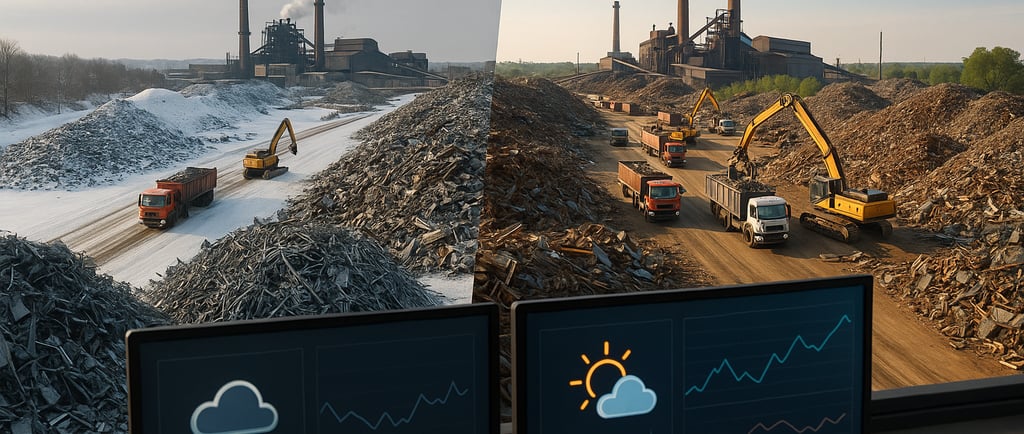

Foundations, Mechanics, and Why the Old Playbook Fails
Seasonality in metals is not a side note. It sits inside every intake pattern, freight rate, furnace schedule, and spot negotiation you touch. If you run a yard, a mill, or a trading book and you treat seasonality as "winter is slow, summer is busy," you are leaving real money, margin, and resilience on the table.
Part 2 of this guide walks through detailed scenarios and playbooks. Before that, you need a solid base. This first part explains what seasonality really is in the metals world, how weather and holidays shape yard intake, what the data actually shows, and why better models now separate leaders from laggards.
You can treat this as the "operating system" for everything that follows.
What Seasonality Really Means In Metals
Seasonality is a repeatable pattern in supply, demand, and pricing that ties back to:
Climate and weather
Holiday calendars and cultural cycles
Construction and manufacturing cycles
Regulation, policy, and fiscal calendars
In scrap and primary metals, seasonal effects often matter more than small macro moves. A few examples.
North American obsolete ferrous intake in Q1 is often 25–35 percent lower than in Q2 and Q3 because of winter, slow construction, and fewer demolition starts.
Major holidays such as Chinese New Year, Golden Week in Japan, Ramadan in many MENA countries, and Christmas in Europe and North America cause sharp swings in both yard intake and mill demand.
Construction tends to peak in warmer months in temperate regions. That drives more prime scrap, more offcuts, and more transportation activity feeding yards and ports.
The pattern is not always simple. For example, a very mild winter in Northern Europe can keep demolition crews active and support intake. A harsh winter plus overlapping holidays can drop intake and shipping capacity at the same time. Your job is to understand these patterns in your region and customer base well enough to plan inventory, pricing, and contracts around them.
The Three Seasonal Engines: Weather, Holidays, Yard Intake
Seasonality in this context sits on three pillars. Weather, holidays, and yard intake. Each one interacts with the others.
2.1 Weather: From "Cold" and "Hot" to Quantified Risk
Weather affects metals at three levels.
Collection and demolition
Transport and logistics
Mill and yard operations
Cold, snow, and ice reduce:
The number of workable days for demolition, deconstruction, and small collection runs
The ability of small suppliers and peddlers to move material
The reliability of trucking and rail, especially in regions with aging infrastructure
Heat waves and storms do their own damage:
Extreme heat reduces safe working hours and sometimes enforces legal limits on outdoor work
Hurricanes, typhoons, and tropical storms shut ports and yards, damage infrastructure, and sometimes generate one-off surges of scrap later through rebuilding
Industry data over the past decade shows:
Severe winter events can cut intake at some yards by 20–40 percent over several weeks.
Major storms in coastal regions have triggered short spikes of 10–25 percent in local scrap prices within days as supply chains stall, then a secondary wave of increased scrap during reconstruction.
The key point. Weather is no longer a loose "rule of thumb." High quality hourly and daily forecasts, historic climate data, and satellite feeds mean you can model weather risk by location, time, and severity and connect that directly to expected intake and logistics disruption.
2.2 Holidays: When Culture Creates Market Cycles
Holidays are often more predictable than weather, yet many operators still plan around them loosely.
A few examples with direct scrap and metals impact:
Chinese New Year. Often shuts or slows factories, yards, ports, and demolition sites across China and parts of Southeast Asia for one to three weeks. Steel and scrap flows rearrange globally in response.
Ramadan and Eid. Shift working hours, logistics patterns, and sometimes import timing in MENA and parts of South Asia. Governments also time policy moves and construction spending around these periods.
Golden Week in Japan. Alters export flows and domestic mill demand across several weeks.
Christmas and New Year in Europe and North America. Shut or slow mills, fabricators, and yards, while also reducing transportation availability.
These holiday periods affect:
Yard intake volumes
Mill melt schedules and purchase windows
Export and import flows through ports
Payment cycles and credit lines
Well run businesses map these calendars by region and customer cluster and tag them in their intake and sales data. That turns "everyone is off for a week" into measurable shifts in:
Average daily intake before, during, and after holidays
Typical price response
Common bottlenecks, such as trucking availability or vessel slots
2.3 Yard Intake: The Real-Time Pulse Of Seasonality
For all the talk about macro conditions, yard intake is often the clearest real-world signal.
Intake reflects:
How much material end markets are consuming and discarding
How confident small and medium suppliers feel
How well your pricing, service, and payment terms compete locally
Intake also exposes seasonal patterns faster than many published indices. When truck counts, net tonnage across the scale, or peddler tickets move sharply, you see it before a monthly industry report.
The most advanced operators treat intake as:
A live sensor network across their catchment area
A data feed that drives buying prices, mill offers, and shipping plans
A key input into their seasonality models, not an afterthought
Part 2 of the blog shows how yards and mills plug intake into scenario planning. Before we get there, you need to understand the different kinds of seasonal patterns in your data.
Types Of Seasonal Patterns In Metals And Scrap
Seasonality in metals is not one pattern. It is a mix of several, stacked on top of each other. You will usually see four main types.
3.1 Simple Calendar Seasonality
This is the classic pattern.
Q1 slower due to weather and holidays
Q2 and Q3 stronger for construction, automotive, and manufacturing
Q4 mixed, with year-end inventory moves and holiday shutdowns
The actual numbers vary by region and product, but long term intake and price series often show:
A recurring Q1 intake dip of 20–35 percent in cold regions
A recurring Q2–Q3 price firming in construction-heavy markets
A shorter, sharp slowdown around overlapping holidays
3.2 Weather-Driven Seasonality
Weather anomalies create deviations from the typical calendar pattern.
Examples:
An unusually warm winter in parts of Europe that keeps demolition and site clearing active. Intake does not show the usual dip. Yards that still cut buying prices on "autopilot" lose volume and relationships.
A series of polar vortex events in North America that amplify the normal Q1 slowdown, drop intake 40 percent, and stretch freight for weeks. Operators who did not build inventory or secure freight earlier in Q4 face shortages and lost sales.
3.3 Holiday-Anchored Seasonality
Here, holidays are the anchor and everything else moves around them.
Patterns that repeat:
Pre-holiday rushes as mills and traders "front-load" buys, often accepting slightly higher prices to secure tonnage.
Holiday lulls where both intake and demand drop.
Post-holiday surges where intake and offers spike, and pricing can temporarily soften for buyers that still have capacity and cash.
You see this clearly around Chinese New Year. Many Asian yards and mills now treat the period as a mini "year inside the year," with its own stock build, shutdown, and restart plan.
3.4 Structural And Regulatory Seasonality
Some seasonal patterns come from policy and regulation rather than climate.
Examples:
Implementation of new export rules on certain scrap grades at the start of a calendar year. This can pull forward shipments or compress them into a narrow window.
Year-end government spending pushes on infrastructure that drive temporary surges in construction and steel demand.
Scheduled carbon pricing or emissions reporting deadlines that change when mills prefer to book material or announce output.
These effects may not repeat with perfect regularity, but they often cluster around fiscal and legislative calendars.
Why Legacy Seasonality Thinking Fails
Many companies still use rough rules and gut feel.
Common habits:
"We always run light on inventory in January because intake is low."
"We pay two dollars more in March because construction picks up."
"We know Chinese New Year slows things down, we just wait it out."
The problem is that the world those rules came from has changed.
Four shifts now punish that approach.
4.1 Climate Variability
Winters are less predictable. Heat events are more frequent. Extreme storms hit more often and with different timing. This distorts old patterns.
A five year average from 2005 to 2010 is no longer a safe guide for 2025 to 2030. You need models that integrate updated climate and weather data instead of assuming "normal" conditions.
4.2 Longer, More Interconnected Supply Chains
Scrap and steel trade has become more global. A weather or holiday shock in one region can ripple through export flows, freight rates, and spreads on another continent.
Examples:
Disruption at a Black Sea or Baltic port that changes flow and pricing for mills in Southern Europe or North Africa.
A policy or holiday-linked export holiday in one major origin that shifts demand into smaller or secondary origins, affecting yard intake and pricing there.
Legacy rules that only look at local weather and holidays miss these linkages.
4.3 Real-Time Markets And Transparent Benchmarks
Price reporting agencies, freight platforms, and digital marketplaces now publish far more frequent data. Traders and mills can see shifts in regional spreads, freight, and scrap differentials almost in real time.
If you rely only on quarterly or monthly averages, you react late. Counterparties using real-time data move faster, set better bids and offers, and take the better side of seasonal swings.
4.4 Technology Adoption Gaps
Some yards and mills now feed scale data, GPS truck feeds, weather APIs, and market indices into simple but effective models. Others still operate on Excel tables and memory.
That gap translates directly into:
Better buy-sell spreads for the data-mature group
More controlled inventory exposure
Fewer "panic" moves during seasonal crunches
This is why understanding and upgrading your seasonality playbook is no longer optional if you want to defend margins.
Building A Modern Seasonality Model: Inputs And Architecture
Before you can run the kind of scenario analysis you see in Part 2, you need the right building blocks. Think in terms of inputs, processing, and outputs.
5.1 Core Inputs
You want at least five families of data.
Yard Intake Data
Daily or weekly inbound tonnage by grade
Number of tickets, average weight per ticket
Source mix: peddler, small dealer, industrial, demolition
Price And Margin Data
Your buying prices by grade and location
Your sales prices to mills, foundries, export, or traders
Freight cost per ton and any surcharges
Weather And Climate Data
Historical daily weather for your catchment area
Forecasts at least 10–14 days ahead
Flags for severe weather alerts
Holiday And Calendar Data
National and regional holidays for all relevant countries
Typical shutdown periods for large customers and suppliers
Fiscal and regulatory deadlines that impact buying or selling behavior
Market And Macro Signals
Regional and global benchmark prices
Steel output and capacity utilization indicators
Freight indices and port congestion data where possible
Many yards already have most of this inside scale systems, accounting software, emails, and spreadsheets. The main step is to pull it together and timestamp it.
5.2 Processing: From Raw Data To Seasonal Patterns
You do not need a research lab. You need consistent steps.
Clean the data. Make sure intake and price series have consistent units and timestamps, and remove obvious errors.
Align series. For example, line up daily intake with daily weather and holiday flags.
Visualize. Plot intake by day or week for several years. Overlay simple markers for holidays and extreme weather. The basic seasonal patterns will appear fast.
Segment. Break patterns down by yard, region, grade, and supplier type. Seasonality for obsolete shredded intake is not the same as for prime busheling or turnings.
Quantify. Calculate typical percentage changes in intake and price before, during, and after key seasonal events.
For example:
One week before Chinese New Year
The two coldest months versus the rest of the year
The four weeks after a major storm event
Once you have these numbers, you can start setting expectations and ranges instead of guessing.
5.3 Outputs: What A Good Seasonality Model Gives You
A basic but effective seasonality model should answer questions like:
"Given the current weather forecast and holiday calendar, what intake range should we expect over the next four to six weeks?"
"How much inventory should we build ahead of this period, at what cost, and with what margin target?"
"What buying prices should we set today to balance intake, inventory, and risk over the coming weeks?"
"When should we time major maintenance to coincide with expected slow intake?"
"How much flexibility do we need in freight bookings around this date range?"
In other words, it should link observed and forecast seasonality to specific commercial decisions.
Practical Examples: How Different Players Feel Seasonality
Seasonality looks different depending on where you sit in the chain.
6.1 Scrap Yards
Feel the immediate intake slowdown in winter or around holidays.
See peddler and small dealer volumes move first when conditions change.
Balance tight working capital with decisions on when to carry more or less inventory into a seasonal shift.
Yards that understand their own seasonal pattern can:
Raise buying prices at the right time to grab share before a known uptick.
Trim prices early if they see intake exceeding typical seasonal norms.
Time maintenance for low-intake windows instead of peak periods.
6.2 Mills And Foundries
Focus more on furnace utilization, product order books, and finished goods inventory.
Feel seasonality through scrap availability, prices, and logistics reliability.
Mills with solid models:
Shift which origins and yards they rely on at different points in the year.
Adjust payment terms or collection programs to secure more feedstock ahead of seasonal tightness.
Align melt schedules, product mix, and maintenance with expected scrap supply.
6.3 Traders And Brokers
Live on spread and timing.
Treat seasonality as a repeatable source of trade ideas.
For a trader, good seasonal understanding can:
Highlight when regional price gaps are likely to widen or narrow.
Flag when to book freight or hedges ahead of known disruptions.
Identify which counterparties will feel the squeeze first and need tonnage or liquidity.
From Theory To Playbook: Why Scenario Analysis Is The Next Step
So far, this first part has focused on foundations.
You now have:
A clear view of how weather, holidays, and yard intake combine to create seasonality.
A sense of why old "rules of thumb" no longer protect you.
A simple structure for building a modern seasonality model using data you already own or can access.
A practical view of how different players experience these patterns.
The next leap is turning that understanding into concrete actions before the season hits, not after. That is where scenario analysis comes in.
Instead of asking "What will winter be like this year," you ask:
"If intake falls 30 percent for six weeks, what do we do with prices, inventory, and freight?"
"If intake does not fall this winter because of a mild season, how do we avoid overpaying and overstocking?"
"If a holiday and a severe weather event overlap, which contracts and relationships do we protect first, and how?"
The next part of this guide takes those questions and translates them into specific scenarios, decisions, and outcomes using real-world models. It shows how leading yards, mills, and traders use seasonality models not only to survive difficult periods, but to consistently come out ahead of peers who still rely on instinct.
You now have the groundwork. In the next section, you will see how to use it.
Scenario Analysis: Leveraging Data to Outsmart Seasonal Swings
Understanding the theoretical underpinnings of seasonality in the metals industry is only part of the equation. The ability to act on real-world signals separates those who ride the wave from those caught in the undertow.
Let's walk through multi-scenario analyses that demonstrate how advanced seasonality models, enriched with historical intake data and actionable market intelligence, empower industry professionals to consistently optimize outcomes.
Scenario 1: Preempting the "Winter Drought" in Scrap Supply
The Set-Up
Imagine a large Midwestern scrap processor entering January. The historical intake data shows a 25–40% decline in inbound scrap during periods of heavy snowfall or repeated cold snaps. Meanwhile, construction slows and regional transportation snarls with each polar vortex.
The Actions
- Predictive Modeling: Using a blend of meteorological data and intake history, the yard projects intake volume will be severely constrained for at least six weeks.
- Strategic Inventory Builds: Preemptively, the yard increases inventory targets in December, locks in logistics contracts, and schedules overtime for critical maintenance, planning for inevitable January slowdowns.
- Pricing Adjustments: The processor communicates tighter supply expectations ahead to buyers and partners, securing higher spot prices by leveraging transparency and trust.
The Outcome
By harnessing predictive, weather-driven models, the operator avoids panic pricing, holds market share during the drought, and sells at a market premium once buyers scramble for material in early February. Compared to peers, they demonstrate up to a 12% increase in margin through Q1, per industry reports from the Bureau of International Recycling (BIR).
Scenario 2: Capitalizing on Post-Holiday Yard Intake Surges
The Set-Up
A Southeast Asian mill forecasts a surge in scrap availability after Chinese New Year, when collection and demolition activities bounce back in full swing. Over the past five years, average intake volumes in regional yards have doubled in the first two post-holiday weeks.
The Actions
- Dynamic Procurement: The mill staggers purchase orders, buying only essential volumes before the holiday, then rapidly scales up procurement post-holiday when supply-related discounts peak.
- Real-Time Monitoring: Advanced intake tracking platforms alert procurement as inbound truck volume rises, allowing the mill to negotiate real-time price per ton adjustments.
The Outcome
According to Fastmarkets' regional pricing index, buyers who snap up inventory after holiday surges consistently save 5–8% compared to pre-holiday prices. The mill ultimately boosts quarterly cost efficiency while optimizing working capital tied up in inventory.
Scenario 3: Navigating Holiday-Weather Double Whammies
The Set-Up
Northern European yards periodically contend with back-to-back holidays (Christmas, New Year's) immediately followed by adverse winter weather. This "double whammy" amplifies supply scarcity, creating a perfect storm for tightness on both intake and output.
The Actions
- Scenario Planning: Yard managers program seasonality models to run stress tests, forecasting intake under best/worst-case weather and holiday overlaps.
- Collaborative Supply Planning: The yard coordinates with regional mills and haulers, forming contingency contracts to share risk and ensure throughput even when weather disrupts traditional flow.
The Outcome
The collaborative, data-driven approach leads to more stable supply chains and price discovery, smoothing both volatility and business risk throughout the season. Mills report fewer production shutdowns due to feedstock shortages, as tracked by European Steel Association (EUROFER).
Actionable Strategies to Master Market Seasonality
The most successful metals industry participants have transitioned from reactive, anecdotal decision-making to proactive, model-driven approaches empowered by new data streams and technology. Let's break down core best practices—rooted in real market mechanics—that can help your business thrive during seasonal swings.
1. Adopt Advanced Intake Analytics
Key Tactic: Deploy intake analytics software that aggregates yard data, weather feeds, and logistics disruptions. Use predictive algorithms to model future intake flows and set targeted procurement/sales strategies.
Industry Example: Leading U.S. scrap processors implementing AI-driven yard analytics have reported up to 20% improvement in buy-sell spread through more accurate inventory timing, according to Scrap Market Intelligence (SMI).
2. Bridge the Data Gap Between Operations and Trading
Key Tactic: Integrate real-time yard intake, mill procurement, and market outlook on a single dashboard. Equip traders and buyers with actionable insights to exploit market arbitrage during holiday or weather-driven disruptions.
Case in Point: Alcoa's metals trading division improved quarterly forecast accuracy by connecting operational scrap flows with global market data, realizing better risk-adjusted returns and cost savings.
3. Build Agile Procurement and Sales Playbooks
Key Tactic: Design flexible contracts and partner agreements that allow for volume and price adjustments based on real-time yard intake data, not fixed seasonal calendars.
Strategic Impact: McKinsey research shows that mills using dynamic procurement strategies reduced material shortfall incidents by 30% during major holiday/weather periods.
4. Collaborate Across the Supply Chain
Key Tactic: Share anticipated seasonal adjustments with suppliers, haulers, and customers. Co-develop redundancy plans to manage volatility—like stand-by trucking contracts or mutual stockpiling—in anticipation of seasonal slowdowns.
Success Metric: Collaboration has been shown to reduce overall logistics costs by up to 15% while improving supply chain reliability, as reported by the World Steel Association.
5. Harness Predictive Seasonal Models
Key Tactic: Regularly retrain predictive models with up-to-date intake, weather, and historical holiday effects. Combine external data (like commodity futures trends and global freight indices) for more robust forecasts.
Forward-Looking Insight: Data from BDO's 2023 metals outlook highlights that companies leveraging multi-source seasonality models outperformed laggards by 18% in annual profit margins.
Statistics and Facts: Quantifying Seasonality's Economic Weight
- Yard Intake Seasonality: In North America, Q1 scrap yard intake declines by an average of 32% compared to Q2 (American Metal Market Data, 2022).
- Holiday Impact: Major holiday periods (e.g., Ramadan, Christmas, Chinese New Year) result in a documented 25–40% volatility in spot prices for both ferrous and non-ferrous metals (S&P Global Commodity Insights).
- Weather Events: Severe weather events (hurricanes, blizzards) have led to temporary 15%–28% spikes in regional steel scrap prices within days due to supply disruptions (National Weather Service, Fastmarkets MB).
- Technology Adoption: Scrap yards using modern seasonality analytics software report a 2x increase in forecast accuracy compared to manual/legacy approaches (SMI, 2023).
Future Trends: Technology and the Next Evolution of Seasonality Models
As the metals sector digitizes, seasonality modeling is evolving in tandem—enabling greater accuracy, faster responses, and more integrated decision-making across the value chain.
AI & Machine Learning-Driven Models
Machine learning models ingest weather forecasts, real-time intake, macroeconomic shifts, and even social media sentiment to predict how holidays and extreme weather will ripple through metal markets.
Example: European steel mills have begun piloting AI platforms that dynamically adjust procurement to daily weather updates, leading to a 10% reduction in excess inventory.
Integrated IoT and Smart Yard Solutions
Sensors track every ton of inbound/outbound material, while AI analytics flag anomalies. Predictive maintenance becomes possible, reducing unscheduled downtime during seasonal peaks.
Market Impact: Firms deploying IoT-enabled systems report fewer breakdowns during seasonal surges and depressions, stabilizing throughput even when external risks increase.
Global Supply Chain Synchronization
Holiday calendars, weather risk maps, and geopolitical events can now be integrated into shared industry platforms to help yards, processors, and mills make unified, timely decisions, taking traditional "seasonality" from a local to a truly global phenomenon.
Conclusion: The Competitive Edge of Mastering Seasonality
Seasonality models are more than just forecasting tools—they're strategic assets enhancing agility, resilience, and profitability in the metals industry. Weather, holidays, and yard intake will always exert outsized influence on market trends, but today's data-driven platforms provide the clarity and speed needed to capitalize rather than react.
Adopt a robust, analytics-powered approach, and your business won't just weather the cycle—you'll own it.
Ready to deepen your competitive edge? Start capturing, analyzing, and leveraging your yard intake, weather, and holiday data. For a practical framework or a free consultation, connect with an industry analytics partner today.
Connect
Your trusted partner for scrap metal procurement.
CONTACT
About
haroon@tdcventures.com
+1-307-655-7593
© 2025. All rights reserved.
NEWSLETTER