
Shelter Cooling with Passive Metal Design
Discover how passive metal design—using reused steel, reflective roofing, and smart ventilation—creates cool, circular shelters that protect displaced people from extreme heat without relying on air conditioning.
CLIMATE MIGRATION & CIRCULAR INFRASTRUCTURE PLANNING
Instant Summary
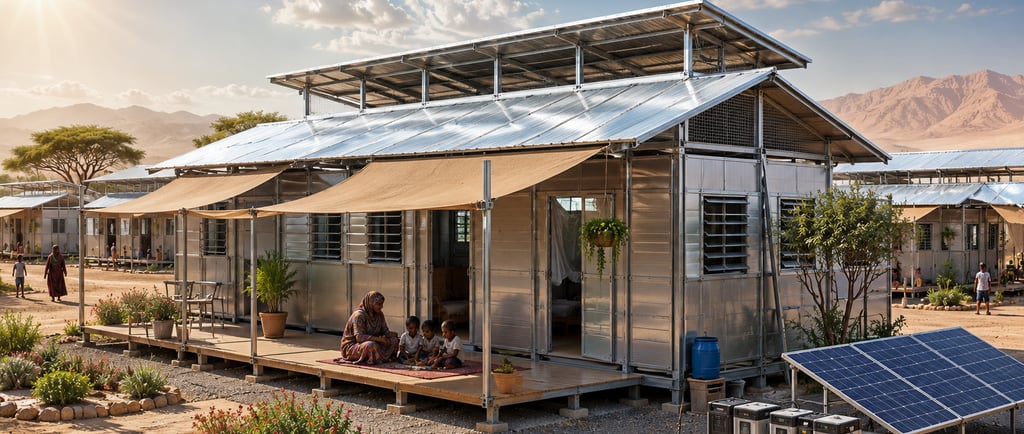
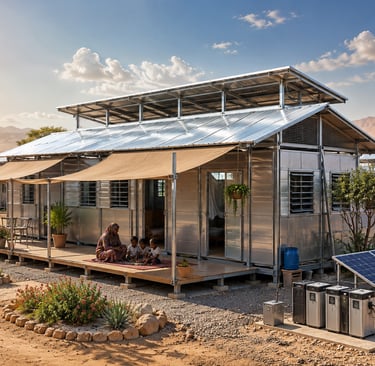
Passive metal design uses reused steel frames, reflective roofing, ventilated wall and roof assemblies, shaded openings, and microgrid-ready detailing to reduce dangerous heat inside emergency and relocation shelters without depending on air conditioning. In 2026, this matters because heat is now a shelter safety issue, not a comfort upgrade. Climate-linked displacement, longer heat seasons, weak grid access, and rising cooling demand are forcing humanitarian teams, municipal planners, shelter manufacturers, NGOs, and circular infrastructure specialists to rethink how fast-built shelters are designed, reused, cooled, powered, and maintained.
A well-designed passive metal shelter does three jobs at once. It protects people from extreme heat. It reduces fuel, generator, and grid dependence. It keeps valuable steel, panels, fixings, vents, shade systems, and wiring pathways in productive use across multiple deployment cycles. The result is a shelter model that can move from emergency response to planned relocation, then to reuse, resale, local repair, or material banking instead of becoming waste after one crisis.
Table of Contents
Context: Why Passive Metal Cooling Matters for Shelter Designers
The Challenge: Heat Risk in Migrant and Emergency Shelters
Key Definitions: Passive Cooling, Reused Steel, Microgrids, and Circular Infrastructure
Core Model: Designing Humane, Circular Shelters with Passive Metal Cooling
Step-by-Step Example: Deploying Refurbished Steel Shelters in High-Heat Zones
Implementation Playbook: From Planning to Onsite Deployment
Performance Measurement and QA: Scorecard and Metrics
Pattern Scenarios: Lessons from Shelter Operations
FAQs: Passive Metal Shelter Cooling in Practice
Competitive Differentiation: Closing Likely Gaps
Strategic Positioning: Turning Passive Cooling into a Long-Term Advantage
Conclusion: The Future of Shelter Cooling Is Passive First, Circular by Design
Context: Why Passive Metal Cooling Matters for Shelter Designers
Shelter design is entering a harsher climate reality. Heat is no longer a seasonal inconvenience that can be handled with fans, bottled water, and advice posters. It is now a direct threat to human survival, especially for people living in tents, thin-walled cabins, informal settlements, containerized units, and other fast-built shelters with limited insulation and unreliable electricity.
Between 2000 and 2019, studies cited by the World Health Organization estimated roughly 489,000 heat-related deaths each year, with 45 percent occurring in Asia and 36 percent in Europe. That figure matters for shelter design because displaced people often live in exactly the conditions that make heat more dangerous: overcrowding, low shade, poor ventilation, limited water access, poor health services, weak electricity, and restricted ability to move somewhere cooler.
The climate signal is also clear. The World Meteorological Organization reported that 2015 to 2025 were the hottest 11 years on record. It also reported that 2025 was the second or third hottest year on record, about 1.43°C above the 1850 to 1900 average. The previous year, 2024, remained the hottest year on record at about 1.55°C above the pre-industrial baseline. That means shelter teams are not planning for a distant future. They are designing inside a present-day heat emergency.
At the same time, climate migration and disaster displacement are growing in operational importance. The World Bank has projected that climate change could force up to 216 million people to move within their own countries by 2050 without strong climate and development action. The Internal Displacement Monitoring Centre reported that disasters triggered 45.8 million internal displacements in 2024, with weather-related events accounting for nearly all disaster displacement. South Asia alone saw disaster displacement nearly triple in 2024 to 9.2 million movements.
This creates a design problem that standard shelter models cannot solve on their own. Emergency shelters need to be quick, cheap, repairable, transportable, and safe. Climate relocation shelters need to last longer, connect to services, protect public health, and avoid locking host communities into wasteful infrastructure. Passive metal design sits between these two needs. It uses durable metal systems, especially reused steel, but changes how those systems behave under sun, wind, dust, humidity, rain, and repeated relocation.
The old logic was simple: build fast now, fix comfort later. That logic fails in extreme heat. A thin metal shelter with no shade and no airflow can become hotter than the outside air. A container-style unit placed in full sun can trap radiant heat. A tent with poor ventilation can become dangerous for infants, older adults, pregnant women, people with cardiovascular disease, and people taking medications that affect hydration or thermoregulation. If cooling depends only on powered equipment, the shelter becomes vulnerable to fuel shortages, generator failure, grid outages, battery theft, and late procurement.
Passive metal design reverses that dependency. It treats the shelter envelope as the first cooling system. The roof reflects heat before it enters. The shade layer blocks direct solar gain. The wall and roof cavities move hot air out. The vents are sized and placed for cross-breeze. The openings are shaded so people can keep air moving without turning the shelter into a solar oven. The frame is reused, traceable, repairable, and built for redeployment. The shelter can later accept solar panels, battery systems, DC fans, LED lighting, phone charging, or cold-chain support without being rebuilt from scratch.
For governments, NGOs, and modular builders, this shift is practical. Passive cooling cuts operating costs, lowers peak electricity demand, reduces reliance on diesel, and improves safety even before microgrids arrive. It also helps procurement teams justify better materials because the shelter is no longer a disposable item. It becomes an asset that can move across emergencies, camps, return areas, worker housing, clinics, schools, and relocation sites.
The Challenge: Heat Risk in Migrant and Emergency Shelters
Extreme heat inside emergency shelters is dangerous because it compounds every other vulnerability. People do not experience heat as an isolated weather event. They experience it while sleeping in crowded spaces, waiting for water, caring for children, recovering from trauma, queuing for documents, cooking near shelters, walking long distances, and managing illness with limited clinical support.
In many hot-weather response settings, the shelter itself becomes part of the hazard. Metal roofs and walls absorb solar radiation during the day, then release heat into the living space. Dark roofing, low roof height, poor air gaps, sealed openings, overcrowding, and dense shelter spacing can turn a temporary structure into a heat trap. At night, retained heat prevents recovery sleep. That matters because night-time cooling is one of the body's main ways to recover from daytime heat exposure.
The risk is worse in displacement settings because energy access remains limited. UNHCR's Clean Energy Challenge notes that more than 90 percent of refugees living in rural areas have very limited access to modern, reliable, and clean energy. That means conventional cooling plans often fail at the first operational test. Air conditioners need stable power. Fans need wiring, batteries, or generators. Diesel needs transport, storage, security, maintenance, and money. In a crisis, all of those can break down.
The global cooling trend adds more pressure. The International Energy Agency has warned that, without stronger efficiency action, energy demand from space cooling could more than triple by 2050. It also projected that the global stock of air conditioners in buildings could rise from 1.6 billion to 5.6 billion by 2050. That trajectory cannot simply be copied into humanitarian response. Camps, relocation sites, and informal settlements cannot wait for full grid expansion before shelters become survivable.
Heat risk also has a labor dimension. Humanitarian staff, local contractors, camp workers, health teams, WASH teams, security teams, and community volunteers must work inside and around these structures. When internal shelter temperatures rise, health posts slow down, distribution points become unsafe, school spaces close, and community services shift to early morning or late evening. A shelter that cannot stay usable during peak heat weakens the whole operation.
There is also a gender and protection dimension. If shelters are too hot during the day, people may sleep outdoors at night. That can increase exposure to harassment, theft, assault, snakes, insects, and poor air quality. Women and girls may face greater safety risks when they need to move at night for water, sanitation, or cooler air. Older adults and people with disabilities may not be able to relocate themselves to shaded communal areas. Passive cooling is therefore connected to dignity, protection, and inclusion.
The construction sector has its own problem. Fast-built shelters often use virgin materials, single-use components, ad hoc sizing, and non-standard fixings. After a camp closes or a relocation site shifts, damaged panels and frames may be abandoned, burned, dumped, or sold informally. This wastes embodied carbon and makes future response more expensive. Steel is valuable, durable, and recyclable, but it only supports circular infrastructure when it is designed for disassembly, labeling, repair, and redeployment.
The practical challenge is not simply how to cool one shelter. It is how to create a repeatable shelter system that works under heat, moves across sites, uses fewer new materials, stores well, repairs locally, supports future electrification, and gives procurement teams clear performance evidence.
Key Definitions: Passive Cooling, Reused Steel, Microgrids, and Circular Infrastructure
Passive Cooling
Passive cooling means reducing indoor heat without relying mainly on powered mechanical cooling. In shelter design, this includes solar orientation, high-reflectance roofing, shaded walls and openings, ventilated roof cavities, raised floors, cross-ventilation, stack ventilation, insulation, radiant barriers, cool surfaces, light-colored finishes, and site planning that preserves airflow. Passive cooling does not mean "no technology." It means the first layer of cooling comes from physics, materials, layout, and building form.
Passive Metal Design
Passive metal design applies those principles to metal shelters. It accepts that metal is strong, modular, familiar to contractors, and useful in rapid assembly, but it refuses to let metal act as an uncontrolled heat sink. The design goal is to keep solar heat off the metal where possible, reflect it where exposed, ventilate the cavities where heat builds up, isolate hot surfaces from occupants, and make parts reusable after the deployment ends.
Reused Steel
Reused steel refers to structural frames, purlins, panels, brackets, columns, roof sheets, doors, window guards, and other steel components recovered from demolition, industrial surplus, temporary works, decommissioned buildings, warehouses, logistics assets, or previous shelter deployments. Reused steel is different from recycled steel. Recycling melts material down and remakes it. Reuse keeps the component closer to its original form. That can preserve more value, avoid new production impacts, and reduce procurement lead times when quality control is strong.
The carbon logic is significant. Steel production is carbon-intensive. Reusing a steel section can avoid a large share of the emissions tied to making a new section, especially when the component can be inspected, cleaned, cut, drilled, coated, and recertified for a non-critical or low-rise shelter application. The exact saving depends on the product, origin, transport distance, and replacement assumption, but in shelter programs, the bigger point is simple: a reusable frame that serves five deployments is a different asset than a disposable frame that serves one.
Solar Reflectance Index (SRI)
Solar Reflectance Index, or SRI, measures how well a surface rejects solar heat. A high-SRI surface stays cooler under sunlight than a low-SRI surface. Cool Roof Rating Council guidance explains that higher SRI roof surfaces return more solar energy to the atmosphere and can improve occupant comfort while reducing air-conditioning use. For shelters, SRI is useful because roof temperature is often the dominant heat source. A light, reflective roof can lower surface temperature, reduce radiant heat into the shelter, and make interior conditions safer.
Microgrids
Microgrids are local power systems that can operate with or without the main grid. In displacement and relocation settings, they often combine solar panels, batteries, charge controllers, distribution wiring, metering, and sometimes diesel backup. Microgrid-ready shelter design does not require every shelter to receive panels on day one. It means the shelter already has safe routing paths, mounting points, junction boxes, battery-safe zones, earthing points, low-voltage options, and maintenance access. That saves time when funding, equipment, or grid support arrives later.
Circular Infrastructure
Circular infrastructure is a way of designing buildings, services, and site systems so they can be reused, repaired, moved, adapted, or recycled with less waste. In shelter cooling, circular infrastructure means every cooling element should have a second life plan. Shade nets should be removable. Reflective panels should be replaceable. Steel frames should be tagged. Vents should use standard sizes. Coatings should have maintenance intervals. Fasteners should be accessible. Damaged parts should be repairable by local teams. The shelter should not be a black box. It should be a kit of known assets.
Thermal Comfort
Thermal comfort is the condition where people can remain in a space without dangerous heat stress or unacceptable discomfort. In emergency shelters, the goal is not hotel comfort. The goal is survivability, sleep, protection, privacy, safe caregiving, and basic daily function. A shelter does not need to feel cold to be successful. It needs to avoid dangerous heat buildup, reduce radiant heat, keep air moving, and provide recovery during the hottest hours and at night.
Core Model: Designing Humane, Circular Shelters with Passive Metal Cooling
A strong passive metal shelter model should be built around six design pillars: site, skin, shade, airflow, assets, and future power. Each pillar solves a specific failure point seen in hot-weather shelter operations.
The First Pillar: Site
The first pillar is site. A shelter that is well designed on paper can fail when placed in dense rows with no shade, no wind path, and reflective ground around it. Site planning should start with sun path, prevailing wind, drainage, dust, access roads, fire spacing, WASH location, clinic location, and expansion zones. In hot climates, the spacing between shelters is not empty land. It is part of the cooling system. Narrow gaps trap heat and block airflow. Wider shaded lanes allow breezes to pass, reduce radiant load, and make public movement safer.
The Second Pillar: Skin
The second pillar is skin. The shelter envelope should block, reflect, or release heat before it reaches occupants. High-SRI roof coatings, light-colored exterior panels, ventilated double roofs, insulated liners, radiant barriers, and low-conductivity breaks between exterior metal and interior surfaces can all help. Research on cool roof coatings has found large reductions in roof surface temperature under hot conditions. One 2025 experimental study reported cool roof coating surface temperature reductions ranging from at least 8.7°C to 34.2°C across tested products. That scale of reduction is especially important for thin shelter roofs because roof heat can dominate daytime indoor heat gain.
The Third Pillar: Shade
The third pillar is shade. Shade is often the cheapest cooling intervention, but it is frequently treated as an accessory. In a heat-aware shelter design, shade is part of the base specification. Roof overhangs, raised canopy layers, shade cloth, local reed mats, tensile mesh, solar-panel shade, and shaded verandas reduce direct sun on roofs, walls, doors, and waiting areas. A shade layer above a metal roof is especially useful because it creates an air gap. Hot air rises and escapes instead of transferring directly into the shelter.
The Fourth Pillar: Airflow
The fourth pillar is airflow. Ventilation must be designed, not guessed. Cross-ventilation needs openings on opposing or adjacent walls, clear interior paths, and vent area sized for the number of occupants. Stack ventilation needs high exhaust points and lower intake points. Roof vents, ridge vents, gable vents, wall louvers, insect-screened openings, shaded windows, and door-top vents can work together. The main mistake is placing small vents where they look neat rather than where air pressure and occupant use make them effective. A vent blocked by a bed, plastic sheet, stored supplies, or privacy concern is not a working vent.
The Fifth Pillar: Assets
The fifth pillar is assets. Circular shelters need asset identity. Each steel frame, roof panel, louver, bracket, shade component, and wiring channel should be marked or logged. This can be done with QR tags, stamped codes, painted color bands, or simple paper records. The system should record source, inspection date, coating date, deployment site, repairs, and redeployment status. This turns a pile of metal into a managed material bank. It also helps donors see that the shelter investment continues to deliver value after the first site closes.
The Sixth Pillar: Future Power
The sixth pillar is future power. Passive cooling should reduce dependence on energy, but it should not block future electrification. The shelter should be ready for DC fans, LED lights, phone charging, solar panels, battery storage, and sensor kits. Microgrid-readiness should be designed into the frame and roof from the start. A shelter that needs drilling, rewiring, reinforcement, and re-permitting later will cost more and create safety risks. A shelter with preplanned mounting and wiring paths can accept power upgrades in phases.
A useful way to think about the design target is "passive first, active light." The shelter should be safe enough to function without air conditioning, then use small amounts of power for fans, lights, communications, and essential services. Fans can be life-changing in hot shelters, but they work best when the building envelope is not fighting them. A fan inside a sealed metal box moves hot air around. A fan inside a shaded, reflective, cross-ventilated shelter supports comfort with much lower energy demand.
This model also supports local economic activity. Reused steel needs sorting, cleaning, inspection, cutting, coating, tagging, assembly, maintenance, and repair. Shade systems need fabrication and replacement. Vents need installation and upkeep. Sensor kits need checks. These tasks can create camp-based or host-community jobs when handled with proper safety controls and fair pay. That makes passive metal shelter design part of a wider circular infrastructure plan, not just a product detail.
Step-by-Step Example: Deploying Refurbished Steel Shelters in High-Heat Zones
Imagine a relocation site being prepared in a hot, semi-arid region after repeated drought and flood cycles have made several rural settlements unsafe. The site must receive 1,000 people in the first month, with capacity to expand to 3,500. The first shelter units need to be assembled quickly, but the site is expected to remain active for several years. Power supply is limited. Diesel is expensive. Daytime temperatures can exceed 43°C during heat peaks.
The team begins with site reading. Engineers, local builders, community representatives, protection staff, and WASH planners walk the site at different times of day. They record sun exposure, wind direction, dust movement, drainage points, shaded natural features, access routes, and areas where people already gather. They avoid placing the first shelter rows in low-airflow pockets. They keep open corridors aligned with prevailing breezes. They identify locations for communal cooling spaces, water points, clinics, and shaded distribution zones.
Next, the team selects the shelter kit. The frame uses inspected reused steel sections from a regional material bank. Each section is cleaned, checked for deformation and corrosion, coated where needed, and marked by size and use. The roof uses light-colored metal sheets with a high-reflectance coating. The wall panels are designed with replaceable sections so that damaged panels do not require full shelter replacement. Fasteners are standard sizes available in local markets.
The design then adds a ventilated roof layer. Instead of fixing a single metal sheet directly above the living space, the shelter uses an elevated roof skin with a continuous air gap and ridge exhaust. Solar radiation hits the outer sheet first. The reflective surface rejects a portion of that heat. The air gap carries residual heat away. The interior ceiling or liner reduces radiant heat exposure for occupants. This is critical because people can feel intense heat from a hot roof even when air temperature appears only moderately elevated.
The team places doors, windows, and vents around airflow. Each shelter gets low intake openings on the shaded side and high exhaust openings near the roofline. Louvers are angled to protect privacy and reduce rain entry. Insect screens are removable for cleaning. Vents are sized so they continue working when residents use curtains or privacy screens. The team avoids the common mistake of designing openings that people later keep closed because of glare, privacy, dust, or safety concerns.
Shade is added before occupancy, not later. Each shelter row receives a simple shade structure that protects the hottest wall and creates a small outdoor living edge. The roof shade is either a raised mesh canopy, a locally made mat layer, or a panel system that can later carry solar modules. Shaded outdoor space reduces indoor crowding during the day and gives families a safer place to cook, sit, repair items, or wait.
The team sets a performance target before declaring units fit for use. During the first hot days, they measure indoor and outdoor temperatures, roof surface temperature, relative humidity, air movement, and night-time cooling. A shelter is not judged only by how quickly it was assembled. It is judged by whether peak indoor heat is controlled, whether night-time heat release is adequate, whether vents are used by residents, and whether shade stays stable in wind.
For a first deployment cluster of 200 shelters, the team may set practical targets such as: peak indoor air temperature no more than 3°C to 5°C above shaded outdoor air, roof surface temperature at least 15°C lower than a dark uncoated metal reference panel, measurable airflow through sleeping areas during common wind conditions, and no major radiant hot spots above beds during peak sun. These targets are simple enough for field teams to understand but strict enough to prevent unsafe "metal box" deployments.
Microgrid readiness is installed from the start. The roof frame includes safe solar mounting points, but not every shelter receives panels immediately. Wiring paths are capped and labeled. Battery zones are ventilated and protected from direct sun. Communal buildings, health posts, and cooling rooms receive priority for early solar and battery systems. Household shelters can later receive fan and lighting kits without unsafe retrofits.
After occupancy, residents become part of the quality process. They report which units are hottest, where airflow is blocked, which shade elements fail, whether insects or dust cause vents to be closed, and whether night-time heat remains high. This feedback is not treated as anecdotal noise. It is design data. If women report that windows are kept closed for privacy, the team adds privacy-safe vents. If families block vents with storage, the team changes interior layout guidance. If roof shade tears in wind, the attachment detail changes before the next batch is installed.
By the end of the first season, the shelter system has a performance record. The reused steel frame can be disassembled and redeployed. Roof coatings have maintenance notes. Vents have cleaning schedules. Shade materials have replacement intervals. The procurement team now has evidence for better future buying: lower cooling energy need, fewer heat complaints, fewer emergency retrofits, better repairability, and stronger reuse value.
Implementation Playbook: From Planning to Onsite Deployment
A passive metal shelter program should begin before the emergency. Waiting until a heatwave has started is too late. The strongest programs build a ready inventory of designs, suppliers, reused steel sources, coating specifications, vent kits, shade options, and testing protocols.
First Task: Climate Risk Mapping
The planning phase starts with climate risk mapping. Teams should identify expected maximum temperatures, heat index patterns, humidity, night-time temperature trends, wind direction, dust loads, rainfall, flood risk, fire risk, and local material availability. Heat planning should include today's climate and near-term climate change. A shelter designed only for historical averages will fail more often as heat extremes intensify.
Second Task: Material Sourcing
The second planning task is material sourcing. Reused steel should come from known streams where inspection and documentation are possible. Demolition contractors, industrial yards, warehouse refurbishments, decommissioned temporary structures, telecom towers, logistics racks, and surplus construction stock can all feed a shelter material bank. Each material stream needs acceptance rules. Bent sections, deep corrosion, unknown coatings, contaminated surfaces, and non-standard profiles can create more risk than value.
Third Task: Design Standardization
The third task is design standardization. Shelter kits should use repeatable bay sizes, standard fasteners, modular roof panels, replaceable vent units, and consistent shade attachment points. Standardization reduces assembly errors and speeds repair. It also makes training easier. A field team that learns one shelter kit can deploy, repair, and disassemble many units.
Fourth Task: Thermal Specification
The fourth task is thermal specification. Procurement documents should not only ask for "metal shelter" or "modular shelter." They should specify heat performance features. That includes minimum solar reflectance or SRI for roof surfaces, roof air gap depth, vent area, cross-ventilation layout, shade coverage, interior radiant protection, corrosion protection, and safe fan readiness. ASTM E1980 is commonly referenced for Solar Reflectance Index, while ASTM C1549 is used to determine solar reflectance near ambient temperature with a portable solar reflectometer. Referencing recognized tests helps prevent vague claims from suppliers.
Fifth Task: Prototype Testing
The fifth task is prototype testing. Before bulk procurement, a sample shelter should be tested under real or simulated heat. Test one basic control shelter and one passive metal design. Measure roof surface temperature, indoor air temperature, globe temperature if possible, humidity, air movement, and night-time heat release. Record resident usability: Can vents stay open during rain? Do people feel exposed? Does glare enter sleeping areas? Can children reach unsafe metal edges? Can the shade system survive wind?
Sixth Task: Local Assembly Training
The sixth task is local assembly training. Passive cooling details fail when workers are rushed or untrained. A roof air gap blocked by misplaced flashing does not ventilate. A louver installed backward does not protect against rain. A reflective coating applied to a dirty surface may fail early. A shade canopy fixed too close to the roof may trap heat. Training should use photos, mockups, checklists, and first-unit inspections.
Seventh Task: Occupancy Guidance
The seventh task is occupancy guidance. Residents need simple instructions that respect real life. Keep high vents open when safe. Do not block low vents with storage. Use shade screens during peak sun. Clean insect screens. Report torn shade or damaged coatings. Avoid cooking directly beside intake vents. Use night flushing when safe by opening vents during cooler hours. Good shelter design should not depend on perfect behavior, but clear guidance improves results.
Eighth Task: Maintenance
The eighth task is maintenance. Reflective surfaces lose performance when covered by dust, soot, mold, or scratched coatings. Vents clog. Shade cloth tears. Fasteners loosen. Corrosion starts at cut edges. Maintenance schedules should be short, realistic, and assigned to named teams. In dusty regions, roof cleaning may be part of heat safety. In coastal regions, corrosion checks matter more. In high-wind zones, shade attachments may need frequent inspection.
Ninth Task: Redeployment Planning
The ninth task is redeployment planning. From day one, the program should know what happens when the site changes. Which parts can be reused immediately? Which need repair? Which need recoating? Which go to recycling? Which stay for host-community use? Which components are locally owned after handover? A circular shelter plan without end-of-use rules is just an environmental claim.
Performance Measurement and QA: Scorecard and Metrics
Passive shelter cooling must be measured because heat safety cannot rely on visual inspection. A shelter can look clean, solid, and well-built while still creating dangerous indoor heat.
First Metric: Indoor-Outdoor Temperature Difference
The first metric is indoor-outdoor temperature difference. Measure indoor air temperature at occupant height, not near the roof. Compare it with shaded outdoor air temperature. A passive shelter may not always be cooler than outside air during peak heat, but it should avoid large heat amplification. If indoor air is consistently 5°C to 8°C hotter than shaded outdoor conditions, the shelter needs design changes.
Second Metric: Roof Surface Temperature
The second metric is roof surface temperature. Use an infrared thermometer to compare the passive roof surface with a dark or uncoated reference surface. This is one of the fastest ways to verify whether reflective coatings and shade layers are working. In hot sun, the roof is often the main driver of radiant heat discomfort.
Third Metric: Radiant Heat
The third metric is radiant heat. Air temperature alone does not capture what occupants feel. A person lying under a hot metal roof can experience severe radiant heat even when measured air temperature seems acceptable. Globe temperature or mean radiant temperature is more advanced, but even basic field checks can identify hot ceiling zones and direct radiant exposure.
Fourth Metric: Airflow
The fourth metric is airflow. Measure or observe whether air crosses the occupied zone. A shelter with vents high above the floor but no air movement near sleeping areas may not protect people well. Field teams can use low-cost anemometers, smoke pencils, ribbons, or tissue strips. The point is to verify movement through the shelter, not merely the presence of openings.
Fifth Metric: Night-Time Recovery
The fifth metric is night-time recovery. Heat risk rises when shelters stay hot overnight. Measure indoor temperature at sunset, midnight, and early morning during hot periods. If the shelter fails to cool at night, residents lose sleep and the next day starts with accumulated stress. Night flushing, roof ventilation, spacing, and reduced thermal mass exposure can help.
Sixth Metric: Energy Avoided
The sixth metric is energy avoided. If one shelter design needs powered cooling for safe use and another does not, the difference should be counted. Estimate fan hours, generator fuel avoided, battery capacity saved, and microgrid load reduction. This matters because every watt saved at shelter level can be redirected to clinics, water pumping, lighting, refrigeration, communications, or community cooling centers.
Seventh Metric: Health and Complaint Data
The seventh metric is health and complaint data. Track heat exhaustion reports, clinic visits during heat events, sleep complaints, requests for relocation, vent closure issues, shade failures, and water demand changes. Health data must be handled carefully, but shelter teams should still watch for patterns. If one cluster has more heat complaints than another, the layout or installation may be the cause.
Eighth Metric: Circular Value
The eighth metric is circular value. Track reused steel weight, new material avoided, component reuse rate, repair rate, replacement rate, disassembly time, and redeployment count. A strong target is not only "how many shelters were built," but "how many shelter components remained useful after the first deployment." Circular performance should be part of donor reporting.
Ninth Metric: User Acceptance
The ninth metric is user acceptance. A technically clever shelter that people modify heavily may be failing socially. Residents may cover vents for privacy, remove shade because it blocks movement, avoid metal surfaces because they feel unsafe, or prop doors open because windows are inadequate. Post-occupancy interviews reveal whether the design works for actual families, not just engineers.
Quality assurance should happen at four stages: factory or yard inspection, first-unit inspection, batch inspection, and post-occupancy inspection. Each stage should check different risks. Yard inspection checks steel quality and coating. First-unit inspection checks assembly and thermal details. Batch inspection checks repeatability. Post-occupancy inspection checks real heat performance and resident use.
Pattern Scenarios: Lessons from Shelter Operations
First Pattern: The "Shiny Box Problem"
The first pattern is the "shiny box problem." A metal shelter may look durable and professional, but if it has a single exposed roof skin, poor shade, and limited ventilation, it can perform worse than expected in heat. The solution is to treat durability and thermal safety as linked requirements. Metal strength is useful only when the shelter also controls solar gain and heat release.
Second Pattern: The "Late Shade Problem"
The second pattern is the "late shade problem." Many deployments add shade after residents complain. By then, people may already have experienced heat illness, sleep loss, and unsafe coping behaviors. Shade should be installed before occupancy in hot climates. If funding is tight, prioritize roof shade, west-wall shade, shaded outdoor waiting areas, and shaded water points.
Third Pattern: The "Closed Vent Problem"
The third pattern is the "closed vent problem." Designers often assume vents stay open. Residents close them for privacy, dust, insects, rain, noise, theft concerns, or safety. The fix is not telling people to behave differently. The fix is designing vents that people can use without giving up privacy and protection. High louvers, angled baffles, insect screens, rain hoods, lockable vent positions, and shaded openings help.
Fourth Pattern: The "Microgrid Mismatch Problem"
The fourth pattern is the "microgrid mismatch problem." Shelters are often electrified later, after they are already built. Teams then drill holes, run exposed wires, overload circuits, attach solar panels to weak roofs, or place batteries in hot unsafe corners. Microgrid-ready design prevents this. Even if the budget does not allow solar on day one, the shelter should know where solar, wiring, earthing, fans, and batteries will go.
Fifth Pattern: The "Dust Decline Problem"
The fifth pattern is the "dust decline problem." Reflective roofs work best when clean. In dusty, smoky, or polluted environments, reflectance can drop. That means maintenance is part of cooling. Roof cleaning, coating checks, and shade inspections should be treated as heat-safety tasks, not cosmetic work.
Sixth Pattern: The "One-Climate Kit Problem"
The sixth pattern is the "one-climate kit problem." A shelter kit that works in dry heat may fail in humid heat. In dry climates, night flushing, shade, reflective roofs, and evaporative options may work well. In humid climates, airflow, radiant protection, mold control, and rain-safe ventilation become more important. In windy coastal areas, corrosion and shade anchoring matter. Shelter systems need climate variants, not one universal answer.
Seventh Pattern: The "Waste After Response Problem"
The seventh pattern is the "waste after response problem." After an emergency, shelter materials often scatter into informal reuse, scrap, dumping, or uncontrolled storage. A circular shelter program avoids this by tagging components, recording condition, and planning retrieval. The end of one deployment should become the start of the next material cycle.
Eighth Pattern: The "Clinic-First Lesson"
The eighth pattern is the "clinic-first lesson." Household shelters matter, but health posts, schools, child-friendly spaces, registration points, and cooling centers often need priority treatment because many people pass through them. Passive cooling in public buildings can reduce heat exposure for hundreds or thousands of people per day. Humanitarian guidance increasingly treats low-cost passive cooling in public buildings as a practical heat response measure.
FAQs: Passive Metal Shelter Cooling in Practice
Can metal shelters really stay cool in extreme heat?
Yes, but only when the metal is part of a designed thermal system. Bare metal in full sun can become dangerously hot. A passive metal shelter uses reflective surfaces, shade, air gaps, insulation or radiant barriers, cross-ventilation, and protected openings to reduce heat gain and remove hot air. The difference between exposed metal and designed metal can be large.
Is passive cooling enough without fans or air conditioning?
In many settings, passive cooling can make shelters safer and reduce the need for powered cooling. In severe heat, fans, cooled public spaces, hydration plans, health screening, and emergency protocols may still be needed. The best approach is passive first, then low-energy active support where available. Passive design reduces the size, cost, and urgency of powered systems.
What is the most important part of passive shelter cooling?
The roof usually comes first. It receives intense solar radiation and can drive indoor heat. A high-reflectance roof, raised shade layer, ventilated air gap, and interior radiant protection can make a major difference. After the roof, focus on cross-ventilation, shaded openings, shelter spacing, and west-facing wall protection.
What SRI should a shelter roof target?
For hot-climate shelters, a high-SRI roof is preferred. Many programs should target SRI 75 or higher where products and budgets allow, while verifying performance through recognized test methods and field checks. In very dusty settings, teams should also plan cleaning and maintenance because dust can reduce reflectance over time.
Is reused steel safe for shelters?
Reused steel can be safe when it is properly sourced, inspected, cleaned, graded for the intended use, protected against corrosion, and used within appropriate structural limits. It should not be treated as random scrap. A reused steel shelter program needs acceptance criteria, inspection records, and clear rules for what can and cannot be used.
Does reused steel always reduce carbon?
It usually reduces embodied carbon when it replaces new steel and avoids energy-intensive remelting, but the actual saving depends on transport, processing, coating, waste, and the comparison product. The strongest circular benefit comes when the same component is reused across several deployments.
How does passive cooling connect to microgrids?
A cooler shelter needs less powered cooling. That reduces microgrid load and makes small solar and battery systems more useful. Microgrid-ready shelter design also makes later electrification safer and cheaper because solar mounting, wiring routes, fan points, and battery zones are already planned.
Can these shelters work in humid climates?
Yes, but the design must change. Humid climates need more attention to airflow, mold risk, rain-safe ventilation, material drying, drainage, and night-time heat. Evaporative cooling may be less useful in humid weather, while radiant protection and air movement become more important.
What is the biggest procurement mistake?
Buying shelters based only on unit cost and assembly speed. A cheap shelter that overheats can create medical costs, retrofits, resident dissatisfaction, and energy demand. Procurement should include thermal performance, repairability, reuse value, maintenance, and microgrid readiness.
How should teams prove that passive cooling works?
Use simple before-and-after or side-by-side testing. Compare a standard shelter with a passive metal shelter under the same conditions. Measure indoor temperature, roof surface temperature, airflow, humidity, night-time cooling, energy use, complaints, and heat-related clinic visits. Publish the results internally so future procurement improves.
Competitive Differentiation: Closing Likely Gaps
Most shelter providers still compete on speed, unit price, durability, transport volume, and assembly simplicity. Those factors matter, but they are no longer enough. A shelter that arrives quickly but overheats is not a complete solution. A shelter that lasts structurally but fails thermally creates health risk. A shelter that uses strong metal but has no reuse plan wastes value. A shelter that can be electrified only through later improvisation creates safety and cost problems.
Passive metal design creates differentiation in several ways.
First, it gives manufacturers a measurable heat-safety claim. Instead of saying "suitable for hot climates," they can show tested indoor-outdoor temperature differences, roof surface reductions, airflow readings, and post-occupancy results. Buyers trust measured performance more than brochure language.
Second, it gives NGOs a lower operating burden. Passive cooling reduces dependence on diesel, reduces peak electrical load, and lowers the need for emergency retrofits. In places where more than 90 percent of rural refugees have very limited access to reliable clean energy, energy-light design is a major operational advantage.
Third, it gives donors a stronger lifecycle story. A circular shelter kit can be tracked, maintained, redeployed, and reported as an asset. Donors can fund a shelter system rather than a one-time purchase. That makes the investment easier to defend over multiple crises.
Fourth, it gives governments a better relocation tool. Climate migration is not only sudden disaster response. It includes planned movement, informal settlement growth, urban reception pressure, and long-term adaptation. Passive metal shelters can support phased settlements because they are modular, service-ready, and easier to upgrade than tents or ad hoc cabins.
Fifth, it supports local markets. Reused steel recovery, coating, shade fabrication, vent installation, inspection, and maintenance can be linked to local workshops and job programs. That matters in host communities where humanitarian procurement can either bypass local capacity or build it.
Sixth, it reduces future retrofit risk. A shelter designed for microgrid readiness can accept solar, fans, sensors, and lighting later. A shelter that ignores future power needs may become expensive and unsafe to modify.
The likely gap in many current offerings is not lack of material strength. It is lack of thermal proof, circular tracking, and field feedback. Providers that close those gaps can move from commodity shelter supply to climate-ready infrastructure supply.
Strategic Positioning: Turning Passive Cooling into a Long-Term Advantage
Passive metal shelter cooling should be positioned as a public health, infrastructure, and procurement solution, not a design preference. The strongest message is simple: in a hotter world, shelter must reduce heat risk before it consumes energy.
For Humanitarian Agencies
For humanitarian agencies, the strategic value is risk reduction. Heat-safe shelters can reduce medical pressure, improve sleep, protect vulnerable groups, and keep services functioning. They also reduce the moral and operational cost of placing people inside structures that become unsafe during predictable heat.
For City and National Governments
For city and national governments, the value is preparedness. Climate migration will place more pressure on urban edges, reception centers, worker housing, flood relocation sites, drought relocation zones, and post-disaster temporary settlements. Passive metal shelters can become part of national stockpiles, emergency contracts, and material banks. The same components can serve disaster response, seasonal worker accommodation, clinic overflow, school overflow, and planned relocation.
For Donors and Development Banks
For donors and development banks, the value is lifecycle return. Funding a disposable shelter creates a short benefit window. Funding a circular passive shelter system creates repeated benefit across deployments. The value can be tracked through reuse rate, avoided new material, avoided fuel, reduced cooling load, and lower replacement cost.
For Manufacturers
For manufacturers, the value is product leadership. The market will increasingly ask for climate proof. A shelter manufacturer that can document heat performance, circular material content, microgrid readiness, and repair cycles will stand apart from suppliers selling basic metal boxes. The best suppliers will offer not only units, but a managed system: design, testing, installation, training, maintenance, retrieval, and redeployment.
For Circular Infrastructure Companies
For circular infrastructure companies, the value is asset visibility. Shelter systems create a practical use case for material passports, reused steel certification, QR-tagged components, repair records, and redeployment inventories. This turns circular construction from theory into field infrastructure.
For Communities
For communities, the value is dignity. A cooler shelter means better sleep, safer caregiving, less time spent escaping the shelter, fewer dangerous outdoor sleeping choices, and more usable indoor space during the day. A repairable shelter also means residents are less dependent on distant suppliers for every failure.
The best strategic position is not "we build emergency shelters." It is "we build heat-safe, circular shelter infrastructure for a world where displacement lasts longer and heat hits harder."
Conclusion: The Future of Shelter Cooling Is Passive First, Circular by Design
Shelter cooling is becoming one of the defining design challenges of climate migration. The world is hotter. Displacement is more complex. Energy access in many camps and rural settlements remains weak. Cooling demand is rising globally, but humanitarian response cannot depend on air conditioning as the first line of defense.
Passive metal design offers a practical path forward. It keeps the speed and strength of metal shelter systems while correcting their biggest heat failures. It uses reflective roofs, shade, air gaps, cross-ventilation, radiant protection, reusable steel, standard parts, microgrid readiness, and measured performance to create shelters that are safer from day one and more valuable over time.
The key lesson is direct: do not treat cooling as an appliance problem. Treat it as a shelter design problem, a site planning problem, a material reuse problem, and a public health problem. Fans, solar panels, batteries, and cooling centers still matter, but they work better when the shelter itself is not absorbing and trapping avoidable heat.
By 2026, the case for passive metal cooling is no longer theoretical. Heat deaths are measurable. Disaster displacement is rising. Refugee energy access remains limited. Cooling energy demand is on a steep global path. Humanitarian shelter guidance is paying more attention to passive cooling. Cool roof and reflective material research continues to show meaningful surface temperature reductions. Circular construction practices are moving from sustainability reports into field logistics.
The next generation of climate migration shelters should be judged by tougher questions. Does the shelter stay usable during peak heat? Does it protect people without constant power? Can residents sleep safely at night? Can the frame be reused? Can the roof be recoated? Can vents be repaired locally? Can the unit connect to a microgrid later? Can the system prove its performance with field data?
A shelter that answers yes is no longer temporary in the weak sense of the word. It is mobile, repairable, heat-aware infrastructure. That is the standard climate migration now requires.
Connect
Your trusted partner for scrap metal procurement.
CONTACT
About
haroon@tdcventures.com
+1-307-655-7593
© 2025. All rights reserved.
NEWSLETTER