
Slag as SCM: Standards, Performance and Limits
Discover how slag as a Supplementary Cementitious Material cuts concrete's carbon emissions & boosts durability. Learn the specs, constraints, and future of this key circular construction material.
SUSTAINABLE METALS & RECYCLING INNOVATIONS
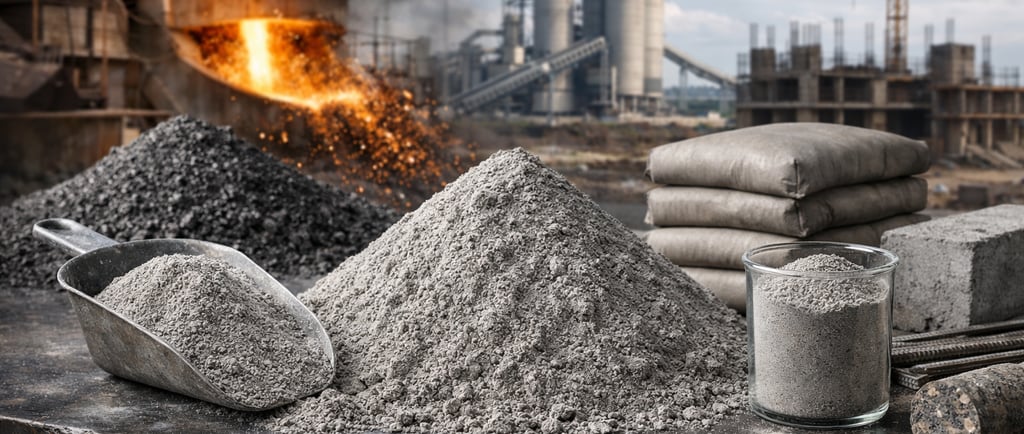
Cement sits at the center of modern construction, and at the center of a hard emissions problem. Global cement production was about 4,158 Mt in 2022. IEA Direct emissions intensity has stayed near 0.6 t CO2 per tonne of cement in recent years. IEA The lever that keeps coming up, across public procurement, infrastructure owners, and technical bodies, is simple: reduce clinker per tonne of cement and per cubic metre of concrete, without giving up strength, durability, or constructability. IEA
That is where supplementary cementitious materials enter. They reduce the clinker share of the binder system. They also change the pore structure and chemistry of concrete in ways that often improve long-term durability. Slag, specifically ground granulated blast-furnace slag, has become one of the most relied-on options because it can deliver both carbon reduction and performance when you specify it correctly. Enterprise Ireland+1
Why slag as an SCM is now a front-line option
It targets the biggest emissions driver in concrete mixes
Clinker production drives most cement emissions through calcination and fuel use. IEA When you replace a portion of Portland cement with GGBS, you cut the clinker needed for the same binder mass. A 2024 Irish public procurement report summarizes typical impacts like this: for every 1 kg of cement replaced with GGBS, about 0.7 to 0.8 kg of CO2 can be saved, and replacing 30% of a 300 kg/m³ clinker cement content can yield about a 20% reduction in embodied carbon per m³, depending on the full mix design. Enterprise Ireland
It already has proven, large-scale references
This is not a lab-only material. Large projects have used high GGBS substitution for decades. A public procurement case summary cites Aviva Stadium in Dublin using a 40% GGBS replacement rate and reporting over 4,000 tonnes of CO2 savings, and The Shard using a cement blend with 70% GGBS. Enterprise Ireland
It strengthens durability where owners lose money
Many owners do not fail on 28-day strength, they fail on chloride ingress, sulfate exposure, freeze-thaw scaling, and corrosion-driven spalling. Slag tends to reduce permeability over time and improve resistance to chloride transport, especially at later ages, when hydration products densify the pore network. American Concrete Institute+2Vlaams Instituut voor de Zee+2 That is why transport agencies and marine owners often push slag in exposure classes tied to salts and seawater.
It fits circular materials policy and procurement rules
Slag use links industrial byproducts to construction supply chains. It also aligns with a procurement trend toward measured environmental claims, EPDs, and verified LCA reporting, instead of marketing claims. Type II self-declared claims fall under ISO 14021, and Type III EPDs align with ISO 14025, with EN 15804 commonly used for construction product EPD rules in Europe. EPD International+3ISO+3ISO+3
What slag as an SCM actually is, and what it is not
“Slag” is not one uniform material. It is a family name for several byproducts from iron and steelmaking.
The SCM everyone means in concrete standards is granulated blast-furnace slag, ground into a fine powder. You will see these terms:
GBFS: granulated blast-furnace slag, created by rapidly quenching molten slag to form a glassy, reactive material. American Concrete Institute
GGBS or GGBFS: GBFS that has been dried and ground to a cement-like fineness so it can react in the binder system. American Concrete Institute
Slag cement: a common North American term for ground granulated blast-furnace slag used as a binder constituent, governed in many specs by ASTM C989. ASTM International | ASTM
What it is not
Air-cooled blast-furnace slag, which is crystalline and commonly used as aggregate or road base, not as an SCM binder. American Concrete Institute
Many steel slags from electric arc furnaces and basic oxygen furnaces, which can contain free lime and periclase that create expansion risks unless processed for specific aggregate uses. Those can be valuable, but they are a different technical conversation than GGBS as an SCM.
This distinction matters because performance, stability, and standards compliance depend on glass content, fineness, and chemistry. If you treat “slag” as a single commodity input, you will get inconsistent concrete.
How slag reacts in concrete, and why performance shifts over time
Portland cement reacts quickly. It builds early strength fast. Slag reacts more slowly in typical mixes because it is latent hydraulic, it needs activation from the alkaline environment and calcium hydroxide produced during cement hydration. American Concrete Institute+1
That reaction profile creates a predictable pattern:
Early age (1–3 days): strength can lag versus straight Portland cement mixes, especially in cold placements. intrans.iastate.edu
Later age (7 days onward, often stronger at 56–90 days): slag blends commonly catch up and can surpass baseline strength when curing is adequate and fineness is right. intrans.iastate.edu
Permeability and chloride transport: slag blends often show lower chloride migration and diffusion than plain Portland systems at comparable w/cm, with improvements growing with curing and age. Vlaams Instituut voor de Zee+2PMC+2
Heat of hydration: slower reaction and lower heat release can reduce thermal cracking risk in mass concrete, which is one reason high slag contents show up in large pours. intrans.iastate.edu
This is also where mix design discipline matters. Slag performance depends on:
Slag grade and fineness. ASTM C989 grades are built around strength activity index levels, commonly referenced as 80, 100, and 120. ASTM International | ASTM
Cement chemistry and alkali availability.
Water-to-cementitious ratio, curing time, and curing temperature. intrans.iastate.edu+1
The real constraints you must plan for
Slag works best when you design for it, not when you swap it in late.
Construction stage constraints
Finishing windows can shift because bleed rate and set timing can change with slag fineness, temperature, and replacement rate. intrans.iastate.edu
Cold weather placement can amplify slow early strength. That can affect stripping schedules, saw cutting, and opening to traffic. intrans.iastate.edu
Admixture interactions can change. Some projects reduce superplasticizer demand, others do not, depending on the full particle packing and cement chemistry. Treat this as trial-batch territory, not assumption.
Supply and market constraints
GGBS supply ties directly to blast-furnace ironmaking. Public procurement guidance now explicitly flags a coming squeeze: demand for GGBS and PFA is rising while supply rates can fall as the source industries decarbonise and change processes. Enterprise Ireland+1 In practice, that pushes buyers to:
qualify multiple sources,
track chemistry and fineness over time,
lock logistics early, especially when grinding capacity is regional.
Governance constraints
Owners increasingly want proof, not promises. ISO 14021 sets requirements for self-declared environmental claims, and ISO 14025 underpins Type III environmental declarations, which EPD programs use to publish verified life-cycle data. ISO+2ISO+2 If you cannot trace the slag source and document impacts, you will struggle in carbon-scored tenders.
Where this goes next
You now have the “why” and the “what.” The next step is the “can you use it here, and will a third party accept it.” That is where standards, performance classes, and documented limits decide what is allowed in real projects.
3. International Standards Governing Slag Utilization
As the global construction industry accelerates its sustainability agenda, regulatory bodies, standards organizations, and industry consortia have intensified efforts to systematize the use of slag as a Supplementary Cementitious Material (SCM). These standardized frameworks are criticalthey guarantee not only performance and safety but also foster international trust in slag-derived materials, facilitating cross-border adoption and circular flows of byproducts.
Key Standards Shaping Slag’s Role
Several international standards have become pivotal benchmarks for the use of slag in cement and concrete:
ASTM C989/C989M (Standard Specification for Slag Cement for Use in Concrete and Mortars)
EN 197-1 (European Standard for Common Cements, including those containing GGBFS)
BS 6699 (British Standard Specification for Ground Granulated Blastfurnace Slag for use with Portland cement)
ISO 14021 (International Standard for Self-Declared Environmental ClaimsType II Environmental Labeling)
These standards meticulously define the chemical composition, physical criteria, and performance properties required before slag can be used as a cement substitute. For example, EN 197-1 requires strict limits on loss-on-ignition, sulfate, and magnesium oxide content, directly impacting durability and strength. ASTM C989, meanwhile, categorizes blast furnace slag into three grades based on its strength activity index.
Regulatory Harmonization and Market Access
Harmonized standards are essential for market development. The European Union’s Construction Products Regulation (CPR) and initiatives under ISO have streamlined acceptance of slag-based cements between member states, slashing trade barriers and fostering larger-scale circularity. In Asia and the Americas, standards such as JIS A 6206 (Japanese Industrial Standard) and CSA A3001 (Canadian Standard Association) support growing domestic markets for slag cement.
Case in Point:
The United Kingdom’s Highways England adopted advanced standards promoting GGBFS use in major infrastructure projectsresulting in a 20% drop in embodied carbon across relevant concrete works.
Traceability and Environmental Declarations
Modern standards increasingly require transparency in environmental impact. Environmental Product Declarations (EPDs) and Life Cycle Assessment (LCA) documentation, often aligned with ISO 14025, ensure full supply chain traceability, quantifying CO2 savings per ton of slag utilized and building client trust.
4. Performance Parameters: Concrete Strength, Durability, and Environmental Metrics
Evaluating slag’s effectiveness as an SCM extends far beyond simple substitution. It’s the comprehensive performance profileranging from structural integrity to ecological impactthat sets the benchmark.
Strength Development and Structural Reliability
Early and Late Strength Gain:
While Portland cement offers rapid early strength, slag-blended concretes exhibit notable strength development over time. Studies show that, at 56–90 days, slag-containing concretes often surpass the strength of ordinary concrete, yielding superior long-term performance.Enhanced Workability:
Slag’s smooth particle morphology improves mix flow and reduces water demand. Project data from precast manufacturers shows that blends with 40–60% GGBFS achieve a 10–15% reduction in superplasticizer needs.
Durability and Service Life
Sulfate and Chloride Resistance:
Slag cement dramatically enhances resistance to aggressive agents, reducing maintenance costs and prolonging structure lifespans. In coastal bridges, for example, GGBFS blends have shown a fivefold reduction in chloride ingress, extending service life by up to 40 years versus traditional concrete.Alkali-Silica Reaction (ASR) Mitigation:
Slag’s chemistry helps immobilize reactive silicas, drastically reducing risk of ASR cracking that plagues regular concrete.
Fact:
The U.S. Federal Highway Administration reports that strategic use of slag has saved over $50 million each year in deferred bridge replacement and maintenance in corrosive environments.
Environmental and Circularity Metrics
Embodied Carbon Reduction:
GGBFS substitution for Portland cement yields a CO2 emission cut of approximately 0.8–1.0 tons per ton of cement replaced. Globally, the use of SCMsprimarily slag and fly ashhas already reduced cement sector emissions by at least 200 million metric tons annually.Resource Conservation:
Each ton of slag reused in cement equates to about 1.4 tons of natural resources conserved, according to the World Business Council for Sustainable Development (WBCSD).
Limitations and Variability
Source Variability:
The properties of slag differ by furnace type, feedstock, and cooling technique, requiring careful source vetting and blending for predictable performance.Blending Limits:
Most standards recommend slag replacement rates of 25–70%, balancing resource efficiency, setting time, and required mechanical performance.
5. Limits and Leverage Points: Maximizing Slag’s Value
While slag’s sustainability potential is significant, scaling its impact hinges on pushing both technical and systemic boundaries.
Technical Boundaries
Replacement Thresholds:
High-slash replacement rates (beyond 60–70%) can extend setting times excessively, lead to cold-weather curing challenges, and call for specialized admixtures. Concrete performance standards like ASTM C618 and EN 206 define thresholds for different construction and exposure classes.Performance Variability:
Consistency of slag supply and composition remains a technical hurdleparticularly when sourcing from new steel plants or manufacturing routes (e.g., electric arc furnaces versus blast furnaces).
Circularity Leverage Points
Blended SCM Solutions:
Combining slag with other SCMs, such as fly ash, calcined clays, and silica fume, can address some singularity risks and optimize for price, carbon, and strength.Early Integration in Design:
Leading architects and civil engineers now specify slag-blended solutions during project inceptionwhich not only minimizes environmental impact but can boost project economics and meet green procurement mandates.
Overcoming Bottlenecks: Industry Data
According to the Global Cement and Concrete Association, less than 30% of global potential slag is currently harnessed as an SCMa significant opportunity gap. Key levers for improvement include:
Investments in slag grinding, activation, and processing infrastructure
Collaboration between steelmakers, cement producers, and logistics partners
Digital platforms for real-time tracking of slag flows and circular byproduct exchanges
SECTION 6. ADVANCED BUSINESS MODELS THAT MAKE SLAG SCM SCALE
Slag SCM does not scale on technical merit alone. It scales when contracts, logistics, and proof systems remove uncertainty for specifiers and buyers. That is the commercial layer many projects miss.
6.1 Long-term offtake with quality and logistics built in
Spot buying works when supply is loose. Slag SCM is heading the other way in many regions, because blast-furnace output will not rise everywhere, while low-carbon concrete demand keeps growing. cembureau.eu+2cembureau.eu+2
Use offtake contracts that lock three things:
Volume. Define monthly and annual bands, plus a minimum take clause.
Quality. Tie acceptance to a certificate of conformity, plus routine test frequencies, plus a dispute process.
Logistics. Define who owns the haulage risk, storage risk, and demurrage risk.
What changes when you do this
Ready-mix producers stop treating slag as an “optional blend”.
Engineers stop worrying about last-minute substitutions.
Steel producers gain predictable revenue for a co-product stream, instead of treating it as a disposal variable.
6.2 Grinding-as-a-service and regional “SCM hubs”
Grinding capacity often becomes the bottleneck, not slag generation.
Two models work well:
Toll grinding. A steel producer sells granulated slag, a grinder converts it to GGBS on a fee basis, then ships to cement or ready-mix customers.
Hub-and-spoke terminals. A port or inland terminal receives granulated slag, stores it under controlled moisture conditions, then dispatches to one or more grinding plants or directly to users where standards allow.
Why this model matters
It reduces transport of finished powder over long distances, which cuts cost and cuts supply risk.
It helps smaller markets access consistent fineness and grading, instead of living with “whatever turns up”.
6.3 Performance warranties and third-party risk cover
Large owners hate early-age strength surprises, and they hate durability disputes even more. You can lower that resistance by bundling risk.
Add-on commercial layers you now see in mature markets:
Guaranteed strength gain curve. You publish expected 1, 7, 28, and 56-day bands for defined temperature ranges.
Durability assurance. You include chloride migration or diffusion targets for exposure classes where applicable, plus curing requirements.
Independent verification. You pay for third-party testing and auditing across a defined sampling plan.
This aligns with the move from ingredient rules to performance rules. ASTM C1157, for example, focuses on how cement performs rather than locking exact composition. American Cement Association+1
6.4 “Low-embodied-carbon concrete” as a premium product line
Public buyers increasingly ask for low-embodied-carbon materials, and they ask for proof.
In the US, federal construction projects can include low-embodied-carbon material requirements for concrete and cement under Inflation Reduction Act related guidance. U.S. General Services Administration
In parallel, “Buy Clean” style procurement has spread across agencies and states, pushing EPD-based comparisons into bid evaluation. Carbon Leadership Forum+1
Ireland’s public procurement guidance explicitly links GGBS substitution to quantified CO2 savings, and it pushes EPD submission as part of public purchasing practice. Enterprise Ireland+1
This creates a clear business model:
Sell a “standard mix” and a “low-carbon mix” as distinct SKUs.
Price the low-carbon option using a transparent premium tied to EPD results and supply constraints.
Bundle curing and schedule planning so the buyer does not pay the premium and then sabotage results on site.
6.5 EPD services and carbon documentation as a revenue stream
EPDs used to be marketing. Now they function as procurement tickets.
A practical example: the Irish concrete sector publishes product EPDs that identify mix classes and substitution rates such as 30% GGBS replacement for a defined ready-mix product, with declared impacts per functional unit. Irish Green Building Council
Monetizable add-ons:
EPD “fast lanes” for repeat mixes with only minor recipe adjustments.
Project-level embodied carbon packs that map each pour to an EPD and a delivery ticket.
Chain-of-custody documentation for SCM origin, processing, and test history.
6.6 Digital traceability and real-time SCM allocation
As supply tightens, allocation becomes a business decision. Digital tracking makes it defensible.
What good looks like
Every batch links to a slag source, grinding batch, fineness metrics, and relevant chemistry checks.
Every delivery links to project exposure class, curing plan, and acceptance testing.
Every buyer can see “what changed” when a source changes.
This matters more because industry bodies expect better alignment between standards, design codes, and procurement rules to increase blended cement and SCM use. GCCA
6.7 Case model, how a supplier wins a strategic account
You win long-term volume when you sell certainty, not powder.
A strong offer package includes:
A two-source qualification plan so a single steel plant outage does not stop the job.
A trial-batch program with temperature bands and early-age mitigation steps.
A documented durability target for chloride exposure, plus a curing spec.
An EPD and tender pack ready for public procurement scoring.
This is how high GGBS projects get built without schedule panic. The same logic sits behind major projects cited in procurement guidance, such as Aviva Stadium using 40% GGBS and The Shard using a 70% GGBS cement blend. Enterprise Ireland
SECTION 7. FUTURE PROJECTIONS, WHAT CHANGES BETWEEN NOW AND 2050
7.1 Slag SCM demand rises, but conventional supply can fall
GGBS supply depends on blast-furnace ironmaking. Steel decarbonisation changes that link.
A 2025 scenario analysis for the EU projects granulated blast-furnace slag supply dropping from about 18 to 19 Mt in 2025 to 6.9 to 11.4 Mt in 2035, and 0 to 3.2 Mt in 2045. ScienceDirect
European cement industry materials guidance also states that blast-furnace slag and fly ash become less available over time as steel and power sectors decarbonise. cembureau.eu
At the same time, steelmaking routes shift.
In 2023, electric furnaces produced about 28% of crude steel, per OECD Steel Outlook citing worldsteel. OECD
IEA analysis for the steel sector describes a decline in blast furnace share in its Net Zero aligned pathway by 2030, with higher scrap-based production. IEA
Implication you should plan for
In many regions, “easy GGBS” becomes harder to secure.
Supply becomes more regional, more contracted, and more politically tied to public procurement.
7.2 New slags and new SCM streams become part of the portfolio
You cannot bet the next 20 years on legacy SCMs alone.
GCCA notes that future low-carbon metal processes may produce new slags suitable for use as SCMs. GCCA
Industry and research also point to growth in limestone use, calcined clays, and other non-traditional substitutes where fly ash and GGBS decline. GCCA+1
What this means for slag producers and cement buyers
Treat GGBS as “core supply”, but build a blended SCM playbook.
Pre-qualify ternary systems (for example GGBS plus limestone, or GGBS plus calcined clay) so you do not restart approvals every time supply shifts.
7.3 Policy drives faster adoption than voluntary commitments
In the next decade, procurement rules will move markets faster than technical papers.
Signals you can already see:
Federal low-embodied-carbon requirements on public construction in the US. U.S. General Services Administration
Buy Clean style policy rollouts and guidance that turn EPD submission into a condition of bidding. Carbon Leadership Forum+1
Industry coalitions pushing clean concrete commitments to standardize demand signals. RMI
This shifts the buying question from “should we use slag” to “can we prove we used it, and did it hit the declared GWP target”.
7.4 Expect more performance-based specifications
Owners want outcomes: strength, durability, service life, and declared impacts.
Expect two changes:
More use of performance-based cement acceptance, which reduces fear of blended systems when tests prove results. American Cement Association+1
More mix-level performance specs tied to exposure classes, with curing requirements written into the contract, not treated as a field preference.
7.5 The durability business case grows in importance
Carbon is a driver, but durability is the cash driver for owners.
When low-carbon mixes also cut chloride ingress and corrosion risk, owners get a two-part return:
Lower upfront embodied carbon.
Lower lifecycle cost through reduced repairs and longer replacement cycles.
That is why transport agencies and long-life asset owners keep pushing SCM content, even when contractors resist early-age schedule changes.
7.6 Industry metrics will tighten and become public-facing
Both industries, steel and cement, face scrutiny on intensity metrics and progress reporting.
Worldsteel reports 2023 averages of 1.92 t CO2 per tonne of crude steel cast and 21.27 GJ per tonne. worldsteel.org
Cement decarbonisation roadmaps continue to stress clinker reduction as a major lever alongside fuel switching, efficiency, and carbon capture. IEA+1
As disclosure expands, “documented SCM use” will move from a sustainability story to a contractual requirement.
SECTION 8. ACTIONABLE TAKEAWAYS AND CONCLUSION
8.1 If you are an owner or public buyer
Write requirements that reward outcomes, not ingredients.
Do this in your next tender pack:
Set a maximum GWP for concrete by strength class and exposure class, and require EPD submission for mixes used on the job. U.S. General Services Administration+1
Allow blended cements and SCMs explicitly, including slag, when performance tests prove compliance.
Require a curing plan tied to temperature bands and opening-to-traffic targets.
Ask for source traceability for SCM, including grinding batch IDs and conformity records.
8.2 If you are a designer or engineer of record
Stop treating slag as a late-stage substitution.
Do this in design stage:
Specify cement class or performance requirements that permit slag systems, and avoid clauses that force CEM I or straight Portland unless the exposure truly demands it.
Define acceptance at 56 days when durability matters more than 7-day breaks, and align that with construction sequencing.
Write a durability target where relevant, such as chloride migration or diffusion criteria, and make curing part of the spec.
8.3 If you are a ready-mix or precast producer
Sell certainty, then protect it operationally.
Do this operationally:
Qualify at least two slag sources where feasible, because supply risk is rising in many regions. cembureau.eu+1
Run trial batches at winter temperatures, not only at 20°C lab conditions.
Set internal rules for when you adjust fineness, admixtures, or cement content to protect early strength.
Publish two product lines, standard and low-embodied-carbon, with clear performance commitments and EPD support. World Resources Institute+1
8.4 If you are a steelmaker or slag processor
Treat GGBS as a strategic product, not a byproduct.
Do this commercially:
Invest in granulation consistency and moisture control.
Offer long-term offtake with quality documentation and testing cadence.
Partner with grinders and terminals to widen your reachable market radius.
Build an EPD-ready data pack for your slag stream so downstream customers can use it in bids.
8.5 If you are a policymaker or standards body
Remove the reasons engineers default to clinker-heavy mixes.
Do this in codes and standards:
Update cement and concrete standards on a predictable cadence so they do not lag market needs. GCCA
Shift public works specs toward performance-based acceptance, and align testing with service-life outcomes.
Support EPD and digital documentation requirements so buyers compare like with like. Carbon Leadership Forum+1
Conclusion
Slag as an SCM already delivers proven emissions cuts and durability gains when you specify it early and manage curing and quality. Enterprise Ireland+1 The constraint is no longer “does it work.” The constraint is supply certainty, documentation, and contract structures that protect performance while markets and steelmaking routes change. cembureau.eu+2OECD+2
If you want slag SCM to remain a dependable decarbonisation lever through 2035 and beyond, you need three moves:
Lock supply through long-term agreements and regional processing capacity.
Shift specs toward performance and service life, not ingredient tradition.
Treat traceability and EPDs as core project infrastructure, because more buyers now require verified proof to award work. U.S. General Services Administration+2World Resources Institute+2
Connect
Your trusted partner for scrap metal procurement.
CONTACT
About
haroon@tdcventures.com
+1-307-655-7593
© 2025. All rights reserved.
NEWSLETTER