
Smart Home E-Waste: Gateways, Sensors, Hubs
Learn how repair-ready design, secure data erasure, and circular take‑back systems transform smart home e‑waste — from hubs and sensors to XR headsets — into a competitive advantage. Read the full framework.
IMMERSIVE TECH RECYCLING & CIRCULAR ELECTRONICS
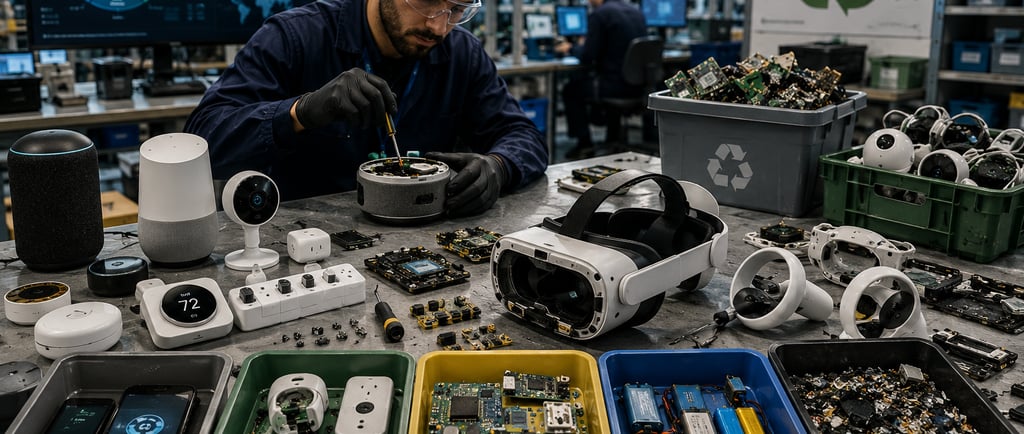
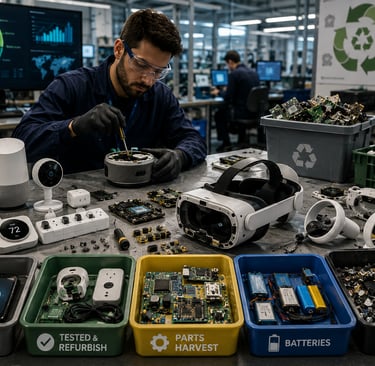
Context: Why Smart Home E-Waste Matters Now
The rapid evolution of connected home technology—from foundational hubs to immersive XR wearables—has fundamentally changed how we interact with our environments. Estimates project the global inventory of smart home and XR devices to easily exceed 1.5 billion by 2026, reflecting not just technological adoption but a growing mountain of electronic waste that's difficult to process sustainably.
Why is this surge so challenging? Unlike traditional electronics, smart home devices are often designed for fast upgrades, low repairability, and tight integration across platforms. Consumer demand for newer, better features drives short product cycles—meaning devices become obsolete almost overnight. A 2023 IDC report noted that the average lifecycle for a connected home device is shrinking to just 2.5 years in competitive markets, fueling an exponential increase in "invisible" e-waste.
This creates a twofold imperative for industry stakeholders—smart home brands, utilities, recycling and refurbishment partners, and IT asset disposition (ITAD) providers. On one hand, there are mounting regulatory risks: local and national authorities now assign liability and reporting standards that didn't exist a decade ago. On the other, organizations face clear opportunities to demonstrate environmental leadership, capture new revenue streams, and answer rising consumer demand for greener, more ethical electronics.
Extended Reality (XR) hardware—VR headsets, AR glasses, haptic controllers—highlights the complexity: these units often contain sensitive data, customized user environments, and non-standard batteries. Without a circular, repair-ready system, brands risk higher compliance costs, loss of customer trust, and missed chances for brand differentiation. Conversely, companies that act now can transform today's compliance risks into tomorrow's competitive edge, building loyalty through transparency and sustainability.
2. Defining Smart Home E-Waste and Circular Electronics
Smart home e-waste isn't just about old tablets and phones. It encompasses gatekeepers of home connectivity—Wi-Fi hubs, voice assistants, sensors, cameras, energy monitors, XR headsets, and more—that quietly amass in junk drawers and landfills across the globe. These devices are uniquely challenging:
Multi-layered integration: Many interact with dozens of other connected devices.
Embedded batteries: Non-removable batteries complicate recycling and pose fire risks.
Sensitive data retention: Devices often store user names, Wi-Fi access codes, video footage, and audio commands—heightening privacy stakes.
Circular electronics flips the throwaway model, advocating lifecycle optimization. The aim: maximize reuse, prioritize repair, and ensure true recycling—shaped by principles such as:
Design for repair: Think modular PCB layouts, swappable batteries, and standardized screws over glue or epoxies. The EU's right-to-repair policy has directly influenced product teardown scores, pushing manufacturers toward transparency and accessibility.
Design for circularity: Use easily separable plastics and metals, clear labeling, and minimized chemical adhesives. Apple's Daisy robot, which disassembles iPhones for material pooling, stands as a vanguard example of this philosophy in action.
Incentivized take-back programs: Many consumers want to "do the right thing" but lack convenient or rewarding recycling channels. According to The Circular Electronics Initiative, visible incentives—such as trade-in credits or bill rebates—can boost take-back rates by over 35%.
Secure refurbishment: With privacy concerns at an all-time high, secure data wipes and device grading are non-negotiable. ITAD providers commonly meet NIST 800-88 data-sanitization guidelines to ensure compliance.
Accountable recycling: Sourcing R2- or e-Stewards-certified downstream vendors for recycling guarantees that scrapped devices won't end up exported to unregulated markets or incinerated.
Alignment with ITAD: As firms seek to unite consumer and business electronics flows, mapping standards from enterprise ITAD into the home space improves traceability and regulatory compliance.
The smart home sector lags behind traditional IT, as revealed in a 2022 Green Electronics Council study, which found just 18% of major smart device brands actively support lifecycle extension beyond warranty. Pressure is growing: a more circular, repair-focused approach is no longer optional—it's a strategic necessity.
3. The 4-Part Framework for Managing Smart Home E-Waste
A best-practice approach to smart home and XR e-waste unites four pillars for a resilient, future-ready system:
Design
Prioritize repairability and modularity from day one. Amazon's 2024 redesign of the Echo Dot, for instance, shifted to snap-in battery packs, reducing disassembly time by 45% in pilot tests. Other brands have published open repair manuals or launched certified refurb programs.
Collect
Establishing robust take-back systems is vital. Leading companies combine mail-in, in-store drop-off, and installer-collection programs. For example, Ecobee's nationwide "retire and recycle" mail-back saw a 60% boost in device returns after partnering with a major retail chain and offering $10 smart thermostat credits.
Refurbish
Centralized refurbishment hubs or partnerships with ITAD-certified firms enhance processing speed and quality. Robust device grading and parts harvesting sharply boost overall ROI and keep valuable materials in play. Secure data erasure—leveraging organizational standards like NIST or ISO/IEC 27001—ensures privacy and legal compliance.
Recycle
Efficient downstream recycling with traceable, certified vendors maximizes material recovery—some advanced recycling lines now recover up to 97% of device mass for re-entry into the commodity market. The EU's Extended Producer Responsibility (EPR) directives make full traceability mandatory across many countries, pushing U.S. companies to follow suit.
Step-By-Step Action Plan
Audit product lines: Regularly review each SKU's modularity, ease of battery removal, and material disclosures. The WEEE Directive in Europe requires detailed annual product registers, so early gap analysis saves time and money.
Map e-waste flows: Leading brands install serial number tracking from sale to take-back container, then reconcile ID batches at recycling hubs. This digital trail is essential for circularity scorecards and compliance.
Select take-back models: Match take-back methods to your customer segments. Installer retrieval works well for utilities; mail-back suits direct-to-consumer brands.
Develop repair/refurbishment centers: Either in-house or with external ITADs, ensure SOPs cover secure handling, real-time grading, and diagnostics.
Deploy secure data erasure: Automate erasure at intake; log certificates by device. Leverage third-party audit services if necessary.
Grade for next life: Use a clear matrix—working, repairable, or salvage (for parts harvesting or recycling).
Test component chains: Anticipate future needs; harvest chips, LEDs, or batteries that can be repurposed.
Train all partners: Training programs—using short explainer videos and checklists—have been shown to double compliance rates versus paper manuals.
Track everything: From device barcodes to downstream recycling certificates, digital logging supports ROI analysis and audit readiness.
Worked Example: Installer Scenario
A large U.S. utility remodels its smart thermostat initiative to include e-waste management. Installers receive branded collection kits, digital return slips, and a per-unit incentive for every legacy device returned. Devices are shipped to a regional ITAD hub, where 65% are refurbished, 30% are responsibly recycled, and the rest undergo parts harvesting. The utility publishes a quarterly sustainability impact whitepaper, enhancing regulatory trust and brand image.
Part 2: Repair, Refurbishment, Data Security, and Take-Back Design
4. Why Repair-Ready Design Is the Difference Between Circularity and Waste
Smart home e-waste is hard to manage because most devices were never built to come apart cleanly. A smart speaker may look simple from the outside, but inside it can contain microphones, speakers, magnets, adhesives, plastic clips, screws, wireless chips, storage, sensors, rubber feet, and sometimes a glued-in battery. A smart camera may include lenses, CMOS sensors, infrared emitters, speakers, microphones, Wi-Fi modules, storage, and weatherproof seals. XR headsets go further. They combine batteries, lenses, displays, processors, cameras, depth sensors, speakers, straps, plastics, foam, magnets, and proprietary connectors inside a compact wearable shell.
This is why repair-ready design matters. A product that can be opened in 3 minutes, tested in 5 minutes, and rebuilt with standard parts has a second life. A product that needs heat guns, solvents, custom tools, and destructive disassembly often goes straight to material recovery. That difference changes the economics of circular electronics.
The global e-waste problem makes this urgent. The Global E-waste Monitor 2024 reported that the world generated 62 million tonnes of e-waste in 2022, while only 22.3% was documented as formally collected and recycled. The same report projects global e-waste to reach 82 million tonnes by 2030 if current trends continue. That means brands cannot treat repair as a side topic anymore. Repair is now a cost issue, a compliance issue, a carbon issue, and a customer trust issue.
Repair-ready smart home products should include several practical design choices. Batteries should be removable without destroying the housing. Screws should be visible or clearly marked. Plastics should be labeled by resin type. Circuit boards should avoid unnecessary bonding to housings. Displays, cameras, and speakers should be replaceable as separate modules. Firmware should allow secure reset and ownership transfer. Replacement parts should remain available beyond the standard warranty window.
This matters even more for devices tied to home security, energy, health, or child monitoring. A broken smart lock, camera, thermostat, or baby monitor may still have strong reuse value, but only if a refurbisher can verify function, erase data, reset pairing, and certify the device for resale. Without those steps, the product becomes a privacy risk and a waste stream.
The EU is pushing the market in this direction. The Ecodesign for Sustainable Products Regulation entered into force on July 18, 2024, and expands the EU's ability to set product rules around durability, repairability, recycled content, spare parts, and digital product information. Its direction is clear: products entering the European market will face stronger expectations around repair, reuse, and traceable end-of-life handling.
The EU's right-to-repair rules also changed the direction of the repair market. The Directive on common rules promoting the repair of goods was adopted on June 13, 2024, entered into force on July 30, 2024, and must be applied by Member States from July 31, 2026. For electronics brands, 2026 is no longer a distant compliance date. It is the point at which repair promises need to become operational systems.
For smart home and XR brands, the lesson is direct: products designed only for first sale are becoming commercial liabilities. Products designed for repair, secure reset, parts harvesting, and certified recycling are more resilient.
5. The Hidden Data Risk Inside Smart Home and XR Devices
Smart home e-waste is not only a material problem. It is also a data problem.
A discarded smart speaker may retain account links, Wi-Fi credentials, voice assistant history, household routines, Bluetooth pairings, and user preferences. A smart camera may retain video clips, thumbnails, network data, device IDs, and cloud account associations. A thermostat may reveal occupancy patterns. A hub may reveal the structure of the entire smart home network. XR headsets may store room scans, hand tracking data, app data, biometric-adjacent interaction data, saved environments, user profiles, and payment-linked accounts.
This is why refurbishment workflows for smart home and XR devices need to borrow from enterprise ITAD standards. The device may be small, but the data risk is not small.
NIST SP 800-88 defines media sanitization as a process that makes access to target data infeasible for a given level of effort. In practice, a smart home e-waste program should not rely on a basic "factory reset" unless that reset has been tested and verified for that product type. The safer model is to define device-specific sanitization procedures, log each wipe, verify reset status, and keep a certificate tied to the device serial number or intake ID.
For smart home devices, secure handling should include:
Device intake should capture model, serial number, MAC address where appropriate, physical condition, battery status, account lock status, and visible damage. The device should then move into a locked processing path. If it can power on, technicians should perform a documented reset, firmware update where available, account unlinking, pairing test, and network isolation check. If it cannot power on, the storage component or board should be handled under a stricter salvage or destruction process.
XR devices require deeper controls. A headset may contain mapped room data, saved avatars, enterprise apps, training records, location history, app credentials, and sensor calibration files. If the headset came from a corporate training environment, defense contractor, healthcare provider, school, or industrial site, the data risk increases. Refurbishment partners should use a chain-of-custody process, not a loose bin process.
This is also why certified downstream partners matter. R2v3 was created to reflect current electronics reuse and recycling needs, including stronger attention to data, worker safety, environmental handling, and responsible downstream processing. For brands and utilities running smart home take-back programs, R2v3 or equivalent certified partners reduce risk when devices leave the brand's direct control.
Data security is one of the strongest arguments for formal take-back. If consumers leave smart cameras, hubs, or XR devices in drawers, sell them informally, or throw them away, the brand loses control of both the environmental outcome and the privacy outcome. A documented take-back route gives the brand a defensible answer: the device was collected, reset, graded, reused where possible, and responsibly recycled where necessary.
6. Take-Back Systems That Actually Work
Most consumers do not recycle small electronics because the process is inconvenient. A smart plug, motion sensor, voice remote, old hub, or broken camera is too small to justify a special trip. These devices sit in drawers for years. The waste is invisible until millions of households do the same thing.
A successful smart home take-back program must remove friction at the point where the customer already has attention. The right moment is usually one of these:
When the customer buys a new device.
When an installer replaces an old device.
When a utility upgrades a thermostat or energy monitor.
When a security company replaces cameras, locks, or sensors.
When a brand launches a new generation of hub or headset.
When a warranty replacement is shipped.
When a customer cancels a subscription.
These moments matter because they connect behavior to timing. The customer is already thinking about the device. The brand should use that moment to capture the old unit.
Mail-back works well for direct-to-consumer brands, but only when the return kit is simple. The box should be prepaid, small, and already labeled. The customer should not need to print anything. The instructions should fit on one card. A QR code can link to a 60-second reset guide, but the program should still accept devices from customers who fail to reset them.
Retail drop-off works well for high-volume categories. Smart speakers, routers, cameras, gaming accessories, XR controllers, and hubs can be collected through bins or service desks, provided staff are trained to separate battery-containing devices from non-battery devices. Battery sorting is essential because lithium-ion battery fires remain a serious operational risk in waste and recycling systems.
Installer collection is the strongest model for thermostats, energy monitors, security systems, smart locks, access control devices, and networked sensors. The installer is already in the home. They can remove the old device, scan it, bag it, and place it into a controlled return stream. This model is especially useful for utilities and security companies because it allows high capture rates and cleaner device records.
Subscription-based hardware can go further. If a brand owns the device or leases it as part of a service, return terms should be built into the contract. The customer should know from day one that the device must be returned, reset, reused, refurbished, or recycled. This reduces loss, improves parts recovery, and makes end-of-life reporting more accurate.
The EU's common charger rule shows how policy can reshape electronic waste at the design and collection level. By the end of 2024, USB-C became the common charging standard for many small electronic devices sold in the EU, with laptops following later. For smart home and XR brands, the broader lesson is clear: standardization reduces accessory waste, simplifies reuse, and makes refurbishment easier.
The strongest take-back systems combine convenience, proof, and reward. A customer should be able to return a device easily. The brand should be able to prove what happened to it. The customer should receive a clear benefit, such as a credit, bill rebate, accessory discount, warranty extension, or loyalty reward.
7. Refurbishment: Where the Real Economic Value Sits
Recycling is important, but refurbishment usually creates more value.
A working smart thermostat, camera, hub, XR controller, smart speaker, router, or sensor may be worth far more as a tested second-life product than as shredded material. The challenge is that refurbishment needs discipline. It cannot be a random bench repair process. It needs grading rules, test scripts, parts controls, data handling, cleaning standards, packaging standards, and warranty logic.
A strong refurbishment process starts with triage. Devices should be sorted into four groups.
Grade A devices are fully functional, cosmetically clean, reset, updated, and ready for resale or redeployment.
Grade B devices work but need light repair, cleaning, housing replacement, battery replacement, or accessory pairing.
Grade C devices are useful for parts harvesting.
Grade D devices should move into certified recycling or controlled destruction.
This grading step turns mixed e-waste into inventory. A bin of returned smart home devices is a cost. A graded batch of 1,000 devices becomes a resale pool, parts pool, warranty pool, and recycling pool.
Refurbishment also protects supply chains. Smart home and XR devices often contain components that are useful across generations: speakers, microphones, screws, magnets, camera modules, brackets, boards, power supplies, charging docks, straps, and housings. A controlled parts-harvesting program can reduce the need for new spare parts, especially for warranty support and older models.
The economics become stronger when brands design for this from the beginning. A removable battery can turn a failed device into a repairable device. A modular camera can keep a smart display in use. A replaceable strap or face gasket can extend the life of an XR headset. A standard screw can reduce labor time. A QR-coded part can reduce technician errors.
The repair market is also being shaped by regulation. From July 31, 2026, EU Member States must apply the new right-to-repair rules. This will push brands to make repair access, spare parts, and repair information more practical for covered products. Even where smart home categories are not yet fully covered, the direction of policy is clear enough for brands to prepare now.
Refurbishment should not be treated as a sustainability side project. It should sit inside the product, warranty, finance, and customer retention strategy. A refurbished device can support lower-cost replacement, warranty swaps, emerging-market resale, rental programs, certified pre-owned stores, installer stock, and donation programs.
For XR, refurbishment may become even more valuable. Enterprise XR deployments in training, manufacturing, healthcare, education, logistics, and field service often involve fleets of devices. These fleets need cleaning, battery service, strap replacement, firmware management, hygiene controls, and secure reset. A brand or reseller that can manage XR refurbishment professionally can reduce customer hardware costs and keep devices out of the waste stream.
8. Smart Home Interoperability and Its Impact on E-Waste
One reason smart home e-waste grows quickly is platform lock-in. If a hub stops supporting a device, the hardware may still work, but the customer sees it as useless. If a brand shuts down cloud support, a sensor, plug, camera, or lock can become stranded. If a device cannot connect to a new ecosystem, it may be discarded even when the physical unit is functional.
Interoperability can reduce this type of waste.
Matter, the IP-based smart home protocol managed by the Connectivity Standards Alliance, was built to improve compatibility across smart home ecosystems. Its promise is simple: devices should work across major platforms more easily, reducing dependency on single-brand ecosystems.
This has circularity implications. If a smart plug, sensor, bulb, or lock can be reset and reused across multiple ecosystems, its second-life value rises. If a device only works inside one closed platform, resale and redeployment are harder. Interoperability can turn a returned device from "obsolete" into "usable somewhere else."
In 2026, smart home interoperability is also moving toward energy management. Matter and the OpenADR Alliance announced a partnership focused on connecting in-home smart devices with demand response systems, using Matter for in-home communication and OpenADR 3 for utility-grid communication. This matters because smart thermostats, appliances, EV chargers, heat pumps, and energy gateways are becoming part of grid flexibility programs. Devices that remain interoperable and supported can stay useful longer, while unsupported devices may become early waste.
There is a caution, however. Interoperability does not remove privacy risk. A 2026 research paper on Matter traffic found that encrypted traffic metadata could still reveal device types and user interactions under certain conditions. The researchers reported high accuracy in identifying interactions and device types from metadata patterns, and noted that CSA acknowledged the findings. For recyclers and refurbishers, this reinforces one point: smart home devices should be treated as privacy-sensitive assets even when data appears encrypted or reset.
The circularity opportunity is clear. Brands should support longer firmware life, account transfer, secure reset, open pairing, and multi-platform compatibility. A device that remains useful across platforms is easier to resell, easier to donate, easier to redeploy, and less likely to become waste.
Part 3: Compliance, Measurement, Business Models, and the Circular Future
9. Compliance Pressure Is Moving From Waste Handling to Product Accountability
For years, electronics compliance focused mainly on what happened after disposal. That is changing. The new direction is full product accountability: what was made, what materials were used, how long it lasted, whether it could be repaired, whether parts were available, how it was collected, where it went, and how much was recovered.
The WEEE Directive already sets collection obligations in Europe, but performance remains difficult. The European Environment Agency reported that the EU WEEE collection rate was 40.6% in 2022, below the 65% target. This gap matters because smart home devices are small, widely distributed, and easy to lose into household drawers or mixed waste.
Extended Producer Responsibility is the policy backbone behind much of this shift. Under EPR logic, producers cannot sell devices into a market and ignore their end-of-life path. They must help finance or manage collection, recycling, reporting, and in some markets, consumer education. For smart home brands, EPR risk rises as device volumes increase and product categories become harder to separate from general electronics.
The Digital Product Passport is also becoming important. Under the EU's Ecodesign for Sustainable Products Regulation, product information systems are expected to support repair, reuse, recycling, and compliance. For smart home and XR devices, a digital product record could eventually include material composition, spare parts, repair guidance, battery information, recycled content, firmware support dates, and end-of-life instructions.
This will change how brands manage product data. A circular smart home device should not rely on scattered PDFs, disconnected serial number records, and incomplete recycling certificates. It should have a traceable identity from manufacture through sale, service, return, repair, resale, parts harvesting, and recycling.
The brands that prepare early will have an advantage. They will know which products are repairable, which parts fail most often, which returned devices have resale value, which markets produce the most returns, and which downstream vendors perform properly. Brands that wait will face higher audit risk, higher reporting costs, and weaker control over their own waste stream.
10. How to Measure a Smart Home Circularity Program
A smart home e-waste program should be measured like a serious operating system, not a public relations campaign.
The first metric is collection rate. How many sold, installed, leased, or replaced devices are coming back? This should be measured by product line, region, sales channel, installer, and program type. A mail-back program may perform differently from retail drop-off. Installer collection may outperform both for thermostats and security devices.
The second metric is reuse rate. Of all collected devices, how many can be resold, redeployed, donated, or used as warranty replacements? This number is often more important than recycling rate because reuse usually preserves more embedded value.
The third metric is repair rate. How many devices need minor work, and what are the common failure points? If 40% of returned smart cameras fail because of one connector, the product team needs that feedback. If XR headset returns are driven by straps, batteries, or hygiene components, the design team should know.
The fourth metric is parts recovery. This tracks boards, batteries, lenses, cameras, speakers, magnets, screws, housings, cables, and packaging components that can be reused internally.
The fifth metric is secure data completion. Every device that stores or transmits user data should have a documented reset, wipe, account unlinking, or destruction outcome. This is where NIST-style media sanitization programs become useful.
The sixth metric is certified recycling rate. Devices that cannot be reused should move to verified recyclers with documented downstream controls. Certification alone is not enough. The brand should still track certificates, weights, materials, and final processing routes.
The seventh metric is avoided waste and avoided new production. This links circular operations to business value. If 10,000 smart thermostats are refurbished and redeployed, the brand should estimate avoided new units, avoided raw material demand, avoided disposal, and retained customer value.
The eighth metric is customer participation. A take-back system fails when customers do not understand it. Brands should track return kit activation, QR scans, drop-off use, installer return rates, reward redemption, and repeat participation.
The strongest programs publish simple numbers customers can understand: devices collected, devices refurbished, devices recycled, batteries safely processed, parts reused, and estimated waste avoided. The reporting should be honest. Inflated sustainability claims create trust problems. Specific numbers create credibility.
11. Business Models for Smart Home and XR Circularity
Circular electronics needs to make business sense. The good news is that smart home and XR hardware already supports several practical business models.
Certified pre-owned sales are the most direct. Returned smart speakers, hubs, displays, cameras, thermostats, XR controllers, and headsets can be cleaned, tested, reset, repackaged, and sold at lower price points. This opens access to price-sensitive customers while reducing waste.
Warranty replacement pools are another strong use case. Instead of sending a new unit for every warranty case, brands can send certified refurbished units. This is already common in many electronics categories and can work well for smart home devices if quality control is consistent.
Installer redeployment is useful for utilities, security providers, internet providers, and smart building firms. A refurbished thermostat, sensor, gateway, or hub can be used in a lower-risk installation, training environment, pilot program, or secondary market.
Parts harvesting can reduce service costs. Batteries, boards, speakers, sensors, lenses, housings, stands, screws, and cables can support repairs when new parts are unavailable or expensive.
Hardware-as-a-service can improve return rates. When customers subscribe to a service that includes the device, the brand has more control over replacement, return, redeployment, and end-of-life handling. This model works especially well for home security, elder care monitoring, energy management, and enterprise XR.
Trade-in credits can support customer upgrades while recovering old devices. The key is to price the credit carefully. The reward should be enough to drive returns, but not so high that it destroys margin.
Utility rebate programs can connect smart home circularity to energy goals. When utilities replace thermostats, energy monitors, smart plugs, or gateways, they can collect old devices and report both energy and waste outcomes. This creates a stronger public-interest case than a simple device sale.
Enterprise XR fleet management may become one of the highest-value circular models. Companies using XR for training, remote assistance, simulation, or field work need secure reset, cleaning, battery service, firmware control, storage, and redeployment. A circular fleet service can reduce hardware replacement costs and improve compliance.
The future business case is not "recycling as a cost." It is circular inventory management. Every returned device has a possible next use: resale, redeployment, replacement, parts, materials, or documented destruction. The brand's job is to route each unit to the highest-value responsible outcome.
12. The Role of Retailers, Utilities, Recyclers, OEMs, and ITAD Providers
Smart home circularity cannot be solved by one player.
OEMs control design, parts, firmware, reset tools, repair manuals, packaging, and warranty policy. If they do not design for repair and secure reset, every downstream partner works harder.
Retailers control customer access. They can collect devices at upgrade moments, offer trade-in credits, educate customers, and bundle return kits with new purchases.
Utilities control major smart thermostat and energy device programs. They can collect legacy devices during installation, connect returns to rebate programs, and report public benefits.
Security companies and internet providers control installed device fleets. Their technicians can recover cameras, routers, sensors, locks, access points, and hubs during service visits.
ITAD providers bring secure processing, data handling, grading, resale, parts harvesting, and certified downstream routes. They can bring enterprise discipline to consumer device flows.
Recyclers recover materials, manage hazardous components, process batteries, and provide downstream documentation. Their role becomes stronger when upstream partners send sorted, traceable, and safer device streams.
Policymakers set the floor. Regulation defines minimum expectations, but market leaders can move faster. In 2026, the gap between minimum compliance and best practice is where brand trust is built.
The best programs create shared operating rules. The OEM defines device reset and grading steps. The retailer or installer captures the device. The ITAD partner grades and sanitizes it. The refurbisher repairs and tests it. The recycler processes end-of-life units. The brand receives data back into product design and compliance reporting.
13. Special Considerations for XR Electronics Recycling
XR hardware deserves separate attention because it combines smart home traits with wearable computing complexity.
A VR headset or AR device may contain cameras, microphones, displays, lenses, batteries, proximity sensors, accelerometers, gyroscopes, speakers, haptic motors, magnets, straps, foam, plastics, and custom boards. Some devices also capture room geometry, hand tracking data, voice data, location context, and enterprise app activity. This makes XR devices more sensitive than many standard smart home products.
XR repair should focus on the highest-failure and highest-contact parts first. Straps, face gaskets, foam, lenses, charging ports, batteries, speakers, controllers, and cable assemblies should be designed for replacement. Hygiene is also central. A headset that touches the face needs cleaning, material safety, and replacement-contact components before resale or redeployment.
Enterprise XR adds another layer. Devices used in healthcare, defense, manufacturing, education, or field service may contain sensitive training data, proprietary workflows, and room scans. These devices should move through secure ITAD-style intake, not informal resale channels.
XR recycling is also material-intensive. Displays, optics, batteries, magnets, circuit boards, and sensors contain valuable materials, but miniaturization makes recovery difficult. Better design can improve outcomes. Labels, modular assemblies, fewer adhesives, accessible fasteners, and battery removal instructions can reduce disassembly time and improve recovery quality.
XR brands should also plan for firmware and cloud dependency. A headset that loses software support may become waste even if the hardware works. Long-term support policies, secure reset tools, offline diagnostics, and transferable ownership can extend device life.
For XR, circularity is a product strategy. The winning model is not just a better headset. It is a headset that can be repaired, cleaned, reset, redeployed, refurbished, and recycled without guesswork.
14. A Practical 2026 Roadmap for Smart Home and XR Brands
A serious smart home e-waste program should start with product truth.
First, audit the product line. List every device, accessory, battery type, data-storage risk, repair difficulty, firmware support status, and known failure point. Include old models, not just current products.
Second, rank devices by circular value. A high-volume smart plug may need low-cost collection and bulk recycling. A smart thermostat may justify refurbishment. A camera may need strict data controls. An XR headset may justify full testing, cleaning, and resale.
Third, build a take-back path for each device type. Do not force every product into one channel. Use installer collection for installed devices, mail-back for direct-to-consumer devices, retail drop-off for high-volume small electronics, and fleet return for enterprise XR.
Fourth, define data handling rules. Every connected device needs a reset path. Every data-bearing device needs a verified sanitization path. Every failed device needs a fallback process.
Fifth, create a grading system. Use simple grades that technicians can apply consistently: resale-ready, repairable, parts, recycle, destroy.
Sixth, choose certified partners. Use R2v3, e-Stewards, ISO-aligned, or equivalent partners based on region and risk. Confirm downstream routes, not just front-door certification.
Seventh, close the loop with product teams. Returns should not only produce recycling reports. They should produce design feedback. Which screws slow technicians down? Which batteries fail? Which clips break? Which devices are blocked by account locks? Which accessories are missing?
Eighth, report with numbers. Publish devices collected, units refurbished, parts harvested, batteries processed, materials recycled, and downstream partners audited.
Ninth, prepare for digital product records. Smart home and XR brands should start collecting product-level data now, even before every rule applies. Repairability, spare parts, battery details, material composition, and end-of-life instructions will only become more important.
Tenth, connect circularity to customer retention. A customer who returns an old device should receive a clear next step: trade-in credit, upgrade offer, repair option, resale choice, or impact receipt.
15. The Future of Smart Home E-Waste Is Repairable, Traceable, and Accountable
Smart homes are becoming infrastructure. Hubs, routers, cameras, sensors, locks, speakers, thermostats, energy monitors, appliances, XR headsets, and wearable controllers now shape how people live, work, manage energy, protect property, train employees, and interact with digital environments. That makes their end-of-life path too important to ignore.
The old model was simple: sell the device, support it for a while, replace it with a new version, and let the customer figure out disposal. That model no longer fits the scale of the problem. Global e-waste is rising, formal recycling is still too low, and regulation is moving toward stronger producer responsibility.
The next model needs to be more disciplined. Devices should be designed for repair. Batteries should be removable. Data should be erasable. Parts should be traceable. Firmware should support reuse. Customers should have simple return options. Refurbishers should have clear manuals and test scripts. Recyclers should receive safer, better-sorted streams. Brands should know where their products go after first use.
Smart home and XR circularity is not only about reducing waste. It is about protecting customer data, lowering service costs, improving product design, recovering value, meeting new rules, and building trust in connected hardware.
By 2026, the direction is clear. The brands that win will not be the ones that sell the most devices with the shortest replacement cycle. They will be the ones that build connected products with a second life, a third use, and a responsible final route.
A smart home device should not become waste the moment a new version launches. A hub should be reset and redeployed. A sensor should be repaired or harvested. A camera should be securely wiped. A headset should be cleaned, graded, and reused. A battery should be removed safely. A circuit board should move into certified recovery.
That is the standard smart home and XR electronics now need: repair-ready, privacy-safe, traceable, and built for circular value from the start.
Connect
Your trusted partner for scrap metal procurement.
CONTACT
About
haroon@tdcventures.com
+1-307-655-7593
© 2025. All rights reserved.
NEWSLETTER