
Storm-Hardened Transmission Towers: Reuse and Recycling
Discover how utilities can slash restoration time and carbon emissions by reusing storm-hardened transmission towers. A complete guide to circular recovery and resilient grid infrastructure.
CLIMATE-RESILIENT INFRASTRUCTURE & CIRCULAR MATERIALS
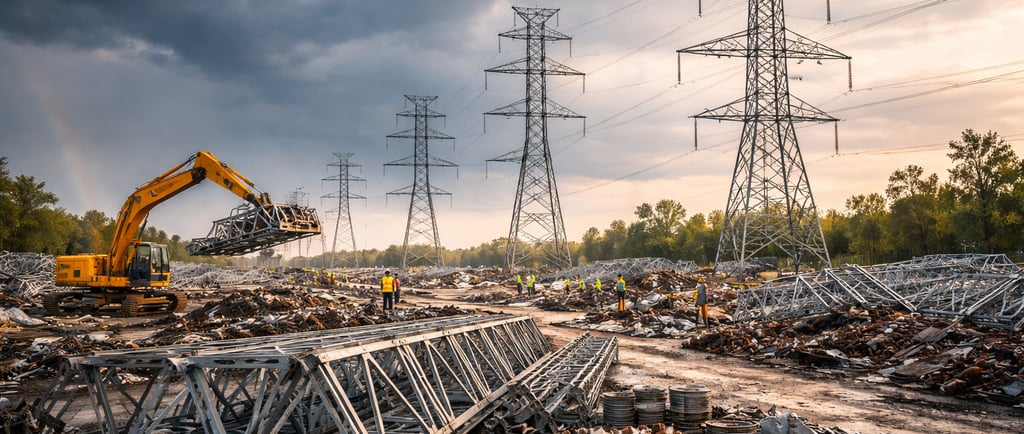
Context: Why Utilities Must Rethink Tower Resilience
As climate change accelerates, utilities around the globe are navigating a new era of risk. The increasing intensity and frequency of hurricanes, ice storms, and inland flooding events threaten the very backbone of the grid—the transmission tower. According to the U.S. Department of Energy, more than 70% of major electrical outages in recent years were directly linked to extreme weather (DOE, 2023). For utilities, this means not only facing spiraling emergency response costs, but also heightened regulatory scrutiny and reputational exposure.
Transmission towers are more than steel skeletons; they represent multi-million-dollar investments carrying the lifeblood of modern economies—power. When a single storm can topple hundreds of miles of lines and supporting structures, the ripple effects include data center downtime, cell tower failures, and interruptions to hospitals and schools. Outdated “rip and replace” methods compound these risks. They slow down the utility’s ability to bounce back, generate tonnes of metal waste destined for landfills, inflate expenses, and lock the sector into a high-carbon supply chain at a moment when public and regulatory expectations are pivoting towards sustainability.
The race is on to redefine what makes an asset “resilient.” It’s no longer just about brute strength; it’s about agile restoration, material circularity, and the ability to rebuild better, faster, and greener. As electric utilities set decarbonization goals and regulators demand emissions tracking across grid assets, the intersection of resilience and sustainability has become the new competitive battleground.
Why Is This Shift Inevitable?
Financial Pressure: Climate-driven outages cost U.S. utilities over $30 billion annually (CNA, 2022).
Regulatory Evolution: State mandates such as California’s SB 350 now set specific targets for climate resiliency and embodied carbon in all utility infrastructure.
Public Scrutiny: Stakeholders expect not just reliable power but proof that the grid is being rebuilt with future climate threats—and carbon budgets—in mind.
Utilities that lean into low carbon, storm-hardened, and modular tower designs—especially those prioritizing circular materials—are positioned to minimize downtime, optimize resource efficiency, and maintain stakeholder trust in a decarbonizing world.
2. Defining the Problem: Post-Storm Tower Failure and Waste
As severe weather slams grid corridors, conventional infrastructure models falter. Utility crews responding to hurricane or ice storm damage often encounter tangled clusters of downed towers, many built decades ago from virgin steel alloys now flagged for their high carbon footprint. Immediate priorities include rapid assessment, restoring flows to critical customers, and managing the tremendous surge in metal debris.
The Core Risks and Pitfalls
Safety and Restoration: Crews must quickly stabilize any downed high-voltage structures, sometimes facing hazardous accessibility due to floodwaters or debris fields.
Procurement Delays: Global supply chain disruptions since 2020 have made sourcing new steel and tower components slower and more expensive. Custom-fabricated replacement parts may take weeks or months to arrive.
Material Waste: Traditional salvage is often manual and uncoordinated; much structurally sound steel, aluminum, and hardware is treated as disposable. This approach not only drives up landfill costs and emissions but also wastes an opportunity for rapid circular reuse.
Regulatory Compliance: Increasingly, regulators require detailed waste and emissions reporting. Utilities lacking a salvage and reuse protocol risk both fines and lost insurance recoveries.
Quantifying the Impact
Waste Volume: A typical transmission corridor may yield 100–500 tons of scrap steel per major storm event.
Carbon Footprint: Producing new steel emits roughly 1.9 tons CO2-e per ton—reusing material can cut this by half or more (World Steel Association, 2023).
Lost Time: Utilities using outdated salvage protocols report restoration times up to 50% longer than those with modern, pre-planned reuse frameworks.
Innovative utilities now recognize that every downed tower is a resource, not just a liability: each modular section that can be repurposed directly saves money, time, and emissions while supporting climate-resilient grid recovery.
3. Key Concepts: Resilience, Infrastructure, and Recycled Metals
Understanding the building blocks of resilient, circular infrastructure is essential for utilities, investors, and stakeholders focused on future-proofing the grid. Let’s break down the core concepts—each one central to designing and delivering effective, low-carbon transmission solutions.
Resilience
Transmission tower resilience refers not just to the ability of the towers to withstand hurricane-force winds, flying debris, or ice loading, but also their capacity for rapid functional recovery. This includes modular construction, advanced coatings that extend service life, and built-in tracking systems for swift salvage operations after disasters.
Example Attribute: Towers with bolted joints vs. welded—easier to dismantle, inspect, and reuse, enabling faster recovery.
Low-Carbon Infrastructure
Low-carbon infrastructure in the grid context extends from design and material selection to construction, operation, and post-end-of-life recycling. Utilities are increasingly required to provide emissions tracking evidence—from the sourcing of recycled metals to the final assembly of the tower.
Recycled Metals
Modern recycled steel and aluminum are almost indistinguishable (in terms of mechanical properties) from their virgin counterparts, provided they are properly certified. In fact, the U.S. and European grid sectors now require minimum recycled content targets for new infrastructure: up to 70% for steel, and even higher for aluminum.
Circular Materials
Beyond recycling, circular materials strategies set out to “close the loop” by continuously reusing existing tower sections, hardware, and foundations wherever possible. These systems are underpinned by digital registries, QR asset tags, and standardized salvage plans, ensuring maximum resource capture after storms.
Storm-Hardened Design
Storm-hardened towers do not simply “add weight.” Instead, they leverage next-gen design tools to optimize shape, material, and connection type for local climate risks. For example, salt-resistant coatings extend longevity in hurricane-prone coastal corridors, while modular upper crossarms make rapid replacement possible.
Grid Hardening
This refers to a holistic utility strategy: from prioritizing climate-resilient corridors, to installing advanced surveillance, to routine storm drills and team training. Grid hardening is integral to minimizing outage risks and maximizing the value of every recycled and reusable grid component.
4. The Resilient Tower Reuse Framework
The Resilient Tower Reuse Framework, or Circular Resilient Tower Method, is a step-change in how utilities approach transmission tower lifecycle management. This system centers on modular, storm-hardened structures built with high-recycled-content metals and end-to-end digital traceability.
Framework Stages:
Design: Use tower blueprints prioritizing bolted, modular segments, with each part manufactured from at least 70% post-consumer or scrap-based metals. Attach QR tags for detailed tracking and digital records.
Material Sourcing: Carefully select suppliers that can certify recycled content and chain of custody. This assures both emissions reduction and compliance with evolving state and federal mandates.
Deployment: Standardize field assembly practices. By moving away from on-site welding to bolted connections, utilities ensure that future disassembly for reuse or recycling is safe and efficient.
Inspection & Maintenance: Implement predictive inspection routines, using drones, smart sensors, and digital asset management software to log and update the structural health and salvageability of each section.
Response & Salvage: After severe weather events, deploy rapid response teams with standardized checklists to triage towers. Systematically dismantle, test, and sort undamaged sections for reuse or fast-tracked recycling.
Reuse & Recycle: Redirect re-certified, undamaged metal sections to new or emergency repair projects. Log emissions and recovery metrics for both internal benchmarking and regulatory reporting.
The Competitive Edge
Utilities employing this framework consistently report:
Restoration timelines shortened by 30–50%
Total lifecycle cost reductions
Readiness to meet “embodied carbon” standards set by investors and regulators
By adopting this framework, utilities unlock the potential for resilient and sustainable grid modernization, positioning themselves as industry leaders in storm recovery and environmental compliance.
5. Step-By-Step: Applying Circularity to Tower Projects
Circularity isn’t just a buzzword—it's a practical set of steps that utilities can follow to harden assets, minimize waste, and track carbon savings. Each step integrates best practices from leading grid operators and lessons learned from severe-weather rebuilds.
Detailed Actions Checklist
Climate and Risk Profiling: Conduct high-resolution climate risk mapping for all major corridors, with predictive analytics to prioritize high-threat regions.
Modular Design Selection: Opt for tower designs that use interchangeable, standardized modules. For high-risk areas, specify reinforced bases and corrosion-resistant fasteners.
Specify Recycled Content: Institute minimum recycled content for procurement: aim for at least 70% in major structures, matching or exceeding industry benchmarks.
Digital Asset Tagging: At manufacture or installation, equip every major section with a unique QR or RFID tag, logging specs, recycled content, and chain of custody data into the asset management platform.
Condition Monitoring Upgrades: Embed advanced coating and fatigue sensors to extend inspection cycles and simplify identification of reuse candidates post-storm.
Post-Event Salvage and Inspection: Deploy trained teams who can rapidly field-segregate reusable from recyclable and scrap components.
Salvage Protocols & Templates: Utilize regulator- and insurer-approved salvage plan templates, ensuring all documentation needs are anticipated and recovery is maximized.
Closed-Loop Reuse: Set up regional holding depots and surge logistics plans to efficiently integrate recovered sections into repair or replacement schedules.
Performance Tracking: Continuously update recovery rates, emissions impacts, and QA scores in centralized dashboards for both internal review and external reporting.
Continuous Improvement: Feed lessons and field data into new design specifications and procurement planning, ensuring the framework evolves as risks and regulations change.
6. Example: Post-Storm Rebuild Using Recycled Steel Towers
Case studies underscore the value of this approach. Consider a southeastern U.S. utility whose transmission line crossing a major floodplain was decimated by Hurricane Andros (a composite scenario based on industry reporting).
Rebuild in Action: The Hurricane Andros Response
Situation: 40 towers collapsed, with debris scattered over 15 miles. The company’s prior investment in modular, high-recycled steel towers paid dividends.
Salvage & Recovery: Using QR-tagged sections, recovery teams quickly identified 55% of base segments and 70% of crossarms as structurally sound and fit for reuse.
Restoration Timeline: The ability to reuse pre-certified, undamaged modules meant that restoration was completed within 7 days—five days faster than the regional average for similar-scale incidents.
Environmental Impact: Over 600 tons of new steel production was avoided, equivalent to a 1,200-ton reduction in CO2-e emissions—meeting both state resiliency standards and internal sustainability KPIs.
Long-Term Benefit: Recovered metal, digitally re-certified, was rapidly redeployed for grid upgrades elsewhere, tightening the utility’s resource loop and reinforcing a reputation for both speed and environmental leadership.
7. Submittals and QA: The Paper Trail That Decides Whether Reuse Is Fast or Frozen
Storm recovery does not fail only in the field. It often fails in the paperwork. A utility may recover hundreds of tonnes of tower steel after a hurricane, but if it cannot prove origin, metallurgy, coating condition, dimensional fit, inspection status, and chain of custody, that steel will sit in a yard instead of going back into service. That is becoming a bigger issue as public agencies and major owners place more weight on Environmental Product Declarations, facility-specific emissions data, and traceable material records. The U.S. General Services Administration now requires product-specific, third-party verified EPDs for low-embodied-carbon steel purchases under its IRA material rules, with specific GWP thresholds by product category such as 686 kgCO2e/t for unfabricated hot-rolled sections in the top 20% tier and 987 kgCO2e/t for structural steel plate from electric arc furnaces in the same tier. The Federal Highway Administration has also made clear that EPDs are no longer niche sustainability paperwork. They are useful for project-level and network-level life cycle assessment and asset management decisions.
For transmission towers, that means a publish-ready reuse program needs a disciplined submittal stack. At minimum, every reusable section should move with its original mill data if available, its geometry and connection record, coating history, field damage notes, non-destructive test results where required, and a clear disposition tag that says one of three things: ready for direct reuse, reuse after refurbishment, or recycle only. FEMA and EPA debris guidance both point in the same direction here. Separate material streams early, protect recyclables and reusable items from contamination, and resolve staging, handling, and compliance issues before the next storm, not during it. When utilities skip segregation and documentation at the debris yard, they lose value twice. First in time, then in material quality.
A strong QA process for storm-hardened towers should also treat reused steel as an engineered asset, not a salvage gamble. That means written acceptance criteria for straightness, bolt-hole elongation, section loss, coating adhesion, galvanizing repair, and connection-face integrity. It also means clear hold points. For example, a lower-leg section with minor coating damage may pass visual screening, but if it came from a floodplain collapse, you may require additional coating thickness checks, ultrasonic thickness readings at splash-zone exposure points, and a sign-off by a designated materials engineer before release. This sounds strict, but strict is what makes reuse bankable with insurers, regulators, and internal capital teams.
A useful way to think about QA is to divide the recovered inventory into three lanes. Lane one is direct redeployment, typically for components with clean traceability, no structural distress, and only minor handling damage. Lane two is refurbishment, where blasting, regalvanizing, recoating, bolt replacement, or limited shop correction can return the piece to service. Lane three is circular recycling, where the section no longer makes sense for structural reuse but still carries major value as feedstock. That last lane still matters. World Steel notes that every tonne of steel scrap used avoids about 1.5 tonnes of CO2, while the International Aluminium Institute reports that recycled aluminium uses about 8.3 gigajoules per tonne versus 186 gigajoules for primary aluminium, a 95.5% energy saving. In a tower corridor with mixed steel and aluminium hardware, those numbers turn salvage discipline into a real carbon and procurement story, not a public-relations footnote.
Imagine two post-storm yards after the same cyclone. Yard A piles tower legs, diagonals, bolts, insulators, and conductor hardware into mixed heaps. Crews torch-cut tangled sections for trucking convenience. Three weeks later, the utility has scrap revenue, but little direct reuse. Yard B uses pre-issued component IDs, QR scans, quarantine zones, and a simple disposition workflow on tablets. Within 72 hours, it has a list of reusable base panels, members needing coating repair, and plate that should move straight to the recycler. Both yards handled the same debris. Only one produced an inventory that could accelerate restoration. That is why submittals and QA are not an afterthought. They are the difference between a circular recovery plan on paper and one that actually works.
8. Measurement Plan: What You Track Is What You Improve
Utilities already measure outage duration and frequency. That is necessary, but it is not enough for tower reuse. A serious measurement plan has to connect resilience, material recovery, carbon, safety, cost, and speed. NERC’s 2024 State of Reliability is useful here because it treats transmission resilience as something that can be quantified across severe weather events, not just described. NERC identified 11 large weather-caused transmission events in 2023 and tracked restoration statistics for them. DOE’s resilience grant guidance also pushes recipients toward five-year baselines and consistent project metrics over time. In other words, the sector is moving from broad claims to evidence.
For tower projects, the core metrics should start with restoration. Measure time from storm landfall to corridor access, from access to triage completion, from triage to first re-energized segment, and from event start to full restoration. Then separate those numbers by build type. How do modular bolted towers perform versus legacy welded structures? How do corridors with pre-positioned reusable modules compare with corridors that rely on fresh fabrication? Once utilities break the numbers out this way, they stop talking about resilience in generic language and start seeing where the delay really sits.
Next, track circularity with the same seriousness. Useful measures include percentage of recovered tower mass diverted from landfill, percentage directly reused in the same network, percentage reused after refurbishment, percentage sent to certified recyclers, and percentage lost to contamination or unknown status. World Steel reports that in 2022 the industry recycled around 650 to 700 million tonnes of steel scrap, saving around 1 billion tonnes of CO2 emissions, while average new steel products contain about 30% recycled steel. That gives utilities an external benchmark. You do not need to beat the global steel sector. You do need to know whether your post-storm program is getting better year after year.
Carbon metrics should be practical, not academic. A good utility dashboard can estimate avoided embodied carbon from direct reuse, avoided virgin steel demand from recycling, transport emissions from moving recovered sections, and emissions intensity of new replacement steel based on EPD values. GSA’s low-embodied-carbon steel requirements show where procurement is going. A utility that already gathers product-specific EPDs and facility-specific data where available will find it much easier to justify resilient rebuild spending in a world where public funding, investor pressure, and procurement policy increasingly care about embodied emissions.
Then come the commercial metrics. Measure cost per restored tower, cost per mile restored, avoided emergency fabrication spend, avoided disposal fees, scrap or recovery revenue, and insurance support tied to documented salvage. Add safety metrics too: recordable incidents during debris handling, percentage of recovered pieces inspected before movement, and number of nonconforming reused components caught before installation. The point is not to build a bloated KPI deck. The point is to show, with discipline, that reuse is reducing risk rather than shifting it.
A useful mini-scenario makes this real. Say a coastal utility loses 28 towers across two corridors. In year one, with no formal reuse program, it restores full service in 16 days, landfills or shreds most debris, and buys urgent replacement steel at peak market rates. In year three, after adding pre-event tagging, depot storage, and inspection rules, a similar event hits. This time the utility restores full service in 11 days, directly reuses 32% of recoverable mass, refurbishes another 18%, and cuts emergency procurement by a quarter. The storm is still expensive. The difference is that the utility now has proof that the new method changes the outcome.
9. Patterns That Work: Mini-Scenarios from the Field
The first pattern is simple. Utilities that plan before the storm recover faster after the storm. EPA’s disaster debris guidance stresses pre-incident planning for reuse, recycling, staging, permits, and end markets. NREL’s resilience planning work reaches a similar conclusion from the power side. Standardized, comprehensive data collection and clear investment prioritization improve resilience planning quality. In practice, that means the best storm recovery programs do not invent their salvage logic under pressure. They write it, test it, and assign it before the first warning bulletin arrives.
The second pattern is that stronger structures alone are not enough. Hardening works best when paired with monitoring, sectionalization, storage, and local backup capability. DOE’s 2024 report to Congress on grid resilience shows this clearly. In Louisiana, one selected project is expected to avoid more than 609 million minutes of customer interruptions by combining system hardening with a microgrid and battery storage, including replacing more than 90 towers with 150 mph wind-rated designs. That matters because storm-hardened towers reduce structural failure, but local support systems reduce the size and duration of the outage when failures still occur.
The third pattern is that digital visibility closes the gap between inspection and action. The IEA notes that digitalisation improves outage insight and helps develop preventative measures, while its review of AI in energy highlights examples where predictive maintenance reduced outages by up to 30% and where sensor-backed machine learning cut cable outages by 15%. Applied to transmission towers, the message is clear. If you can see component condition earlier, you can repair more selectively, stock more intelligently, and decide faster which storm-damaged pieces deserve a second life.
Consider a mountain utility facing heavy icing. It has older lattice towers in one district and newer bolted modular towers in another. After a severe ice storm, both districts take damage. The legacy district spends days figuring out exactly which fabricated members are bent, which bolt patterns still match, and which replacement pieces must be custom-made. The modular district uses depot stock and digital records to swap standardized bracing sets and base assemblies. Even when both districts face similar weather, one is running a repair operation and the other is running a puzzle. That distinction becomes more important as weather volatility rises and supply chains remain uneven.
Another pattern is regional flexibility. DOE’s 2024 Grid Modernization Strategy states that increased transmission interconnection between regions improves resilience to extremes of weather and physical disasters. That has a direct tower implication. If you are rebuilding major corridors for a more interconnected grid, then tower design, spare policy, and material recovery should not be siloed by district. A reusable inventory system that can support emergency restoration in multiple regions gives each recovered section more strategic value. It is no longer just a leftover part from yesterday’s storm. It becomes tomorrow’s contingency stock.
10. Pitfalls That Quietly Kill a Good Reuse Program
The biggest pitfall is mixing salvage ambition with weak acceptance rules. Some utilities say they want circular recovery, but their engineering teams do not trust field decisions and their contractors are paid by tonnage moved, not value preserved. The result is predictable. The salvage yard fills up, the paperwork lags, and internal confidence collapses. Reuse then gets blamed for delay when the real issue was poor governance. The fix is to set decision rights clearly. Who can quarantine a member, who can release it, who can downgrade it to scrap, and who signs the final structural acceptance? Without that chain, the program becomes a warehouse, not a recovery engine.
The second pitfall is contamination. EPA warns that pre-incident planning helps improve the characteristics of debris to support safe reuse and recycling by reducing contamination. In tower work, contamination is not limited to hazardous substances. It includes lost identity, poor handling, cross-mixed hardware, torch damage, corrosion from long wet storage, and undocumented substitutions. A perfectly reusable leg section can be ruined simply by dragging it across a rubble field, stacking it improperly, or leaving it uninspected through a wet season.
The third pitfall is measuring the wrong thing. A utility may celebrate scrap tonnage sold while ignoring restoration speed, direct reuse rate, and avoided purchase cost. That misses the real target. Circular recovery is not a metal-recycling side business. It is a resilience tool. The right question is not “How much scrap did we sell?” It is “How many days, dollars, and tonnes of CO2 did we avoid by turning damaged assets into usable stock?” World Steel’s data on scrap savings and steel recovery rates show how large the opportunity can be, but only if utilities count the full value chain.
The fourth pitfall is buying for strength while forgetting service life. If a replacement tower is stronger but harder to inspect, harder to disassemble, or tied to unique fabricated members with long lead times, you may have improved one risk and increased another. The lesson from recent resilience programs is that better grid performance often comes from combinations of measures. Stronger wind ratings, modular members, better monitoring, automation, depot stock, and local backup each do part of the job. Utilities that chase single-point fixes often spend heavily and still get stuck in the next major event.
11. Future Trends: Where Storm-Hardened Tower Strategy Is Heading Next
The first clear trend is that climate pressure is moving from background risk to design input. NOAA’s climate risk work notes 24 U.S. billion-dollar disasters through November 1, 2024 with documented losses of $61.6 billion, and emphasizes that actual losses are higher once uninsured and indirect effects are included. The IEA also points to more frequent or intense extreme weather and to the resulting physical damage, losses, and transfer constraints across transmission and distribution systems. In plain terms, design assumptions based on the weather of 20 years ago are becoming less credible. Tower replacement, retrofit cycles, and spare strategies will increasingly be tied to forward-looking hazard bands, not only historical averages.
The second trend is policy pressure on embodied carbon. Buy Clean rules, low-carbon material grants, and EPD requirements are building a new commercial reality in infrastructure procurement. GSA now sets steel GWP limits by category and requires third-party verified EPDs, while EPA’s cleaner construction materials work is pushing for more consistent emissions reporting. For utilities, this means storm restoration and capital renewal are starting to converge. The tower you specify for resilience may also need to satisfy a carbon threshold, a reporting standard, and a sourcing expectation. Reuse becomes more attractive in that setting because the cleanest tonne of steel is often the one you do not have to make again.
The third trend is deeper digital inspection. The IEA has already highlighted AI-backed monitoring for power assets, including examples from E.ON and Enel. DOE’s AI for Energy report also points to near-term uses of AI to improve grid performance. Over the next few years, expect more utilities to connect drone imagery, LiDAR, weather feeds, corrosion records, and prior outage history into condition models that rank tower components by failure risk and reuse potential. That matters before storms because it sharpens pre-positioning. It matters after storms because it shortens triage.
The fourth trend is more pressure from load growth. The IEA expects global electricity demand to grow by an average of 3.4% annually through 2026. DOE’s grid work also underscores how aging assets and electrification are colliding at the same time. If demand keeps rising while extreme weather gets harsher, utilities will have less tolerance for long replacement lead times and less room for slow rebuild methods. That favors tower systems built for interchangeability, fast inspection, and reuse. It also favors regional stock strategies and cross-utility mutual support that include component libraries, not just crews.
12. Advanced Toolkit Guidance and Conclusion: How to Build a Program That Still Works on the Worst Day
A mature storm-hardened tower program needs a practical toolkit, not slogans. Start with a corridor risk register that combines wind, flood, salt exposure, icing, wildfire adjacency, terrain access, and expected annual loss inputs. NREL’s resilience planning research points to structured hazard characterization, attribute metrics, performance metrics, threat-risk analysis, investments, and investment prioritization as core elements of serious planning. Use that logic at the corridor level, then tie each corridor to a design family, spare rule, and salvage plan.
Next, build a component passport system. Each major member should carry a persistent ID linked to geometry, steel grade, coating specification, install date, repair history, inspection notes, and end-of-life route. If you already maintain asset management software, this does not need to be a grand technology project. It can begin with QR labels and a clean data model. The point is to make every piece legible during chaos. When a storm drops ten towers in swamp access conditions, legibility saves days. It also makes your EPD and carbon reporting easier because the material record is already attached to the asset.
Then set up three physical support layers. First, a regional storm depot with standardized members, bolts, coatings, and temporary restoration kits. Second, a reuse yard layout with quarantine, inspection, refurbishment, and recycle-only zones. Third, pre-negotiated recycler and fabricator agreements that kick in automatically after a major event. EPA and FEMA guidance both stress the value of pre-incident planning, staging discipline, and separation of recoverable streams. Utilities that already know where materials will go do not lose the first week arguing over yard space, permits, or contracts.
You also need a field decision kit. That should include a triage checklist, photo standards, damage codes, coating repair thresholds, NDT triggers, and transport rules for suspect members. Pair it with a simple digital dashboard that shows quantities by status, expected release date, and likely deployment corridor. The IEA’s work on digitalisation is useful here because it makes the broader point that better data does not just lower operating costs. It reduces unplanned outages, improves resilience, and shortens downtime by helping operators identify failure points faster. That same logic applies to storm salvage.
Finally, build the business case in language your finance and regulatory teams will accept. Use a five-year baseline. Show avoided outage minutes, avoided emergency procurement, avoided disposal costs, avoided embodied carbon, and any improvement in SAIDI or storm restoration time. DOE’s resilience reporting already points utilities in that direction, and recent funded projects show that hardening plus local support systems can produce measurable interruption savings and stronger monitoring capability. A tower reuse program is easiest to defend when it stops sounding like a waste initiative and starts reading like a reliability and capital-efficiency plan.
The larger point is this: storm-hardened transmission towers should no longer be treated as single-life assets in a multi-hazard world. The grid is aging, electricity demand is rising, and severe weather is becoming a more expensive design condition. At the same time, steel and aluminium recovery offer major carbon and resource gains, and procurement rules are shifting toward better traceability and lower embodied emissions. Utilities that join these threads now will recover faster, buy less virgin material under pressure, and build a transmission estate that gets stronger with each rebuild rather than more costly and more exposed. That is what modern resilience looks like. It is not only the ability to stand through the storm. It is the ability to come back with speed, proof, and less waste the morning after.
Connect
Your trusted partner for scrap metal procurement.
CONTACT
About
haroon@tdcventures.com
+1-307-655-7593
© 2025. All rights reserved.
NEWSLETTER