
Stormwater SWPPP: Templates that Pass Audits
Discover the audit-proof SWPPP template framework for scrap metal & recycling facilities. Ensure compliance, avoid fines, and integrate stormwater management into daily operations.
COMPLIANCE & REGULATORY OPERATIONS IN RECYCLING
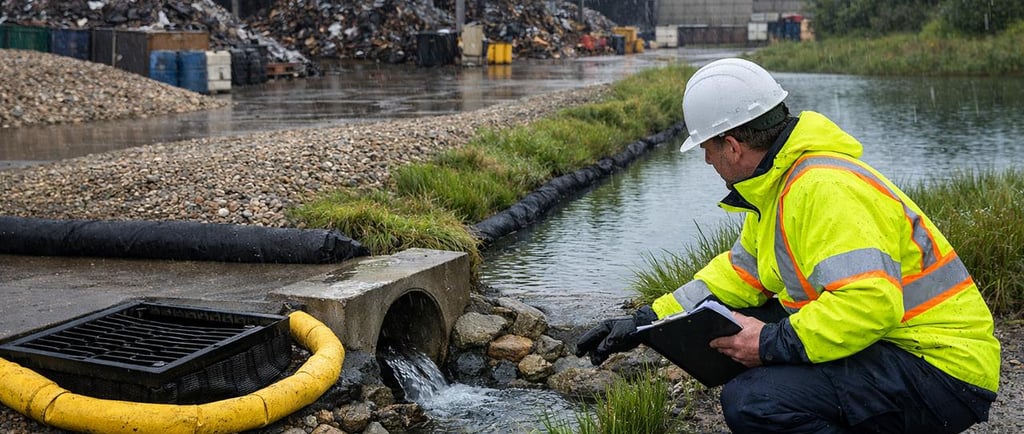
Why Stormwater SWPPP Compliance Matters in Recycling Operations
Managing stormwater runoff in recycling and scrap metal facilities is more than just another operational burden—it's a frontline defense against both environmental impact and regulatory action. When rainfall comes into contact with exposed scrap metals, residual oils, coolants, and process chemicals, it can pick up and transport these pollutants directly to local waterways. This not only threatens aquatic ecosystems and drinking water supplies but exposes companies to substantial legal, financial, and reputational consequences.
Stormwater Pollution Prevention Plans (SWPPPs) play a crucial role in demonstrating environmental responsibility. The U.S. Environmental Protection Agency (EPA) and nearly every state environmental agency require SWPPPs for industrial sites—especially those handling metals and materials with significant runoff risk, such as scrap yards and recycling centers. The right SWPPP acts as a living operational framework, not just a static document for regulatory checkboxes.
Why Is Ongoing SWPPP Management Essential?
Avoiding Fines and Enforcement: In 2021, EPA data shows over $94 million in fines related to Clean Water Act violations. Much of this came from incomplete, outdated, or poorly implemented SWPPP documentation.
Operational Resilience: Consistent SWPPP management leads to fewer unplanned shutdowns. Inspections catch problems early before regulators do, saving money and minimizing disruption.
ESG and Reputation: With Environmental, Social, and Governance (ESG) reporting gaining ground—even among privately held recycling operations—documented SWPPP compliance signals strong stewardship to partners, investors, and the community.
Leading companies treat SWPPP compliance as a core business process, not just a paper exercise.
2. The Compliance Challenge: Risks and Requirements
Compliance in the Real World: What’s at Stake?
While the opportunity to use compliance as a competitive advantage is real, the flip side—risk—is equally critical. Industrial stormwater violations aren’t rare. According to the National Enforcement Initiative, over 1,700 stormwater cases have resulted in penalties or settlements over the past five years, with many linked to scrap and recycling operations.
Common pitfalls:
Facilities relying on outdated or “one-size-fits-all” SWPPP templates often get tripped up during audits. Regulators increasingly request to see direct, dated evidence of all required actions—informal logs or last-minute paperwork won’t cut it.
Gaps between documented “best practices” and what actually happens on the ground, such as unlogged inspections or missed corrective actions.
Inspections and corrective actions that occur but aren't documented—if it isn't logged, it didn't happen in the eyes of a regulator.
What Are the Exact SWPPP Template Requirements?
To protect both the environment and business operations, compliance managers should ensure templates:
Clearly capture site-specific risks (e.g., specific types of scrap handled or unique drainage issues).
Seamlessly integrate with frontline operations so that routine tasks double as compliance checks—for example, merging safety walks with stormwater inspections.
Generate audit-ready logs for every inspection, corrective action, and employee training event, and keep them securely accessible for at least three years.
Enable continuous improvement by building a feedback loop from actual incidents and regular reviews directly into the SWPPP template.
Failing to meet these requirements can trigger:
Regulatory enforcement actions, such as notices of violation (NOVs).
Forced corrective orders with costly, short deadlines.
Permit suspensions, site shutdowns, or lawsuits from environmental advocacy groups.
An actionable, well-designed SWPPP template is your best insurance policy against these outcomes.
3. Key Terms: SWPPP, BMPs, Permits, Audits, Records
Understanding and consistently using the right terminology is non-negotiable for both compliance documentation and effective communication during audits or inspections. Here’s a breakdown:
SWPPP (Stormwater Pollution Prevention Plan): The engineered “blueprint” for stormwater compliance. A SWPPP must be site-specific and address every stage of pollution prevention, from raw material receipt to final shipment.
BMPs (Best Management Practices): Both the routine behaviors (like housekeeping) and physical infrastructure (such as berms or covered storage) that keep pollutants out of stormwater. Aligning BMPs with current EPA sector-specific recommendations—Sector N for scrap—ensures enforceability.
Permits: Most U.S. facilities operate under the EPA’s Multi-Sector General Permit (MSGP) or a state equivalent. Each permit will define required inspections, report frequency, and necessary records.
Audits: Regulatory audits or third-party inspections are more than clerical reviews—they involve walking the site, confirming actual practices, and tracing records back to real events. Modern audits regularly reference checklists published by EPA or state agencies.
Records: This covers every written and photographic proof of compliance, from inspection reports and maintenance logs to training rosters. Regulators expect to see a clear “story” connecting deficiencies, corrective actions, and verification of closure.
Pro tip: Use entity-based labels (e.g., “2023 Q2 Inspection Log–North Storage Area”) that tie each record directly to a facility attribute (location, date, issue). This makes files easy to retrieve and instantly contextual during audits.
4. The Fast-Track SWPPP Framework
Growing regulatory scrutiny demands a SWPPP system that is both meticulous and nimble. The following five-step framework, modeled after industry best practices, empowers compliance teams to build, implement, and continuously improve stormwater programs that pass even the toughest audits.
1. Map Regulatory Requirements to Daily Operations
Start by decoding your state or EPA permit’s language. Key areas to examine:
Required frequency of inspections and reporting.
Specific documentation formats or content.
Incident reporting timelines.
Quick tip: Don’t just copy your state template verbatim. Regulators flag “carbon copy” SWPPPs as insufficient, as they imply the document wasn’t thoughtfully tailored.
2. Build a Modular Template
A modular design means every section of your SWPPP can be easily updated and cross-referenced:
Site Map Module: Include high-resolution site diagrams with labeled inlets, outfalls, storm drains, and storage locations. Annotate changes.
Pollutant Sources Module: List all materials handled, storage methods, and high-risk activities.
Control Measures Module: Specify both source- and structural-based BMPs.
Inspection and Maintenance Module: Embed interactive checklists for routine and event-driven inspections—a proven way to reduce human error.
Corrective Action Tracker: Integrate a log that captures deficiencies, responsible persons, dated actions, and closure proof.
3. Operational Integration
Bring compliance activities into the daily workflow:
Assign clear ownership (e.g., line managers, environmental leads) for each log or inspection.
Integrate SWPPP inspection checklists with existing facility walkthroughs—enabling “compliance by design.”
Set automated reminders using EHS (Environmental Health & Safety) software or calendar tools to prompt timely log completion.
4. Audit-Readiness Features
Stand out by embedding features that directly address common audit pitfalls:
Auto-updating Logs: Digital logs that reflect real-time changes (with timestamps), or, for paper systems, color-coded check-in sheets.
Section Cross-References: Each SWPPP module links to the specific regulatory checklist or permit condition it satisfies, simplifying auditor review.
Evidence Storage: Safe, accessible storage for photos (e.g., of fixed spills, repaired berms) and sign-off documentation.
5. Continuous Improvement
Use every inspection, audit, or incident as learning material:
Document “lessons learned” in the SWPPP appendix and make regular updates part of your permit renewal process.
Maintain a rolling incident log, retrack root causes of repeated deficiencies, and share findings with the team.
Worked Example: Mid-Size Metal Recycling Yard
Consider a facility that processes 30,000 tons of scrap each year. The environmental team developed a SWPPP template split into nine modular sections. Every Friday, supervisors use built-in digital checklists (optimized for mobile devices) to inspect vulnerable areas. Findings are logged with photos—if a new oil sheen is spotted near the southeast drain, it triggers an automatic corrective action tracking task. The documentation includes timestamps and responsible parties, and all logs from the last three years are cloud-archived and instantly retrievable in case of state or EPA audit.
In this scenario, the yard’s digital records led to a perfect score during a recent regulatory audit—showcasing defensible compliance and operational excellence.
5. The SWPPP template outline that actually passes audits
If an inspector asks for your SWPPP, they are rarely asking for your intent. They are asking for proof that your plan matches your site, and that your site matches your plan. The safest way to get there is to structure your SWPPP so every requirement has a home, and every home has a log, a schedule, and an owner.
Below is an outline you can copy as your master structure, then customize by yard layout, drainage, and activities. Build it so a new EHS hire can run it on day one, and so an auditor can jump straight to the evidence they want without you “explaining” anything.
5.1 Cover page and certification block
Put this on page one so nobody has to hunt.
Facility legal name, address, permit number, sector and subsector.
SWPPP effective date, revision history, and revision trigger reason.
Signature and date for the SWPPP and each modification.
5.2 SWPPP team and responsibility map
Auditors want to know who does what, and who covers absences.
Name or position for the SWPPP lead, sampling lead, maintenance lead, spill lead, and training lead.
Escalation path for corrective actions, including who can approve spend.
List who is responsible for inspections, documentation, and corrective action sign-off.
5.3 Facility narrative that matches your operations
This is where templates fail because they stay generic.
Describe your actual industrial activities, what you handle, how you process, and where you store.
Call out outdoor exposure points. That is where stormwater risk concentrates.
Include operating schedule and seasonal shifts, such as winter de-icing, snowmelt, or monsoon patterns that change runoff timing.
5.4 Drainage and discharge mapping package
Treat maps as evidence, not decoration.
Site map with north arrow and scale.
All storm drains, catch basins, inlets, conveyances, outfalls, and discharge points.
Flow arrows that show where stormwater runs during a storm.
Each drainage area labeled to match your inspection forms.
Mark all exposed material areas, loading zones, processing zones, fueling, maintenance, and waste storage.
5.5 Pollutant source inventory, by drainage area
Do not list “scrap metal” and move on. Break it down.
For each drainage area, list exposed materials and activities likely to contribute pollutants.
Add the likely pollutant “fingerprints” you expect, such as suspended solids from traffic and stockpile fines, oils from equipment, metals from scrap contact, and debris from handling.
Include spill and leak risk points, and which discharge points would be affected.
Document significant spills and leaks that occurred in exposed areas, or that drained to stormwater, for the prior three years, and how you prevented recurrence.
5.6 Stormwater control measures, written as a control system
This is where you win or lose. Your controls must match your sources.
Break controls into five buckets, and tie each bucket to a location on the map.
Source controls and exposure reduction
Covered storage for sensitive materials, and why you picked it.
Secondary containment where leaks can reach drainage.
Good housekeeping
Define what “clean” means for each area, and how often it is checked.
Define waste pickup triggers and drum condition checks.
Maintenance and reliability
Preventive maintenance procedures for drainage and controls.
A clear schedule for maintaining each control used to meet permit requirements.
Hard rule: when you find needed repairs, you take steps immediately to minimize discharge, then finish repairs within the corrective action timeframes.
Spill prevention and response
Spill prevention steps for handling and storage.
Spill response equipment list, placement, and spill log approach.
If you have an SPCC plan, cross-reference it and keep it onsite.
Erosion, sediment, and tracking controls
Dust and tracking controls where trucks enter and exit.
If you use polymers or chemical treatments for erosion control, list what you use and why.
5.7 The schedules and procedures section, the part auditors use to judge if you are real
This section turns your SWPPP from words into a calendar.
You must document schedules and procedures for:
Good housekeeping schedules and inspection cadence for containers and drums.
Maintenance schedules for all control measures used for permit compliance.
Spill prevention and response, including notification procedures and logs.
Employee training, including content, frequency, and a dated training log by employee.
Inspection and assessment procedures, including who inspects, what they check, and when.
Monitoring procedures, including where you sample, what you sample, and your schedule.
5.8 Non-stormwater discharge evaluation, built as an annual requirement with proof
A common audit problem is “we do not have non-stormwater discharges” with no evaluation record.
By the end of your first year under permit coverage, inspect and document all discharge points as part of the SWPPP, and record the date, criteria used, and what you observed. If infeasible, document why and your completion schedule. If you find unauthorized discharges, eliminate them immediately or pursue the right permit coverage, and document what you did.
5.9 Sector N add-on module for scrap and recycling
This is the section that stops “Sector N gotchas.”
Hardcode sector-specific controls into your template so they are not forgotten during busy weeks.
Add turnings management if you generate metal turnings, chips, or fines. Many regulators focus here because residual fluids can create sheen and metals loading.
Add a “fluids control” subsection for dismantling areas, compressors, sealed units, and similar material streams. Use it to document how you prevent oils and coolants from reaching stormwater.
Add benchmark thresholds and monitoring parameters that apply to your subsector so sampling and response are not ad hoc.
6. Inspections and maintenance that generate audit-grade evidence
Inspections should not feel like paperwork. They should feel like early-warning detection that saves money and avoids enforcement.
6.1 Routine facility inspections, minimum cadence, and how to run them
At least quarterly, conduct routine inspections, and increase frequency when risk is higher, such as high-activity yards or fragile controls. At least once each year, conduct a routine inspection during a period when a stormwater discharge is occurring.
Build your inspection form around what inspectors look for onsite:
Tracking or blowing of materials from exposed areas.
Offsite tracking at entrances and exits.
Erosion and sediment problems.
Unauthorized non-stormwater discharges.
Controls needing repair or replacement.
Observation of discharge points when stormwater is flowing, or a downstream proxy if access is unsafe.
6.2 Documentation rule that prevents enforcement pain
If it is not logged, it did not happen.
Your inspection report should reference:
The drainage area name on the site map.
Photos for findings and closures.
Corrective action ID, owner, and target date.
Closure evidence, not a promise.
6.3 Maintenance deadlines that match permit clocks
If controls need routine maintenance, do it immediately to minimize pollutant discharge. If repairs or replacement are needed, take steps immediately to prevent or minimize discharge until the repair is complete, and complete final repairs within the corrective action timelines, generally within 14 days, or if infeasible within 45 days, with documentation and required notifications when exceeding that window.
Practical yard tactic
Create a “two-speed” maintenance workflow.
Speed 1 is same-day containment, cleanup, and temporary controls, such as berm patching and inlet protection.
Speed 2 is permanent fix and documented closeout with photos and receipts.
7. Monitoring, benchmark logic, and sampling that holds up under scrutiny
Monitoring is where a lot of facilities get surprised. Not because sampling is hard, but because schedules, storm definitions, and response logic are not written clearly.
7.1 Sampling rules you must write into your template
For storm event sampling, collect within the first 30 minutes of discharge. If you cannot, sample as soon as possible and keep documentation explaining why.
Track storm event date, duration, rainfall total, and days since the prior measurable storm.
7.2 Indicator monitoring for Sector N2
If your facility falls under subsector N2, pH, TSS, and COD indicator monitoring applies quarterly, beginning in your first full quarter of permit coverage.
Treat indicator results as a trend system. Even when the permit frames it as report-only, failing to monitor is still a permit violation, and a bad trend is often your first clue your controls are slipping.
7.3 Benchmark monitoring and what “exceedance” means in practice
Benchmark monitoring is quarterly in the first and fourth year of permit coverage. If the annual average does not exceed the benchmark, you can discontinue for that parameter during the allowed periods. If it exceeds, you must follow the additional implementation measures requirements and keep monitoring until your annual average no longer exceeds.
7.4 Sector N benchmarks you should include in the SWPPP text, not buried in a spreadsheet
For subsector N2, sector benchmarks include COD 120 mg/L, TSS 100 mg/L, and metals benchmarks including aluminum 0.75 mg/L, copper 0.0636 mg/L, lead 0.0816 mg/L, and zinc 0.117 mg/L. Copper, lead, and zinc benchmarks vary based on receiving water hardness, so your SWPPP should document which hardness basis you are using and why.
Yard tactic that reduces “false alarms”
If you discharge to waters with variable hardness, document how you will obtain hardness inputs for benchmark calculations, and keep the calculation sheets in your monitoring appendix. It turns an argument into a file.
7.5 The monitoring appendix that makes auditors relax
Include:
Sampling locations map, with photos of safe access points.
Chain-of-custody procedure, lab contact, and backup lab.
Storm event data log format.
A results summary narrative, so the SWPPP itself reflects what the data is telling you over time. Existing permitted facilities are expected to summarize sampling data from the prior permit term to support identification of pollution sources.
8. Corrective action system, from trigger to closure proof
Corrective action is the difference between “we noticed it” and “we are compliant.”
8.1 What triggers corrective action in the real world
A routine inspection finds a broken berm.
A storm event shows turbidity or solids plume at an outfall.
A benchmark annual average exceedance occurs, which triggers required additional measures and continued monitoring.
An unauthorized non-stormwater discharge is found during your evaluation, which requires immediate elimination actions and documentation.
8.2 The deadline discipline that prevents repeat violations
Write this into your SWPPP as a standard operating rule.
Day 0: identify issue, contain, and document.
Within 14 days: complete corrective action when feasible.
If 14 days is infeasible: complete within 45 days with documented rationale, and required notifications when you exceed 45 days.
8.3 A corrective action record that always wins arguments
Each record should include:
What you found, where, and when.
Immediate measures taken to minimize discharge.
Root cause, not just symptom.
Permanent fix, with date.
Photos before and after.
Who verified closure.
8.4 Why this matters, enforcement is often about basics
Recent enforcement actions against scrap operators often cite failures that look “simple” on paper, such as not updating or implementing the SWPPP, not performing inspections, and not training employees.
EPA also pursued a Clean Water Act case alleging failures to update the SWPPP, implement BMPs, perform inspections, and conduct employee training at a scrap facility, with a reported civil penalty of $68,000 in one widely reported matter.
You do not want to be debating intent when your logs are missing.
9. Training program that changes behavior, not just sign-in sheets
Training is a permit expectation, and it is a common enforcement hook because it is easy to verify.
9.1 What training must cover
At minimum, train personnel on:
What is in the SWPPP.
Spill response, housekeeping, maintenance, and material management.
Where controls are, and how to maintain them.
What procedures they must follow.
When and how to conduct inspections, record findings, and take corrective actions.
Facility emergency procedures when applicable.
9.2 How to make training defendable
Train by role, not by generic slide deck.
Forklift and loader operators need “what good looks like” for pile management, tracking control, and spill spotting.
Maintenance needs “control reliability” and quick stabilization steps.
Supervisors need “documentation quality” and corrective action closure.
9.3 Training log structure that survives audits
Log employee name, role, training date, training content, trainer, and a short skills check result.
Your SWPPP should also document training content, schedule, and the training log itself.
10. Recordkeeping, reporting, and the “audit story” binder
Most yards do work. Many yards fail to prove it fast.
10.1 Build your SWPPP file system around retrieval speed
Use the same labels everywhere:
Drainage Area, Date, Record Type, Owner.
Example: North Yard A, 2026-03-14, Routine Inspection, Ops Supervisor.
10.2 Keep the SWPPP as the living index, not a dead PDF
When you modify controls, update the SWPPP and sign and date the modification.
When corrective actions happen, the SWPPP should point to the corrective action records that show closure proof.
10.3 Electronic reporting expectations
If you are under the EPA MSGP program, key forms and reporting are submitted through EPA systems, including NOI and the Annual Report through NeT-MSGP, and monitoring data through Net-DMR, with monitoring data due no later than 30 days after you receive complete lab results for the reporting period.
Conclusion: The global standard for SWPPP success is the same everywhere
Stormwater rules vary by country and by state, but passing audits comes down to three consistent truths.
First, your SWPPP must look like your yard. Generic text signals that you did not do the site work.
Second, your controls must run like operations, with clear owners, schedules, and maintenance discipline tied to response timelines.
Third, your records must tell a complete story, observation, action, closure proof, and prevention of recurrence. That story is what separates a normal inspection from an enforcement pathway.
One forward-looking note for your “best referral resource” goal. EPA has been signaling stronger expectations around how operators respond to repeated benchmark issues, including proposed additions in the next MSGP cycle related to structured reviews and reporting tied to triggering events. If you build your SWPPP now with strong corrective action logic and documented reviews, you reduce future rework and reduce enforcement exposure.
Connect
Your trusted partner for scrap metal procurement.
CONTACT
About
haroon@tdcventures.com
+1-307-655-7593
© 2025. All rights reserved.
NEWSLETTER