
Supply Chains for Rapid Rebuilds: Metals Focus
Explore how steel, aluminum, and recoverable metals power rapid rebuild supply chains for climate recovery, disaster housing, and circular infrastructure—cutting waste, slashing carbon, and speeding up safe reconstruction.
CLIMATE-RESILIENT INFRASTRUCTURE & CIRCULAR MATERIALS
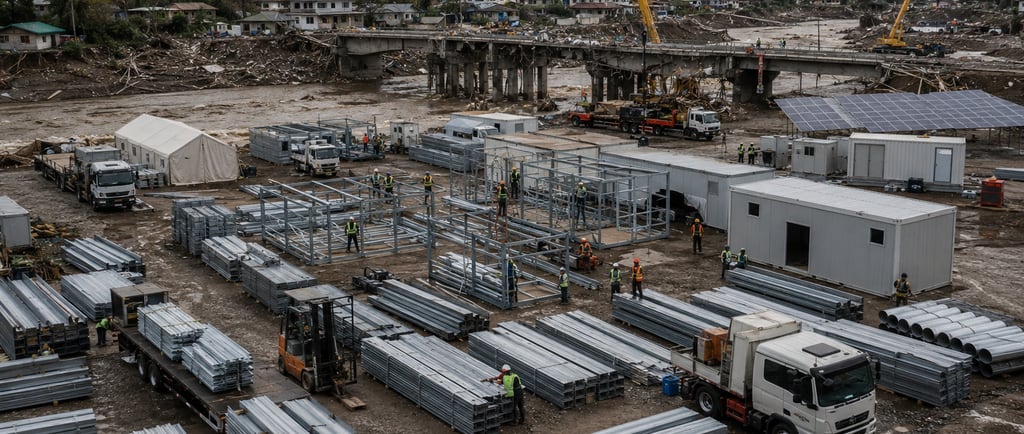
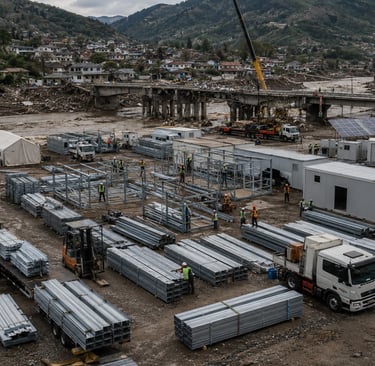
In 2026, the speed of rebuilding after disasters is no longer measured only by how fast crews can pour concrete, import timber, or install temporary shelters. It is measured by how quickly a city, region, or relief agency can locate materials, prove their quality, move them through blocked transport routes, assemble them safely, power them, track them, maintain them, and recover them for future use.
That is why metals sit at the center of modern rapid rebuild planning.
Steel, aluminum, and other recoverable metals are the backbone of shelters, bridges, clinics, water systems, mobile energy units, storage yards, sanitation blocks, and temporary-to-permanent buildings. They are strong enough for repeated use, valuable enough to recover, and flexible enough to support modular construction. In a world facing floods, wildfires, earthquakes, heat waves, conflict damage, and climate migration, metal supply chains can decide whether recovery takes weeks or years.
The pressure is rising. The Internal Displacement Monitoring Centre reported that 82.2 million people were living in internal displacement at the end of 2025, the second-highest figure ever recorded. Disaster displacements reached 29.9 million in 2025, still above the past-decade average, while conflict-related displacement also reached record levels. These figures matter for construction and metals because displacement is not only a humanitarian issue. It is also a logistics, infrastructure, procurement, housing, and materials issue. Every large displacement event creates urgent demand for shelters, frames, roofing, road repair, power systems, water infrastructure, drainage, fencing, medical posts, and storage facilities. (The Guardian)
The World Bank’s Groundswell report warns that climate change could force up to 216 million people to move within their own countries by 2050 across six major regions. That forecast does not mean all movement will happen suddenly, but it does show why governments and aid buyers need material systems that can respond repeatedly, across decades, rather than one-off emergency purchasing after each crisis. (worldbank.org)
Metals are critical because they work across both timelines. They help build fast in the first 72 hours, first 30 days, and first year after a disaster. They also retain long-term value when shelters are relocated, repaired, expanded, sold, recycled, or stored for the next event. Steel can be recycled repeatedly without losing its core properties, and every tonne of steel scrap used avoids about 1.5 tonnes of CO₂, 1.4 tonnes of iron ore, 740 kilograms of coal, and 120 kilograms of limestone, according to the World Steel Association. (iea.blob.core.windows.net) Aluminum has a similar role in lightweight frames, cladding, solar mounting systems, roofing, windows, mobile clinics, and electrical components. The International Aluminium Institute states that recycled aluminum uses about 95.5% less energy than primary aluminum, based on 186 gigajoules per tonne for primary aluminum versus 8.3 gigajoules per tonne for recycled aluminum. (International Aluminium Institute)
This changes the question for disaster recovery teams. The issue is not only “Where can we buy materials?” The better question is “Where can we find verified, reusable, recoverable metals close enough to deploy fast, safe enough to use, and documented enough to circulate again?”
Context: Why Metals Supply Chains Matter for Rapid Rebuilds
The built environment is one of the biggest pressure points in climate response. Buildings and construction account for a large share of global emissions, material extraction, labor, and public spending. The 2025 to 2026 Global Status Report for Buildings and Construction from UNEP and the Global Alliance for Buildings and Construction states that the sector represents 11% to 13% of global GDP, employs around 9% of the world’s workforce, accounts for roughly 37% of global CO₂ emissions, and uses nearly 50% of global material extraction. (UNEP - UN Environment Programme)
That means every rapid rebuild has two jobs. It must restore safety quickly, and it must avoid locking disaster-hit communities into wasteful, expensive, high-carbon rebuilding patterns.
Traditional reconstruction often fails on both counts. Materials arrive late. Temporary units remain in use longer than planned. Low-grade products degrade under heat, wind, salt, floods, or repeated relocation. Procurement teams buy what is available in the moment, then lose track of where assets went. When the next crisis hits, the process starts from zero again.
Metals can break that cycle when they are managed correctly. Reused steel frames, certified secondary steel, aluminum roofing, modular metal trusses, galvanized posts, containerized utility units, light-gauge steel framing, and metal-based microgrid structures can be designed for repeated assembly and dismantling. This matters in climate migration settings because many “temporary” sites last years. A shelter that is assembled in 48 hours but cannot be repaired, cooled, powered, moved, or recovered becomes a future liability.
Steel also brings scale. World crude steel production was about 1.88 billion tonnes in 2024, with China producing just over 1 billion tonnes and India producing nearly 150 million tonnes. This gives the global economy a huge steel base, but it also exposes recovery projects to price swings, regional shortages, trade controls, freight disruptions, mill lead times, and quality differences. (Wikipedia) A disaster buyer cannot assume that global abundance means local availability. After a flood, fire, earthquake, or storm, the right steel may exist, but it may be trapped in the wrong country, wrong format, wrong length, wrong grade, wrong certification status, or wrong customs channel.
That is why rapid rebuild planning needs regional metals maps before disaster strikes. These maps should identify demolition yards, fabrication shops, steel service centers, modular building suppliers, scrap processors, transport yards, port access points, rail links, bridge repair contractors, roofing stockists, battery container suppliers, and mobile crane operators. A region that knows its available metal stock before a disaster can respond faster than a region that begins sourcing after roads are already damaged.
Problem Definition and Operational Stakes
Disaster recovery creates abnormal demand. Housing, transport, water, sanitation, power, education, and health services all need materials at the same time. The market is then forced to serve emergency shelter buyers, local rebuild contractors, public works departments, aid agencies, private homeowners, insurers, and commercial buyers at once.
The result is predictable. Prices rise. Lead times stretch. Lower-quality suppliers enter the market. Documentation gaps increase. Buyers compete instead of coordinating. Materials move to the highest bidder rather than the highest public need.
Pakistan’s 2022 floods show the scale. The post-disaster needs assessment estimated total damage at $14.9 billion, economic losses at $15.2 billion, and recovery and reconstruction needs at $16.3 billion. Housing damage alone was estimated at $5.6 billion, while transport and communications damage reached $3.3 billion. Roads, railways, bridges, homes, drainage, schools, clinics, and agriculture-linked infrastructure all needed repair at the same time. (thedocs.worldbank.org)
The housing shock was enormous. Around 780,000 homes were destroyed and more than 1.27 million were partially damaged, while thousands of kilometers of roads and railway tracks were affected. (Springer) In this type of event, rapid rebuild supply chains do not fail because one material is missing. They fail because many systems need materials at once, and because those materials must be moved through flooded, damaged, or congested routes.
The Türkiye and Syria earthquakes in February 2023 created a different but equally important lesson. The disaster killed tens of thousands of people, destroyed or damaged vast numbers of buildings, and forced large-scale use of container cities and temporary housing. A year later, many survivors were still living in temporary settlements, while permanent housing delivery lagged far behind need. (The Guardian) The lesson for metals is clear. Containers, steel-framed units, fencing, cranes, temporary bridges, warehouse sheds, utility poles, water tanks, and repair materials are not side items. They are part of the first recovery wave.
Ukraine shows the long-rebuild version of the same problem. The 2026 Rapid Damage and Needs Assessment estimated Ukraine’s recovery and reconstruction needs at almost $588 billion over the next decade, with total damage of about $195.1 billion as of December 31, 2025. Housing, transport, and energy are among the most affected sectors. (worldbank.org) For steel, aluminum, copper, and other metals, this is not a single procurement event. It is a decade-long materials challenge involving substations, rail, bridges, schools, hospitals, homes, heating systems, water networks, and industrial capacity.
Maui’s 2023 wildfires show another important reality. Even in a high-income setting, temporary housing can become a multi-year need. FEMA extended temporary housing assistance for Maui wildfire survivors through February 2027, years after the original August 2023 disaster. (Maui Recovers) This matters because “temporary” infrastructure often needs long-term maintenance, energy reliability, corrosion protection, fire safety, storm resistance, and asset tracking. A metal shelter or modular unit that is planned for six months may end up housing families for three years.
The operational stakes are therefore practical and immediate.
First, poor metals planning extends displacement. If frames, roofing, fasteners, panels, bridge parts, power containers, or water system supports are late, people remain in tents, schools, hotels, camps, or damaged homes longer.
Second, weak quality control creates safety risk. Steel of unknown origin, corroded members, mismatched bolts, uncertified welds, thin roofing, contaminated scrap, or reused components with hidden fatigue can turn an emergency shelter into a hazard.
Third, poor tracking wastes money. If agencies cannot identify where metal assets went, who installed them, what grade they were, how long they were used, and whether they can be recovered, every disaster becomes a fresh purchase.
Fourth, linear procurement creates carbon and waste. The steel sector accounts for about 2.8 gigatonnes of CO₂ per year, or around 8% of total energy system emissions, according to the IEA. (IEA) If rapid rebuild systems rely only on new material, rushed manufacturing, and disposal after use, disaster recovery becomes part of the emissions problem.
Key Concepts and Definitions
Climate migration means the movement of people linked to climate stress, including floods, drought, sea-level rise, extreme heat, storms, water scarcity, land degradation, and related economic pressure. It may happen suddenly after a disaster or slowly as livelihoods become harder to sustain. It can be internal or cross-border, but the largest forecasts focus on internal movement because most people move within their own countries first.
Rapid rebuilds are recovery projects that restore shelter, services, access, and basic infrastructure under emergency conditions. They include temporary shelter villages, modular clinics, bridge repairs, school replacements, microgrid sites, sanitation blocks, storage compounds, water towers, road repairs, drainage systems, and temporary-to-permanent housing.
Circular infrastructure is infrastructure designed so its components can be reused, repaired, redeployed, recycled, or resold instead of discarded. In metals, this means using standard sizes, bolted connections, accessible fasteners, durable coatings, clear grade records, digital asset tags, and dismantling plans.
Reused steel means steel components taken from a previous use and used again with inspection, testing, documentation, and fit-for-purpose design. This is different from recycled steel. Reused steel keeps the component in or near its existing form, such as beams, columns, frames, plates, posts, containers, or trusses. Recycled steel is melted and remade. Both matter, but reuse usually preserves more embodied value because the component avoids remelting.
Secondary metal means metal that comes from scrap or recovered sources rather than primary extraction. Secondary aluminum, recycled steel, recovered copper, and processed scrap can reduce energy use and emissions when properly sorted, tested, and processed.
Microgrids are local power systems that can operate independently or alongside a main grid. In rapid rebuilds, they usually combine solar panels, batteries, inverters, control systems, backup generation, and metal support structures. They power shelters, clinics, water pumps, lighting, cold storage, communications, and charging stations.
Emergency procurement means buying under urgent conditions with shortened timelines, special approvals, and higher pressure. Good emergency procurement does not mean skipping controls. It means using pre-approved suppliers, faster documentation, clear thresholds, and rapid testing.
Asset tagging means giving each component a unique identity through QR codes, NFC tags, RFID labels, stamped IDs, digital records, or geolocation. For metals, tags should connect each beam, frame, container, roof panel, bridge plate, generator skid, or battery enclosure to grade, origin, inspection status, location, maintenance, and recovery plan.
Material passports are digital records that describe what a component is, where it came from, what it contains, how it was tested, where it was installed, and how it can be reused later. For rapid rebuilds, a basic material passport is often enough: grade, dimensions, coating, supplier, test date, batch number, installation location, and next inspection date.
A circular procurement marketplace is a system where buyers can find reusable and secondary materials from verified suppliers. For disaster recovery, the most useful version is regional, because speed depends on distance, border rules, loading capacity, and transport access.
The Circular Rebuilds Operating Model: Fast, Safe, Recoverable
A metals supply chain for rapid rebuilds should be built around four phases: assess, source, deploy, and recover. These phases overlap during a real crisis, but separating them helps teams plan clearly.
Phase 1: Rapid Assessment
The first phase begins before materials move. Teams must understand who is displaced, what infrastructure failed, what access routes remain open, what hazards are active, and what materials are needed.
This assessment should use satellite imagery, local authority reports, mobile survey data, drone mapping where allowed, supplier stock records, transport status, and community-level reporting. New research continues to show that real-time displacement monitoring is improving through the use of mobile phone location data, social media signals, and traditional humanitarian datasets. A 2025 study on dynamic displacement estimates argued that faster, more granular data can improve resource allocation in complex crises, including cases such as Ukraine and the 2022 Pakistan floods. (arXiv)
For metals, rapid assessment should answer specific questions. How many shelters need metal frames or roofing? Are bridges, culverts, or road barriers damaged? Are clinics and schools structurally safe? Is there a need for temporary towers, fencing, flood barriers, ramps, stairs, lighting poles, or water tank stands? What wind, snow, heat, flood, seismic, salt-air, or fire conditions must the materials handle?
The assessment must also map available supply. This includes stock at fabricators, mills, steel service centers, salvage yards, demolition contractors, port warehouses, modular construction suppliers, rail depots, container yards, electrical contractors, solar installers, battery suppliers, and public works stores. A supplier 80 kilometers away with verified steel and working trucks may be more useful than a cheaper supplier 900 kilometers away behind customs delays.
Phase 2: Source and Stage
Once demand is clear, buyers should source in batches. Batch sourcing groups materials by function, grade, location, and urgency. For example, roof sheets and fasteners may move first, structural frames second, fencing third, and microgrid skids fourth. This prevents high-value trucks from waiting for incomplete loads and lets receiving teams inspect material in organized groups.
Proximity matters. Every kilometer adds cost, delay, fuel use, security risk, and damage risk. However, local sourcing must not override quality. Reused and secondary metals need inspection. Structural steel should be checked for dimensions, corrosion, deformation, cracks, weld quality, grade markings, coating condition, and prior use. Aluminum should be checked for alloy type, corrosion, dents, fatigue, and compatibility with fasteners. Copper and electrical metals need theft-risk control, insulation checks, and contamination review.
Staging hubs are the bridge between sourcing and deployment. A good hub is close enough to the affected area to reduce delivery time but far enough from floodwaters, unstable roads, unrest, fire risk, or aftershock zones. It needs forklifts, cranes, weighbridges where possible, secure storage, lighting, inventory control, testing space, and clear lanes for incoming and outgoing trucks.
The staging hub should also act as the first quality gate. Materials with no paperwork, visible damage, contamination, or mismatched specifications should be held until cleared. In rushed disaster work, this step protects lives and budgets.
Phase 3: Deploy and Assemble
Deployment is where design choices become visible. A steel shelter designed for bolted assembly can be installed faster, inspected more easily, and dismantled later. A shelter that depends on field welding, custom cuts, undocumented fasteners, and mixed components will slow down crews and create future waste.
Modular metal systems should use standard spans, standard connectors, repeatable roof angles, replaceable panels, and clear load paths. Field teams should be trained before disasters, not during them. Local labor should be included wherever possible, because recovery also needs income. A displaced community that can assemble, repair, and maintain its own shelter stock becomes less dependent on external contractors.
Quality checks during assembly should be simple and strict. Crews should confirm anchor points, bolt torque, bracing, roof fixings, panel overlap, drainage, ventilation, sharp edges, electrical grounding, fire separation, and access for people with limited mobility. For reused steel, non-destructive testing may be needed for higher-risk structural components. Lower-risk items such as fencing, storage racks, temporary partitions, or non-load-bearing supports still need visual checks and safe installation.
Phase 4: Run, Monitor, Maintain, and Recover
Rapid rebuilds fail when teams leave after installation. Metal assets need maintenance. Roof screws loosen. Coatings scratch. Salt air accelerates corrosion. Floodwater contaminates lower members. Solar panel mounts need inspection after wind. Battery containers need ventilation and fire safety checks. Water tank stands need load checks. Temporary bridges need traffic controls.
Each asset should have a maintenance schedule from day one. In a shelter site, this may include weekly roof checks, monthly corrosion checks, quarterly anchor inspections, and post-storm reviews. In a microgrid site, it may include electrical safety checks, battery temperature logs, inverter performance, grounding checks, and structural inspection of panel mounts.
Recovery planning should also start on day one. Every major metal asset should have a next-life plan. Can it remain as part of permanent housing? Can it be moved to another site? Can it be returned to a stockpile? Can it be repaired? Can it be sold into a local reuse market? Can it be recycled at end of life? Without this plan, the asset becomes unmanaged scrap.
Implementation Playbook: A Practical Guide for Metals-Based Rapid Rebuilds
A strong metals supply chain starts before the crisis.
Governments, NGOs, port authorities, aid buyers, construction firms, and metals traders should build regional supplier lists that include verified yards, fabricators, stockholders, modular builders, transport firms, testing labs, crane companies, and installers. Each supplier profile should include material types, monthly capacity, loading equipment, certifications, previous emergency work, payment terms, transport reach, and documentation ability.
The first step is incident forecasting. Teams should map likely hazards by region: floods, storms, earthquakes, wildfire, heat, landslide, conflict damage, coastal surge, or drought-linked migration. Each hazard creates different metal needs. Flood zones need raised platforms, galvanized frames, drainage grates, bridges, culverts, and corrosion-resistant fasteners. Wildfire zones need non-combustible cladding, roofing, utility poles, and storage structures. Earthquake zones need ductile systems, bracing, safe connections, and rapid structural assessment tools.
The second step is material stock mapping. This should include both new and recoverable sources. Demolition contractors may know which beams, columns, trusses, and decking can be recovered. Scrap processors may hold heavy plate, pipe, beams, rails, and machinery parts. Steel service centers may hold certified stock ready for cutting. Fabricators may hold offcuts useful for brackets, connectors, and repairs. Container yards may hold units that can be converted into clinics, storage, workshops, or service rooms.
The third step is supplier audit. Each supplier should be scored on response speed, paperwork, quality consistency, ability to load mixed orders, transport partners, testing access, financial reliability, and past performance. In disaster work, a low price from an unreliable supplier is expensive. A delayed truck can leave a clinic without power, a shelter site without roofing, or a road repair crew without plate.
The fourth step is customs and border preparation. Cross-border disaster supply often fails because materials are stuck in paperwork. Pre-agreed emergency import codes, aid exemptions, product descriptions, packing lists, mill certificates, fumigation requirements for packaging, tax handling, and inspection rules can save days. This matters for islands, landlocked countries, and regions dependent on port access.
The fifth step is transport readiness. Rapid rebuild teams need at least two routes for critical materials. If the main road floods, a rail siding, barge route, port transfer, or military logistics route may become essential. Heavy metals require loading equipment, weight checks, road permits, bridge capacity reviews, and secure yards. Light-gauge framing and aluminum systems need protection from bending, scratching, and theft.
The sixth step is testing and quality control. Portable spectrometers can help identify metal composition. Ultrasonic testing can detect hidden flaws. Visual inspection can catch corrosion, distortion, weld damage, missing coatings, and unsafe cuts. For structural components, engineers must match material condition to use. A reused beam may be suitable for a storage shed but not a bridge. A corroded frame may be acceptable after cleaning and coating for a non-critical shelter extension but not for a clinic roof.
The seventh step is assembly planning. Designs should use standard parts. A shelter kit should not depend on rare fasteners, special equipment, or single-supplier parts. Instructions should work for local crews, not only engineers. Components should be numbered, packed by build sequence, and paired with spare fasteners.
The eighth step is power integration. Metal supply chains connect directly to energy recovery. Solar arrays need aluminum rails or galvanized steel mounts. Batteries need steel enclosures, racks, lifting points, ventilation, and fire separation. Clinics need stable power for refrigeration, lighting, sterilization, communications, and medical devices. Water pumps need power. Lighting improves safety. Without energy planning, shelter sites remain incomplete.
The ninth step is digital tracking. A QR code on a beam is useful only if the record behind it is useful. Each tagged asset should include supplier, grade, dimensions, coating, inspection status, installation date, location, maintenance notes, and recovery plan. For low-connectivity areas, teams need offline records that sync later.
The tenth step is after-action review. After every deployment, the team should record which suppliers delivered, which materials failed, which transport routes worked, which components were over-specified, which were under-specified, how much material was recovered, how much was recycled, and what should be pre-positioned next time.
Decision Guide: How to Avoid Common Failure Points
If reused steel is available, the first question is not whether it is cheaper. The first question is whether it is suitable. Check grade, dimensions, condition, prior use, corrosion, deformation, and documentation. If the component will carry load, involve a qualified engineer. If it is non-structural, inspection can be lighter, but it should still be documented.
If supplier traceability is weak, isolate the material. Do not mix unknown steel with certified batches. Use third-party testing where risk justifies cost. If the material cannot be verified, downgrade it to lower-risk use or send it to recycling.
If transport is uncertain, split the load. Do not put all roofing, all fasteners, or all energy equipment on one route. Send critical connectors and tools separately when possible. A site with frames but no bolts is still a failed delivery.
If assembly stalls, check three areas first: missing parts, unclear instructions, and site access. Many delays are not caused by lack of labor. They are caused by poor packing, wrong sequence, or blocked movement on site.
If microgrid equipment is delayed, separate critical loads. Clinics, lighting, water pumps, communications, and cold storage should get priority. Backup generators or temporary battery systems can cover life-safety needs while the main system arrives.
Part 2: Metrics, Case Studies, and Forward-Looking Strategies
The Metrics That Matter in Metals-Based Rapid Rebuilds
A rapid rebuild supply chain should be measured by outcomes, not activity. Counting trucks, tonnes, suppliers, or purchase orders is not enough. The real question is whether people received safe shelter and services faster, with less waste, lower cost risk, and more recoverable material.
The first key metric is time to first safe use. This measures how long it takes from incident confirmation to the first occupied shelter, powered clinic, repaired bridge, functioning water point, or operational sanitation unit. For emergency shelter, every day matters. A system that cuts procurement time by one week can reduce exposure to heat, cold, disease, violence, and income loss.
The second metric is time to full service coverage. A site may have some shelters operating quickly, but full coverage includes lighting, water, sanitation, cooking areas, drainage, waste handling, access routes, disability access, clinics, and communications. Metals appear across this whole chain, not only in shelter frames.
The third metric is verified material share. This measures how much steel, aluminum, and other metal arrived with proper inspection, documentation, and grade confidence. A high verified share reduces safety risk and helps future reuse.
The fourth metric is reused and recycled content. Teams should track how much material came from reuse, how much came from recycled inputs, and how much came from primary production. This matters because steel and aluminum have large emissions footprints, while scrap-based and reuse-based paths can reduce energy and carbon impacts. Steel scrap avoids about 1.5 tonnes of CO₂ per tonne used, and recycled aluminum saves more than 95% of the energy required for primary production. (iea.blob.core.windows.net)
The fifth metric is asset recovery rate. If 1,000 tonnes of steel enter a temporary shelter and service site, how much is still usable after one year? How much was repaired? How much was redeployed? How much was lost? How much went to scrap? This is where circular infrastructure becomes measurable.
The sixth metric is maintenance burden. Cheap components often become expensive through repeated repair. Track hours spent on corrosion treatment, roof leaks, fastener replacement, damaged doors, warped panels, structural fixes, and energy system supports. A slightly higher-quality metal system may cost more upfront but save money over three years of use.
The seventh metric is local economic participation. Rapid rebuilds should create local jobs where possible. Track local labor hours, local fabrication, local transport, local repair work, and training. This helps communities move from aid dependence to recovery income.
Case Study 1: Pakistan Floods and the Cost of Rebuilding at National Scale
Pakistan’s 2022 floods remain one of the clearest examples of why materials planning must connect shelter, transport, and climate resilience. The floods affected millions of people, damaged housing at massive scale, and created recovery needs across roads, agriculture, schools, health facilities, water systems, and communications. The PDNA estimated $14.9 billion in damage, $15.2 billion in losses, and $16.3 billion in recovery and reconstruction needs. Housing damage was estimated at $5.6 billion, while transport and communications damage reached $3.3 billion. (thedocs.worldbank.org)
For metals supply chains, Pakistan shows three lessons.
First, housing and transport cannot be separated. If roads, bridges, culverts, and rail links are damaged, shelter materials cannot move on schedule. This makes steel plate, bridge components, culverts, guardrails, cranes, and repair equipment part of shelter response.
Second, recovery must consider flood exposure. Metal components in flood zones need corrosion planning, elevated design, strong anchoring, and maintenance access. Unprotected steel in wet environments can fail faster than planned. Aluminum may be useful in roofing and lightweight assemblies, but it still needs compatible fasteners and proper detailing to avoid galvanic corrosion.
Third, owner-driven reconstruction needs material guidance. The World Bank approved additional financing in 2024 for the Sindh Flood Emergency Housing Reconstruction Project, building on an original $500 million project and supporting hundreds of thousands of multi-hazard resilient core housing units. (worldbank.org) For metals, this means local builders and households need clear rules on safe roofing, tie-downs, posts, fasteners, door frames, window frames, and flood-resistant detailing.
Case Study 2: Ukraine and the Decade-Long Metals Demand of Reconstruction
Ukraine’s reconstruction shows that rapid rebuilds can become long national recovery programs. The 2026 RDNA estimated almost $588 billion in recovery and reconstruction needs over the next decade, with housing, transport, and energy among the most damaged sectors. (worldbank.org)
The metals demand in this type of recovery is broad. Housing needs structural steel, rebar, roofing, cladding, heating equipment, doors, windows, pipes, and electrical metals. Transport needs bridge steel, rail materials, road barriers, culverts, stations, depots, and repair workshops. Energy needs transformers, substations, towers, steel enclosures, cable trays, battery containers, generator skids, solar mounting systems, and grid repair hardware.
Ukraine also shows why circular recovery matters. Damaged buildings and infrastructure create huge volumes of debris, some of which may contain recoverable metals. A disciplined system can separate usable components, recyclable scrap, contaminated materials, and unsafe debris. This reduces landfill pressure and can feed local repair and reconstruction supply.
The key lesson is that a national rebuild should not treat scrap as waste. It should treat recoverable metals as a strategic material reserve. When tested and sorted properly, recovered steel, copper, and aluminum can support repair industries, local fabrication, and future construction inputs.
Case Study 3: Maui Wildfires and the Long Life of Temporary Housing
The Maui wildfire recovery shows how temporary housing can become a long-term infrastructure issue. FEMA’s Direct Temporary Housing Assistance was extended through February 2027, showing that survivors may depend on temporary solutions for years after a disaster. (Maui Recovers)
For metals, this changes design requirements. A modular unit used for three months can survive with minimal maintenance. A unit used for three years in a coastal environment needs corrosion control, safe stairs and ramps, durable roofing, reliable electrical grounding, stormwater management, secure anchoring, and routine inspection.
Maui also highlights the social cost of slow rebuilding. When families remain in temporary housing for years, the quality of that housing affects health, employment, schooling, privacy, safety, and community stability. Metal-based modular housing can help, but only when it is planned as dignified housing rather than basic storage for people.
Case Study 4: Türkiye Earthquake Recovery and the Role of Modular Metal Systems
After the 2023 Türkiye and Syria earthquakes, container cities and temporary housing became a major part of the emergency response. The disaster showed the value of prefabricated metal systems, but it also exposed the limits of speed without enough long-term capacity. A year after the earthquakes, many survivors still lived in temporary settlements while permanent housing delivery remained behind need. (The Guardian)
This case shows why modular metal systems need two paths from the start. The first path is emergency use: fast shelter, storage, clinics, toilets, kitchens, and offices. The second path is future use: relocation, resale, conversion into permanent service buildings, or recovery into stockpiles.
Container and steel-frame systems should therefore be designed for repair, insulation, ventilation, heat control, weatherproofing, and safe dismantling. A container that becomes too hot, poorly ventilated, or hard to maintain is not a complete shelter solution. The metal box is only the beginning. Livability depends on climate control, shade, airflow, sanitation, power, privacy, and safe site planning.
Forward-Looking Strategies for 2026 and Beyond
The next generation of rapid rebuild supply chains will be judged by readiness before the event. The strongest governments, NGOs, and private suppliers will not wait for disaster declarations to start finding metal.
The first priority is regional metal reserve planning. This does not mean every government must own huge warehouses of steel. It means every region should know where recoverable and deployable metal stock exists. Public agencies can create agreements with demolition firms, scrap yards, steel stockholders, modular builders, ports, and fabricators. These agreements should define emergency pricing rules, inspection requirements, loading times, and priority access.
The second priority is pre-approved designs. Shelter frames, roofing kits, clinic modules, sanitation blocks, storage sheds, solar mounts, pedestrian bridges, ramps, and water tank stands should be designed before disasters. Each design should match locally available materials and tools. A perfect design that needs imported fasteners is weaker than a good design that local crews can build immediately.
The third priority is stock standardization. Mixed metal inventories slow teams down. Standard beam lengths, tube sizes, sheet gauges, bolt types, brackets, clips, and panel dimensions make storage, assembly, repair, and recovery easier. Standardization also helps training. Crews become faster when they build the same safe system repeatedly.
The fourth priority is climate-specific detailing. Flood zones need raised floors, corrosion protection, drainage, and strong anchoring. Hot zones need reflective roofing, shade structures, ventilation, and heat-safe materials. Coastal zones need salt-resistant coatings and fasteners. Snow zones need roof load design. Earthquake zones need ductile connections and bracing. Wildfire zones need non-combustible outer layers and defensible site planning.
The fifth priority is circular contracts. Procurement documents should require recovery plans, asset tags, inspection logs, maintenance schedules, and end-of-use options. Suppliers should be rewarded for recoverable design, clear documentation, and repair support, not only low price.
The sixth priority is local fabrication capacity. Small and medium fabrication shops can produce brackets, frames, doors, grilles, ramps, supports, and repair parts quickly if they have drawings, steel stock, and payment certainty. Training local shops before disasters builds resilience and keeps money in the affected region.
The seventh priority is low-carbon sourcing without slowing response. Emergency buyers should not delay life-saving work while searching for perfect materials. But they can still use a hierarchy. Reuse first where safe. Then high-recycled-content metal where available. Then standard new material where needed. Track the choice and improve the reserve for next time.
The eighth priority is integrated power planning. Every rapid rebuild site should include energy needs in the first material plan. Solar mounting systems, battery enclosures, cable trays, grounding rods, light poles, and secure equipment cages are metal items. If they are missing, the site may have shelter but no safe power.
The ninth priority is digital records that work offline. Disasters often damage connectivity. Asset systems must work on phones or tablets without continuous internet. Field teams should be able to scan, record, inspect, and update later.
The tenth priority is treating scrap yards and metal traders as emergency partners. Many disaster systems overlook them. That is a mistake. Scrap processors, metal brokers, and yards know where material is, how much it weighs, how it can be cut, what it costs, how fast it can move, and which buyers or suppliers are serious. With proper vetting and quality control, they can help governments and NGOs move faster.
Conclusion: Metals Turn Rapid Rebuilds Into Repeatable Recovery Systems
The future of disaster recovery will not be built through one-time purchasing alone. It will be built through prepared material networks, verified suppliers, reusable components, local fabrication, rapid testing, smart staging, and disciplined recovery of assets after use.
Metals are central to that future because they combine speed, strength, repairability, residual value, and circular potential. Steel can frame shelters, repair bridges, hold solar panels, support water tanks, protect clinics, and return to use again. Aluminum can reduce weight, speed installation, resist corrosion in the right applications, and cut energy demand when recycled. Copper and other electrical metals keep microgrids, pumps, clinics, and communications running.
The core lesson for 2026 is simple. Rapid rebuilds cannot depend on panic buying after disaster strikes. They need prepared metals supply chains that already know what exists, where it is, who can verify it, who can move it, how it will be installed, how it will be maintained, and how it will be recovered.
A better rapid rebuild system starts with a map of materials, a list of trusted suppliers, a set of tested designs, a regional staging plan, a quality process, and a recovery plan for every major asset. When those pieces are in place, metals stop being only construction inputs. They become a repeatable recovery resource that can help communities rebuild faster, safer, cleaner, and with less waste after every crisis.
Connect
Your trusted partner for scrap metal procurement.
CONTACT
About
haroon@tdcventures.com
+1-307-655-7593
© 2025. All rights reserved.
NEWSLETTER