
Temporary-to-Permanent: Designing for Reuse
How reuse-driven, temporary-to-permanent infrastructure can transform disaster recovery, cut waste, and build lasting value for communities facing climate migration. Read the full blueprint.
CLIMATE MIGRATION & CIRCULAR INFRASTRUCTURE PLANNING
Context: Why Reuse-Driven Circular Infrastructure Matters
Climate migration is no longer a theoretical risk—it is a measurable, present-day phenomenon impacting millions. Estimates from the World Bank predict that by 2050, over 216 million people could be internally displaced by climate change impacts such as floods, droughts, hurricanes, and sea-level rise. These shifts drive urgent humanitarian needs, placing unprecedented demands on disaster recovery planners, urban infrastructure managers, NGOs, relief donors, and modular builders.
Historically, crisis response has centered on rapid but unsustainable solutions: trailer camps, tent cities, and prefabricated "instant" buildings. While effective in saving lives immediately, these traditional solutions have three persistent failings:
Resource Waste: Most temporary infrastructure is designed for single use. After the crisis, materials often end up in landfills. According to the Ellen MacArthur Foundation, the construction sector generates over a third of global waste—much of it coming from demolition and temporary builds.
Expenses without Legacy: Billions in donor funding are poured into projects that, after the emergency, provide little or no legacy benefit to host communities. Temporary facilities like pop-up clinics and relief camps are dismantled or abandoned, but communities' needs continue to evolve.
Social and Environmental Impact: Lifeless, overcrowded camps erode dignity and safety, while discarded material increases emissions that worsen the climate crisis.
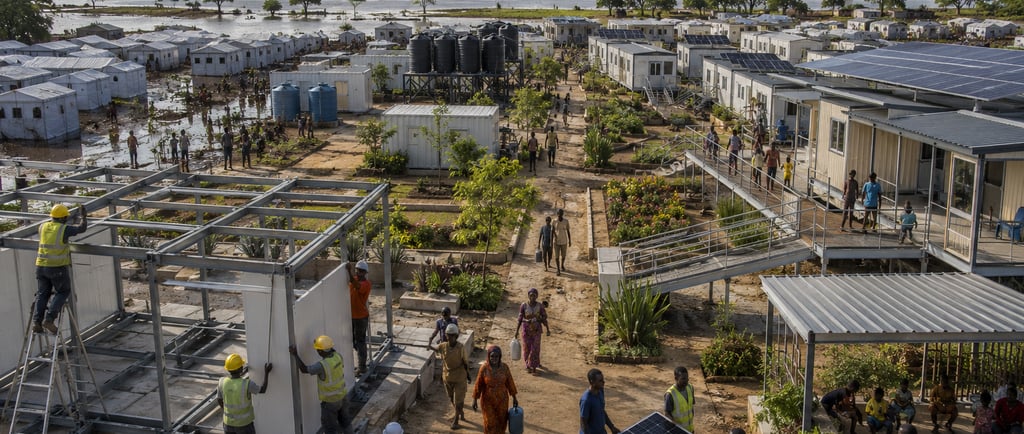
Circular infrastructure challenges this paradigm. By prioritizing the reuse of high-value components (such as modular construction elements, reused steel, and scalable microgrids), we can dramatically reduce waste, cut costs, and elevate the social value of recovery initiatives. A circular approach transforms the initial urgency of disaster recovery into an opportunity: temporary schools, clinics, or housing become foundational building blocks—easily upgraded, repurposed, or relocated as needs shift.
Why it Matters Now:
With climate migration on the rise, cities and responders must integrate resilience into every phase of emergency planning, from immediate relief to long-term redevelopment. In doing so, communities gain adaptive infrastructure ecosystems that increase future-proofing, operational efficiency, and sustainable development outcomes. The result is a powerful synergy: less landfill, lower emissions, and greater human dignity.
2. Defining the Temporary-to-Permanent Framework
The Systemic Problem:
Conventional emergency infrastructure is fundamentally linear—it is constructed, used for a crisis, and then discarded. The result? Mountains of wasted materials, inflated operating budgets, and infrastructure scars that persist long after cameras leave. In 2019 alone, the United Nations Office for Disaster Risk Reduction (UNDRR) reported billions spent on post-disaster shelter, with much of it classified as "single-use investment."
The Emergent Opportunity:
A temporary-to-permanent approach flips the script. By embedding modular, circular thinking into the design phase, assets such as housing pods, clinics, and energy systems are transformed into dynamic, upgradable investments.
Asset Investment: Every dollar spent creates not just immediate shelter, but a future-ready asset—one that can be relocated, upcycled, or integrated into long-term infrastructure planning.
Adaptability: Reused materials like certified steel and prefabricated modular systems grant flexibility. As community needs evolve—from crisis to stabilization—assets shift in role and function, extending their lifecycle benefits.
Benefits at a Glance:
Lower lifecycle costs and reduced embodied carbon
Seamless transition from "temporary" to "permanent" with minimal disruption
Tangible legacy in the form of education, healthcare, and civic infrastructure
This framework is not simply theory; it's being actively piloted by organizations like the Red Cross, UNHCR, and forward-thinking municipal governments.
3. Operational Stakes: What's on the Line?
In disaster recovery and climate adaptation planning, the stakes transcend simple logistics. Each decision reverberates through community health outcomes, environmental footprints, financial stability, and social cohesion.
Speed:
Rapid deployment is often the difference between life and death. Modular construction, especially when leveraging pre-certified reused steel and digital asset passports, can trim deployment times by 30–50% compared to traditional builds. In a world where temporary needs can become semi-permanent, this agility is non-negotiable.
Cost:
Crisis budgets are inherently constrained. Circular infrastructure unlocks savings: reused steel can cost up to 30% less than new, and modular construction methods reduce labor requirements. Additionally, microgrids cut utility costs by leveraging renewables—critical for donors seeking the most impact per dollar.
Resource Scarcity:
With every ton of reused steel or modular panel, funding stretches further. The International Energy Agency notes that steel production is one of the largest sources of global emissions; each ton reused saves approximately 1.5 tons of CO₂ compared to newly produced steel.
Social Impact:
The physical environment shapes recovery. HUMANE design elements—privacy screens, natural daylight, community zones—translate directly into improved health, reduced trauma, and higher participation in education and community activities.
Legacy:
Zombie camps—empty, abandoned shells—signal wasted opportunity. Reused, upgradeable assets can instead seed new schools, clinics, or civic hubs, leaving a positive legacy.
Accountability (ESG and Reporting):
Investors and donors increasingly demand clear environmental, social, and governance (ESG) metrics. Circular infrastructure facilitates transparent reporting on waste reduction, emissions avoided, and community benefit.
4. Key Concepts: Modular, Circular, Humane Design
To build successful temporary-to-permanent infrastructure for climate migration, clear understanding and application of core concepts is essential:
Climate Migration:
Populations are forced to relocate in response to acute hazards (storms, fires, floods) or slower-onset changes (rising seas, prolonged drought). The IPCC reports that climate-related disasters have increased five-fold over the last 50 years.
Circular Infrastructure:
Assets are designed for continuous reuse. Instead of being demolished, components such as steel frames, walls, and energy systems are engineered for disassembly, certification, and redeployment.
Reused Steel:
Harvested from prior builds, recertified for structural applications, and traceable via digital passport systems. The American Institute of Steel Construction demonstrates that reused steel has an equivalent lifespan and load-bearing capacity to virgin materials—when properly inspected.
Microgrids:
Self-contained, decentralized energy networks—commonly combining solar panels with battery storage, sometimes with backup diesel or fuel cell options. These systems operate independently during crises, then plug into broader electricity infrastructure as communities stabilize.
Modular Construction:
Prefabricated units manufactured in controlled environments and quickly assembled onsite. This "kit of parts" maximizes speed, uniformity, and adaptability for multiple use cycles.
Design for Disassembly:
Standardized, universal connection systems (bolts, interlocking panels, ISO corners) enable module separation, transport, and reassembly with minimal skill or equipment.
Humane Design:
A philosophy promoting occupant dignity, health, and inclusion. It focuses on daylight access, indoor air quality, private spaces, and opportunities for social interaction—even in temporary settings.
Statistical and Case Study Evidence: What Reuse-Driven Infrastructure Already Proves
The strongest argument for temporary-to-permanent infrastructure is no longer theoretical. The world is already paying for displacement, emergency shelter, camp services, replacement materials, diesel fuel, repeated procurement, debris removal, and rebuilding. The question is whether those costs keep producing short-lived assets, or whether they create reusable infrastructure that can serve again after the first crisis ends.
By 2026, the displacement picture has become clearer and more urgent. The Internal Displacement Monitoring Centre reported that 82.2 million people were living in internal displacement at the end of 2025, while disasters triggered 29.9 million internal displacements during that year. Even though disaster displacement fell from the exceptional 2024 level, the baseline remains extremely high, and millions continue to live in repeated cycles of evacuation, return, damage, and rebuilding. The long-term climate risk is even larger. The World Bank's Groundswell report projects that climate change could force up to 216 million people to move within their own countries by 2050, with climate migration hotspots appearing as early as 2030. It also states that strong climate and development action could reduce this internal climate migration by as much as 80 percent.
These numbers matter because displacement is not only a shelter problem. It is a housing, sanitation, power, health, logistics, land-use, finance, and governance problem. A temporary clinic that cannot be repaired becomes waste. A camp power system built around diesel becomes a fuel liability. A school made from fragile materials may solve one semester and fail the next rainy season. A circular temporary-to-permanent model treats each emergency asset as part of a longer service life. The asset may begin as a crisis unit, then become a community clinic, classroom, warehouse, women's center, vocational training space, sanitation hub, or power node.
The waste case is equally strong. The Ellen MacArthur Foundation notes that only 20 to 30 percent of construction and demolition waste is currently reused or recycled, often because buildings are not designed for disassembly and because material information is missing. The same source states that better disassembly and reuse could prevent 0.6 billion tonnes of CO₂ emissions every year. The World Green Building Council has also highlighted the scale of waste in the built environment, noting that building materials account for around half of solid waste generated each year worldwide, with large amounts of material sent to landfill before being used at all.
For disaster recovery, this waste pattern creates a direct funding problem. Every abandoned wall panel, bent frame, single-use container, and non-reusable shelter kit represents money that cannot be spent on water, health, energy, protection, education, or local employment. In a circular model, the first procurement decision has to answer a harder question: what happens to this asset after the first emergency phase? If the answer is landfill, abandonment, or unsafe informal reuse, the design has failed before deployment begins.
The Better Shelter and UNHCR Refugee Housing Unit is one of the clearest examples of how humanitarian shelter can move beyond a tent-only mindset. The unit was created through collaboration between Better Shelter, UNHCR, and the IKEA Foundation, and it uses a steel frame, wall panels, a lockable door, ventilation, and basic functions that support safer daily living. UNHCR describes the RHU as a shelter designed with feedback from displaced people, with features intended to restore some normalcy and dignity. The model has moved from prototype testing to wide deployment. Housing Innovation Collaborative reports that more than 60,000 RHU units have been deployed across more than 66 countries, with a listed medium-term life of one to ten years, a one-day offsite and one-day onsite deployment profile, and a cost reference of about USD 1,250 per unit, or about USD 312 per resident for four residents.
The lesson is not that one shelter solves displacement. It does not. The more important lesson is that a humanitarian asset can be designed as a repeatable product, shipped flat, assembled quickly, repaired, adapted, and assessed over time. In Ethiopia's Dollo Ado region, early Better Shelter prototypes were tested in real camp conditions with Somali refugees. Better Shelter reports that the shelters held up during testing and that refugee feedback shaped future improvements. That feedback loop matters. Temporary-to-permanent design cannot be imposed from a desk. It has to be tested against heat, dust, rain, privacy needs, safety concerns, family size, cultural use patterns, local repair capacity, and available transport.
Energy infrastructure offers an even stronger case. Azraq refugee camp in Jordan became a global reference point when UNHCR opened a 2-megawatt solar photovoltaic plant in 2017. The system was designed to serve about 20,000 Syrian refugees in nearly 5,000 shelters, allowing families to use lighting, fans, refrigerators, televisions, and phone charging. By 2018, the clean power reach had expanded. ReliefWeb reported that solar power was serving at least 40,901 Syrian refugees in up to 10,470 shelters. In 2026, the Jordan UN country team reported that families in Azraq had previously faced electricity access of up to 15 hours per day, showing how power access still shapes cooking, heating, study, safety, and medical care in camp life.
Azraq proves a vital point for circular infrastructure. Power is not an accessory. It changes whether a shelter can function as a home, whether a clinic can store vaccines, whether students can study after sunset, whether families can communicate, and whether women and children feel safer moving through the settlement at night. A solar plant or modular microgrid can start as emergency infrastructure, then serve host communities, public facilities, water systems, schools, and market activity if it is planned for future connection, ownership, maintenance, and transfer.
The Rwanda mini-grid evidence adds a useful financial and emissions layer. A study of solar-diesel hybrid mini-grids for Nyabiheke refugee camp found that replacing diesel-only systems with renewable or hybrid designs could cut total costs by up to 32 percent and reduce emissions by up to 83 percent, with payback periods ranging from 0.9 to 6.2 years depending on the system design. For donors, this is critical. Diesel dependence often looks cheaper in year one but becomes expensive through fuel transport, price changes, maintenance, theft risk, emissions, noise, and service interruptions. A modular renewable system costs more upfront in some contexts, but it can turn emergency spending into a durable public asset.
Construction materials carry the same logic. Steel is one of the most important materials in temporary-to-permanent infrastructure because it is strong, familiar, standardized, and suitable for repeated use when inspected properly. Research published in 2025 notes that direct reuse of structural steel can reduce lifecycle emissions by more than 90 percent compared with new production pathways, because reuse preserves the embodied carbon already spent in the first life of the material. This is especially important for modular clinics, schools, water platforms, sanitation blocks, solar mounting systems, shade structures, and raised flood-resilient foundations.
The commercial construction market is also moving in the same direction. Global modular construction is no longer a niche response tool. Grand View Research valued the global modular construction market at about USD 111.1 billion in 2025 and projected it to reach about USD 207.8 billion by 2033, with an 8.2 percent compound annual growth rate from 2026 to 2033. Mordor Intelligence gave a more conservative estimate, placing the market at about USD 96.77 billion in 2026 and projecting USD 129.81 billion by 2031, with a 6.05 percent compound annual growth rate. The exact forecasts differ, but the direction is consistent. Factory-built, repeatable, lower-waste construction is becoming a mainstream answer to housing shortages, labor gaps, cost pressure, and faster deployment needs.
For climate migration, this market shift matters because humanitarian and public agencies do not need to invent every component from scratch. They can borrow from commercial modular building, cold-chain logistics, solar deployment, industrial steel reuse, offsite manufacturing, and product traceability. The challenge is to adapt those tools to harsh field conditions, public accountability, local labor participation, and long-term reuse.
A strong temporary-to-permanent program should therefore be measured by four numbers, not one. First, deployment time: how quickly can the asset become safe and usable? Second, service life: how many years or use cycles can it support? Third, circular value: how much material value remains after the first deployment? Fourth, social performance: does the asset improve safety, privacy, health, learning, livelihoods, and community function?
This is where many emergency projects fail. They measure speed, but not future value. They track units delivered, but not units reused. They report capital cost, but not avoided waste, avoided diesel, avoided replacement spending, or avoided demolition. A reusable shelter that lasts across multiple events may look more expensive than a tent on day one. Over three to ten years, the economics can reverse. A steel-framed modular clinic that can be relocated, expanded, and refitted may cost more than a lightweight temporary structure, but it can serve several emergencies, then become a permanent rural health post or public health outreach unit.
The case study lesson is clear. Better Shelter shows the value of dignified, repeatable shelter design. Azraq shows that renewable camp power can support normal life, not only basic survival. Nyabiheke shows that mini-grid planning can reduce cost and emissions against diesel baselines. Steel reuse research shows that keeping high-value materials in service can cut carbon sharply. Modular construction growth shows that industry capacity is expanding beyond emergency use. Together, these examples point to one conclusion: reuse-driven infrastructure is not a side idea. It is the next practical standard for agencies and governments that want speed, lower waste, lower carbon, and stronger public value from the same recovery budget.
Future Trends: Where Temporary-to-Permanent Infrastructure Is Heading
The next decade will decide whether climate displacement infrastructure remains reactive or becomes planned public capacity. By 2026, the pressure is coming from both sides. On one side, disasters, conflict, heat, water stress, and sea-level rise are pushing more people into temporary settlement patterns. On the other side, governments, donors, insurers, city planners, and construction firms face rising scrutiny over carbon, waste, procurement quality, and long-term value. Temporary-to-permanent infrastructure sits at the center of that pressure.
The First Major Trend: Traceable Reuse
In the past, reused materials often struggled to enter formal projects because buyers lacked proof. Where did the beam come from? What load did it carry? Was it exposed to fire, corrosion, chemicals, or floodwater? Has it been tested? Can it be insured? Can it pass code review? Digital product passports are becoming one answer. The European Commission's updated construction product rules state that Digital Product Passports will carry information on construction products, including performance and conformity declarations, safety information, instructions for use, and sustainability data. The rules are also intended to help calculate full building carbon footprints more reliably.
This matters far beyond Europe. Once major markets require digital records for construction products, suppliers worldwide will adapt. For temporary-to-permanent infrastructure, a passport system can record steel grade, inspection history, coating, repair records, deployment dates, disassembly notes, transport impacts, and reuse cycles. A clinic frame used after a flood in Pakistan could later be redeployed as a school structure after a cyclone in Bangladesh, then become part of a permanent health post, with each use recorded. The passport becomes the asset's memory. It reduces uncertainty, supports procurement approval, and helps donors prove avoided emissions and material retention.
The Second Trend: Material Banking
Buildings, camps, warehouses, decommissioned industrial sites, and public assets will increasingly be treated as stored material value. This changes demolition into recovery. A temporary-to-permanent program should map available steel sections, aluminum frames, modular panels, doors, windows, roofing systems, containers, cable trays, electrical equipment, solar mounts, batteries, and water tanks before a disaster strikes. When a crisis occurs, the response team should know what can be pulled, tested, certified, cut, repaired, packed, and redeployed.
This is especially important because global supply chains remain exposed to shocks. During major disasters, demand for shelter, steel, generators, medical units, pipes, and clean water equipment can spike at the same time roads, ports, and local warehouses are damaged. Reused components stored regionally can cut lead times and reduce dependency on long-distance imports. A city or region with a pre-certified reserve of reusable frames, floor cassettes, wall panels, and service modules can move faster than one waiting for fresh procurement.
The Third Trend: Circular Modular Design for Public Services, Not Only Shelter
Early emergency response often focuses on sleeping space, but climate displacement settlements need full civic function. They need triage clinics, maternal health rooms, cold storage, mental health spaces, schools, shaded distribution points, secure sanitation, water treatment, food storage, charging stations, admin offices, legal aid rooms, and safe spaces for women and children. The same modular kit can serve several of these needs if the structural grid, service cores, wall panels, doors, ventilation, and utilities are designed for change.
For example, a 30-square-meter module may begin as an emergency consultation room. Six months later, it may become a vaccination room. After relocation, it may become a classroom. Later, two units may connect to form a permanent clinic wing. This requires standard module dimensions, interchangeable panels, accessible service routes, bolted connections, replaceable finishes, and code-ready structural documentation. The goal is not to make every unit identical. The goal is to make every unit usable across more than one life.
The Fourth Trend: Energy-First Planning
Disaster recovery cannot treat power as a later upgrade. Without electricity, water pumping fails, cold chains fail, lighting fails, phone charging fails, digital registration fails, and clinics operate at reduced capacity. Solar microgrids, battery storage, hybrid backup systems, and smart load management will become basic settlement infrastructure. The Azraq and Nyabiheke cases show why this matters: renewable and hybrid systems can improve daily life while reducing diesel exposure, emissions, and operating costs.
The future model is not a single generator at the edge of a camp. It is a modular energy layout with priority circuits for clinics, water, refrigeration, lighting, communications, and safety. It can expand as population grows and shrink or relocate as people return or resettle. When the temporary site closes, the power assets should not become stranded equipment. Solar panels, inverters, batteries, poles, cable, switchgear, and mounting frames should move into host community schools, clinics, municipal buildings, markets, or future disaster reserves.
The Fifth Trend: Real-Time Displacement Planning
Traditional assessment methods are often too slow for fast-moving disasters. New research is testing ways to estimate displacement using anonymized mobile phone data, GPS signals, satellite imagery, and other digital traces. A 2026 paper on context-aware displacement estimation used mobile phone data to distinguish actual displacement from routine commuting after Super Typhoon Nando in the Philippines, reducing false displacement estimates by 1.6 to 2.7 percentage points on weekdays compared with simpler methods. Another 2025 study used large-scale GPS data from 25 million mobile devices to estimate internal displacement patterns in Ukraine during the early phase of the Russian invasion.
For infrastructure design, this is important because better movement data can support better asset placement. Instead of overbuilding in one location and underbuilding in another, agencies can deploy modular assets according to changing population flows. If data shows that families are moving from floodplains to peri-urban host areas, temporary-to-permanent assets can follow that pattern. If return is likely within weeks, lighter mobile kits may make sense. If displacement is likely to last years, stronger modular units, permanent utility connections, and community land planning become more urgent.
The Sixth Trend: Code-Ready Humanitarian Construction
Temporary infrastructure has often operated in a grey zone between emergency exemption and permanent regulation. That approach is risky. As climate displacement becomes more frequent and longer lasting, temporary assets will increasingly need to satisfy fire safety, accessibility, structural, sanitation, electrical, and environmental requirements. This does not mean every emergency shelter must be built like a permanent apartment. It means the path from temporary use to approved long-term use must be designed from the start.
This requires three practical moves. First, pre-approved standard designs that can be adapted by climate zone and hazard profile. Second, inspection systems for reused components, especially steel, aluminum, timber, electrical systems, and pressure equipment. Third, documentation that local authorities can review quickly. If a modular clinic is designed for a one-year emergency permit but can later meet permanent health facility requirements with upgrades, it becomes a real public asset instead of a sunk cost.
The Seventh Trend: Local Repair and Local Economic Participation
Reuse-driven infrastructure only works if communities can maintain it. A modular school that requires imported parts for every repair will fail under field conditions. A steel platform that local welders cannot inspect or modify safely becomes a bottleneck. A solar system without trained local technicians becomes fragile. The future of temporary-to-permanent design will depend on local skills, spare parts, open repair documentation, and practical training.
This should change procurement scoring. Buyers should not only ask who can deliver the cheapest unit. They should ask who can train local teams, supply spare parts, document repairs, accept returned components, and support redeployment. For large programs, local assembly can create jobs while reducing transport volume. Better Shelter's Ethiopia prototype work showed the importance of feedback from real users; the next step is deeper local participation in assembly, repair, adaptation, and long-term ownership.
The Eighth Trend: Climate-Specific Design
A single universal emergency unit is no longer enough. Heatwaves require passive cooling, reflective roofing, shade, cross-ventilation, and safe night-time airflow. Flood zones require raised platforms, corrosion protection, water-resistant finishes, and quick cleaning. Cyclone zones require anchoring, wind-rated frames, and impact-resistant closures. Drought-affected regions require water storage, dust control, shaded public areas, and efficient sanitation. Cold regions require insulation, vapor control, safe heating, and snow-load capacity.
Temporary-to-permanent infrastructure should therefore be modular at two levels. The base structure should remain repeatable. The climate package should change by hazard. A flood package may include elevated steel frames, removable floor panels, and wash-down wall linings. A heat package may include shaded verandas, ventilated roof gaps, solar fans, and high-reflectance skins. A cold package may include insulated panels, vestibules, and safe heating integration. The asset passport should record which package was installed, where it was used, and what condition it is in after recovery.
The Ninth Trend: Whole-Life Procurement
Governments and donors are beginning to ask better questions about lifecycle cost, carbon, social value, and waste. The old metric of cost per unit delivered is too narrow. A cheap unit that fails after one season can become expensive. A stronger reusable unit may deliver more value across five deployments. Whole-life procurement should compare purchase cost, transport, assembly, maintenance, energy use, repair, disassembly, storage, redeployment, residual material value, and disposal.
This shift will reward suppliers who can prove performance across time. It will also reward designs that use standard components, common fasteners, clear manuals, durable materials, and easy inspection points. A reusable steel-framed sanitation block that can be dismantled and moved is more valuable than a low-cost single-use structure that must be demolished. A modular classroom that can become a clinic is more valuable than a purpose-built temporary room with no second use.
The Tenth Trend: Integration with Host Community Planning
Climate displacement rarely happens in empty space. People move into towns, villages, informal settlements, peri-urban land, and host communities that already face pressure on schools, clinics, roads, water, housing, and jobs. If temporary infrastructure only serves displaced people and leaves host communities with no lasting benefit, resentment can rise. If the same assets improve shared services, the social equation changes.
This is where temporary-to-permanent design becomes a political and planning tool. A modular clinic can serve displaced families during the emergency and later remain as a permanent health point for the host district. A solar microgrid can power camp services first and then connect to a school, market, or water pump. A modular classroom can absorb displaced children during the crisis and then reduce overcrowding in the local school system. A sanitation unit can become a public hygiene facility after relocation. The asset must be planned with land tenure, ownership transfer, maintenance budgets, and community governance in mind from day one.
The future is clear. Temporary infrastructure will still need to be fast. But speed alone will no longer be enough. The next standard will be fast, traceable, repairable, reusable, code-ready, locally serviceable, and ready for a second life.
Conclusion: Temporary Should No Longer Mean Disposable
Climate migration is forcing governments, cities, NGOs, donors, builders, and infrastructure planners to rethink what emergency response is supposed to leave behind. The old model treated temporary infrastructure as a short-term expense: buy it, ship it, use it, abandon it, replace it. That model no longer fits the scale of displacement, the cost of materials, the pressure on public budgets, or the environmental damage caused by repeated waste.
A temporary-to-permanent model starts from a better premise. Every emergency asset should carry future value. A shelter should be able to become safer housing or be redeployed to another crisis. A clinic should be able to expand, relocate, or become part of a long-term health network. A school should be able to serve displaced children first and host communities later. A microgrid should be able to power urgent services during a crisis and then remain as local energy infrastructure. A steel frame should not be treated as debris when it can be inspected, documented, stored, and used again.
The numbers make the case. Disaster displacement remains in the tens of millions each year, and 13.6 million people were still living in internal displacement due to disasters at the end of 2025. Climate change could push up to 216 million people to move within their own countries by 2050 if the world fails to reduce risk and invest in adaptation. Construction and demolition systems still lose huge material value, with only 20 to 30 percent of construction and demolition waste currently reused or recycled. At the same time, modular construction is growing into a major global market, steel reuse can cut lifecycle emissions sharply, and clean camp energy has already shown measurable social and financial value.
The practical direction is now visible. Design for disassembly must become normal. Digital product passports must track materials and components across use cycles. Procurement must reward service life, reuse, repair, and residual value, not only the lowest day-one price. Energy, water, sanitation, health, and education assets must be planned together. Local technicians and communities must be trained to assemble, maintain, adapt, and eventually own the infrastructure. Emergency sites must be planned with their afterlife in mind.
This is the real promise of temporary-to-permanent infrastructure. It does not pretend that every crisis settlement will become a permanent town. It does not assume every displaced family will stay. It does not force permanence where return is possible. Instead, it makes sure that public money, donor funding, materials, labor, and carbon are not wasted when needs change.
The future of climate migration response will be judged by what remains after the emergency phase ends. If what remains is landfill, rusting units, diesel dependency, and abandoned camps, the response has failed at the second test. If what remains is reusable structure, cleaner power, safer services, stronger local capacity, and assets that can serve again, the response has created lasting public value.
Temporary should describe the first use, not the quality of the asset. Permanent should describe the value that survives after the crisis moves on.
Connect
Your trusted partner for scrap metal procurement.
CONTACT
About
haroon@tdcventures.com
+1-307-655-7593
© 2025. All rights reserved.
NEWSLETTER