
The End of ICE? How EV Adoption Rewrites Scrap Flows
Discover how the EV Adoption revolution is fundamentally reshaping global scrap metal flows, creating new opportunities in battery recycling and aluminum while disrupting traditional ICE-derived scrap streams.
SUSTAINABLE METALS & RECYCLING INNOVATIONS
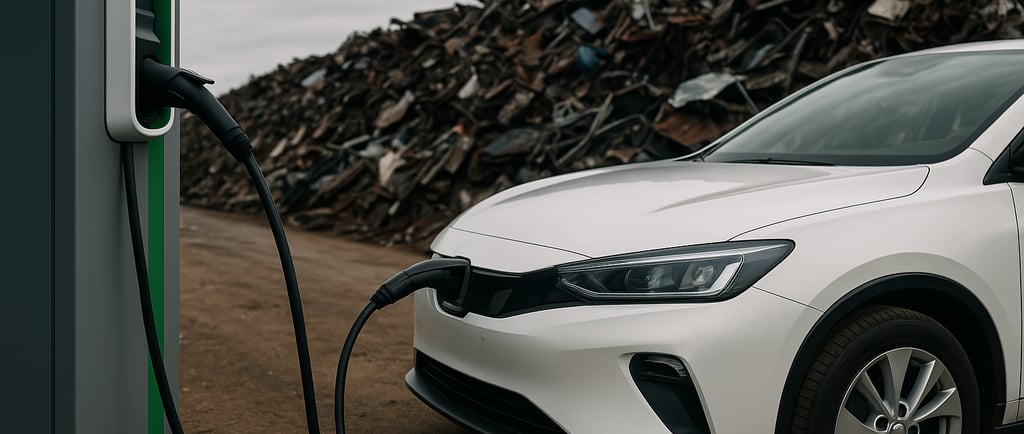
The transition from internal combustion engine (ICE) vehicles to electric vehicles (EVs) represents one of the most profound industrial shifts of the 21st century. While most headlines focus on EV range, charging infrastructure, or climate targets, the implications for the metals industry—and particularly for those involved in the trade and recycling of scrap metal—are both immense and under-explored. This transformation is set to redefine how, where, and what types of scrap flow through global markets, affecting profitability, operations, and even the sustainability credentials of traders and manufacturers alike.
For metal buyers and scrap dealers, understanding how these vehicle technology shifts reverberate through supply chains is now critical for future-proofing operations. Beyond merely maintaining competitiveness, those who move early stand to leverage new supply channels, benefit from price premiums, and become leaders in the emerging "green metals" economy. In this definitive guide, we'll break down EV adoption's core market drivers, decode the evolving structure of scrap flows, and provide actionable strategies to help industry participants thrive amid disruption.
Market Drivers: What's Fueling the EV Expansion?
To contextualize the seismic changes shaping scrap flows, we first need to examine the primary forces fueling electric vehicle uptake—a process driven by an intersection of global policy, technological innovation, and shifting consumer and corporate priorities.
1. Regulatory Mandates & Policy Push
Governments are unequivocally steering the auto sector away from fossil fuels through a mix of "carrot-and-stick" policy approaches. Over 20 countries and numerous states—including the United Kingdom, Germany, Japan, and California—have proclaimed definitive timelines for banning new ICE vehicle sales, ranging from as soon as 2030 to 2040. In parallel, robust financial incentives, such as purchase rebates, tax credits, and grants for charging infrastructure, make EVs both accessible and attractive.
These government-led initiatives are underpinned by commitments to global climate agreements (like the Paris Accord) and by urban air quality standards. According to BloombergNEF, over 278 million EVs could be on the road globally by 2040 if pledges are achieved. Legislative certainty around ICE phase-outs creates both market risks (for traditional scrap streams) and opportunities (for recyclers and suppliers in green metals).
Additional Insight: Policy levers also target the circularity of resources, setting minimum content thresholds for recycled materials and increasingly mandating end-of-life take-back schemes for batteries and vehicles themselves.
2. Rapid Technological Advancements
The pace of battery tech innovation continues to surprise even the most optimistic analysts. According to the International Energy Agency (IEA), average lithium-ion battery pack prices have plunged from above $1,100 per kilowatt-hour in 2010 to below $140 in 2023—a reduction of nearly 90%. Improvements in battery energy density, durability, and rapid charging strengthen the consumer value proposition, while simultaneously reshaping material input requirements for automakers.
Furthermore, emerging advancements in solid-state batteries, cobalt-free cathodes, and silicon anode chemistries hold the potential to further reroute demand away from traditional automotive metals toward new lithium, nickel, and manganese-rich materials.
Industry Trend: Legacy steel and aluminum producers are already investing in alloys tailored to the unique demands of EV chassis and casing designs.
3. Shifting Consumer Demand
The market's appetite for EVs is crossing from early adopters to the mainstream. McKinsey research projects EVs will account for 45–50% of total new car sales globally by 2030. This upward trajectory is driven by a blend of heightened environmental consciousness, rising gasoline prices, and the tangible lower total cost of ownership (TCO) for EVs. Parallel investments in public and private charging networks are erasing historic barriers—opening the market to formerly reluctant buyers.
Notably, major automakers such as Volkswagen, General Motors, and Hyundai have publicly pledged multibillion-dollar investments in electrification, with some announcing plans to manufacture only zero-emission vehicles after 2035. These seismic commitments ripple down the supply chain, reshaping the composition and destiny of both primary and secondary (scrap) metals.
4. Corporate and ESG Pressures
Environmental, Social, and Governance (ESG) reporting has transcended box-ticking—becoming a fundamental requirement for accessing capital and for securing major B2B supply contracts. Datasets tracked by MSCI reveal that more than $35 trillion in assets under management are now linked to ESG strategies. Automakers must document transparent, low-carbon, and recycled content sourcing—and this expectation is swiftly transferring onto their suppliers and metals partners.
For the metals and recycling industries, "traceability" and "low-carbon supply" are increasingly non-negotiable. Recycled metals—especially those with verified origin and low associated carbon emissions—command premium valuations and can unlock access to new, ESG-focused corporate buyers.
Earlier-Stage Case Study: Leading automakers like Tesla and Stellantis have begun to forge alliances directly with battery recycling startups such as Redwood Materials and Li-Cycle, signaling a major market shift toward closed-loop resource strategies.
How EV Adoption Rewrites Scrap Flows
The conventional flow of end-of-life vehicles and their associated scrap streams is about to undergo a dramatic reshuffling.
Understanding the Current Scrap Flow Ecosystem
Historically, retired ICE vehicles fuel a circular materials economy. The average automobile contains nearly one ton of steel, sizable aluminum and copper content, as well as smaller volumes of lead, zinc, and rare alloys. High recycling rates—surpassing 85% in many mature markets—are driven by established processes for dismantling and recovering these metals.
According to the World Steel Association, automobiles represent over 10% of global steel scrap recycling, while the copper sector estimates nearly 700,000 tonnes annually originate from ICE vehicle dismantling alone. The ICE vehicle end-of-life stream forms an essential economic pillar for regional scrap dealers, foundries, and secondary metal processors.
The process typically unfolds through:
Dismantling: Removal of valuable components—engines, transmissions, alternators—sold locally or exported for remanufacturing.
Shredding: Mechanical processing separates ferrous and non-ferrous fractions, with ferrous metals often heading directly into electric arc furnaces.
Materials Sorting: Advanced sensor sorting allows high-purity recovery of copper, aluminum, and specialty alloys.
Disruption: The Impact of More EVs, Fewer ICEs
1. Slowing ICE Scrap Supply
As EVs displace new ICE sales, the pipeline of future ICE-derived scrap diminishes. The average vehicle lifespan ranges from 12 to 20 years, meaning today's auto purchases largely dictate scrap availability in the 2030s and 2040s. The Society of Motor Manufacturers and Traders (SMMT) projects a 30% reduction in new ICE vehicle registrations across Europe by 2028—a precursor to declining scrap inflows after 2040.
While the global ICE vehicle fleet remains sizable (over 1.2 billion units in 2023), every percentage point of new EV market share compounds a deferred reduction in future ICE scrap volumes, especially for core metals like engine-grade steels and copper wire harnesses.
2. Rise of 'Green' Scrap—With a Twist
EVs are engineered with fundamentally different architectures:
Alternative Drivetrains: Absence of exhaust systems, oil pans, and fuel tanks.
High-Voltage Batteries: The single largest component by weight and value in EVs—a typical 60–90 kWh battery contains 8–12 kg of lithium, 30+ kg of nickel, and smaller but highly valuable amounts of cobalt and manganese.
Lightweighting Surge: To compensate for heavy battery packs, automakers increasingly rely on high-strength aluminum alloys, magnesium, and composite materials for frames.
Battery recycling remains in its infancy. The IEA estimated that less than 5% of spent EV batteries were recycled globally as of 2022, due to low volumes and a lack of infrastructure. However, with over 12 million tons of lithium-ion batteries expected to retire cumulatively by 2030, battery recycling will become a dominant segment of the metals scrap industry.
3. Changing Demand: The New Scrap Metal Hierarchy
Aluminum's Ascent: EVs contain 20–30% more aluminum than ICE vehicles, intensifying both primary aluminum demand and positioning end-of-life EVs as future aluminum scrap reservoirs.
Battery Metals Surge: Lithium, nickel, cobalt, and manganese are set to define "urban mining" in the coming decade. The market for recycled battery-grade metals—particularly cobalt and nickel—could approach $20 billion by 2030, as projected by Roskill (a CRU Group company).
Copper's Complicated Path: While ICE vehicles are copper-intensive, EVs use even more copper in battery packs and wiring—with estimates of up to 83 kg per EV versus 23 kg in ICE cars. As such, while ICE copper scrap will diminish, demand for recycled copper from batteries and power electronics will surge.
Real-World Data: China, the world's largest EV market, has already seen regional mismatches—surging demand for battery metals alongside oversupply of ICE body scrap, reflecting complex transitions in local scrap markets.
In the next section, we'll expand on scrap flow scenario analyses, embed more data and case examples, explore future trends in recycling technology, and deliver advanced actionable strategies geared specifically toward metal buyers and sellers. This will ensure a highly comprehensive, SEO-optimized, and NLP-primed resource for industry professionals.
Part Two: Scenario Analyses, Expanded Impacts, Statistics, And Next Steps
The first part explained why the shift from ICE to EVs is real and structural. The second part answers three harder questions.
How do different EV adoption paths change scrap flows in time, not just in theory.
What happens to specific metals, facilities, and regions.
What should yards, traders, mills, and large buyers actually do over the next 3 to 10 years.
Think of this as moving from "EVs will change scrap" to "here is what happens in 2028, 2035, and 2040, and here is how you respond."
Global Context: Where EV Volumes Stand Today
Before building scenarios, you need a firm baseline.
According to the IEA Global EV Outlook 2024, nearly one in five cars sold in 2023 was electric, close to 14 million units, with roughly 95 percent of sales concentrated in China, Europe, and the United States. IEA Global electric car stock has climbed from near zero in 2010 to tens of millions of vehicles in use today, and it keeps rising steeply.
More recent data shows the trend continues. EVs reached about 16 percent market share of new car registrations in the EU by late 2025. ACEA Global estimates for 2024 and 2025 point to roughly 17 to 20 million electric cars sold per year, which would bring EVs to about 20 to 25 percent of new light vehicle sales.
That means the next decade is the "inflection zone." ICE vehicles still dominate the fleet, but EVs dominate the growth. Scrap flows will mirror that lag, with a heavy ICE bias today, a mixed stream in the 2030s, and a battery-heavy, aluminum-rich stream in the 2040s and 2050s.
Scenario Analysis: Three Paths And What They Mean For Scrap
No one knows the exact path EV adoption will follow. However, three broad scenarios show how different futures change scrap flows.
Scenario 1: Fast Transition
Assumptions:
Global EV share of new light vehicle sales reaches about 50 percent by 2032 and 70 percent by 2040.
China, the EU, and a few high income markets move quicker. Many of them cross 60 percent EV share of new sales before 2030.
Policy targets for ICE phaseout remain in place and are largely met in Europe and parts of North America and East Asia.
Implications for scrap:
ICE vehicle sales drop sharply through the 2030s. Since the average vehicle lasts 12 to 20 years, this translates into a steep decline in end-of-life ICE units starting around 2040.
Auto-derived ferrous scrap, which today accounts for more than 10 percent of global steel scrap flows, sees a noticeable contraction in the 2040s. Not a collapse, because existing ICE stock is huge, but a year-on-year decline.
Ferrous scrap shifts toward demolition, industrial offcuts, and heavy equipment, while the share that comes from light vehicles drops.
EV shells arrive in growing numbers. These bodies often contain more aluminum per vehicle, including castings and extrusions, which changes the non ferrous yield mix.
Battery volumes rise to a central role. One UNDP and partner analysis suggests end-of-life lithium-ion batteries could reach about 20,500 kilotons globally by 2040. A large share of that total will be from EVs.
In a fast transition, the main risk for traditional yards and mills is ferrous auto scrap tightening just as battery and non ferrous flows surge. The winners are those who prepare their facilities and contracts to capture and process EV-related materials safely and at scale.
Scenario 2: Split-Speed Transition
Assumptions:
China and parts of Europe push ahead with policy and infrastructure. Some markets in Southeast Asia, Africa, Latin America, and the Middle East keep ICE in the mix for longer.
Global EV share of new sales hits about 40 percent by 2035 and 55 to 60 percent only closer to 2045.
ICE bans are delayed or softened in some markets, and hybrids continue to sell well.
Implications for scrap:
ICE vehicle retirement stays steady or even rises in some regions for longer, especially where used ICE imports remain common.
Auto scrap flows become more uneven. You may see tight supply of some ICE grades in Europe at the same time as steady supply in parts of Africa or Latin America.
International trade in vehicle shells, parts, and even high voltage components grows as exporters try to clear old stock.
Battery scrap and end-of-life packs still grow sharply but remain concentrated in China, Europe, and a few early adopter markets in the 2030s.
In this scenario, traders with cross border reach can arbitrage regional gaps in different scrap types. The risk is stranded assets in regions that delay EVs and also face stricter export rules for waste and used vehicles.
Scenario 3: Slower, Policy-Challenged Transition
Assumptions:
Political and social pushback in some regions slows ICE phaseout. Some markets keep significant ICE sales past 2040.
EV share of new sales plateaus under 40 percent through the mid 2030s and grows only gradually from there.
Battery cost reductions slow and charging buildout lags in some countries, even while others keep moving forward.
Implications for scrap:
ICE scrap supply remains abundant in many markets well into the 2040s. Prices for certain auto grades could stay under pressure, especially where there is excess shredding capacity.
EV scrap and EOL batteries still rise, but more slowly. The opportunity for large dedicated battery recycling plants may center in a smaller set of core markets.
The mix inside yards becomes messy. You see three main types in parallel: legacy ICE, mild hybrids, and full EVs, each with different hazards and material profiles.
For scrap professionals, the message from these scenarios is simple. The direction is clear. Only the slope and the regional timing are uncertain. You cannot control global adoption rates but you can control how prepared your buying, processing, and risk models are for each path.
Metal-By-Metal Impacts: Who Wins, Who Gets Squeezed
Ferrous Scrap
Cars are a major but not exclusive source of global steel scrap. In a world that produces close to 2 billion tonnes of crude steel per year, recycled scrap already covers a large part of EAF feed and a lower but rising share in BOF routes. Auto scrap is attractive because it is relatively uniform in form and well understood by mills and shredders.
EVs change ferrous scrap in three ways.
Gradual volume shift
ICE vehicle bodies eventually shrink as a share of the total vehicle fleet. The timing depends on the scenario above. Yards that rely heavily on end-of-life cars must backfill volumes from demolition, machinery, white goods, and industrial sources.
Different steel grades
EVs use more advanced high strength steels in crash structures and battery enclosures. That does not remove steel from the picture. It changes the microstructure and composition. Mills and processors will need better sorting and charge recipes to control residuals and guarantee properties.
Higher contamination risk
EVs that enter shredders without proper depollution can carry live high voltage components. That is a safety issue first and an operational issue second. Fires, explosions, and equipment damage already occur at sites that handle mixed battery scrap. This will scale if protocols stay loose.
Aluminum
Most EV platforms contain more aluminum than comparable ICE vehicles and use it in more structural roles. This includes extruded crash beams, cast subframes, and sometimes entire body sections.
Impacts:
Higher aluminum yield per unit at end of life. Many estimates place EV aluminum content 20 to 30 percent above ICE for the same segment, especially in premium and mid range vehicles.
Shift in alloy mix. There is more structural and casting material, not only sheet. That influences which downstream smelters and foundries find EV scrap attractive.
Tighter connection to low carbon supply chains. Automakers that publish detailed emissions reports often track recycled aluminum share and energy sources used in remelting. Scrap with clear origin and consistent chemistry can command better pricing in that context.
Battery Metals
Batteries sit at the core of EV-driven scrap change. They combine high value, complex chemistry, strict safety rules, and fast changing policy.
Several reference points matter here.
Global end-of-life lithium-ion battery volumes could reach tens of millions of tonnes by 2040, with estimates near 20,500 kilotons in one widely cited study.
In Europe alone, the volume of batteries entering recycling routes could surpass one million tonnes per year by 2030, with a market value near 15 billion euros.
The EU Battery Regulation sets clear minimum recovery efficiencies and recycled content targets. For example, it requires at least 50 percent lithium recovery and 90 percent recovery for cobalt, nickel, copper, and lead, with mandatory minimum recycled content for cobalt, lithium, nickel, and lead in new batteries after 2031.
At the same time, global energy and climate targets imply strong growth in demand for lithium, nickel, cobalt, and graphite. One research review suggests that between 2021 and 2050, lithium demand for clean energy could increase around 26 times, cobalt six times, nickel twelve times, and graphite nine times.
For scrap professionals and metal buyers, this combination means:
Battery scrap shifts from niche to core feedstock within 10 to 15 years.
Quality of collection, safe handling, and legal compliance become as important as price.
Regulations in Europe, China, and other key markets will favor closed loops, where OEMs and large cell producers sign long term offtake agreements with recyclers.
Copper
EVs use more copper per unit than ICE vehicles, due to motors, power electronics, and heavier wiring. On top of that, charging infrastructure and grid reinforcements need large volumes of copper and sometimes aluminum.
Impacts include:
Rising demand for high quality copper scrap from motors, busbars, and cables.
New copper-containing scrap streams linked to inverters, converters, and power electronics.
Growing interest in traceable, low embedded emissions copper, which favors secondary sources collected and processed under clear standards.
Even if ICE harness scrap shrinks over time, total copper tied to mobility and power systems remains strong. The center of gravity simply shifts from fuel engines to electric drivetrains and networks.
Technology And Policy: How They Lock In New Scrap Patterns
Several policy and technical trends will lock in new scrap pathways over the next decade.
Battery passport and traceability rules
The EU Battery Regulation introduces digital passports that carry information about battery origin, chemistry, and recycled content. This moves scrap away from anonymous flows and toward tagged, contract-bound material. Similar ideas are emerging in other regions.
Extended producer responsibility
More markets are moving toward rules that make vehicle and battery producers responsible, in part, for end-of-life treatment. This can create contract flows where OEMs direct batteries to specific partners and pay or get paid based on recovered material.
Better recycling processes
Hydrometallurgical and direct recycling processes aim to recover active materials in forms that can go back into new cells, not only as basic metals. This can raise recovery yields and change price structures for black mass and intermediate products.
Second life before recycling
Some EV packs will move into stationary storage before they reach true end of life. That delays scrap flows and reduces short term metal availability, but it can improve total lifecycle economics and cut waste.
Anyone planning long term supply, investment, or plant design must assume more regulation, more tracking, and more specialized processing, not less.
Case Snapshots: How Different Regions Already Feel The Shift
China
China is the largest EV market in the world by volume. It combines aggressive policy, high local content, and large domestic battery and cell makers.
Effects already visible:
High throughput of used EVs and early battery returns from first generation models.
A mix of licensed recyclers and informal handlers. Authorities are tightening rules to channel packs into compliant facilities.
Regional mismatches between the availability of traditional auto scrap and newer EV scrap. Some provinces report oversupply of ICE body shells at the same time as tight capacity for safe battery processing.
Europe
Europe has strong climate targets and binding regulations around batteries and end-of-life vehicles.
Key features:
Rapid increase in EV market share in countries like Norway, the Netherlands, and several Western European states.
Early ramp-up of recycling plants designed specifically for lithium-ion batteries, backed by OEM and cell producer contracts.
Stricter waste shipment rules that limit export options for hazardous and complex waste, including some types of battery scrap.
In practice, this means European yards that want to handle EVs and batteries at scale need to align early with formal recycling channels. The informal or export-heavy play that worked for some ICE parts may not be viable.
North America
The United States and Canada combine growing EV adoption with sizeable legacy ICE fleets and strong political debate around the pace of transition.
Features worth noting:
Federal and state incentives under laws such as the Inflation Reduction Act support domestic battery production and recycling.
Several large recycling firms are building capacity near cell plants and gigafactories.
There is still a large stock and steady flow of ICE vehicles that feed traditional auto scrap streams.
For many yards, the next decade will be a hybrid period. They will see a mix of older ICE, hybrids, and EVs, all at once.
Actionable Next Steps: Playbooks For Different Market Participants
Below are practical steps for key actors. The idea is not a slogan list. It is a concrete plan you can start to implement over the next 6 to 36 months.
For Scrap Yards And Dismantlers
Map your intake by powertrain. Start tracking how many ICE, hybrid, and EV units you receive each month. Even a simple spreadsheet gives you a lead indicator on future scrap mix.
Design and train for EV depollution. Build standard operating procedures for safe isolation of high voltage systems, removal of packs, and handling of orange cables and power electronics. Invest in training and protective gear.
Segment materials early. Separate EV packs, motors, power electronics, and high aluminum content structures before shredding. This improves safety and yield and opens specialized sales channels.
Build relationships with licensed battery recyclers. You want clear outlets, agreed pricing models, and pre-approved shipping and packaging rules before volumes surge.
Document everything. Take photos, record serial numbers where possible, and keep weight and composition records. This will help when buyers and regulators ask for traceability.
For Shredders And Processors
Audit fire and explosion risk. Review current procedures for handling high voltage components, small batteries, and electronics. Upgrade detection systems and suppression systems where needed.
Adjust shredding lines for more aluminum and complex non ferrous content. Plan for improved downstream sorting, including optical and sensor-based technologies that can separate more alloy families.
Work with mills and smelters to refine specifications. EV-rich scrap may have different density, residuals, and cleanliness. Align specifications now so you can sell new blends at known discounts or premiums.
Develop separate streams for black mass and battery-containing fractions. Do not treat battery-rich material as a nuisance. It is a future core product that needs its own handling and sales strategy.
For Steel Mills And Foundries
Model auto scrap decline. Use realistic assumptions about EV adoption in your core supply markets to project auto scrap availability in 2030, 2035, and 2040. Test how different paths affect your metallic charge mix and cost.
Expand supplier dialogues beyond traditional scrap grades. Start discussing EV shells, busheling, and mixed heavy melt as part of your long term plan, not as side topics.
Explore new quality controls. As more high strength and coated steels enter the scrap pool, you may need better monitoring of residuals and coatings to maintain product performance.
Consider strategic stakes or offtake agreements in recycling assets. Access to consistent high quality scrap, including EV-rich streams, may become a competitive advantage in certain regions.
For Non Ferrous Smelters And Refiners
Target EV-related streams early. Build purchasing programs for motors, busbars, cables, and power electronics. Set clear price lists and quality rules so yards know how to sort and ship.
Prepare for more complex input. EV components can contain mixed metals, ceramics, and polymers. Pilot new pre-treatment steps to improve recoveries and reduce impurities.
Engage with battery recyclers. Copper and aluminum foils from black mass processing will become important sources. Align on quality requirements and logistics now.
For Traders And Brokers
Build a grade language for EV-era scrap. Develop internal codes and contract descriptions that distinguish ICE-derived auto scrap, EV shells, battery packs, and EV non ferrous components.
Develop region-specific views. Track EV adoption, ICE bans, and recycling rules by country or region. Use that to anticipate where ICE scrap will tighten, where EV scrap will surge, and where export routes may close.
Offer blended supply contracts. Some mills and smelters will want security over multiple feed types. That might include auto scrap, demolition scrap, and EV-related grades in the same annual deal.
Strengthen compliance and documentation. As traceability and ESG expectations rise, being able to provide clear origin, handling, and emissions information will help you secure higher value clients.
For Automakers And Large Industrial Buyers
Integrate scrap and recycling strategy into sourcing. Do not treat end-of-life as a distant topic. Use it to secure future supply of critical materials.
Partner with recyclers and yards in key markets. Long term contracts, joint ventures, or structured offtake deals can secure flows of cobalt, nickel, lithium, copper, and aluminum.
Design for disassembly and recycling. Small changes in pack layout, fastener choice, and labeling can make a big difference in recycling yield and cost.
How To Use This As A Reference Playbook
If you are a yard operator, this article should help you answer questions like:
What happens to my ICE car volumes after 2035 in my region.
When do I start seeing EV packs in meaningful numbers.
Which new buyers should I talk to now.
If you are a trader, it should help you:
Build scenarios for your core lanes under different EV adoption paths.
Decide where to invest time in new relationships, especially with battery recyclers and non ferrous smelters.
Rewrite contract language to reflect new materials and risks.
If you are a mill or smelter, it should help you:
Stress test your raw material plan against structural changes in scrap supply.
Decide where investment in sorting, tracking, and supplier development has the highest return over the next decade.
The end of ICE is not a single date. It is a long, uneven transition that will reshape what arrives in your yard, what goes into your furnace, and how you describe and price each load. The players who treat EV-driven scrap as a central planning topic now, not as a minor aside, will be the ones who still have security of supply, pricing power, and credibility with regulators and large buyers in the 2030s and 2040s.
Connect
Your trusted partner for scrap metal procurement.
CONTACT
About
haroon@tdcventures.com
+1-307-655-7593
© 2025. All rights reserved.
NEWSLETTER