
Tiny Screws, Big Problems: Fastener Standards
Non-standard fasteners in XR devices create major repair and recycling bottlenecks. Discover how universal fastener standards can slash teardown times, boost refurbishment yields, and prepare your hardware for upcoming right-to-repair regulations.
IMMERSIVE TECH RECYCLING & CIRCULAR ELECTRONICS
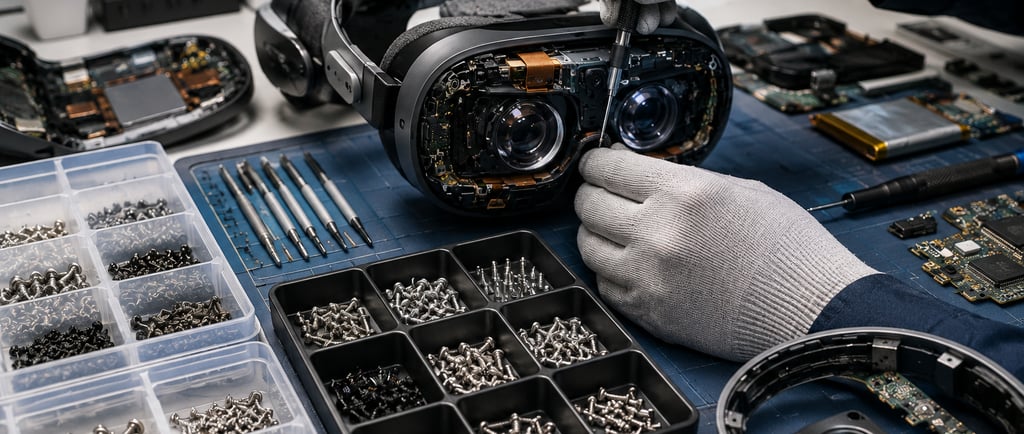
Instant Answer
Tiny screws in XR devices create huge headaches for design teams and recyclers. Non-standard fasteners limit repairability and recycling, slowing circular electronics. Universal fastener standards—aligned with recycling and repair—are essential for efficient teardown, refurbishing, and reuse across OEMs and repair networks.
Table of Contents
Context: Why Tiny Fasteners Matter for XR and Electronics Recycling
The Problem: Fastener Fragmentation Blocks Circularity
Defining Fastener Standards, Pain Points, and Opportunities
The Circular Fastener Framework: Design, Collect, Refurbish, Recycle
Implementation Playbook: Fastener Choices that Scale
Measurement, QA & the Scorecard
Case Patterns & Scenarios from the Field
XR & Electronics Fastener FAQ
Competitive Differentiation: Market Gaps and Category Leadership
Conclusion
1. Context: Why Tiny Fasteners Matter for XR and Electronics Recycling
If your team has ever tried to break down an XR headset or recycle a mixed pile of electronics, you know the scene: dozens of screw types, oddball heads, proprietary locks, and stuck enclosures. For OEM design teams, repair networks, and standards groups working in immersive tech or electronics recycling, fastener choices aren't trivial—they're the difference between scalable circularity and throwaway waste.
Fastener chaos is one of the most overlooked repair and recycling blockers for XR (extended reality), AR/VR, and broader consumer electronics. Non-standard screws increase teardown times, kill refurbishment yields, and frustrate professional repairers and recyclers alike. According to iFixit's 2023 repairability ratings, more than 60% of consumer electronics scored low due to the use of proprietary or non-standard fasteners, directly impacting both device longevity and second-life opportunities.
Fastener selection isn't just about assembly from an engineering perspective—it speaks directly to product sustainability. Every design choice behind an enclosure either supports or sabotages the circular economy. As devices get smaller and component density grows, even minor design changes in fastener types can have massive operational consequences.
The industry has reached a breaking point. As AI-driven recycling lines scale globally, and right-to-repair laws gain traction in Europe, North America, and Asia-Pacific, OEMs and standards organizations must treat fastener standards as core circular design decisions, not random afterthoughts. In 2023, the EU's Circular Electronics Initiative highlighted standardization as a critical driver for achieving circular electronics goals. Without harmonized fastener strategy, the best recycling automation and repair networks will struggle to scale.
2. The Problem: Fastener Fragmentation Blocks Circularity
The Core Headache
Non-standard fasteners introduce friction and inefficiency at every phase of the electronics lifecycle—design, manufacturing, repair, refurbishment, and recycling.
Design: Every custom screw adds complexity to the bill of materials (BOM), creates potential supply chain disruptions, and increases both component and assembly costs. A 2022 analysis by Accenture found that devices with more than three screw types per SKU see assembly costs rise by up to 8.5% compared to those with harmonized fasteners.
Repair: Each unique fastener demands specialized tooling, slowing down field repairs and challenging scale across global service centers. Non-uniform screws extend service times; iFixit tear-downs show up to 40% more time spent on devices with proprietary screws versus those with standardized sets.
Recycling: Mixed fasteners confuse robotic disassembly and raise manual teardown costs dramatically. The International Electronics Recycling Congress (IERC) reports that fastener mix is now a leading cause of e-waste line slowdowns and lower material recovery rates, as incompatible heads jam sorting equipment and extend labor times.
Refurbishment: Teams waste precious time matching driver tips or are forced into brute-force approaches—risking internal component damage. Refurb centers estimate that each extra unique fastener type adds $0.15 in labor and increases risk of breakage by 7%.
Historic case studies—like the original iPhone and early Oculus Rift—show how even well-intended product security measures (such as proprietary "pentalobe" or tri-point screws) effectively locked out repairers and recyclers, contributing to millions of devices being landfilled instead of returned to circulation.
Why It's Operationally Vital
A chaotic fastener mix creates sharp pain points across operational and financial metrics:
Longer downtime in OEM and repair network operations, driving up warranty costs and straining customer relationships.
Increased repair network costs: Each additional fastener type requires new training, inventory, and tooling, raising per-unit service costs.
Elevated compliance risk: As right-to-repair and e-waste mandates tighten, non-standard fasteners expose OEMs to legal scrutiny or lost market access.
Lower material recovery rates: Device scrap values drop when enclosures cannot be economically opened or sorted for precious metals.
These bottlenecks underscore why fastener standardization is pivotal to achieving circularity goals. Without it, hardware remains landfill-bound, and both OEM and aftermarket supply chains fail to scale.
3. Defining Fastener Standards, Pain Points, and Opportunities
Fastener Standards—What, Why, and How
Fastener standards are formalized, documented choices regarding screw size, drive type, material, and torque spec used across product families and generations. In a world where electronics span dozens of regions and repair ecosystems, these standards bridge the gap between original design and end-of-life recovery.
Pain Points:
Fragmentation: Consumer XR devices often contain 6–12 different screw types per product, sometimes mixing metric and imperial threads, confusing repair documentation and increasing supply chain risk.
Security Obfuscation: OEMs add obscure "security" screws (e.g., Apple's pentalobe) to deter tampering. This not only blocks illegitimate access, but also hampers legitimate repair, authorized refurbishment, and recycling channels.
Lack of Documentation: The majority of consumer device OEMs do not publish fastener specs or maps, leading to failed repairs or incorrect disassembly sequences, risking device destruction.
Supply Chain Variability: Fastener substitutions happen late in the build phase if the original part is unavailable: this cascades confusion through repair and recycling partners.
Industry Opportunity:
The opportunity is clear: create a cross-industry movement toward fastener harmonization. Global standards, supported by ISO (International Organization for Standardization), ANSI (American National Standards Institute), and other standards bodies, can drive the following:
Adopt 1 to 3 standard, globally available fastener profiles (such as Torx T5, Phillips PH0, or Tri-point Y0) for all access points and assemblies.
Openly publish complete fastener specs and location maps with each new product, enabling efficient repair and recycling workflows.
Require fastener standard compliance in cross-OEM standards bodies like the Consumer Technology Association or Global Electronics Sustainability Alliance, making it a category-level expectation.
Real-World Impact
Industry data shows immediate upside: When companies like Fairphone and Framework introduced public fastener maps and open schematics with standard screws, teardown and recovery times dropped by up to 60%. These leaders captured extra revenue from resale and earned consumer trust, setting new benchmarks for right-to-repair compliant hardware.
Furthermore, the 2024 EU Right to Repair Directive has begun requiring manufacturers to make repair information and parts—including fastener details—available to independent repairers, making non-standard fasteners a direct compliance liability.
4. The Circular Fastener Framework: Design, Collect, Refurbish, Recycle
A robust approach to fastener strategy sits at the center of true circular electronics, particularly for XR devices. Here's a detailed breakdown of the Circular Fastener Framework, guiding hardware teams through best practices:
a. Design for Circularity
Simplicity First: Select fasteners universally recognized and available (e.g., Torx or Phillips). Limit each device to 1–2 types whenever possible, supporting global access and streamlining assembly.
Accessibility and Visibility: Avoid hidden, glued, or pentalobe screw applications. Place screws where tools can reach them with minimal risk of internal damage.
Material Science Alignment: Choose screw alloys compatible with common recycling methods, such as eddy current or magnet-based sorting, to ensure efficient material recovery.
b. Collection and Traceability
Standardized Documentation: Record every fastener in BOM and supporting repair guides, specifying thread size, length, location, and torque values.
Visual Mapping: Annotate internal and external diagrams to serve as "fastener maps"—helping technicians rapidly identify necessary driver bits and sequences.
Digital Ledger Integration: For high-value assemblies or hazardous components, embed fastener IDs into QR/barcode systems for streamlined traceability throughout the lifecycle.
c. Refurbishment and Repair
Single-Tool Paradigm: Design devices so that the most common service procedures require only one screwdriver or kit, reducing tool overhead and training costs.
Zone Harmonization: Group similar screws by functional areas (e.g., keep all battery enclosure screws uniform), minimizing fastener mix within key zones.
Standard Driver Bundling: Ship a compatible driver kit with each device family, empowering third-party repair networks and enhancing UX for authorized end users.
d. Disassembly and Material Recovery
Screws Over Adhesives: Favor removable mechanical fasteners at major junctures, slashing labor time during recycling and decreasing scrap loss.
Automated Disassembly Compatibility: Select fasteners compatible with popular recycling robots and high-throughput manual lines; consult major e-scrap automation vendors.
Sort-Friendly Materials: Specify head materials that align with targeted recycling stream (aluminum/steel) to support automated separation.
Worked Example: Standardizing Fasteners in XR Headset Design
Background:
A leading OEM launched an AR headset featuring six different screw types, including rare tri-wing and micro-pentalobe fasteners. Independent repair networks reported 30% longer repair times versus leading industry peers, and e-waste contractors classified the device as uneconomical to process due solely to fastener complexity.
Action:
Designers instituted a company-wide fastener policy for the next product revision:
All internal and external screws standardized to Torx T5 and PH0 sizes.
Published complete fastener maps in service manuals and online support hubs.
Implemented color-coded shrouds and fastener markings matching driver bits.
Results:
Repair and refurbishment cycle times improved by 2x versus the older model (estimated).
Salvage rates rose to 85% of internal components versus 45% for the previous generation.
Recycling contractor cost-per-unit dropped by ~25%.
Product scored 8/10 on the iFixit repairability index, up from 5/10.
Takeaway:
Cross-disciplinary fastener strategy unlocked both cost savings and category-leading sustainability benchmarks—illustrating the power of harmonized design for circular XR.
5. Implementation Playbook: Fastener Choices that Scale
Fastener standardization only works when it moves from a sustainability idea into daily engineering discipline. For XR devices, that means the fastener plan must be locked before industrial design freezes, before tooling is purchased, and before the first repair guide is written. If fasteners are treated as minor hardware details, circularity becomes expensive later. If they are treated as service architecture, repair and recycling become easier to scale across factories, authorized service centers, independent repair networks, refurbishers, and e-scrap processors.
The first rule is simple: reduce variety. An XR headset should not require a technician to switch between six driver bits before reaching the battery, mainboard, display stack, sensors, thermal module, speaker assemblies, or strap system. The ideal access path uses one primary driver type for the outer shell and one secondary driver type for sensitive internal assemblies. In practice, Torx T3 to T6, Phillips PH00 to PH0, and standardized metric micro screws are the most practical choices because they are globally available, already familiar to repair technicians, and supported by broad tool supply chains. Exotic security screws may look like product protection, but in circular electronics they often become service tax. Every obscure screw head adds tool cost, training time, documentation burden, and failure risk.
This matters even more in 2026 because repairability is no longer a niche consumer preference. It is moving into regulation. The EU's smartphone and tablet ecodesign rules started applying on June 20, 2025, with requirements around durability, repairability, spare parts access, and software support for devices placed on the EU market. Those rules do not directly cover every XR headset yet, but they send a clear signal to hardware teams: the direction of travel is toward repairable product architecture, not sealed products that only the OEM can service.
The second rule is to separate "service screws" from "manufacturing screws." A manufacturing screw is selected mainly for assembly speed, torque control, automation, vibration resistance, and cost. A service screw must also survive removal, reinstallation, field handling, and technician variation. XR devices need both categories, but they should not be mixed randomly. A screw that is buried inside an optical stack and never touched after assembly can have stricter requirements than a screw used to access a battery or face gasket. The access path should use service-ready fasteners that tolerate repeat cycles without stripping, losing bite, or damaging soft plastics.
Battery access deserves special attention. The EU battery regulation requires many portable electronics to move toward user-replaceable batteries from 2027, using basic or supplied tools, with replacement batteries available for years after sale. XR devices often sit close to edge cases because of compact enclosures, heat, safety, and wearable comfort, but the direction is obvious. If the battery is glued behind fragile panels, hidden cables, or non-standard screws, the device will age poorly in repair and reuse markets. If the battery can be reached through a documented screw path, the product has a second-life advantage.
A practical XR fastener policy should start with five design decisions.
First, choose a primary drive family. Torx is often a strong candidate for XR and compact electronics because it gives better torque transfer than Phillips and reduces cam-out when used correctly. Phillips is common and cheap, but it is easier to strip in micro sizes, especially when users or undertrained repair workers apply the wrong downward pressure. Tri-point and pentalobe screws should be used only where there is a documented safety or compliance reason. They should not be used to make ordinary repair harder.
Second, limit screw lengths. Many device failures during reassembly happen because a long screw is inserted into a short boss and punctures a board, display layer, battery pouch, speaker chamber, sensor ribbon, or antenna path. This is common in compact electronics because internal tolerances are tight. A circular fastener design should use one length per zone wherever possible. The outer shell can use one length. The battery bracket can use one length. The mainboard shield can use one length. The strap mount can use one length. This reduces technician error and supports automated sorting during teardown.
Third, use captive screws where they make sense. Framework's repairable laptop design is a useful benchmark outside XR. iFixit noted that access starts with five Torx screws on the lower case, and those screws are captive, so they do not fall out or get lost during service. That one design choice reduces missing fasteners, technician frustration, and reassembly errors. XR teams can apply the same principle to battery covers, removable straps, replaceable face interfaces, speaker modules, compute pucks, controller shells, and service panels.
Fourth, avoid hidden screws unless they are clearly marked in the service documentation. Hidden screws under stickers, rubber feet, fabric, foam, magnetic covers, adhesives, or cosmetic trim can be acceptable only when the removal path is obvious and documented. Hidden screws become a major repair failure point because technicians may pry before they realize the enclosure is still mechanically locked. In XR devices, that can crack lenses, bend sensor brackets, damage flex cables, or separate laminated assemblies. If a screw is hidden for cosmetic reasons, the repair guide should show the exact location, tool, torque, removal angle, and replacement part.
Fifth, design around tool access. A standard screw is still a bad screw if the driver cannot reach it straight. Angled access increases stripping risk. Deep recessed access requires longer bits. Narrow wells can block common repair tools. Screws near magnets, camera modules, heat sinks, speaker meshes, lenses, and antennas require more clearance planning. A good fastener standard includes head type, size, thread, length, material, coating, torque range, and access geometry.
Fastener choices must also reflect recycling. A recycler does not need the same perfect access as a warranty repair technician, but they do need predictable opening points. The Global E-waste Monitor 2024 reported that the world generated 62 million tonnes of e-waste in 2022, up 82% from 2010, and projected that annual e-waste could reach 82 million tonnes by 2030. Only 22.3% was formally collected and recycled in 2022. This means product design cannot assume every unit will return to a careful OEM-run service center. Many units will enter mixed e-waste streams where speed, tool availability, and material recovery economics decide whether the device is processed or discarded.
For recyclers, the best fastener is one that allows fast enclosure opening without destroying valuable components. XR devices often contain cameras, IMUs, batteries, circuit boards, displays, copper coils, speakers, magnets, aluminum frames, magnesium parts, steel screws, copper flexes, and rare earth elements in small motors and speakers. If the enclosure takes too long to open, the recycler may downgrade the unit to bulk processing. That can reduce component reuse and increase material loss. A standardized screw path supports selective recovery.
The playbook should therefore be written as a cross-functional policy, not a single engineering note. The industrial design team owns access and aesthetics. The mechanical team owns torque, retention, vibration, thread engagement, and material compatibility. The service team owns repair time, tool count, screw maps, and reassembly error rates. The sustainability team owns circularity targets and end-of-life outcomes. Procurement owns fastener supply continuity. Compliance owns right-to-repair and repair information duties. Recycling partners own teardown economics. If one group controls fasteners alone, the design will usually serve one lifecycle stage and fail another.
A strong implementation plan should follow this sequence.
Start with a fastener audit across current devices. Count every screw type, drive type, length, thread, coating, and location. Measure how many driver changes are needed to reach the most common repair items: battery, strap, facial interface, speaker, fan, display cable, charging port, controller battery bay, and mainboard. Record which screws strip most often, which are misplaced most often, and which cause the most teardown delays.
Then classify every screw by lifecycle role. Some screws are assembly-only. Some are repair-critical. Some are safety-critical. Some are cosmetic. Some are recycling-critical. A repair-critical screw should never be proprietary without a clear reason. A recycling-critical screw should never be hidden behind permanent adhesive. A safety-critical screw may need stricter torque controls, but it should still be documented for qualified repairers.
Next, set a screw budget per product. A realistic XR target is no more than two drive types across the device, no more than three screw lengths in normal service paths, and no more than one driver bit required for first-level service access. A controller should aim for one drive type. A headset can justify two if it has separate enclosure and optical stack requirements. Anything above that needs engineering approval.
After that, create a fastener map before final design validation. The map should show location, screw ID, drive type, length, thread, torque, removal sequence, risk notes, and reuse rule. It should also show which screws are captive, which are replace-only, and which can be reused. This map should feed the service manual, refurb workflow, parts catalog, recycler guide, and QA checklist.
Finally, test the fastener system under real teardown conditions. Do not only test perfect lab removal by senior engineers. Test with trained repair technicians, new repair technicians, third-party service workers, and recycling operators. Give them standard tools. Time the process. Count bit changes. Count stripped heads. Count dropped screws. Count reassembly errors. Count parts damaged during access. Then redesign the fastener system before launch.
This is where many OEMs fail. They test whether the device can be assembled, but not whether it can be repaired 18 months later after heat cycles, sweat exposure, dust, skin oils, repeated handling, and minor drops. XR devices are worn products. Their fasteners live in a harsher context than a desk-bound router or TV. Face interfaces collect sweat and cosmetic residue. Straps flex. Headsets heat and cool. Controllers absorb impacts. Screws must be selected for that reality.
The best fastener strategy is not the one with the fewest screws at any cost. Adhesives, clips, welds, and snap-fits can reduce screw count, but they can also make repair worse if they break during opening. A better goal is controlled removability. Use screws where repeated access matters. Use clips where they can survive service. Use adhesive only where sealing, safety, or performance genuinely requires it. Avoid permanent bonding for parts that are likely to fail, degrade, or require cleaning.
By 2026, the winning XR hardware teams will treat fasteners the way software teams treat APIs. They will document them, govern them, version them, and design them for use beyond the original factory. The device that opens cleanly will last longer, refurbish better, recycle faster, and earn trust from repairers, buyers, regulators, and enterprise customers.
6. Measurement, QA & the Scorecard
Fastener standardization cannot be managed through opinion. It needs measurement. A product team may believe a device is repairable because the internal engineering team can open it. That is not enough. The real test is whether a trained technician can open it quickly, safely, repeatably, and with common tools after the product has been in the field.
A useful scorecard should measure three things: access, reliability, and circular value.
Access metrics
Access metrics show how fast and how safely a device can be opened. The first metric is time-to-first-critical-component. For XR, the critical component is usually the battery, charging port, strap connector, speaker, fan, mainboard, display cable, or controller battery system. If it takes 25 minutes and four driver changes to reach a battery, the fastener design is failing circularity. If it takes less than 10 minutes with one tool and a clear sequence, the design is moving in the right direction.
The second access metric is driver count. Each extra driver bit creates friction. In a repair center handling 100 units per day, even 30 seconds of tool switching per unit becomes 50 minutes of lost labor per day. Across 250 operating days, that is more than 200 technician hours per year. When a repair network handles thousands of units, driver count becomes real money.
The third access metric is screw count by service path, not total screw count. A headset may contain many screws, but the more important question is how many screws block common repairs. A device with 40 total screws can still be serviceable if the battery path needs six standard screws. A device with 16 total screws can be difficult if the first repair path requires hidden clips, adhesive, and three screw types.
The fourth access metric is non-destructive opening rate. This measures how many devices can be opened without breaking clips, tearing flex cables, cracking covers, deforming bosses, or damaging cosmetic panels. XR devices need this metric because their enclosures are often compact, curved, layered, and sensor-heavy. A product that survives disassembly only 70% of the time is not fit for large-scale refurbishment.
Reliability metrics
Reliability metrics measure whether the fastener system survives service. Track strip rate by screw ID. Track boss cracking. Track thread pull-out. Track torque failure. Track missing screw frequency. Track wrong-screw insertion. Track repeated removal cycles. For service-critical screws, run repeat-cycle tests. Remove and reinstall the screw 5, 10, and 20 times under controlled torque conditions. If the screw strips or the boss weakens before realistic service life, the design needs revision.
Torque consistency is one of the most overlooked QA points. Over-torque can crack plastic bosses, crush shields, deform battery brackets, and damage optical alignment. Under-torque can create rattles, poor grounding, thermal issues, and loose structural elements. XR products are sensitive because they combine mechanical fit, optics, sensors, thermal management, and user comfort in a tight enclosure. A loose screw near a fan, speaker chamber, or sensor bracket can create customer-visible defects. A fastener scorecard should include torque window compliance during factory assembly and after service reassembly.
Circular value metrics
Circular value metrics connect fasteners to business outcomes. Track repair yield. Track refurb yield. Track component recovery rate. Track cost-per-unit teardown. Track recovery value per unit. Track warranty repair time. Track returned-device resale value. Track how often technicians abandon a repair because access is too difficult. These numbers turn fastener choices into financial evidence.
The Global E-waste Monitor shows why this matters at system level. In a business-as-usual scenario, documented formal collection and recycling rates may decline to 20% by 2030 while total e-waste rises. That gap means electronics brands cannot rely on downstream recycling systems alone. Product design must make recovery cheaper and faster from the start.
A practical XR fastener scorecard can use a 100-point model.
Repair access should carry 30 points. This includes first-opening time, driver count, screw visibility, adhesive avoidance, and access to priority components. A strong device should allow battery or primary service access with one driver type and a documented sequence.
Fastener standardization should carry 20 points. This measures total drive types, screw length variety, use of global standards, service-zone consistency, and avoidance of proprietary heads. A product using one or two common drive types should score high. A product using multiple security screws without a safety reason should score low.
Documentation should carry 15 points. This includes fastener maps, torque values, screw IDs, replacement part numbers, reassembly warnings, and exploded diagrams. Documentation must be available to authorized repairers, internal teams, and relevant recycling partners. With the EU Right to Repair Directive adopted in 2024 and obligations taking effect across Member States by July 31, 2026, repair information and access to spare parts are becoming harder to ignore.
Durability should carry 15 points. This includes strip resistance, boss strength, corrosion resistance, vibration performance, repeated removal cycles, and torque retention after heat exposure. XR devices need sweat, humidity, drop, and thermal-cycle testing because they operate close to the body.
Recycling compatibility should carry 10 points. This measures whether recyclers can quickly open the device, remove batteries safely, separate boards and metals, and avoid destructive shredding of reusable assemblies. The device should include recycling guidance for high-volume processors.
Service economics should carry 10 points. This measures labor time, tool cost, training burden, repair abandonment rate, and parts loss. If a standardized fastener change saves two minutes per repair across 50,000 annual service events, that is more than 1,600 labor hours recovered.
QA should not stop at design validation. It should continue through production and field data. Manufacturing teams should track substitutions carefully. If procurement swaps a screw because of shortage, that change must update the BOM, service guide, repair kits, and recycler documentation. A late screw substitution can create years of confusion if the field manual shows one screw while the shipped unit uses another.
Returned units should be inspected for fastener failure patterns. Are technicians stripping one specific screw? Are screws falling out after vibration? Are customers losing captive covers? Are controllers cracking around screw posts after drops? Are recyclers cutting through shells because the screw path is too slow? These findings should feed the next design cycle.
A mature fastener QA process uses teardown drills. Pick random production units each quarter. Send them to internal repair, third-party repair, and recycling partners. Ask each group to follow documentation and record time, tool changes, damage, confusion points, and missing information. Compare results across teams. If engineers can open the product in 8 minutes but third-party technicians take 22 minutes, the issue may be documentation, access design, tool availability, or training.
Repairability ratings provide external pressure. Fairphone 5 earned a 10/10 repairability score from iFixit, and Framework's laptop designs have also been recognized for repair-first architecture. These examples matter because they show that repairability can be a product feature, not a compromise.
XR has not reached that maturity yet. Apple Vision Pro received a provisional 4/10 repairability assessment from iFixit, with the teardown pointing to the difficulty of servicing dense, layered hardware. Meta Quest 3 was described by iFixit as "not super repairable." These are not simply brand critiques. They show the repair gap facing the wider XR category as devices become denser, lighter, more expensive, and more sensor-rich.
The scorecard should be visible to leadership. Fastener complexity should be reviewed in the same gate meetings as cost, weight, battery life, thermal performance, and regulatory risk. If a product misses the repair access target, leadership should know before launch, not after repairers complain.
The strongest QA culture treats every stripped screw as data. Every missing screw is data. Every hidden screw that causes a broken clip is data. Every recycler complaint is data. Fastener issues are small in size but large in consequence. A device does not need to fail electronically to become waste. It only needs to be too slow, too risky, or too expensive to open.
7. Case Patterns & Scenarios from the Field
The fastener problem shows up differently across consumer XR, enterprise XR, controllers, smart glasses, repair centers, and recyclers. The pattern is consistent: small decisions made during design become large costs later.
The first field pattern: the "premium sealed headset."
This device is visually impressive, compact, and expensive. It uses layered glass, aluminum, soft seals, internal displays, cameras, fans, speakers, sensors, and a dense board stack. To preserve appearance and rigidity, the enclosure relies on hidden screws, clips, adhesive, and non-obvious opening paths. The product feels refined in the showroom, but repairers struggle. A battery replacement requires heat, suction, prying, multiple tools, and a high risk of cosmetic damage. A display cable failure becomes a major repair. A recycler cannot open the unit fast enough to recover parts cleanly.
Apple Vision Pro sits close to this pattern. iFixit's teardown highlighted the complexity of the device and later gave it a provisional 4/10 repairability score. For XR designers, the lesson is clear: dense architecture must be balanced with documented, repeatable service paths. A premium device can justify advanced materials and tight tolerances, but it still needs practical access to parts that fail, age, or require safe removal.
The second pattern: the "mass-market headset with repair debt."
This device is priced for adoption and built for scale. Cost pressure drives snap-fits, adhesive, custom brackets, and fast assembly. The product may be easier to buy than repair. When units return, service teams face a difficult choice: repair selectively, replace full modules, or scrap the device. The product may sell well, but its second-life pathway remains weak.
Meta Quest 3 and Quest 3S show the tension in mass-market XR. iFixit described Quest 3 as difficult to repair, while reporting that Quest 3S reused some existing parts from Quest 2, which may help replacement part availability. The lesson is mixed. Reusing parts across generations can support repair supply, but reuse alone does not solve access design. A part is only valuable if a technician can reach it without destroying other parts.
The third pattern: the "enterprise headset with service pressure."
Enterprise XR devices are used in training, manufacturing, logistics, healthcare, design review, and field operations. These units may be deployed in fleets. Downtime matters. If a strap, battery, face interface, cable, speaker, or controller fails, the customer wants rapid service. A device with standardized fasteners supports fleet maintenance. A device with hidden screws and fragile access points creates service tickets, replacement shipments, and customer frustration.
Enterprise buyers increasingly care about total cost of ownership. The purchase price is only part of the cost. Repair time, spare parts, downtime, hygiene parts, battery replacement, shipping, technician training, and disposal all matter. Fastener standardization gives OEMs a way to reduce fleet support costs and strengthen enterprise sales claims.
The fourth pattern: the "controller graveyard."
XR controllers absorb drops, sweat, dust, battery leaks, joystick wear, trigger failure, and strap damage. They are often cheaper than headsets, so companies may replace rather than repair them. That creates a hidden e-waste stream. Controllers contain boards, buttons, sensors, antennas, plastics, magnets, screws, and sometimes batteries. If the enclosure uses fragile clips or mixed micro screws, repair becomes uneconomical.
A controller fastener standard should be stricter than the headset standard because controllers face more physical abuse and higher replacement volume. One drive type. Limited screw lengths. Clear battery access. Replaceable joystick or trigger modules. Captive screws for covers where possible. If the controller is built as a disposable sealed object, the OEM is building future waste into the system.
The fifth pattern: the "smart glasses miniaturization trap."
Smart glasses push hardware into tiny temples, hinges, bridge structures, lens carriers, and external compute modules. Space is limited, and every gram matters. Teams may choose adhesives, micro screws, laser welding, or press-fit parts to reduce size and weight. This can work for first-generation launches, but it creates a long-term repair challenge. Hinges wear. Batteries degrade. Speakers fail. Lenses scratch. Cables fatigue. If none of these can be serviced, smart glasses become another short-life electronics category.
IDC reported that the XR market is shifting, with mixed and virtual reality headset shipments expected to decline in 2025 while other XR formats such as glasses gain more importance. That shift makes fastener strategy more urgent, not less. Smaller devices need even better repair planning because there is less room for technician error.
The sixth pattern: the "recycler's mixed bin problem."
A recycler receives headsets, controllers, smart glasses, accessories, and mixed consumer electronics from different brands and generations. The units have unknown condition, missing labels, damaged plastics, swollen batteries, stripped screws, and no service documentation. Workers have limited time per device. If opening requires special bits or destructive work, the unit may be downgraded to bulk processing. That can reduce recovery quality.
This is where fastener maps and standard screw families become valuable beyond repair. A recycler does not need a luxury service manual, but they need enough information to remove batteries safely, separate boards, recover copper and aluminum, and avoid puncturing hazardous components. The Global E-waste Monitor's formal recycling rate figures show that the world is already behind. Design that speeds end-of-life handling helps close that gap.
The seventh pattern: the "repair leader effect."
Fairphone and Framework show that repairable design can become brand identity. Fairphone 5 earned a perfect iFixit repairability score, and Framework's laptop approach uses visible, documented, accessible fasteners and modular parts. These companies are not XR headset makers, but their design logic is directly relevant. The repair path is part of the product. The screw is part of the customer promise. The manual is part of the product experience.
XR brands can learn from this. The first XR OEM to publish clear fastener maps, use common service screws, support independent repair, and offer modular replacement assemblies will have a credible claim in enterprise sustainability, public procurement, education, and right-to-repair markets. This is a business opening, not only a compliance issue.
A realistic field scenario shows the value.
A school district buys 2,000 XR headsets for training and immersive learning. After 18 months, 14% of units need service. The most common issues are degraded face interfaces, loose straps, charging port wear, and battery decline. If the device requires proprietary tools and difficult opening, the school ships units back, waits weeks, and pays high service fees. If the device uses standard fasteners and published service paths, the district or a local service partner can replace common parts quickly. The result is lower downtime, lower cost, and longer device life.
A second scenario comes from recycling. A processor receives 10,000 mixed XR units from corporate refresh programs. If each unit takes 12 minutes to open, the batch requires 2,000 labor hours. If standard access brings teardown to 6 minutes, the batch saves 1,000 labor hours. At scale, fastener design becomes the difference between selective recovery and bulk destruction.
A third scenario comes from OEM warranty operations. A headset with four screw types and no captive screws has high reassembly error. Some units return twice because screws are misplaced or overtightened. A revised model uses two screw types, one main driver, captive access screws, and torque markings in the service guide. Repeat returns drop. Service training gets shorter. Refurb yield improves. The customer never sees the fastener policy, but they feel the result through better service.
These case patterns point to one conclusion: fastener choices are not background details. They shape repair economics, buyer trust, recycler behavior, compliance posture, and brand reputation.
8. XR & Electronics Fastener FAQ
Why do tiny screws matter so much in XR recycling?
Tiny screws matter because they control access. In XR devices, valuable and sensitive components sit behind compact layered assemblies. Batteries, displays, boards, cameras, copper coils, aluminum frames, speakers, magnets, fans, and sensors cannot be recovered cleanly if the enclosure cannot be opened safely. A single non-standard screw can slow a technician, force destructive prying, or push a recycler toward lower-value processing.
Are screws always better than adhesive?
No. Screws are better when a part needs repeat access, safe removal, or end-of-life separation. Adhesive can be useful for sealing, vibration control, dust resistance, waterproofing, and thin assemblies. The problem is permanent adhesive on parts that are likely to fail, age, or require recycling separation. Batteries, charge ports, straps, face interfaces, speakers, and common wear components should not be trapped behind permanent adhesive without a strong reason.
Which screw types are best for XR devices?
For most XR products, common Torx and Phillips micro screws are the safest starting point. Torx often performs better in small sizes because it handles torque well and reduces cam-out. Phillips is widely available but more prone to stripping if the wrong bit or pressure is used. The best choice depends on material, torque, service cycle, and global tool availability. The worst choice is a random mix of uncommon drives without documentation.
Should XR brands use security screws?
Security screws should be limited to genuine safety, tamper, or compliance needs. They should not be used to block normal repair. If a security screw protects a high-voltage area, eye-safety module, calibration-sensitive optical assembly, or certified safety enclosure, document the reason and provide qualified repair access. If a security screw only makes battery replacement harder, it creates circularity risk.
How many fastener types should an XR headset use?
A practical target is one primary drive type for service access and no more than two drive types across normal repair paths. Screw length variety should also be limited. A device with one drive type but eight similar-looking screw lengths can still create reassembly damage. The goal is not only fewer screw heads. The goal is fewer ways to make a mistake.
What is a fastener map?
A fastener map is a documented guide showing every screw location, drive type, thread, length, torque value, removal sequence, replacement part number, and risk note. It helps repairers avoid wrong-screw damage and helps recyclers identify safe opening points. A fastener map should be part of the service manual, not an internal-only engineering artifact.
Why do wrong screws cause so much damage?
Compact electronics often place boards, display layers, batteries, antennas, and flex cables close to screw posts. If a technician inserts a longer screw into a shorter hole, it can puncture a board, press into a battery, crack a lens carrier, or break a plastic boss. Standardized screw lengths by zone reduce this risk.
What are captive screws, and why are they useful?
Captive screws stay attached to the panel or cover when loosened. They reduce lost screws, speed service, and lower reassembly error. Framework's laptop design uses captive Torx screws for lower-case access, a design detail that supports repeat repair. XR devices can use captive screws for access covers, battery modules, strap systems, controller covers, and service panels.
How do fasteners affect right-to-repair compliance?
Repair laws increasingly focus on access to parts, tools, and repair information. The EU Right to Repair Directive was adopted in 2024 and entered into force in July 2024, with Member States required to implement it. The direction is clear: manufacturers will face more pressure to support repair rather than replacement. Fasteners are part of that because a part is not truly repairable if the device cannot be opened with reasonable tools and information.
Do current EU repair rules cover XR headsets?
Not always directly. Smartphone and tablet ecodesign rules apply to those categories, and battery rules affect many portable electronics. XR devices may sit outside some current category definitions depending on form factor and jurisdiction. However, OEMs should not wait for product-specific rules. Regulation is moving toward repairable hardware, and enterprise buyers are also asking stronger sustainability questions.
How do fasteners affect refurbishment yield?
Refurbishment yield depends on whether devices can be opened, repaired, cleaned, tested, and reassembled without damage. Non-standard screws increase teardown time and raise the risk of stripped heads, broken clips, and wrong-screw damage. Standardized screws improve repeatability. Higher repeatability means more units can be resold instead of scrapped.
How do fasteners affect recycling value?
Fasteners affect recycling value by controlling whether high-value components can be separated before bulk processing. Batteries must be removed safely. Boards may contain precious metals. Aluminum or magnesium frames may need separation. Copper coils and flexes may have recovery value. If opening takes too long, recyclers may lose the economics needed for selective recovery.
Can robotic disassembly solve fastener complexity?
Robotic disassembly helps only when product architecture is predictable. Robots need consistent screw locations, known drive types, stable access angles, and reliable documentation or vision recognition. Random screw types, hidden screws, stripped heads, adhesive-covered access points, and mixed product batches make automation harder. Standardized fasteners are a precondition for better recycling automation.
What should OEMs publish for independent repairers?
OEMs should publish fastener maps, service manuals, part numbers, torque values, replacement screw kits, approved tools, safety warnings, calibration needs, and reassembly checks. The Repair.eu analysis of the EU repair directive argues for access to spare parts, repair information, and tools for independent repairers, refurbishers, remanufacturers, and end users across the expected life of covered products.
What is the best fastener policy for a new XR product?
Use one primary service driver. Limit screw lengths by zone. Use captive screws for access covers. Avoid hidden screws unless documented. Avoid proprietary heads unless safety requires them. Publish a fastener map. Test teardown with real repairers and recyclers before launch. Track strip rate, repair time, missing screws, wrong-screw damage, and refurb yield after launch.
9. Competitive Differentiation: Market Gaps and Category Leadership
The XR category still has a repairability gap. The market has spent years competing on resolution, field of view, passthrough quality, hand tracking, comfort, app libraries, spatial computing features, controller design, and price. Those things matter. But as XR moves into enterprise fleets, education, healthcare, industrial training, and public sector procurement, buyers will also care about service life, uptime, repair cost, battery replacement, hygiene parts, and end-of-life handling.
This creates a clear opening for category leadership. The first major XR brands to make fastener standardization visible will stand apart. They can say their devices are built for fleet service. They can show lower downtime. They can publish repair paths. They can offer replacement screw kits. They can train local repair partners. They can support refurb marketplaces. They can give recyclers clear disassembly guidance. That is a stronger sustainability claim than vague statements about recycled packaging or carbon goals.
The market timing supports this shift. IDC reported that the XR market is changing, with mixed and virtual reality headset shipments under pressure in 2025 while glasses-first formats and other XR segments become more important. The category is still evolving, and design norms are not locked. That gives manufacturers a window to make repairability part of the standard before short-life hardware habits become entrenched.
The regulatory timing also supports action. The EU's ecodesign rules for smartphones and tablets started applying in 2025, and the EU Right to Repair Directive moves into national implementation by 2026. Even where XR is not yet directly targeted, policy direction is clear. A brand that waits for exact XR rules may face rushed redesign, service documentation gaps, spare parts pressure, and compliance costs. A brand that prepares early can turn repair readiness into a sales advantage.
The e-waste timing is even sharper. Global e-waste is projected to reach 82 million tonnes by 2030. Formal recycling is not keeping pace. This creates pressure on OEMs to design products that can be collected, repaired, reused, and recycled with less friction. Fasteners are one of the lowest-cost design changes that can improve circular outcomes. They do not require a new chip architecture. They do not require a new display technology. They require discipline.
The competitive gaps are easy to identify.
First, most XR brands do not publish useful fastener maps. Teardown videos exist, but they are not the same as official service documentation. A repairer should not have to reverse-engineer a device from YouTube before replacing a battery or strap connector.
Second, many devices still mix access methods without clear service logic. Screws, clips, adhesives, tapes, magnets, and hidden anchors can all exist in the same product. That may be acceptable for factory assembly, but it creates confusion in repair and recycling.
Third, spare screw kits are often missing from official parts channels. A repairer may be able to buy a replacement module but not the correct screws. This encourages reuse of worn screws, wrong substitutions, or incomplete reassembly.
Fourth, fastener choices are rarely included in public sustainability reporting. Brands may report recycled content, packaging reductions, renewable energy, and carbon estimates, but they rarely report repair access time, screw type reduction, refurb yield, or end-of-life opening time. That is a missed opportunity.
Fifth, recyclers are rarely treated as design stakeholders. Repair teams may get some attention. Recycling partners often receive little to no product-specific disassembly guidance. For XR, that is risky because batteries, displays, boards, magnets, copper, aluminum, and plastics need careful handling.
A category leader can close these gaps with a simple public position: every serviceable XR device should have standard fasteners, a published fastener map, accessible spare screws, and a measured repair scorecard.
This can become a procurement advantage.
Enterprise buyers can ask vendors to disclose five numbers: number of driver types, time to battery access, percentage of service screws using common standards, availability period for replacement screws, and refurb yield for returned units. The vendor with better numbers has a stronger total cost of ownership story.
This can also become a brand trust advantage.
Fairphone's 10/10 iFixit score shows how repairability can become part of consumer identity. Framework's laptop strategy shows how visible repair design can attract buyers who care about ownership, maintenance, and upgrade paths. XR does not need to copy those products directly, but it can copy the principle: make repair legible.
The strongest market position would combine design, documentation, and proof.
Design means the device uses common screws, low driver count, limited screw lengths, captive access screws, and serviceable high-failure parts.
Documentation means the OEM publishes fastener maps, service guides, torque values, safety notes, and part numbers.
Proof means the OEM reports repair time, refurb yield, spare parts availability, service tool requirements, and end-of-life disassembly guidance.
This creates a category leadership story that goes beyond compliance. It tells customers the product is built to stay in use. It tells repairers the brand respects their time. It tells recyclers the device is not designed as a locked box. It tells regulators the company is ahead of the curve. It tells enterprise buyers the device has lower lifecycle risk.
In XR, the next major design race will not only be about thinner optics or better passthrough. It will also be about lifecycle performance. The devices that win long-term deployments will be the ones that can be cleaned, serviced, repaired, refurbished, and recycled without heroic effort. Fasteners are one of the clearest places to start.
10. Conclusion
Tiny screws are not a tiny issue. In XR electronics, fasteners decide whether a device can be opened, repaired, refurbished, recycled, and trusted across its full life. They affect warranty cost, technician training, service speed, spare parts planning, recycler economics, compliance readiness, and brand reputation.
The industry can no longer treat fasteners as invisible hardware. XR devices are becoming more complex, more expensive, more personal, and more common across enterprise and consumer settings. At the same time, e-waste is rising, repair laws are tightening, and buyers are asking harder questions about sustainability and lifecycle cost. In that environment, a non-standard screw is not just a screw. It is a barrier.
A circular XR product needs a fastener system that is designed from day one. It needs common drive types. It needs fewer screw lengths. It needs clear access paths. It needs captive screws where they reduce error. It needs fastener maps. It needs torque values. It needs spare screw kits. It needs testing with real technicians and recyclers. It needs scorecards that connect design choices to repair time, refurb yield, and recovery value.
The best examples already exist in adjacent electronics. Fairphone and Framework show that repairable design can be part of the product promise. EU repair and ecodesign rules show that regulation is moving toward longer-lasting, serviceable devices. The Global E-waste Monitor shows that the waste problem is too large for weak design habits to continue. XR brands should read these signals clearly.
The companies that act early will gain more than compliance readiness. They will reduce service costs, improve fleet value, increase recovery rates, strengthen resale channels, and build trust with buyers who want products that last. The companies that ignore fastener design will keep pushing hidden costs downstream to repairers, recyclers, customers, and the environment.
Fastener standardization is one of the most practical steps XR hardware teams can take now. It is low-cost compared with major component redesigns. It is measurable. It is easy to document. It helps repair. It helps recycling. It supports better product stewardship.
The future of circular XR will not be built only through advanced recycling plants or new material science. It will also be built through disciplined, boring, practical design decisions. The right screw, in the right place, with the right documentation, can keep a device in use longer and keep valuable materials out of waste streams. That is the standard XR electronics now needs.
Connect
Your trusted partner for scrap metal procurement.
CONTACT
About
haroon@tdcventures.com
+1-307-655-7593
© 2025. All rights reserved.
NEWSLETTER