
TSCA And PFAS: What Recyclers Must Document
A step-by-step guide for recyclers on documenting TSCA and PFAS compliance to avoid fines, maintain market access, and meet 2026 regulatory deadlines. Learn audit-ready practices.
COMPLIANCE & REGULATORY OPERATIONS IN RECYCLING
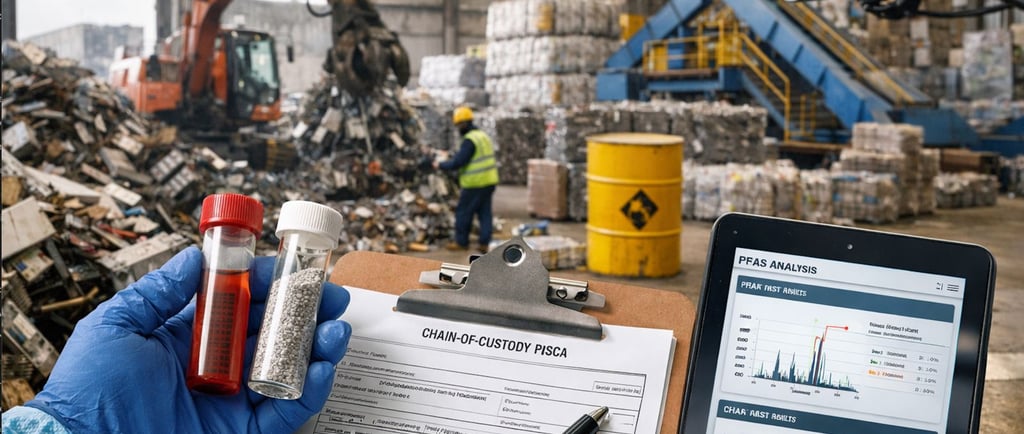
Context: Why TSCA & PFAS Matter for Recyclers
In 2026, the regulatory environment for recyclers is more complex—and unforgiving—than ever before. The US Environmental Protection Agency (EPA) and a growing number of state authorities have turned their attention to entities previously overlooked: flow-through recycling facilities and secondary material handlers. The Toxic Substances Control Act (TSCA), once regarded as primarily targeting manufacturers, now applies vigorously to the recycling supply chain due to a heightened focus on hazardous substances like per- and polyfluoroalkyl substances (PFAS).
PFAS—known as “forever chemicals” due to their persistence—are found in diverse recycling streams: plastics resins, automotive shreds, e-waste plastics, textiles, and industrial packaging. The reason for this scrutiny is clear: PFAS resist degradation, linger in landfills and water, and threaten environmental and public health. As a result, regulatory enforcement is no longer limited to routine audits. Increasingly, downstream buyers in the circular economy—such as smelters, resin reclaimers, large CPG brands, and OEMs—refuse to accept material unless recyclers can provide auditable evidence of TSCA and PFAS compliance. The bar has risen from relying on trust to demanding traceable, transparent, and third-party verifiable documentation.
Regulatory compliance is not just a “back office” issue. As of 2024, an IndustryWeek survey found that over 55% of large material buyers rank TSCA and PFAS documentation among their top three supplier onboarding criteria—up from just 15% in 2021. For recyclers, failing to meet these documentation expectations risks not just EPA penalties but immediate exclusion from major markets, financial partners, and preferred supplier lists.
Future Trends to Watch:
Expansion of state “PFAS in products” bans, impacting permissible feedstocks.
Automation and AI-based audit tools, making random inspections more frequent.
Emerging “circularity certifications” for recyclers, requiring audit-ready TSCA/PFAS evidence.
Growing adoption of blockchain-based chain of custody systems for compliance transparency.
Key Takeaway:
TSCA and PFAS compliance is now a front-line business issue for recyclers—not just a regulatory checkbox. Transparent documentation is the new currency of trust.
2. Defining the Compliance Stakes in Recycling
The Problem:
For recycling operations, documentation requirements may seem like overhead, but the absence—or weakness—of compliance records directly endangers operational continuity and market access. In 2023, the EPA reported over 120 citations issued to US recycling facilities for incomplete TSCA documentation. Over 60% of those citations led to buyer-initiated holdbacks and urgent resampling, with some facilities facing six-figure remediation costs.
Operational Stakes in Detail:
Permit Loss or Suspension: Environmental permits are the foundation for a recycling facility’s operation. Non-compliance can result in suspension or termination, often with little room for appeal. In multi-state networks, this can trigger a cascading shutdown.
Hefty Regulatory Fines: EPA fines for TSCA violations can exceed $37,500 per day/per violation (source: EPA Enforcement Annual Results 2022). PFAS remediation costs can exceed $100,000 per incident, and may involve years of cleanup liability.
Buyer Cancellations and Delayed Payments: Modern procurement contracts increasingly contain compliance clauses calling for immediate termination or payment withhold in case of documentation gaps.
Brand/Reputational Damage: Missed compliance can lead to public supplier blacklisting—not just by one buyer, but across the industry—undermining years of business reputation.
Loss of Insurance Coverage: Commercial general liability and environmental policies increasingly exclude coverage for PFAS-related events unless continuous compliance documentation is proven.
Business Interruption: Shutdowns disrupt operations, affect multi-site networks, and may require expensive outside consultants to restore compliance.
Data Point:
According to a 2022 ISRI risk analysis, more than 20% of recycling industry insurance claims with losses above $50,000 were related to missing or incomplete documentation for regulated hazardous substances—including PFAS.
Key Insight:
The operational risks of poor documentation are real, immediate, and growing. Integrating compliance documentation into every business workflow is essential for risk management and continued market access.
3. TSCA, PFAS, and Key Documentation Terms
TSCA (Toxic Substances Control Act):
TSCA, enacted in 1976 and substantially amended in 2016 (via the Lautenberg Act), mandates the EPA to regulate chemical substances and mixtures that could pose “unreasonable risk.” Key recycling materials affected include electronic plastics, flame-retardant components, and post-consumer resins. Under TSCA Section 6(h), certain PFAS compounds are now subject to more rigorous restrictions.
PFAS (Per- and Polyfluoroalkyl Substances):
PFAS comprises over 4,000 synthetic chemicals, valued for oil/water repellency and chemical stability. They are used in electronics, non-stick surfaces, wires, films, auto parts, and industrial textiles—all of which may flow through recycling streams. The EPA has recently added thousands of PFAS compounds to its Toxics Release Inventory (TRI), triggering expanded documentation duties for recyclers.
Core Documentation Elements (with Examples):
Material Origin and Chain of Custody: Geographical source, supplier identity, date/time stamps, previous handlers. Example: Record of a plastics load sourced from a post-industrial processor in Ohio, including a timestamped digital manifest.
Assessment/Sampling Records: Laboratory analyses documenting whether material contains restricted TSCA or PFAS constituents. Example: PDF test results from a NELAP-certified lab attached to the lot record.
Storage and Handling Logs: Automated or manual logs tracking the movement, storage times, segregated areas, and handlers.
Disposal, Treatment, and Shipment Manifests: EPA uniform hazardous waste manifest, including digital forms where allowed. Example: Manifest that tracks PFAS-impacted resin being transported to an EPA-approved hazardous waste incinerator.
Supplier/Buyer Declarations: Digital or physical forms certifying the presence/absence of regulated substances.
Audit Trails: System-generated logs indicating who reviewed, modified, or approved compliance entries.
Additional Terms:
Non-Detect (ND): Used to denote test results where PFAS/TSCA substances are below regulated thresholds.
Corrective Action Log: Record of error detection, root-cause analysis, corrective employee retraining, and closure date.
Key Point:
Precise, verifiable, and time-stamped documentation across the chain of custody is the foundation for passing regulatory and buyer audits in today’s compliance landscape.
4. The Compliance Framework: Risk-First, Operation-Focused
Traditional vs. Modern Compliance Programs:
Legacy compliance approaches typically bolted on extra paperwork and periodic audits, but created delays and bottlenecks, especially under the pressure of high-volume operations. Today’s leaders implement practical, digital-first compliance frameworks integrated seamlessly with operational workflows.
Four Pillars of Practical Compliance
Risk Identification: Visual mapping of flow paths—identifying every input that might introduce TSCA- or PFAS-related risk, backed by supplier history and industry intelligence. For instance, mapping e-waste streams back to specific contract manufacturers.
Process Integration: Embedding compliance into front-line operations—using electronic forms at material intake, digital manifests at dock points, or QR code scans at sorting stations—ensures compliance steps are “baked in” rather than bolted on.
Automated Documentation: Adopting digital platforms—whether via tablets, mobile apps, or cloud-based compliance suites—enables real-time data capture, instant access during audits, and reduces human error. According to a 2023 Circularity Tech Council survey, facilities using mobile checklists reported a 35% reduction in compliance lapses.
Exception Management: Automated alerts and escalation protocols for any data gaps, missing results, or non-conforming loads ensure that red flags trigger immediate action, containing liability before it escalates.
Expanded Process with Case Example
Inventory all incoming loads: Use digital logbooks or RFID scans to capture source, supplier, and weight data in real time.
Flag TSCA/PFAS screen-triggers: Pre-populate digital flags based on material type, supplier risk rating, and recent regulatory trends.
Sample high-risk materials: Allocate rapid field-testing kits or direct to a contracted lab partner based on risk protocols.
Document sample results: Attach electronic lab/PFAS screen results to the relevant record, creating a permanent, searchable compliance file.
Separate and store flagged material: Use geotagged storage or video verification to prove segregation of suspect/non-compliant batches.
Complete transfer logs: Implement automated, time-stamped batch movement records—no manual paperwork backlogs.
Update buyer paperwork: Generate and send downstream compliance certificates or audit-ready digital exports to buyers as needed.
Retain all records: Ensure secure, encrypted cloud archives for 3–5 year retention periods, accessible for unplanned audits.
Weekly compliance checks: Use dashboards to alert compliance teams to stale, incomplete, or at-risk documentation.
Issue corrective actions: Assign digital tasks, set hard deadlines, and verify closure for any compliance lapses.
Case Study Highlight:
A large midwestern metals recycler adopted a SaaS-based compliance platform in 2022. After implementation, audit cycle time reduced by 60%, and the facility avoided $250,000 in potential permit-related delays following a surprise EPA inspection.
Implementation playbook: what recyclers must document, step by step
This section assumes a simple reality. You do not control what comes in. You control what you can prove about what came in, what you did to it, where it went, and why your decisions were reasonable.
Start by defining your compliance unit.
Use “lot” as the unit for proof. A lot can be a load, a gaylord, a bale batch, a roll-off, or a day’s production run, but pick one definition and keep it consistent.
Assign every lot a unique ID at intake. Print it as a QR label and place it on the physical container or bay. Make the ID follow the material through sorting, storage, rework, and shipment.
A. Intake documentation that holds up in an audit
At minimum, your intake record should prove five things: who, what, when, where, and how much.
Who
Supplier legal name and site address, plus a site contact.
Carrier name, truck ID, trailer ID, driver name if available.
If you accept brokered loads, document both the broker and the true origin, then mark who had custody at each handoff.
What
Material description in operational terms, not marketing terms. “Mixed rigid plastics, post-industrial, suspected fluorinated coating risk” beats “scrap plastic.”
Known or suspected PFAS indicators. Add a field called “PFAS risk trigger” with a short reason, for example “textile treatment,” “firefighting foam history,” “fluorinated surface treatment,” “stain-resistant product stream.”
When and where
Date and time of receipt, scale ticket time, unloading bay.
Photos at intake. Take 6 to 10 photos. Include wide shot, close-up, and any labels, tags, or product markings.
How much
Gross, tare, net weights, and moisture notes if you track them.
Container count and packaging type.
B. Risk-screening rules that are easy to run on the floor
You need a risk screen that a supervisor can execute in 60 seconds without reading a regulation.
Use a two-tier model.
Tier 1, fast routing triggers
Route to normal processing if the stream is historically low-risk and supplier history is clean.
Route to hold-and-test if any trigger hits.
Common recycler triggers
E-waste plastics with unknown flame retardant history.
Textiles, carpets, upholstery, and coated fabrics.
Food-contact packaging bales where grease-resistance coatings are common.
Auto shred, ASR-adjacent plastics, and unknown elastomers.
Industrial wipes, filter media, and treated paper streams.
Tier 2, escalation triggers
Escalate to compliance review if you see repeat supplier exceptions, missing origin data, or inconsistent load composition.
C. Sampling, analysis, and chain of custody that survive scrutiny
If you test, your documentation must show the sample is valid and the result is tied to the lot.
Sampling plan
Document who sampled, their training, and the exact method used.
Document the sampling locations and the composite logic. “5 grabs from 5 points across the pile, combined into one composite” is audit-friendly.
Document the equipment list and PFAS contamination controls. PFAS sampling guidance commonly warns against PTFE and other PFAS-containing materials.
Chain of custody
Every sample needs a chain-of-custody form, signed at handoffs.
Mark suspected high concentration samples on the form so the lab can handle them correctly.
Use lab-supplied containers when possible. Many guidance documents prefer HDPE or polypropylene containers with PFAS-safe caps for many matrices.
Analytical method selection
For broad PFAS work across matrices, align your lab program to EPA Method 1633A for the relevant sample types where applicable. It includes defined QC elements and is designed for multiple matrices using LC-MS/MS.
Document why you chose the method, what your reporting limits are, and what “non-detect” means in your program. “ND” without the reporting limit is weak.
Quality control artifacts you should keep with the lot record
Field blanks and equipment blanks, when appropriate.
Duplicates or split samples on a defined cadence, for example 1 in 20 high-risk lots.
Lab report, data package elements you can obtain, and any qualifiers.
Corrective action notes if a blank shows contamination.
D. Storage, segregation, and movement logs that prove control
Auditors and buyers look for a simple proof pattern: you identified risk, you controlled it, and you prevented mixing.
Create three physical states and document each state change.
Released, normal inventory.
Hold, pending results or pending paperwork.
Restricted, confirmed or suspected PFAS issue.
For each movement, capture:
Timestamp.
From location and to location.
Operator name or badge.
Reason code, for example “awaiting lab,” “re-sample,” “ship approved,” “dispose.”
If you use video, keep a short clip index keyed to lot IDs. Do not rely on video alone. Video supports a record, it does not replace it.
E. Shipment documentation and buyer-ready compliance packets
Assume your buyer will ask you for proof with zero notice.
Build a standard “lot export” packet that you can generate in minutes:
Lot summary, origin, weights, dates, custody chain.
Processing history, what you did to it, and whether it was blended.
Test results, method, lab accreditation, reporting limits.
Storage and segregation proof for hold lots.
Disposition, where it shipped, who carried it, and what the buyer received.
If you ship to multiple downstream processors, use consistent data fields so each buyer sees the same structure. That reduces the chance of “custom paperwork” errors.
F. TSCA 8(a)(7) PFAS reporting and record retention, what it means for recyclers
Many recyclers are not “manufacturers” under TSCA in the common sense, but TSCA can still reach you through your supply chain and your customers’ demands. The TSCA 8(a)(7) PFAS rule applies to entities that manufactured, including imported, PFAS or PFAS-containing articles since January 1, 2011.
EPA’s current reporting window is April 13, 2026 to October 13, 2026, with an extended deadline for small manufacturers only reporting as PFAS article importers.
Even if you are not the reporting entity, you will get data requests.
Buyers, brand owners, and importers will send supplier surveys that mirror TSCA fields, such as uses, volumes, disposal, exposures, and hazards. EPA lists those information categories in its overview of TSCA 8(a)(7).
Record retention matters because it is one of the first audit questions.
Under 40 CFR Part 705, relevant records must be retained for 5 years beginning on the last day of the submission period.
A practical recycler rule is simple. Keep the full lot packet plus your decision notes for at least 5 years for high-risk streams, and longer if contract terms or state rules require it.
Measurement and quality assurance: how you prove your program works
A strong TSCA and PFAS documentation program is measurable. If you cannot measure it, you cannot defend it.
Build metrics that track completeness, speed, and containment.
A. Documentation completeness metrics
Lot record completeness rate. Target 98 percent or higher for required fields.
Missing critical fields count per week. Critical means origin, weight, custody, disposition, and test status when required.
Time to close an exception. Track median and 90th percentile.
B. Testing and sampling quality metrics
High-risk lot test coverage. For example, “90 percent of Tier 1 holds tested within 10 business days.”
Re-sample rate. If it climbs, your sampling method or contamination controls may be failing.
Blank contamination rate. Any recurring blank contamination is a red flag for PFAS cross-contamination risk. Use ITRC sampling precautions to tighten field materials and handling.
C. Operational containment metrics
Hold lot dwell time. Long dwell time drives blending mistakes and inventory pressure.
Segregation breach incidents. Define a breach clearly, then treat it like a safety near-miss.
Rework rate due to paperwork. This is where you find training gaps.
D. Audit readiness drills
Run a quarterly “two-hour audit drill.”
Pick 10 lots at random, including at least 3 holds.
Your team must produce the full packet, plus explain each decision.
Score each packet. If your average score is below 90 percent, your program is not audit-ready.
E. Penalty awareness and why speed matters
When regulators do enforce, penalty ceilings can be high and are inflation-adjusted. TSCA maximum civil penalties are updated through EPA’s civil penalty adjustment process and referenced through 40 CFR Part 19.
You do not manage this risk by panic. You manage it by making sure your records are complete, time-stamped, and consistent.
Mini-case scenarios: what “audit-ready” looks like in real life
Scenario 1: Textile and carpet bales, “stain-resistant” legacy risk
What goes wrong: You accept bales with unknown treatment history, then blend them into a plastics output stream.
What to document:
Supplier declarations and product category notes.
Risk trigger selection, for example “treated textiles.”
Hold status, segregation location, and movement logs.
Sampling plan, chain of custody, and lab results with reporting limits.
Disposition decision with reason, for example “restricted, routed to approved disposal or specialty processor.”
Scenario 2: E-waste plastics to pellet buyers
What goes wrong: The buyer asks for proof after an internal brand audit, not after a spill.
What to document:
Full chain of custody to show you controlled commingling.
Processing history, including shredding line, wash line, and any additives.
PFAS method alignment and QC artifacts if you tested, especially if you cite EPA Method 1633A.
A buyer packet you can send in hours, not weeks.
Scenario 3: Landfill leachate or wastewater offsite shipment
What goes wrong: You cannot show how you characterized the waste stream, or how you avoided sample contamination.
What to document:
Sampling precautions, PFAS-safe materials, and chain-of-custody proof.
Analytical method and QC steps.
Shipping manifests and treatment facility acceptance documentation.
Scenario 4: Buyer asks about TRI and release reporting exposure
What goes wrong: A customer asks if you track PFAS releases because TRI PFAS obligations are expanding and they want supply chain transparency.
What to document:
Your internal PFAS tracking notes and any release control measures.
Whether your facility falls into TRI-covered sectors, and how you track PFAS if applicable.
EPA notes that TRI PFAS additions continue annually, and EPA stated the total PFAS subject to TRI reporting reached 205 for Reporting Year 2025, with forms due July 1, 2026.
FAQs and toolkits: documents you should have ready today
FAQs
How long should you keep PFAS and TSCA-related records?
If you are a reporting entity under 40 CFR Part 705, retain relevant records for 5 years beginning on the last day of the submission period.
If you are not a reporting entity, keep records long enough to satisfy buyer contracts, insurers, and state requirements. Five years is a practical baseline for high-risk streams.
What is a defensible definition of “non-detect”?
Non-detect must be paired with the reporting limit and method. “ND” alone is not defensible.
Store the lab report, reporting limits, and any qualifiers.
Do you need to test every load?
No. You need a written risk-based plan, proof you followed it, and proof you contained exceptions.
Over-testing without contamination controls can create noisy data. Under-testing creates blind spots.
How do you avoid PFAS sample contamination?
Use PFAS-aware sampling precautions, avoid PFAS-containing materials when possible, and document your controls.
ITRC and EPA sampling guidance stress contamination controls and clean containers, and they emphasize proper chain of custody.
Toolkits you can build as templates, no tables needed
Toolkit 1: PFAS and TSCA intake form fields
Lot ID, date/time, scale ticket, supplier, origin, carrier, material description, photos.
PFAS risk trigger dropdown plus free-text reason.
Routing decision, released or hold.
Supervisor sign-off.
Toolkit 2: Sampling and chain-of-custody packet
Sampling plan one-pager.
Chain-of-custody form.
Field notes page with equipment list and contamination controls.
Photo log of sampling points.
Lab report and QC notes.
Toolkit 3: Hold and segregation SOP
Physical signage rules.
Movement logging rules with timestamps.
Breach definition and incident report template.
Release criteria, who can release and what proof they need.
Toolkit 4: Buyer compliance packet export
Lot summary, custody, processing history.
Test summary with method and reporting limits.
Storage and segregation proof for holds.
Disposition and shipment documentation.
Toolkit 5: Quarterly audit drill script
Pick 10 lots at random.
Two-hour timer.
Score sheet for completeness, traceability, and decision clarity.
Corrective action assignment and closeout.
Trend watch for 2026 that changes what buyers ask for
EPA’s TSCA 8(a)(7) PFAS reporting window is live in 2026, which will drive more supplier data requests and more scrutiny of “unknown” answers.
PFAS measurement is standardizing across matrices, including through EPA Method 1633A, which increases the chance that buyers will require method-aligned results and QC artifacts.
TRI PFAS reporting keeps expanding, and EPA has tied additions to annual cycles under the NDAA mechanism, which pushes more supply chain questions onto recyclers.
Connect
Your trusted partner for scrap metal procurement.
CONTACT
About
haroon@tdcventures.com
+1-307-655-7593
© 2025. All rights reserved.
NEWSLETTER