
Waste Heat to Power: ORC Units on Shredders for Actionable Decarbonization
Discover how ORC units convert industrial shredder waste heat into clean electricity. Cut energy costs, reduce Scope 1 & 2 emissions, and turn a thermal liability into a powerful decarbonization asset.
SUSTAINABLE METALS & RECYCLING INNOVATIONS
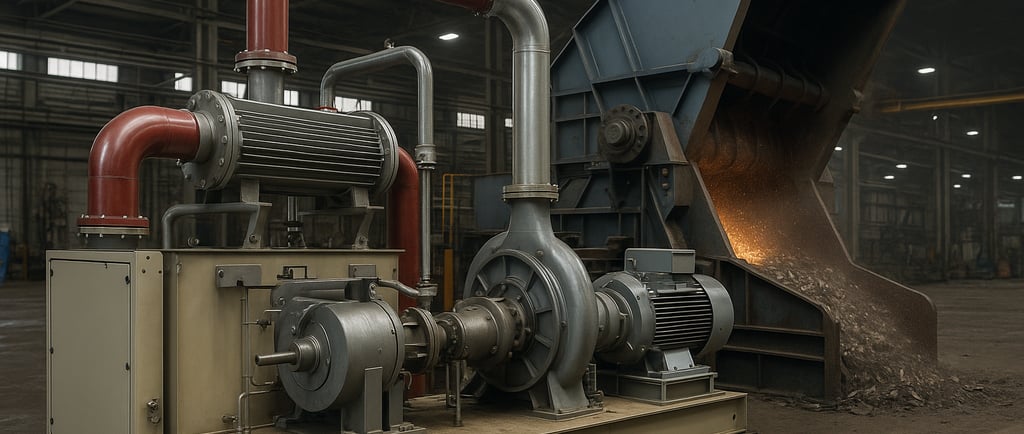
Waste heat is a largely untapped resource in industrial operations—bleeding valuable energy into the atmosphere, driving up operational costs, and hindering progress toward aggressive sustainability targets. In today’s era of heightened regulatory scrutiny and strong investor demand for lower-carbon practices, industrial leaders across manufacturing, metals recycling, and materials processing are under sharp pressure to deliver actionable decarbonization. Organic Rankine Cycle (ORC) technology paired with industrial shredders stands out as a pragmatic solution—converting thermal losses into a renewable power source.
This guide will unpack the strategic, compliance, and environmental case for ORC deployment on shredders. We'll explore how this technology unlocks measurable emissions savings, fortifies business resilience, and aligns with the latest sustainability frameworks.
Understanding ORC Technology: Turning Waste Heat Into Energy
What Is the Organic Rankine Cycle (ORC)?
The Organic Rankine Cycle (ORC) is a transformative, closed-loop thermodynamic process, analogous in principle to the classic steam Rankine cycle but engineered for superior efficiency at lower temperatures. Instead of water, ORC utilizes a high-molecular-mass organic fluid—think pentane, toluene, or proprietary refrigerants—selected for favorable boiling characteristics. This enables the conversion of low- and medium-grade industrial waste heat into electricity, an area traditional steam turbines cannot economically exploit.
ORC System Components:
Heat Exchanger (Evaporator): Waste heat flows into the system, transferring energy to the organic working fluid.
Organic Turbine/Expander: The now-vaporized fluid expands across a turbine, generating mechanical power, which is converted into electricity by a generator.
Condenser: Post-turbine, the vapor is cooled and condensed back to liquid.
Pump: Back in liquid phase, the fluid is pressurized and recirculated to repeat the process.
This closed-loop operation ensures robust, low-maintenance, and highly automatable function. According to the IEA, global installed ORC power capacity topped 3 GW in 2022, with rapid growth projected through 2030 as decarbonization becomes a boardroom imperative.
Why Focus on Shredders?
Industrial shredders—critical in automotive recycling, e-waste dismantling, and metals processing—characteristically operate under extreme friction and torque, generating abundant continuous waste heat. For example, a 1,000 kW electric shredder may discharge up to 20-30% of input energy as heat via bearings, gearboxes, and electric motor losses. This heat, if unmanaged, leads to:
Increased ambient workspace temperatures,
Accelerated wear/fatigue of machine components,
Higher utility bills due to facility cooling demands,
Escalating emissions through lost energy efficiency,
Difficulty meeting corporate and regulatory decarbonization targets.
Repurposing this heat with an integrated ORC unit not only recoups valuable energy previously dissipated, but also turns a known operational liability into a measurable productivity and sustainability win.
Real-World Waste Heat Data Point:
In a typical metals recycling plant, continuous operation of a large shredder can waste over 1 GWh of heat per year—enough to power roughly 90-100 average US homes over the same period.
The Decarbonization Imperative: Challenges and Opportunities
The Triple Lens: Cost, Risk, and Compliance
1. Containing Exploding Energy Costs
For shredding operators, energy often ranks as a top-three operating expense—sometimes second only to raw material acquisition. Unchecked, rising utility prices and carbon surcharges can turn an otherwise profitable facility into a financial risk. According to the US Energy Information Administration, industrial electricity rates rose over 7% from 2021 to 2023 alone—and this trend shows no signs of slowing, particularly as global demand for decarbonized power accelerates.
2. Navigating Rising Regulatory and Investor Risk
Global environmental regulation is increasingly focused on “hard-to-abate” sectors like heavy industry. Extended Producer Responsibility (EPR) policies are being adopted in major markets across the EU, Canada, and parts of Asia. Coupled with emerging carbon pricing mechanisms—such as the EU’s Emissions Trading System (ETS), California’s Cap-and-Trade, and Asia’s growing carbon markets—organizations are being financially penalized for excessive carbon output.
Beyond regulators, investors are re-balancing portfolios toward companies with clear, defensible decarbonization strategies. BlackRock, the world’s largest asset manager, identified climate risk as investment risk—prompting a wave of ESG-focused capital flows toward sustainable manufacturing and recycling operations.
3. Compliance as Strategic Differentiator
New frameworks, like the EU’s Corporate Sustainability Reporting Directive (CSRD) and SEC climate disclosure guidelines in the US, demand comprehensive emissions transparency, not just at the company level but throughout value chains. Demonstrable progress on decarbonization is a non-negotiable for both compliance and supply chain competitiveness. Implementing ORC to recover and reuse waste heat provides a documented, auditable emissions reduction pathway that resonates with regulators, customers, and investors alike.
Quantifying Your Impact: LCAs and Decarbonization Strategy
Life Cycle Assessment (LCA) is the gold standard methodology for evaluating the cradle-to-grave environmental impacts of industrial processes. For shredding operations, integrating ORC-derived power directly reduces Scope 1 and Scope 2 emissions, enabling operators to:
Quantifiably track year-over-year carbon reductions,
Benchmark against both industry averages and internal goals,
Substantiate green marketing, investor reporting, and customer assurance efforts,
Attain third-party verified program certifications (e.g., ISO 14067 for carbon footprinting).
Supporting Statistic:
A 2023 ASME review found that waste heat recovery in metals recycling using ORC could decrease process CO2 emissions by up to 12%—a significant stride in sectors where year-on-year reductions of just 2-3% are often viewed as a success.
How to Deploy ORC Units On Shredders: Step-by-Step Action Plan
Step 1: Conduct a Waste Heat Audit
The process begins with a rigorous waste heat audit, combining on-site thermal measurements and process simulation to map:
Heat Source Temperatures: Shredder exhaust, bearings, gearboxes, and ambient discharge.
Load Profiles: Seasonal, weekly, and hourly variability to inform optimal sizing.
Potential for Integration: Physical space, accessibility, and retrofitting requirements.
A professional audit typically delivers a clear set of heat-recovery targets with technical recommendations, forming the backbone of your ORC business case. Companies like DNV, TÜV SÜD, and reputable ORC system integrators offer industry-leading assessment frameworks.
Step 2: Build the Business Case
Smart decarbonization investments must deliver on both environmental goals and the bottom line. Construct your business case by quantifying:
Capital Expenditure (CapEx): Equipment, installation, and commissioning costs.
Operational Expenditures (OpEx): Maintenance contracts, spare parts, and periodic system optimization.
Revenue Streams: Direct electricity savings, sales to the grid (in deregulated energy markets), carbon credits (under programs like the Clean Development Mechanism or US 45Q tax credit).
Payback Period: Most ORC waste heat recovery projects in Europe and North America achieve payback within 3-6 years due to rising energy/carbon prices and generous incentives (e.g., Germany’s BAFA Heat Bonus, or the US Department of Energy’s Section 48C).
Future Trend:
As battery costs decrease and grid flexibility increases, pairing ORC units with on-site storage will become more viable, allowing operators to run shredders and auxiliary operations with even higher self-consumption and lower power draw from the grid during peak hours.
Step 3: Navigate Risk and Compliance
ORC installation must be carefully mapped against:
Health & Safety Codes: Ensure that new systems meet local regulations for worker safety, emergency shutoff, and fire prevention.
Environmental Permits: Document and register emissions reductions, and apply for grants or utility incentives where available.
Corporate ESG Strategy: Report all performance improvements against GHG targets using standardized, auditable protocols such as the Greenhouse Gas Protocol (GHG) or CDP (formerly Carbon Disclosure Project).
Step 4: ORC System Integration and Commissioning
During rollout:
Custom Engineering: Collaborate with ORC suppliers and shredder OEMs to optimize system fit, calibration, and performance.
Automation and IoT Analytics: Integrate the ORC unit with facility control platforms for real-time heat recovery analytics, remote monitoring, and predictive maintenance.
Training: Invest in hands-on operator training and digital knowledge transfer to ensure long-term, sustainable operation with minimal unplanned outages.
Industry Best Practice:
Leading facilities conduct phased commissioning with cross-functional teams from engineering, safety, and finance to systematically address integration, mitigate downtime, and accelerate benefits.
Designing ORC systems for shredders: from theory to plant reality
Once you know that ORC on shredders makes sense in principle, the hard work is design. The plants that extract the most value do three things well. They map every relevant heat source in detail. They size the ORC for realistic operating hours and loads. They copy what already works in steel, cement, and aluminium instead of experimenting blindly.
Mapping your heat sources around the shredder
A shredder line rarely has just one useful heat source. You normally see a cluster of streams that sit in the low to medium temperature band where ORC performs well.
Typical sources around a medium to large metal shredder include:
Motor and drive cooling circuits. High power electric motors and frequency drives reject heat into closed water or glycol loops. These often run between 50 and 80 degrees Celsius.
Gearbox and hydraulic oil cooling. Gearboxes and hydraulic units for feed rollers, pusher systems, and downstream conveyors often reject oil at 70 to 110 degrees Celsius.
Exhaust or ventilation air. Extraction systems that pull dust and fumes away from the hammermill or cutting chamber can carry air at 60 to 120 degrees Celsius, sometimes higher near enclosed housings.
Ancillary equipment. Pre shredders, downstream mills, compressors, and dust filters add more low grade heat to the same building.
Studies on energy intensive industries show that ORC gives the best performance for heat sources in the 120 to 250 degree Celsius range, and still works well down to around 80 degrees Celsius when you design carefully.aspire2050.eu+1 For shredders this usually means focusing on the hotter oil circuits and any exhaust streams, then using water circuits as a secondary source or as a way to stabilise flow.
You want a structured survey, not guesswork. During the waste heat audit, insist on logging temperatures and flows over several weeks. Logging should cover start up, steady operation, and partial load. Short spot measurements are not enough. Many failed projects assumed “8,000 hours at full load” and then discovered that the shredder in fact runs at high load for 3 to 5 hours a day, five days a week, with long idle periods or seasonal downtime.
Rule of thumb: if you cannot guarantee at least 3,000 to 4,000 operating hours per year at a stable thermal input, your ORC unit will be hard to justify on pure power economics alone. In those cases it may still make sense if you value CO2 reductions, grid independence, or power quality.
Estimating power output for different shredder sizes
The next step is to turn heat into numbers that your finance team understands. ORC electrical efficiency at shredder temperatures (80 to 180 degrees Celsius) often sits in the 8 to 14 percent range, depending on design and ambient conditions. Vendors in industrial heat recovery report single units from 1 to 20 megawatts of electric output in sectors such as glass, cement, and steel, with simple payback typically in the 3 to 6 year range.exergy-orc.com Shredders usually fall at the lower end of this power range, but the same logic applies.
You can use simple scenarios to frame discussions.
Scenario A: single medium shredder
Shredder drive: 2 megawatts installed motor power.
Waste heat fraction: 25 percent of input energy emerges as useful low to medium temperature heat.
Available thermal power: around 500 kilowatts of continuous heat during operation.
ORC net efficiency: assume 10 percent.
Net electrical output: about 50 kilowatts.
Operating hours: 6,000 hours per year at productive load.
Annual electricity production: 300 megawatt hours.
If your electricity cost is 0.12 euro per kilowatt hour, this equals around 36,000 euro per year in avoided purchases. If your local grid emission factor is 0.4 tonnes of CO2 per megawatt hour, the same system avoids around 120 tonnes of CO2 per year.
Scenario B: cluster of high power shredders on one site
Now consider a multi line site. Two 3 megawatt automotive shredders and one 1.5 megawatt pre shredder, all running heavy duty cycles.
Total installed drive power: 7.5 megawatts.
Waste heat fraction: 25 percent.
Available thermal power: around 1.9 megawatts when all three lines run at load.
ORC net efficiency: assume 11 percent because the oil and exhaust temperatures are higher.
Net electrical output: around 200 to 210 kilowatts.
Operating hours: 7,000 hours per year across the fleet.
Annual electricity production: roughly 1.4 to 1.5 gigawatt hours.
At the same electricity and grid carbon values as above, this yields:
Cost savings: about 170,000 to 180,000 euro per year.
Avoided emissions: around 560 to 600 tonnes of CO2 per year.
For plants in regions with higher power prices or higher grid carbon intensity, the economic and climate benefits scale further. EU studies on industrial power show emission factors ranging from about 0.09 tonnes of CO2 per megawatt hour in France to 0.63 in coal heavy systems such as the Czech Republic.aspire2050.eu At the upper end of that range, the same 1.5 gigawatt hours of ORC power would avoid close to 900 tonnes of CO2 per year.
These scenario numbers are not exact design values. They give your team a realistic starting range and a way to compare ORC with alternative investments such as extra solar PV, more efficient motors, or better air handling.
What shredders can learn from cement, steel, and aluminium
Shredder operators do not need to be first movers. Other sectors have already proved that ORC can run reliably in hot, dusty, and cyclic environments.
Cement
A study of cement plants in the EU estimated that about 576 megawatts of ORC capacity could be installed across 241 facilities, recovering between 2.9 and 4.6 terawatt hours of electricity each year. This would avoid roughly 1.5 million tonnes of CO2 annually and save between 260 and 416 million euro in power costs at then current prices.aspire2050.eu Importantly, most of that heat comes from exhaust gases and clinker cooling air at 300 to 450 degrees Celsius, conditions that are more severe than those around a shredder.
Steel
The same analysis for EU steel plants found potential for about 748 megawatts of ORC capacity on electric arc furnaces and rolling mills, with expected energy recovery in the range of 3.7 to 6.0 terawatt hours per year. Avoided emissions were estimated between 1.35 and 2.16 million tonnes of CO2, and annual electricity cost savings between 344 and 551 million euro.aspire2050.eu
A flagship example is the Feralpi plant in Riesa, Germany, where an ORC unit of around 2.7 megawatts electric output captures heat from an electric arc furnace and converts it into power.turboden.com Another case is ORI Martin in Brescia, Italy, where an ORC unit of 2.2 megawatts electric and associated heat recovery supplies both plant needs and district heating. That system provides winter heat for about 2,000 households, summer electricity for around 700 households, and cuts roughly 10,000 tonnes of CO2 per year.turboden.com
These projects run in environments with violent temperature cycles, abrasive particulates, and strict reliability requirements. If ORC can survive above an electric arc furnace, it can handle the thermal and mechanical conditions around a shredder line when designed correctly.
Aluminium and other metals
Recent research on waste heat recovery in aluminium production shows similar potential. One study on an aluminium plant with about 16 megawatts of low to medium temperature waste heat found that ORC could convert a meaningful share of this into electricity, improving plant energy efficiency and reducing emissions.Frontiers+1 For shredder operators who feed aluminium smelters or rolling mills, this creates an interesting value chain. Waste heat recovery at both ends of the scrap loop improves the carbon profile of the metal you process and sell.
Using LCAs to confirm the benefit
Life cycle assessment work on ORC plants shows that, when located in regions with fossil heavy grids, each kilowatt hour of electricity from ORC typically has a lower environmental footprint than the grid mix it replaces.ResearchGate+1 That makes ORC particularly attractive for metals recycling and shredding, where buyers now ask for detailed carbon footprints at coil, billet, or bale level.
For your own project, you should insist that the ORC supplier supports a simple LCA of the installation. That LCA should cover the embodied impact of the ORC equipment, the avoided grid power, and any changes in your own process energy efficiency. The result will support investor pitches, customer PPAs, and compliance with schemes that require product level carbon reporting.
Sizing and integration rules that matter for shredders
Once you trust the concept and know the rough power potential, you need to shape the physical integration.
First, match the ORC to your shredder duty cycle
Shredder duty cycles can be irregular. You may run very hard on certain days, then shift to maintenance, storage clearing, or lower throughput.
To deal with this, many plants:
Use an intermediate thermal oil or pressurised water loop between the shredder heat sources and the ORC. This loop acts like a buffer and lets the ORC ramp more slowly than the shredder itself.MDPI+1
Add a small thermal storage volume, often using tanks or solid media, so that the ORC can keep running smoothly during short gaps.IEA+1
Set minimum load thresholds below which the ORC parks in standby rather than cycling on and off.
Second, design for contamination and fouling
Shredder environments carry dust, metal fines, rubber fragments, paint, plastics, and oil vapours. If you connect an ORC directly to dirty exhaust streams without proper conditioning, heat exchangers foul fast. The cement and steel sectors again provide proven layout lessons.
Good practice includes:
Locating heat exchangers where gas velocities are manageable and where existing filtration already removes coarse dust.
Choosing exchanger geometries that you can clean with standard tools and that tolerate some fouling without catastrophic performance loss.ScienceDirect+1
Including bypass lines so that you can isolate the ORC for maintenance while the shredder stays available for production.
Third, work with your shredder OEM early
Retrofitting a completely independent ORC system is possible, but it often creates mechanical clashes and warranty questions. Engaging the shredder OEM or a trusted integrator early allows you to:
Re use existing cooling circuits with minor upgrades instead of building entirely new ones.
Ensure that bearing and gearbox temperature limits are respected even if the ORC or heat exchanger trips.
Integrate ORC alarms and trips into the main shredder control and safety system rather than running a separate control island.
Fourth, integrate ORC into your site energy strategy
ORC does not run in isolation. It sits beside your grid connection, any existing CHP units, compressors, and, increasingly, on site solar or storage.
At site level, you should ask:
How will ORC output interact with time of use tariffs or demand charges. Many plants choose to use most ORC power internally and reduce peak demand instead of exporting to the grid.
Whether it makes sense to charge a small battery system with ORC output during lower load periods and then discharge during the most expensive tariff windows.
How ORC output and heat recovery can support low temperature users on site, such as office heating, parts washing, or pre heating of process streams.
The International Energy Agency estimates that capturing and reusing industrial waste heat could meet up to 20 percent of global industrial energy demand and avoid hundreds of millions of tonnes of CO2 each year.Bloom Energy+1 For shredder operators, ORC is one way to plug into that opportunity in a concrete, measurable way.
Why ORC on shredders belongs in your net zero roadmap
Net zero discussions in metals recycling often focus on three levers. Switching to low carbon electricity. Improving logistics and material flows. Reducing process energy use. ORC on shredders cuts across all three. It reduces electricity drawn from the grid, improves the effective efficiency of each megawatt you buy, and sends a strong signal to upstream and downstream partners that you take heat recovery seriously.
Global studies on waste heat recovery potential suggest that thousands of terawatt hours of feasible industrial heat remain unused each year.Bloom Energy+2McKinsey & Company+2 In sectors like cement and steel, ORC already converts part of that into power and heat with credible economics. For shredders, the opportunity is smaller in absolute megawatts but large in strategic value.
If you operate even a handful of large shredders across multiple sites, a coordinated roll out of ORC across the fleet can:
Cut your Scope 2 emissions by several percent without changing throughput.
Improve the narrative for customers who buy your shredded scrap for “green steel” or low carbon aluminium.
Free working capital over time as avoided power costs compound.
In the next section of this guide, you can go further into practical project delivery. That includes vendor selection checklists, contract and performance guarantee structures, incentive mapping by region, and a realistic 18 to 36 month roadmap from first audit to stable operation.
Vendor selection: how to avoid expensive mistakes
Once you know that ORC is a fit for your shredder line, vendor selection decides whether the project becomes a reliable asset or a long-running headache. The ORC market is mature enough that you can learn from dozens of industrial plants across steel, cement, glass, and chemicals.MDPI+1
Start with a structured RFI
Before you invite full proposals, run a short, focused request for information. Ask each vendor for:
Installed base in metals, recycling, or similarly harsh environments.
Specific plants with electric drive equipment or furnaces, not only geothermal or biomass.
Power range and temperature range of reference projects.
Typical electrical efficiency at your expected inlet temperatures.
Minimum and maximum thermal input the unit can handle without cycling.
Standard working fluids and why they recommend each one.
Typical availability and maintenance intervals.
Standard performance guarantees and contract forms.
Vendors with several references in electric arc furnaces, rolling mills, or heat recovery from process gases will usually adapt well to shredder waste heat. The Riesa EAF project in Germany, for example, increased overall furnace efficiency by about 4 to 5 percent and produced more than 15,000 megawatt hours of electricity in its first two years.Academia+1 That type of experience matters more than marketing material.
Technical questions that filter serious candidates
In the RFP stage, dig deeper into design choices. Focus on questions that expose how the vendor thinks about real plant constraints.
Working fluid and temperature window
Ask:
Which working fluid do you propose and what are its operating pressures at your inlet temperatures.
How sensitive is performance to ambient temperature at your location.
How they handle fluid degradation, sampling, and replacement.
You want a vendor who can show you performance maps, not just a single point efficiency number. Studies on ORC plants show that off-design behaviour and partial load performance can drive a large share of lifetime energy yield.MDPI+1
Part-load and cycling behaviour
Shredder duty is rarely flat. Ask vendors to quantify:
Minimum stable load (for example, 50 percent thermal input) and impact on efficiency.
Start-up time from cold and from warm standby.
Number of expected start-stop cycles per year without penalty.
You should see clear part-load curves and written guidance on how to operate in sync with your shredder schedule.
Fouling, filtration, and maintainability
For exhaust or ventilation heat recovery, insist on design details for fouling control:
Filtration stages between shredder exhaust and heat exchangers.
Heat exchanger geometry, cleaning methods, and cleaning frequency.
Expected pressure drop increases over time and how they affect shredder performance.
Steel and EAF case studies show that robust waste gas conditioning and easy-to-clean exchangers are critical for long term availability.tenova.com+1 If a vendor cannot explain this clearly, treat that as a warning sign.
Controls and integration
Your operators will judge the project on how it behaves on the control screens. Ask vendors to clarify:
Interface standards with your existing PLC and SCADA systems.
How ORC alarms interact with shredder trips and interlocks.
What data points you can log for power, temperature, and availability.
Remote monitoring and support arrangements.
Aim for a system that behaves like any other plant utility. You want simple control logic from the operator point of view, even if the ORC has complex internals.
O&M model and life cycle support
Operating costs matter almost as much as CapEx. Check:
Whether the vendor offers long term service agreements with fixed annual fees.
Availability guarantees tied to that service.
Local service presence or certified partners in your region.
Spare parts lead times and on-site stock recommendations.
Industrial waste heat recovery studies show that plants with structured service agreements and clear responsibilities maintain higher availability and energy yield over time.emergenresearch.com+1
Contract structures and performance guarantees
Once you are confident on the technical side, the contract protects your downside. There are three main models for ORC projects around shredders and other industrial heat sources.
Model 1: Classic EPC with performance guarantees
You buy, own, and operate the ORC unit. An EPC-style contract covers design, procurement, installation, and commissioning.
Key protections:
Guaranteed net electric power at defined thermal input, inlet temperature, and ambient conditions.
Guaranteed overall availability after the ramp-up period, often 95 percent or higher.
Liquidated damages if measured performance falls below guaranteed levels within defined tolerances.
Clear test procedures and measurement methods, agreed in advance.
Studies on EAF and steel mill ORC projects often reference acceptance tests at specific operating points, followed by seasonal performance checks.ResearchGate+1 You should mirror that approach.
Model 2: Energy performance contract or shared savings
In this model, an ESCO or the ORC vendor finances and owns the unit, then sells you electricity at a discount or shares the savings. This structure:
Reduces your upfront capital requirement.
Shifts some performance risk to the ESCO.
Requires careful baseline definition and ongoing measurement.
You pay through a power purchase agreement or savings sharing formula over 8 to 15 years. In regions with high power prices and strong policy support for industrial efficiency, this model can be attractive.
Model 3: Build-own-operate for district energy integration
Where your shredder plant sits near a town or industrial park, combined power and heat projects become possible. The EAF project at ORI Martin in Brescia, for example, delivers around 11 megawatts of thermal energy to the district heating grid in winter and 2.2 megawatts of electricity in summer through its ORC installation.turboden.com+1
For shredders, heat quantities will be smaller, but you can still explore:
Selling low temperature heat to neighbouring users.
Pre-heating air or water for other industrial sites.
Joining local initiatives that pool excess heat sources.witpress.com+1
In these cases, third parties may own and run the ORC plant and related heat networks, while you provide the waste heat under contract.
Core clauses to lock in
Regardless of the model, focus on:
Clear definition of reference conditions for guarantees.
Agreed test protocols, including instrumentation and uncertainty.
Availability and maintenance responsibilities, including planned outage windows.
Cybersecurity and data access rights for performance monitoring.
End-of-life responsibilities for working fluids and major components.
Well structured contracts reduce disputes and support bankability if you seek external finance.
Incentives, credits, and grants
Waste heat to power projects sit in a favourable policy space. Many governments want to cut industrial emissions quickly while improving energy security. ORC units on shredders fit that profile.
Europe
In Europe, national and EU-level programs directly support waste heat recovery and ORC.
Germany’s Federal Office of Economics and Export Control (BAFA) provides funding for carbon saving and efficiency measures in industrial plants. ORC systems are explicitly eligible in one of the modules, with support rates up to about 50 percent of eligible project costs and a maximum grant per project of 15 million euro.CE Delft - EN
Horizon Europe calls fund innovation actions for industrial waste heat to power. Recent calls highlight ORC technologies and target large energy intensive sites as demonstration grounds.grantbite.com+1
The Knowledge Centre for Organic Rankine Cycle (KCORC) and linked research groups report that industrial waste heat in Europe could support at least 150 terawatt hours per year of electricity production using ORC.Climeon+1 That magnitude helps justify public support, because each terawatt hour of ORC power displaces grid electricity and avoids related emissions.
When you build your business case in an EU country, involve energy agencies or funding advisers early. Many schemes require pre-approval or registration before you place equipment orders.
United States
In the United States, several federal tools can support shredder ORC projects if they sit within wider industrial decarbonization or recycling upgrades.
The Qualifying Advanced Energy Project Credit under Section 48C of the tax code provides an investment tax credit of up to 30 percent for eligible projects. The Inflation Reduction Act expanded this program to 10 billion dollars in total credits, with at least 4 billion reserved for projects in specific energy communities.U.S. Department of the Treasury+3The Department of Energy's Energy.gov+3IRS+3
Guidance summarised by industry groups notes that a broad range of projects qualify, including equipment that reduces greenhouse gas emissions at industrial or recycling facilities. Waste heat to power projects can often fit if they form part of a wider upgrade.zeta2030.org+1
The Inflation Reduction Act also extends and enhances the general Investment Tax Credit and Production Tax Credit for clean energy projects through at least 2025, with a base ITC level around 30 percent for qualifying systems that meet labour and siting conditions.US EPA
On top of federal support, state-level programs and utility incentives can provide extra funding for efficiency and demand reduction. That is particularly relevant if your shredder draws heavily from a strained grid.
Other regions
In many Asian markets, dedicated energy efficiency funds and soft loan programs support industrial waste heat projects, often through development banks or state-owned lenders.
Multilateral banks and climate funds sometimes back large industrial decarbonization programmes that include waste heat to power as one measure among several.
For a global shredder operator, mapping all these instruments can shift project economics dramatically. A system that looks marginal on pure power savings can become attractive when you add grants, tax credits, and low-cost finance.
Practical 18 to 36 month roadmap
A shredder ORC project does not appear overnight. Most plants move through a structured path that runs from initial screening to portfolio roll out over roughly two to three years.
Months 0 to 3: screening and motivation
You:
Collect basic data on shredder power, operating hours, and cooling or exhaust systems.
Estimate waste heat quantities with rough calculations and vendor input.
Compare ORC with other uses of capital, such as motor upgrades or compressed air improvements.
Output: a short internal note that confirms whether ORC merits a serious feasibility study.
Months 3 to 9: detailed audit and feasibility
Work with an engineering partner or ORC vendor to:
Run detailed measurements of temperatures, flows, and duty cycles over several weeks.
Build a mass and energy balance for the shredder line and adjacent equipment.
Define realistic thermal input profiles for the ORC.
Prepare initial layout sketches and integration concepts.
Produce an economic model that includes power savings, maintenance, and policy support.
At this point, you should have a pre-feasibility study that your leadership team can approve or reject.
Months 9 to 15: design, vendor selection, and financing
If you proceed:
Issue a formal RFP to shortlisted vendors with clear technical and commercial requirements.
Evaluate proposals using a weighted score that covers performance, price, references, and service.
Select a preferred bidder and enter contract negotiations.
Apply for grants, tax credits, or soft loans with support from advisers.
The goal for this stage is a signed contract, a defined funding plan, and an agreed timeline.
Months 15 to 24: installation and commissioning
During this phase:
Detailed engineering fixes the final layout, structural supports, and tie-in points.
Site works install heat exchangers, piping, the ORC skid, and electrical connections.
Controls integration with shredder PLCs and plant SCADA is completed.
Cold and hot commissioning tests verify safety systems, performance, and stability.
Plan installation during periods of lower production if possible. Many plants coordinate with planned shredder maintenance to minimise disruption.
Months 24 to 36: optimisation and portfolio planning
Once the ORC has run through at least one full year of seasons and production cycles:
Review measured performance versus guarantees and original business case.
Tune operating strategies for different material mixes and ambient conditions.
Refine maintenance intervals based on real data.
Develop a template for repeat projects at other plants or shredder lines.
By this stage, you should treat ORC as part of your standard plant design toolkit. As new shredders or sites come online, waste heat recovery should be considered at concept design and costed alongside core process equipment.
This roadmap is not rigid, but it gives shredder operators realistic expectations. Many plants underestimate the time needed for permitting, funding applications, and integration design. Building that time into your plan from day one reduces frustration and supports stronger outcomes.
Connect
Your trusted partner for scrap metal procurement.
CONTACT
About
haroon@tdcventures.com
+1-307-655-7593
© 2025. All rights reserved.
NEWSLETTER