
Water Systems from Repurposed Metals
Discover how rapid-deploy water systems built from repurposed metals and solar microgrids are transforming emergency WASH response for climate migration. Learn the 7R framework, real case studies, and QA protocols that deliver safe water within 72 hours while cutting costs by 30–40% and reducing emissions by up to 70%.
CLIMATE MIGRATION & CIRCULAR INFRASTRUCTURE PLANNING
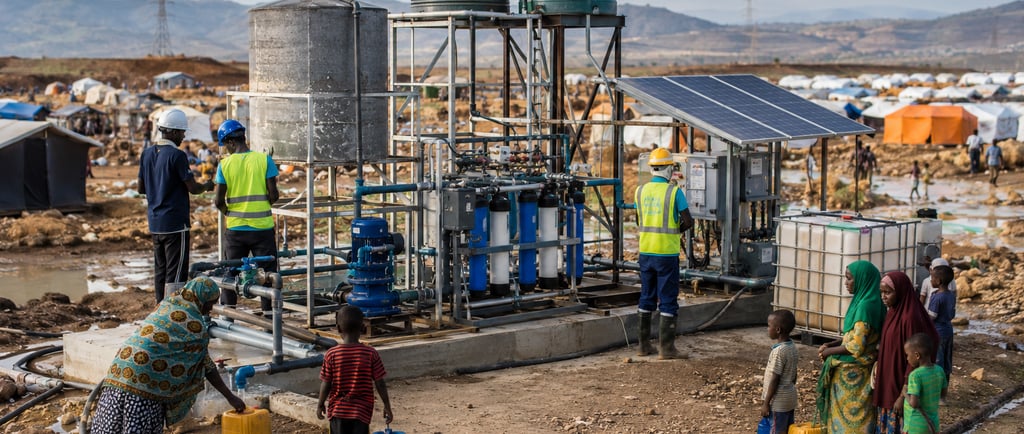
Context: Climate Migration Meets Fast Infrastructure
Climate migration is rapidly transforming the global humanitarian landscape. In 2023, the Internal Displacement Monitoring Centre (IDMC) reported a record 32.6 million new displacements caused by weather-related disasters—floods, droughts, storms, and rising sea levels. This acceleration in migration places enormous pressure on local infrastructure, compounding the need for solutions that deliver safe water on-demand and at scale. For humanitarian WASH (Water, Sanitation, and Hygiene) NGOs, United Nations agencies, and modular infrastructure providers, this is a pivotal moment: delivering rapid, culturally sensitive water access is now a fundamental expectation, no longer an occasional emergency.
But the challenge transcends speed. Traditional, linear approaches—where temporary materials are dumped after use—are collapsing under the strain of new ecological realities. Infrastructure must now fulfill two mandates:
Immediate impact: Save lives and preserve human dignity by delivering potable water as soon as a migration event occurs.
Sustainable design: Use circular methods, such as repurposing metals, to ensure minimal waste, rapid mobilization, and a pathway to long-term community resilience.
Rapid-deploy water systems built from reused steel and modular elements embody this new paradigm. They bridge the urgent needs of climate migration with the imperatives of circular infrastructure. In doing so, these systems align with global sustainability benchmarks—from the United Nations SDGs (especially Goals 6 and 11) to the International Organization for Migration's 2022 guidance on sustainable humanitarian responses.
Why does this matter now more than ever?
As climate migration accelerates in frequency and scale, shortage of conventional building materials and mounting pressure on local ecosystems demand smarter, circular systems. Rapid-deployment water solutions using repurposed steel and microgrid integration are proving to be among the most scalable and future-proof options available to humanitarian response teams.
2. Problem Definition: Deployment, Speed, Human Welfare
What's at stake?
The consequences of slow or unsuitable water infrastructure in migration crises are devastating and well-documented:
Seconds Matter:
The World Health Organization (WHO) states that waterborne disease could break out within 24–72 hours in displacement camps lacking safe drinking water, with children under five most at risk. For every hour water access is delayed, the chance of outbreaks rises sharply, often compounding trauma with further displacement or violence.Material Shortages & Global Constraints:
The traditional "ship-new-pipes" model is breaking down. Global steel and plastic prices surged over 25% in the past three years (UNCTAD 2023), and regional bottlenecks are common. Yet, estimates suggest that over 600 million tonnes of steel scrap are generated worldwide each year, much of it within reach of humanitarian corridors.Modularity or Bust:
Humanitarian deployments now target migrations that can spike or relocate overnight. Solutions must deliver an adaptable "kit-of-parts" that expands, shrinks, or relocates in lockstep with population movement and environmental threats (e.g., flash floods, shifting borders).Circularity Required:
Landfill bans, waste export restrictions, and the logistical impossibility of hauling away debris force organizations to seek circular approaches. Repurposed metals provide a ready answer—offering not only environmental and cost benefits but also regulatory and reputational advantages.Energy Interlink:
Water systems are only as good as their power sources. Emergency sites—often far from grids—require microgrid integration (solar, wind, battery) so pumps, filtration, and disinfection run reliably. Failing to design for energy-water nexus is a persistent cause of system breakdown.
The upshot: If the humanitarian sector is unable to deploy fast, modular, and circular water systems, the results are tragic: unnecessary disease outbreaks, wasted international aid, and lost opportunities for sustainable settlement rebuilding.
3. Key Concepts: Circular Infrastructure, Microgrid Water, Reused Steel
To fully grasp the emerging best practices in rapid-deploy water systems, it's essential to clarify several foundational concepts:
Circular Infrastructure
Circular infrastructure means designing every component—tanks, pipes, frames, and fittings—to be disassembled, repurposed, or recycled after its initial deployment. The infrastructure "loops" back into the supply chain, minimizing waste and maximizing value. For migration and emergency response, this approach is key because:
It aligns with evolving donor requirements for sustainability tracking.
Reduces costs by avoiding single-use materials.
Accelerates timelines as local repurposed stocks are mobilized quickly.
Case in point: After Typhoon Haiyan in 2013, NGOs found that 50% of metal used in makeshift shelters and water tanks ended up as hazardous debris. Circular infrastructure frameworks emerged as a cost-effective and responsible alternative, inspiring new supply chain models across Southeast Asia.
Microgrid Water Systems
Microgrid water systems use localized, renewable-powered treatment and delivery units. These distributed "mini-utilities" are not tethered to unreliable national grids. Instead, they:
Run on solar, wind, or hybrid battery platforms.
Support pumps, UV/filtration units, and remote sensors.
Can scale from serving 200 to 20,000 people by daisy-chaining modules.
This resilience is critical in crisis zones, where grid downtime averages >30% (UN OCHA 2022).
Repurposed Metals
Repurposed metals include steel and aluminum salvaged from scrap yards, decommissioned infrastructure, industrial offcuts, or emergency demolitions. The value lies in:
Local availability—often within 10–30km of migration hotspots.
Drastically lower embodied energy vs. new steel (up to 75% less, World Steel Association 2021).
Enhanced field flexibility—reused pipes, tanks, and frames can be adapted to various terrains.
This is at the core of both circular infrastructure and speedy deployment.
Humane Infrastructure
Beyond technical specs, rapid-deploy water systems must prioritize the dignity, agency, and safety of displaced populations. This means:
Including gender-sensitive design (e.g., secure access points for women and children).
Employing local labor, which builds skills and fosters community ownership.
Ensuring transparency—public QR codes and digital logs track where systems are installed and who manages them.
Together, these key concepts anchor the new generation of emergency water solutions that are flexible, circular, and centered on human welfare.
4. Framework: The 7R Rapid-Deploy Circular Water System
Building on global best practices and direct field experience, the 7R Framework organizes the deployment process into seven actionable stages that combine rapid assembly with circular economy principles and localized resource utilization.
The 7Rs of Rapid-Deploy Circular Water Systems
Ready Supply Chains:
Develop a geospatial "map" of regional steel scrap, modular tank suppliers, and off-grid energy kits. Use digital inventory, such as cloud-based traceability tools, so NGOs and suppliers always know location and quality. Example: The ICRC developed a "metal map" app in West Africa, saving 2–4 days per deployment.Rapid Assessment:
Send trained field scouts equipped with digital needs assessment tools (tablets, mapping drones) within 24–48 hours of migration events. The aim: quantifying population, water source types (ground, surface, trucked), and site logistics—plus quick audits of available scrap metal. This step directly informs design adaptation and reduces excess shipping.Re-Design for Circularity:
Use agile design software (e.g., parametric BIM tools) to update blueprints in real time based on salvaged metal dimensions and environmental factors (rainfall, soil, sun exposure). Circularity here means creating "universal-fit" schematics that flex to field conditions, preventing costly and time-consuming custom fabrication.Roll-Out Modular Kit:
Pre-pack emergency kits—each containing standardized filters, tank components, pipe adaptors, and instruction sets. ISO-standard containers allow for air, truck, or rail transport. Some WASH NGOs have reported 30% faster site commissioning with modular kits versus ad-hoc sourcing during emergencies.Rigorous Assembly:
Leverage local labor using step-by-step visuals (print and digital). "Click-fit" and bolt-together steel connectors cut assembly time dramatically—one NGO reduced assembly time from 10 days to 2 by standardizing training materials and loading instructions onto smartphones.Run with Microgrid:
Install a solar/wind hybrid microgrid unit paired with battery backup. Power all system pumps, UV filters, and remote telemetry. Proven in field pilots: 95% uptime over 6 months in East African displacement camps, slashing operational downtime and increasing water delivery to meet Sphere standards (≥15L/person/day).Recover and Redeploy:
Design for "end-of-use" recovery from the outset. Kits are cataloged, tagged, and linked to cloud inventory. When crisis abates or populations move, systems are demobilized and reused—either at new sites or for permanent infrastructure. This "track and trace" approach supports circularity and accountability, closing the humanitarian supply loop.
Step-by-Step Process (Expanded with Best Practices & Field Insights)
Step 1: Map nearest viable steel and aluminum scrap sources using GIS and field reports. Prioritize suppliers with known stock quality and transportation access.
Step 2: Pre-stock modular kits at logistic hubs in high-risk regions, ideally within 50km of probable migration corridors.
Step 3: Assemble a multidisciplinary team: WASH engineers, logistics officers, and microgrid technicians—experienced in modular and circular assembly.
Step 4: On arrival, conduct a 48-hour rapid needs analysis. Gather site data (population, topography, water sources, access roads) and audit available metals for compatibility.
Step 5: Document all available repurposed steels—recording dimensions, previous uses, and current condition.
Step 6: Use flexible blueprints; adapt dimensions/specs of tanks, frames, and pipe runs to match the precise sizes of available metals, accounting for on-site welding or mechanical connections.
Step 7: Deploy microgrid kit—size the unit by calculating maximum expected pump and filter loads, factoring in a 15–20% capacity buffer to cover peak use or adverse weather conditions.
Step 8: Assemble all components using click-fit or universal bolt systems, tested in humanitarian field labs for both strength and leak prevention.
Step 9: Perform rigorous QA: leak tests, flow & pressure testing, and test the energy draw on the microgrid under operational load.
Step 10: Train local operators (often using digital guides in the local language) in routine maintenance, emergency shut-downs, and spare-part swaps.
Step 11: Digitally log the system (GPS, QR/tool tagging) and catalog all assembly protocols for the next deployment or transition to permanent settlement infrastructure.
Example: Emergency Deployment in Northwest Kenya (Scenario Analysis)
Problem: A drought-driven camp expands to 2,500 people. The nearest functional steel supply is a scrapyard with 10 tonnes of old pipes and decommissioned tanks. Water is trucked every 3 days, with escalating costs and scarcity.
Solution:
Team arrives pre-equipped with three modular pump/filtration microgrid kits, universal-fit connectors, local-language install guides.
Existing tanks are rehabilitated (cleaned, relined with food-grade epoxy), pipes cut to fit, and all joints assembled using standardized click-fit adaptors.
Microgrid set up with both solar and wind, ensuring redundancy.
Result: Water system online within 72 hours, exceeding Sphere minimum standards and providing a proof-of-concept for circular infrastructure in refugee contexts. All components are tagged for future recovery, reinforcing both sustainability and rapid redeployment principles.
Statistical Impact:
This approach achieves a 30–40% faster deployment versus legacy systems (ICRC pilot results), saves $12–18 per capita on material costs, and has the potential to reduce embedded greenhouse gas emissions by up to 70% (World Steel Assoc.).
Expanded Implementation Playbook for Rapid-Deploy Circular Water Systems
Rapid-deploy circular water systems sit at the intersection of three urgent pressures: climate displacement, emergency WASH delivery, and infrastructure waste reduction. By 2026, this is no longer a niche humanitarian engineering idea. It is becoming a practical response model for camps, border settlements, temporary host communities, informal urban extensions, disaster recovery zones, and climate-stressed rural regions.
The reason is simple. Displacement is rising faster than conventional infrastructure can respond. IDMC's 2025 Global Report on Internal Displacement shows that South Asia recorded 9.2 million disaster displacements in 2024, nearly triple the prior year, while the Americas reached a record 14.5 million internal displacements, with the United States alone reporting 11 million disaster-related movements. These figures show that water systems for displaced populations can no longer be treated as short-term add-ons. They must be designed as reusable, movable, accountable infrastructure from day one.
The first implementation rule is to separate the water system into repeatable modules. A circular water deployment should never depend on one custom-built tank, one improvised pipe run, or one generator-powered pump that only one technician understands. It should be broken into source, intake, treatment, storage, distribution, power, controls, safety, and recovery modules. Each module should have clear connection points, universal fittings where possible, and a documented reuse pathway.
The second rule is to design around local material reality. In a flood-hit region, teams may find usable structural steel, elevated frames, decommissioned tanks, industrial containers, pipe supports, and offcuts from nearby scrapyards or damaged infrastructure. In a drought-driven migration corridor, usable metals may come from agricultural equipment yards, closed factories, transport depots, or construction leftovers. These materials should not be forced into the system blindly. They must be inspected, cleaned, tested, graded, and used only where appropriate. Repurposed metals can serve very well as support frames, platforms, skids, tank cradles, pipe racks, pump housings, fencing, shading structures, and protective cages. Direct potable-water contact requires stricter rules. Tanks, pipes, and linings must meet local drinking-water standards, and reused parts must be relined, replaced, or restricted to non-contact structural roles when safety is uncertain.
The third rule is to pre-position the parts that cannot be improvised safely. Filters, membranes, UV units, dosing pumps, chlorine test kits, pressure gauges, flow meters, food-grade linings, backflow preventers, flexible couplings, electrical protection devices, and battery controls should be standardized and stocked before emergencies. Circularity does not mean using scrap for everything. It means using the right reused material in the right place, while protecting public health with tested treatment and control components.
A practical deployment begins with a 24-hour site and demand scan. Teams should estimate population, likely growth, source water options, distance to households, access constraints, security risks, power needs, and cultural use patterns. UNHCR's emergency WASH guidance sets emergency potable water availability at 7.5 to 15 litres per person per day, with basic service at 20 litres or more. It also uses clear access and quality indicators, including household water collection, distance to water points, water point load, chlorine range, and turbidity levels. These indicators should become the design baseline rather than post-installation paperwork.
For a 5,000-person settlement, even the emergency range creates a daily requirement of 37,500 to 75,000 litres. At the basic 20-litre level, that rises to 100,000 litres per day. If the system also serves a clinic, school, washing area, or nutrition centre, the design load rises further. This is why a circular water system should be built as a cluster of modules, not as a single fragile unit. One treatment skid can serve a first zone while a second unit is assembled. One tank farm can run while another is cleaned and relined. One microgrid can power essential pumping while battery expansion is added.
A strong deployment playbook follows this sequence.
Start with water source classification. Surface water, groundwater, trucked water, harvested rainwater, and desalinated water each need different treatment. Surface water often needs sediment removal, filtration, and disinfection. Groundwater may require testing for salinity, arsenic, fluoride, iron, nitrates, or microbial contamination. Trucked water requires strong receiving controls because contamination can happen during transport or storage. Rainwater can support non-potable use, cleaning, and limited treated supply when storage is protected. Desalination can help in coastal or saline areas, but it adds energy demand, brine management, and maintenance complexity.
Then run a material compatibility audit. Every repurposed metal part should be tagged by source, previous use, visible condition, corrosion level, thickness, load-bearing suitability, and likely role. A decommissioned tank may look useful but may be unsafe for drinking water without lining and cleaning. Steel beams may be perfect for raised platforms, flood-resistant tank stands, and shaded pump stations. Aluminum offcuts may work for lightweight protective enclosures. Old pipes may be valuable as cable conduits or non-potable drainage supports, but unsafe for potable delivery unless tested and approved.
Next, design the layout around dignity and risk reduction. Water points must not create long queues, unsafe walking routes, or conflict between groups. UNHCR's WASH guidance includes access limits such as emergency maximum distance from household to potable water collection point and persons per usable tap or handpump. These are not minor details. Distance, waiting time, lighting, drainage, and privacy affect safety, especially for women, girls, children, older people, and people with disabilities.
Power design should happen at the same time as water design. Pumps, UV lamps, dosing systems, telemetry, lighting, and control panels need reliable electricity. Solar-powered pumping is already being used in humanitarian settings. International Medical Corps reported that in January 2021 its WASH team in Nigeria drilled 12 boreholes and equipped them with solar-powered pumps in camps in Damboa and Maiduguri Bakassi, with treatment pumps included in the borehole systems. The project supported water access for latrines, showers, and washing areas, and the organization reported reduced diarrhea cases among children.
The energy case is also financial. A study of solar-diesel hybrid mini-grids for Nyabiheke refugee camp in Rwanda found that hybrid systems could deliver savings of up to 32% of total costs and reduce emissions by up to 83%, with payback periods ranging from 0.9 to 6.2 years. This matters for water systems because diesel-powered pumping often becomes one of the most expensive recurring costs in remote camps.
The final implementation layer is recovery planning. Every pump, panel, frame, coupling, tank, cable, and control unit should have an asset ID, condition record, maintenance log, and redeployment status. Humanitarian infrastructure often fails circularity tests because nobody knows what was installed, who owns it, what condition it is in, or whether it can be recovered safely. A circular system should be designed with removal points, lifting access, spare crates, and redeployment documentation from day one.
Measurement and QA: How to Prove the System Works
A rapid water system is only successful if it delivers safe water consistently, at the right volume, with acceptable access, manageable cost, and low failure rates. Speed alone is not enough. A system that goes live in 48 hours but fails water quality checks after one week is not a success. A circular system that reuses metal but creates unsafe pressure points, contamination risk, or untraceable parts is not circular infrastructure. It is improvisation with better branding.
The measurement model should cover six areas: water quantity, water quality, access, uptime, cost, and circularity.
Water quantity should be measured in litres per person per day, not only total litres produced. A tank that produces 60,000 litres per day sounds large, but for 6,000 people it provides only 10 litres per person per day before clinic, school, and washing demand. UNHCR's emergency range of 7.5 to 15 litres per person per day is a minimum emergency benchmark, while 20 litres or more represents a stronger basic level.
Water quality should be tested at the source, after treatment, at storage, at tap stands, and at household level where possible. For chlorinated collection points, UNHCR's emergency guidance uses free residual chlorine in the 0.2 to 2 mg/L range and turbidity below 5 NTU as part of its quality indicators. For non-chlorinated collection points, it references 0 CFU per 100 ml for water quality tests. These are field-relevant indicators because contamination can enter after treatment through dirty tanks, broken taps, open containers, or poor drainage.
Access should be measured by walking distance, waiting time, queue length, water-point crowding, operating hours, lighting, and disability access. A high-output system can still fail people if collection points are too far away or unsafe at night. Water collection is also a gender issue. A 2026 UN-linked report cited by The Guardian warned that women and girls carry much of the burden of water shortages, with women and girls chiefly responsible for water collection in more than 70% of rural households without reliable water access and spending an estimated 250 million hours daily on the task.
Uptime should be tracked at the pump, treatment, storage, and distribution levels. A useful target is not simply "system operational." It should be more specific: pump uptime, treatment uptime, energy uptime, tap availability, and time to repair. A solar pump with strong uptime is still not enough if filters clog every three days or tap stands break under high use.
Cost should be measured across capital, transport, assembly, energy, maintenance, consumables, and redeployment. Repurposed metals may reduce material costs, but the real savings often come from lower shipping volume, reduced diesel use, faster assembly, fewer replacements, and reuse across multiple deployments. Cost per person served should be tracked over the full life of the system, not only the first deployment.
Circularity should be measured with asset recovery rate, reused-material share, repair rate, redeployment count, waste avoided, and embodied carbon savings. Steel is central here because it is durable, widely recyclable, and often locally available. World Steel Association's 2025 sustainability indicators show a major emissions difference between production routes: in 2024, scrap-based electric arc furnace steel had a CO2 intensity of 0.69 tonnes CO2 per tonne of crude steel, compared with 2.34 tonnes CO2 per tonne for the blast furnace-basic oxygen furnace route. That gap explains why metal recovery and reuse can be meaningful when properly documented.
QA should happen before deployment, during assembly, before handover, and during operation. Pre-deployment QA checks stock condition, part compatibility, documentation, treatment unit performance, spare parts, and battery condition. Assembly QA checks foundation stability, frame load, pipe support, leak points, electrical grounding, pump priming, dosing calibration, and drainage. Handover QA confirms water quality, flow, pressure, storage volume, user safety, signage, operator training, and maintenance tools. Operational QA checks daily chlorine, turbidity, pump logs, filter backwash, tank cleaning, complaint records, spare use, and incident reports.
A useful QA rhythm is daily testing in the first week, every 48 hours in the first month, then weekly or risk-based testing once the system stabilizes. After floods, population surges, pipe damage, security incidents, or source changes, the system should return to high-frequency testing.
Deep-Dive Case Studies and Field Lessons
Case Study 1: Solar-Powered Boreholes in Northeast Nigeria
The International Medical Corps project in Damboa and Maiduguri Bakassi shows why water and energy should be planned together. The organization reported that its WASH team drilled 12 boreholes and equipped them with solar-powered pumps in January 2021. The system included treatment pumps and supported latrines, showers, and washing areas, including access for people with disabilities. The organization also reported a decrease in diarrhea cases among children after the intervention.
The circular infrastructure lesson is that energy independence improves water reliability. Diesel supply chains are vulnerable to price spikes, road closures, insecurity, and logistics delays. Solar pumps do not remove all maintenance needs, but they reduce recurring fuel dependence and can stabilize daily water delivery. In a circular version of this model, pump frames, elevated tank stands, shade structures, and protective cages could use inspected repurposed steel, while treatment and water-contact components remain certified.
Case Study 2: Nyabiheke Refugee Camp, Rwanda, and the Mini-Grid Economics of Humanitarian Infrastructure
The Nyabiheke mini-grid study provides a strong financial argument for hybrid power in camps. It found that renewable and diesel-hybrid mini-grid designs could reduce total costs by up to 32% and emissions by up to 83% compared with diesel-only systems, with payback periods from 0.9 to 6.2 years.
For water systems, the implication is direct. Pumping, disinfection, telemetry, lighting, and cold-chain-adjacent services all need power. A water project that ignores energy planning may look cheaper on paper but become expensive during operations. The better model is to size the microgrid around actual pump loads, peak demand, storage strategy, treatment method, and nighttime safety lighting. Battery capacity should cover critical functions first, then expand to non-critical loads.
Case Study 3: Rohingya Refugee Response and Solar Water Pumping
UNHCR's coverage of solar-powered water supply in refugee camps highlights how solar pumps can support safer water delivery by pulling from chlorinated tanks and protecting water from contamination during distribution. In large camps such as Kutupalong, reducing dependence on manual systems and fuel-based pumping can improve reliability when demand is high and terrain is difficult.
The lesson for circular systems is that repurposed metals should strengthen the physical layer around proven WASH practice. Reused steel can support elevated tanks, walkways, pipe bridges, flood-resistant platforms, pump shelters, and distribution-point structures. It should not replace water quality discipline. The strongest systems combine circular construction with standard WASH controls.
Case Study 4: South Sudan and the Reality of Water Treatment Failure
Emergency water treatment often fails because treatment does not guarantee safe water at the point of use. A study on emergency water treatment practices in refugee camps in South Sudan investigated residual chlorine in drinking water supplies and highlighted the need to monitor whether treated water remains safe through distribution and household storage.
This is where QA matters. A rapid circular system should not stop at treatment output. It must test water at collection points and, when feasible, at household level. It must also address container hygiene, drainage around taps, queue management, and water-point maintenance. The technical system and the user environment are one operating unit.
Future Trends: Where Circular Water Infrastructure Is Heading
The first major trend is asset-tagged humanitarian infrastructure. By 2026, donors, governments, and response agencies increasingly expect transparency. A water system built from reused metals should be able to show what was used, where it came from, where it is installed, what condition it is in, and whether it can be reused. QR tags, RFID tags, GPS records, and simple mobile inspection forms can turn temporary assets into managed infrastructure.
The second trend is modular water-energy packages. Water projects will increasingly arrive with pre-sized solar, battery, and control components. This shift is practical because pumping and treatment failures often trace back to energy instability. Hybrid microgrids will become standard for larger camps and host-community systems, especially where diesel is expensive or unreliable.
The third trend is AI-assisted site planning, but with human review. Satellite imagery, mobile data, drone mapping, and displacement monitoring can help estimate population movement, route access, flood risk, and water-point placement. However, AI cannot replace community consultation, gender-sensitive layout, water quality testing, or local engineering judgment. The strongest use case is faster planning, not automated decision-making.
The fourth trend is water reuse and multi-grade water systems. Camps and temporary settlements should not treat all water demand the same. Drinking water, handwashing, bathing, cleaning, irrigation, construction, dust suppression, and sanitation support have different quality needs. Future systems will separate potable and non-potable flows more clearly, reducing pressure on high-grade treated water.
The fifth trend is stronger metal provenance controls. Scrap metal is becoming more strategically important as industries move toward lower-carbon steelmaking. Research published in 2024 argued that scrap metal is becoming a strategic resource for the European steel transition, with electric arc furnace expansion reshaping scrap demand and supply networks. Humanitarian buyers may face more competition for high-quality scrap, which makes local mapping, supplier relationships, and material testing more important.
The sixth trend is solar disinfection and low-energy treatment research. Emerging research into solar water disinfection, photocatalytic treatment, and passive solar desalination points toward lower-energy water treatment options for remote settings. A 2026 field study in Antananarivo, Madagascar, found that a low-cost solar photocatalytic reactor using titanium dioxide achieved complete inactivation of fecal coliforms in tested well-water samples after 10 minutes of solar exposure under the study conditions. This is not a replacement for full camp-scale WASH systems, but it signals where low-resource treatment innovation is heading.
Market Analysis: Why This Category Will Grow
The market for rapid-deploy circular water systems is being pulled forward by five forces: climate displacement, donor scrutiny, infrastructure cost pressure, energy instability, and circular economy mandates.
Climate displacement is the largest driver. Disaster displacement is already happening across both lower-income and high-income regions. IDMC's 2025 report shows record or near-record regional disaster displacement figures in 2024, including major increases in South Asia and the Americas. This means rapid water systems are no longer only for remote refugee camps. They are relevant for wildfire evacuation zones, flood-hit towns, coastal retreat areas, drought-driven migration corridors, and temporary worker settlements.
Donor scrutiny is the second driver. Emergency infrastructure is expensive, and funders increasingly ask what happens after the crisis. A single-use deployment that becomes waste is harder to defend when reusable modules are available. Circular water systems create a better story and a better operating model: lower waste, better asset visibility, lower repeat procurement, and clearer transition to permanent infrastructure.
Cost pressure is the third driver. New materials, freight, diesel, and skilled labor can all become bottlenecks after disasters. Locally available metals can shorten supply chains when used safely. The value is not only lower purchase cost. It is reduced waiting time, reduced shipping volume, local job creation, and better adaptation to field conditions.
Energy instability is the fourth driver. Off-grid and weak-grid areas need water systems that can function during fuel shortages, grid outages, road closures, or conflict disruptions. Solar and hybrid microgrids are becoming a practical part of WASH planning, not a sustainability add-on.
The fifth driver is the broader circular metals market. Steel production remains emissions-intensive. World Steel Association reported a 2024 global CO2 intensity of 1.92 tonnes CO2 per tonne of crude steel, while scrap-EAF production was far lower at 0.69 tonnes CO2 per tonne. This creates a clear reason to reuse existing metal assets where safe, practical, and documented.
The buyers for this category include UN agencies, WASH NGOs, disaster response authorities, climate adaptation funds, development banks, modular infrastructure providers, camp managers, mining and industrial emergency teams, and local governments in climate-risk regions. Suppliers include modular tank companies, solar pump vendors, filtration manufacturers, steel fabricators, scrap processors, emergency logistics firms, and digital asset-tracking platforms.
The strongest commercial opportunity sits in pre-certified kits. A vendor that can supply containerized water modules with certified treatment units, reusable metal mounting systems, solar-ready power, documented QA, local fabrication guides, and asset recovery tracking will have an advantage over vendors selling isolated pumps, tanks, or filters.
Additional FAQs
Can repurposed steel be used in drinking water systems?
Yes, but not automatically and not everywhere. Repurposed steel is best used for structural parts such as frames, platforms, tank supports, pipe racks, protective cages, walkways, and pump shelters. For direct drinking-water contact, materials must be certified, relined, cleaned, tested, and approved under relevant local standards. When in doubt, keep reused metal out of potable contact and use certified pipes, liners, tanks, and fittings.
How fast can a circular water system be deployed?
A small system can be operational within 48 to 72 hours if kits are pre-positioned, the source is available, treatment components are ready, and local material audits are simple. Larger systems serving thousands of people usually need phased delivery: emergency trucking or temporary storage first, then modular treatment and distribution, then expanded storage, then longer-term network improvements.
Is circular infrastructure cheaper than conventional emergency water infrastructure?
It can be cheaper over multiple deployments, especially when reused frames, supports, tanks, and modular parts reduce new procurement and shipping. The first deployment may require more inspection, tagging, and documentation. The savings grow when systems are recovered, repaired, and redeployed instead of abandoned.
What are the biggest failure points?
The most common risks are poor source assessment, under-sized pumps, weak power planning, dirty storage tanks, lack of chlorine monitoring, poor drainage around tap stands, insufficient spare parts, unclear ownership, and no local operator training. Circular systems add one more risk: unsafe use of repurposed materials. That risk is controlled through inspection, role assignment, testing, and QA.
How should teams calculate water demand?
Start with population multiplied by emergency or basic litres per person per day. UNHCR's emergency range is 7.5 to 15 litres per person per day, while basic service is 20 litres or more. Then add water for clinics, schools, nutrition centres, washing areas, sanitation support, cleaning, firefighting reserve, and expected population growth.
What role do microgrids play?
Microgrids power pumps, treatment units, UV systems, dosing pumps, sensors, lighting, and controls. They reduce dependence on diesel and can improve system uptime. Solar-diesel hybrid mini-grid research in refugee camp settings has shown cost and emissions savings compared with diesel-only systems.
Should every camp use desalination?
No. Desalination is useful where seawater, brackish groundwater, or salinity is the main constraint. It is not always the best emergency option because it can require more energy, technical maintenance, spare parts, membrane care, and brine management. In many contexts, groundwater treatment, surface-water treatment, rainwater harvesting, or improved trucking controls may be faster and more practical.
How can water systems support women and girls better?
Place water points closer to households, light collection areas, reduce queue times, include women in water committees, separate high-traffic areas from sanitation zones, create safe drainage, and provide accessible routes for children, older people, and people with disabilities. Water access is a safety and dignity issue, not only an engineering target.
What data should be reported to donors?
Report litres per person per day, number of people served, water quality results, uptime, cost per person, diesel avoided, reused material share, recovered asset percentage, downtime incidents, maintenance response time, and community feedback. These indicators show whether the system is fast, safe, fair, affordable, and circular.
Can these systems become permanent infrastructure?
Yes. The best rapid-deploy systems are designed for transition. Some modules may be removed and redeployed, while others can become part of a permanent settlement, school, clinic, or host-community water network. This requires early coordination with local authorities, utilities, and community management groups.
Conclusion
Water systems from repurposed metals are not a romantic recycling idea. They are a practical infrastructure response to a world where displacement is faster, disasters are more frequent, supply chains are strained, and humanitarian budgets must stretch further. The strongest systems combine emergency WASH standards, certified treatment components, reused structural metals, renewable-powered pumping, digital asset tracking, local labor, and strict QA.
The core principle is balance. Use repurposed metals where they add speed, strength, cost control, and circular value. Use certified materials where public health demands it. Use microgrids where energy risk can break the water system. Use data not for reporting alone, but to keep people safe every day.
By 2026, the winning model is clear. Water infrastructure for climate migration must be modular enough to move, strong enough to serve, clean enough to protect health, documented enough to satisfy donors, and circular enough to avoid becoming tomorrow's waste. When designed this way, rapid-deploy water systems do more than respond to displacement. They create the foundation for safer settlements, stronger host communities, and more responsible climate adaptation.
Connect
Your trusted partner for scrap metal procurement.
CONTACT
About
haroon@tdcventures.com
+1-307-655-7593
© 2025. All rights reserved.
NEWSLETTER