
Wildfire-Safe Building Metals: Vents, Cladding and Framespost
Discover how wildfire-safe metals in vents, cladding, and frames protect WUI properties. Explore the 4R model for resilience, low-carbon materials, and insurance benefits.
CLIMATE-RESILIENT INFRASTRUCTURE & CIRCULAR MATERIALS
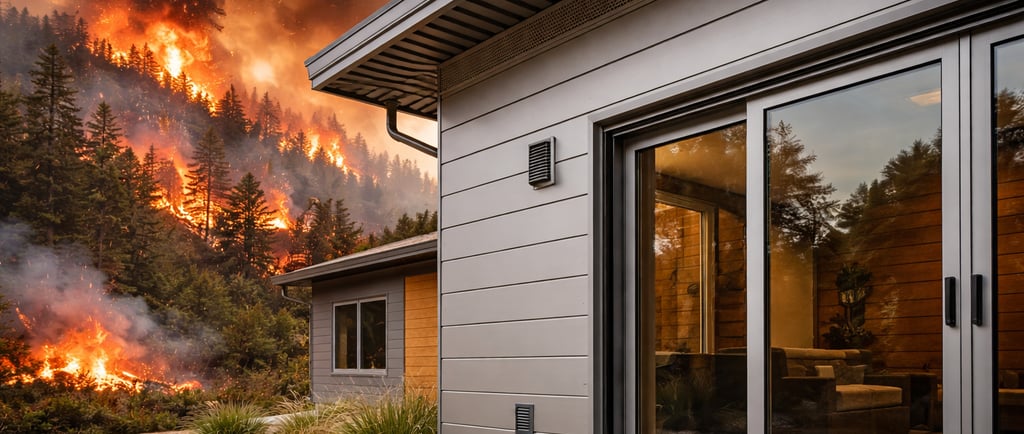
1. Context: Why Wildfire-Safe Metals Matter in WUI Zones
The urgent need for wildfire-safe building metals has never been greater, as wildfire disasters increasingly threaten suburbs, communities, and rural developments within Wildland-Urban Interface (WUI) zones. Between 2017 and 2023, the United States experienced over 58,000 wildfires annually, with more than 9 million acres burned in peak years (National Interagency Fire Center, 2023). Embers—firebrands carried on high winds for miles—still account for over 80% of wildfire-related structural ignitions, often entering homes through poorly protected vents, cracks, or combustible cladding, far outpacing direct flame intrusion.
This risk landscape makes building material selection a front-line defense. The Insurance Institute for Business & Home Safety (IBHS) and National Fire Protection Association (NFPA) have both documented that wood, vinyl, and plastic-based building elements dramatically elevate ignition risk, with post-fire investigations confirming these materials often result in total loss—even when fire suppression arrives quickly. In contrast, noncombustible, ember-resistant metals such as recycled steel, aluminum, and specialized alloys consistently outperform traditional alternatives for both immediate protection and long-term resilience.
Regulatory pressures and insurance scrutiny are rising: California's CAL FIRE regulations, including the WUI Code Title 24 and Chapter 7A, have tightened material requirements for new builds and retrofits. Insurers—responding to multi-billion-dollar loss events—now demand documentary evidence of ignition-resistant construction during policy underwriting. For property managers, architects, and builders, this means material compliance isn't just good sense; it's increasingly a make-or-break requirement for financing, coverage, and future resale value.
Key Contextual Facts:
Average cost to rebuild a wildfire-destroyed home in California: $350–$500+ per square foot, depending on region and code upgrades (CoreLogic, 2022).
Average claim denial due to non-compliant building materials: Up to 15% in some high-risk zones (Insurance Journal, 2021).
Climate Impact: Wildfires now contribute up to 20% of California's annual GHG emissions (CARB, 2023).
In this context, wildfire-safe metals—especially those produced with low-carbon processes and verifiable recycled content—aren't just a technical upgrade, but a strategic choice for climate-resilient infrastructure. They support ongoing asset management, preserve property values, ease insurance renewals, and fulfill the evolving demands of regulators, lenders, and tenants.
2. Defining the Wildfire-Exposure Problem
Vulnerabilities at the Building Envelope
The wildland-urban interface poses compound risks for buildings. Research by the IBHS and FEMA reveals that the most common failure points in structural fires are:
Vents: Gable, soffit, and roof vents constitute the primary entry for embers, which then ignite unseen attic insulation or wood framing.
Cladding: Traditional siding materials like wood and vinyl can ignite at temperatures as low as 600°F (316°C), while embers smolder in seams or at the base of siding.
Door/Window Frames: Wood frames, especially when installed with untreated, combustible trims, can ignite, deform, or fail to maintain fire separation under radiant heat.
Shortcomings of Minimal Compliance
While WUI codes set a legal baseline—often requiring "noncombustible or ignition-resistant" materials—actual field performance depends on system-level protection, not just isolated ratings. Audit data from 2021 post-mortem surveys (CAL FIRE and IBHS) show that buildings meeting minimum code sometimes still failed due to:
Incomplete transitions (e.g., metal siding joined to wood fascia)
Overlooked vent details (poor mesh attachment or perimeter sealing)
Use of non-certified, hybrid-metal components lacking performance documentation
Operational & Strategic Stakes
Compliance vs. Reality Gap: Many "WUI-compliant" products pass static fire tests but lack real-world ember resistance, especially at joints and penetrations.
Recovery Speed: The time and cost to reoccupy buildings post-fire hinge on whether core envelope features withstood exposure and can be cleaned rather than replaced. Full teardown and hazardous waste disposal, standard with wood/foam/plastic failures, stretch recovery timelines by weeks or months.
Insurability: Insurers are tightening standards, denying or revoking policies for structures with ambiguous or insufficient documentation of noncombustible, code-compliant components.
Sustainability: Using metals produced from recycled, low-carbon sources reduces the environmental impact and aligns with sustainability certifications (e.g., LEED, Living Building Challenge).
Occupant Safety & Business Continuity: Life safety outcomes improve substantially when ember entry and flame spread are preemptively managed with robust, well-detailed metal assemblies.
Emergent Opportunity: By adopting a holistic, systems-based approach—specifying tested, recycled, and traceable wildfire-safe metals in vents, cladding, and frames—stakeholders can outperform code, drive down future risks, accelerate recovery, and achieve meaningful reductions in both operational and embodied carbon.
3. Key Concepts: Low-Carbon, Recycled Metals & Resilience
Understanding the attributes and roles of wildfire-safe metals in resilient infrastructure is essential. Let's break down the central concepts driving modern specification and risk reduction:
Wildfire-Safe Metals
Noncombustible metals such as galvanized steel, fire-rated aluminum, and purpose-engineered alloys withstand:
Ember exposure: Do not ignite or melt when subject to wind-blown firebrands.
Direct flame impingement: Maintain integrity under direct attack.
Radiant heat: Resist warping or off-gassing that could compromise structure.
Example: Galvanized steel siding systems routinely pass ASTM E119 fire tests, while fire-rated aluminum vent products meet UL 10C and NFPA 285 criteria.
Low-Carbon, Recycled Metals
Sourcing and production methods matter.
Recycled steel saves 60–74% of greenhouse gas emissions versus virgin production (World Steel Association, 2022).
Recycled aluminum can save up to 95% of the energy and >95% of CO₂ emissions compared to primary smelting (Aluminum Association, 2023).
Suppliers increasingly provide Environmental Product Declarations (EPDs), enabling accurate embodied carbon accounting.
Resilience
Building resilience means ensuring structures withstand fires, minimize downtime after events, and allow for rapid, cost-effective repairs:
Steel and aluminum cladding often require only deep cleaning to return to service post-fire.
Modular vent units and window frames built from recycled metals can be rapidly replaced, limiting disruption to operations and tenancy.
Circular Materials & Lifecycle Value
Circular economy principles move beyond "recyclable" claims, specifying components that can be:
Reused in future constructions
Easily disassembled post-fire or at end-of-life
Returned to suppliers for reprocessing into new products
This supports not only resilience but also future-proof asset value and emissions tracking.
WUI Codes & Performance Standards
Effective execution requires meeting—not just referencing—standards such as:
CAL FIRE WUI Code (Chapter 7A)
NFPA 1144 & 1145
ASTM E136 (Noncombustibility Testing)
UL Listings (vents, frames, doors, assemblies)
Ember-Resistance
The IBHS and CAL FIRE recommend vent screens no larger than 1/8” aperture, engineered from stainless steel or rated aluminum mesh. Performance is validated through simulated ember showers and field burn tests. Innovations such as dual-layer and honeycomb meshes increase resistance, while heat-activated shutters (self-closing) add active protection.
4. Core Framework: The 4R Model for Wildfire-Safe Metal Selection
To navigate material and assembly selection, the 4R Model provides a clear, actionable roadmap rooted in fire science, resilience strategy, and sustainability:
1. Resist
Prioritize metals that naturally withstand ignition, melting, and deformation under direct wildfire exposure. These include:
Galvanized structural steel: High melt point, strength retention at extreme temperatures.
Fire-rated aluminum alloys: Advanced coatings prevent oxidation, stabilize under radiant heat.
Corrosion-resistant coatings: Build in longevity post-fire, especially in coastal or humid zones.
2. Respond
Engineer systems that act under fire risk:
Active ember resistance: Fine mesh (≤1/8”), noncombustible vent construction.
Self-closing vents: Shutters triggered by elevated temperatures.
Intumescent gasket and sealant use: Key for window/door frames, ensuring airtight barriers when exposed to heat.
3. Recover
Design for rapid, modular replacement:
Modular vents and cladding panels: Enable targeted post-fire repairs.
Standardized frame sizes and mounting methods: Minimize downtime, simplify ordering and installation.
Supplier relationships: Pre-qualified sources ready for post-incident supply.
4. Reduce
Lower the total lifecycle carbon footprint and operational risk:
Mandate EPD-verified, recycled-content metals
Specify products from manufacturers with renewable-energy portfolios
Integrate documentation into compliance packages for permitting and insurance
Industry Example
A recent case in Oregon's WUI zone retrofitted 40 multi-family units, swapping out old wood trim and vents for recycled steel equivalents. Result: insurance premium reductions (9–14%), CAL FIRE compliance without add-ons, and a verified 35% reduction in embodied carbon (project EPD summary, 2023).
5. Implementation Playbook: Steps, Checklist & Failure Modes
Transitioning from strategy to execution requires a rigorous, phased approach. Below is an expanded guide for real-world projects:
Step-by-Step Implementation Blueprint
Detailed WUI Risk Assessment
Leverage GIS fire maps, historical burn boundaries, and local wind data to pinpoint high-exposure building zones.
Collaborate with fire department and code officials to validate results.
Comprehensive Envelope Audit
Walk the building, inventorying every vent, panel, frame, and transition. Rate each for combustibility, age, code compliance, and maintenance status.
Pre-Qualification of Candidates
Develop a matrix of acceptable metals, recycled content targets (e.g., 60%+ for steel), and pre-selected, code-listed products.
Use EPDs to filter for carbon and toxicity impacts.
Component-By-Component Specification
For each vent: Require powder-coated, 304-grade stainless or UL-listed aluminum, mesh ≤1/8”, with fire-caulked installation at the perimeter.
For cladding: Mandate factory-finished, recycled steel or aluminum, fully sealed seams, and concealed fasteners over mineral-based weather barrier.
For frames: Fire-rated aluminum with thermal breaks; joints sealed with intumescent foam.
Supply Chain Verification
Demand supplier certificates for recycled content, EPDs, and CAL FIRE product listings.
Maintain real-time logs for documentation and insurer review.
Skilled Installation & Crew Training
Hold pre-install "toolbox talks" focused on wildfire-zone detailing: mesh tension, fastener selection, sealant handling, and inspection checklists.
Engage third-party QA/inspection at rough-in and final completion.
Post-Install Testing
Where available, run negative pressure smoke tests or ember particle tests to verify envelope tightness and barrier integrity.
As-Built Documentation & Recovery SOPs
Compile a continuously updated package with product data, batch numbers, EPDs, supplier contacts, and O&M best practices. This aids in rapid recovery post-event and unlocks insurance credits.
Failure Modes in the Field
Perimeter Gaps: Even high-grade mesh fails if not caulked/sealed at the edges.
Unrated Fasteners: Steel mesh held by low-melt adhesives or zinc-coated fasteners instead of stainless.
Legacy Material Overlaps: Leaving wood trim at transitions can nullify metal protection.
Unverified Recycling Claims: "Greenwashed" metals without EPD or independent verification.
Decision Tree
If vent or cladding is wood, vinyl, or mesh size >1/8"—Call for immediate upgrade.
If recycled content <40% or doc unavailable—Replace supplier.
If frames are hybrid or include wood composites—Specify fire-rated metal alternatives with all supporting test data.
Measurement and quality assurance that actually prevents losses
Wildfire hardening fails most often at the gap level. The material can be noncombustible and still lose the building if embers get into an attic, a crawlspace, a wall cavity, or a soffit return. That is why the best projects treat ember exclusion like water exclusion. You do not "install a product," you commission an envelope system.
Start with performance targets you can verify in the field. Most guidance converges on three practical truths.
First, vents need ember-resistant design, not only a screen. Multiple authoritative guides recommend metal mesh no larger than 1/8 inch, because larger openings allow embers and firebrands to enter. FEMA's homeowner guidance explicitly calls out covering exterior attic vents and under-eave vents with metal wire mesh no larger than 1/8 inch. California's home-hardening guidance also flags openings larger than 1/8 inch as susceptible and points to State Fire Marshal listed ember- and flame-resistant vent products or metal mesh in the 1/16 to 1/8 inch range.
Second, exterior wall assemblies must be treated as assemblies. If your cladding system includes combustible components, you need assembly-level evidence, not only a metal face sheet. NFPA 285 exists because exterior wall fire propagation depends on how components interact, not how each piece performs alone. This matters in WUI work because many "metal cladding" packages still rely on combustible weather-resistive barriers, foam plastic insulation, gaskets, adhesives, and tapes. Those items can become the failure path even when the outer skin does not ignite.
Third, you should separate "noncombustible" claims from marketing. ASTM E136 is commonly used to assess combustibility by exposing specimens to 750°C in a vertical tube furnace. It is not a perfect replica of real fires, but it is an accepted signal for whether a material contributes meaningfully to combustion and heat release.
A field-ready QA plan
Preconstruction submittal checks
Require these documents before you order anything:
Product listing or test evidence for vent ember and flame resistance where applicable, and proof the exact model number matches what will be installed. California often routes this through listed WUI products and approved ember- and flame-resistant vents.
Exterior wall assembly evidence if any combustible components are present, typically via NFPA 285 test reports for the specific assembly build-up and limits.
Material combustibility evidence where relevant, such as ASTM E136 for components being represented as noncombustible.
Environmental Product Declarations for major metal components when you are making low-carbon claims, plus a recycled content statement that is third-party verified where possible.
On-site installation acceptance criteria
These are simple, repeatable checks that catch the common defeat mechanisms:
Vent opening control. No vent opening larger than the specified limit. No missing screens. No torn mesh. No plastic mesh. Mesh is corrosion-resistant metal and mechanically fastened, not glued. FEMA and NFPA guidance repeatedly push metal mesh at 1/8 inch for ember control.
Perimeter sealing. Every vent perimeter is sealed to substrate with a fire-appropriate sealant where allowed by code and manufacturer instructions. The goal is "no bypass path around the screen."
Joint and transition continuity. Every transition from metal cladding to eave, soffit, fascia, window head, sill, and corner has a continuous noncombustible backing or closure. If you leave a wood trim return or an open hem, embers will find it.
Fastener survivability. Fasteners, clips, and ties at vent and cladding interfaces should not be low-melt plastics. Use metal hardware suitable for the environment and corrosion profile.
Inspection holds. Add two hold points where work pauses until it passes inspection: after vent rough-in and after cladding weather barrier plus flashings, before final closure.
Commissioning tests you can actually run
You do not need exotic lab gear to catch the biggest problems:
Smoke pencil or theatrical smoke around vents, soffit returns, and frame perimeters on a windy day, or using fans to create pressure. This reveals bypass leakage and unsealed gaps quickly.
Targeted attic inspection after vent install. You want clean, tight interfaces and no visible daylight around vent frames.
Photo documentation of every vent, every corner, every window head and sill flashing, and every cladding termination. Insurers love photos because they reduce ambiguity during underwriting and claims.
Metrics that matter for owners and insurers
If you want this to be a repeatable asset-management program, track it like one:
Percent of vents upgraded to ember-resistant or listed vent products.
Percent of cladding terminations with noncombustible closures installed as designed.
Number of envelope defects found per 1,000 square feet during QA, and how many required rework.
Time to complete post-event clean-and-recommission versus replace-and-rebuild.
This is the difference between "we used metal" and "we reduced loss probability."
Scenarios and deployment patterns that match real WUI risk
Wildfire exposure does not look the same across building types. The best specs change by scenario, mainly because ember deposition patterns, wind exposure, and adjacency risk change.
Scenario A: Single-family homes with complex roofs
Complex roof geometry creates ember traps. Valleys, dormers, dead-end gutters, and soffit intersections collect embers. Your priorities are:
Ember-resistant vents everywhere, including attic, gable, soffit, and foundation vents, with metal mesh at 1/8 inch or smaller, per widely used guidance.
Metal drip edge and metal flashing continuity, because embers exploit roofing edges and fascia gaps.
Noncombustible cladding at the first six feet above grade where ember piles and radiant heat are most punishing.
Scenario B: Multi-family and mixed-use buildings
The risk becomes system spread. One unit ignites and then the exterior helps spread fire to adjacent units. You need:
Exterior wall assembly testing discipline, especially when any combustible insulation or WRB is present, since NFPA 285 focuses on fire propagation in exterior wall assemblies.
Protected vents and protected utility penetrations at scale, since one weak unit can become the ignition source.
Metal balcony and deck interfaces designed to avoid ember lodgment. Metal is not magic if the design creates ash trays.
Scenario C: Commercial buildings, warehouses, light industrial
These often have large vent areas, louvers, and rooftop equipment. The priorities shift:
Use listed louver and vent solutions designed for ember and flame exposure. Where guidance allows, reduce opening size and use corrosion-resistant metal screening.
Protect rooftop equipment curbs and penetrations. Embers enter through gaps at curbs and conduit bundles.
Design replaceable sacrificial metal elements. You want to swap out louvers and screens fast after an event rather than doing deep envelope surgery.
Scenario D: High-wind, urban-interface fires
Events like the Marshall Fire show that structure-to-structure ignition and wind-driven ember transport can overwhelm assumptions that "wildland is far away." NOAA's research on the Marshall Fire highlights how extreme winds drove rapid spread into communities, and documented reports show over 1,000 homes destroyed. In these conditions:
Avoid exterior combustible attachments, including decorative fences and mulch beds near walls.
Favor metal exterior details that do not ignite and do not produce flaming droplets.
Focus on closure and adjacency, because exposure comes from neighboring structures as much as from vegetation.
Case studies and what they teach you about metals, vents, and assemblies
Case study 1: Marshall Fire, Colorado, 2021
The Marshall Fire became the most destructive in Colorado history by structures lost, destroying roughly 1,084 structures and damaging many more in a matter of hours. It was not a classic forest fire scenario. It behaved like an urban conflagration under extreme winds. The lesson for "wildfire-safe metals" is blunt: you have to harden for ember storms and radiant heat from nearby burning buildings, not only for a flame front at the vegetation line. That pushes you toward ember-resistant vents, noncombustible cladding systems with verified assembly performance, and metal frames detailed with heat-appropriate seals, because the exposure can arrive from any direction.
Case study 2: Ember research and the Zone 0 concept
IBHS has continued to publish applied findings for homeowners and communities, including the idea that a small area immediately adjacent to the home should be completely noncombustible to cut ignition risk materially. Metals are a natural fit here, but only when paired with geometry that does not collect embers. A metal cladding panel with an open lower edge, combined with mulch, can still create a sustained ignition exposure at the base. The lesson is that metals reduce combustibility, but detailing reduces ignition pathways.
Case study 3: Vents as a dominant failure pathway
Multiple public agencies and safety organizations consistently emphasize vents because ember intrusion into attics and cavities can ignite structures without visible exterior flames. California's guidance warns that vents with openings larger than 1/8 inch are susceptible to embers and recommends ember- and flame-resistant vent products or metal mesh in the 1/16 to 1/8 inch range. FEMA similarly recommends metal mesh no larger than 1/8 inch for vents. The lesson is that if you do only one retrofit category, vents are often the highest return per dollar, especially when paired with sealing.
Case study 4: Carbon and rebuilding, why low-carbon metals matter after loss
Rebuilding after wildfire is expensive and it is trending higher in many markets. Recent industry commentary and rebuilding guidance articles frequently cite rebuild costs in the hundreds of dollars per square foot in high-cost regions, and real-world recovery timelines often stretch due to permitting and labor constraints. Using recycled metals reduces embodied energy and emissions relative to primary production. For aluminum, widely cited industry figures state recycled aluminum saves about 95 percent of the energy required for primary production. This matters because wildfire emissions and climate impacts reinforce each other, and state agencies like CARB track wildfire emissions as part of the broader climate problem set. The lesson is that "wildfire-safe metals" can be both a resilience upgrade and a carbon reduction move, but only if you procure recycled-content material with documentation.
Toolkits you can reuse on every project
Toolkit 1: The specification checklist you attach to drawings
Use this as a written scope for vents, cladding, and frames. Keep it short enough that it gets read, but strict enough that it forces quality.
Vents
All attic, soffit, gable, and underfloor vents must be ember resistant. Use listed ember- and flame-resistant vents where available or metal mesh screening that meets the local standard and guidance. Mesh opening target is 1/8 inch or smaller per common guidance from FEMA, NFPA, and CAL FIRE materials.
No plastic components in the air path unless explicitly allowed by a listed, tested product for that application.
Perimeter must be sealed to prevent bypass around mesh.
Cladding
Exterior wall system must be noncombustible where required, and assembly performance must be documented when combustible components exist, with NFPA 285 evidence where applicable for the exact assembly build-up and limits.
All terminations and penetrations require noncombustible closures, flashings, and seal strategy.
Frames
Use metal frames suited to exposure and code path. For doors and openings that require fire performance, rely on tested assemblies and recognized standards, since opening protection is an assembly issue. UL 10C is one widely used positive-pressure fire test standard for door assemblies.
Sealants and gaskets must be rated for heat exposure consistent with the assembly requirements.
Toolkit 2: The procurement and documentation packet for underwriting
Insurers increasingly care about proof, not promises. Build a packet once, then reuse the structure.
Include:
A one-page summary of what changed: vents, cladding, frames, and transitions.
Product cut sheets with exact model numbers.
Listing or testing proof for ember-resistant vents and relevant assemblies.
Exterior wall assembly fire propagation evidence when applicable, such as NFPA 285 reports and permitted substitutions.
EPDs for primary metal components and a recycled-content statement.
Photo log: before, during, after, focusing on vents, corners, and terminations.
Toolkit 3: The contractor "five-minute failure mode briefing"
You want crews to avoid the mistakes that negate expensive materials.
Tell them to avoid:
Leaving any unsealed perimeter gaps around vents.
Using adhesives to hold mesh or screens.
Mixing metal cladding with leftover wood trim at corners, soffits, or fascia returns.
Creating open hems, open channels, or ledges that trap debris and embers.
Substituting WRBs, tapes, or insulation types without confirming the assembly fire path.
Toolkit 4: A maintenance cadence that keeps the building hardened
Hardening degrades over time due to corrosion, pests, and homeowner modifications.
Set a cadence:
Before fire season: inspect vents, sealants, and cladding terminations; clear debris near openings; repair screens.
After wind events: check for vent damage and loose flashings.
After any nearby fire: inspect for ember damage, soot infiltration points, and warped components.
NFPA's public guidance on preparing homes for wildfire includes practical maintenance actions like cleaning debris and using 1/8 inch metal mesh screening at vents.
FAQs that your target audience will actually search
Do ember-resistant vents really matter if my cladding is metal?
Yes. Embers exploit openings. Vents are repeatedly identified as critical intrusion points, and widely used guidance recommends metal mesh at 1/8 inch or smaller or listed ember- and flame-resistant vent products, because larger openings are susceptible.
Is 1/4 inch mesh good enough?
Many older installs used 1/4 inch. Current guidance often points tighter. FEMA's guidance specifies metal wire mesh no larger than 1/8 inch for vents, and CAL FIRE materials flag openings larger than 1/8 inch as ember-susceptible. If your local code allows 1/4 inch, you can still choose 1/8 inch where ventilation design supports it, but you must confirm moisture and attic ventilation requirements.
If metal does not burn, am I automatically safe?
No. Metals reduce combustibility. They do not guarantee system performance. If your assembly includes combustible WRBs, insulation, gaskets, or detailing that traps embers, you can still lose the building. That is why assembly testing concepts like NFPA 285 exist and why transition detailing and sealing dominate outcomes.
What standards matter most for this topic?
For vents, you want ember and flame resistance evidence and compliance with applicable WUI requirements and listings. California's guidance points to State Fire Marshal listed ember- and flame-resistant vent products or specified metal mesh ranges. For exterior walls, NFPA 285 is central where assemblies include combustible components. For "noncombustible" claims, ASTM E136 is a commonly referenced combustibility assessment at 750°C.
How do I prove my building is hardened for insurance?
You provide a documentation packet. Include product listings, model numbers, photos of installation details, and assembly fire evidence where relevant. Include vent compliance evidence and photos because vents are easy to audit visually and are heavily emphasized in guidance.
What is the climate argument for recycled metals in wildfire-safe upgrades?
Recycled aluminum is widely reported to save about 95 percent of the energy required for primary production. On the wildfire side, agencies like CARB track wildfire emissions and show that wildfires are a major climate factor through carbon loss and emissions. When you rebuild or retrofit at scale, embodied carbon becomes a real line item, so recycled-content metals with EPDs matter.
Conclusion: What "best in class" looks like in one sentence, then in practice
Best in class is simple to describe and hard to fake. You stop embers from getting inside. You prevent exterior systems from propagating fire. You document everything so it survives permitting, underwriting, resale, and claims.
In practice, that means you treat vents, cladding, and frames as a connected envelope system. You specify ember-resistant vents using recognized guidance like 1/8 inch metal mesh limits or listed ember- and flame-resistant vent products, and you install them with sealed perimeters so embers cannot bypass the screen. You treat cladding as an assembly, not a face sheet, and you use assembly-level evidence when combustible layers exist, with NFPA 285 as a core reference point. You choose metal frames and opening protection that align with tested assembly logic where fire-rated performance is required, rather than relying on vague "fire rated" marketing. Finally, you pair resilience with verified low-carbon sourcing using EPD-backed recycled metals, especially in materials like aluminum where recycling energy savings are dramatic, and you keep a maintenance rhythm so the building stays hardened year after year.
Connect
Your trusted partner for scrap metal procurement.
CONTACT
About
haroon@tdcventures.com
+1-307-655-7593
© 2025. All rights reserved.
NEWSLETTER