
Women-Led Recycling Cooperatives: Case Studies
Explore global case studies from Pune, Bogotá, and Brazil showing how women-led recycling cooperatives build fairer, more efficient circular systems. Learn the real conditions, revenue models, and policy levers that make them work.
WASTE-TO-RESOURCE & CIRCULAR ECONOMY SOLUTIONS
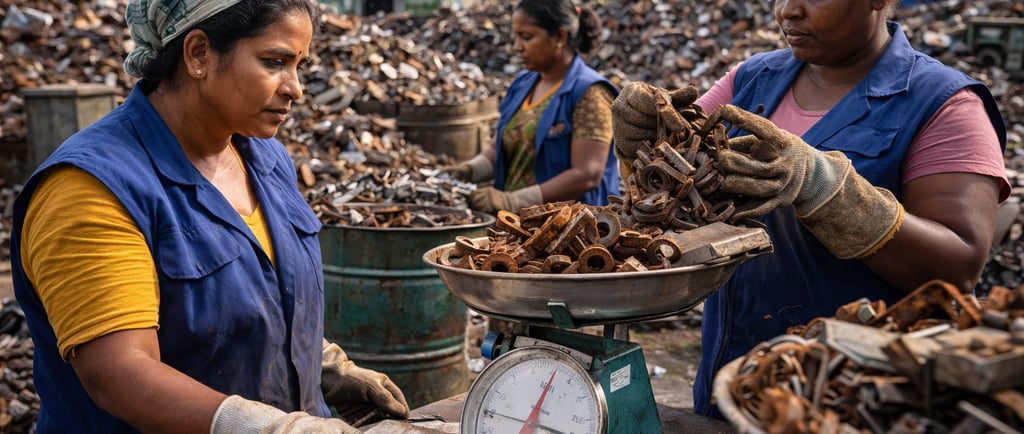
Table of Contents
Context: Why Women-Led Recycling Cooperatives Matter
The Opportunity and the Risks
Key Concepts: Equity, Culture, Community, Governance
The Framework: Embedding Culture in Circular Material Systems
Global Case Studies and What They Actually Show
Finance, Revenue Models, and Commercial Viability
Digital Tools, Data Rights, and Operational Visibility
Policy Design, Public Procurement, and Legal Recognition
Measurement, Quality Assurance, and What to Track
Implementation Playbook for NGOs, Cities, and Investors
Future Outlook: What Changes Between 2026 and 2030
Conclusion
1. Context: Why Women-Led Recycling Cooperatives Matter
Women-led recycling cooperatives matter because the global waste economy is getting bigger, more expensive, and more politically exposed at the exact moment cities need more local recovery, more circular jobs, and more trusted community infrastructure. The World Bank’s What a Waste 3.0 reports that the world generated 2.56 billion tonnes of solid waste in 2022 and, under business as usual, could reach 3.86 billion tonnes by 2050. The same research estimates the sector already supports about 18 million urban waste jobs worldwide. WIEGO and the ILO also continue to show that informal workers remain central to recovery systems, with an estimated 15 to 20 million people working as informal waste pickers globally. That means any serious conversation about circularity, public service delivery, climate mitigation, or recycling system redesign is already a conversation about informal labor, and in many places it is also a conversation about women’s labor.
This is where women-led cooperatives change the terms of the debate. Too often, waste policy is written as though collection, sorting, cleaning, aggregation, and neighborhood-level trust appear by magic once a city signs a contract or buys trucks. In reality, recovery depends on dense local relationships, route knowledge, household behavior change, material discipline, and the ability to work through social friction every day. Women in informal recovery systems are often the people already doing this work, especially in sorting, collection, household engagement, and peer enforcement. When they move from invisible labor to organized leadership, the system does not just become fairer. It usually becomes easier to govern, easier to measure, and harder to disrupt.
The environmental argument is strong, but the economic and governance arguments are just as important. UNEP’s Global Waste Management Outlook 2024 estimates that municipal solid waste could rise from 2.1 billion tonnes in 2023 to 3.8 billion tonnes by 2050. It also estimates the direct global cost of waste management at USD 252 billion in 2020, rising sharply once hidden health, climate, and pollution costs are included. The report argues that stronger circular systems can produce net economic gains instead of escalating losses. In that setting, women-led cooperatives should not be treated as side projects for donors or as symbolic inclusion programs. They are practical institutions for lowering leakage, improving participation, stabilizing local recovery chains, and retaining more value inside neighborhoods that are usually excluded from formal climate and circular economy finance.
There is also a labor reality that policymakers can no longer ignore. WIEGO notes that informal workers make up the bulk of this industry, while only an estimated 4 million workers are formally employed in the waste management and recycling industry worldwide. That gap explains why formalization efforts so often fail. Many city reforms still assume that the answer is to replace informal workers with mechanized systems or private contractors. Yet evidence from worker-led models shows that exclusion creates conflict, service gaps, political backlash, and loss of recyclable value. Inclusion, by contrast, can raise coverage, reduce landfill pressure, and create a pathway toward safer work and better incomes without destroying existing livelihoods.
Women-led cooperatives matter for another reason that standard waste policy often misses. They tend to widen the frame of what counts as system success. A contractor may focus on tonnage moved. A cooperative led by women often has to focus on cash flow, school attendance, elder care, route safety, buyer trust, debt, harassment, seasonal demand, and whether members can survive a price crash without dropping out. That wider frame is not a distraction from performance. It is what makes performance last. When the people running recovery systems understand the social conditions of work, the recycling system becomes more resilient because the institution is built around real human constraints instead of paper assumptions.
The relevance is especially high in metals and mixed recyclables. Informal workers do not only handle low-value materials. They are often the first link in the chain that moves aluminum, steel, copper-bearing scrap, electronics, and reusable goods back into circulation. WIEGO notes that waste pickers divert significant quantities of materials and that a 2020 report estimated waste pickers collect 58 percent of plastics globally. In metals, the same logic applies. Recovery begins where materials are recognized, separated, protected from contamination, and routed to buyers who will actually pay. Women-led cooperatives can strengthen these links because they combine neighborhood access with collective bargaining and, when well supported, basic quality control.
This is why women-led recycling cooperatives are not simply community projects, and they are not merely an informal-sector welfare story. At their best, they are local circular economy institutions. They turn trust into collection efficiency, inclusion into labor stability, and community knowledge into material recovery. They can improve environmental outcomes, but their deeper importance is that they make circularity governable in places where a purely technical model keeps failing.
2. The Opportunity and the Risks
The opportunity is large because most cities still underuse the community infrastructure that already exists around recovery. Women’s networks often connect households, apartment staff, market traders, schools, repair activity, reuse practices, and informal collectors in ways municipal systems cannot replicate quickly. Where those networks are organized into cooperatives, they can create more reliable supply flows, better segregation discipline, and better feedback loops between residents and service providers. This is one reason worker-led models have remained durable in cities where formal systems have struggled with trust, contamination, and citizen compliance. In Pune, for example, SWaCH reports that its member base of 4,000-plus waste pickers serves around 1 million households daily, covers more than 70 percent of the city, and recycles 82,891 tonnes of waste annually. Those are not marginal numbers. They show what happens when worker organization becomes city infrastructure.
The opportunity is also financial. Cooperatives can reduce intermediary extraction, improve price discovery, and retain a larger share of revenue at the worker level. They can aggregate volumes, store materials until prices improve, and negotiate from a stronger position with scrap dealers, processors, producer responsibility organizations, and municipal buyers. Even where income levels remain modest, the move from isolated survival work to organized selling changes bargaining power. WIEGO notes that earnings vary widely, but it also stresses that organized workers usually have stronger negotiating positions than unorganized workers and that gender income gaps are less pronounced inside cooperative settings than outside them.
There is a public-finance opportunity too. Cities that integrate worker organizations can avoid building every part of the recovery chain from zero. The World Bank now frames waste management as a driver of economic development and urban competitiveness, not just a sanitation cost. In lower-income settings, this matters because municipal budgets are already stretched. What a Waste 3.0 notes that public expenditure in many low- and middle-income countries remains far below what is required for universal service and environmentally sound disposal. In that context, organized cooperatives can function as cost-effective extensions of the public system, especially when contracts, space, equipment, and data rights are designed properly.
Yet the risks are serious, and many of them come from inclusion that is only performative. Token inclusion is the most common failure mode. A city or donor announces women’s participation, appoints a few women to visible roles, then keeps control over budgets, route design, material sales, grievance mechanisms, and external reporting somewhere else. The result is predictable. Women are made responsible for delivery without being given the authority or revenue base needed to govern delivery. Over time, that creates burnout, exit, internal mistrust, and the cynical conclusion that formalization is just another way to extract labor from already precarious workers.
Governance failure is the second major risk. Cooperatives are often romanticized, but they are institutions, and institutions can reproduce hierarchy. Without clear bylaws, transparent financial records, rotation rules, attendance norms, election procedures, and enforceable conflict resolution, a cooperative can easily become dominated by a few individuals or external brokers. The issue is sharper where literacy gaps, digital exclusion, language barriers, or caste and ethnic divisions shape participation. The question is not whether a women-led cooperative is automatically equitable. It is whether its design actively prevents concentration of voice, money, and information.
Another risk is cultural misfit. Many recycling reforms still import templates designed for formalized, contractor-led systems in high-income contexts, then apply them to neighborhoods where livelihoods, kinship, local authority, and social legitimacy work very differently. The problem is not only that these models are socially tone-deaf. It is that they often reduce operating performance because they ignore how participation is actually secured. If route compliance depends on trust with households, if material retention depends on neighborhood reputation, or if leadership legitimacy depends on customary structures, a technically neat but culturally blind design will underperform from the start.
Occupational risk remains a constant. Women waste pickers often face lower earnings, unsafe working environments, harassment, weak access to sanitation, and uneven control over tools, transport, storage space, and digital devices. WIEGO notes that women waste pickers typically earn less than men and face multiple forms of inequality, while broader research across waste-picking contexts continues to document steep exposure to health and safety hazards. Formal recognition by itself does not remove these risks. In some cities, workers are formalized on paper but still work without gloves, storage, legal protection against displacement, or guaranteed access to high-value material streams.
A further risk is transition by displacement. This is the pattern where a city uses the language of modernization, cleanliness, or digitization to move toward centralized collection or private concessions that squeeze out worker organizations. Recent debate in Pune has shown how fragile inclusive systems can be when mechanized or contractor-led pilots are introduced without strong written protections for workers. The lesson is not that technology or service redesign is bad. It is that a just transition must be governed, not assumed. If the modernization pathway destroys women’s income, flexibility, and bargaining power, the city may gain cleaner optics while losing the human system that made recovery work in the first place.
The real balancing act, then, is not between environmental ambition and social inclusion. It is between shallow reform and system reform. Shallow reform seeks quick tonnage gains and external legitimacy. System reform asks who owns the work, who gets paid, who controls data, who can stay in the market when prices fall, and who has legal standing when procurement rules change. Women-led cooperatives succeed when that second set of questions is answered before money arrives, not after conflict begins.
3. Key Concepts: Equity, Culture, Community, Governance
If women-led recycling cooperatives are going to do more than survive from grant cycle to grant cycle, four ideas have to move from rhetoric into operations: equity, culture, community, and governance. These are not soft themes attached to an economic project. They are the operating conditions that determine whether collection is stable, whether members stay, whether conflicts can be absorbed, and whether local systems can hold value instead of leaking it upward.
Community
Community in this context is not a vague idea of togetherness. It is a working asset. It includes route trust, word-of-mouth credibility, reciprocal care, information flow, and the social permission needed to enter homes, markets, and commercial premises where recoverable materials sit. Community is what lets a collector know which street produces cleaner cardboard, which apartment block will cooperate if spoken to in the right language, which shopkeeper can be trusted to segregate cans, and which buyer has a history of manipulating weights. A cooperative that ignores these relationships in favor of a purely administrative membership model loses one of its biggest productive advantages.
Community also shapes resilience during shocks. When commodity prices dip, when disease outbreaks interrupt work, or when police harassment intensifies, isolated workers absorb the full shock themselves. Organized groups can redistribute route opportunities, pool information, rotate access to better material streams, and negotiate collectively. That collective capacity is one reason organized waste picker movements have lasted decades in cities where short-term pilot projects came and went.
Equity
Equity is often misread as equal treatment. In practice, it means fair treatment shaped by real differences in care burdens, safety exposure, literacy, mobility, disability, migration status, caste or ethnic discrimination, and market access. In women-led cooperatives, equity usually requires design choices that standard recycling contracts do not include. These can include flexible meeting times, emergency funds, childcare support, shared equipment systems, transparent weighing and payout rules, special support for elderly members, and deliberate pathways for younger women to move into leadership and bookkeeping roles. Without those design choices, women may be present in the cooperative while still carrying the heaviest burdens and receiving the weakest returns.
Equity also means confronting segmentation inside the value chain. In many settings, men are more likely to control transport, heavier materials, or higher-value trading relationships, while women are pushed toward lower-paid sorting and cleaning work. Research on informal recycling continues to show that who handles which material often determines who captures margin. A cooperative serious about equity has to ask not only who is included, but where women sit in the chain, who controls storage, who negotiates sales, and who sees the real price sheet.
Governance
Governance is where idealism either becomes a durable institution or collapses into internal politics. Good governance is rarely glamorous. It is attendance records that cannot be quietly manipulated. It is cashbooks members can read. It is grievance systems that work even when a respected leader is accused. It is election rules that prevent the permanent capture of office. It is minutes, price logs, route rosters, procurement records, and external agreements that are transparent enough to survive stress. In other words, governance is the machinery that protects dignity from becoming a slogan.
The strongest worker-led recycling systems show that governance improves not only fairness but performance. In Bogotá, the registration and updating of waste picker data became central to recognition and service design. WIEGO’s documentation of the Colombian experience notes that Bogotá’s RURO registry recorded 25,322 waste pickers in 2022, building on a census mandated by Constitutional Court rulings. Data here was not a side exercise. It became part of how rights, payment, visibility, and policy were structured. Good governance in recycling increasingly includes data governance. If workers do not exist in official systems, they are easy to displace.
Culture
Culture is often treated as decorative in development programming, then rediscovered only when implementation fails. In reality, culture shapes language, authority, conflict, rhythm, trust, and legitimacy. It influences who can speak in meetings, how disputes are settled, what counts as disrespect, and which forms of public recognition matter. In women-led cooperatives, cultural alignment can affect everything from route acceptance to member retention. A cooperative that communicates only in an official language while members work and think in another language is already limiting participation. A governance model that ignores religious calendars, local obligations, or norms around elder authority may look tidy on paper and still fail in practice.
Culture also shapes environmental practice. In some contexts, it helps frame stewardship through moral responsibility, care for place, or intergenerational duty rather than through abstract climate language. That can be powerful. People are more likely to sustain sorting and collection behavior when the work is linked to dignity, neighborhood pride, and a sense of guardianship, not only to technical compliance. The most effective cooperatives often understand this instinctively. They do not present recycling as a detached environmental chore. They present it as useful work rooted in local identity and collective survival.
Why These Concepts Belong Together
These four concepts are interdependent. Community without governance can become favoritism. Governance without equity can become procedural exclusion. Equity without culture can become a policy script that people do not trust. Culture without economic structure can become symbolism without bargaining power. Women-led cooperatives perform best when all four are treated as operating rules rather than values posters. The point is not to build a cooperative that sounds equitable. The point is to build one that can collect, sort, negotiate, account, survive shocks, and keep legitimacy at the same time.
4. The Framework: Embedding Culture in Circular Material Systems
A women-led recycling cooperative becomes durable when its social design and its commercial design reinforce each other. That is the logic behind a practical framework for embedding culture into circular systems. The task is not simply to “add women” to a recycling model or “formalize” an informal activity. The task is to build an institution that can move material efficiently while also carrying trust, safety, voice, and fair distribution. In 2026, that means designing for both circular performance and social permanence.
A useful way to think about this is the Community, Equity, Governance, and Culture framework, or CEGC. Its purpose is simple. It helps cities, NGOs, funders, and cooperatives decide whether they are building a recovery system with women at the center of value and authority, or whether they are simply placing women into a system that still works against them. The distinction matters because many projects look inclusive at launch and become extractive in practice. The framework is meant to prevent that drift.
Step 1: Ground the System in Existing Networks
The first step is not to write a project document. It is to map the real social and material system that already exists. This means identifying collectors, sorters, aggregators, repair actors, transport links, neighborhood leaders, women’s groups, faith networks, market committees, and informal buyers. It also means understanding where high-value materials move, where leakage occurs, who controls storage, and which routes are considered safe or unsafe. In many cities, this mapping immediately reveals that women are already central to material recovery but absent from formal recognition. That insight should shape everything that follows.
Good mapping also asks where vulnerability clusters. Which members are most exposed to eviction, debt, harassment, poor sanitation, digital exclusion, or poor health. Which members control customer relationships but not cash. Which members do the most unpaid cooperative work. Which members cannot attend meetings because of care duties. If this is not documented early, the cooperative may reproduce these inequities inside its own structure. The best early-stage designs treat social mapping and value-chain mapping as one exercise, not two separate reports.
Step 2: Co-Design Rules Before Scaling Operations
Many projects rush into equipment purchases, branding, or route allocation before the rules are settled. That is usually backwards. Governance should be designed before expansion because expansion magnifies every hidden flaw. The core questions are straightforward. How are leaders chosen. How are meetings called. How are absences handled. How are disputes escalated. How are prices communicated. Who can approve expenditures. What counts as misuse of funds. What data will be public to members. Which decisions require an assembly vote. Which can be delegated.
The Belo Horizonte experience remains instructive here. The city’s partnership with ASMARE did not work simply because officials acknowledged waste pickers morally. It worked because consultation, legal recognition, and institutional roles were translated into a functioning system. By 2012, the city had achieved over 95 percent household collection coverage and 93 percent environmentally sound disposal, while its earlier reforms had formally included cooperatives and built participatory spaces such as the Waste and Citizen Forum. This is what co-design looks like when it becomes policy architecture instead of workshop language.
Step 3: Build Equity Into Revenue, Roles, and Time
Equity cannot be retrofitted after a cooperative starts generating money. Revenue-sharing logic has to be decided early. Some systems will combine individual earnings with collective funds for emergencies, equipment, childcare, or reinvestment. Others will separate route-based income from pooled sales. The exact model can vary, but opacity cannot. Members need to know how value is created, how deductions are made, and how collective funds are governed. Hidden margins destroy trust faster than almost anything else.
Roles also need deliberate design. If women remain concentrated in labor-intensive, lower-paid functions while men or external actors dominate transport, weighing, bookkeeping, or sales negotiations, the cooperative will reproduce chain inequality inside a worker-owned structure. One corrective is rotation. Another is role pairing, where newer members shadow leaders in tasks like negotiation, recordkeeping, and route planning. A third is targeted investment in the specific assets that unlock value capture, such as scales, storage space, digital payment access, or contracts with bulk generators.
Time is an equity issue too. Women in recycling often carry unpaid domestic work alongside income-generating labor. A cooperative that schedules every meeting at the wrong hour, or that depends on unpaid committee work from the same few people, is quietly transferring system costs onto women’s bodies. That is bad ethics and bad management. Serious institutions account for time burdens the same way they account for fuel, rent, and materials loss.
Step 4: Integrate Culture Into Daily Operations
Culture should appear in operations, not only in mission statements. That can mean multilingual meeting practice, meeting formats that respect local hierarchies without surrendering democratic accountability, public rituals of recognition, culturally meaningful naming, neighborhood education in familiar idioms, or conflict processes that combine formal rules with trusted local mediators. The point is not to romanticize tradition. The point is to ensure that the cooperative’s internal life feels legible and legitimate to the people whose labor sustains it.
In practical terms, this often improves performance. Households cooperate more when they understand the people collecting from them and when the cooperative is seen as part of the local social fabric rather than an outside scheme. Member retention is also stronger when participation does not require workers to abandon their language, social identity, or local rhythms in order to be considered professional. Professionalism should mean reliability, accountability, and quality, not cultural erasure.
Step 5: Structure External Partnerships So They Do Not Hollow Out Worker Power
External partners can strengthen a cooperative, but they can also quietly recentralize control. Municipal contracts, donor reporting systems, producer responsibility funds, ESG pilots, and corporate offtake agreements often come with metrics and compliance requirements that the cooperative did not design. If those requirements are too rigid, too extractive, or too externally defined, the cooperative may end up spending its energy serving the reporting needs of outsiders while losing autonomy over its own priorities.
The solution is not to reject partnerships. It is to set terms. Contracts should define payment schedules, service scope, data ownership, health and safety obligations, dispute mechanisms, and what happens during policy changes or procurement shifts. Where possible, cooperatives should control or co-control the data that proves their contribution. Bogotá’s registry experience shows how powerful recognized data can be. Pune’s long-running model shows what is possible when organized workers become indispensable to service delivery. Belo Horizonte shows the value of formal municipal recognition backed by law and participatory forums. The through-line is clear. Partnerships work when worker organizations enter them as institutions, not as beneficiaries.
A Worked Model for 2026
Imagine a secondary city in East Africa or South Asia with weak collection coverage, rising recyclable demand, and a large population of women already engaged in collection and sorting. A city government wants to improve recovery rates. A donor wants climate and livelihoods outcomes. A producer responsibility organization wants cleaner material streams. A women-led cooperative wants stable income and legal protection. A bad version of this project would launch a pilot, buy carts and uniforms, and ask for monthly tonnage reports. A serious version would begin with mapping, legal review, bilingual organizing, member verification, route design based on existing livelihood patterns, shared scales, mobile payment protocols, transparent bylaws, and a phased contract that ties growth to protections rather than replacing workers the moment volumes rise. That second model is slower at the start, but it is far more likely to survive procurement changes, market shocks, and leadership turnover.
The lesson of the framework is simple. Women-led recycling cooperatives become transformative when they are designed as economic institutions with social intelligence, not as charity projects with environmental language. If community, equity, governance, and culture are built into the operating system from the beginning, the cooperative can do more than recover waste. It can recover value, legitimacy, bargaining power, and local control.
5. Global Case Studies and What They Actually Show
The strongest way to understand women-led recycling cooperatives is to look at what happens when real institutions, not pilot concepts, are given time, legal space, and operating responsibility. Across Latin America, South Asia, and parts of Africa, the same pattern keeps appearing. When women waste pickers or women-led worker organizations gain recognition, routes, storage, data visibility, and a lawful place in municipal or producer-funded systems, recovery improves and livelihoods become less fragile. When they are treated as temporary labor at the edge of the system, the opposite happens. Materials leak, conflict grows, and gains remain shallow.
Pune
Pune remains one of the clearest examples of what scale looks like when organized waste pickers are treated as urban service providers. SWaCH reports that its worker-owned cooperative serves around 1 million households daily, covers more than 70 percent of Pune, and recycles 82,891 tonnes of waste each year. Recent reporting in 2025 described SWaCH as having about 3,850 members, mostly women, diverting more than 227 tonnes of waste a day and helping avoid an estimated 100,000 tonnes of CO2 annually. These figures matter because they show that a women-centered and worker-rooted model can operate at city scale, not just in a neighborhood demonstration zone. They also show that climate outcomes, service delivery, and livelihood protection can sit inside the same institutional design.
But Pune also shows the fragility of success when modernization is framed without justice. In 2025, local reporting described mechanized collection pilots that put routes and incomes at risk for SWaCH workers, with some workers already displaced from specific areas despite the cooperative’s established role and its agreement with the municipal corporation. This is one of the most important global case patterns in 2026. Even high-performing inclusion models remain vulnerable if their legal protection is thin, if procurement can be restructured without worker consent, or if efficiency is defined only through equipment and contractors. The lesson is blunt. A system can praise women waste pickers as climate workers one year and undermine their livelihoods the next unless inclusion is written into contracts, tendering rules, and transition design.
Bogotá
Bogotá offers a different but equally important lesson. The city’s Constitutional Court decisions pushed the state to recognize waste pickers as rights-bearing workers rather than disposable informal actors. WIEGO documents that a city census verified 13,984 waste pickers in 2012 and that the RURO registry recorded 25,322 waste pickers in 2022. That growth in recognized data is not a statistical footnote. It changed how workers could be seen, counted, and paid. It also laid the foundation for recycling as a public service component rather than a tolerated informal activity. For women-led organizations, this matters because visibility in registries, service systems, and payment structures is often the difference between precarious survival and negotiable institutional power.
At the same time, Bogotá shows that legal recognition does not erase commodity volatility. In 2025, waste pickers in the city publicly protested falling prices for recyclables, with organizers saying plastic prices had dropped sharply and many workers were earning below the national minimum wage. That case matters because it reveals a hard truth many circular economy narratives skip. Formal recognition improves bargaining power, but it does not guarantee income stability if end-market prices collapse or if imported material and industrial pricing power push margins down. Women-led cooperatives therefore need more than moral recognition. They need financial buffers, fairer pricing structures, storage capacity, access to better buyers, and policy tools that reduce exposure to brutal price swings.
Brazil’s catadores movement
Brazil’s catadores movement offers a third pattern, and one of the most sophisticated. The country has a large waste picker population, with WIEGO noting over 281,000 people working as catadores. Brazil’s National Solid Waste Policy created an important legal route for integrating cooperatives into reverse logistics and municipal systems, and later case work on reverse logistics for packaging showed how producer responsibility can support waste picker organizations rather than exclude them. Research on inclusive recycling in Brazilian cooperatives also documents how producer-funded reverse logistics programs can create additional income streams for cooperatives when invoices, contracts, and organizational structures are in place. For women in these cooperatives, especially in a sector where leadership has historically been hard won, this means policy can be designed to channel commercial value toward organized labor instead of bypassing it.
Belo Horizonte
Belo Horizonte remains a landmark because it shows what happens when municipal reform absorbs worker knowledge instead of erasing it. The city’s consultations with ASMARE helped shape a mixed system that recognized waste pickers as part of the solution. Broader municipal outcomes included more than 95 percent household collection coverage and 93 percent environmentally sound disposal, while participatory structures created room for waste picker voices in policy. The most important lesson here is not nostalgia for one city. It is design discipline. Inclusion worked because consultation, legal change, and service logic were connected. Women-led cooperatives elsewhere can draw a clear lesson from this. Being invited to meetings is not enough. Institutional power begins when worker organizations affect system architecture.
African case patterns
African case patterns are still less fully documented than Latin American ones, but the direction is clear. Recent research on African waste pickers emphasizes that they sustain essential urban functions and environmental management under harsh conditions, while emerging projects in Ghana have shown that women-focused leadership and training can improve recovery and create more inclusive local recycling models. One project in Ghana reported support for 30 waste picker leaders, 70 percent of them women, and recovery of more than 327 tons of plastic. Another initiative in Dodowa explicitly aimed to move women waste pickers from collectors into small-scale recyclers, which matters because margin usually rises as workers move upstream into processing and productization. The case pattern here is important. In many African cities, the next frontier is not only recognition of collection labor. It is helping women-led groups capture more value further along the chain.
Taken together, these case studies point to four durable truths. First, women-led cooperatives work best when they are treated as economic institutions, not social projects. Second, legal recognition matters, but recognition without commercial design leaves workers exposed. Third, public systems improve when worker knowledge shapes operations. Fourth, the biggest missed opportunity in 2026 is still value capture. Too many women-led groups are praised for collection while being blocked from the storage, processing, invoicing, and contracting functions that generate stronger and more stable income.
6. Finance, Revenue Models, and Commercial Viability
No women-led recycling cooperative becomes durable on good intentions alone. It needs a revenue model that can absorb price shocks, cover operating costs, reward labor fairly, and fund reinvestment. This is where many well-meaning interventions fail. They train members, provide uniforms, maybe buy a few carts or balers, then leave the cooperative tied to the same unstable buyer networks and thin margins that made workers vulnerable in the first place. If the commercial model stays weak, the institution stays fragile.
The first source of revenue is usually material sales
but this is also the most volatile. Prices for recyclables can swing sharply by material, by season, by freight costs, by import competition, and by the bargaining behavior of intermediaries. The 2025 protests in Bogotá made this visible, with waste pickers reporting steep price declines for plastic in a matter of months. Metals can offer stronger margins than low-grade plastics, but they also require more careful sorting, safer handling, and better buyer relationships. Cooperatives that rely only on daily spot sales remain exposed. The more stable models blend spot sales with service payments, producer-funded reverse logistics fees, or municipal remuneration.
The second revenue source is public service payment.
Bogotá’s experience is instructive because municipal systems there are required to pay waste picker associations according to the volume of recyclables collected under the public sanitation service framework. That kind of remuneration matters because it recognizes that waste pickers do not only sell materials. They also provide collection, sorting, diversion, and public-good services that reduce pressure on landfills and municipal budgets. For women-led cooperatives, public service payments can stabilize cash flow and reduce dependence on daily commodity fluctuations. They also strengthen the case for formal bookkeeping, payroll discipline, and investment planning.
The third revenue source is producer responsibility and reverse logistics finance.
Brazil’s experience is especially useful here. OECD guidance published in 2024 notes that including waste pickers in cooperatives, associations, and companies should support just formalization and safer working conditions in EPR systems. WIEGO’s technical brief on EPR warns that producer-funded systems can either include or displace waste pickers depending on design. Meanwhile, Brazil case studies show that producer-funded packaging reverse logistics can create direct income for cooperatives when they are legally able to invoice for services. This is a major commercial insight. The future of women-led recycling cooperatives is not only in selling recovered material. It is also in getting paid for traceable recovery, sorting quality, and reverse logistics performance.
A fourth source is value-added processing.
This is still underdeveloped in many women-led groups, but it is where the biggest margin shift can happen. The Ghana Circular Innovation Hub explicitly set out to move women from collection into small-scale recycling. That move matters because the economics of a cooperative change when it can wash, shred, pelletize, pre-process, compact, or otherwise prepare materials to a more valuable standard. The same logic applies in metals. Groups that can guarantee cleaner grades, reduce contamination, or aggregate higher-value scrap can negotiate better prices and reduce dependency on predatory middlemen. This is not easy. It requires space, safety systems, equipment, working capital, and buyers. But without some pathway toward higher-value functions, many cooperatives remain stuck at the thinnest end of the margin pool.
Finance structure inside the cooperative matters just as much as external revenue. Groups need rules for individual earnings, collective funds, emergency reserves, equipment maintenance, debt, and reinvestment. The most resilient models separate immediate livelihood needs from institutional sustainability. Members need cash flow now, but the cooperative also needs retained earnings for repairs, storage expansion, legal registration, audits, digital tools, and working capital. If everything earned is immediately distributed, the institution remains permanently one shock away from crisis. If too much is withheld without transparency, trust breaks. Financial design in these cooperatives is therefore not a technical back-office task. It is a central governance function.
Working capital is one of the least discussed bottlenecks. Many women-led cooperatives are forced into quick sales because they cannot hold stock. That weakens bargaining power. A cooperative with even modest storage and working capital can wait, aggregate, negotiate, and sell in better lots. A cooperative without it may accept poor prices simply to meet urgent household needs. This is one reason investor and donor support often misses the mark. Grants for visible assets are common, but finance for inventory holding, cash-flow smoothing, or purchase guarantees is much rarer. Yet these are exactly the tools that can reduce dependency on exploitative intermediaries.
There is also a case for blended finance, but only when it respects worker control. Municipal contracts, producer payments, concessional equipment finance, revolving funds, and climate-linked grants can work together. UNEP’s 2024 outlook argues that a full circular economy pathway could create a net annual gain of USD 108.5 billion globally by 2050, compared with far worse outcomes under business as usual. If that scale of value is even partly true, then women-led recovery institutions should not be financed like fragile side projects. They should be financed as part of the infrastructure that makes circularity possible. The missing bridge in many markets is not proof of concept. It is capital structured for worker-owned institutions rather than for large firms alone.
The commercial bottom line is clear. A women-led recycling cooperative becomes financially viable when it combines several things at once: fair payment for service, better prices for material, some ability to hold or process stock, transparent internal finance, and formal pathways to invoice public or producer-funded systems. Remove any one of those and the institution may still survive. Put them together and it can begin to grow.
7. Digital Tools, Data Rights, and Operational Visibility
Digital tools are becoming more important in recycling cooperatives, but their value depends on who controls them and what problem they solve. A WhatsApp group by itself does not fix weak pricing. A mobile payment account does not automatically create equity. A dashboard does not matter if the cooperative cannot use the data to negotiate better terms. The real question in 2026 is not whether women-led cooperatives should go digital. It is whether digital systems increase worker control, reduce cash leakage, speed up payments, improve traceability, and strengthen bargaining power without creating new exclusion.
Data visibility is often the first breakthrough.
Bogotá’s RURO registry is a clear example of how counting workers changes power. Once waste pickers were documented in official systems, their existence, contribution, and social conditions became harder to ignore. Registries can support payment, route planning, welfare access, and policy design. For women-led cooperatives, that matters because invisibility has long been one of the main tools of exclusion. When members are not counted, their work is easier to erase, their needs are easier to dismiss, and their contribution is easier to appropriate. Data can therefore be protective, provided the cooperative has a say in how that data is collected, stored, and used.
Mobile payments are another important shift, especially for women.
World Bank work on digital payments and women’s economic empowerment argues that digital payment systems can help women generate, accumulate, and control income when designed well. Earlier foundational work on M-Pesa in Kenya documented how quickly mobile money scaled because it could work through ordinary mobile phones and solve real transaction problems. For recycling cooperatives, digital payments can reduce cash handling risks, create transaction records, support savings, and make revenue-sharing more transparent. These are not small gains in sectors where cash leakage, payment delays, and opaque deductions are common.
But digital finance can also exclude the very women it is meant to support if access is uneven. Device ownership, literacy, SIM registration rules, bank linkage, language, and control over phones inside the household all matter. A digital payment system that routes money into accounts controlled by someone else does not improve women’s agency. Nor does a reporting app that assumes literacy levels or connectivity many workers do not have. This is why digital adoption needs to be accompanied by rights-based design, training, and plain-language governance. A tool is only empowering if the cooperative can use it without surrendering autonomy or leaving its most vulnerable members behind.
Digital communication tools can also reduce governance friction.
Groups using messaging platforms to share price updates, meeting notices, route changes, and grievance records can move faster and reduce rumor-driven conflict. The practical benefit is not glamorous, but it is real. Faster communication often means fewer disputes about weigh-ins, fewer missed meetings, and quicker response when a buyer changes terms or a municipal officer blocks access. In institutions operating on thin margins and high trust dependence, those small frictions matter.
Traceability is where digital tools may matter most over the next five years.
As EPR systems expand and as brands, municipalities, and investors ask for more evidence on collection, recovery, and environmental outcomes, the ability to show where materials came from and who handled them will become commercially valuable. Yet this carries a danger. If traceability systems are designed by large buyers, platforms, or compliance firms without strong worker protections, cooperatives may provide the labor and the data while outsiders capture the commercial premium. Data rights therefore need to become a core part of cooperative strategy. Who owns route data. Who sees volumes. Who can sell traceability claims. Who benefits if verified recovery earns extra payments. These questions are increasingly economic, not merely technical.
Digital operations can also support safety and productivity.
Route mapping, pickup scheduling, simple inventory systems, shared buyer lists, and digital ledgers can reduce wasted trips and strengthen stock control. In dense cities, even minor route improvements can add up over a month. In commodity chains, even basic price logging can reveal whether a buyer is consistently underpaying. The important point is that these tools should serve worker-owned strategy, not surveillance. A cooperative should use digital records to see more clearly, negotiate more confidently, and account more fairly. It should not become a low-cost data source for everyone else.
The digital future for women-led recycling cooperatives is strongest when it is modest, useful, and controlled. The priority list is simple: transparent payments, shared records, member registries, price visibility, inventory tracking, route communication, and traceability on terms the cooperative understands. When digitalization starts there, it strengthens the institution. When it starts with flashy platforms and no attention to power, it usually strengthens someone else.
8. Policy Design, Public Procurement, and Legal Recognition
Policy is where good intentions either become enforceable rights or disappear into project language. For women-led recycling cooperatives, the most decisive policies are often not the ones branded as gender policy. They are the ones that define access to materials, eligibility for contracts, rules for registration, payment for public services, health and safety obligations, land use for sorting space, and how EPR money flows. If these rules exclude worker organizations by default, women-led groups stay precarious no matter how much praise they receive in conferences or donor reports.
Bogotá shows what legal recognition can do when it is serious.
Constitutional rulings pushed the city to recognize waste pickers, register them, and integrate them into the public sanitation service framework. That created a model where recyclers’ work was not seen only as informal salvage but as part of urban service provision. Legal status here mattered because it changed the negotiating ground. Waste picker organizations could argue from rights and service contribution, not from charity. For women-led groups, that kind of shift is foundational. It improves visibility, strengthens claims for payment, and provides firmer ground for inclusion in procurement and planning.
Brazil offers a broader policy lesson.
The National Solid Waste Policy and later reverse logistics measures created a legal pathway for catadores to participate in product return systems and municipal recovery efforts. WIEGO and related case studies show that when EPR and reverse logistics frameworks deliberately include cooperatives, these worker organizations can receive direct support, issue invoices, and secure extra revenue streams. That is what intelligent regulation looks like. It does not merely tolerate existing workers. It creates channels for value to reach them.
OECD guidance published in 2024 makes the same point more directly.
It states that the inclusion of waste pickers in cooperatives, associations, and companies, along with training and worker protections, should encourage a just transition to formal systems. This matters because EPR is expanding across many markets, including places where informal recovery is already doing most of the practical work. If EPR schemes are built around large contractors, automated sorting, or compliance intermediaries alone, they risk turning a circular policy into a dispossession policy. If they are built around inclusive registration, safe upgrading, fair payment, and cooperative participation, they can strengthen women-led recovery systems instead.
Public procurement is one of the most underused tools in this field.
Cities spend money on waste systems every year, but tender structures often exclude smaller worker organizations through insurance requirements, fleet assumptions, balance-sheet tests, or packaging of contracts at scales no cooperative can meet. This can be changed. Contracts can be broken into service zones. Worker organizations can be eligible as consortia. Evaluation criteria can recognize diversion, local employment, inclusion, and neighborhood engagement, not only truck capacity. The point is not to lower standards. It is to write standards that fit the actual service ecology of the city.
Legal recognition also has to include land and infrastructure.
A cooperative without lawful access to sorting space, storage, water, sanitation, and basic occupational safety remains vulnerable. Many worker organizations can collect, sort, and aggregate effectively but still operate under threat of eviction or closure because land use and licensing rules were never designed for them. This is a policy problem, not merely a project problem. Formal recognition should include the physical conditions required for legal, safe, and commercially meaningful work.
Pakistan’s emerging EPR discussion is relevant here as well.
A 2025 analysis supported by the EU SWITCH-Asia Programme argues that integrating the informal workforce into EPR is essential for efficiency and worker welfare, while also warning that full absorption into formal employment structures may not be feasible or acceptable for many informal actors. It recommends a voluntary, incentive-based integration approach. That is a useful insight well beyond Pakistan. Good policy does not assume every worker wants the same model of formalization. It creates pathways that improve safety, bargaining power, and income without forcing a one-size-fits-all transition.
For women-led cooperatives, the policy agenda in 2026 is clear. Recognition in law. Eligibility in procurement. Inclusion in EPR. Access to infrastructure. Payment for service. Data visibility. Protection during modernization. Without these, inclusion stays fragile. With them, women-led cooperatives become part of the formal circular economy without losing the community intelligence that made them effective in the first place.
9. Measurement, Quality Assurance, and What to Track
A women-led recycling cooperative cannot defend its value, improve performance, or negotiate better contracts if it cannot measure what it does. Yet measurement in this field is often badly designed. Too many programs count tonnes and call it success. Tonnes matter, but tonnes alone tell very little about worker welfare, route quality, price realization, gender inclusion, safety, value retention, or whether the cooperative is getting stronger or merely working harder. A serious measurement system has to capture both material performance and institutional health.
The first layer is operational.
How many households, shops, markets, or institutions are covered. How much material is collected by stream. What contamination rates look like. How much is sold, at what grade, and to whom. How many missed pickups occur. How much stock is held. What price spread exists between different buyers. These are the numbers that help a cooperative improve recovery and see where money is being lost. They also matter for municipalities and producer systems that want proof of diversion and service reliability. SWaCH’s own reporting on household coverage and annual recycling volumes is a good example of operational metrics that are both simple and powerful.
The second layer is financial.
Revenue by material. Revenue by service contract. Average member earnings. Payment delays. Reserve fund levels. Equipment maintenance costs. Debt exposure. Cash leakage incidents. Price volatility by month. These indicators show whether the cooperative is economically strengthening or just moving more waste through a weak business model. Bogotá’s recent protests over falling recyclable prices are a reminder that volume can rise while incomes fall. Without financial metrics, a cooperative may look productive while members grow poorer.
The third layer is social and gendered.
How many members are women. How many hold leadership roles. How many attend assemblies. How many use grievance mechanisms. How many have access to mobile payments. What share of members report controlling their own income. What share have social protection or health coverage. What dropout patterns exist by age, care burden, ethnicity, migration status, or disability. WIEGO’s gender work is useful here because it treats women’s conditions at home, at work, and in leadership as connected, not separate. That matters because an institution can look gender-inclusive on paper while quietly relying on unpaid female labor and excluding the most burdened members from decision-making.
The fourth layer is governance quality.
Are elections happening on time. Are minutes recorded. Are price sheets shared. Are complaints resolved. Are financial records readable by members. Is leadership rotating. Are contracts reviewed collectively. Is attendance stable. These are the indicators that show whether the cooperative is becoming a stronger institution or drifting toward concentration of power. Governance metrics rarely appear in donor dashboards, but they are often the earliest warning signs of future breakdown.
The fifth layer is environmental and public value.
Waste pickers and their organizations contribute far beyond the material they sell. The International Alliance of Waste Pickers and WIEGO have estimated that waste pickers help avoid between 0.17 and 0.39 billion tonnes of CO2 equivalent each year. UNEP’s 2024 waste outlook also makes clear that circular and zero-waste approaches produce far better economic and environmental outcomes than business as usual. For women-led cooperatives, this means climate claims should not be monopolized by large firms or technology vendors. Worker organizations are already producing climate value. The task is to measure it credibly enough that they can be paid for some of it, or at minimum defend their role in climate and circular policy.
Quality assurance should also include health and safety. Injury rates, availability of gloves and protective equipment, access to water and sanitation, safe storage, fire risk, exposure to hazardous materials, and route safety for women should all be tracked. A cooperative that grows tonnage while leaving members more exposed is not improving. It is externalizing growth costs onto bodies. That may be common in informal markets, but it should not be accepted as progress.
The best measurement systems are not huge. They are regular, understandable, and owned by the cooperative. If data collection becomes too complex, it turns into a donor burden. If it becomes too external, members stop trusting it. The strongest model is one where the cooperative tracks a manageable core set of indicators that can support better pricing, better contracts, better inclusion, and better planning. In 2026, measurement is no longer a side task. It is part of how women-led recycling cooperatives defend their legitimacy in an increasingly competitive circular economy.
10. Implementation Playbook for NGOs, Cities, and Investors
If you are an NGO, city, foundation, producer responsibility organization, or impact investor, the first thing to understand is that you do not create women-led recycling cooperatives out of thin air. You work with labor systems, trust systems, and material systems that already exist. The most common mistake is to arrive with a model before understanding the local chain. The better approach is to begin with mapping. Identify who is already collecting, sorting, storing, repairing, trading, and leading. Map not only the material flow but also the power flow, the care burden, the debt pressure, and the safety risks. Until you know who already holds the system together, you do not know what you are trying to strengthen.
The second step is recognition before expansion.
Do not scale routes, buy equipment, or install reporting requirements until legal identity, member verification, and governance rules are clear. This does not mean heavy bureaucracy at the start. It means clarity on who belongs, how leaders are chosen, how money is handled, how conflicts are settled, and what the cooperative is entitled to do. Bogotá’s registry process and Belo Horizonte’s consultation history both show that visibility and recognition are not administrative luxuries. They are part of how institutions become durable.
The third step is to design the commercial model at the same time as the social model.
Too many programs build strong identity and weak revenue. A serious design asks from the start where income will come from, how much will come from material sales, whether municipal or EPR payments are possible, what equipment really improves margin, and what working capital is needed to avoid forced sales at bad prices. If the cooperative will remain trapped in low-price daily transactions, no amount of training language will make it sustainable.
The fourth step is to choose the smallest set of assets that changes bargaining power.
Sometimes that is not a truck. It may be a weighing scale, a secure storage area, invoicing support, a baler, shared phones, digital payment onboarding, or a price-board system. In many places, the asset that matters most is not the most expensive one. It is the one that lets the cooperative stop accepting whatever terms the nearest intermediary offers. That is where margin begins to shift.
The fifth step is to build women’s leadership as an operating function, not as a visibility exercise.
This means real control over meetings, cashbooks, buyer relationships, contracts, route decisions, and grievance processes. It also means practical support such as timing meetings around care responsibilities, making records accessible, and ensuring younger women can move into roles that control information and money. WIEGO’s gender work is clear that women face barriers at home, at work, and in leadership. Those barriers need to be designed around directly, not admired from a distance.
The sixth step is to structure partnerships carefully.
If a city wants service delivery, define the service clearly and pay for it on time. If a producer responsibility organization wants traceable recovery, define what data is required and who owns it. If an investor wants climate and social outcomes, make sure reporting does not consume more energy than operations. Every external relationship should strengthen the cooperative’s position, not pull decision-making outward. This is where many projects quietly fail. They help a cooperative grow visible enough to be useful, then shift the real control elsewhere.
The seventh step is to prepare for conflict and transition before it arrives.
Commodity prices will fall. Political administrations will change. Private contractors will seek larger contracts. Technology vendors will pitch modernization. Internal disputes will happen. Build reserves, create clear records, document impact, and secure written rights early. Pune’s recent tensions around mechanized collection show why this matters. Even strong institutions can be weakened if transition plans are drafted without worker protection.
The eighth and final step is patience with discipline.
Strong cooperatives are not built in one grant cycle. They become credible through repeated delivery, fair internal rules, better prices, visible impact, and the ability to survive stress. The role of outside partners is to reduce structural barriers and support institutional maturity, not to script every move. If that discipline is followed, women-led recycling cooperatives can become some of the most effective and trusted circular economy institutions a city has.
11. Future Outlook: What Changes Between 2026 and 2030
The next four years are likely to be decisive for women-led recycling cooperatives because several forces are converging at once. Waste volumes are rising. Circular economy policy is expanding. EPR systems are spreading. Cities are under pressure to reduce landfill use and climate emissions. At the same time, digital traceability, private capital, and contractor-led modernization are moving deeper into recovery chains. This creates a rare moment of risk and opportunity. If women-led cooperatives are integrated into these changes, they could gain new revenue, stronger recognition, and better bargaining power. If they are bypassed, the circular transition could harden inequality while claiming to solve it.
One major change will be the growing importance of EPR.
More countries are developing or strengthening producer responsibility systems, and many of these systems will need large-scale collection and sorting capacity to work. The policy question is whether they treat waste pickers as delivery partners or as informal obstacles to be replaced. OECD guidance, WIEGO’s technical work, and country discussions such as Pakistan’s all point toward the same answer. Just transition requires inclusion, incentives, safety, and flexibility. The most successful EPR frameworks by 2030 will likely be the ones that channel money and contracts to organized worker groups rather than treating them as residual labor.
A second change will be stronger demand for proof.
Municipalities, brands, financiers, and climate actors increasingly want data on diversion, recovery, traceability, and emissions. This could benefit women-led cooperatives if they control the systems that generate proof. It could also hurt them if compliance becomes so expensive or centralized that only large firms can participate. The institutions that thrive by 2030 will probably be those that adopt practical, cooperative-controlled measurement tools early while resisting extractive data arrangements.
A third change will be increasing pressure around living income and social protection.
Recent work on waste pickers in Colombia shows that even formally recognized organizations can still struggle with low incomes. That gap between recognition and livelihood will become harder to ignore as circular economy rhetoric grows. Investors, municipalities, and producer systems will face tougher questions about who gets paid, how much, and under what conditions. Women-led cooperatives that can document wages, costs, social protection gaps, and service contribution will be in a stronger position to demand fairer remuneration.
A fourth change will be a shift from collection-only models toward value capture models.
The Ghana initiatives cited earlier point in this direction, moving women from collection into small-scale recycling. Similar pathways are likely in metals, e-waste, organics-linked compost enterprises, and local remanufacturing niches. By 2030, the strongest women-led cooperatives may no longer define themselves only as waste collectors. They may look more like distributed resource enterprises, combining service provision, preprocessing, trading, repair, education, and verified recovery. The closer they get to those higher-value functions, the more resilient their economics are likely to become.
A fifth change will be political.
Climate policy is increasingly intersecting with labor, urban justice, and social protection. Waste pickers are already making strong claims in this space, including recent climate-focused positioning that estimates their work avoids between 0.17 and 0.39 billion tonnes of CO2 equivalent each year. As climate finance and circular policy grow, women-led cooperatives have a strong case to argue that they are not peripheral beneficiaries. They are already delivering measurable climate and urban resilience outcomes. The challenge is turning that moral truth into institutional and financial recognition.
The most likely divide by 2030 will not be between formal and informal systems in the old sense. It will be between inclusive circular systems that reward organized labor and extractive circular systems that use the language of sustainability while concentrating profit, data, and control elsewhere. Women-led recycling cooperatives can win in that future, but only if policy, finance, and digital infrastructure are designed with them, not around them.
12. Conclusion
Women-led recycling cooperatives matter because they solve several problems at once. They recover value from waste. They create and stabilize livelihoods. They widen women’s access to income and leadership. They improve neighborhood-level trust. They help cities divert material from dumps and landfills. They make circularity concrete where many top-down systems remain abstract. In a world generating more waste, facing tighter public budgets, and demanding more credible climate action, that combination is not marginal. It is strategic.
The global evidence now points in a consistent direction. Pune shows that worker-led, women-centered systems can operate at real urban scale. Bogotá shows that data and legal recognition can shift power. Belo Horizonte shows that public systems perform better when worker knowledge shapes policy. Brazil’s reverse logistics cases show that EPR can create revenue for cooperatives when regulation is designed for inclusion. Emerging African cases show that the next step is helping women-led groups move beyond collection into higher-value functions. These are not isolated stories. They are different versions of the same lesson. Women-led recycling cooperatives work best when they are treated as institutions with rights, capabilities, and commercial logic.
The central mistake to avoid is shallow inclusion. A system does not become just because it uses the language of empowerment. It becomes just when women have access to routes, contracts, data, safe working conditions, fair prices, leadership, and the ability to influence the rules under which they work. It becomes durable when those gains survive commodity shocks, procurement changes, and shifts in political leadership. That is the real standard.
By 2030, the circular economy will be judged less by how often it is praised and more by who it pays, who it protects, and who it allows to lead. Women-led recycling cooperatives belong near the center of that future, not at its edges. They are already doing the work. The question for cities, funders, producers, and policymakers is whether they will finally build systems worthy of that fact.
Connect
Your trusted partner for scrap metal procurement.
CONTACT
About
haroon@tdcventures.com
+1-307-655-7593
© 2025. All rights reserved.
NEWSLETTER