
XR Device Passports: Ownership and Repair Records
Learn how XR device passports track ownership, repair history, and end-of-life data to drive circularity, compliance, and trusted resale for AR/VR fleets.
IMMERSIVE TECH RECYCLING & CIRCULAR ELECTRONICS
The Urgency: Circularity and Compliance in XR Electronics
XR (Extended Reality) hardware is transforming productivity, training, and patient care across global industries. Enterprise deployments of AR headsets, smart glasses, and VR goggles are growing at breakneck speed, with IDC projecting over $100 billion in XR spending by 2026. Alongside this rapid adoption, however, the XR electronics sector confronts an escalating wave of e-waste.
Device lifespans in immersive tech are notoriously short. Hardware turnover, proprietary designs, and opaque end-of-life (EOL) processes create high uncertainty about where devices end up—and who is accountable for their final disposition. According to the Global e-Waste Monitor, over 53 million metric tons of e-waste are generated globally each year, with less than 18% documented as formally collected and recycled. XR electronics, rich in rare earths and hazardous components, now contribute visibly to this problem.
Regulators are responding with sharper teeth. The EU's Digital Product Passport mandate (now entering phased rollout from 2026) and tightening national rules on e-waste, right-to-repair, and manufacturer take-back demand that hardware providers and operators not only manage assets responsibly—but also prove it, with granular records.
For XR OEMs, asset managers, and compliance teams, the operational stakes are clear:
Absence of clean, accessible device records blocks sustainable repair, resale, and safe material recovery.
Manual, paper-based audits extend compliance cycles and expose hidden risks.
Claims of sustainability carry diminished weight without digital evidence.
E-waste leaks, loss of sensitive data, and regulatory breaches trigger costly fines and damage reputation.
Across immersive tech, the demand for authenticated, traceable device lifecycles creates new necessity: robust device passports that anchor asset accountability, enable swift compliance, and unlock sustainable value recovery.
2. Defining XR Device Passports and the Repair Data Opportunity
What is an XR Device Passport?
An XR device passport is a persistent, structured digital file assigned to each XR device or its critical subcomponents. This evolving record encapsulates the entire lifecycle: from original manufacturer, through various owners, repairs, field upgrades, damage events, refurbishments, data sanitation, all the way to recycling or final retirement.
Unlocking the Repair Data Opportunity
Device passports bridge multiple gaps for XR hardware ecosystem stakeholders:
Ownership Record: By near-automatically tracking chain-of-custody with digital signatures, device passports supply verifiable evidence for audits and support secure device decommissioning—preventing data leakage and asset loss.
Repair Record: Recording every repair or modification (including parts swapped, firmware upgrades, and authorized refurbishments) supports warranty claims, design-for-repair strategies, and demonstrates compliance under right-to-repair legislation. A 2022 study by iFixit and the IEEE found that transparent repair logs boost second-life device value by as much as 30%.
Design for Recycling: Over 40% of recycling effort is lost to insufficient information about device material composition, parts, or hazard risks. Passports that embed original blueprints and modular bill of materials data accelerate safe dismantling and maximize parts recovery for the circular economy.
Alignment with Evolving Policy and Market Demands
XR device passports directly address key hurdles in right-to-repair, digital product passport (DPP), and e-waste regulations already set to become mandatory in the EU and increasingly mirrored internationally. By making hidden device histories visible, they:
Enable secondary markets by lowering trust barriers between sellers and buyers.
Facilitate warranty/service network efficiency by centralizing repair history and triggers for recalls.
Prove carbon and resource impact reduction, backing up enterprise ESG claims.
Broader Opportunity:
Passports also become valuable touchpoints for analytics, feeding anonymized real-world data to product engineering teams to improve resilience and repairability—contributing to a dynamic "design-make-use-recover" feedback loop essential for a circular electronics economy.
3. Core Framework: Building a Device Passport System for XR
A future-proof XR device passport system functions as the digital nervous system for all hardware lifecycle events. It demands thoughtful architecture, combining data, identifiers, controls, and seamless user experience.
Main Framework Elements:
Data Model Specification: Define what data is essential, in what format, and how it will be updated over time. This foundational schema must include both static (e.g., build specs) and dynamic (e.g., repairs, transfers) data fields—enabling compliance and value capture at every lifecycle stage.
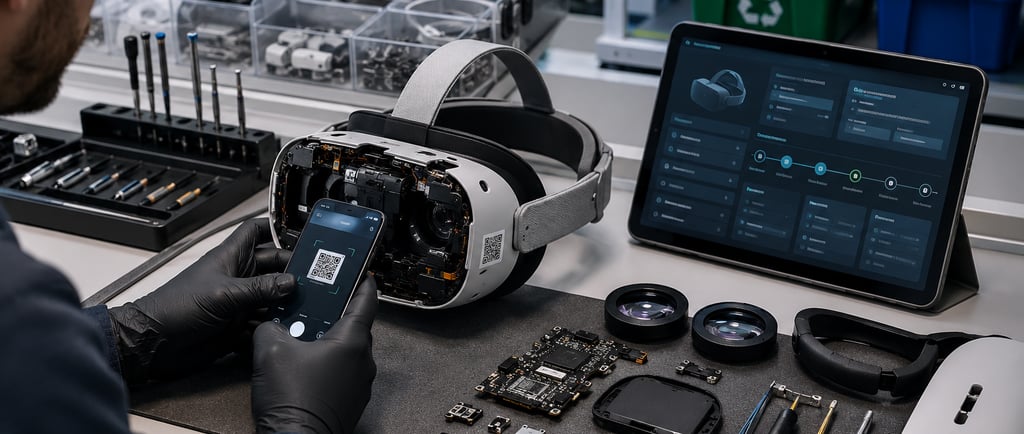
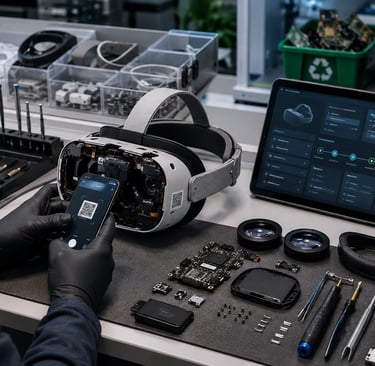
Digital Identifier Integration: Physical-to-digital connection is accomplished through tamper-evident QR codes, embedded NFC tags, or serialized RFID chips—applied at manufacturing or at enterprise intake. These labels serve as gateways to the digital passports, simplifying updates at the point of repair, transfer, or EOL.
Distributed Platform with Access Controls: All stakeholders—OEMs, asset managers, maintenance techs, and certified recyclers—interact with the passport system based on role, ensuring each touchpoint is authenticated, traceable, and compliant. Platforms can operate as cloud services or integrate into existing ERPs.
Process Automation: Modern APIs enable automating updates whenever a repair, ownership transfer, or recycling event is logged in other connected systems, reducing manual data entry and error risk.
Audit & Compliance Readiness: The best passport platforms feature immutable logs, real-time reporting, and audit modules that pull evidence for regulators or clients at a moment's notice—streamlining certifications, warranty processing, and ESG documentation.
Step-by-Step Process
Data Model Design: Start with required fields—serial, owner chain, repairs, compliance events. Expand to optional fields like incident type or device usage hours.
Tagging & Labeling: Assign digital identifiers (QR/NFC) at the earliest viable point to both new and legacy assets.
System Integration: Synchronize the XR device registry with asset procurement, repair/maintenance, and recycling logistics systems. Example: auto-log a 'repair complete' event from an MRO platform.
Stakeholder Permissions: Segment access—OEMs manage firmware fields, owners log transfers, repairers upload service actions, recyclers close the chain.
Workflow Automation: Push and pull data with minimal click burden through connected systems; enable real-time notifications to the relevant actor for each event.
Event Logging: Create tamper-resistant, timestamped entries for all critical actions (ownership update, repair, data wipe, EOL).
Reporting & Compliance Module: Instantly generate certified reports for end-of-life hand-off, repair trend analysis, and historic chain-of-custody.
Continuous Improvement: Aggregate and anonymize data for feedback to engineering teams, directly informing 'repair bottleneck' fixes and future device modularity.
Sample Passport Fields
A mature passport record for XR hardware might include:
Serial/Unique Asset ID
Make/Model/Batch Number
Date of Manufacture
Full Ownership Chain and Timestamps
Location/Deployment History
Maintenance and Repair Logs
Parts Swapped (serial number, supplier, date)
SW/FW Versions and Updates
Incident/Damage History
All Refurbishment Notes
Data Erasure and Sanitization Verification
Recycling/EOL Process Details (method, tracked vendor, regulatory code)
Compliance Flags (WEEE, RoHS, batteries directive, etc.)
Practical Example: Enterprise XR Fleet Management
Scenario:
Consider an engineering firm with 1,200 AR smartglasses for field service. Each device receives a scannable QR at rollout, binding to its passport. Mobile repair teams use a portal to register battery or lens swaps, software patches, or diagnostics. When preparing to retire units, facility IT logs EOL handoff directly. Integrated APIs push all repair and recycling data into the device passport automatically.
Real-World Impact:
Time spent preparing for audits drops by over 80%.
Warranty disputes decrease, as maintenance records are immutable and centralized.
More than 95% of components are tracked to verified recyclers, slashing risk of regulatory non-compliance fines.
4. Why XR Device Passports Matter for Repair, Resale, and Trust
The real value of an XR device passport is not the record itself. The value is what the record makes possible. In XR hardware, ownership and repair history affect everything: warranty claims, resale value, insurance, security, compliance, refurbishment yield, and recycling quality.
A headset with no repair history is a risk. A headset with a verified repair history is an asset.
That difference matters more in XR than in many other electronics categories because immersive devices combine sensitive optics, batteries, cameras, displays, microphones, motion sensors, wireless modules, plastics, adhesives, firmware, and sometimes biometric or spatial data. A second-hand VR headset or enterprise AR device is not simply a used gadget. It may have stored user accounts, mapped rooms, enterprise credentials, health-related training records, or industrial inspection data.
This is why a passport must capture more than ownership transfer. It must capture the condition of the device at each stage of use.
By 2026, the global e-waste problem has become too large for vague sustainability claims. The Global e-Waste Monitor 2024 reported that the world generated 62 billion kg of e-waste in 2022, equal to 7.8 kg per person, while only 22.3% was documented as formally collected and recycled. The report also projects 82 billion kg of e-waste by 2030, with the documented recycling rate falling to 20% under a business-as-usual scenario. That makes traceability a practical necessity, not a reporting luxury.
XR is still a smaller share of electronics waste compared with phones, laptops, small appliances, and screens, but it is a high-complexity category. Many devices contain lithium-ion batteries, rare earth magnets, copper, aluminum, circuit boards, lenses, sensors, and mixed plastics. These materials can be recovered, repaired, or reused, but only when the right information reaches the right actor at the right time.
That is the repair data opportunity.
A recycler needs to know whether the battery has been damaged, swollen, replaced, or exposed to heat. A refurbisher needs to know whether the lenses were replaced with original parts or third-party parts. A corporate buyer needs to know whether the device has gone through verified data erasure. A regulator needs proof that the device did not disappear into informal waste channels. A manufacturer needs failure data to improve future product design.
Without a passport, each of those actors works with partial information. With a passport, the XR device carries a verified history.
This becomes especially important as AR and VR adoption moves from experimental pilots to larger fleets. IDC expected global AR and VR headset shipments to grow from an estimated 6.7 million units in 2024 to 22.9 million units in 2028, driven by lower device costs, AI features, and growth in smart glasses. More devices in circulation means more repair events, more returns, more trade-ins, more warranty disputes, and more end-of-life decisions.
The passport turns each of those events into evidence.
5. The Policy Shift: Why Digital Product Passports Are Becoming Market Infrastructure
The strongest reason XR companies should prepare for device passports in 2026 is simple: regulation is moving in that direction.
The EU's Ecodesign for Sustainable Products Regulation is building a new product governance model around sustainability, traceability, product information, and the Digital Product Passport. The European Commission describes the regulation as a system for shaping sustainable products through new rules, tools, and the Digital Product Passport.
This matters for XR because the DPP model is no longer theoretical. The battery sector is already showing how product passports move from policy language into operating reality.
From February 2027, battery passports will become mandatory for certain EV batteries sold in the European Union, including information such as composition, origin of key materials, carbon footprint, and recycled content. Volvo has already moved ahead of the deadline by launching a battery passport for the EX90, with records covering raw material origins, components, recycled content, carbon footprint, and state of health. The passport is accessed through a QR code, while a fuller version is available for regulators.
The lesson for XR is clear. The first wave of product passports may focus on batteries and other priority categories, but the logic will spread. Electronics with batteries, sensors, circuit boards, and mixed materials sit directly inside the policy direction.
Right-to-repair rules add another layer. In 2024, the European Parliament approved repair rules requiring producers to make repair a more accessible option for covered products. Reuters reported that the law gives consumers stronger repair rights, extends guarantees by 12 months when a product is repaired under guarantee, and bans software or hardware practices that block repair. The European Commission estimated that premature disposal of usable goods produces 35 million metric tons of waste and 260 million metric tons of greenhouse gas emissions each year.
For XR, this points to a future where repairability cannot remain hidden in service tickets or vendor portals. Repair records will need to be available, verifiable, and tied to product identity.
A device passport can support this in four ways.
First, it can prove repair eligibility. If the device is still within warranty, the passport can show purchase date, repair attempts, part replacements, and service status.
Second, it can prove repair quality. If the device was repaired by a certified technician using approved parts, that record can follow the device into resale or redeployment.
Third, it can support spare parts planning. If an enterprise fleet shows repeated battery, strap, lens, controller, or sensor failures, procurement teams can plan parts inventory before downtime spreads.
Fourth, it can protect buyers. A second-life XR headset with verified service history, battery condition, sanitation status, and data wipe evidence deserves a stronger valuation than an unknown device sold through an informal channel.
In 2026, digital product passports are moving from compliance paperwork to market access infrastructure. XR brands that wait until regulation names their category directly will lose time. The companies that start now will have cleaner data, stronger resale channels, and lower audit stress when rules tighten.
6. What an XR Device Passport Should Actually Contain
A useful XR passport must be built around lifecycle events. It should not become a static PDF, a hidden spreadsheet, or a marketing page. It should behave like a living record that changes each time the device changes hands, condition, location, part composition, firmware state, or end-of-life status.
The first layer is product identity. This includes the device serial number, model, SKU, batch number, manufacturing date, region of sale, and original configuration. For XR hardware, the original configuration matters because devices often ship with different storage capacities, sensor sets, straps, controllers, lenses, batteries, enterprise firmware, or regulated accessories.
The second layer is material and component information. A passport should capture the main plastics, battery chemistry, circuit board type, display type, lens materials, magnets, aluminum or magnesium content, screws, adhesives, cable types, and hazardous components. This does not need to reveal trade secrets. It does need to give repairers and recyclers enough information to work safely.
The third layer is ownership and custody. Every transfer should be logged with time, party type, location, and authorization status. For enterprise XR fleets, custody may move from procurement to IT, from IT to a training department, from a training department to field staff, then back to IT for redeployment or retirement. Each handoff creates risk. A passport reduces that risk by making ownership visible.
The fourth layer is repair and maintenance history. This is the heart of the system. The passport should log battery replacements, display repairs, lens swaps, strap and housing repairs, controller pairing, firmware updates, camera or sensor recalibration, speaker or microphone repairs, water exposure, drop damage, thermal events, and failed diagnostic tests.
The fifth layer is software and security status. XR devices are software-heavy. Firmware, operating system version, device management profile, enterprise enrollment status, account lock status, and security patch level can affect resale and redeployment. A headset that is physically functional but locked to a previous organization may have little resale value. A passport should show when the device was unenrolled, reset, wiped, and cleared for transfer.
The sixth layer is hygiene and human-use status. XR devices touch the face, hair, hands, and shared work environments. In healthcare, education, training centers, arcades, and enterprise labs, sanitation matters. A passport can log cleaning protocol, foam interface replacement, facial gasket replacement, and contamination incidents. This is especially relevant for devices shared by many users.
The seventh layer is end-of-life handling. The passport should record whether the device was reused, repaired, harvested for parts, refurbished, recycled, exported, destroyed, or returned to the OEM. It should capture the vendor, facility, regulatory code, material recovery route, and certificate of recycling or destruction.
The eighth layer is impact reporting. This includes estimated avoided emissions from repair versus replacement, reused parts, recovered materials, avoided landfill, and life extension. These figures must be calculated conservatively. Bad sustainability math damages trust. Clear assumptions matter.
By 2026, the best XR device passport is not the one with the most fields. It is the one with the right fields, the right permissions, and the lowest burden on the people who must update it.
7. Case Studies and Lessons from Adjacent Industries
XR does not need to invent device passports from scratch. The strongest lessons already exist in batteries, automotive, consumer electronics, medical devices, and enterprise IT asset management.
The battery passport is the clearest case. Volvo's EX90 battery passport shows how traceability can move from raw material origins to consumer-facing transparency and regulator-ready reporting. The project took more than five years to develop and required changes in how Volvo traced parts through its manufacturing process. That timeline is important. It shows that product passports are not a last-minute software add-on. They require supplier records, production data, facility audits, QR access, and internal process change.
For XR companies, that means the work must start before regulation forces it. A headset manufacturer cannot build credible repair and ownership records after devices have already gone through years of sales, repairs, returns, and redeployments. The data must be collected from the beginning.
The e-waste sector offers a second lesson. The Global e-Waste Monitor found that e-waste generation is rising five times faster than documented recycling. It also reported that US $91 billion worth of metals were embedded in 2022 e-waste, including US $19 billion in copper, US $15 billion in gold, and US $16 billion in iron. Only US $28 billion in secondary raw materials was reclaimed through urban mining.
This matters for XR because device passports help recyclers recover more value from smaller, complex products. When a recycler knows the material mix, battery location, adhesive type, screw locations, display construction, and hazardous components, dismantling becomes faster and safer. When that information is missing, valuable products can be shredded too early, stored too long, or handled through low-value routes.
Enterprise IT asset disposition provides a third lesson. Companies already require certificates of data destruction, chain-of-custody reports, serial-level asset reconciliation, and recycling certificates for laptops, phones, servers, and storage devices. XR devices should be treated with the same seriousness. In many cases, they may carry equally sensitive information.
Healthcare provides a fourth lesson. Medical devices require maintenance logs, calibration records, service histories, and controlled retirement. XR is increasingly used in surgical training, physical therapy, medical education, and patient engagement. As use expands, the line between consumer headset and regulated training device becomes harder to ignore. Hospitals and clinics will not accept vague records for hardware used in sensitive environments.
The lesson across these sectors is consistent. Passport systems work when they reduce uncertainty. They fail when they become detached from daily operations.
An XR device passport should therefore be tied directly to repair benches, warehouse intake, fleet management, mobile device management, refurbishment lines, reseller checks, and recycler receiving workflows. If the system depends on people remembering to update records after the fact, the data will decay.
8. Implementation Roadmap for XR OEMs, Enterprises, Repairers, and Recyclers
A practical XR passport rollout should begin with the assets already causing the most operational friction. That usually means high-value headsets, enterprise smart glasses, shared training devices, devices with batteries, devices used in regulated environments, and devices being resold or retired.
The first step is asset discovery. Organizations need a clean count of devices by model, location, owner, status, and condition. This sounds basic, but many XR fleets are scattered across departments, labs, training centers, warehouses, field teams, and third-party partners. If the asset base is messy, the passport system will only make the mess more visible.
The second step is identifier assignment. New devices should receive identifiers at manufacturing or procurement. Legacy devices can receive QR, NFC, RFID, or barcode labels at intake. The identifier must survive normal handling, cleaning, transport, and storage. For shared-use XR devices, labels should be placed where they are easy to scan but not likely to peel, rub off, or interfere with comfort.
The third step is field selection. Start with essential fields: serial number, model, owner, location, warranty status, repair history, battery condition, firmware status, data wipe status, and end-of-life status. Add material and compliance fields where the information is available. Do not overbuild the first version. A passport that repairers actually update is more valuable than a perfect record that nobody maintains.
The fourth step is permission design. OEMs, owners, repairers, resellers, recyclers, auditors, and consumers do not need the same view. Some information should be public, such as model, general material guidance, repair instructions, and recycling route. Some should be restricted, such as enterprise ownership, deployment location, internal incident notes, user account history, and security status.
The fifth step is repair workflow integration. Each repair event should be logged at the point of work. The technician should scan the device, select the repair type, record the part, upload diagnostics where needed, and close the job. The system should write the event into the passport automatically. The fewer manual steps, the better the record quality.
The sixth step is ownership transfer design. When a device moves from one party to another, the passport should support a verified transfer. This is critical for trade-ins, leasing, reseller programs, corporate returns, and take-back schemes. A clean transfer can include device condition, accessories included, data wipe confirmation, reset status, and outstanding repair flags.
The seventh step is end-of-life integration. A passport should not stop at refurbishment. It should close the loop. If a device is harvested for parts, the passport should record which parts were removed and what happened to the rest. If recycled, it should record the facility, date, method, certificate, and material route. If destroyed, it should include proof.
The eighth step is reporting. Compliance teams should be able to generate reports by device, batch, facility, vendor, country, or time period. Procurement teams should be able to see failure patterns. Sustainability teams should be able to report repair rates, reuse rates, avoided replacement, and verified recycling. Finance teams should be able to value second-life inventory.
The ninth step is review. Every quarter, the organization should check whether records are being updated, which fields are being skipped, where data quality is weak, and which teams need better instructions. Device passports succeed through routine maintenance, not one-time setup.
9. Metrics That Prove an XR Device Passport Is Working
A passport system must prove its own value. The best way to do that is to measure outcomes across repair, compliance, cost, security, resale, and recovery.
Repair rate is the first metric. How many devices are repaired instead of replaced? A rising repair rate usually means better diagnosis, better parts visibility, and more confidence in second-life use.
Mean time to repair is the second metric. If repairers can access device history, part data, warranty status, and previous failure notes in one place, repair time should fall. This matters for enterprise fleets because every broken headset can interrupt training, inspection, design review, or field service work.
Redeployment rate is the third metric. How many devices return to active use after repair, cleaning, reset, or refurbishment? A passport should increase redeployment because it gives IT and operations teams the confidence to reuse devices safely.
Warranty dispute rate is the fourth metric. A clean repair history reduces conflict between OEMs, customers, resellers, and service centers. The passport shows when damage occurred, what was repaired, which parts were used, and whether unauthorized work took place.
Data wipe verification rate is the fifth metric. Every retired, resold, or transferred XR device should have clear evidence of reset, account removal, enterprise profile removal, and data sanitation. This is essential for corporate, healthcare, education, and government buyers.
Resale value is the sixth metric. Devices with verified service history, battery status, working accessories, sanitation records, and data wipe proof should command stronger resale prices than unverified devices. In practice, the passport becomes a trust layer for second-life markets.
Parts recovery rate is the seventh metric. A device passport can show how many batteries, lenses, straps, controllers, displays, sensors, and boards were reused or harvested. This helps companies move beyond broad recycling claims and toward component-level circularity.
Verified recycling rate is the eighth metric. The passport should show which devices reached approved recyclers and which were lost, stored, exported, or destroyed. This helps reduce leakage into informal channels.
Audit preparation time is the ninth metric. A well-run passport system should reduce the time needed to prepare compliance, ESG, and end-of-life documentation. Manual audit preparation can take weeks when records sit across spreadsheets, emails, service tickets, vendor portals, and PDF certificates. A passport brings those records into one traceable path.
Design feedback is the tenth metric. The most valuable long-term output is product improvement. If thousands of repair records show the same weak hinge, battery issue, lens scratch pattern, strap failure, or controller fault, engineering teams can redesign future devices around real-world failure patterns.
That is where passports become more than compliance infrastructure. They become a product improvement engine.
10. Risks, Barriers, and Design Mistakes to Avoid
The first risk is poor data quality. A passport filled with incomplete fields, vague repair notes, duplicate device IDs, and missing transfer records creates false confidence. Bad data is worse than no data because it can mislead auditors, buyers, and repair teams.
The second risk is overcollection. XR devices may involve sensitive user, enterprise, location, biometric, and spatial information. A passport should not become a surveillance record. It should track the device lifecycle, not private user behavior. Privacy-by-design is essential.
The third risk is vendor lock-in. If passport records sit inside one closed platform, owners may lose access when they change vendors, repair partners, resellers, or recyclers. XR passports should support export, standard identifiers, API access, and long-term record retention.
The fourth risk is weak physical tagging. If QR codes peel off, NFC tags fail, labels become unreadable after cleaning, or identifiers are easy to tamper with, the physical-to-digital link breaks. Tagging design matters as much as software design.
The fifth risk is repairer exclusion. A passport system that only supports authorized repair channels may weaken the repair economy and conflict with right-to-repair expectations. The system should distinguish between certified, independent, internal, and unauthorized repair events, but it should not erase repair history simply because a third party performed the work.
The sixth risk is confusing consumers. A passport should present different layers for different audiences. A consumer does not need a full bill of materials. A recycler does. An auditor may need verified certificates. A repairer needs part history and diagnostics. Good access design keeps the record useful.
The seventh risk is treating blockchain as the answer by default. Some use cases may benefit from distributed verification, but most passport problems are process problems first. The core requirements are trusted identifiers, verified updates, clear permissions, durable records, and useful reporting. Technology choice should serve those needs.
The eighth risk is ignoring the informal market. Many devices leave formal channels through resale platforms, small repair shops, employee loss, liquidation, or unmanaged export. Passport systems should make legitimate transfer easy enough that users do not bypass it.
The ninth risk is inflated sustainability claims. A passport can support circularity, but it does not create circularity by itself. If a company still designs glued, hard-to-open, short-life devices, the passport only documents the problem. The record must be paired with repairable design, spare parts access, take-back channels, and verified recovery.
11. What XR Companies Should Do in 2026
XR companies should treat 2026 as the preparation year.
OEMs should begin by mapping product data, material data, serial records, repair records, firmware records, and take-back records. They should define which data can be public, which data belongs to owners, which data regulators may need, and which data must remain protected. They should also start pilot passports for current devices instead of waiting for the next generation.
Enterprise XR users should start with fleet-level records. They should know how many devices they own, where they are, who uses them, which ones are broken, which ones are retired, and which ones have been wiped. If this cannot be answered in one day, the organization needs a passport-style asset record.
Repair providers should prepare to become trusted data contributors. Repairers who can provide clean digital service records will be more valuable to OEMs, enterprises, insurers, and resale channels. Every repair should become part of the device's future value, not a disconnected invoice.
Recyclers should push for better incoming information. XR devices should not arrive as anonymous mixed electronics. Recyclers should ask for battery status, model information, material guidance, hazard notes, and ownership confirmation. This will improve safety, reduce handling time, and increase recovery value.
Resellers should use passports as a trust signal. A used XR device with verified repair, cleaning, reset, and data wipe history should be positioned differently from an unverified unit. The passport can support grading, pricing, warranty offers, and buyer confidence.
Regulators and industry groups should work toward common data fields. Without shared field definitions, every company will build a different passport. That creates friction for repairers, recyclers, auditors, and buyers. XR needs common language around device condition, part status, battery health, repair type, data wipe proof, and end-of-life route.
The 2026 priority is not perfection. The priority is getting the record structure in place before volumes rise and rules tighten.
12. The Future: XR Passports as the Backbone of Circular Immersive Hardware
The future XR device passport will not sit quietly in a compliance folder. It will connect manufacturing, ownership, repair, resale, refurbishment, security, and recycling into one traceable lifecycle.
When a headset is manufactured, the passport will begin with verified product identity, material data, and repair guidance. When the device is sold, ownership will be recorded. When it enters enterprise use, deployment and custody will be logged. When it breaks, repair history will update. When it is resold, the buyer will see verified condition and wipe status. When it reaches end of life, the recycler will know how to handle it safely.
That is the logical endpoint: every XR device becomes traceable, repairable, transferable, and recoverable by design.
This will matter more as AR and VR mature. PwC has projected that AR and VR could add up to US $1.5 trillion to global GDP by 2030, with use cases across product development, healthcare, training, process improvement, and retail. If immersive hardware becomes part of daily work in healthcare, manufacturing, education, logistics, design, and field service, then the circular systems around that hardware must mature at the same pace.
The e-waste numbers make the case urgent. The world is already losing valuable materials, missing recycling targets, and sending complex electronics into fragmented end-of-life channels. UNITAR reported that just 1% of rare earth element demand is currently met by e-waste recycling, despite billions of dollars of recoverable resources sitting inside discarded electronics.
XR device passports will not solve that alone. But they provide the missing evidence layer.
They help a repairer decide what can be fixed. They help a buyer trust a refurbished device. They help a recycler recover value safely. They help a regulator verify claims. They help an OEM see failure patterns. They help enterprises prove that devices were wiped, transferred, repaired, reused, or recycled properly.
In 2026, the companies that build XR passports early will gain more than compliance readiness. They will gain control over asset value, repair intelligence, resale trust, and end-of-life proof. The companies that delay will face fragmented records, weaker recovery channels, slower audits, and lower confidence in second-life devices.
The future of XR hardware will not be defined only by better displays, lighter headsets, faster chips, and smarter AI features. It will also be defined by what happens after the first owner is done with the device.
A passport gives every XR device a memory. More importantly, it gives every stakeholder a reason to keep that device in use for longer, recover more value from it, and prove what happened when its first life ended.
Connect
Your trusted partner for scrap metal procurement.
CONTACT
About
haroon@tdcventures.com
+1-307-655-7593
© 2025. All rights reserved.
NEWSLETTER