
Youth Apprenticeships in Repair & Reuse: Community, Equity, Culture
Discover how community-rooted youth apprenticeships in repair and reuse drive equity, cultural continuity, and circular economy jobs. Includes frameworks, case studies, and a practical scorecard.
WASTE-TO-RESOURCE & CIRCULAR ECONOMY SOLUTIONS
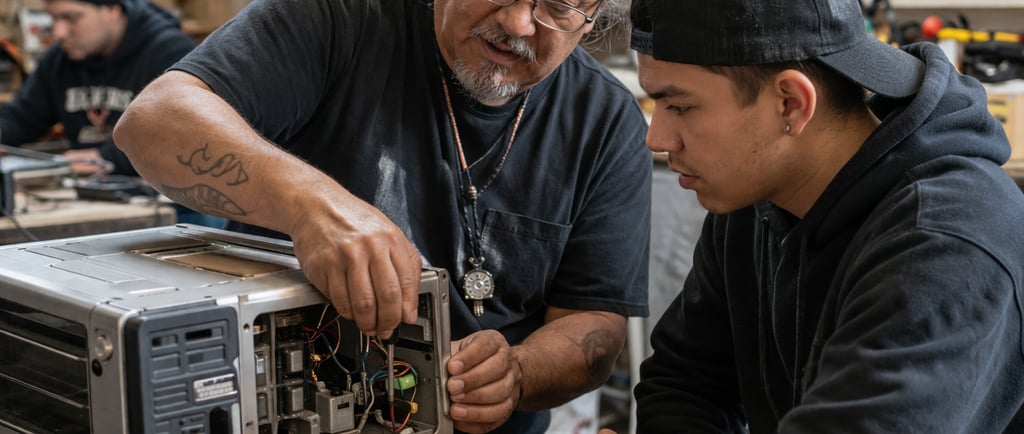
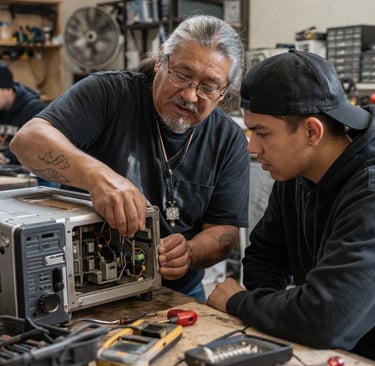
Youth apprenticeships in repair and reuse are no longer a niche workforce idea. In 2026, they sit at the intersection of youth employment, circular economy policy, local industrial rebuilding, right-to-repair law, community wealth creation, and cultural continuity. That matters because the global youth labour market is still under strain. The ILO reports global youth unemployment at 12.4 percent in 2025, while around 262 million young people, roughly one in four, were neither employed nor in education or training in 2025. At the same time, the material case for repair has become impossible to ignore. The Global E-waste Monitor 2024 recorded 62 million tonnes of e-waste in 2022 and projects 82 billion kilograms by 2030, while documented formal collection and recycling stood at only 22.3 percent in 2022 and could fall to 20 percent by 2030 under business as usual.
This is why repair and reuse apprenticeships deserve to be treated as serious infrastructure, not side projects. Repair is already a large labour market, not a hypothetical one. The ILO’s 2025 work on circular employment found that between 121 million and 142 million people are employed in the circular economy globally, and repair and maintenance alone account for 46 percent of those jobs, at least 65.2 million workers. At the policy level, the market is also moving. The EU’s repair directive was adopted on 13 June 2024, entered into force on 30 July 2024, and must be applied by member states from 31 July 2026, with the stated aim of increasing repair and reuse and extending product lifetimes. That means training systems built now are entering a policy environment that is starting to reward durability, spare parts access, and service labour rather than disposal alone.
Table of Contents
Why Youth Apprenticeships in Repair and Reuse Matter Now
What a Community-Rooted Repair and Reuse Apprenticeship Actually Is
The Equity Gap in Green Skills and Circular Work
Why Culture, Governance, and Intergenerational Knowledge Matter
How to Build an Apprenticeship Model That Can Last
Measurement: What Really Counts and Example Scorecard
Mini-Case Patterns: Diverse Scenarios in Action
FAQs: Common Questions on Youth Repair Apprenticeships
Embedded Five-Layer Distribution and Reuse Toolkit
Competitive Differentiation: Market Gaps and Upgrades
1. Why Youth Apprenticeships in Repair and Reuse Matter Now
The case for youth repair apprenticeships starts with a simple fact. The world has too much waste, too few accessible early-career pathways, and too many systems that separate technical skill from community need. Repair and reuse answer all three at once when they are designed well. A repair apprenticeship can turn a broken laptop, toaster, fridge, bike, tool, garment, appliance, or small machine into a live training asset. It can teach diagnostics, disassembly, safe handling, customer communication, inventory discipline, materials literacy, and business judgment in the same learning loop. It can also keep goods in local circulation longer, reduce replacement costs for households, and build local service capacity that remains in the community after grant cycles end. The repair economy is therefore not only environmental. It is civic, social, practical, and labour-intensive in exactly the way youth pathways need to be.
The urgency is even stronger in electronics and household equipment. The Global E-waste Monitor 2024 estimates that e-waste management could lead to losses of USD 40 billion in 2030 under current trajectories. It also shows benefits of USD 42 billion in recovered metals and USD 26 billion in monetized avoided greenhouse gas emissions under stronger collection and management scenarios. In other words, repair and reuse are not soft add-ons to recycling. They are part of the economic logic of a smarter materials system. Youth apprenticeships matter here because every repair-ready device or product category requires hands, judgment, and repeat practice. If repair systems grow but training does not, the labour bottleneck shifts from policy to execution.
There is also clear evidence that community repair activity is already widespread enough to support training pipelines. Repair Café data recorded more than 37,000 repairs in 2024, with 62 percent completed successfully. Academic and practitioner sources in 2025 and 2026 place the number of registered Repair Cafés worldwide at about 3,652. That is important because it shows repair culture is not hypothetical demand waiting to be invented. It already exists in distributed local forms. What many places still lack is the next layer: structured progression for young people from volunteer exposure to paid, mentored, credentialed practice.
2. What a Community-Rooted Repair and Reuse Apprenticeship Actually Is
A serious youth apprenticeship in repair and reuse is not just a workshop where young people fix donated goods. It is an earn-and-learn pathway anchored in real work, real standards, and real progression. It combines supervised technical practice, paid or stipend-supported participation, off-the-job learning, structured mentoring, portfolio evidence, and a visible next step into employment, self-employment, cooperative work, or further training. The strongest versions also connect repair work to local need. That could mean refurbishing computers for low-income households, repairing appliances for community resale, restoring tools for local trades access, or maintaining equipment used by schools, nonprofits, or cultural institutions. The model works best when the training site is also a community service site, because then the apprentice does not learn in abstraction. They learn inside a functioning local system.
This point matters because too many workforce programs confuse activity with pathway. A few weeks of exposure, a one-day repair event, or an unpaid volunteer role can spark interest, but that is not the same thing as a durable apprenticeship. A proper pathway has entry criteria, support systems, mentor responsibilities, attendance expectations, tool and safety protocols, formative assessment, and defined exits. It also treats repair as multidisciplinary work. A young person may begin with testing and cleaning, then move to fault identification, replacement part handling, refurbishment standards, pricing, customer intake, resale documentation, and eventually peer mentoring. That layered structure is what turns a circular economy slogan into a labour market route.
The most effective community-rooted models also resist the old split between social value and economic value. Wales offers a useful policy signal here. Its 2025 evaluation found that the government’s commitment to fund 80 repair and reuse hubs across town centres was met, and the assessment identified positive social, environmental, and economic impacts, including stronger wellbeing and social connection, reduced waste, encouragement of second-hand purchasing, and wider community benefit. That is a strong reminder that a repair apprenticeship should be built as a local institution, not only as a training line item.
3. The Equity Gap in Green Skills and Circular Work
The green transition is already producing a familiar problem. Jobs are being discussed faster than pathways are being built. The Green Jobs for Youth Pact, led by ILO, UNEP, and UNICEF, states that the world needs to double the size of the green talent pool by 2050, and it has set goals that include creating 1 million new green jobs for youth and greening 1 million existing jobs by 2030. That scale tells us two things. First, youth-focused green training is now a mainstream policy concern. Second, if repair and reuse programs do not actively build equitable access, the same groups already excluded from technical and higher-wage work can be excluded again under greener branding.
That exclusion is not abstract. Youth employment evidence shows that many young people from marginalized backgrounds do not know enough about apprenticeship options, do not see people like themselves in outreach material or workplaces, and need targeted recruitment through colleges, youth hubs, and community organizations. Youth Futures Foundation guidance for employers is blunt on this point: authentic voices matter, outreach must be deliberate, and progression has to be visible. The lesson for repair and reuse is simple. If a program only waits for applicants, uses generic language, or recruits through narrow institutional channels, it will reproduce exclusion. Equity requires design, not hope.
This also means apprenticeship design must reflect how young people actually encounter green issues and opportunities. A 2024 cross-country youth consultation with 40,793 respondents found that 68.4 percent cited social media platforms as a source of information about climate change and disaster risk, while 51.1 percent cited school or higher education. For repair and reuse programs, that suggests two immediate moves. Recruitment should happen in both digital and institutional spaces, and the message should connect environmental purpose with practical work, income, belonging, and visible skill gain. Young people rarely respond to abstract sustainability language alone. They respond when the pathway feels real, local, and worth their time.
Equity also depends on how success is defined. If success means only “placement into any job,” then low-paid, unstable, low-status outcomes can still be counted as wins. But if success means retained participation, skill progression, recognized competence, credible pay, safety, cultural fit, and a next step into leadership or stable work, then the program has to be designed very differently. This is one reason repair and reuse are promising. They can support employment, cooperative enterprise, neighbourhood service models, refurbishment businesses, school-based technical pathways, and public-interest infrastructure all at once. That wider field creates more than one way for young people to stay in the work.
4. Why Culture, Governance, and Intergenerational Knowledge Matter
Repair is often described as a technical act. In practice, it is also a cultural one. Every community already has beliefs about fixing, making do, passing things down, caring for tools, respecting materials, and deciding what is worth saving. Some of those beliefs live in households. Some live in trades. Some live in Indigenous knowledge systems, migrant memory, or older working-class practice. When an apprenticeship ignores those forms of knowledge and imports only a standard technical template, it misses one of the strongest retention tools available: recognition. Young people are more likely to stay when the program says, in effect, your home knowledge, your language, your elders, your craft history, and your local repair culture belong here too.
This is especially important in Indigenous and community-led contexts. Research on a Canadian Indigenous work-integrated learning model found that fresh approaches to trades training are needed for access and success, and that community-based training grounds the apprentice in culture and Indigenous ways of knowing, doing, and being. In the Nuxalk Nation case, the model operated in-community, reduced barriers tied to leaving home, aligned training with community plans, and produced both participant benefits and community infrastructure gains. The case also stressed that bringing education to the people, rather than forcing people to leave their community to access it, was a central condition of success. That lesson transfers directly to repair and reuse. Local training is not only a convenience choice. In many places, it is the difference between participation and dropout.
Governance matters for the same reason. A repair apprenticeship can be managed in a top-down way, where young people are recipients, or it can be governed as a community asset, where young people, local institutions, employers, and cultural stewards have real voice. The second model is harder, but it lasts longer because it creates accountability in the right places. Wales’ repair and reuse evaluation found value not only in waste reduction, but also in wellbeing, social connection, and broader community benefit. Those outcomes do not appear by accident. They emerge when the program is attached to local trust, not just delivery targets.
Intergenerational learning is the final piece. Repair Café’s own framing warns that repair knowledge is being lost, especially among younger generations. That makes youth apprenticeship more than a labour program. It becomes a cultural transmission system. A mentor is not only passing on a wiring method, stitch technique, calibration habit, or fault-finding sequence. They are passing on patience, care, frugality, pride in workmanship, and a way of relating to materials that resists disposability. In an economy that often teaches replacement first, that shift in worldview is not minor. It is foundational.
5. How to Build an Apprenticeship Model That Can Last
A durable youth repair apprenticeship needs five structural commitments from the start. It needs deliberate outreach, real support, credible work, recognized skill evidence, and a visible future. Deliberate outreach means going where underrepresented youth already are, using trusted local partners, and showing relatable role models. Real support means transport help, flexible scheduling, mental health awareness, language access, safe tools, and mentors who know the difference between correction and humiliation. Credible work means the tasks matter to someone outside the classroom. Recognized skill evidence means the apprentice leaves with something that employers, training bodies, or cooperative partners can understand. A visible future means the young person can answer the question, “What happens after this?” on day one, not on the final week.
This is where micro-credentials and digital badges can help, but only if they are tied to real assessment. UNICEF’s 2024 think piece defines a micro-credential as recognition awarded after a short, focused learning program with clear skills training, assessment, validation, and certification. It also stresses that these credentials work best when connected to employers, qualification frameworks, and labour-market recognition. For repair and reuse, that means a badge should not be a decorative participation token. It should certify something specific, such as electrical safety basics, diagnostic intake, soldering competence, appliance refurbishment workflow, textile repair finishing, tool restoration, reuse inventory handling, or peer mentor readiness. When designed well, small credentials help young people stack evidence of competence without forcing them to wait years for recognition.
The employer and enterprise side matters too. Repair cannot survive on sentiment alone. It needs workflows, parts access, intake systems, resale logic, customer communication, and demand signals. Here, European and community examples are useful. The eReuse model in Barcelona reported work with 400 entities, 20 consolidated workplaces in 18 social reuse centres, more than 10,000 reused devices tracked to final recycling, and over 5,000 devices entering reuse circuits each year. It also estimates roughly one job created for every 300-plus devices and reports strong gains from product life extension. That kind of model shows how a repair apprenticeship can sit inside a functioning reuse economy rather than a stand-alone training room.
The policy direction also supports building now rather than later. Europe’s repair directive is taking effect from 31 July 2026, Wales has already met its 80-hub repair and reuse commitment, and global green jobs efforts are now actively calling for youth pathways at scale. In practice, that means the strongest programs over the next few years will be the ones that stop treating repair as a volunteer sideline and start treating it as a civic labour market with training standards, cultural depth, and local economic purpose. The organizations that understand this early will not just train apprentices. They will shape the local repair economy itself.
6. Measurement: What Really Counts & Example Scorecard
Creating truly impactful youth apprenticeships in repair and reuse means measuring beyond simple job placements. Instead, organizations that lead in circular workforce systems focus on data that aligns with community values, cultural continuity, and equity outcomes—ensuring their approach leads to lasting change.
Modernizing Metrics: From Participation to Circular Impact
It’s not enough for a program to count attendance. Leading programs set and monitor metrics that reflect:
Community engagement (e.g., participation in cultural events)
Equity progress (e.g., representation of Indigenous or marginalized youth)
Circular economy outcomes (e.g., kilograms of metals or appliances kept out of landfills)
Skill acquisition (e.g., micro-credentials awarded or new skills documented in learning portfolios)
Sustained employment and leadership pathways (e.g., job offers extended, apprentices promoted to peer mentor roles)
By visualizing progress with tools such as digital dashboards, organizations foster transparency and nurture community trust—a cornerstone for ongoing governance and program refinement.
Example Scorecard: Moving Beyond Conventional KPIs
MetricTargetActual (Sample Cohort)Attendance Rate≥93%97%Mentor Check-Ins≥90%92%Youth Retention Rate86%–95%90%% Underrepresented Youth60%72%Repairs Completed per Month1014Materials Diverted (kg)100155Cultural Event Participation2/month3Apprentices Advancing to Jobs≥50%68%
Holistic Evaluation: Incorporating Qualitative Insights
Apprenticeship programs gain deeper audience insight by layering quantitative KPIs with qualitative data:
Apprentice self-reflections and interviews capturing cultural learning moments
Community testimonials about the value of sustained repair practices
Feedback from elders and technical mentors on intergenerational knowledge transfer
Storytelling artifacts—photo essays, audio recordings, and apprentice-made videos—shared at public ceremonies
By triangulating these data types, organizations can identify which elements of their community equity framework deliver the highest resonance and where to iterate for even greater equity and cultural sustainability.
Industry Trends: The Next Generation of Workforce Metrics
Emerging leaders in circular workforce development are investing in digital tracking tools that integrate skill validation (such as digital badges or micro-credentials) with social impact analytics. As AI-driven workforce management becomes mainstream, expect to see platforms that automatically capture both technical skill milestones and cultural engagement indicators—streamlining reporting for funders and supporting more sophisticated equity audits.
7. Mini-Case Patterns: Diverse Scenarios in Action
Concrete examples breathe life into the theory of culturally anchored youth apprenticeships, showing how programs adapt to serve different community needs while driving system-level change in the circular economy.
Example 1: Indigenous Skills Transfer—Reviving Tradition and Building Futures
Region: Pacific Northwest Tribal Nation
Lead entities: Tribal Council, Local Technical College
A tribal government, facing a generational loss of ceremonial toolmaking skills, decided to blend Western repair training with ancient practices. They partnered with local elders and a technical college to co-develop an apprenticeship centered on metal tool refurbishment, where youth learned both welding techniques and traditional engraving.
Noteworthy results:
90% participant retention over two years
Apprentices produced restored tools for communal ceremonial use
Increased community pride and new leadership roles for youth alumni
Key Learning: Program success was directly tied to tribal governance and cultural protocol, rather than standardized technical training alone. Elders noted a renewed sense of cultural vitality—a metric as important as employment placement.
Example 2: Urban Municipality Partnership—Cross-Cultural Skill Sharing
Region: Urban Midwest, U.S.
Lead entities: City Workforce Board, Immigrant-Serving Nonprofit, Appliance Recycler
Faced with unemployment among newcomer youth and a growing e-waste stream, a city workforce board structured apprenticeships with bilingual mentorship. Youth not only learned technical repair of home appliances but also shared their own family repair traditions in peer circles, resulting in:
75% of apprentices reporting increased social connectedness
Significant landfill diversion, with 1,200 appliances refurbished in the first year
Two apprentices eventually launching micro-businesses for local appliance repair
Key Learning: The strongest outcomes arose when cultural identity was integrated with economic opportunity, proving that circular workforce models must reflect the cultural diversity of urban communities.
Example 3: Recycler-Run Apprenticeship—Equity at Scale
Region: Great Lakes, Canada
Lead entities: Major Metal Recycler
A leading metals recycler, recognizing industry skills shortages and the need for greater diversity, created an in-house apprenticeship. Rotations through repair, logistics, and sorting departments—timed to coincide with cultural holidays and storytelling events—saw:
Apprentice cohort with 65% representation from underserved backgrounds
Peer mentoring cycles embedded in the annual calendar
A reduction in annual staff turnover by 30%
Key Learning: Embedding peer-led reflection and cultural events even within larger, private-sector players dramatically increased both retention and circular outcomes.
8. FAQs: Common Questions on Youth Repair Apprenticeships
Q1: What sets a youth apprenticeship in repair/reuse apart from traditional vocational programs?
A: These apprenticeships are co-created with the community, centering local culture, Indigenous governance, and equity at every stage—from curriculum to credentialing—unlike standard technical tracks.
Q2: How do I know if my program is truly equitable?
A: Equity must be visible in the numbers (% marginalized youth), the lived experience (apprentice testimonials), and the governance (real voice in decision-making, not just token consultation).
Q3: Why should repair programs focus on cultural sustainability?
A: Without cultural anchoring, programs risk perpetuating extractive mindsets and skills loss. Cultural sustainability ensures circularity is owned by the community and regenerates intergenerational knowledge.
Q4: How does governance influence program success?
A: Community-led governance—especially when including youth—drives authentic accountability, more relevant curriculum, and higher retention.
Q5: What’s the best way to pair mentors and apprentices?
A: Match based on shared lived experiences, language, and interest in both technical and cultural learning, using intake forms and interviews.
Q6: What are the main pitfalls to avoid?
A: Non-local management, exclusion of cultural practices, superficial equity efforts, and inflexible scheduling are common failure points that erode trust and engagement.
Q7: Can small organizations adopt this model without big budgets?
A: Yes. Co-designing with community partners, leveraging in-kind contributions (space, tools, expertise), and focusing on targeted cohorts can make impactful programs attainable even with limited resources.
9. Embedded Five-Layer Distribution and Reuse Toolkit
A practical toolkit amplifies results by guiding leaders through structured, NLP- and SEO-optimized process steps:
Community Engagement Guide: Downloadable worksheets to map local repair/reuse priorities and cultural touchpoints for program alignment
Equity Audit Template: Excel/Google Sheet for real-time tracking of recruitment, participation, and retention among marginalized groups
Governance Board Decision Matrix: Framework to select, train, and orient local governance bodies
Curriculum Co-Design Canvas: Visual template for blending technical and traditional skills
Digital Badge Integration Guide: Resource for using digital credentials to document skill and cultural achievements
By layering these resources, apprenticeship leads secure continuous quality improvement and outcomes data they can confidently share with funders and stakeholders.
10. Competitive Differentiation: Market Gaps and Upgrades
Addressing Market Gaps
While public and private sector support for circular economy jobs has grown, few programs prioritize the unique blend of:
Cultural protocol adherence: Ensuring each apprenticeship cycle is rooted in local traditions, not just imported frameworks
True equity pathways: Not limited to recruitment, but evident in progression, leadership, and recognition
Community governance models: From Indigenous Circle models to youth advisory councils
Skills recognition: Offering micro-credentials and public ceremonies honoring both trade and cultural achievement
Strategic Upgrades for Leading Organizations
Leverage partnership ecosystems: Build coalitions with tribal councils, cultural nonprofits, technical colleges, and recyclers to pool expertise and funding.
Integrate digital tools: Adopt platforms for skill assessment and peer storytelling, aligned with the latest in workforce analytics and ESG (Environmental, Social & Governance) reporting.
Continuous improvement loops: Run post-program reviews with community, governance board, and apprentices, surfacing insights that drive each cycle’s impact higher.
The Path Forward: A New Era for Circular Workforce Leaders
As municipalities, workforce boards, and private enterprises compete to show ESG leadership, culturally respectful youth repair and reuse apprenticeships provide an unmatched edge. By centering community values, equity, and tradition, programs create circular economy talent pipelines that are resilient, highly skilled, and deeply invested in their home communities. This approach transforms not just the workforce—but the very culture of circularity itself.
Conclusion: Circular Workforce Success Is Community-Rooted
By intertwining governance, equity, mentorship, and culture into every aspect of youth repair and reuse apprenticeships, organizations can create not just jobs, but lasting community wealth and heritage. Those that invest in culturally embedded frameworks lead the global transition to regenerative, circular economies—where every repair not only reduces landfill but enriches community, equity, and cultural continuity.
Connect
Your trusted partner for scrap metal procurement.
CONTACT
About
haroon@tdcventures.com
+1-307-655-7593
© 2025. All rights reserved.
NEWSLETTER